UK government cracks down on people who annoy others with phone music
Fines of up to £100 for those people
It's cheaper to just buy these headphones
People who play music, TikTok videos or out-loud video calls on public transport probably aren't self-aware enough to know how annoying it is, but apparently the UK government does, because it's finally cracking down on so-called "headphone dodgers".
From next Monday, transport authorities will be allowed to fine rule-breakers by up to £100 if they're causing a nuisance. Prime Minister Andy Burnham is fronting the campaign, after previous governments toyed with the idea.
It's a good idea, but the success is dependent on enforcement, as transport safety officers and not drivers are expected to hand out the fines. Given how minimally-staffed most public transport services are, some (me) are dubious that the rules will make a difference.
However if you've been a 'headphone dodger' and you want to turn a new leaf (good on you), it'd make sense to buy a pair of headphones that cost much less than the £100 penalty fare.
And naturally, we've tested a few that we can recommend…
Sennheiser CX 80U
(Image credit: Future)
Starting with something nice and cheap, we've got some wired earbuds, which you can easily plug into the USB-C port on a phone and keep bundled up in your pocket the rest of the time. No Bluetooth dropouts, no losing a bud as you board the bus, no apps, none of that.
The Sennheiser CX 80U sound great, block surrounding noise quite well, and offer a nice simple design. We gave them 4.5 stars out of 5 in our review, only knocking them for some missing features of pricier buds.
Best of all, though, they're really cheap. They launched for $39.95 / £34.99 in January this year, but you can find them even a little cheaper than that on Amazon.
Sony WH-CH530 (or even the Sony WH-CH730N)
(Image credit: Sony)
If you want great-value headphones, you can't go wrong with a pair from Sony, and its recently-released Sony WH-CH530N are really affordable at $69 / £50.
We haven't yet finished testing these on-ears, they're that new, but their predecessors the WH-CH520 got 4.5 stars in our review. We praised the balanced sound and long-lasting battery, and the newer pair will likely bring improvements.
As you can see in the picture, they come in a wide range of colors, and also have noise cancellation, which isn't something you can say about all options at this price point.
Prefer over-ears? Go for the just-reviewed, all-new Sony WH-CH730N: a solid four stars and they're just under that £99 (or equivalent, in your country of residence) fine line, if you'll pardon the pun…
The JLab JBuds Mini ANC are tiny — you can even clip the case onto your keyring — so you've got no excuse for not having buds on the bus. At $49.99 / £49.99 they won't break the bank either.
We enjoyed the non-ANC JLab JBuds Mini too, when they came out three years ago, and they're ideal for people who want lightweight buds.
Have further thoughts? Drop us a comment — or better yet, fill out the poll below this text and then add your comment!
A new 4,300-mile (7,000-kilometer) undersea fiber cable will shuttle data between the U.S. and France at breakneck speeds of up to 1 million gigabits per second (Gbps) — enough to move around 125 terabytes of data every second, or roughly 25,000 HD movies, each 5 gigabytes large. The cable, called Petal, will be funded and operated by Facebook and Instagram parent company Meta.
When it comes online in 2029, the ocean-spanning cable will be the first to deliver petabit capacity — double the capacity of existing subsea cables of this length — across transoceanic distances, Meta representatives said in a statement. That's enough to allow 75% of the world's population to stream music at once.
Petal will also be the first commercial subsea cable system to use multi-core fiber technology, according to the statement. Whereas conventional fiber strands typically contain a single core, each of Petal's fiber strands will contain two cores that carry optical signals in opposite directions, allowing a single strand to provide the capacity that would conventionally require a pair of single-core fibers.
Each fiber strand is roughly as thick as a human hair, measuring just 125 micrometers in diameter. Petal will contain 24 pairs of dual-core fibers, giving it 96 individual fiber cores in total and enabling it to carry as much data as 48 conventional fiber pairs, Meta engineers said.
Japanese technology company NEC will be responsible for the overall design and construction of Petal, while Sumitomo Electric will provide the fiber itself.
"Achieving petabit-per-second capacity across a transoceanic submarine system represents a major technological milestone in the history of global telecommunications," Eduardo Mateo, chief strategy officer of the Submarine Networks Division at NEC, said in the statement.
Installing thousands of miles of fragile glass cable on the ocean floor is an engineering feat in itself. Equally challenging is ensuring that these cables can carry the tiny pulses of infrared light that transport fiber-optic data across such huge distances without impacting performance.
This is typically achieved through repeaters — amplifiers installed at regular intervals along the cable that use lasers to boost the optical signals.
A 4,300-mile subsea cable typically needs about 100 of these repeaters to amplify the signals along its length, Meta representatives said.
Petal will incorporate something called "fan-in/fan-out" technology. As each two-core fiber strand enters a repeater, an optical interface routes the signal from each core into a separate single-core fiber strand so that each can be amplified independently. The amplified signals are then routed back into the two cores of the dual-core fiber before continuing along the cable.
Combined with its dual-core fiber, this feat of signal engineering will enable Petal to double its data-carrying capacity without requiring a proportional increase in power, Meta representatives said.
Petal is one of many subsea cable investments by Meta in recent years, including Marea in 2018, Amitie in 2023 and Anjana in 2025. Marea, the company's first transatlantic fiber instalment, supports 192 Tbps, meaning Petal will offer more than five times that capacity.
A failed firmware update that bricks a device is worse than no update at all. Here's how design-phase decisions and build-environment archiving keep OTA capability reliable for a device's entire deployed life.
Last month, the U.S. House passed the AM Radio for Every Vehicle Act, reports the Chicago Sun-Times. They call it "a bipartisan effort to require AM radio in new vehicles," adding that the bill now "awaits action in the Senate, where a companion measure has already garnered support, according to public records."
Broadcasters said AM radio remains a critical source of information, offering news and weather alerts, particularly when cell networks and internet service are disrupted or unreliable... "AM radio — all radio — has always been about connection, and in Chicago, especially, the connection is incredibly strong," Mary Sandberg Boyle, vice president and general manager of WGN-AM 720, said. "You don't need a subscription. You don't need a data plan or an app. You turn on the radio, and it's there..." Boyle said the accessibility of radio becomes especially important during severe weather and breaking news situations. "That's when local radio is really more important because we have the ability to stay live, pivot our content and what we're covering, and we can access a large amount of audience members very quickly and keep everybody safe," she said. Boyle also serves on the board of directors of the National Association of Broadcasters, which has argued that preserving AM radio access is an access issue rather than a matter of nostalgia.
The legislation emerged after several automakers removed AM radio from certain electric vehicle models, citing interference from electric power systems. Companies including Tesla, Rivian, Volvo and others have either eliminated or limited AM radio in some EVs. The Alliance for Automotive Innovation, which represents most major automakers, has opposed the requirement. In congressional testimony last year, President and CEO John Bozzella argued that "analog AM radio does not contribute to motor vehicle safety" and requiring it as standard equipment "is not necessary to ensure public safety."
Under the bill, the U.S. Department of Transportation would be required to develop regulations ensuring AM radio remains available in new vehicles sold in the U.S. The measure would also bar automakers from charging consumers separately for AM radio access... While public discussion around the legislation has largely focused on emergency alerts and news access, some scholars say preserving AM radio also has implications for media diversity... "I think the media landscape is really overwhelmingly homogenized right now, and AM radio is important in many markets," [said Zachary McDowell, associate professor of communications at the University of Illinois Chicago]. "It's a space that still allows for all sorts of different voices that is still open and accessible."
The article also includes this quote from Rodney Gibbs, executive director of Heartland Signal, which operates a local talk radio station. "Despite the kind of shiny objects that digital media is, AM radio still has a viable and durable audience. It's a daily, unscripted, authentic conversation between the host and the listeners. You don't get that from broadcast television. You don't get that from digital media."
Huawei's new Kirin 9050 Pro is being called its "most powerful" all-Chinese chip tech giant has ever made
Huawei is claiming a 55% density gain by 'folding' its chip in half and stacking it instead of shrinking the actual die
The chip still uses US hardware and foreign technology to manufacture, including ASML scanners and pre-2022 Applied Materials and Lam Research equipment
Huawei has introduced the Kirin 9050 Pro, a mobile processor that it says is fully free of American technology.
The chip powers the Mate XT 2, the third device in the company's tri-fold line, which starts at 19,999 yuan (~$2,980), and went on sale in China on September 12 2026.
The South China Morning Post noted Huawei is reducing reliance on advanced foreign semiconductor equipment, and this might be what the state-backed AI and chip giant wanted to highlight above all else, even as it refused to mention sanctions anywhere in its own press materials.
An impressive SoC that continues to indicate a shrinking technological gap
Richard Yu, chairman of Huawei's consumer business group, said on stage that the Kirin 9050 Pro is the company's "most powerful Kirin chip ever" and, based on the performance figures, touts a 42% overall improvement over the last-gen Mate XTs' Kirin 9020.
At the chip level, it claims 24% higher peak single-core and 52% better multi-core throughput against the Kirin 9030 Pro, plus a 142% jump in graphics rendering. The nine-core LinxiCore CPU peaks at 3.1GHz, the Maleoon GPU adds hardware ray tracing, and the Da Vinci NPU runs a 30-billion-parameter mixture-of-experts model on device.
The performance figures alone aren't the only interesting thing about Huawei's new silicon offering; the Kirin 9050 Pro is the first commercial silicon built on LogicFolding, a technique Huawei semiconductor chief He Tingbo presented at IEEE ISCAS in Shanghai in May and expanded on in a signed paper.
Rather than shrinking transistors, LogicFolding splits logic across two active silicon layers bonded face to face, with roughly 50 million vertical interconnects at a pitch of about 1.5 micrometers. Because signals travel shorter distances, Huawei says it could lower operating voltage while raising density.
However, all of these figures (including performance) come directly from Huawei, with no independent verification or peer-reviewed studies. More interestingly, while the Kirin is considerably less dependent on US or Western tech, it doesn't remove it from the equation entirely, and you still have to look closely at the bill of materials for receipts.
Huawei did not announce a process node for the Kirin 9050 Pro, and that silence has been deafening in more ways than one. SemiAnalysis tore down the predecessor in June 2026 and found SMIC's third-generation 7nm process, N+3, reaching about 113 million transistors per square millimeter with no extreme ultraviolet lithography anywhere in the flow.
SMIC's process, however, still leverages ASML immersion scanners. Bloomberg reported in 2024 that SMIC built the earlier Kirin 9000s using equipment acquired from Applied Materials and Lam Research before the October 2022 export rules closed that door, and the same is still in play here.
Despite this, Huawei has come a long way since its phones were declared America-free seven years ago. A UBS and Fomalhaut Techno Solutions analysis seen by the Wall Street Journal in late 2019 found the Mate 30 Pro contained no American parts, and Huawei cybersecurity officer John Suffolk told the paper that "all of our 5G is now America-free." The Kirin 990 inside that phone, however, was fabricated by TSMC on an EUV node.
Huawei's approach, backed by the Chinese state, to essentially rid itself of US influence in the fabrication end of the spectrum remains more of an ongoing struggle than one which it has already achieved, even as it continues to push ahead in certain disciplines and erode a performance gap that industry players earlier thought would take years longer than it is now projected to.
Un'analisi genomica condotta dai ricercatori della Stanford University e pubblicata su Nature Communications ha rivelato la presenza di sequenze di DNA di coyote selvatico (Canis latrans) nel genoma del Chihuahua. Attraverso le piattaforme software Gnomix e Gnofix, basate sulla tecnica di local ancestry inference (LAI), il team ha mappato l'origine evolutiva di specifici segmenti genetici nelle razze autoctone messicane. A differenza della maggior parte dei cani moderni di origine europea, il Chihuahua e lo Xoloitzcuintli conservano una componente precolombiana distintiva: il primo mostra tratti ereditati dal coyote, mentre il secondo racchiude oltre il 4 per cento di ascendenza legata ai cani artici. L'ibridazione è avvenuta prima dell'arrivo di Cristoforo Colombo nelle Americhe, sebbene resti da chiarire se si sia trattato di incroci spontanei o guidati. La statura ridotta del Chihuahua rappresenta invece l'esito di una successiva selezione artificiale condotta dalle popolazioni locali.
The discussion of communication communication technologies continues as the panel of Chuck Joiner, Jeff Gamet, and Marty Jencius make the jump from telegraphs and long-distance calls to texting, smartwatches, satellite connectivity, and possible implanted devices. How science fiction anticipated so many of today’s modern communications questions such as convenience, safety, privacy, tracking, and social change wrap […]
Kepler Communications plans to deploy next-generation optical relay satellites on Rocket Lab’s upcoming Neutron rocket in one of several launches the Canadian operator has slated for 2028.
WARSAW, Poland — The Lithuanian space laser communications company Astrolight has signed a memorandum of understanding with ATMOS Space Cargo, to demonstrate in-flight optical communications link between a reentry spacecraft […]
Bentham Science Launches Two New Journals to Accelerate Research in Wireless Communications and Engineering
Bentham Science Publishers has announced the launch of two new peer-reviewed journals designed to capture the rapid transformation of modern technology: Wireless and Communication Letters and Current Engineering Letters and Reviews. Both publications are now open for manuscript submissions, offering researchers an international platform to share emerging discoveries in communication systems, engineering technologies, and interdisciplinary innovation. The launches arrive as advances in artificial intelligence, sixth-generation wireless networks, satellite systems, advanced materials, and sustainable engineering continue to reshape scientific research and industrial development.
Wireless and Communication Letters is focused on the technologies that enable today’s increasingly connected world. The journal will publish original letters, full-length research articles, comprehensive reviews, mini-reviews, and guest-edited thematic issues addressing both theoretical developments and practical applications. Its scope covers the complete communication chain, from antennas and radio-frequency hardware to signal processing, network architecture, cybersecurity, and intelligent software. By emphasizing the efficient dissemination of research, the journal aims to provide a rapid channel for findings that could influence the next generation of wireless infrastructure.
The technical challenges addressed by the journal are central to the future of digital connectivity. Fifth-generation networks have already introduced high-speed mobile broadband, ultra-reliable low-latency communication, and massive machine-type connectivity, but researchers are now investigating 6G systems capable of supporting even greater data rates, extremely precise sensing, and seamless integration with artificial intelligence. These systems may combine terahertz frequencies, reconfigurable intelligent surfaces, distributed antennas, edge computing, and advanced machine-learning algorithms. Such technologies require new approaches to spectrum allocation, energy efficiency, network coordination, and data security.
The journal also welcomes research on the Internet of Things and machine-to-machine communication, areas in which billions of sensors and devices are expected to exchange data with minimal human intervention. In these environments, communication protocols must operate reliably despite limited power, unpredictable radio conditions, and enormous numbers of connected nodes. Research into low-power wide-area networks, intelligent scheduling, network virtualization, and secure device authentication could help support applications ranging from industrial automation and smart cities to remote healthcare and environmental monitoring.
A further component of the journal’s scope involves the physical science of communication. Antenna design, electromagnetic propagation, microwave engineering, optical links, and satellite communication determine how information travels through real environments. Engineers must account for obstacles, atmospheric conditions, interference, polarization, bandwidth limitations, and the movement of users or spacecraft. Developments in compact antennas, beamforming, optical wireless communication, and satellite-terrestrial integration could improve connectivity in rural regions, disaster zones, transportation systems, and future space missions.
Wireless and Communication Letters is led by Editor-in-Chief Dr. Nasimuddin of the Antenna and Optical Department at the Institute for Infocomm Research in Singapore. Supported by an international editorial board, the journal states that it will apply a rigorous and objective peer-review process. This is particularly important in a field where theoretical claims must often be tested through simulations, prototypes, channel measurements, or performance comparisons. Research involving modulation, coding, information theory, cognitive radio, software-defined networking, artificial intelligence, privacy, and communication protocols will be considered within the journal’s broad technological remit.
Alongside the communications title, Bentham Science has introduced Current Engineering Letters and Reviews, an interdisciplinary journal intended to connect research across the full spectrum of engineering sciences. Announced on 3 August 2026, the journal will publish research articles, short communications, comprehensive reviews, mini-reviews, and thematic issues. Its mission is to bring together discoveries that are often separated into specialist fields, reflecting the reality that many modern technologies emerge from collaboration among mechanical, electrical, materials, chemical, biomedical, environmental, and computer engineers.
The new engineering journal will cover aerospace, civil, structural, transportation, manufacturing, energy, robotics, automation, nanotechnology, artificial intelligence, and digital engineering. It will also address sustainable engineering, renewable energy systems, smart materials, advanced manufacturing, and biomedical technologies. These subjects are increasingly connected: an electric vehicle, for example, depends simultaneously on materials science, power electronics, software, communications, manufacturing, and transportation engineering. An interdisciplinary publication can provide a forum for examining such systems as integrated technological platforms rather than isolated components.
The scientific importance of this approach is becoming more visible as engineers confront challenges involving climate change, resource efficiency, resilient infrastructure, and automation. Renewable energy systems require improved storage, power conversion, and grid management; smart materials can respond to changes in temperature, pressure, or electromagnetic fields; and artificial intelligence can optimize industrial processes by identifying patterns in large streams of sensor data. At the same time, engineering research must demonstrate reliability, scalability, safety, and economic feasibility if laboratory innovations are to produce measurable benefits in society and industry.
Both journals invite contributions from researchers, engineers, scientists, academics, and industry professionals worldwide. Bentham Science says that information about open-access policies, article processing charges, waiver eligibility, editorial policies, and complaints and appeals procedures is available through the respective journal websites. With their emphasis on rapid communication, technical rigor, and interdisciplinary exchange, the two publications seek to become new hubs for research at the intersection of connectivity, intelligent systems, sustainable technology, and engineering innovation.
Subject of Research: Wireless communications, communication engineering, interdisciplinary engineering research, emerging technologies, artificial intelligence, sustainable engineering, and advanced technological systems.
Article Title: Bentham Science Launches Two New Journals to Accelerate Research in Wireless Communications and Engineering
News Publication Date: 3 August 2026 (for the announcement of Current Engineering Letters and Reviews; no publication date is provided for Wireless and Communication Letters).
Keywords
Wireless communications, 5G, 6G, Internet of Things, satellite communications, antenna design, signal processing, artificial intelligence, engineering research, sustainable engineering, robotics, renewable energy, smart materials, advanced manufacturing.
Researchers achieved the first real-world demonstration of quantum entanglement over a busy telecommunications fiber network. A single photon carrying quantum information had to travel more than 24 kilometers through an optical fiber already crowded with powerful internet signals. Despite the noise, it reached downtown Chicago still entangled with its partner at Northwestern University’s Evanston campus. [...]
All right, quiz time: In a single sentence, can you tell me exactly what Google Voice does?
It’s a question even the most giddy Google-appreciating geeks struggle to answer succinctly — and for normal, non-tech-obsessed Homo sapiens, the answer typically falls somewhere between “Huh?” and “Wait, is that the same thing as gChat?”
Really, it’s no surprise. Google Voice is one of Google’s most complex, confusing, and poorly promoted services. But it’s also one of its most powerful — if you take the time to figure out exactly what it does and how it can work for you.
And especially if you’re using your phone for any manner of business, it can make a night-and-day difference in your ability to stay as connected and productive as possible, no matter where you’re working or what type of device you’re using at any given moment. Without exaggeration, it’ll completely change the way you think about your modern mobile devices and what a phone number even is.
Consider this your unofficial guide to getting started with Google Voice and then getting the most out of the underappreciated but potential-packed service.
The Google Voice business basics
We’ll start with the basics — and go back to that question I posed at the beginning of this conversation: What exactly is Google Voice?
In its simplest form, Google Voice is a cloud-based service that manages your phone number for you. Instead of being connected to a SIM card (or eSIM) and tied specifically to a single physical smartphone, your number lives in a fluffy Google server and is controlled entirely by Google software.
That arrangement ultimately frees your digits from their traditional shackles and allows you to communicate in all sorts of convenient, efficiency-enhancing ways — without any complex carrier-switching or awkward add-ons required.
At its core, that empowers you to:
Make and receive calls using your standard number on any device — phone, tablet, or even desktop computer. No one you’re talking to will know the difference.
Send and receive regular text messages through the Voice website or apps on any device anytime — even with multiple devices being connected simultaneously.
Together, that means any phone, tablet, or computer where you sign into Google Voice effectively becomes “your phone” — regardless of what type of connection it relies on or if it even has active cellular service.
So, for instance, you could:
Install the Google Voice app on an old Android phone or iPhone and then have it ring whenever a call comes into your number, be able to make outgoing calls on it from your number, and be able to send and receive text messages on it with your regular number as long as it’s connected to Wi-Fi.
Install the Google Voice app onto a Chromebook, an Android tablet, or an iPad and communicate with customers and co-workers in all those same ways from there.
Sign into the Google Voice website on any laptop and handle calls and messages on it as if it were your phone — regardless of whether your actual current smartphone is nearby or even powered on.
And there’s more: Google Voice also automatically transcribes your voicemails and lets you listen to or read ’em from any device where you’re signed in. It brings Google-caliber spam filtering to your incoming calls, text messages, and voicemails, along with the option to have all of your calls screened for you. And it gives you a robust system of contextual call forwarding — almost like Gmail filters for your phone.
Like I said, this is one seriously powerful but also confoundingly complicated service. Let’s dive in and explore every last piece of the puzzle so you can make sure you’re taking full advantage of everything it has to offer.
Getting started with Google Voice
The first step to getting started with Google Voice is simply signing into the service and setting yourself up with a number. That part of the process is easiest if you begin on a computer.
For individual, non-company-connected Google accounts, Voice plans range from free to $20 a month for different sets of features. You can immediately choose a new Google Voice number in any available area code for free, or you can opt to pay $20 to transfer an existing number into the service. In either scenario, you’ll have to be in the US to be eligible. (Sorry, international pals!)
With company-connected Google Workspace accounts, Voice is available in the US as well as in Belgium, Canada, Denmark, France, Germany, Ireland, Italy, Netherlands, Portugal, Spain, Sweden, Switzerland, and the UK. Your Workspace administrator will have to activate the service for you, and it costs $10, $20, or $30 per user per month — billed to the company — depending on what tier of service is selected.
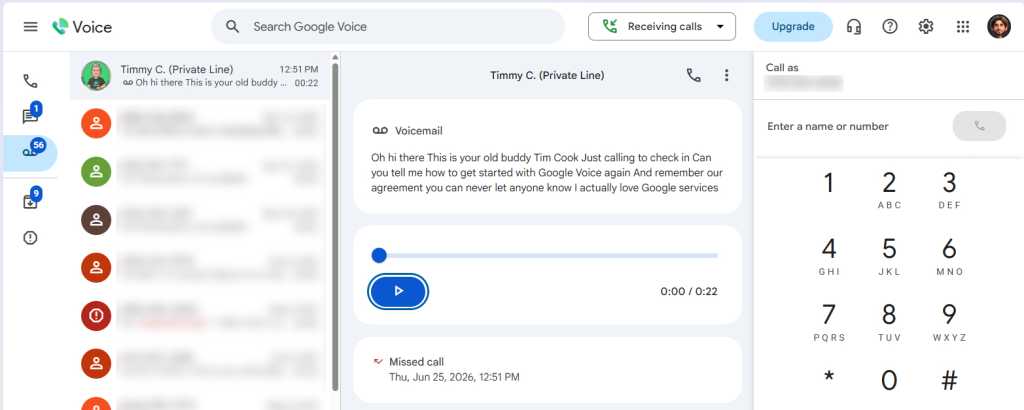
Either way, once you’ve got your number set, you’ll find yourself facing the main Google Voice dashboard. That’s where you’ll always be able to see your recent calls and messages, make new calls and messages, and read or listen to voicemails left on your number.
The Google Voice dashboard lets you manage everything related to your calls and messages from any device where you’re signed in.
JR Raphael / Foundry
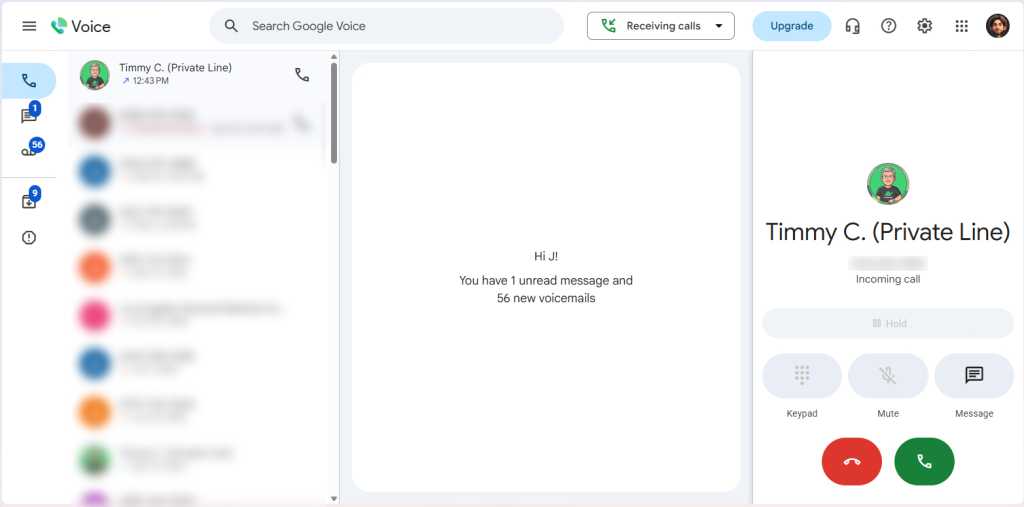
And as long as you have the website open, any calls coming into your number will actually ring your computer — and you can answer ’em right then and there.
Incoming calls can be answered on any device where you’re signed into Google Voice — including a computer.
JR Raphael / Foundry
We’ll come back to explore some advanced settings in a second. First, we need to shift our focus for a moment and get Google Voice set up on any phones where you want to use it — including the primary phone you rely on for your day-to-day communication.
Setting up phones with Google Voice
Now that we’ve got the core Voice setup finished, this part’s pretty easy:
Either way, open the app up and follow the prompts to sign in using the same Google account you used in your initial setup on your computer.
On Android, you’ll be prompted to connect that device to Google Voice to allow the phone to make and receive calls using your Google Voice number. If your phone has active cellular service with a separate number that’s connected to your carrier, follow the steps to link the two and allow them to work together.
If you’re using an older or secondary phone that doesn’t have active cellular service, just skip that step. You’ll still be able to make and receive calls with your Google Voice number whenever the phone’s connected to Wi-Fi.
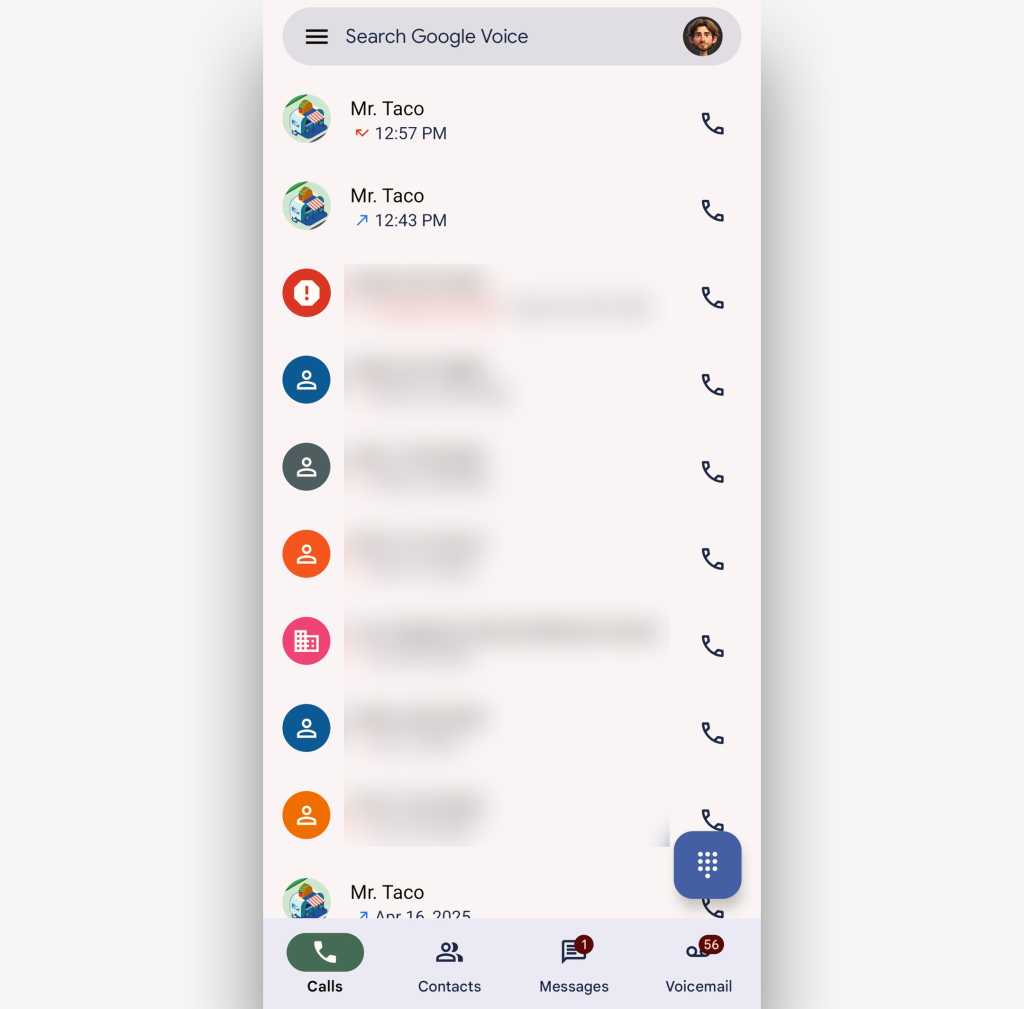
On both Android and iOS, you’ll then see the main Google Voice dashboard interface — with tabs for your recent calls, your contacts, your text messages, and your voicemails. The button in the lower-right corner of the screen will allow you to make a new call or start a new message, depending on which tab you’re viewing.
The Google Voice mobile apps effectively transform any smartphone into your Google Voice device.
JR Raphael / Foundry
And on both platforms, you’ll be able to tap the three-line menu icon in the app’s upper-left corner to find the main settings menu.
In a moment we’ll explore the main Voice settings thoroughly from the service’s website, where every last option is available, but for now, take a quick peek at the “Making and receiving calls” (or “Make and receive calls”) and “Incoming calls” areas of the apps’ settings. Those will control exactly how calls to and from your Voice number will be handled on that specific device — if they’ll rely on your carrier-provided cellular minutes, assuming those are available, or if they’ll rely primarily on Wi-Fi and/or mobile data.
If you have any other phones or any tablets you want to add into the mix and allow to access all of the same Google Voice functions, repeat this same process on any of them, using the appropriate Android or iOS app.
Just remember: If you set up all those devices to answer calls, you’re gonna have an awful lot of things ringing every time someone dials your digits. So if you don’t want a bunch of different devices simultaneously demanding your attention with every incoming call, be sure to go into the Google Voice app’s notification settings on each device and make the appropriate adjustments.
Otherwise, we’re ready to move back to your computer to dive in deep to all of the Google Voice settings.
Exploring the Google Voice settings
All right — ready to get into some of Google Voice’s greatest powers?
Back on the Voice desktop website, click the gear-shaped icon in the upper-right corner of the screen. That’ll take you to the full Google Voice settings menu, where you’ll find every available option.
And my goodness, are there a lot of ’em.
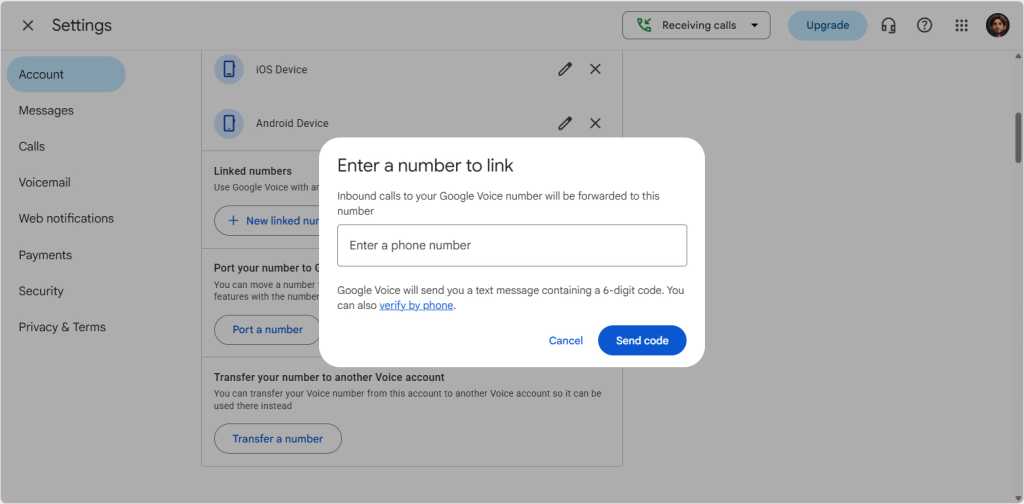
The first section of the screen, “Account,” has all of your basic number and device management settings, for anytime you need to make any foundational changes. The only item there you need to think about right now is “Linked numbers.” If you want to set your Google Voice number up to forward to any other existing numbers — an office line, a secondary cell phone, or even a colleague’s phone — click the “New linked number” button and follow the steps to add and confirm the number you need.
Linking a new number to your Google Voice account for forwarding is as simple as adding the number into the Voice website and then confirming it.
JR Raphael / Foundry
Moving on, the second section of the screen, “Messages,” contains a single switch to have any incoming messages forwarded to your email (in the same Google account’s inbox). It’s a simple touch but a useful one, especially if you live in your inbox and want to make sure you don’t miss anything during the day.
The third section, “Calls,” is where the real Google Voice power starts coming into play. Under “Call forwarding,” you’ll be able to flip a switch next to any linked number you added to have all incoming calls on your Google Voice number forward to it all the time.
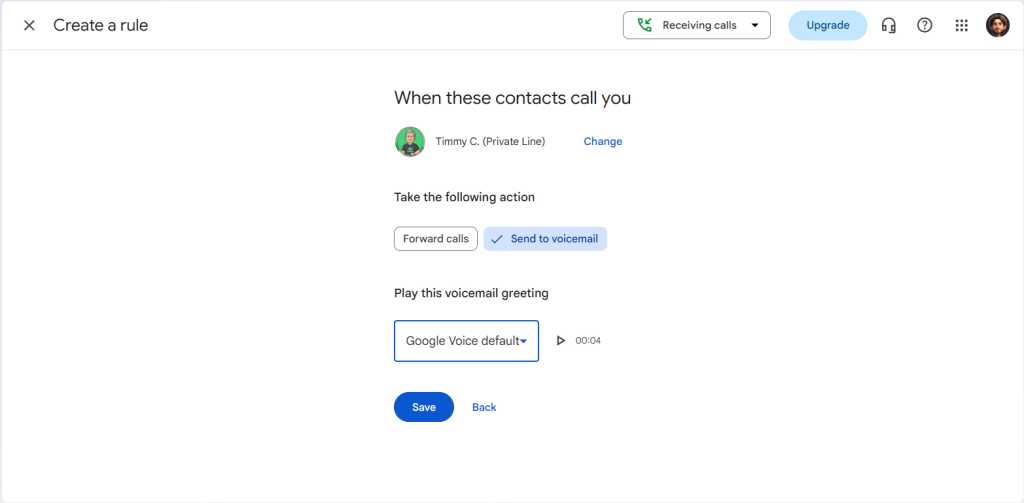
And directly beneath that, the “Custom call forwarding” section will let you set up contextual filters to forward only specific sorts of calls to different linked numbers. Simply click “Create a rule,” and you’ll be able to choose individual contacts, groups of contacts, or broad categories of contacts like anonymous callers and then tell Google Voice exactly what to do when those people ring you.
Google Voice’s rules are like Gmail filters for your incoming calls.
JR Raphael / Foundry
Back on the main Google Voice settings screen, the “Calls” section has some other options worth your while to consider:
“Get email alerts for missed calls” will do exactly what you’d expect. It’s a fantastic way to make sure an important call never goes unnoticed.
“Screen calls” will prompt every incoming caller to state their name and then place them on hold while you hear the recording so you can decide if you want to answer.
“Incoming call options” will activate the abilities for you to record an incoming call by pressing the number 4.
Skip down from there to “Voicemail,” and you’ll find options to record your outgoing voicemail message and manage other voicemail-related preferences.
Under “Payments,” you can connect a payment method to apply credit for international calls, if you’re so inclined. In the US, calls made through Google Voice to other US numbers as well as Canadian numbers are completely free, while calls to other countries vary in their rates.
And last but not least, under “Security,” you’ll probably want to flip the switch next to “Filter spam calls and texts.” That’ll allow Google’s spam detection systems to stop suspected junk calls, messages, and voicemails from ever bothering you.
Whew! Told ya Google Voice had lots of fascinating layers, didn’t I? Hold the phone, though: We’ve got one more pair of powerful possibilities to explore before we call it a day.
Google Voice premium perks
Some of Google Voice’s most useful features are available only for higher-level individual and business accounts.
For accounts using either the Google Voice Standard individual plan ($20 per month) or the Google Voice Standard or Premier team plans ($20 or $30 per user per month), you can dial into a couple of advanced business-oriented phone management options:
You can set up a fully automated, professional-sounding phone menu system that answers calls on one of your Google Voice numbers and directs callers to different places depending on the time of the day and which options they select.
You can have Gemini, Google’s AI assistant, take notes on your calls and then offer a recording, transcription, and summary after.
Those same team plans (but notably not the individual plan) can also create ring groups that make it easy for multiple people to handle calls coming into the same number — like a single streamlined number for a sales team, for instance. The main number can either ring every associated team member’s phone at the same time so whoever answers first gets the call, or it can ring all of the associated numbers individually in a random order. Those plans include advanced Voice-associated data searching capabilities as well, and at the Premier level, there’s also the option to automatically record and transcribe calls without any manual action required.
All of those features can be configured by your Google Workspace administrator in the Google Voice section of the Google Admin console.
Oh, and one more thing: Any Google Voice number can connect directly to a variety of specialty boxes and handsets that effectively allow you to have subscription-free landline-style phones for your desk or home office. You can establish a standalone number through Google Voice for such a line and even have calls from your other Google Voice numbers automatically ring those phones in addition to ringing other devices, so you can easily answer any call anywhere you like.
And now you know, from start to finish, how Google Voice can transform your business and the very way you think about your phones. All that’s left is to create your account, get things set up the way you want, and then enjoy your newly enlightened approach to phone number management.
This article was originally published in June 2022 and updated in July 2026.
For over 20 years, Live Science has been committed to bringing you the latest breakthroughs and incredible discoveries with clarity, authority and good humor (when appropriate, of course). In that time, we've evolved through a modernized website design, a transition to more deeply reported stories, and the addition of engaging videos produced by a dedicated team.
Over the years, we have relied on advertising to support our team of journalists. However, the fast-changing economic landscape has pushed us to continue evolving so we can deliver quality science journalism. That is why I am proud to say we have launched Live Science Pro,a new space on Live Science that allows you to directly support our award-winning team of science journalists so we can continue writing best-in-class stories.
Right now, the world needs credible, rigorous science more than ever. Our mission is to responsibly communicate that science with the highest degree of accuracy, informing the scientific community and sparking the fascination of those who can't wait to learn about our world and the universe beyond. By joining Live Science Pro, your subscription supports this goal and allows us to produce high-quality journalism that is written and fact-checked by our experienced writers and editors, without ever seeing an advertisement on our articles. This means you get all the science, and none of the distractions.
While you can still read the latest science news for free, written to the same high standards as our Pro content, as a part of your paid membership, a Live Science Pro subscription gives you access to our Science Spotlight features, which take an in-depth look at the paradigm shifts and breakthroughs that will transform science in the coming years. Your subscription puts must-reads at your fingertips, including our insightful analyses, which give you crucial context for the biggest science headlines; and interviews and exclusive book excerpts, which provide a more personal look at the people driving progress. You also get access to our opinion pieces, which reveal how experts are thinking about the biggest issues in their fields.
Plus, you'll receive our exclusive, members-only weekly newsletter, which provides a curated look at the stories our writers and editors are most excited about and their take on what matters most in their areas of expertise.
To mark the launch of Live Science Pro, we're offering an introductory price of $3 for the first three months, or for an even better value, you can sign up for an annual subscription for just $30 for the first year. You can find more details on how to subscribe here: livescience.com/subscription
Right now, there are more voices and options than ever. We know you demand credibility and accuracy from your science reporting, and we thank you, again, for placing your trust in ours.
Vodafone gives mobile masts autonomous antenna adjustment using artificial intelligence
AI now rotates mobile antennas without waiting for engineering teams
Robotic mast completes network optimisation in under thirty minutes
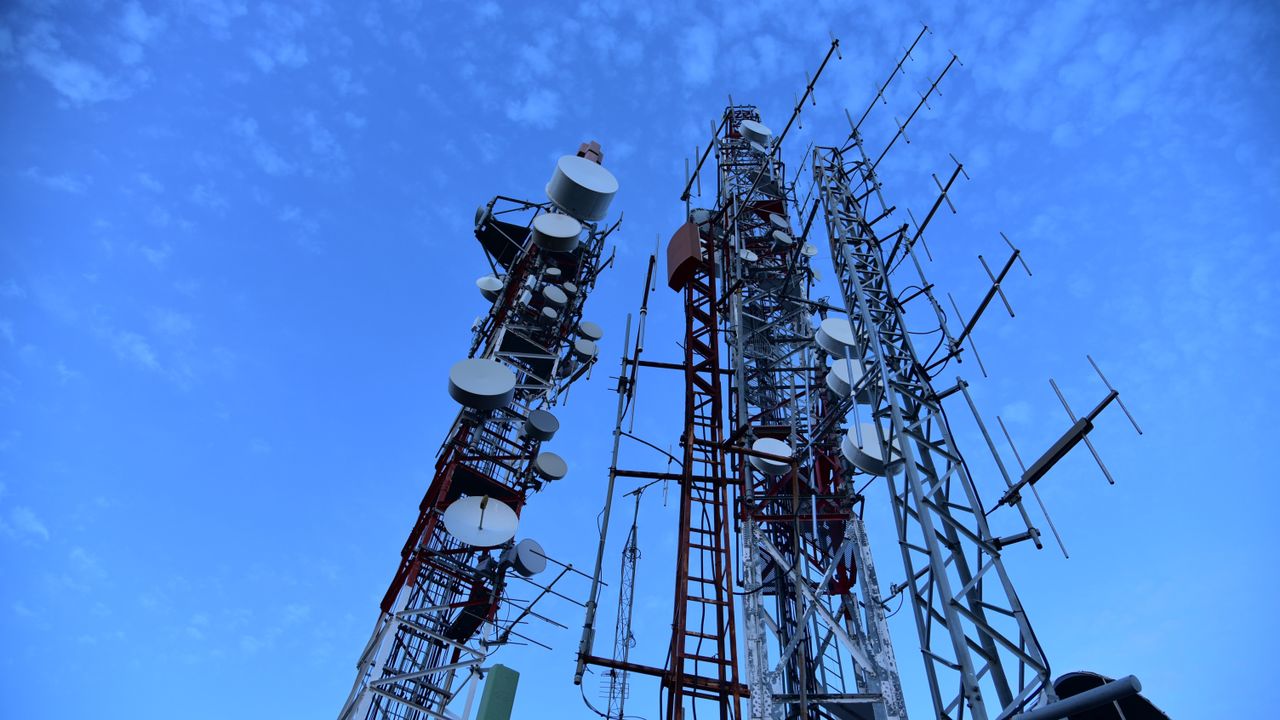
Vodafone has begun trialing a mobile mast fitted with an AI system and a robotic arm capable of adjusting radio antennas automatically.
The technology combines AI analysis with automated hardware movement to reduce manual intervention across 4G and 5G networks.
An algorithm developed internally by Vodafone first evaluates network demand and local conditions before directing the robotic arm's movements.
Robotic arm handles physical adjustments
The robotic component itself comes from Humax Networks, a South Korean equipment supplier working alongside Vodafone on this trial.
Once the AI algorithm identifies where coverage or capacity needs shift, it instructs the arm to rotate or tilt the antenna accordingly.
This process reportedly takes between 20 and 30 minutes to complete while optimising for energy efficiency across the network.
Manual antenna reconfigurations, by comparison, often take days or weeks once planning approvals, site access, and road closures are factored in.
Physical engineering works are typically required as well, adding further delay to any conventional antenna adjustment process.
The system adapts coverage based on environmental patterns, pushing more signal outdoors during clear weather and boosting indoor coverage when conditions turn poor.
Self-organising algorithms also respond to shifts in local traffic congestion, allowing antennas across several sites to reposition ahead of anticipated demand peaks.
Vodafone is currently testing this setup at a site overlooking a shopping centre in Tirana, Albania.
There, coverage automatically shifts between retail and residential zones as usage patterns change throughout the day, tracking real consumer movement.
Francisco Pignatelli, director of mobile access engineering at Vodafone, described the trial as an early example of physical AI within telecoms infrastructure.
“By analysing network demand and making autonomous decisions, the AI algorithm can adjust radio antennas to optimise coverage and capacity without human intervention,” Pignatelli said.
Internal antenna components signal the next shift
Despite the current trial's reliance on physically moving robotic hardware, Vodafone already anticipates a different approach becoming standard soon.
The company expects autonomous antenna technologies capable of adjusting internal components, rather than repositioning entire units, to reach the market within the coming months.
This shift toward internal adjustment is expected to reduce energy consumption further compared with moving an entire antenna assembly outdoors.
Vodafone stated that combining antenna digitalisation with AI-powered automation is a major step toward fully self-adapting wireless networks.
Whether internal antenna adjustment can match the physical precision achieved through robotic arm movement remains an open technical question for now.
Vodafone has not yet detailed how internal components alone will replicate the directional control that robotic rotation currently provides across varying environmental and traffic conditions.

 Login