❌

Reading view

Photojournalist Steve Winter on his iconic Hollywood puma image, the illegal tiger trade and having a black panther knock on his door

For decades, photojournalist Steve Winter has traveled across the world capturing incredible images of big cats as part of his work for National Geographic. Yet he didn't photograph an animal professionally until he was 34.

"If anybody had said, 'You're going to work with big cats for 25 years of your career,' I would have said 'No, I don't know anything about big cats,'" he told Live Science. "But I learned from scientists and local people," he added. "That was very, very important — that's what, to me, was the biggest change in my life."

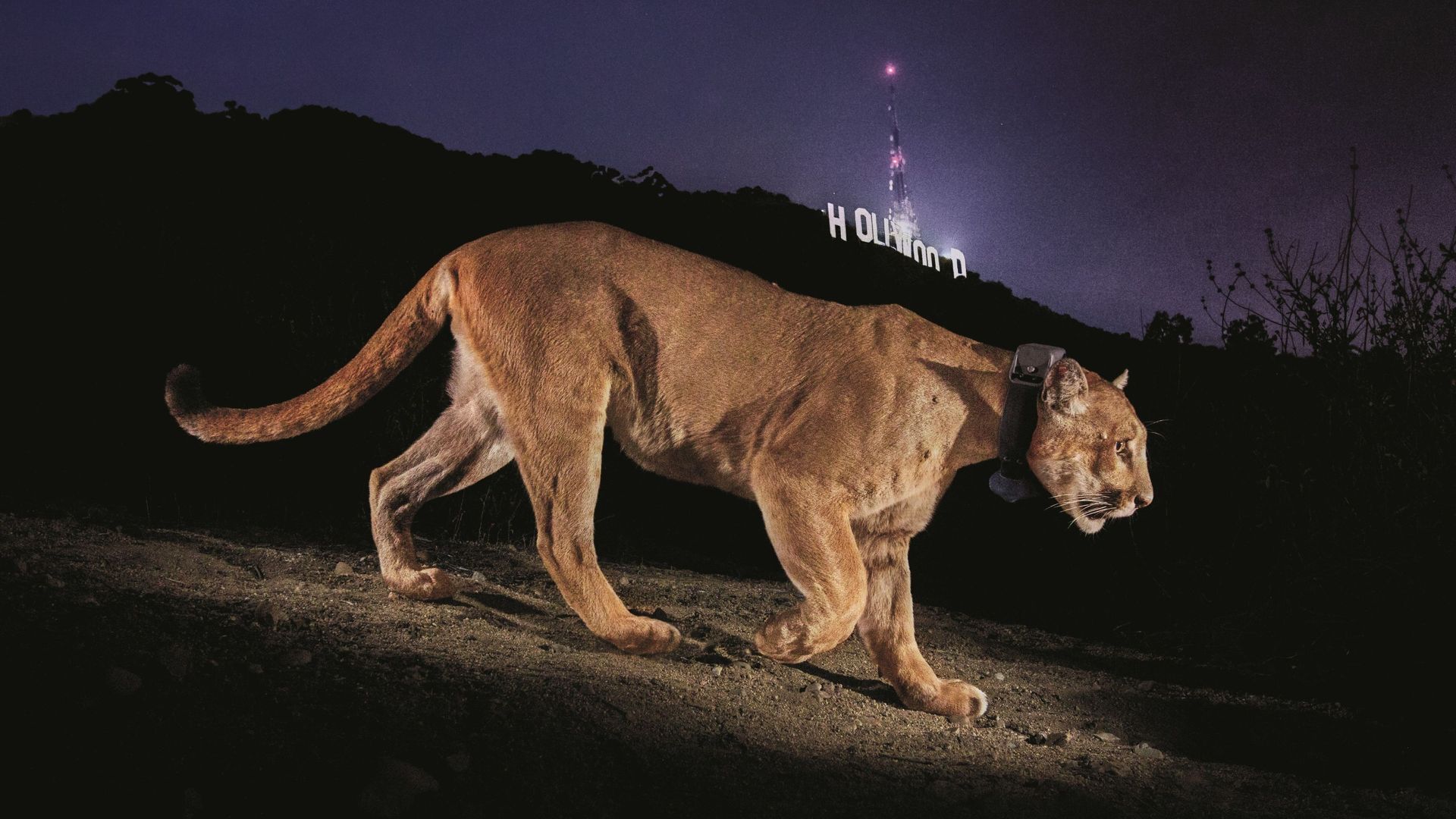
Together with his wife, author and environmental journalist Sharon Guynup, Winter has helped change laws around big cats in the U.S.; revealed the horrors of the Tiger Temple in Bangkok, resulting in its closure; and took an iconic photograph of the cougar P-22 beneath the Hollywood sign, which eventually led to the creation of the world's largest highway wildlife corridor over Highway 101 in California.

In their new book, "Big Cats" (National Geographic Books, 2026), Winter and Guynup provide a retrospective of their careers, looking at the fragility of these predators, the conservation work helping to save them, and the challenges they still face. Live Science spoke with Winter about his career, the changes he's seen, and why he's hopeful for the future.

Steve Winter headshot

Steve Winter has won numerous international awards, including BBC Wildlife Photographer of the Year and BBC Wildlife Photojournalist of the Year. He lectures internationally on photography and conservation issues and has been interviewed on CBS Nightly News, 60 Minutes, NPR, BBC and CNN. He contributes regularly to National Geographic magazine, for which he can spend months working on a single story. He’s camped for weeks in steamy jungles, vast grasslands, and at 15,000 feet in the Himalayas to capture cats’ stunning beauty and secret behaviors. (Image credit: Steve Winter)

Hannah Osborne: You've traveled all over the world and seen so many things. Is there one photograph that really sticks out for you, one that you come back to and think about?

Steve Winter: I always look at the images that have had an impact at the time. That makes a huge difference to me, because in the end, I know that in taking this [photograph], not only did I succeed beyond my wildest expectations, but it's making a difference in the world. Right now, I have just been putting remote cameras up on what will be the world's largest wildlife overpass, and that was started by my Hollywood cougar picture of P-22, Puma 22, under the Hollywood sign. [Editor's note: The common names cougar, puma and mountain lion all refer to the same species, Puma concolor.]

That changed so much in Los Angeles. I've never seen a city be transformed in their love for the fact that they have a mountain lion in a park in the city. What came of that was [people] thinking, "Hey, maybe we should connect these areas where these animals are living." [Editor's note: The Wallis Annenberg Wildlife Crossing over the 10-lane Highway 101 that was inspired by the cougar P-22 is due to open Dec. 2.]

To think about that is pretty amazing, so right now, P-22 and the Hollywood cougar is my go-to image.

He became a celebrity in the land of celebrities; people loved him. There's a P-22 day; schools are using urban wildlife in their curriculum. The LA Natural History Museum has a permanent exhibit, and what is right in the center of it? The Hollywood cougar picture.

HO: How did the P-22 photograph come about?

SW: As wildlife photographers, we will often go to these meetings where people are gathering to save elephants, to save this, to save that. So I went to meet the scientists that worked with these cats in the largest urban park in the United States. I asked Jeff Sikich, a biologist for the National Park Service, "[Do] you have a lot of trails in that park? Do you have any that the cats walk on where you could see the lights of LA in the background?" He kept saying no.

When you're working with camera traps, it's very important to visualize the picture in your mind that you're after [when] you visit a spot. I just said, "Well, Jeff, you know what would really tell the story of urban wildlife is if we had a mountain lion under the Hollywood sign." He looked at me like I'm crazy, and said, "There's no mountain lions in Griffith Park." I said, "If anything changes, let me know."

Eight months later, I got a text. They had a trail camp set up to census bobcats [Lynx rufus] in the park, and there was P-22.
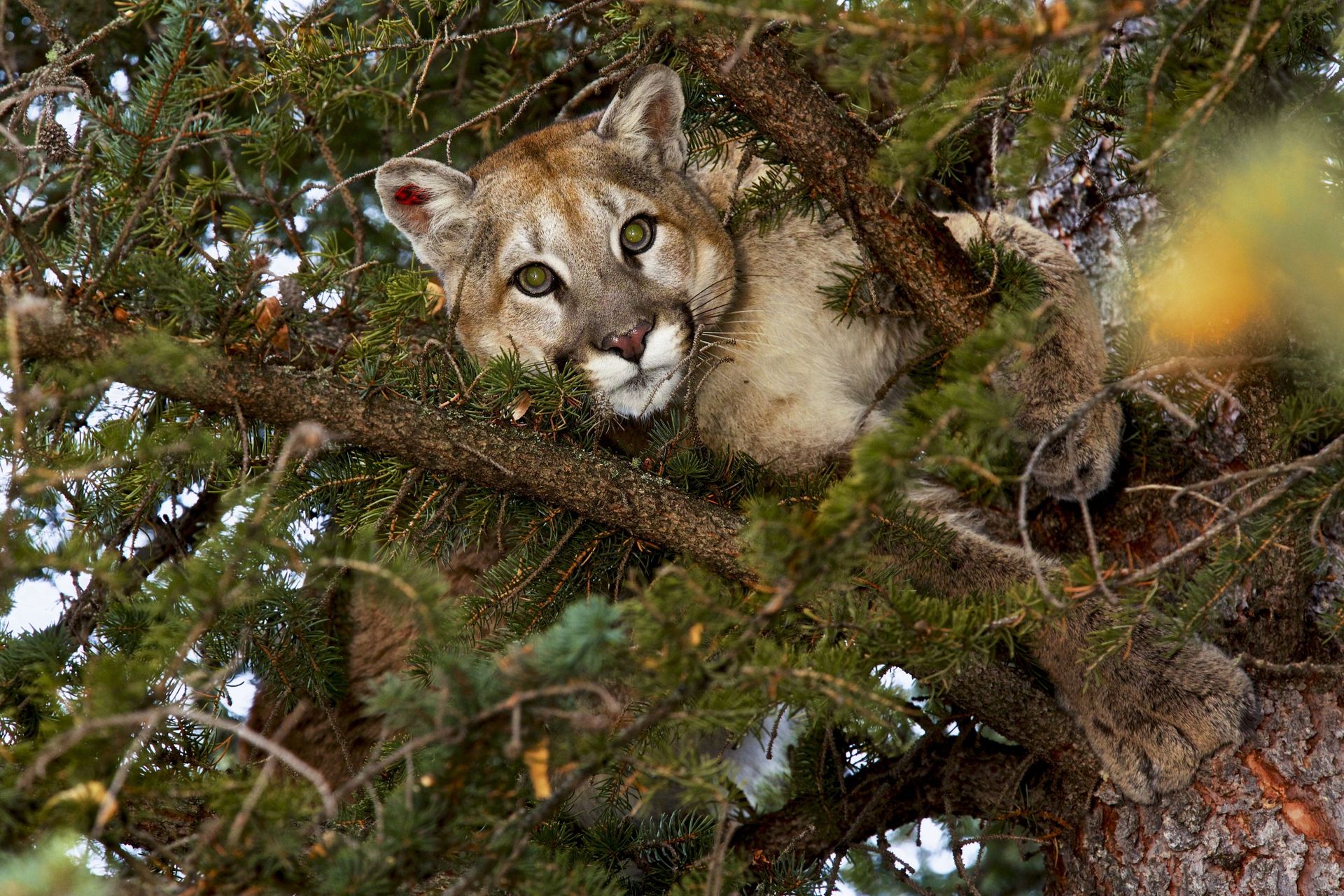
a cougar in a tree looking down

A cougar that biologists had chased into a tree so they could collar it to monitor its movements via GPS. (Image credit: Steve Winter)

With camera traps, you don't need to sit, and I learned that from the beginning. For the second story I did, it was photographing a quetzal, which is a sacred bird of the Maya and the Aztecs. I knew nothing about birds, either. It's got a meter-long [3 feet] tail. I was enamored by the fact that it had a historical background — they used quetzal feathers as a form of currency; they were sacred birds.

I loved all that, but working on that story in a cloud forest in Guatemala on top of a mountain all by myself, every morning I'd come down and set my camera up on the tripod [near the bird's nest], and then take it away at the end of the day. I'd walk back, and all of a sudden, the hair on the back of my head would stand up and on my arm, and I'd get this tingling feeling and it's like, what's going on? I'd turn around. You can't see anything in a rainforest or a cloud forest because the proliferation of life is everywhere. One night when I'm reading my book in the one room shack that I was staying in my bunk bed, all I hear is the stairs creaking. Then I hear the floorboards creaking. Then I hear scratching, and then sniffing, outside the door.

I grabbed the walkie-talkie to call Juan Carlos, the naturalist that I was working with. He would find the quetzal nests for me. I asked him, in Spanish, "Juan Carlos, what is this?"

And he said, "Oh, Steve, don't worry; it's just a black panther [Panthera onca]." I've been there five weeks, and I said, "Well, how come it took you so long to tell me there was a black jaguar here?" And he said, "We didn't want to worry you."
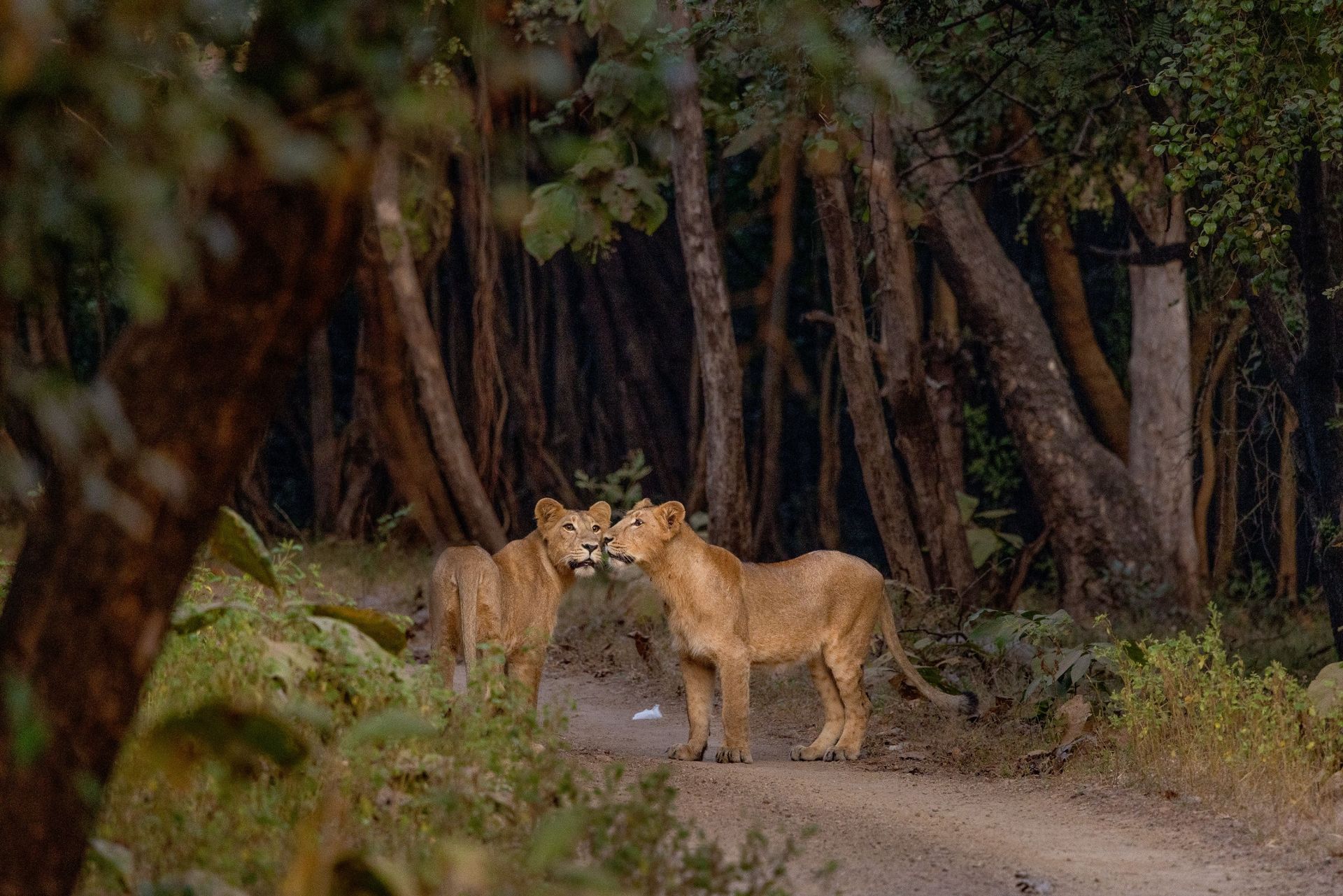
two lions standing on a track with trees and foliage on either side

Two Asiatic lionesses greeting each other with a nose-to-nose touch. (Image credit: Steve Winter)

HO: Throughout the book, you look at topics like poaching, captive tigers in the Tiger Temple in Thailand, and the way they're kept in the U.S. for entertainment. And a lot of these things are still going on. How do you cope with seeing that side of their lives?

SW: When I was first working on tigers, I was in Thailand. I was wanting to work in Thailand and Sumatra because they were the two subspecies that experts said may go extinct. I was working with the most incredible group of scientists I've probably ever worked with. They were trying to save the Indo-Chinese tiger [Panthera tigris corbetti] in Thailand.

But close by was this place called the Thai Tiger Temple. And I said, "Hey, guys; I'd like to go there." And they said, "No, Steve; don't go. These are bad people, and we think they're involved in the black-market trade of tiger parts and tigers to Laos and then into China."

That's a good reason for me to go if you don't want me to go. The first thing I saw was this huge sign that said "conservation." This was a Buddhist monastery. For some reason, the abbot had been given a tiger cub about 10 years before, and he fell in love with tigers. So they started a tiger tourism operation that brought in at least $3 million a year.

I could see something was fishy right away, because by then, I'd learned a lot about these cats. They kept saying that they always had 150 tigers. But you could pet tiger cubs for Instagram selfies or bottle-feed them 365 days a year. If you're breeding tigers, what are you going to have? More tigers. Something was happening to them, because the death rate wouldn't take over the birth rate when you're speed-breeding cubs, which is what they were doing. A female has cubs; they take them away immediately so she'll be ready to have another litter. You can only use the cubs for three months because after that, they're too big to pet.

They had all these tourist things where you could get a selfie with a head of a tiger in your lap. I was saying, "Why are these tigers acting so sleepy?" They're taking this giant head of a tiger and putting it in somebody's lap that's sitting on the concrete. You would think that if you put the head of a tiger in your lap, you're going to end up with your head in their mouth.

[Editor's note: Winter and Guynup worked together on an investigation into the Tiger Temple in 2016, which eventually led to it being exposed for its abuse and connections with the illegal wildlife trade. Shortly after, the Tiger Temple was shut to the public.]

Sharon did the investigation, and I already had pictures. But we went to do a video and go visit the temple again … By the time we got done, the TV stations in Bangkok had taken the video and showed it all over on the nightly news. We kept working on this, and Sharon wrote four more stories. And after the last one, the Thai government was inundated with people calling for the prime minister to shut it down. They went in with the army and the police, and what they found was horrific. They went to the freezer. There were tigers hanging on meat hooks, cubs in jars, with a little Thai flag on them. They shut it down.
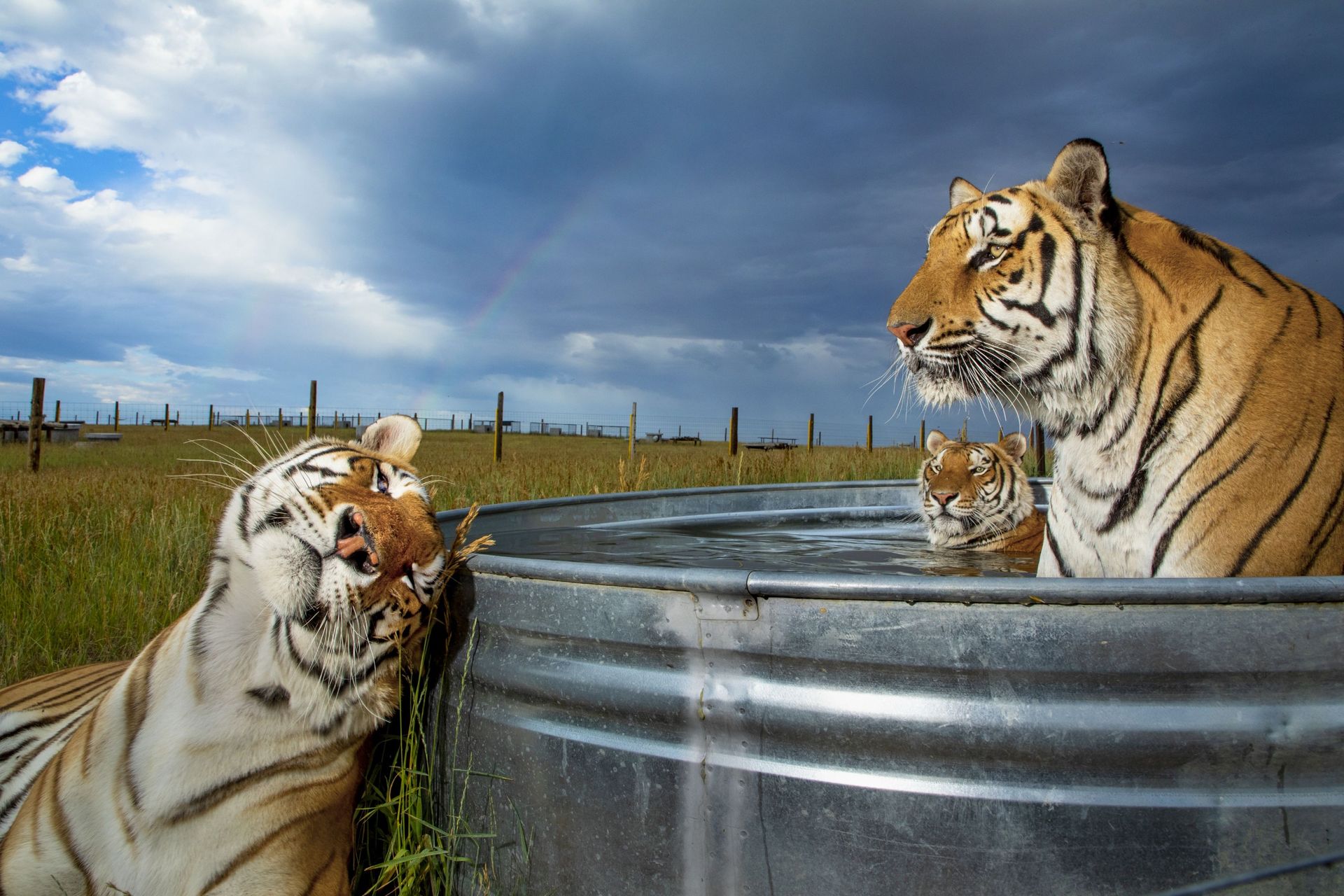
three tigers, with two in a big metal tub, in a grassy landscape

Three tigers that were rescued from Joe Exotic's Oklahoma zoo cooling down at the Wild Animal Sanctuary in Colorado. (Image credit: Steve Winter)

Stopping this is really important. After that, we did a story on tigers in the U.S., which was very difficult psychologically. It was one thing to see them in Thailand, but we had always heard that there were more tigers in the United States than there are in the wild, and people would go, "What are you talking about? We don't have tigers here."

Sharon and I … we found a lot of the same speed-breeding cubs at these roadside zoos, whether it was Doc Antle's Myrtle Beach that was $500 a day, or some dumpy little place on the road down south where you can give them $10 to look at a tiger. They were everywhere.

After that story came out, the National Geographic Society gave a copy of this 30-page story that we had done for the magazine to every member of Congress. We got this text on 20th December, 2022, that President Biden had signed the Big Cat Public Safety Act, which outlawed all that. We were part of getting this law passed, which was incredible.

HO: What are some of the biggest changes in conservation you've seen over your career?

SW: Conservation was changing a lot in the '90s and 2000s. Alan Rabinowitz [a zoologist who served as the president, CEO and chief scientist at Panthera Corp., a nonprofit conservation organization devoted to protecting wild cats] had this idea after he had a lot of scientists in Central and South America give him data on where they were working and where jaguars were. When he took it away and just showed the locations, he goes, this is a corridor, a natural corridor, because now we're talking a lot about connectivity and how roads get in the way. It's like animals are in prison because they can't cross these big freeways or even small ones. Find out where animals are, their migrating paths, and put in an overpass or an underpass or something.
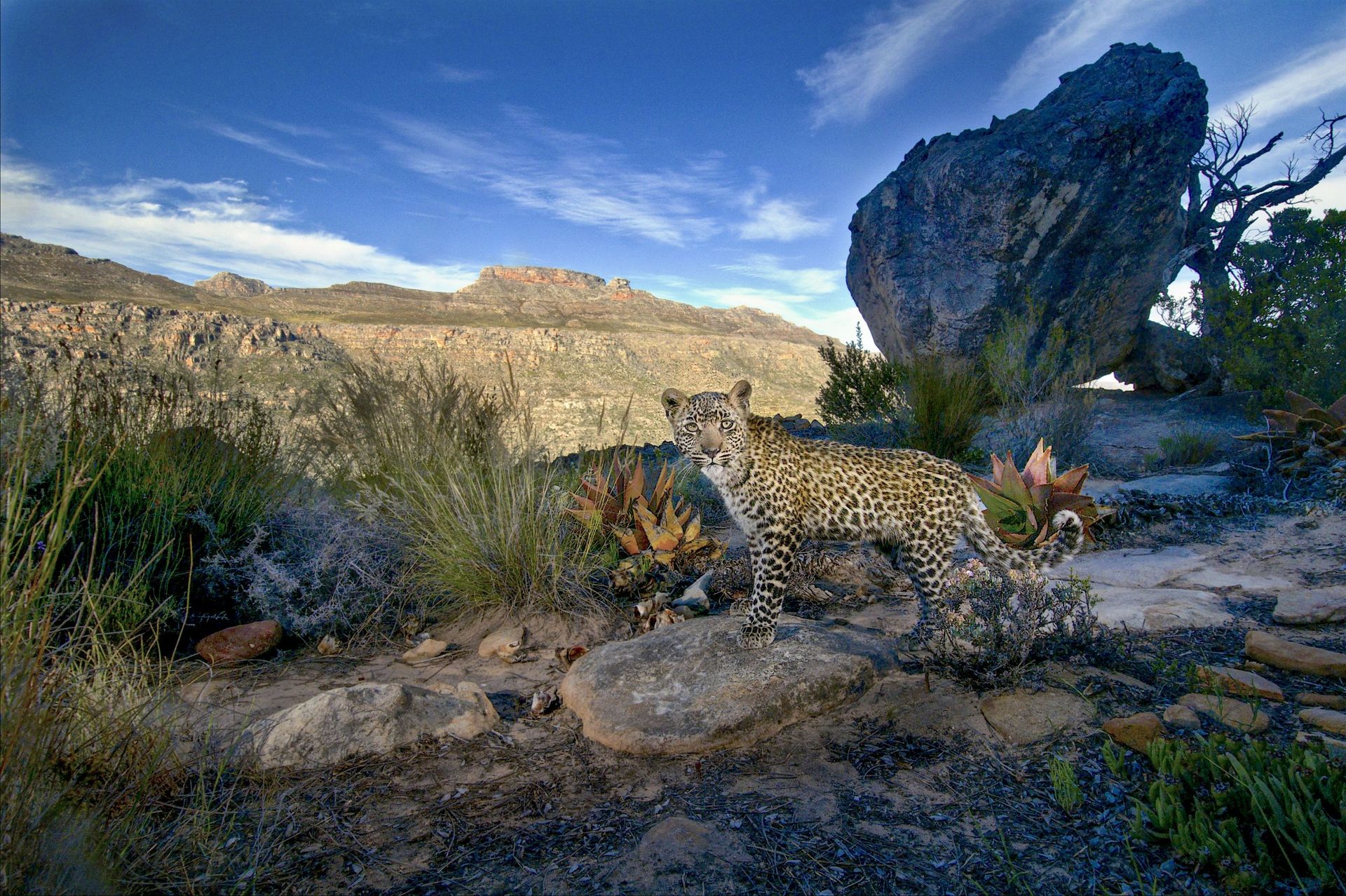
leopard cub in a rocky landscape

A Cape leopard cub in the Cederberg Wilderness Area in South Africa. (Image credit: Steve Winter)

All this was happening, all this new science, new conservation. That was all spearheaded by the work of [biologist and conservationist] George Schaller, who became a friend of ours. What a life that we've had — and are having. We're still working on the connectivity part right now.

HO: Are you hopeful for the big cats in LA?

SW: Oh, definitely. The ones that live in the Santa Monica National Recreation Area will be able to cross the 101 and then go all the way to San Jose. They could actually then hug the top of a certain mountain and get close to San Francisco, which is incredible to think about now. It's a huge metropolitan area, so you're leaving one, going to another. But there's so much land in between, and they can cross safely.

HO: What made you specialize in big cats in the first place, and what's the draw that keeps you coming back?

SW: Big cats are so charismatic and, to me, mystical. And they're an umbrella species, so if you save the largest predator, which is usually a big cat in any landscape, you save everything underneath it.

I was just taken over by these animals. National Geographic had never done a jaguar story before. I found out really quick why: You can't see them. I tried to use remote cameras, camera traps, but they're really smart. They'll go around them, so they don't have the flash going off or they don't like the sound or the smell of meat on these waterproof boxes and the cords and all that.

I just fell in love with big cats, and what a life to be able to work with every one of them. The only one that was on my list that I haven't done is the Amur tiger, Siberian tiger [Panthera tigris altaica]. When I was ready to photograph them with the scientists that had been monitoring them for over a decade, [the tigers] got canine distemper and about 60% died.

Big cats really bounce back when you give them protection, and there was protection given after you lose this many. All the study tigers that had the GPS collars on, the ones they could monitor, died. But the population bounced back, and there's more now than there were before.

I won't get to photograph Amur tigers. And the reason is, there's people — locals — who are working on it, and they're doing an incredible job. I've got a book here that has all the cats that I've worked on. The impact these stories have had, and the change that's come about, is what really makes me proud.

This interview has been condensed and edited lightly for clarity.

Help us improve Live Science Pro: We're always trying to make our content better. Leave us feedback about Pro here.
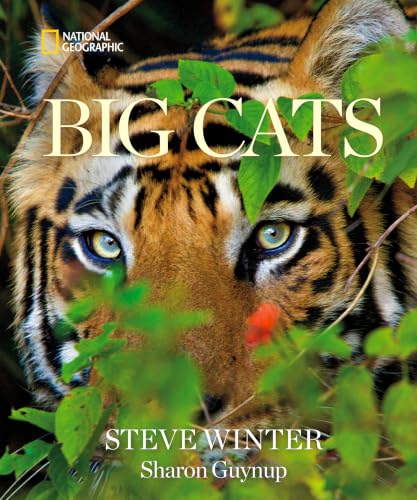
Big Cats

National Geographic
Big Cats

National Geographic photographer Steve Winter has spent his career photographing big cats around the world, from the graceful jaguars of Brazil’s Pantanal to the elusive Himalayan snow leopard. His photographs astound; his stories, even more so. In Big Cats, Winter and environmental journalist Sharon Guynup share experiences behind the lens.

In chapters on every key species—cougar, jaguar, leopard, snow leopard, tiger, and lion—readers will witness the power of Winter’s work, including uplifting stories of how his photographs have made a difference and powered important conservation efforts on behalf of these mighty creatures.

  •  

Why do cats lick each other?

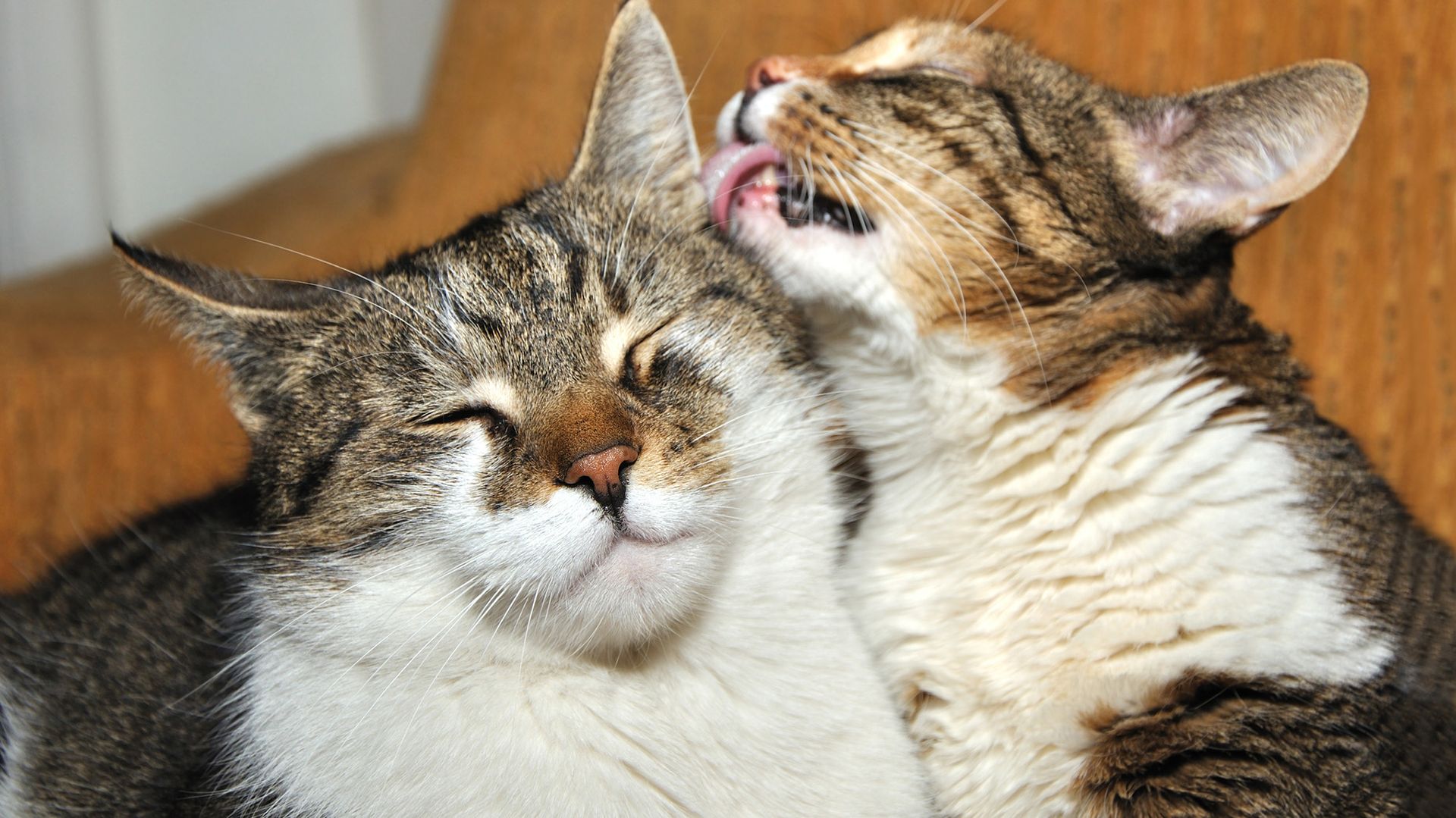
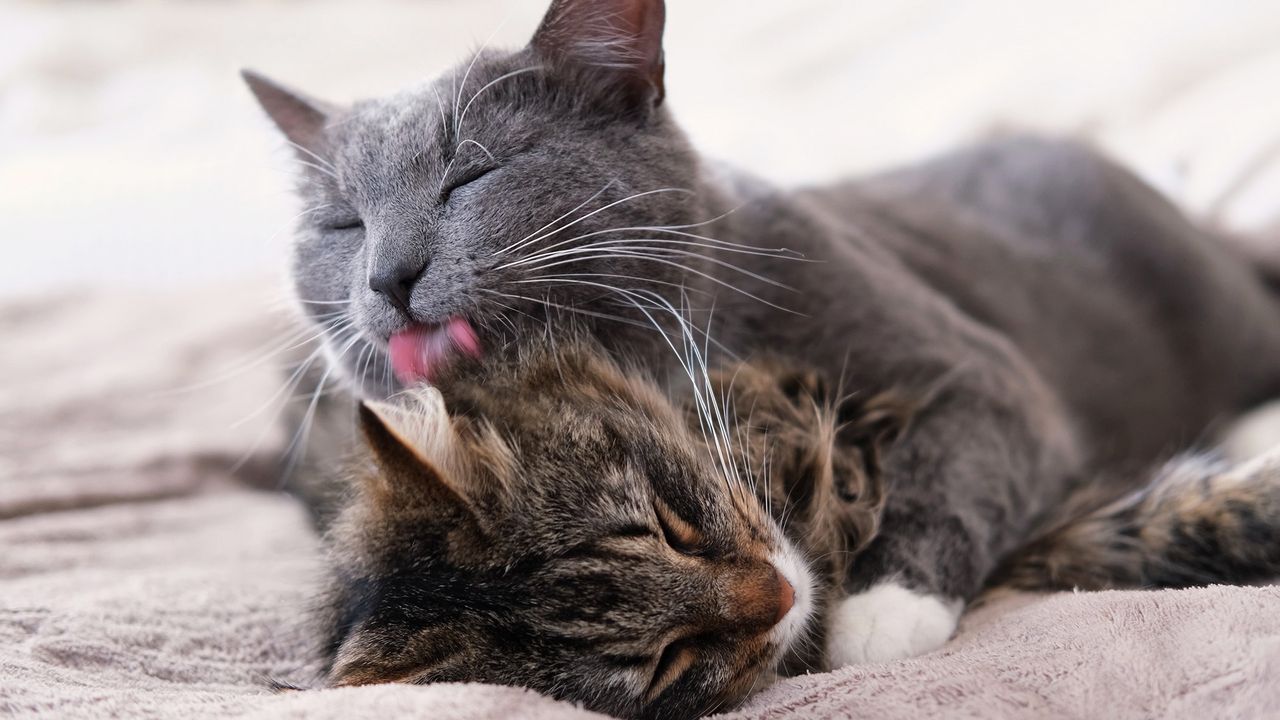
In a multicat household, it's common to see one cat licking another. When some people see this behavior, known as allogrooming ("allo" means "another individual"), they assume it's a sign of friendship.

But is that really the case? Are there hidden, more complex reasons for why cats lick each other?

While research into allogrooming is ongoing, scientists have suggested different explanations for why cats lick each other, including some social reasons and some more practical ones.

Social bonding or social tension?

The historical view, based on observations of free-roaming-cat colonies, was that allogrooming is a sign of affection and helps cats create and maintain bonds with other cats in their social group, perhaps by creating a shared group smell.

But a 1998 study of 25 cats living together in an indoor-outdoor enclosure poked holes in this theory. The study found that aggressive behavior showed up in about 35% of allogrooming sessions, which suggested that allogrooming might not be about friendship. Instead, the authors proposed, it may help to defuse a tense situation in a confined space, where an actual fight would be too risky.

Sign up for our newsletter

The words 'Life Little Mysteries' over a blue background

Sign up for our weekly Life's Little Mysteries newsletter to get the latest mysteries before they appear online.

To investigate, Morgane Van Belle, a cat behavior scientist at Ghent University in Belgium, and her colleagues analyzed videos of allogrooming from 53 two-cat homes. They concluded that allogrooming may have different social functions, depending on the situation.

The team noticed that the cats sometimes licked each other while huddling together and copying one another's body postures. In these moments, allogrooming probably helps strengthen social bonds, the researchers proposed. Most licking was directed toward the ears; this may help cats relax because the skin there is rich in sensory nerve endings, Van Belle said. Allogrooming produces a relaxing effect in other animals too. For example, it lowers the heart rate in horses and triggers the release of feel-good hormones in monkeys.

One brown-and-white cat licks another brown-and-white cat's ear.

Cats often lick the head and neck, especially the ears, of other cats. Ear-licking may help cats relax because the skin there is rich in sensory nerve endings. (Image credit: Madzia71 via Getty Images)

They also noted that allogrooming sometimes led to friendly wrestling, in which the cats grabbed each other with their front legs and tumbled around. This suggests that allogrooming may serve as a signal to start play.

In other situations, however, the researchers noticed that allogrooming was followed by behaviors linked to conflict, such as turning the ears backward, pawing, and biting. In these cases, one cat would stand or lean over the other, and both cats showed subtle signs of stress like lip licking, head shaking or self-scratching.

Based on these observations, Van Belle's team think that allogrooming may be an "appeasement signal" in fraught moments that could lead to conflict or injury, for example, when one cat wants to take over a sleeping spot already occupied by another. They think it possible that the licking helps to calm things down and keeps a spat from turning into a real fight. Similar behavior has been seen in meerkats, where subordinate individuals groom dominant ones to placate them.

Yet because this licking often targets the neck — the same area cats bite during fights — it also may signal a subtle aggressive threat, the researchers suggested.

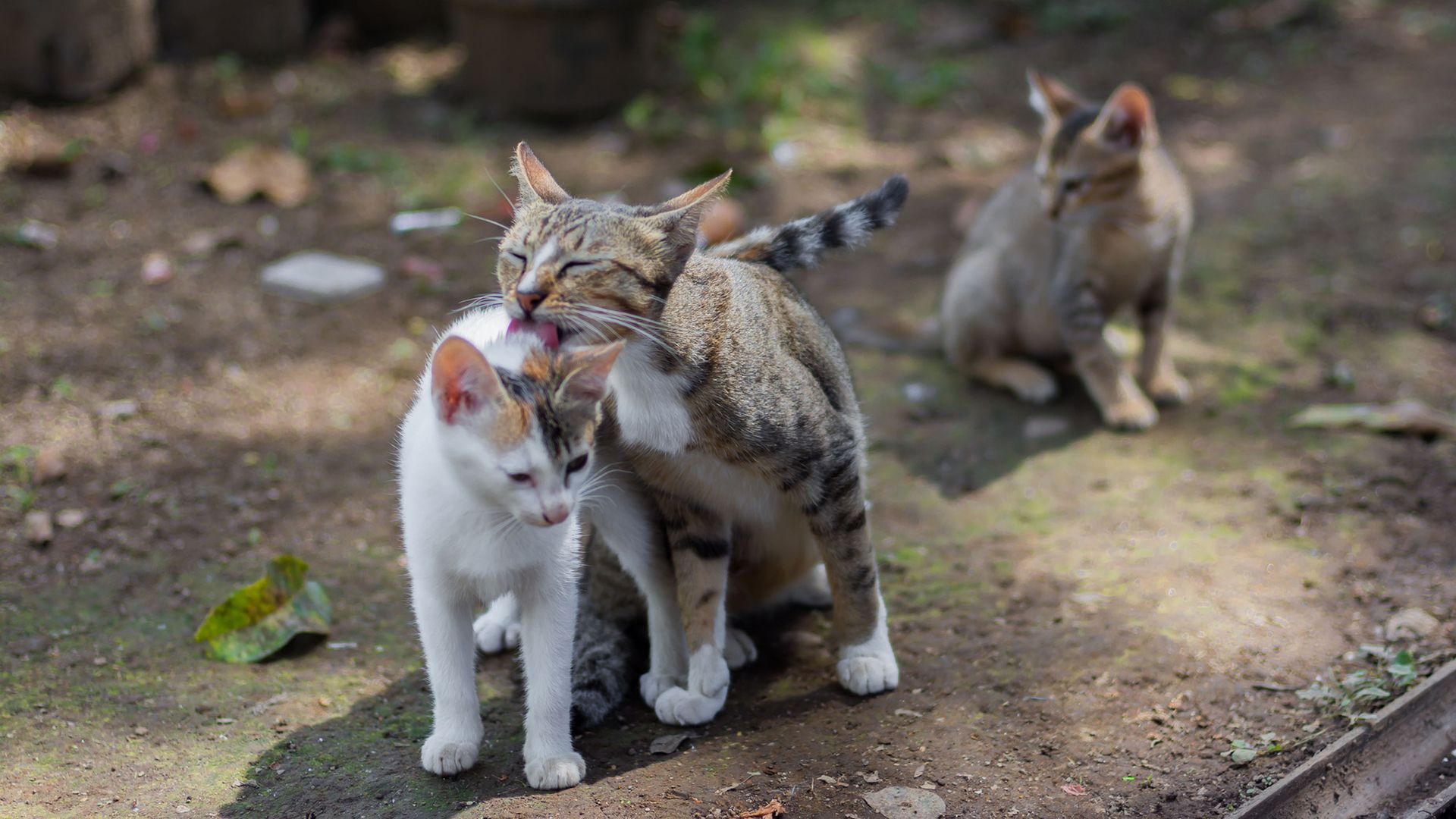
Three kittens who are outside are close together and licking each other.

It's possible that feral cats may have a different allogrooming pattern than pet cats do. (Image credit: Kriswanto Ginting via Getty Images)

Hygiene and grooming

Van Belle and her colleagues think that, beyond sending social signals, allogrooming may help with hygiene. After all, it's often aimed at the head and neck ‪—‬ the areas that are "least accessible for the cat itself during grooming," Van Belle said. Allogrooming is thought to have a hygienic function in other species too. For example, ants achieve colony-level hygiene by grooming heavily infected individuals more, and primates concentrate their grooming on body parts the recipient can't easily reach. When it comes to cats, however, more research is needed. Van Belle's study did not measure parasites, infections or skin cleanliness to see whether such grooming actually reduces dirt or bugs.

Dr. Terry Curtis, a veterinary behaviorist who has studied how often allogrooming happens, also thinks cats might groom each other for hygiene reasons. She wonders whether feral cats, who likely carry more fleas than house cats, might have a different allogrooming pattern.

The explanations proposed by Van Belle and colleagues are reasonable but not definitive, Curtis said. Because so many factors can shape a cat's behavior, she's skeptical that researchers will ever be able to say with real confidence exactly why one cat grooms another.

After working as a veterinary behaviorist for 25 years, Curtis has concluded it is often impossible to understand what's going on in a cat's mind.

"Congratulations, you got a cat," she said. "Let the mystery begin.”

How much of a cat fan are you? Find out by taking our cat quiz!

  •  

A Century-Old Mystery in Cat Kidneys May Finally Have an Answer

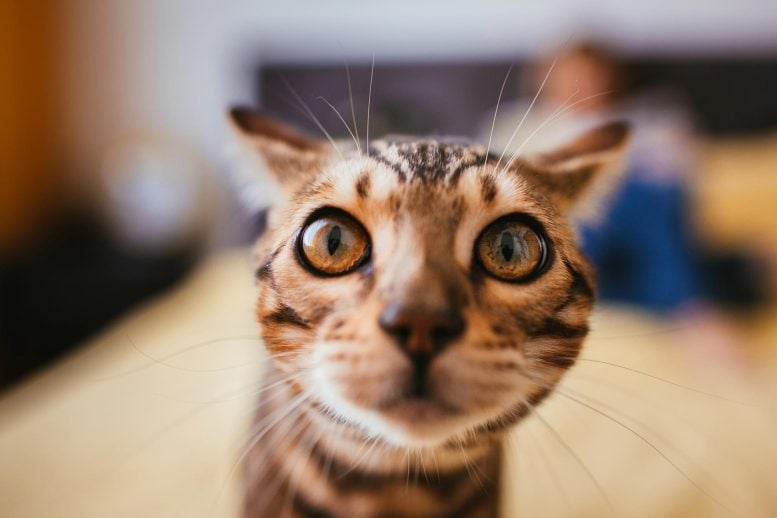
Bengal Cat Eyes CloseLipid droplets in the kidneys may help cats maintain a consistent chemical “scent identity.” Scent marks can linger long after an animal has moved on, allowing urine and other chemical signals to carry information across both distance and time. Yet the molecules responsible for odor do not remain unchanged. They evaporate, break down, and shift [...]
  •  

Home-intruding bobcat no match for police drone

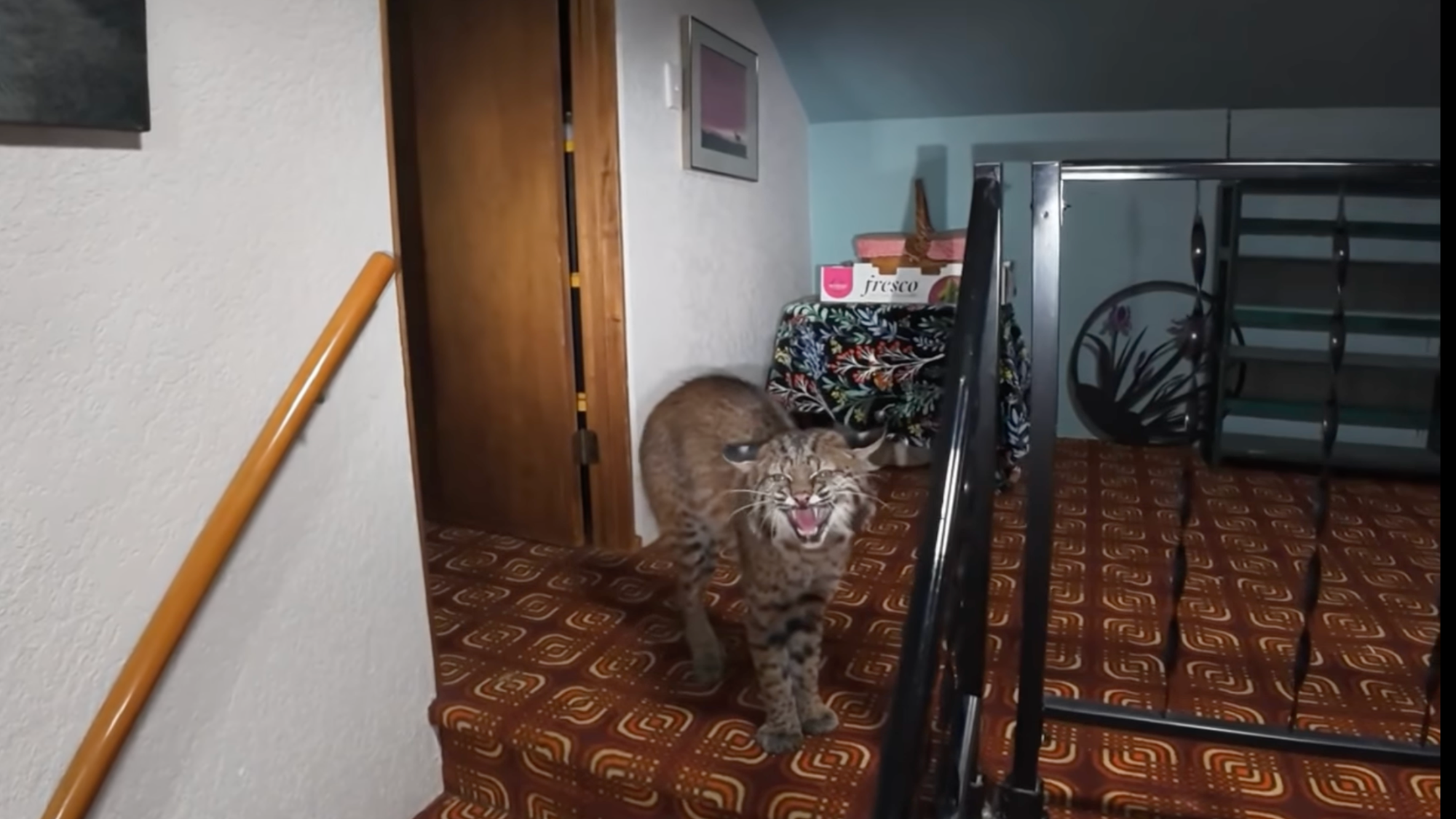
What began as a routine police response to a reported break-in turned into a brief standoff between nature and technology. Last week, law enforcement in the city of Kirkland, Washington (just northeast of Seattle) responded to a 911 call from a resident reporting loud banging inside their home. Officers arrived expecting a human intruder, but were instead greeted by a more literal cat burglar: a trapped and confused bobcat. 

Not wanting to risk a claw to the face, the officers backed out and reassessed the situation. They ultimately decided to deploy a remote-controlled drone into the house, to monitor the feline intruder from a safe distance. Video captured from the drone’s perspective and released on Facebook, shows the frustrated bobcat standing by a staircase, growling and arching its back at the hovering machine. After a brief standoff with the buzzing, metal alien, the bobcat carefully retreated, sidestepping into an adjacent empty room.

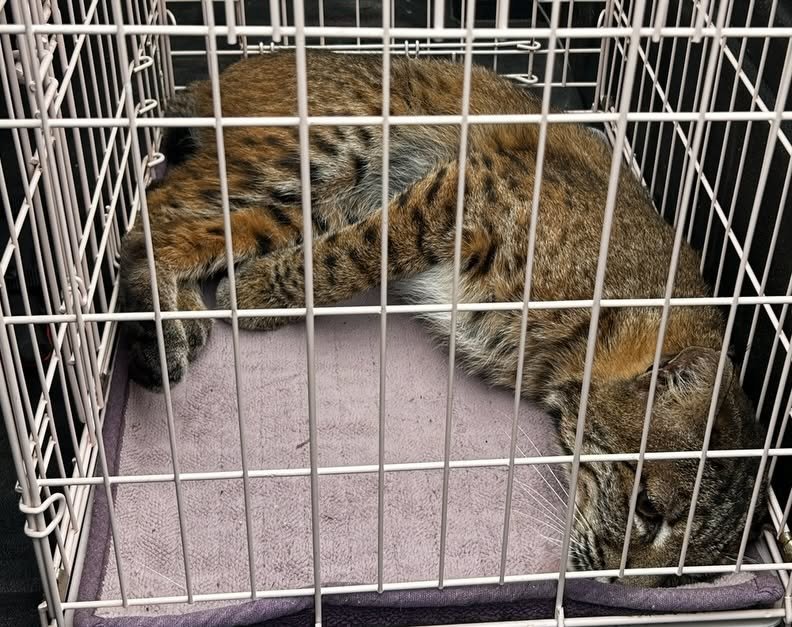
Police were then able to close their door and keep the bobcat isolated until a team from the  Washington Department of Fish and Wildlife arrived. Wildlife officials then sedated the cat, loaded it into a crate, and transported it to nearby Forbes Creek. The feline was then released back into the wild, startled but safe. As for how a bobcat ended up in the house in the first place, Kirkland Police believe the adventurous intruder climbed a tree and jumped through an open window, possibly lured in by the resident’s indoor cat. Both the owner and its likely shocked cat were unharmed, according to the police. Thankfully, curiosity didn’t kill this cat.

The Kirkland Police Department did not immediately respond to Popular Science’s request for comment. 

The aerial deployment was made possible by a public safety drone program the Kirkland Police began in 2022. Today, they reportedly maintain five drones and have 17 FAA-licensed pilots ready to operate them. The typical use cases for those drones include search and rescue, tactical search, scene documentation, and, apparently, bobcat removal. 

a bobcat sleeping in a cage
The bobcat before its release near Forbes Creek. Image: Kirkland Police Department.

Drones are changing the way police surveil wildlife…and people 

Drones and robotic dog-like quadrupeds are reshaping how local communities approach wildlife management. In Japan, authorities deploy a combination of camera-equipped drones and robotic Monster Wolves to locate and deter bears following a record spike in human-bear encounters driven by urban sprawl and declining farmland. In the United States, police in Santa Fe, New Mexico, recently used an aerial drone to track an errant bear wandering near a school. Expanded drone programs are also playing a greater role in locating lost or missing pets. Just last month, firefighters in t Florida used a remotely controlled drone to find an overly adventurous dog trapped in a storm drain. 

But this increased prevalence of drones comes with other, more controversial concerns as well. Police forces around the country are ramping up “drones as first responder” programs, which civil liberty critics say could introduce unreasonable surveillance. Law enforcement around the country has already used these drones to monitor political protesters. Meanwhile, Immigration and Customs Enforcement (ICE), is reportedly interested in using Boston Dynamics’ quadruped robot “Spot”  to aid in immigration operations. Private security companies like Flock and Axon are also investing heavily in aerial surveillance drones. 

The post Home-intruding bobcat no match for police drone appeared first on Popular Science.

  •  

Why do cats have 'leg whiskers'?

Cats are known for the whiskers on their faces. However, if you look closely, you can see that they also have whiskers on their legs. So why do cats have leg whiskers?

To answer why they're useful, it's important to understand what whiskers are. Technically known as vibrissae, whiskers are specialized hairs that are stiffer and several times thicker than other hairs. Although whiskers themselves do not contain nerves, their bases are rooted in specialized receptacles loaded with nerve endings, making whiskers very sensitive.

"Facial whiskers are as sensitive as human fingertips," Robyn Grant, a sensory biologist at Manchester Metropolitan University in the U.K., told Live Science.

Sign up for our newsletter

Life's Little Mysteries logo with a question mark in a magnifying glass

(Image credit: Marilyn Perkins / Future)

Sign up for our weekly Life's Little Mysteries newsletter to get the latest mysteries before they appear online

A cat's whiskers around the nose, which are also known as the mystacial vibrissae, are the longest whiskers they have, according to the veterinary reference book "The Feline Patient" (Wiley, 2025). Although there is variation among cats, on average there are 12 mystacial whiskers set in four rows on each side of the muzzle.

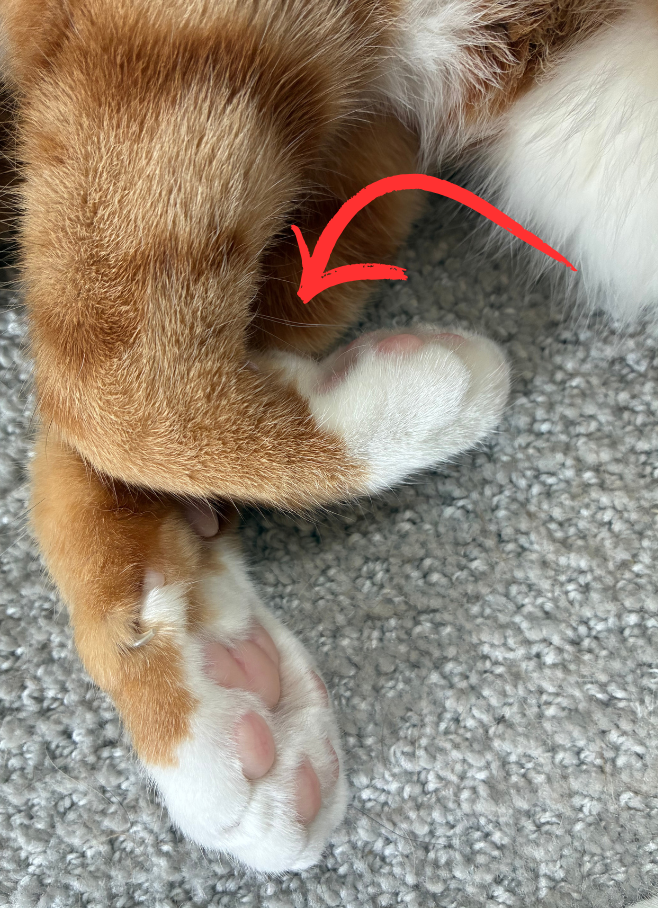
A close up of an orange cat's legs with an arrow

Cat leg whiskers, scientifically known as carpal vibrissae, are attached to their forelegs. (Image credit: Future)

Facial whiskers help cats hunt when light is limited or when their vision is poor. Although cats are good at seeing distant objects, "cats can't really focus on anything less than 10 inches (25 centimeters) from their eyes, so they use their whiskers to figure out where things are," Jonathan Losos, an evolutionary biologist at Washington University in St. Louis and author of "The Cat's Meow: How Cats Evolved from the Savanna to Your Sofa" (Viking, 2023), told Live Science.

In addition, cats have a tuft of whiskers known as superciliary vibrissae above each eye. These whiskers help protect the cat's vision by triggering a blink when stimulated by anything that might fly into their eye, according to The Feline Patient.

Cats also have chin whiskers (mandibular vibrissae) and whiskers on each side of the head, between the ear and chin (genal vibrissae). These also help cats stay aware of the space around them.

Leg whiskers

Cats also possess a tuft of four to six whiskers on the back of each front leg, each about 0.8 to 1.2 inches (2 to 3 centimeters) long. These are known as carpal vibrissae.

"Carpal refers to the bones that, in humans, are in our wrists," Losos said. "Carpal whiskers are attached to cat forelegs near the carpal bones." However, in cats, the carpal bones are not located in the same place as the human wrist. Rather, they "are further up the leg, because cats essentially walk on their toes and not their palms," he explained.

Cats are not the only animals with carpal whiskers. "Most carnivores have them, and many rodents do, as do lemurs and armadillos," Losos said. "Dogs don't have them, but other canine species do. Rabbits don't have them either, nor do ungulates — that is, hooved animals, such as horses and cattle."

The species that have carpal whiskers "tend to be the ones that either grasp things with their forelimbs or climb up trees," Losos said. "The idea is that if it's hard for the animals to see what they're grasping, carpal whiskers can help supplement their vision. Perhaps cats have them and dogs don't because cats can move their forearms laterally from side to side and put their palms together to grab things, whereas dogs can't."

It remains uncertain what role carpal whiskers play in cats, but they likely "guide locomotion — that is, safe forepaw placement — especially during complex locomotion, such as climbing," Grant said. "They might guide prey handling too."

How much of a cat fan are you? Find out by taking our cat quiz!

  •  

Outdoor cats can be exposed to dangerous germs — here's how to protect you and your pets, according to more than 400 studies

Pets form an important part of many people's lives, providing meaningful companionship. However, our pets can sometimes also be a source of unwelcome pathogens and diseases, particularly if they frequently roam outdoors.

We are ecologists and a veterinarian who study wildlife health and the movement of pathogens among wildlife, domestic animals and people. If you let your cat outdoors, or if outdoor cats visit your yard, our recent findings may be relevant.

Zoonotic pathogens are organisms that can infect both animals and humans. From a pathogen's perspective, humans are just another animal host. Wildlife is often emphasized as a source of emerging disease for humans because there are vastly more wild animal species than domestic animal species.

However, even if a pathogen is capable of infecting people, it needs a way to reach us. Humans share more zoonotic pathogens with domestic animals than with wildlife, because domestic animals live close to us. Pathogens benefit even further if they can infect a companion animal.

In our newly published research, we compiled data from more than 400 studies to investigate how a cat's lifestyle, whether they're mostly indoors, outdoor-roaming or feral, affects that cat's likelihood of carrying pathogens that can infect people.

Across this compilation, there were nearly 100 pathogens detected in cats that are considered zoonotic and capable of infecting humans. Familiar examples are rabies, Toxoplasma gondii, roundworms and Salmonella.

Our research

We found that outdoor-roaming pet cats had three to five times the odds of carrying a zoonotic pathogen compared with indoor-only cats. More surprisingly, cats allowed to roam outdoors had similar odds of carrying at least one zoonotic pathogen as feral cats. Outdoor-owned cats carried fewer types of pathogens than feral cats, but the same pathogens that infect feral cats can also infect owned cats.

These risks become a large-scale problem because pet cats that roam freely interact closely with people, wildlife and other domestic animals. Across the studies we reviewed, about 60 per cent of owned cats had unsupervised outdoor access; in some regions, that rate exceeded 90 per cent.

Roaming cats hunt, interact with wildlife or other domestic animals, and move through environments contaminated with pathogens and toxins. Research suggests that cat owners may underestimate hunting by around 80 per cent, meaning that many prey captures and animal contacts go unnoticed.

These interactions are not uncommon and not limited to so-called pest species. Single-country estimates of wildlife killed by cats run into the billions, with more than 2,000 wildlife species documented as prey for domestic cats.

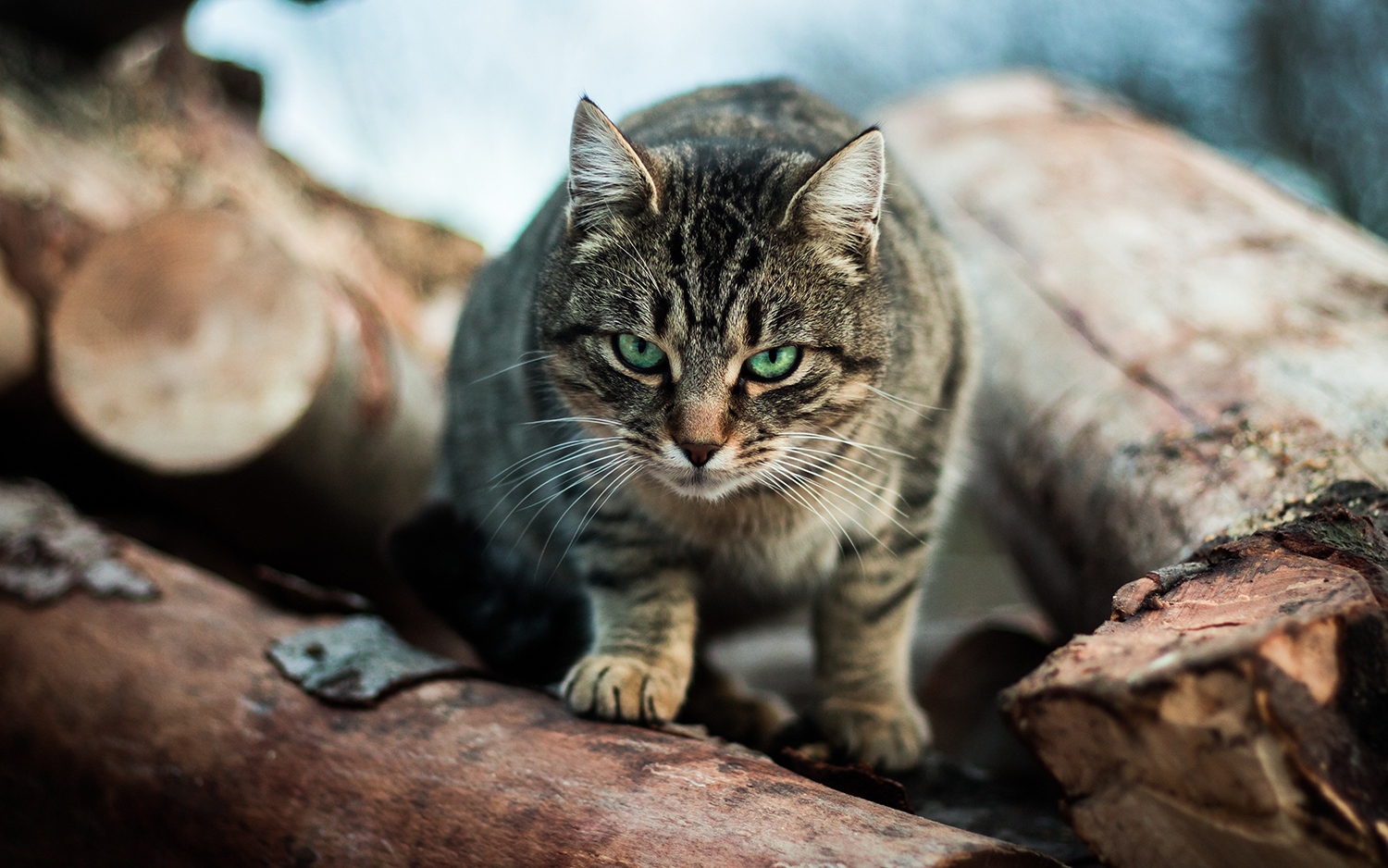
A gray and black striped cat sits on some broken tree trunks and looks at the camera.

Cats hunt animals that can carry zoonotic pathogens, including rodents, birds and bats, many of which would otherwise have little direct contact with people. (Image credit: Anton Darius)

Cats hunt animals that can carry zoonotic pathogens, including rodents, birds and bats, many of which would otherwise have little direct contact with people. Owned cats might bring home rodents carrying viruses, and there are documented cases of cats bringing rabies-positive bats into homes. A cat returning home with prey can therefore create a pathway by which pathogens circulating in wildlife populations reach people.

In addition, it is not only owners who are at risk. Outdoor cats defecate in gardens, parks, playgrounds and other shared spaces, potentially leading to high contamination rates. One study estimated that outdoor cats deposited more than 60 tonnes [60 tons] of feces per 10,000 households each year.

Depending on the parasite, feces can contain hundreds to hundreds of thousands of parasite eggs that can persist in soil or water for months to years, which can infect people or other animals that come in contact with those eggs.

What cat owners can do

The most straightforward intervention is also the most economical and humane: prevent unsupervised roaming. That does not mean denying cats access to the outdoors. It can mean building "catios" or enclosures, leash walks, supervised time outside or other forms of contained outdoor access.

House cats, as well as cheetahs, cougars and lynxes, can purr but can't roar, while other cats, such as lions, tigers and jaguars, can roar but can't purr.

Using systems like "catios" or leash walks can help minimize pathogens for cats. (Image credit: Carlos G. Lopez)

Veterinary care still matters. Treating existing parasitic infections and vaccinating against diseases like rabies are essential precautions, even for indoor cats. Since neither vaccines nor anti-parasitic treatment cover the full spectrum of wildlife-associated pathogens, managing exposure remains the more comprehensive protective approach.

The free-roaming debate is often framed as a false choice: either cats roam freely, or they are deprived of a natural life. That framing is misleading and inconsistent with how we manage other companion animals.

We do not assume dogs need unrestricted access to roads, neighbors' yards or to hunt wildlife to have good welfare. Indoor cats and cats with supervised outdoor access can live healthy, enriched and longer lives.

Policies and strategies that address how and where owned cats roam outdoors can help safeguard biodiversity, feline and wildlife welfare and public health. That is the central insight of One Health, that the same choices that protect ecosystems can also protect the animals and people who share them.

This article was co-authored by David Lapen, who works for and receives research funding from Agriculture and Agri-Food Canada.

This edited article is republished from The Conversation under a Creative Commons license. Read the original article.

How much of a cat fan are you? Find out by taking our cat quiz!

  •  
❌