 Login

Default Folder X 6.3.3



Power cable linking UK and Ireland now passes near Bronze Age human burial remains instead of fictional grave on Welsh beach
Harry Potter fans have forced a new multimillion-pound power cable between the UK and Ireland to be relocated after complaining it would desecrate the “grave” of Dobby, a fictional elf.
The character was laid to rest on Freshwater West beach in Pembrokeshire, Wales, in the film Harry Potter and the Deathly Hallows. Fans of the wizard series come to leave stones reading “Here Lies Dobby” despite being asked not to by the land owner, the National Trust, because the beach is an ecologically sensitive site.
Continue reading...
© Photograph: REUTERS

© Photograph: REUTERS

© Photograph: REUTERS

The App Store is evolving at a breakneck pace not seen since its earliest days. We saw the first glimmers of what was to come early in 2025, but it wasn’t until late last year that the tsunami of apps developed with the help of AI agents really took hold.
Since then, veteran developers are releasing new apps and updating existing ones faster than ever, and new developers are releasing their first apps in droves. Today, supply is dramatically up, demand is flat, and quality is seemingly simultaneously up and down, depending on where you look.
How these forces play out long-term is anyone’s guess, but it’s worth examining because, just as Federico’s link to Bryan Irace’s post about agentic coding tools foreshadowed the rise of tools like Codex and Claude Code, today’s trends are sparks that have the potential to become tomorrow’s App Store wildfires or simply fizzle out.
Utility apps are on the front lines of this change. The TechCrunch story I linked in April picked up on this trend:
Another interesting tidbit from Appfigures is that the Utilities app category moved up the top five chart.
If anything, the trend has accelerated in the months since.
It’s not surprising at all that utility apps have taken off. They’ve been a staple of new developers since long before agents came along. That’s because many are UI wrappers around command line tools. That isn’t a knock against the developers of those apps; most users don’t want to open Terminal to convert a video or audio file to another format using ffmpeg, for example. By building a great UI around command line tools, developers have made them far easier to use.
However, the relative simplicity and narrow scope of many utility apps have made them a natural fit for AI agents, too. That’s why the App Store (and my inbox) is deluged with Mac menu bar and single-screen iPhone and iPad utility apps.
On the one hand, the abundance of utilities has been great for users. More choice means you’re more likely to find the app that perfectly fits your needs.
On the other hand, though, I don’t think what’s happening in the category is sustainable and expect to see it dramatically shift again in the coming months. As we’ve seen from reporting by The New York Times, app supply is outstripping demand by orders of magnitude, which will drive down prices. That alone is likely to cause the utility app market to shrink. But there’s more to it than that.
Remember, the demand shifts that The New York Times reported, based on Sensor Tower numbers, are for the entire App Store, where download numbers have grown 2-3% this year and last. I expect utility downloads to actually shrink in the coming months – again, because of agents. Utilities, especially simple ones, are exactly the sorts of apps that are becoming trivially easy for power users – the very users these utilities are made for – to create themselves. From frontier labs‘ model improvements to a growing number of app-building tools from those same labs and third parties, it’s never been easier to build a web or native app yourself.
And although I agree with people, like Nilay Patel, who say the notion that everyone will build their own software is overblown, the utility market is different. Your average person is not downloading apps to adjust the frame rate and file format of a video or downloading YouTube videos to watch later. But those are exactly the sort of things that people who are using agents are doing with them, whether they’re having an agent do those things directly via a command line tool in an app like Codex or Claude Code or building an app to do the same thing. That’s going to put even more pressure on the category.
That said, I think there will always be a cohort of users who would rather pay for an app than build it themselves, so I’m not predicting the demise of utilities in general – just the end of today’s frothy market. I also think there remains a place for simple utilities that solve hard problems with clever solutions. Not every utility is a UI wrapper for a terminal command. Plenty of apps feature original solutions or thoughtful and unconventional remixes of disparate tools.
Utilities aren’t going away, but just like other App Store deluges, the trend will recede. It’s just that this time, it’s likely to flip faster than usual.
One task awaiting new energy secretary Miatta Fahnbulleh is devising a plan to avoid a crisis by the end of the decade
Welcome to the energy secretary job, Miatta Fahnbulleh. You have a politically tricky decision to make on whether to approve production at the Jackdaw gasfield and the Rosebank oilfield. But here’s another one that can’t wait much longer: what is the broader plan to ensure Britain avoids a gas supply crisis in 2030?
By way of reminder, one of the more alarming reports published by the energy department under Ed Miliband was the one that warned of “an emerging risk” to gas supplies at the turn of the decade if an important piece of kit – an import terminal, say, or the critical 725-mile Langeled pipeline from Norway – were to be out of the action during a severe cold snap.
Continue reading...
© Photograph: PA Images/Alamy

© Photograph: PA Images/Alamy

© Photograph: PA Images/Alamy
CEO Chris O’Shea defends Centrica’s plans as it reports rise in retail profits following focus on bigger margins
The owner of British Gas has claimed that most households would rather speak with an AI chatbot than deal with the company’s staff as it prepares to cut 1,300 jobs from its call centres and back office.
Centrica, the supplier’s FTSE 100 owner, plans to cut 800 jobs as the company carries out a “targeted deployment of AI tools”, on top of the 500 cuts it confirmed last month.
Continue reading...
© Photograph: Owen Humphreys/PA

© Photograph: Owen Humphreys/PA

© Photograph: Owen Humphreys/PA
For months I’ve been trying to receive my FIT payment, which should be more than £1,000
I moved into my new house 14 months ago, and soon afterwards applied to ScottishPower, with whom the solar panels are registered for a feed-in tariff (Fit), for transfer of ownership of the panels and the tariff.
After many emails back and forth, I got a response saying they had all the information required.
Continue reading...
© Photograph: Timon Schneider/Alamy

© Photograph: Timon Schneider/Alamy

© Photograph: Timon Schneider/Alamy

Battery energy storage specialist ELM MicroGrid has spent more than two decades building a nationwide energy storage and utility infrastructure businesses. Now, the company is bringing that expertise home with the installation of a new battery energy storage system at a solar microgrid project in Peoria, IL.
More Americans are using small solar panels in their back yards or balconies as a clean way to cut their electric bills
If you feel like your electricity bill just keeps climbing, you aren’t imagining it. Since 2020, US residential energy prices have surged by about 30%, making power the largest household energy expense behind gasoline, according to the US Energy Information Administration.
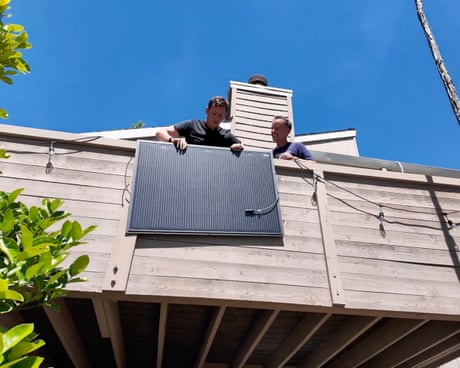
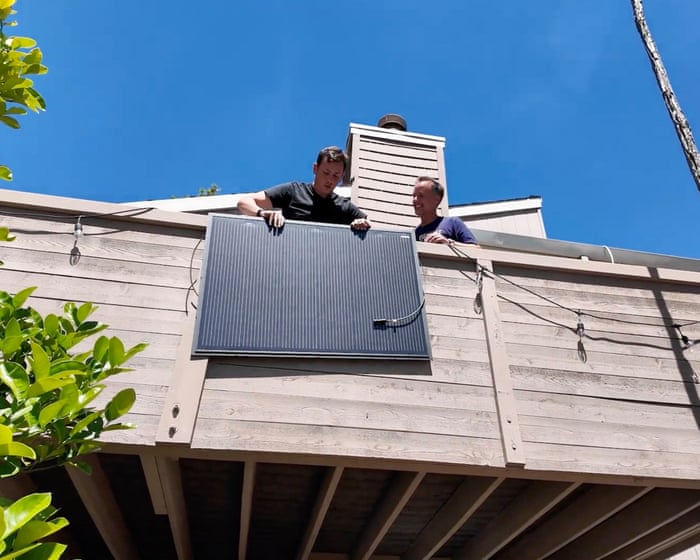
But for residents like Alex Curtis, the days of feeling powerless against rising costs are coming to an end. Curtis is waging a war on his electric bill, and his new weapon of choice is a lightweight, thin-film solar panel.
Continue reading...
© Photograph: Climate Central
© Photograph: Climate Central
© Photograph: Climate Central
