❌

Reading view

Scientists Uncover New Evidence of Mysterious ‘Time-Reversal Symmetry Breaking’ in This ‘Exotic’ Kagome Metal

Physicists report the discovery of new evidence for a mysterious quantum state in an unusual class of materials, in findings that could illuminate a long-running debate over how these systems transition into superconductivity.

In physics, symmetry breaking refers to processes in which a symmetric state collapses from its initial state of disorder into a more ordered one, albeit now possessing less symmetry.

The new research findings reveal evidence that time-reversal symmetry, a fundamental kind of symmetry in nature, appears to be broken at temperatures significantly higher than previously recognized.

The research was detailed in a recent study published in Nature Physics.

Mysterious Kagome Metals

In their study, an international team of researchers led by a team at the Korea Advanced Institute of Science and Technology focused on what are known as kagome metals—a variety of ferromagnetic quantum materials possessing unique qualities.

For their study, the researchers used a specific kagome metal called Cesium Vanadium Antimonide (CsV₃Sb₅), a novel material first discovered in 2021 by researchers at UC Santa Barbara’s NSF Quantum Foundry.

The researchers found that during experiments with the material, which is recognized as a candidate superconductor, CsV₃Sb₅ showed indications that time-reversal symmetry was broken at temperatures significantly higher than previously recognized.

This is significant because it is suggestive of an elusive phenomenon physicists call loop-current order, which describes a state in which the circulation of electrons throughout a material occurs in persistent microscopic loops.

A Signal Emerges

Using an advanced photoemission technique, the team was able to uncover subtle differences in the way electrons respond to circularly polarized light, which is light that is produced using an electric field vector that rotates in a circle as the light wave propagates, equaling one complete rotation for each wavelength.

Based on the team’s measurements, a distinctive signal emerged, which they say is consistent with a time-reversal symmetry-breaking state, meaning that their observations provide what may be the best experimental evidence to-date for an exotic quantum state of matter known as loop-current order, wherein electrons spontaneously assume microscopic wave-like formations.

Loop-current order in kagome metals has been an ongoing area of study for physicists, and the team’s new findings offer what may be the best evidence yet uncovered.

Exotic States and High-Temperature Superconductivity

One reason the team’s findings are so significant is that their results offer some clarity for the otherwise complex sequence of phase transitions that are known to occur within CsV₃Sb₅.

Based on their research, the team now believes loop-current order manifests as the temperature begins to decrease, which is then followed by a periodic rearrangement of electrons known as a charge density wave. Finally, superconductivity then follows, accompanied by the absence of electrical resistance altogether.

Fundamentally, the team’s work could offer new insights into the behavior and characteristics of strongly correlated quantum materials, which could hold promise for future studies involving the mechanisms that produce exotic states of matter.

“These insights deepen our understanding of the phase landscape in kagome metals and highlight connections with a correlated system exhibiting analogous transition hierarchy,” the team reports.

In the future, such studies may also help scientists finally attain the long-sought goal of high-temperature superconductivity, whereby materials capable of conducting electricity with zero resistance, and at temperatures above 30 K (-243°C), helping to reduce the current expenses associated with cooling systems required for superconducting, and ultimately helping to bring these high-power engineering technologies into commercial viability.

The team’s recent study, “Evidence of time-reversal symmetry breaking above the charge density wave order in a kagome metal,” was published in Nature Physics.

Micah Hanks is the Editor-in-Chief and Co-Founder of The Debrief. A longtime reporter on science, defense, and technology with a focus on space and astronomy, he can be reached at micah@thedebrief.org. Follow him on X @MicahHanks, and at micahhanks.com.

  •  

The Search for Simplicity : The Higgs Boson’s Self Coupling

When students first learn quantum field theory, the mathematical language the underpins the behavior of elementary particles, they start with the simplest possible interaction you can write down : a particle with no spin and no charge scattering off another copy of itself. One then eventually moves on to the more complicated interactions that describe the behavior of fundamental particles of the Standard Model. They may quickly forget this simplified interaction as a unrealistic toy example, greatly simplified compared to the complexity the real world. Though most interactions that underpin particle physics are indeed quite a bit more complicated, nature does hold a special place for simplicity. This barebones interaction is predicted to occur in exactly one scenario : a Higgs boson scattering off itself. And one of the next big targets for particle physics is to try and observe it.

A feynman diagram consisting of two dotted lines coming merging together to form a single line.
A Feynman diagram of the simplest possible interaction in quantum field theory, a spin-zero particle interacting with itself.

The Higgs is the only particle without spin in the Standard Model, and the only one that doesn’t carry any type of charge. So even though particles such as gluons can interact with other gluons, its never two of the same kind of gluons (the two interacting gluons will always carry different color charges). The Higgs is the only one that can have this ‘simplest’ form of self-interaction. Prominent theorist Nima Arkani-Hamed has said that the thought of observing this “simplest possible interaction in nature gives [him] goosebumps“.

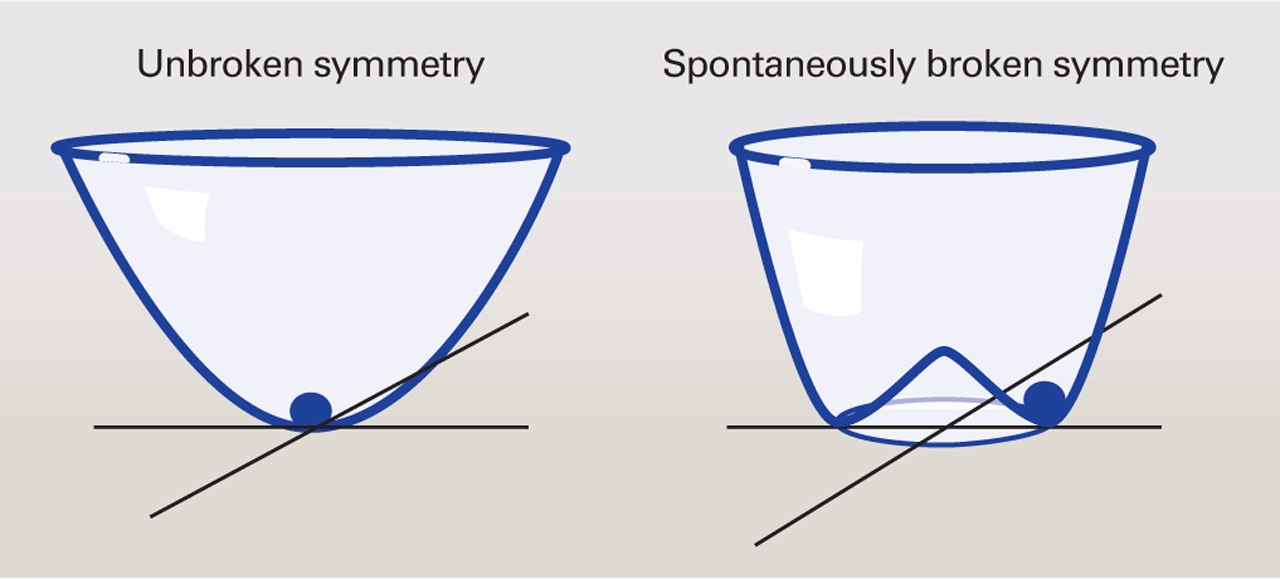
But more than being interesting for its simplicity, this self-interaction of the Higgs underlies a crucial piece of the Standard Model: the story of how particles got their mass. The Standard Model tells us that the reason all fundamental particles have mass is their interaction with the Higgs field. Every particle’s mass is proportional to the strength of the Higgs field. The fact that particles have any mass at all is tied to the fact that the lowest energy state of the Higgs field is at a non-zero value. According to the Standard Model, early in the universe’s history when the temperature were much higher, the Higgs potential had a different shape, with its lowest energy state at field value of zero. At this point all the particles we know about were massless. As the universe cooled the shape of the Higgs potential morphed into a ‘wine bottle’ shape, and the Higgs field moved into the new minimum at non-zero value where it sits today. The symmetry of the initial state, in which the Higgs was at the center of its potential, was ‘spontaneously broken’  as its new minimum, at a location away from the center, breaks the rotation symmetry of the potential. Spontaneous symmetry breaking is a very deep theoretical idea that shows up not just in particle physics but in exotic phases of matter as well (eg superconductors). 

A diagram showing the ‘unbroken’ Higgs potential in the very early universe (left) and the ‘wine bottle’ shape it has today (right). When the Higgs at the center of its potential it has a rotational symmetry, there are no preferred directions. But once it finds it new minimum that symmetry is broken. The Higgs now sits at a particular field value away from the center and a preferred direction exists in the system. 

This fantastical story of how particle’s gained their masses, one of the crown jewels of the Standard Model, has not yet been confirmed experimentally. So far we have studied the Higgs’s interactions with other particles, and started to confirm the story that it couples to particles in proportion to their mass. But to confirm this story of symmetry breaking we will to need to study the shape of the Higgs’s potential, which we can probe only through its self-interactions. Many theories of physics beyond the Standard Model, particularly those that attempt explain how the universe ended up with so much matter and very little anti-matter, predict modifications to the shape of this potential, further strengthening the importance of this measurement.

Unfortunately observing the Higgs interacting with itself and thus measuring the shape of its potential will be no easy feat. The key way to observe the Higgs’s self-interaction is to look for a single Higgs boson splitting into two. Unfortunately in the Standard Model additional processes that can produce two Higgs bosons quantum mechanically interfere with the Higgs self interaction process which produces two Higgs bosons, leading to a reduced production rate. It is expected that a Higgs boson scattering off itself occurs around 1000 times less often than the already rare processes which produce a single Higgs boson.  A few years ago it was projected that by the end of the LHC’s run (with 20 times more data collected than is available today), we may barely be able to observe the Higgs’s self-interaction by combining data from both the major experiments at the LHC (ATLAS and CMS).

Fortunately, thanks to sophisticated new data analysis techniques, LHC experimentalists are currently significantly outpacing the projected sensitivity. In particular, powerful new machine learning methods have allowed physicists to cut away background events mimicking the di-Higgs signal much more than was previously thought possible. Because each of the two Higgs bosons can decay in a variety of ways, the best sensitivity will be obtained by combining multiple different ‘channels’ targeting different decay modes. It is therefore going to take a village of experimentalists each working hard to improve the sensitivity in various different channels to produce the final measurement. However with the current data set, the sensitivity is still a factor of a few away from the Standard Model prediction. Any signs of this process are only expected to come after the LHC gets an upgrade to its collision rate a few years from now.

Limit plots on HH production in various different decay modes.
Current experimental limits on the simultaneous production of two Higgs bosons, a process sensitive to the Higgs’s self-interaction, from ATLAS (left) and CMS (right). The predicted rate from the Standard Model is shown in red in each plot while the current sensitivity is shown with the black lines. This process is searched for in a variety of different decay modes of the Higgs (various rows on each plot). The combined sensitivity across all decay modes for each experiment allows them currently to rule out the production of two Higgs bosons at 3-4 times the rate predicted by the Standard Model. With more data collected both experiments will gain sensitivity to the range predicted by the Standard Model.

While experimentalists will work as hard as they can to study this process at the LHC, to perform a precision measurement of it, and really confirm the ‘wine bottle’ shape of the potential, its likely a new collider will be needed. Studying this process in detail is one of the main motivations to build a new high energy collider, with the current leading candidates being an even bigger proton-proton collider to succeed the LHC or a new type of high energy muon collider.

Various pictorial representations of the uncertainty on the Higgs potential shape.
A depiction of our current uncertainty on the shape of the Higgs potential (center), our expected uncertainty at the end of the LHC (top right) and the projected uncertainty a new muon collider could achieve (bottom right). The Standard Model expectation is the tan line and the brown band shows the experimental uncertainty. Adapted from Nathaniel Craig’s talkhere

The quest to study nature’s simplest interaction will likely span several decades. But this long journey gives particle physicists a roadmap for the future, and a treasure worth traveling great lengths for.

Read More:

CERN Courier Interview with Nima Arkani-Hamed on the future of Particle Physics on the importance of the Higgs’s self-coupling

Wikipedia Article and Lecture Notes on Spontaneous symmetry breaking

Recent ATLAS Measurements of the Higgs Self Coupling

  •  

Standing For Truth Against the Big Bang

I presented on the subject of problems for the big bang on the YouTube channel Standing for Truth Ministries. I discussed the most common problems the big bang theory has, the contradictions, fudge factors and failures.

  •  

Cosmic Asymmetry Revealed: Spiral Galaxy Spin Directions and Clustering of Quartets of Galaxies

Recent studies reveal asymmetries in the universe, challenging big bang assumptions. Research from the JWST indicates a significant predominance of clockwise-rotating spiral galaxies, with implications questioning new physics. Additionally, tetrahedral arrangements of galaxies suggest non-random clustering, hinting at a created order in the cosmos.

  •  

Groups, The Path from a Simple Concept to Mysterious Results

Introduction The concept of a group is as simple as it gets: a set with a binary operation like addition and a couple of natural laws like the requirement that the order of two consecutive operations does not matter: ##(1+2)+3=1+(2+3).## That’s it. The concept of a group is so simple that I still wonder why...
  •  
❌