Researchers used New Horizons images to identify evidence that liquid nitrogen may have flowed from beneath Pluto’s famous heart-shaped glacier. Dark markings across part of Pluto’s enormous heart-shaped glacier may record something unexpected beneath its frozen surface: liquid nitrogen moving upward and briefly flowing across the ice. Using observations from NASA’s New Horizons spacecraft, researchers [...]
According to the researchers behind the detection, the liquid nitrogen evidence captured by NASA’s New Horizons Spacecraft is the first evidence of any liquid flowing on Pluto. They also suggest that the discovery could help scientists better understand other solar system features such as the geysers on Neptune’s moon Triton.
New Horizons Mission Gave First Hint of Liquid Nitrogen on Pluto
When New Horizons captured images of Pluto’s surface between 2015 and 2016, it gathered extensive imagery of a massive surface feature called Sputnik Planitia. Larger than Texas and Oklahoma combined, the frozen nitrogen lake has long fascinated planetary scientists.
When examining the spacecraft’s photos, researchers spotted thin, dark, linear features separating the city-sized geologic convection cells on Sputnik Planitia’s northernmost portions. Critically, the thinner, separating features were more diffuse than the larger ones. Although some previous studies suggested that Pluto may have a liquid water ocean beneath its frozen outer shell, the surface temperatures would prevent any of that water from flowing on the surface long enough to cause the features.
Some theories proposed a liquid nitrogen explanation for the thinner features, even though the research team behind the discovery said that Pluto’s atmospheric and thermal conditions make liquid rain physically impossible. Still, the team notes, the surface patterns on Pluto’s northern Sputnik Planitia “have been darkened in ways that resemble glacial features on Earth that have been wetted by water rain or the subsurface emergence of liquids to the surface.”
To better understand the data, SwRI Associate Vice President and principal investigator on the New Horizons mission, Dr. Alan Stern, reexamined the data, focusing on similar features on Earth.
Sputnik Planitia Evidence “Very Similar” to Greenland Ice Sheet Features
To start, Dr. Stern and colleagues compared the New Horizons images with Earth imagery collected by NASA’s Landsat 9. The researchers focused on the Greenland Ice Sheet, since similar surface features caused by liquid water separating ice and snow have been previously observed.
When focusing on topography, the team said the two regions appeared “very similar.” This similarity suggested that subsurface liquids in the form of nitrogen were rising to the surface and wetting areas of Sputnik Planitia’s nitrogen ice.
Pluto’s northern Sputnik Planitia glacier (in the western or left side of Pluto’s brightheart) is shown here in a color mosaic made from New Horizons imagery. The direction of north is shown on the image. The image is ~ 700 x 350 kilometers across. The red box has been added to show most of the region containing dark features attributed to the wetting of the glacier by liquid nitrogen sourced from a “basal melting” process beneath the glacier. (2026). Image Credit: NASA/John Hopkins APL/Southwest Research Institute.
SwRI Principal Scientist Dr. Kelsi Singer, one of the study’s co-authors, said Sputnik Planitia’s surface is “quite young” in geological terms, with most estimates placing it at less than one million years. As a result, the dark, thin surface features must have formed during that short window of time.
“Pluto has many unique terrains seen nowhere else in the solar system, and this area of Sputnik Planitia is one of them,” Dr Singer explained. “Its surface provides a different set of conditions compared to what we are used to on Earth, and exploring that allows us to better understand how materials behave in environments that are difficult to produce on Earth.”
To support the visual evidence of liquid nitrogen on Pluto, Dr. Orkan Umurhan, a senior research scientist at the SETI Institute, oversaw the creation of computer models designed to simulate the dwarf planet’s local environment. According to the study authors, the models “show that nitrogen ice at the base of Pluto’s kilometers-deep Sputnik glacier can melt, forming liquid nitrogen.”
Dark, narrow surface features have been identified here in areas in Greenland where liquid water darkens the ice and snow in a manner analogous to what is now believed to perhaps be occurring on northern Sputnik Planitia on Pluto due to present or recent liquid nitrogen there. Image Credit: NASA/Johns Hopkins /Southwest Research Institute.
The same models also revealed that buoyancy and pressure from underneath can cause liquid nitrogen to migrate to Pluto’s surface via a series of small conduits that resemble lava or geyser tubes. Although the dwarf planet’s distance from the Sun makes it an extremely frigid environment, the models also suggested that once liquid nitrogen reaches Pluto’s surface, it can maintain liquid form long enough to flow down the nitrogen glacier slopes and cause the features seen in the images.
“Pluto Never Stops Surprising Us”
When discussing the significance of the findings, Dr. Umurhan pointed to the study’s “tantalizing picture that it promotes,” including potentially motivating a further examination of solid-state nitrogen physics at very low temperatures.
“Specifically, it’s important to examine the physics taking place in solid nitrogen materials under stress and strain, which can cause them to melt,” the study author explained, adding that these processes “have never been studied in real detail in the laboratory.”
The SwRI-led team also noted that over half of Pluto remains unmapped in high resolution, meaning there is still a lot of room for future discoveries. This includes further mapping of the other Kuiper Belt planets “to determine if similar processes are occurring elsewhere in that region of the solar system.”
Finally, the SwRI-led team said the findings could offer some assistance in explaining other events across the solar system, such as the geysers observed by NASA’s Voyager 2 on Neptune’s moon Triton.
“Pluto never stops surprising us, and this new result certainly does that,” Stern concluded. “In addition to suggesting that liquids have recently expressed themselves on Pluto’s surface, it also suggests a new kind of time-variable feature on Pluto.”
Christopher Plain is a Science Fiction and Fantasy novelist and has spent the last six years as Associate News Editor and Head Science Writer at The Debrief. Follow and connect with him on X, learn about his books at plainfiction.com, or email him at christopher@thedebrief.org
NASA’s Juno mission scientists have reported the first successful temperature measurements below the surface of Jupiter’s moon Io, including indications of significant heating within the moon’s shallow subsurface.
Collected during a pair of close flybys of the Solar System’s most volcanically active world, the Juno mission measurements were described as a complete “surprise” since the instrument was designed for a different purpose.
“[The readings] break new observational ground for both fiery and icy worlds beyond our planet,” the team said.
MWR Instrument Designed to Probe Jupiter’s Atmosphere Provides Double Duty
Due to the extreme gravitational pull of its host planet, Jupiter, Io is repeatedly stretched and pulled as its slightly elliptical orbit carries it around the massive gas giant. This repeated motion generates a tremendous amount of heat, which the scientists note is “many times greater” than the same type of heat generated on Earth.
However, a detailed understanding of this process has remained elusive, as the only data on the moon’s inner heat came from infrared telescope observations. The team notes this data is limited to the temperature of Io’s upper rocky surface layer.
Conversely, Juno is equipped with an instrument called the Microwave Radiometer (MWR). According to the team’s statement announcing the successful subsurface temperature detection, Juno’s Microwave Radiometer was custom designed by Scott Bolton, the mission’s principal investigator at Southwest Research Institute in San Antonio and a co-author of the study detailing the team’s findings, to “peer beneath Jupiter’s top clouds” for a closer look at the gas giant’s complex atmosphere.
“The MWR’s six microwave antennas serve as a single instrument, simultaneously detecting microwaves at a wide range of wavelengths, from about half an inch to 20 inches (1.3 to 51 centimeters),” the team explains.
“Everywhere We Looked, We Found the Temperature Rising”
Bolton said the team’s novel approach allowed the instrument to observe wavelengths from different depths, “providing a new way to characterize the deep atmosphere of giant planets and the subsurface crusts of icy and rocky moons.” This included observations of Jupiter’s other ‘Galilean’ moons, Ganymede and Europa.
“At Ganymede and Europa, we explored tens of miles below the surface, assuming their ice shells were mostly pure water,” the mission scientists explained.
However, Bolton added, using the instrument to successfully probe into Io’s volcanic rock “was an unexpected discovery.”
This map represents data captured by the Microwave Radiometer instrument aboard NASA’s Juno, indicating heat rising from just beneath the surface of Jupiter’s moon Io. The colors illustrate a distinct temperature gradient across the moon, with the most extreme, localized heat output in red. Image Credit: NASA/JPL-Caltech/SwRI/USGS.
The feat was accomplished during a pair of flybys on December 30, 2023, and February 3, 2024, where Juno came within roughly 930 miles (1,500 km) of Io’s surface. Shannon Brown, the paper’s lead author at NASA’s Jet Propulsion Laboratory in Southern California, said that during these flybys the MWR instrument measured the moon’s thermal emission “at depths ranging from a few inches down to tens of feet.”
“Everywhere we looked, we found the temperature rising by more than 40 degrees Fahrenheit just several feet into the surface — a gradient far steeper than solar heating alone can explain,” Brown said.
This graphic illustrates the areas of Io sampled by the Microwave Radiometer instrument aboard NASA’s Juno spacecraft during two close flybys of the Jovian moon. Image Credit: NASA/JPL-Caltech/SwRI/USGS.
Although more information is likely needed to make a conclusive determination, the team said that the data suggests two possible explanations for the readings. The first option is heat rising steadily through what the team termed a “conductive crust.”
“While this background heat flow — measured at 1 to 3 watts per square meter — is relatively gentle on a local scale (roughly equivalent to a small nightlight glowing under every square yard), across the entire moon it represents a release of energy up to 30 times Earth’s average,” they explained.
Another possibility proposed by the joint research team suggested that the heat signal detected by Juno’s MWR could be coming from cooling lava flows covered by 30 to 35 feet (9 to 11 meters) of solidified crust that cover approximately 10% of Io’s surface “at any given time.”
A Similar Instrument Could be Used to Scan Earth
When discussing the implications of the team’s findings, Bolton said the “surprising” ability to see below Io’s surface “has important implications for studying Earth’s volcanoes.” He also noted that if scientists used a similar instrument to measure areas on Earth near volcanoes, they might see a similar heat signature in the planet’s subsurface temperature gradient, “providing new information on how terrestrial volcanoes work.”
“Io provides a unique window into learning how tidal heating works throughout the cosmos, a fundamental process that provides energy and heat to worlds that are far from their parent star,” Bolton explained. “This process can not only create the most volcanic body in the solar system, in the case of Io, but also fuels the subsurface oceans on the moons of giant planets, such as Europa and Ganymede.”
“Up until this point, we could only observe the heat escaping at the surface or through eruptions,” the mission scientists added. “Now we can characterize how the heat is moving from the interior toward the surface.”
Christopher Plain is a Science Fiction and Fantasy novelist and has spent the last six years as Associate News Editor and Head Science Writer at The Debrief. Follow and connect with him on X, learn about his books at plainfiction.com, or email him at christopher@thedebrief.org.
Scientists from the Southwest Research Institute’s Center for Lunar Origin and Evolution (CLOE) have revealed new models of the Moon’s oldest and largest impact crater, the South Pole-Aitken (SPA) basin, providing fresh insights into the event and resulting material deposition on the lunar surface.
The SwRI team behind the new models, which is part of NASA’s Solar System Exploration Research Virtual Institute, said such details will help prepare future Artemis astronauts for what they could encounter during their upcoming missions.
Impact Study Reveals Details About Moon’s Oldest and Largest Crater
In a statement announcing the new models, Dr. William Bottke, director of CLOE and executive director of SwRI’s Science Directorate in Boulder, Colorado, said that the basin is an attractive potential target for future Artemis missions since it offers a “rare opportunity” to study an earlier era in the Moon’s history.
“The collision struck the lunar surface with such force that it may have excavated material from deep inside the Moon, including portions of the lunar mantle,” explained the co-author of the impact study detailing the new research.
Although previous studies have modeled impacts that may have caused the Moon’s oldest and largest crater, the team’s new effort has revealed new evidence about the composition of the impacting object and its likely direction and angle.
“Our simulation produces the right shape and nature of the impact basin,” explained the impact study’s lead author, Dr. Shigeru Wakita of Purdue University. “It also tells us about the projectile that created it and the direction of the impact.”
Image shows materials excavated (blue) from the SPA by its forming impact, including mantle-derived rocks (orange and black). Models suggest the proposed landing sites for upcoming Artemis missions to the lunar south pole (white blocks) lie within the region. Image Credit: NASA/JPL-Caltech/Goddard/Gabe Gowman-U. Arizona. Data from NASA’s GRAIL mission and NASA’s Lunar Reconnaissance Orbiter Laser Altimeter.
For example, the new model suggests that the object was not a single, uniform object. Instead, the team found that the impactor was likely a “differentiated” object, such as a protoplanet or asteroid, composed of rock and surrounded by an iron core. The models also found that the object approached from the north “at a low angle” before impacting the Moon’s surface on a southward trajectory.
According to the impact study authors, the impact excavated a deep, “asymmetric” cavity and generated enough energy to melt the rock within the crater’s central basin, resulting in the SPA basin’s elongated, tapered shape. Their models also indicated that the object’s lunar collision “lofted” large amounts of material into the air. Critically, their models also revealed that material from both the lunar crust and mantle was likely ejected before ultimately settling back onto the basin floor.
Exploring Gravity’s Role and the Possibility of ‘Valuable’ Mantle in the Impact Ejecta
To help potential future lunar astronauts, including members of NASA’s Artemis mission, target the most scientifically valuable lunar samples, a second companion study explored the effects of gravity on ejecta distribution beneath and around the impact basin. According to the team behind that effort, their effort involved direct comparisons of high-resolution gravity data with models. Specifically, they wanted to determine if pieces of the Moon’s crust and mantle were included in the ejection.
After comparing the two, the authors of the second study determined that the SPA basin “likely contains substantial amounts of mantle-derived rocks” both within its interior and mixed into the wider ejecta blanket surrounding the basin. Also critical for future missions, the analysis revealed that this material was not all scattered during the initial impact.
Instead, the new models showed that subsequent, smaller impacts appear to have “excavated” these underlying mantle deposits. As a result, the team suggests that there is likely enough material on the surface of the Moon’s oldest and largest crater “where it could be readily sampled by robotic rovers or astronauts during future missions.”
The Studies Provide Future Lunar Missions with a “Powerful Roadmap”
When discussing the significance of the gravity study’s findings, lead author Dr. Gabriel Gowman of the University of Arizona said that before now, the “precise distribution” of lunar mantle material on the Moon’s surface “has been a big unknown.” For example, some previous theories suggested that the deepest ejecta might be found only in parts of the basin that are not currently included in planned Artemis missions.
Now, the team’s new models suggest that the impact that formed the SPA basin “ejected enough deep material to form a significant deposit that should still be accessible today.” More importantly, Dr. Gowman added, some of that scientifically valuable mantle material “at a trace level” may exist in regions currently under consideration for upcoming Artemis landings. Taken together, Bottke said, the two studies can provide a “powerful roadmap” for future lunar scientific missions to the Moon’s oldest and largest crater.
“It tells us not just how SPA formed, but where to look for the rocks that can answer some of our biggest questions about the Moon’s origin and evolution,” the researcher explained.
Christopher Plain is a Science Fiction and Fantasy novelist and Head Science Writer at The Debrief. Follow and connect with him on X, learn about his books at plainfiction.com, or email him directly at christopher@thedebrief.org.
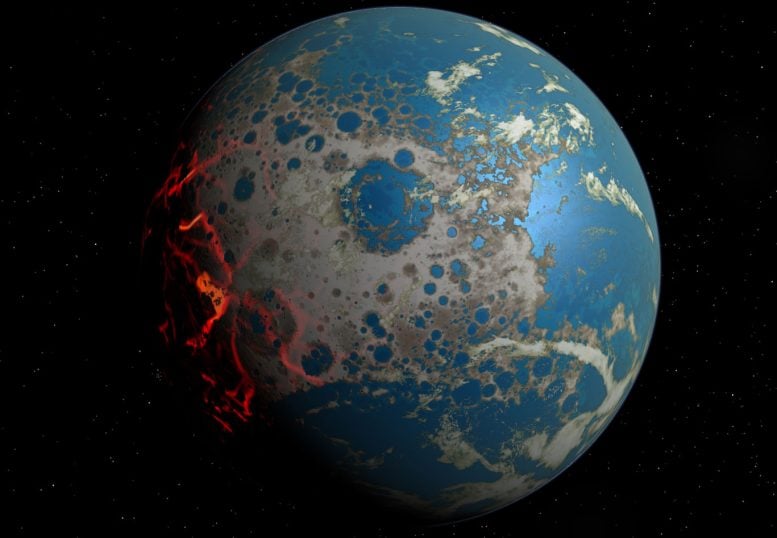
Ancient asteroid impacts may have done more than reshape Earth’s surface. For decades, asteroid impacts have been viewed mainly as agents of destruction. But on the young Earth, they may have done something far more surprising: helped create some of the planet’s first habitable environments. A new study from Southwest Research Institute (SwRI) suggests that [...]

 Login

 Researchers used New Horizons images to identify evidence that liquid nitrogen may have flowed from beneath Pluto’s famous heart-shaped glacier. Dark markings across part of Pluto’s enormous heart-shaped glacier may record something unexpected beneath its frozen surface: liquid nitrogen moving upward and briefly flowing across the ice. Using observations from NASA’s New Horizons spacecraft, researchers [...]