
❌

Reading view

Experiments provide new insights into the reverse sprinkler problem

New insights into the “reverse sprinkler” problem popularized by Richard Feynman have been provided by US researchers using modified rotary sprinklers. The results, which indicate that the reverse sprinkler is driven by the angular momentum induced at its centre by water being drawn in, could shed light on the fluid dynamics of open systems.

Rotary lawn sprinklers are ubiquitous devices that eject water at an angle to the head, thereby generating the torque to rotate and water a 360° area. The puzzle is how – or whether – sprinklers rotate if the problem is inverted and they suck the fluid in rather than blowing it out. A lawn sprinkler will, of course, draw in air, but Feynman conducted experiments with a submerged sprinkler that sucked water in and arrived at conflicting results.

Applied mathematician Leif Ristroph of New York University says that the asymmetry of the problem is not in itself surprising. “You can blow out a candle but you can’t suck it out,” he points out. “When you blow out a fluid through an orifice at a high enough flow rate, it forms a concentrated jet…When you reverse the system and pull in fluid at the same flow rate, the flow does not reverse – it pulls in fluid from all directions. That comes from the irreversibility of the Navier-Stokes equation.”

The correct way to model the system, however, is less clear. Some researchers have argued that the problem should be best solved by considering the total angular momentum of the system. Others focused on the torque exerted on the outside of the structure as fluid enters the nozzles, or the angular momentum that builds up at the centre due to the fluid that flows in from the outside of the arms.

Attempting to disentangle these explanations, Ristroph and colleagues constructed a set of specially designed sprinklers. They submerged the devices before either drawing water out of the centre of each one or feeding it in. Each device’s geometry was designed either to amplify or nullify one of the effects previously proposed to determine the torque and thereby the rotation rate. For example, they tested the impact of the overall angular momentum by comparing devices with “spiral” arms (in which water travelled 360° before escaping) to those with S-shaped “hookback” arms (in which it doubled back). This did not explain the observed results.
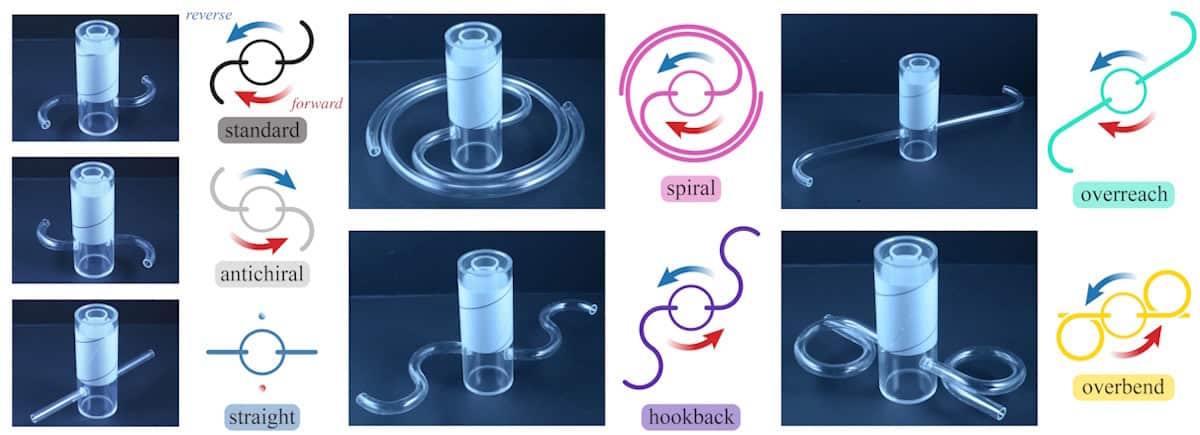
Various sprinkler designs used in the study
Sprinkler geometries The studied sprinkler designs, with the observed rotation direction in the forward (red arrow) and reverse (blue) modes. (Courtesy: NYU’s Applied Mathematics Laboratory)

There was one factor, however, that correlated with torque and rotation rate irrespective of the geometry of the arms. “If you measure the angular momentum flux from any one of these designs it’s quantitatively one-to-one with the torque on the solid [in the forward case],” says Ristroph. “The beautiful thing is the same thing works in the reverse case, except now you should look at the centre where these arms begin, and there are very subtle asymmetries that inject angular momentum to the core of the device…That’s the common unifying principle: in all cases there are jets generated, but in the reverse case those jets are pointing in.” The lower torque at the centre makes the sprinkler much slower in reverse.

Mechanical engineer Earl Dowell of Duke University says that “the study in the paper is largely experimental,” although he acknowledges that “the experiments appear to have been carried out competently and the results presented in a well-organized manner”.

“What the authors call theories are notional ideas based upon highly simplified concepts that tend to be favoured by some physicists,” Dowell adds. “An expert in fluid mechanics…would attack this problem with well-established computational models for the flow field and rigid body dynamics for the sprinkler per se.” He believes that this is not, to his knowledge, being done because neither experiments nor computational simulations are expected to reveal any fundamental new concepts in fluid mechanics.

“I have a hard time thinking this going to generate a practical device,” concedes Ristroph. However, he says that entirely new methods were needed to conduct these experiments and the researchers are now developing new computer simulations of fluid dynamics, in which fluids enter and escape from the system, to apply to it. “This is a beautiful problem to test your experimental methods, your computational methods, modelling, theory…This is a place to give it the best test it can possibly have.”

The research is published in Proceedings of the National Academy of Sciences.

The post Experiments provide new insights into the reverse sprinkler problem appeared first on Physics World.

  •  

New model of ocean waves sheds fresh light on the spread of microplastic pollution

Nature is always more complicated than the models we use to describe it. Ocean waves, for example, are constantly evolving. They grow when wind transfers kinetic energy to the water’s surface. They interact with each other in highly nonlinear ways. And once the wind dies down, their internal viscosity makes them dissipate away to nothing, leaving behind a surface as flat as glass.

This process is familiar to anyone who’s ever been to the seaside, yet physicists’ go-to models of water moving through the ocean essentially ignore it. Instead, the standard theory of wave transport, known as classical Stokes drift theory, concentrates on describing the flow of steady waves with finite amplitude. And while extensions of the theory incorporate complications such as nonlinear wave shapes, uneven seabeds and the inertia of particles carried along by the waves, they don’t account for waves that grow and fade over time.

For Marco Edoardo Rosti, a physicist at Japan’s Okinawa Institute of Science and Technology (OIST), this shortcoming has real-world consequences. “There is increasing interest in understanding near-surface transport processes because they are directly connected to problems such as pollutant dispersion, microplastic accumulation, sediment transport, and air-sea exchange,” he explains. “Since these processes depend sensitively on particle trajectories, even subtle modifications of the drift mechanism may become important over long times.”

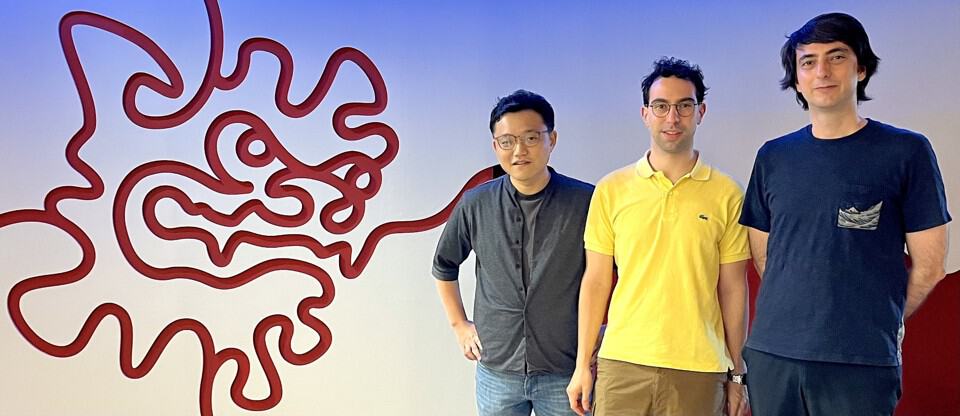
Photo of Tatsuo Izawa, Giulio Foggi Rota and Marco Eduardo Rosti standing in front of the squiggly red line logo of the Okinawa Institute of Science and Technology
Wave mechanics Team members (l-r) Tatsuo Izawa, Giulio Foggi Rota and Marco Edoardo Rosti. (Courtesy: Marco Edoardo Rosti/OIST)

In a study published in the journal EPL, Rosti and his colleagues Alessandro Chiarini, Tatsuo Izawa and Giulio Foggi Rota explored ways of remedying this deficiency. They focused on the simplest type of wave evolution: a freely decaying, single-frequency gravity wave, one where the force of gravity acts to restore equilibrium and smooth out the surface of the water. Physics World spoke with the team about the findings.

What is the most important advance in this work?

Classical Stokes drift theory predicts that on average, particles will get transported through the water horizontally, in the direction of the wave. But by combining fully nonlinear two-phase simulations with a perturbative analytical model, we demonstrate that when you allow those waves to decay, additional transport mechanisms appear.

Specifically, we identified a net vertical particle migration that arises solely from the temporal decay of the wave field, due to the interplay between fluid inertia and viscous dissipation. This migration persists even for fluids with relatively weak viscosity. Also, because the drift velocity depends on depth, even small vertical displacements alter particle trajectories and mixing properties.

Photo of Alessandro Chiarini, seen in profile outdoors near an autumn-leaved forest
International collaboration: Team member Alessandro Chiarini. (Courtesy: Alessandro Chiarini)

More broadly, our results show that unsteadiness in the wave amplitude is not a minor correction to classical Stokes drift. It’s something that can qualitatively change how an individual parcel of fluid moves through space and time – what we call Lagrangian transport. This has important implications for understanding how floating and suspended materials, including sediments, aerosols and microplastics, get redistributed near the ocean surface.

Can you say more about those implications?

Because gravity waves at the ocean surface span a broad range of wavelengths, from centimetres to hundreds of meters, even a modest fractional vertical displacement per wave cycle can significantly change the depth of a drifting particle. And because the drift velocity beneath a wave decays exponentially with depth, these small vertical excursions can substantially alter how much horizontal drift a particle accumulates. That could influence whether microplastics remain near the surface (where they are most bioavailable), or whether they instead migrate to greater depths, where different biological and physical processes govern their fate.

Why have previous studies not seen this vertical drift?

The drift mechanism we identify accumulates gradually as the wave field decays. That means it only becomes apparent when “tracer” particles in the water are exposed to the same wave as its amplitude decreases over many periods. Most wave-tank experiments and field measurements instead follow tracers as they are swept through a passing wave packet, which is a fundamentally different configuration.

In open-sea conditions, similar arguments apply, and the presence of currents, wind forcing and turbulence all complicate the picture. These effects mask a signal that only shows up unambiguously in clean, unforced conditions.

What was the most challenging aspect of this work?

The most challenging part was to bridge the limits of classical wave theories with the fully nonlinear, two-phase simulations of an air-water interface. The classical Landau wave-decay theory, for example, assumes an isolated, weakly viscous fluid (water). However, our high-resolution simulations demonstrate (as previously reported in other studies) a deviation from these idealized assumptions. In fact, the dominant viscous energy dissipation occurs in a thin layer of air just above the water surface, rather than in the bulk.

To investigate how continuous wave energy decay affects Lagrangian particle transport, we developed a perturbative analytical model based on the classical Landau framework. This was a difficult step because the framework is inherently blind to the two-phase dissipative system. As a result, its asymptotic predictions progressively diverged from simulated flow fields at long times, likely due to intrinsic limitations of the Landau decay-wave model.

What do you plan to do next?

The drift mechanism we discuss in this study applies to a very idealized form of wave decay. In the future, we would like to test whether and how this mechanism propagates in more complex but realistic wave conditions. In particular, we want to work out how to measure such mechanisms in wave-tank experiments. To do so, we will study a different setup, one in which waves decay spatially instead of temporally, since this is closer to what observed in wave tanks. We would also like to study how our mechanism affects drift in waves that vary over time, with controlled unsteadiness, rather than simply decaying.

The post New model of ocean waves sheds fresh light on the spread of microplastic pollution appeared first on Physics World.

  •  

Venus flytraps snap shut by rapid cell-wall softening

The trap lobes of the Venus flytrap – a carnivorous plant – snap shut by the rapid softening of their outer walls. This discovery by researchers in France is at odds with previous hypotheses that the mechanism involves water transport through the lobes.

The Venus flytrap is native to temperate and subtropical wetlands in the eastern US. These habitats are very poor in nutrients, so the plants capture insects and spiders to obtain nitrogen. “[Charles Darwin] was completely amazed by the motion, and he thought that if the plant was moving that fast it was because the plant had muscle,“ says biophysicist Yoël Forterre of Aix-Marseille University. “He thought, ‘OK, if the plant has muscle then it must also have nerves’.” Darwin asked his colleagues, who had recently discovered electrophysiological signals in animals like frogs, to measure the plants, and was proved partially correct: ionic signalling in plant cells was first detected in the Venus flytrap. Nonetheless, plants have no muscles or nerves.

 In 2005, Forterre and colleagues in the UK and US discovered that the trap’s rapid closure is amplified by a “snap-buckling instability”. In the trap’s open state, the two lobes adopt buckled, convex shapes that resist closure. These store elastic energy until a potential barrier is overcome. They then release the energy, suddenly becoming concave and snapping the trap shut in around 0.2 s. The underlying driving force has remained mysterious, however, and the instability makes measurement difficult.

“Many biological and chemical tools are kind of invasive and trigger the plant,” explains Forterre; “It’s not easy to probe the state of the plant before, after and most importantly during the motion.”

Poroelastic limit

One hypothesis is that osmosis causes water to diffuse from one side of the lobe to the other, causing bending. This is the most common driver of motion in plants, but its speed limit can be calculated theoretically from the permeability and elasticity of the host material. To work out whether or not the intrinsic speed of the trap exceeded this “poroelastic limit”, the researchers had to remove the amplificatory effect of the snap-buckling instability.

They devised two ways to do this. First, they cut the trap in several places, allowing it to open and close without storing elastic energy. Second, they clamped traps open between two fixed walls, one equipped with a force sensor. In both cases, they found that the closure timescale – inferred in the case of the trap that did not actually close – was around 4 s. Though much longer than in a trap with a snap-buckling instability, this time would have required water to cross the lobes more than an order of magnitude faster than the porolastic limit. This suggested osmosis could not be responsible.

Another popular hypothesis, first advanced in 1981, is that enlargement and softening of the outer walls drives the lobes into the concave shape. The researchers triggered the trap and probed the pressure of the outer surface with a nano-indenter, confirming that it did indeed decrease. However, this did not affirmatively prove that the material had become more flexible, because an osmotic pressure drop would also cause softening.

Forterre and colleagues used dental impression paste to make moulds of the topography of the cell walls before and after the trap was triggered. “If a balloon becomes softer because you have decreased the pressure, that means it has deflated,” explains Forterre; “If you keep the pressure inside the balloon constant but make the material softer, it will inflate.” The researchers confirmed using microscopy that the cells bulged more after the trap was triggered, showing that the driving force was cell-wall softening, not water movement.

The research is described in Science.

Biologist Anja Geitmann of McGill University in Canada describes the new work as “paradigm changing”. “Usually we always talk about changes in turgor pressure that induce movement,” she says; “Here they show that it’s not a change in turgor pressure but a very rapid change in the mechanics of the primary cell wall. That’s completely new: I know of no other system where this happens on this kind of timescale, and they prove it in very smart and clever ways.”

Plant biologist Daniel Cosgrove of Pennsylvania State University in the US, whose group discovered the proteins that allow cell walls to expand and soften, agrees that the research proves conclusively that osmosis is not the cause of the trap’s closure. “What will complete the story is when there’s a paper out explaining the molecular mechanism of how that cell wall gets softened or loosened in a couple of seconds,” he says.

The post Venus flytraps snap shut by rapid cell-wall softening appeared first on Physics World.

  •  
❌