
❌

Reading view

Astronomers Detect Gamma-Ray Burst’s Magnetic Fingerprint
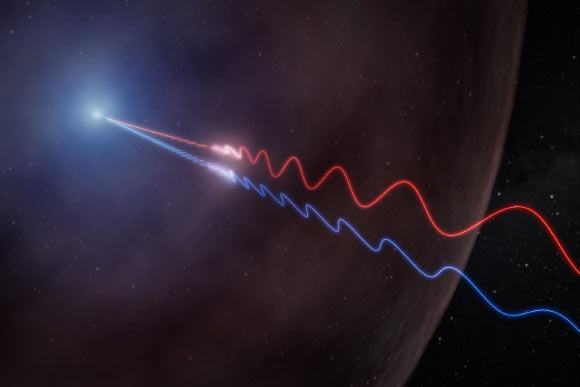
This illustration depicts Faraday rotation in the afterglow of a gamma-ray burst. A powerful jet (upper left) sends polarized radio waves outward through the thin wall of a surrounding bubble of magnetized gas called an HII region. As the light passes through this material, its polarization angle is twisted by the magnetic field. Because the effect is stronger at longer wavelengths, the red and blue waves, which represent different radio wavelengths, exit the bubble oscillating in different directions. By measuring this difference, astronomers were able to map the magnetic environment surrounding GRB 260310A for the first time. Image credit: NSF / AUI / NRAO / M. Weiss

Using NSF’s Very Large Array (VLA), astronomers made the first radio detection of polarized light and Faraday rotation from a gamma-ray burst afterglow, offering an unprecedented glimpse of the magnetic fields surrounding one of the Universe’s most powerful explosions.

The post Astronomers Detect Gamma-Ray Burst’s Magnetic Fingerprint appeared first on Sci.News: Breaking Science News.
  •  

Astronomers Detect Sugar in Interstellar Space for First Time

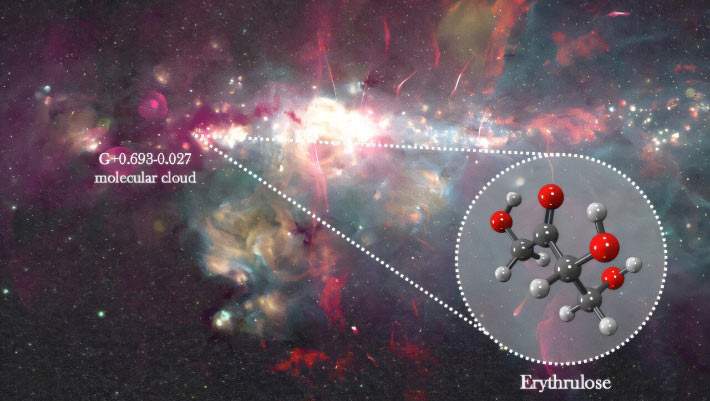
This composite image of the Milky Way’s central region shows the location of the molecular cloud G+0.693-0.027. Image credit: Ashley Barnes / Izaskun JimΓ©nez-Serra / Juan GarcΓ­a de la ConcepciΓ³n.

Using the Yebes 40-m and IRAM 30-m radio telescopes, astronomers have discovered erythrulose, a four-carbon sugar commonly found in raspberries and sunless tanning cosmetics, in the molecular cloud G+0.693-0.027.

The post Astronomers Detect Sugar in Interstellar Space for First Time appeared first on Sci.News: Breaking Science News.
  •  

Astronomers Uncover Hidden Structures Surrounding Orion Nebula

Extended Orion nebula shell sampled by HI emission from the combined VLA and FAST observations (shown in red), HΞ± emission from the European Southern Observatory Digitized Sky Survey (shown in green), and 3.4-ΞΌm emission registered by the Wide-field Infrared Survey Explorer (WISE) satellite (shown in blue). Image credit: Juan D. Soler, University of Vienna / NRAO / VLA / NASA / WISE.

Using the Karl G. Jansky Very Large Array (VLA) s and the Five-hundred-meter Aperture Spherical Radio Telescope (FAST), astronomers have created the sharpest-ever radio maps of neutral hydrogen around the Orion Nebula.

The post Astronomers Uncover Hidden Structures Surrounding Orion Nebula appeared first on Sci.News: Breaking Science News.
  •  

Radar Observations Reveal New Clues about Europa’s Hidden Interior

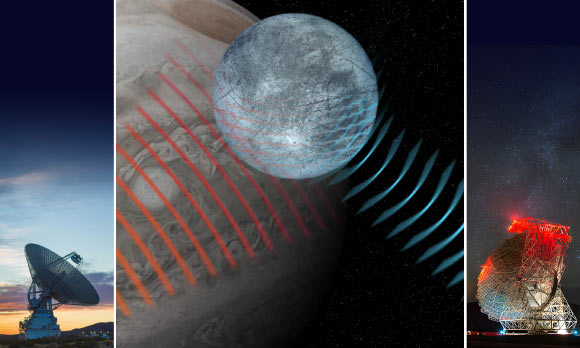
This artist’s impression shows radar waves from NASA’s Goldstone Solar System Radar pinging Europa; the radar waves penetrate Europa’s icy surface before bouncing back to be collected by NSF’s Green Bank Telescope on Earth. Image credit: NSF / AUI / NSF’s NRAO / P.Vosteen.

Using NASA’s Goldstone Solar System Radar and NSF’s Green Bank Telescope, astronomers from the University of California, Los Angeles, confirmed that the icy surface of Jupiter’s moon Europa scatters radio energy in an unusually strong and complex way not seen on rocky worlds.

The post Radar Observations Reveal New Clues about Europa’s Hidden Interior appeared first on Sci.News: Breaking Science News.

  •  

Astronomers Scan Interstellar Object 3I/ATLAS for Alien Radio Signals

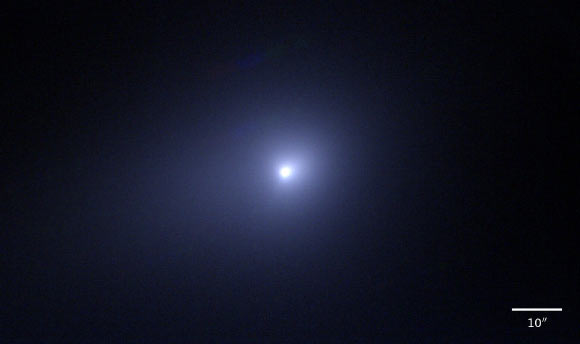
This image from the Subaru Telescope shows the interstellar comet 3I/ATLAS. Image credit: NAOJ.

Using the SETI Institute’s Allen Telescope Array, a 42-element radio interferometer at Hat Creek Radio Observatory in Hat Creek, California, astronomers probed 3I/ATLAS for artificial radio transmissions but found only human-made interference.

The post Astronomers Scan Interstellar Object 3I/ATLAS for Alien Radio Signals appeared first on Sci.News: Breaking Science News.

  •  
❌