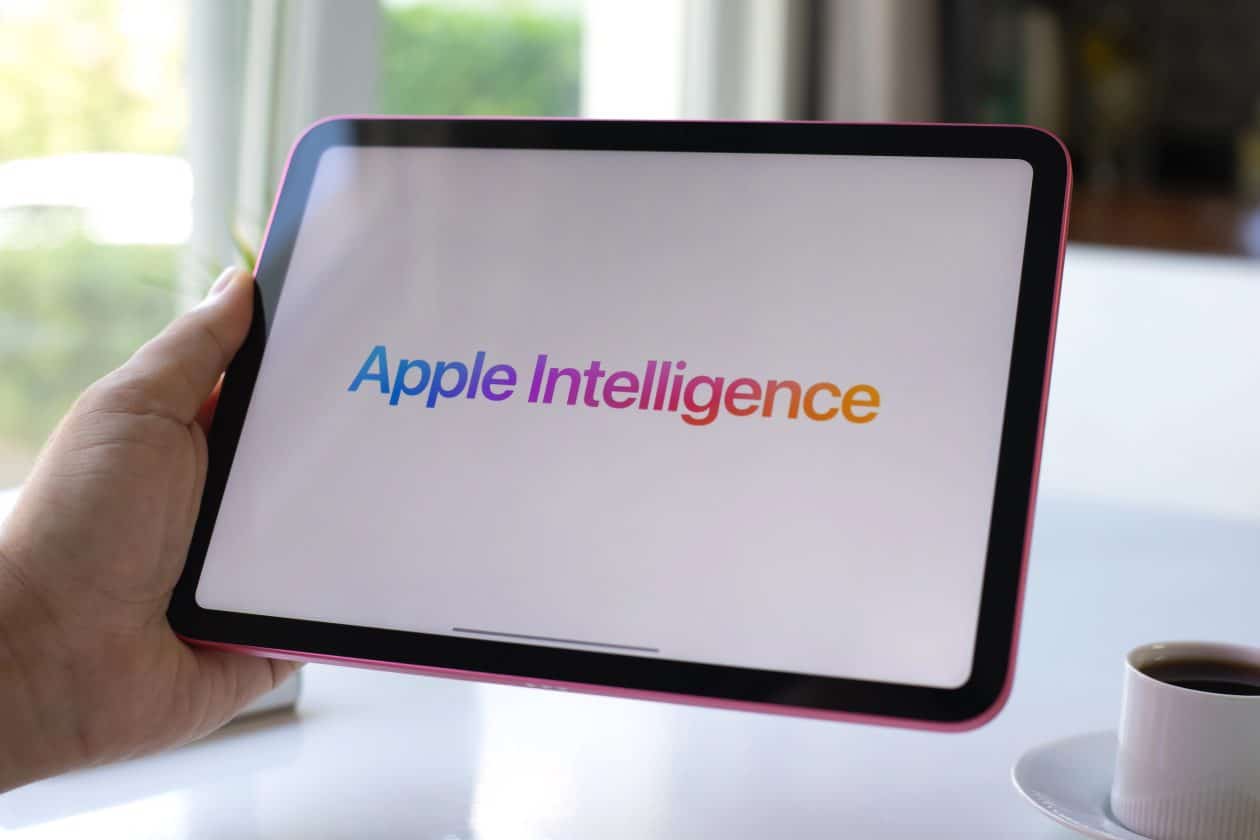
De acordo com uma reportagem da Reuters, a Apple poderá usar uma estratégia híbrida na adoção de recursos de inteligência artificial na China. Em vez de confiar apenas em plataformas de terceiros chinesas, a Maçã pretende também adotar sua tecnologia proprietária no país.
Segundo a agência de notícias, a Maçã estaria treinando seu próprio modelo de IA especificamente para a China — algo que a permitirá ter um maior controle sobre a Apple Intelligence em seu mercado mais competitivo fora dos Estados Unidos (mas sem abrir mão das parcerias).
Esse modelo teria sido desenvolvido em parceria com o Alibaba (e treinado com o apoio da empresa). Caso seja aprovado, ele será o primeiro modelo proprietário de uma empresa estrangeira a ser aprovado no país e permitirá à Apple lidar com as muitas barreiras regulatórias chinesas.
Isso indica que a Apple não pretende substituir por completo as tecnologias de terceiros em seu conjunto de IA no país, mas que poderá usá-las em conjunto com seus modelos proprietários e escolher o mais apropriado para tarefas diferentes a serem realizadas nos seus sistemas.
Apple has published a (temporary, it turns out) guide showing eligible Mac users in mainland China how to connect Alibaba’s Qwen artificial intelligence service to Siri and the company’s Writing Tools feature.
The update, detailed in a Chinese-language support document, allows users who opt in to leverage Qwen — Alibaba’s family of generative AI models — for more detailed responses through Siri, including analysis of photos and documents. Writing Tools can also draw on the service to generate text or images based on user descriptions.
The feature is available on Macs running macOS 26.6 or later, subject to China-specific conditions. Users must activate the extension and sign in to a Qwen account. According to Apple’s guide, Alibaba is prohibited from using any materials processed through the integration to train or improve its models.
The Mac-focused arrangement comes as Apple seeks to strengthen its position in China’s competitive AI PC market. The company has been losing ground to domestic rivals such as Lenovo and Huawei, which have aggressively promoted locally developed AI capabilities. Mac shipments in mainland China fell 9% year-on-year in the first quarter to about 800,000 units, giving Apple a 9% share of the PC market, according to research firm Omdia. Lenovo held 31% and Huawei 16%.
By integrating Qwen, Apple gains a locally compliant way to deliver advanced document analysis, image handling, and content-creation tools while retaining control of the Mac interface. For Alibaba, the partnership expands Qwen’s reach beyond its own apps and cloud services.
Alibaba has previously stated that Qwen will power Apple Intelligence across iPhone, iPad, Mac, and Vision Pro devices in China. Apple’s now unpublished guide, however, currently covered only Macs. Alibaba this week also released Qwen3.8-Max, a 2.4-trillion-parameter model it describes as its most capable to date, though Apple’s documentation did not specify which Qwen version will be used in the Mac extension.
MacDailyNews Take: Apple briefly published a Chinese-language support guide on its website (around August 8, 2026) explaining how eligible Mac users in mainland China could connect Alibaba’s Qwen AI to Siri and Writing Tools. The document was titled something along the lines of “在Mac上配合Apple智能使用千问” (“Use Qwen with Apple Intelligence on Mac”).
It was removed within about a day (by August 9th). Multiple reports have confirmed the takedown. Apple customer service in China stated that the feature integrating Apple Intelligence with Qwen has not yet been officially launched in mainland China, and they had not received notice of such a release.
In a nutshell, with a support guide clearly ready to go, CCP-sanctioned AI is coming soon to Macs in China.
Please help support MacDailyNews — and enjoy subscriber-only articles, comments, chat, and more — by subscribing to our Substack: macdailynews.substack.com. Thank you!
Conforme visto pela agência Reuters, a Apple publicou uma documentação oficial de suporte ensinando usuários do macOS na China a conectar o Qwen, plataforma de inteligência artificial (IA) proprietária da Alibaba, como uma extensão da Apple Intelligence no país.
Embora ensinasse efetivamente a fazer essa integração (o que indica que não era apenas algo preparatório), a documentação foi retirada do ar pouco tempo depois — o que nos leva a entender que ela foi, no mínimo, lançada em cima da hora ou antes do período previsto pela empresa.
O guia atualizado em chinês da Apple diz que os usuários que optam por participar podem usar o Qwen via Siri para obter respostas mais detalhadas a algumas solicitações, incluindo análise de fotos e documentos. As Ferramentas de Escrita também podem se basear no serviço para criar texto ou imagens a partir de uma descrição.
A possibilidade de usar o Qwen estaria disponível para usuários elegíveis com o macOS Tahoe 26.6 ou posterior. Eles devem se sujeitar a condições específicas para o mercado chinês e fazer login na plataforma — que não pode usar os materiais gerados para treinar seus modelos.
Segundo a Alibaba, que poderá usar a integração com os softwares da Apple para aumentar o alcance do Qwen, a plataforma será incorporada à Apple Intelligence também em iPhones, iPads e Vision Pros — embora ainda não se saiba qual modelo alimentará essa integração.
With its new architecture and capabilities, the next generation of Apple Intelligence powers helpful features across the system, simplifying the things users do every day.
China’s cyberspace regulator has officially registered Apple’s on-device generative AI service, Apple Intelligence, for use in the country. This marks a significant step toward the long-awaited launch of the feature for Chinese consumers.
According to Reuters, “China’s cyberspace regulator said on Wednesday that Apple’s on-device generative AI service, Apple Intelligence, has been registered for use on iPhones in China, paving the way for the long-anticipated rollout of the service in the country.”
China mandates that companies register large language models and generative AI services with regulators before making them available to the public. This approval positions Apple to finally introduce its AI capabilities in one of its most important markets.
The service will integrate local AI expertise. Reuters reports, “Apple Intelligence will incorporate capabilities from AI models developed by Baidu and Alibaba, a source familiar with the matter said, speaking on condition of anonymity.”
Alibaba confirmed its involvement in a statement to Reuters: “Its Qwen model will be integrated into Apple Intelligence across Apple’s iPhone (iOS), iPad (iPadOS), Mac (macOS) and Vision Pro (visionOS) operating systems in China.”
A Baidu spokesperson also noted, “Apple is also working with Baidu to develop Apple Intelligence features for Chinese iPhone users.”
The regulator’s statement provided no specific launch date for Apple Intelligence in China.
This development comes at a crucial time for Apple in China, where the company reported a 24.4% year-on-year increase in shipments in the second quarter. The rollout of Apple Intelligence could further strengthen its competitive position in a market where consumers have eagerly awaited these AI features.
MacDailyNews Take: Clearly good news for Apple and should be for Apple’s – and Alibaba’s – stock prices, too.
Please help support MacDailyNews — and enjoy subscriber-only articles, comments, chat, and more — by subscribing to our Substack: macdailynews.substack.com. Thank you!
Apple’s all-new Siri AI. An even more capable AI assistant with expanded intelligence to be more helpful every day.
Apple is exploring new ways to keep AI processing on users’ devices, prioritizing speed, privacy, and reduced reliance on the cloud. The company is in early discussions with PrismML, a startup developing technology that dramatically compresses large AI models to fit and run efficiently on iPhones.
According to PrismML CEO Babak Hassibi, who spoke to CNBC, Apple and other companies have been evaluating the startup’s models, measuring their speed, energy efficiency, and performance on devices. “They’re really evaluating our technology right now,” Hassibi said of Apple. He described the discussions as very early but noted that “things are progressing nicely.”
Shrinking Massive Models for Everyday Devices
PrismML, a Khosla Ventures-backed spinout from the California Institute of Technology, recently released compressed versions of Alibaba’s open-source Qwen model. The company reduced the model from roughly 54 GB to less than 4 GB, enabling all 27 billion parameters to run on an iPhone 15 or newer.
The compression technique simplifies how internal information is stored—reducing values from 16 bits to just one or three possible values. PrismML claims the compressed models use 10 to 15 times less memory, generate responses six to eight times faster, and consume three to six times less energy than conventional versions.
Hassibi acknowledged a small performance trade-off: “PrismML’s models typically lose a few percentage points of overall performance, with factual recall weakening before skills such as reasoning, math and coding.” Despite this, the company is releasing two compressed versions for free, designed to run on iPhones, MacBooks, and Nvidia-powered PCs.
Boosting Siri and On-Device Capabilities
This development aligns closely with Apple’s ongoing efforts to enhance Siri. Just before PrismML’s release, Apple opened the public beta of iOS 27, introducing a major overhaul aimed at making Siri more competitive with offerings from xAI, OpenAI, and Anthropic — while emphasizing on-device processing for personal data.
Running more AI locally would bring several benefits:
• Reduced latency compared to cloud requests
• Lower cloud computing costs
• Support for features that work offline
• Stronger privacy protections, especially for sensitive health, medication, or personal information
Carolina Milanesi, president and principal analyst at Creative Strategies, told CNBC: “The more you can do on device, the better it is,” highlighting applications like computational photography, video generation, and health tools.
Analysts note Apple’s integrated hardware-software approach gives it an edge in optimizing these models. Horace Dediu of Asymco explained that Apple aims to keep most common Siri interactions on-device while routing only the most demanding tasks to the cloud. “They’re trying to figure out how big a model and how clever a model they can fit on the device,” he said.
Potential Industry Impact and Caveats
If PrismML’s technology proves effective at scale, it could influence memory requirements and datacenter demands. However, analysts caution that real-world performance — especially on lengthy prompts, multitasking, battery life, and millions of queries — remains to be fully validated.
Tarun Pathak of Counterpoint Research emphasized: “The ultimate test will be millions of queries, thousands of device combinations and robust testing at scale.” Phil Solis of IDC pointed to power consumption as a key open question for always-on or agent-like features.
Hassibi sees broader applications beyond phones, including robotics and autonomous systems where fast, local intelligence is critical: “It’s very important that the intelligence be local and that it can run fast.”
Pathak summed up the balanced future: “The combination of cloud and on-device AI can serve a more complete, efficient and privacy-centric AI experience. Complex tasks will be offloaded to the cloud, whereas sensitive, latency-critical and privacy-relevant tasks will be executed on-device.”
MacDailyNews Take: Apple’s interest in technologies like PrismML underscores its commitment to privacy as a core differentiator while pushing the boundaries of what smartphones can achieve with AI. As testing continues, this could mark a significant step toward more capable, personal, and private intelligent assistants.
Please help support MacDailyNews — and enjoy subscriber-only articles, comments, chat, and more — by subscribing to our Substack: macdailynews.substack.com. Thank you!

 Login