
❌

Reading view

NASA Welcomes Djibouti as Newest Artemis Accords Signatory  
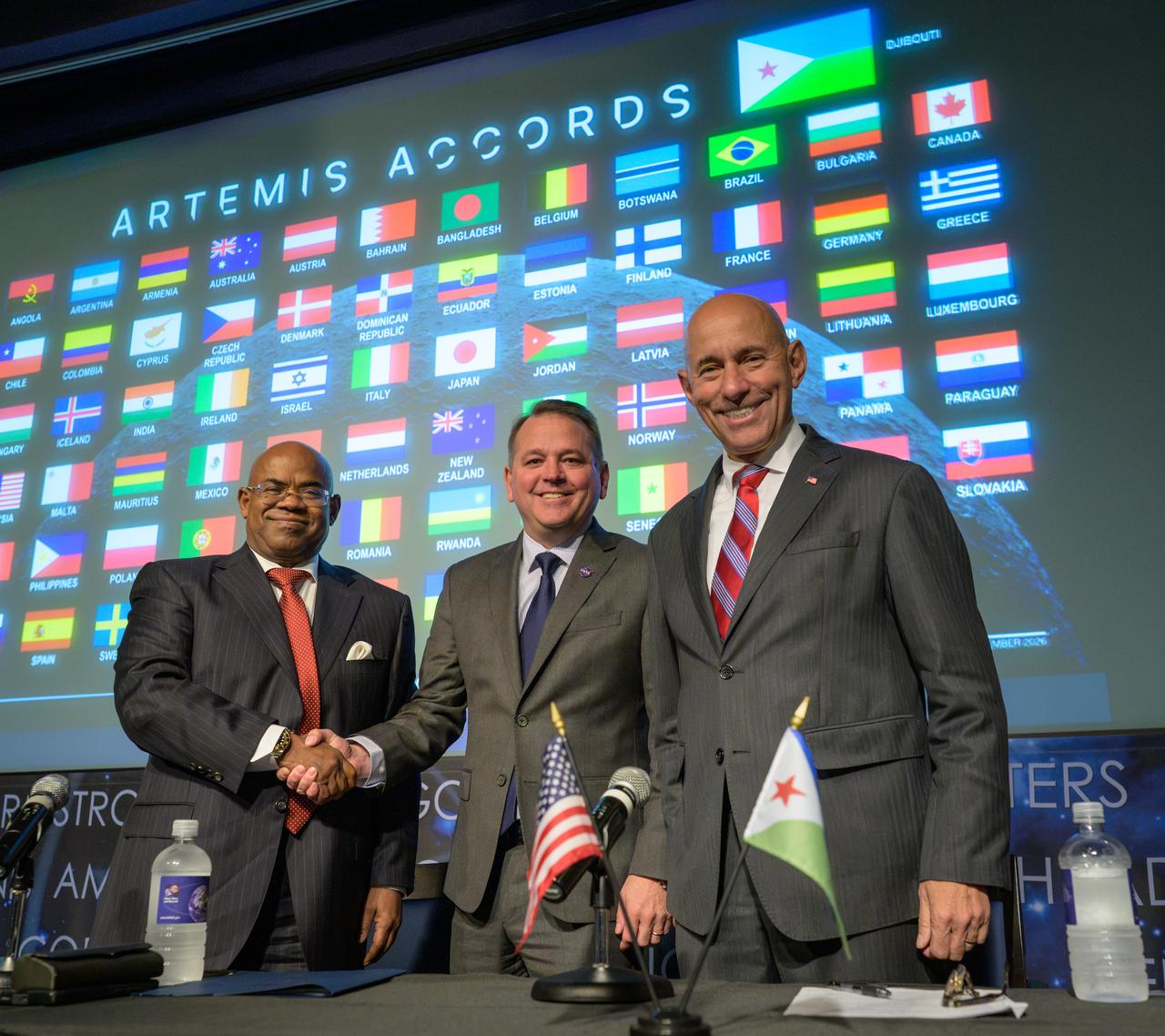
NASA Deputy Administrator Matt Anderson, center, Ambassador of Djibouti to the United States, Mohamed Siad Douale, left, and Assistant Secretary of State for African Affairs, Frank Garcia, right, pose for a group photograph after the Artemis Accord signing, Monday, September 14, 2026, at the Mary W. Jackson NASA Headquarters building in Washington. Djibouti is the 72nd country to sign the Artemis Accords, which establish a practical set of principles to guide space exploration cooperation among nations participating in NASA’s Artemis program.
NASA Deputy Administrator Matt Anderson, center, Ambassador of Djibouti to the United States, Mohamed Siad Douale, left, and Assistant Secretary of State for African Affairs, Frank Garcia, right, pose for a group photograph after the Artemis Accord signing, Monday, September 14, 2026, at the Mary W. Jackson NASA Headquarters building in Washington.
NASA/Bill Ingalls

The Republic of Djibouti became the 72nd nation and eighth African country to sign the Artemis Accords during a ceremony Monday at NASA Headquarters in Washington. The Artemis Accords are the first set of practical principles aimed at enhancing transparency, safety, and coordination among nations as they explore the Moon, Mars, and beyond.

“Djibouti joins this coalition of like-minded nations at an important time,” said NASA Deputy Administrator Matt Anderson, who hosted the ceremony. “President Trump has directed NASA to return Americans to the lunar surface, establish an enduring presence, and lay the foundation for human exploration of Mars. NASA will lead, but we will not do it alone. We are creating opportunities for Artemis Accords nations to contribute hardware, scientific payloads, technology demonstrations, CubeSats, and other capabilities to future missions.” 

Ambassador of Djibouti to the United States Mohamed Siad Douale signed on behalf of Djibouti. U.S. State Department Assistant Secretary for African Affairs Frank Garcia also participated in the event.

Djibouti’s national space program, launched in 2020 and managed by the Centre for Studies and Research of Djibouti within the Ministry of Higher Education and Research, has steadily expanded its technical capabilities. The nation successfully launched its first satellites, Djibouti 1A and Djibouti 1B, in 2023 and 2024, respectively. Both reached orbit aboard American Falcon 9 rockets launched from Vandenberg Space Force Base in California, an early example of how the U.S. is supporting Djibouti capabilities in space.

“By joining the Artemis Accords, Djibouti seeks to deepen its partnership with the United States and with the growing community of nations committed to peaceful space cooperation,” said Douale. “We look forward to building partnerships in scientific research, satellite applications, education, and technical training, while creating new opportunities for Djibouti students, researchers, engineers, and entrepreneurs.”

In 2020, NASA and the State Department joined with seven other founding nations to establish the Artemis Accords, responding to the growing interest in lunar activities by both governments and private companies, and committing nations to:

  • Explore peaceably and transparently
  • Render aid to those in need
  • Enable access to scientific data
  • Ensure activities do not interfere with those of others
  • Preserve historically significant sites and artifacts by developing best practices

By signing the Artemis Accords, nations open the door to opportunities for future lunar exploration with NASA, advancing humanity’s return to the Moon, and shaping the Golden Age of space exploration and innovation.

Learn more about the Artemis Accords at: 

https://www.nasa.gov/artemis-accords

-end-
  •  

NASA Invites Media to Djibouti Artemis Accords Signing Ceremony

NASA insignia.
Credit: NASA

The Republic of Djibouti will sign the Artemis Accords during a ceremony at 11 a.m. EDT, Monday, Sept. 14, at NASA Headquarters in Washington, becoming the 72nd country signatory.

NASA Deputy Administrator Matt Anderson will host Ambassador of Djibouti to the United States Mohamed Siad Douale for the ceremony, together with U.S. State Department Assistant Secretary for African Affairs Frank Garcia.

This event is in person only. Media interested in attending must RSVP no later than 8 a.m. on Sept. 14 to: hq-media@mail.nasa.gov. NASA’s media accreditation policy is online.

In 2020, during the first Trump Administration, the United States, led by NASA and the State Department, joined with seven other founding nations to establish the Artemis Accords, responding to the growing interest in lunar activities by both governments and private companies.

The accords introduced the first set of practical principles aimed at enhancing the safety, transparency, and coordination of civil space exploration on the Moon, Mars, and beyond.

Learn more about the Artemis Accords at:

https://www.nasa.gov/artemis-accords

-end-

Camille Gallo / Elizabeth Shaw
Headquarters, Washington
202-358-1600
camille.m.gallo@nasa.gov / elizabeth.a.shaw@nasa.gov

Share

Details

Last Updated
Sep 10, 2026
Editor
Jessica Taveau

The post NASA Invites Media to Djibouti Artemis Accords Signing Ceremony appeared first on NASA Science.

  •  

NASA Invites Media to Djibouti Artemis Accords Signing Ceremony

NASA insignia.
Credit: NASA

The Republic of Djibouti will sign the Artemis Accords during a ceremony at 11 a.m. EDT, Monday, Sept. 14, at NASA Headquarters in Washington, becoming the 72nd country signatory.

NASA Deputy Administrator Matt Anderson will host Ambassador of Djibouti to the United States Mohamed Siad Douale for the ceremony, together with U.S. State Department Assistant Secretary for African Affairs Frank Garcia.

This event is in person only. Media interested in attending must RSVP no later than 8 a.m. on Sept. 14 to: hq-media@mail.nasa.gov. NASA’s media accreditation policy is online.

In 2020, during the first Trump Administration, the United States, led by NASA and the State Department, joined with seven other founding nations to establish the Artemis Accords, responding to the growing interest in lunar activities by both governments and private companies.

The accords introduced the first set of practical principles aimed at enhancing the safety, transparency, and coordination of civil space exploration on the Moon, Mars, and beyond.

Learn more about the Artemis Accords at:

https://www.nasa.gov/artemis-accords

-end-

Camille Gallo / Elizabeth Shaw
Headquarters, Washington
202-358-1600
camille.m.gallo@nasa.gov / elizabeth.a.shaw@nasa.gov

Share

Details

Last Updated
Sep 10, 2026
Editor
Jessica Taveau
  •  

Kathleen Karika

Kathleen Karika

Associate Administrator for the Office of International and Interagency Relations

Kathleen Karika is NASA’s associate administrator for the agency’s Office of International and Interagency Relations (OIIR). The office is responsible for executive leadership and coordination for all NASA international and interagency activities and partnerships, policy interactions between NASA and other U.S. Executive Branch offices and agencies, and administration of export control. She also serves as the agency’s senior accountable officer for the White House’s Made in America Council.

Karika joined NASA in 2025, after spending 15 years in the U.S. commercial space industry, where she led international business development teams and engaged across the U.S. government, and with allies and partners, on commercial, civil, and national security space missions. She most recently served as director of Research Operations at Virgin Galactic, where she managed business development for suborbital microgravity research missions for the U.S. and international governments, academia, and industry.

Prior to joining Virgin Galactic, Karika oversaw capture activities for international government satellite pursuits at both Maxar (now Vantor and Intuitive Machines) and Lockheed Martin. She also held positions at NASA’s Ames Research Center in California’s Silicon Valley, Avascent (now Oliver Wyman), and the U.S. House of Representatives Science, Space, and Technology Committee.

Karika holds a Bachelor of Science in Applied Mathematical Sciences and a Master of International Affairs from Texas A&M University. She served on the Board of Directors for the American Astronautical Society from 2014-2025, where she served terms as the vice president of International and the vice president of Education and Young Professionals.

The post Kathleen Karika appeared first on NASA Science.

  •  
❌