
❌

Reading view

First switchable graphene nanoribbon that twists on demand

Researchers at Nagoya University have built a graphene nanoribbon that can switch which way it twists using a natural solvent. Graphene nanoribbons are thin ribbon-shaped structures made of fused carbon rings. Twisted or helical versions of these ribbons show promise for advanced light and electronic devices. However, no graphene nanoribbon could switch that twist on demand, until now.
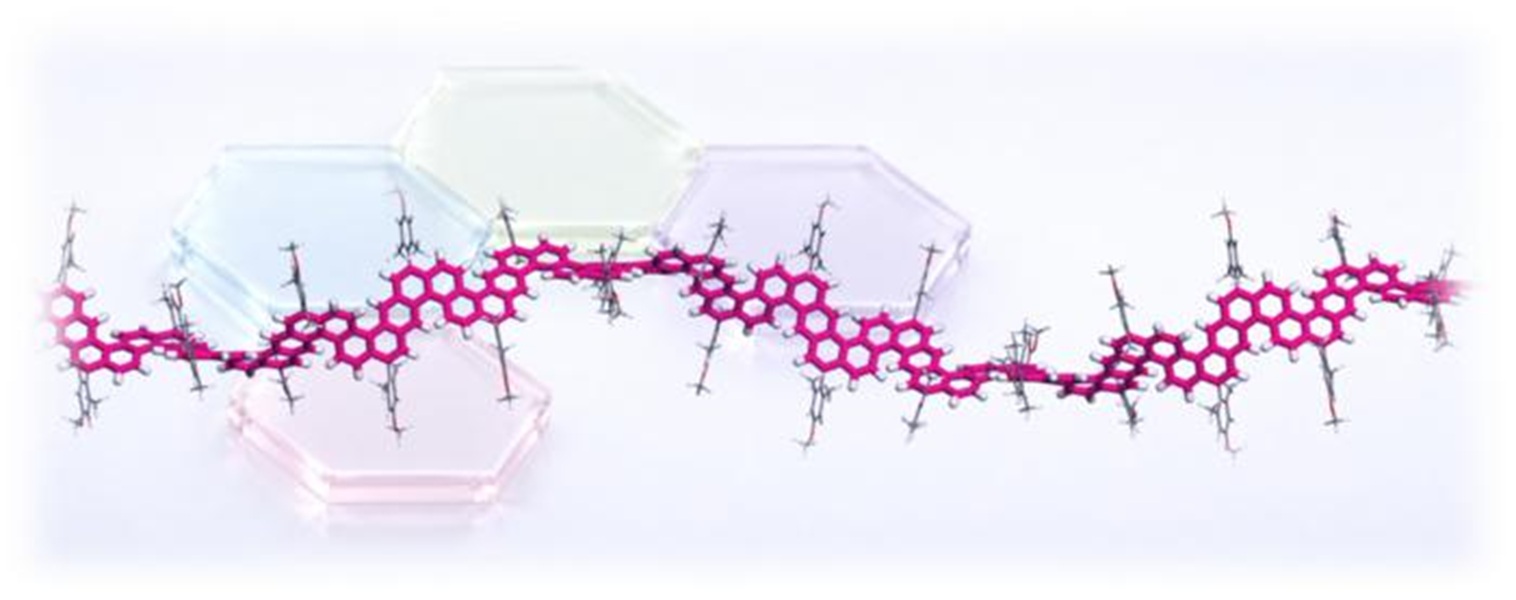
A 3D illustration of the [4]helicene nanoribbon shows the long chain of fused rings that gives the molecule its twisted structure. Source: Tomoyuki Ikai / Nagoya University
Scientists have worked out how to switch between a right-handed and left-handed twist (chirality) by changing the solvent around it. The discovery 1 opens opportunities for new optical switches, chemical sensors, and spintronic components that adapt to changing environments.

Tomoyuki Ikai, lead author and professor at Nagoya University’s Graduate School of Engineering, is a polymer chemist inspired by natural helical structures such as DNA and proteins. Polymers are large molecules built from many small, repeating units linked together in a chain. Ikai had been working on ladder polymers, where each repeating unit is locked into place and cannot freely rotate around the bond connecting to its neighbor (unlike a typical flexible linear polymer).

In 2019, Ikai and his collaborators built the first rigid, helix-shaped polymer. In 2021, they perfected a chemical method to fuse these building blocks together without flaws. This method is what let them build the new graphene nanoribbon.

“We used the same fusion approach already used to make predictable helical ladder polymers. But instead of a stable building block, such as [6]helicene, we used [4]helicene, a 4-ring unit written off as too unstable to be useful,” Ikai said.

Soak, twist, repeat

These units are difficult to control on their own because they switch their chirality too fast to hold one handedness. The team’s method fuses these small, restless units into one long chain. Once joined, they found that a neighbor effect took hold: each unit’s twist began to match its neighbors, and long stretches of the ribbon settled into a single, shared spiral.

To lock it in one overall direction, the researchers dissolved the ribbon in a natural chiral liquid, a liquid made of molecules that come in two mirror-image versions. They tested six candidates before they found the right one: beta-pinene, a compound found in pine trees and citrus peel.

Because beta-pinene molecules can be arranged in left- and right-hand mirror-images, these two versions each push the ribbon toward the opposite spiral. This also changed the twist direction of light the ribbon gave off, a property called circularly polarized luminescence, and is the first graphene nanoribbon shown to switch its light this way.

The switching induced a remarkably high degree of helical bias, with almost all of the helicene units aligning in the same direction. The switching effect is strongest at –90°C and grows weaker as the temperature rises toward room temperature.

“For a long time, people saw [4]helicene as unsuitable for chiral materials, because it could not be controlled,” Ikai said. “In this paper, we show that once you link enough of these units together, the instability itself becomes the useful part.”

A chiral solvent’s nudge toward one handedness is usually very weak on its own. Here, the ribbon’s own structure, with each unit mechanically linked to its neighbors, amplifies that weak nudge into a strong, nearly one-handed result.

An adaptive material

The researchers point to several possible future uses: The switchable light could serve optical devices. The ribbon’s chemical sensitivity to beta-pinene suggests it may work as a chiral sensor, and a similar design could one day help detect hazardous or unstable chemicals. Because graphene conducts electricity well, the ribbon may also suit electronic sensors.

The molecule’s twisted shape connects to spintronics, a field that uses the spin of electrons rather than just their charge. Ikai noted that a right-handed or left-handed structure can, in principle, let electrons of one spin pass through more easily than the other, a property helical structures are known for in physics literature.

The current design only holds its twist while it stays in the chiral liquid. If the solvent is removed, the ribbon drifts back to a mixed, unstable state. Ikai’s next goal is a form of “chiral memory,” a way for the ribbon to lock in its twist even after the solvent is gone. This next step builds on memory techniques the researchers have explored in other helical systems and is now applied to graphene for the first time.

References

  1. Ikai, T., Inagaki, H., Oki, K. et al. (2026) Dynamic helical poly[4]helicene nanoribbon. Nat Commun doi: 10.1038/s41467-026-76724-9 ↩

The post First switchable graphene nanoribbon that twists on demand appeared first on Mapping Ignorance.
  •  

5,000-Year-Old Blue Pigment Reveals Evidence of Ancient Egyptian Nanotechnology—Now It’s Finding New Life in Biomedical Imaging

Thousands of years ago, a striking blue pigment began appearing in the art that adorned the walls of ancient Egyptian tombs, and eventually on the crown of the famous bust of Nefertiti, wife of the 18th dynasty pharaoh Akhenaten and half-sister to one of Ancient Egypt’s most famous kings: Tutankhamun.

However, the ancient artists who first used this remarkable pigment, known today as “Egyptian blue,” had likely never guessed that thousands of years into the future, this unique substance would have applications in modern biomedical research.

That is precisely what one team of researchers discovered several years ago, in a study that revealed how this striking pigment is more than just a modern medical marvel with origins in the ancient world—it also provides evidence of ancient nanotechnology in early Egypt.

The Enigma of Egyptian Blue

“Egyptian blue” is the common term for a pigment first developed in ancient Egypt around 2500 B.C., made from calcium copper silicate. Originally, it was created to provide an artificial alternative to a more costly form of blue pigment from the era, which was produced using lapis lazuli.

However, ancient Egyptian scientists discovered that by heating limestone, sand, and copper, they could produce a far less expensive form of blue pigment, and soon its use spread throughout the ancient Mediterranean world, making its way into the craftsmanship in parts of the ancient world that ranged from Mesopotamia to Greece and Rome.

An Ancient Technology Finds Modern Biomedical Applications

Although Egyptian blue’s obvious practical uses in art were derived from its unique and stunning appearance, time would eventually reveal that it had other uses. Specifically, in a 2020 study published in Nature Communications, a team of researchers reported on their discovery that Egyptian blue in its powdered form can be separated into nanoscale sheets roughly 100,000 times thinner than a human hair.

This is significant because these tiny particles of the substance exhibit significant fluorescence under near-infrared light, which can be used by researchers to track them within biological samples.

Chemist Sebastian Kruss of Georg-August University Göttingen, the lead author of the 2020 study, remarked at the time that he was certain such capabilities “will be of growing interest for material scientists as well as biomedical research” in the years ahead.

Ancient Nanotech’s Survival Through the Centuries

One reason the pigment is so useful is also the likely reason behind its discovery, and that is Egyptian blue’s durability. For many millennia, samples of this unique material have managed to survive, and the material’s nanoscale form remains stable even over such long periods.

In the past, earlier studies had demonstrated that the material fluoresces in near-infrared wavelengths. Additionally, it was known to scientists that the pigment could be broken down into flakes after being stirred in hot water for periods of several days.

Building on this knowledge, the research detailed in the 2020 paper sought to go even further by examining whether those particles could function as fluorescent markers in living systems.

Near-Infrared Applications

One thing that scientists find useful about near-infrared imaging is that it provides an effective way to examine biological material by leveraging wavelengths that fall just beyond the ranges of the visible spectrum.

Although some molecules can already be used as fluorescent markers, Egyptian blue nanoparticles generate significantly brighter signals than several common alternatives. Additionally, unlike other fluorescent compounds, the pigment can resist photobleaching, which is important because this allows its glow to persist even during prolonged observation.

A pair of experiments was used by the team to demonstrate the material’s potential. The first involved using Egyptian blue particles injected within a fruit fly embryo, which were tracked as it developed. In another, the particles were added to plant leaves, allowing comparisons with the performance of a conventional near-infrared imaging molecule.

In this experiment, the team found that the Egyptian blue produced a bright signal that remained visible even against the leaves’ natural fluorescence—the comparison molecule, by contrast, was heavily obscured.

According to Kruss, the tiny Egyptian Blue particles prove to be “very useful glowing labels in biomedical research,” calling the pigment a “very powerful fluorophore.”

An Ancient Discovery Breaking New Ground in the 21st Century

According to Kruss and his colleagues, such particles could eventually help scientists observe processes including embryonic development and cell division, while potentially supporting applications such as image-guided surgery and the labeling of cancerous tissue.

Altogether, this enigmatic form of ancient nanotechnology is still playing a role in helping develop the cutting-edge biomedical technologies of tomorrow, even more than 5,000 years after its initial discovery.

Kruss and his team’s original paper from 2020, “Exfoliated near infrared fluorescent silicate nanosheets for (bio)photonics,” was published in Nature.

Micah Hanks is the Editor-in-Chief and Co-Founder of The Debrief. A longtime reporter on science, defense, and technology with a focus on space and astronomy, he can be reached at micah@thedebrief.org. Follow him on X @MicahHanks, and at micahhanks.com.

  •  

Brewing sustainable power from used coffee grounds

What if your daily coffee routine could help power the world around you? 

Scientists are exploring ways to transform everyday waste, like spent coffee grounds, into materials for greener energy production. One promising method, called triboelectrification, uses electricity generated from motion. With this approach, materials that gain positive and negative charges are rubbed together to generate an electrical charge that can be harnessed by devices called triboelectric nanogenerators, or TENGs. TENGs are a greener alternative to fossil fuels because they generate electricity from everyday movement, such as pedestrian or vehicle motion. 

However, many negatively charged materials used in these devices are made from nonbiodegradable plastics, like PTFE, that persist as long-term waste in the environment. Over time, TENGs are also easily damaged by environmental conditions outside the laboratory. To create sustainable TENGs for real-world applications, scientists need to develop biodegradable and durable designs. 

To address this problem, researchers from Guangxi University in China developed a TENG that uses coffee grounds as its negatively charged material. Their design repurposes coffee waste to create a robust, low-cost device that can harvest energy.

To create the coffee-based material, the researchers mixed coffee grounds with a biodegradable glue-like plastic called polycaprolactone (PCL). They heated this mixture to 80°C (176°F) and molded it into cylindrical pellets. Then, they used a biodegradable plastic called polylactic acid (PLA) to 3D-print a fully enclosed box-like TENG containing vertical channels arranged like the parallel slots of a file organizer to house the pellets. 

Their TENG worked by shaking the coffee ground pellets within the channels, causing them to repeatedly rub against the PLA surfaces. Because coffee grounds strongly attract electrons, the pellets become negatively charged while the PLA surfaces become positively charged. This repeated pellet movement drove the electrons back and forth, generating electricity that was harvested through the TENG’s external circuit. 

To evaluate their TENG’s electrical performance, the researchers used an instrument that measures small amounts of electricity, called an electrometer. The electrometer measures electrical output based on how strongly the device pushes electrons through a circuit, called its voltage, how quickly electrons flow through it, called its current, and how many electrons flow through it, called its transferred charge.

The researchers verified that coffee ground pellets could serve as a viable TENG material by comparing their performance with commercial plastic pellets. The coffee ground pellet system produced a voltage of 0.6 Volts (V), a current of 18 nanoamperes (nA), and a charge transfer of 0.25 nanocoulombs (nC). This output was more than twice that of pure PCL pellets and over half that of nonbiodegradable PTFE. The researchers suggested that the negatively charged components of the coffee grounds altered the surface of the PCL to increase its charge generation and transfer. 

To optimize the TENG, the researchers experimented with different coffee grounds to PCL mass ratios, pellet lengths, and device vibrational frequencies. They found that their device achieved the best electrical performance at a 3:1 ratio of coffee grounds to PCL, with 8 millimeter long pellets, at a vibrational frequency of 2.6 Hertz. These conditions boosted the device’s electrical output to 4.7 V, 75 nA, and 1.3 nC, high enough to power tiny environmental sensors. 

The team also tested their device’s long-term durability by comparing its electrical performance before and after 6 months of storage. They observed only a 6% drop in voltage after storage, demonstrating that it could maintain stable long-term electrical performance for at least 6 months. 

Finally, to explore real-world applications, the researchers integrated 4 TENGs into a wind-energy harvesting system designed for remote island settings. The system used a wheel of rotating cups to capture wind energy and a sliding mechanism to convert it into repeated shaking of the TENGs. As the TENGs shook, the moving pellets inside generated enough electricity to power an LED light and a small weather-monitoring device. 

The researchers concluded that spent coffee grounds can function as biodegradable TENG materials while reducing dependence on fossil fuel-derived materials. By combining coffee waste with biodegradable plastics, the researchers created a TENG with good electrical performance, sustainability, and long-term stability. They suggested that with further development, the device could someday power road warning lights and provide sound-based alerts in remote areas.

The post Brewing sustainable power from used coffee grounds appeared first on Sciworthy.

  •  

Scientists Finally Uncover Why Solid-State Batteries Short-Circuit

New Unique Battery TechnologyResearchers have uncovered a critical mechanism behind battery failure in solid-state batteries, offering new insights that could help unlock safer, longer-lasting energy storage technologies. Every time a smartphone is charged or an electric vehicle is plugged in, billions of lithium ions move through a battery to store energy. Future devices could perform far better with [...]
  •  

Scientists Create Modular Nanorobot Inspired by Mini Lunar Rockets

A groundbreaking advancement in nanotechnology has emerged from the University of Basel, Switzerland, where a research team has engineered a sophisticated modular nanorobot exhibiting unparalleled versatility. This innovative system comprises two distinct, reusable components: a propulsion module and a payload capsule, which autonomously self-assemble through a DNA-based molecular Velcro mechanism. Their dynamic interplay offers promising applications across medicine, industry, and environmental science, heralding a transformative direction in nanorobotics research.

Nanorobotics has often been confined to the realm of science fiction, evoking images of minuscule machines navigating within the human body or cleaning up environmental pollutants. However, the rapid progress in this field reflects a new reality where these tiny constructs—differing fundamentally from conventional robots due to their biochemical and nanoscale nature—have started to fulfill tangible roles. Unlike traditional robots equipped with electronic circuits and software, these nanorobots utilize biomolecules and nanoparticles as their building blocks, innovatively combining bioengineering and materials science.

The design philosophy underlying the Basel team’s nanorobot addresses a critical limitation that has hampered previous efforts: specificity of function. Traditional nanorobots tend to be single-purpose entities, finely tuned for a particular task and lacking adaptability. In contrast, this modular system’s architecture allows for the independent development and exchange of functional units, rendering it highly customizable. Such adaptability is pivotal for extending the utility of nanorobots across diverse scenarios, from executing targeted drug delivery within the human body to catalyzing chemical reactions in industrial environments.

At the core of the nanorobot’s structure lies two integral modules. The first is a magnetic propulsion unit, which empowers the nanorobot with directed mobility under external magnetic fields. This enables precise navigation through complex environments—a critical capability for any targeted therapeutic or catalytic application. The second module serves as a payload capsule, designed to securely house and transport therapeutic agents, enzymes, or other functional molecules to desired locations. This segregation of propulsion and payload functions epitomizes engineering elegance at the nanoscale.

The payload capsule is particularly remarkable due to its internal composition. It encapsulates four enzyme-loaded polymer vesicles—nanoscale spherical structures synthesized from polymers that can safeguard and regulate the biochemical cargo within. These vesicles are equipped with nanoscaled pores, facilitating the ingress of substrate molecules and the egress of reaction products while protecting the encapsulated enzymes from premature degradation or deactivation. Moreover, depending on the specific configuration, these vesicles can be selectively triggered to release bioactive substances on demand, a feature critical for controlled therapeutic interventions.

Achieving a robust yet reversible connection between the propulsion module and payload capsule, the researchers employed a DNA-based “Velcro” assembly system. This approach utilizes complementary strands of DNA grafted on the surfaces of both modules, fostering specific and programmable binding through Watson-Crick base pairing. Such molecular precision guarantees that the modules self-assemble and remain stably coupled during operation, yet can be separated and recombined efficiently. This dynamic assembly-disassembly paradigm allows for easy reloading of the payload and recycling of the propulsion units, a major advantage for scalability and cost-efficiency.

Another notable feature enhancing the nanorobot’s functionality is the strategic modification of the payload capsule with biomolecular ligands that enable targeted docking onto specific cells or substrates. Using the human cancer cell line HeLa as a test model, the scientists demonstrated that these nanorobots, when loaded with fluorescent markers, preferentially accumulate on the cell surfaces. This active targeting capability is instrumental for precise delivery of therapeutic agents, ensuring minimal off-target effects and enhancing treatment efficacy.

In a striking demonstration of biomedical potential, the enzyme-laden nanorobots successfully synthesized an anticancer drug directly at the targeted site, reducing the viability of HeLa cells to a mere 16 percent within 72 hours. This localized drug production exemplifies an advanced therapeutic approach where site-specific synthesis and delivery converge, potentially overcoming challenges related to systemic side effects and suboptimal drug concentrations. According to Dr. Voichita Mihali, the lead author, this concentration of drug activity represents a promising strategy for future oncological applications.

Beyond the biomedical sphere, the modular nanorobot’s catalytic prowess, combined with its magnetic propulsion, opens compelling avenues in environmental and industrial contexts. For instance, nanoscale catalysts capable of performing complex chemical transformations can be transported magnetically to reaction sites, where they perform precise functions before being retrieved for reuse. This magnetically enabled recyclability addresses a critical sustainability challenge, aligning with growing demands for environmentally responsible and economically viable technologies.

The ability to dissociate the two modules after task completion and reload the payload capsules before reassembling them underscores the potential for repeated usability. This reusability is vital for practical implementations where cost limitations and material efficiency are paramount. Moreover, it facilitates adaptability, as different payloads can be swapped in according to the specific functional requirement, whether it be therapeutic commands or industrial chemical catalysis.

Importantly, the modular design philosophy extends the nanorobot’s versatility beyond its current framework. By altering the composition of the payload capsule, this platform could be customized for a plethora of applications without necessitating complete redesign. This adaptability accelerates translational research by leveraging a common technological foundation to address multiple challenges spanning healthcare, environmental remediation, and manufacturing.

The interdisciplinary nature of this project also highlights effective scientific collaboration, combining expertise from the National Center of Competence in Research – Molecular Systems Engineering, the Swiss Nanoscience Institute, and Heidelberg University. Such collaborative efforts are critical to tackling the complex engineering and biological challenges inherent in creating functional nanomachines capable of interacting reliably within diverse and dynamic environments.

While the modular nanorobot represents a significant leap forward, its ultimate deployment in human clinical settings remains a long-term objective, contingent on extensive biocompatibility and safety validation. Nonetheless, its current design and demonstrated functionalities establish a crucial foundation. The system’s adaptability and multifunctionality promise to catalyze new directions in nanomedicine and industrial nanotechnology, potentially revolutionizing how minute robots operate and impact their environments.

In conclusion, the University of Basel’s innovative modular nanorobot not only redefines the capabilities of nanoscale machines but also introduces an engineering paradigm centered on modularity, programmability, and reusability. Its ability to combine magnetic propulsion with a versatile, enzyme-loaded payload paves the way for localized therapies and catalysis with unprecedented precision and efficiency. This research marks a transformative milestone that will likely inspire continued exploration into modular nanorobotics, nurturing advancements that could one day address some of the most pressing challenges in medicine and technology.


Subject of Research: Modular Nanorobots with Enzyme-Based Catalytic Activity and Magnetic Propulsion

Article Title: Multiplex Modular Nanorobotic Systems with Catalytic Activity under Magnetic Navigation

Web References: https://doi.org/10.1002/adfm.202600079

References: Advanced Functional Materials, University of Basel Research Articles

Image Credits: Voichita Mihali, University of Basel

Keywords

Nanorobots, Modular Nanorobotics, Enzyme Catalysis, Magnetic Propulsion, Targeted Drug Delivery, Polymer Vesicles, DNA-Based Assembly, Cancer Therapy, Biocompatible Nanomachines, Reusability, Molecular Velcro, Nanomedicine

  •  

This Strange Crystal Bends Light Like Nothing Else in Nature

Guiding Light MoOCl2This record-breaking crystal can transform from mirror-like to glass-like, opening the door to tiny optical chips, AR displays, and smart contact lenses. Creating truly “invisible” wearable technology such as smart contact lenses and ultrathin augmented reality glasses will require a radical rethink of how optical devices are built. Instead of relying on conventional bulky components, [...]
  •  

Hidden Phase of Matter Finally Captured After Decades of Predictions

Silver Nanoparticle Sphere Quantum Physics State Matter PhaseScientists have finally captured a hidden state of matter, revealing a long-predicted phase with intriguing quantum potential. Researchers from Brown University and the University of Michigan College of Engineering have succeeded in stabilizing a previously elusive state of matter that had existed only in theoretical models. Using carefully engineered nanoparticles as building blocks, the team [...]
  •  
❌