Physicists have revealed that the unusual decay of an “exotic” subatomic particle could offer new clues to its mysterious structure.
The discovery, reported by a team of physicists in a study published in Physical Review Letters, argues that it provides the first “crucial discrimination” between current theoretical models of a variety of subatomic particles known as the Ds(2317) meson.
Exotic Subatomic Mysteries
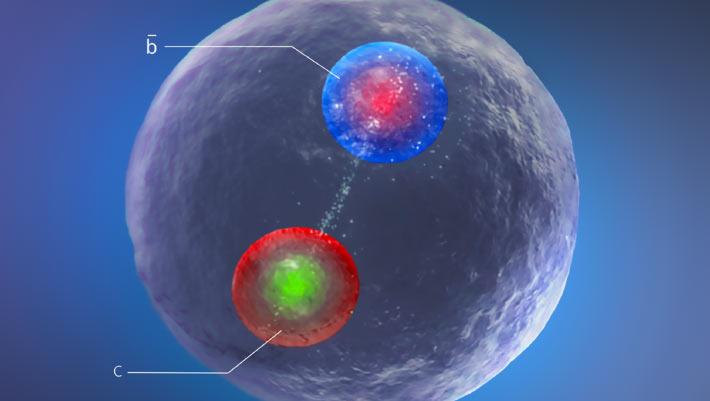
The new research has its beginnings more than two decades ago, with the initial detection of an unusual particle known as the Ds(2317) meson. Part of what makes this particle unique is the fact that it possesses one charm quark (or “c quark,” a kind of elementary particle) and one strange antiquark—the third lightest of all the known quarks.
It was deemed a major discovery at the time, and for good reason: it seemed to point at a significant discrepancy between the particle’s measured mass of 2.317 GeV/c2, and predictions based on estimates that placed it significantly higher, at around 2.4 GeV/c2.
Now, in a new study by researchers with the Belle and Belle II Collaboration, observations of previously undetected behaviors that include never-before-seen light-emissions during the particle’s decay have been described for the first time.
Based on their analysis, the team believes their new findings mark not only a significant first in the study of these particles, but that they may also help researchers solve the longstanding mystery involving apparent discrepancies between the observed and expected mass values for the Ds(2317) meson.
The findings, the team says, could also provide physicists with deeper insights into the fundamental forces that currently bind matter.
Unraveling a Baffling Discrepancy
The team approached the problem by first proposing a range of different models that could potentially describe the internal structure of the Ds(2317) meson. Of key importance was the fact that each of the different models allows researchers to predict a specific range of potential values for the particle’s decay.
This was achieved based on the probability that the Ds(2317 meson will decay by emitting a gamma ray, which was then divided by an entirely separate probability: that the particle would emit a pion—a type of meson with a mass roughly 270 times that of an electron—rather than a gamma ray.
Based on these two possibilities, the team determined that measurements indicating a ratio of greater than 8.1% would point to the likelihood that the meson represents a compact state involving quark-antiquark models.
However, if the calculated value turned out to be lower—specifically in the range of between 0.5% and 4.25%—that would instead favor models that describe the particle as functioning closer to being a sort of molecule-like state of two separate mesons.
Well Above Standard Deviations
With such values in mind, the team then went to work to determine which was more likely with help from data collected by the Japanese KEKB and SuperKEKB electron–positron colliders.
Using this information, the particle’s gamma-emitting decay was successfully detected, revealing a statistical significance above ten standard deviations. Next, the Belle and Belle II Collaboration conducted measurements that showed the decay ratio between photons and pions was close to 7%, placing the determined value smaller than the majority of quark-antiquark models, and at a greater value than those in the molecular models.
“This result provides crucial discrimination between theoretical models of the Ds(2317) structure,” the team writes.
Going forward, the researchers believe additional insights that may help to conclusively reveal the mysterious Ds(2317) meson’s structure may be achievable through more complete measurements of the particle’s decay rate.
The recent paper, “Observation of the Radiative Decay 𝐷*𝑠0(2317)+→𝐷*𝑠+𝛾,” appeared in Physical Review Letters.
Micah Hanks is the Editor-in-Chief and Co-Founder of The Debrief. A longtime reporter on science, defense, and technology with a focus on space and astronomy, he can be reached at micah@thedebrief.org. Follow him on X @MicahHanks, and at micahhanks.com.

 Login