❌

Reading view

In 1976, a college paper blamed the Salem witch trials on moldy bread. It wasn’t true.

In the mid-1970s, Linnda Caporael was a college student facing a seemingly mundane decision. 

A science major at U.C. Santa Barbara, she needed a humanities course to graduate. The course she chose, on women in American history, came with a term paper, and she had to pick a topic.

Caporael’s first choice—Lydia Wardell, a Quaker woman who protested Puritan persecution by walking naked into a meeting house in the 1660s—was intriguing, but already taken. So Caporael instead settled on her second choice: Ann Putnam, one of the accusers in the 1692 Salem witch trials. In doing so, Caporael reshaped the way millions of people view a nearly 300-year-old chapter of American history. 

Caporael’s paper introduced the theory that the visions, convulsions, and distress the “afflicted” girls reported might not have been supernatural after all. Instead, she proposed, they could be explained by ergot, a fungus that grows on rye grain and produces a hallucinogenic toxin. In other words, blame moldy bread. 

The ergot theory, despite being debunked within a year of being published, has continued to spread and thrive like fungus on rye. As recently as 2023, comedian-turned-podcasting-juggernaut Joe Rogan discussed the theory enthusiastically on his show, effectively reanimating a story that seems destined to never fully die.

“It’s sexy,” says historian Margo Burns about the enduring appeal of Caporael’s ergot theory. “It’s about drugs. It’s about witches. It’s about killing people. Also, we like to think that when there’s an unjust sentence or execution, there’s someone or something to blame.”

Burns, a Salem scholar who has spent years tracing how the ergot theory took hold and persisted, says she rarely gets through a talk on the trials without someone in the audience bringing up moldy bread.

Black and white vintage photograph of old colonial house.
It was long thought that Ann Putnam, one of the primary accusers during the Salem witch trials, had grown up in this house, but historians now know this house was built much later, around 1891, near the Putnams’ original home location. Image: Public Domain

How a term paper went viral

The fact that a single undergraduate college paper could have such a lasting and wide-ranging impact on our understanding of the Salem witch trials seems bizarre, but it can be explained in part by a thoroughly modern phenomenon: virality. Although the World Wide Web was still decades away, Caporael’s paper found a way to spread fast through newspaper wire services.

After she started graduate school, Caporael submitted the paper to Science, which, to her surprise, published it in April 1976. That alone might have kept the theory confined within academic circles. Instead, newspaper editors saw a story with mass appeal.

“Editors and newspapers just grabbed it, saying, ‘Oh, here’s a human interest thing,’” Burns says. “And when they put it in their papers, like The Washington Post, The New York Times, The Boston Globe, it got syndicated. And the syndication of those articles went through the whole country and Canada within a matter of weeks.”

Caporael, who had explored the topic through the lens of the scientific method, wasn’t claiming to know what had happened at Salem. At the suggestion of a pre-med friend, she began looking into ergot poisoning as a possible explanation, not a definitive answer. 

According to Burns, who has spoken with Caporael directly, she was only testing whether ergot could be ruled out. Working from the limited sources available to her, Caporael determined that she couldn’t rule it out. Even then, though, she called her own findings “suggestive,” not conclusive.

But that nuance didn’t survive exposure to the public, which in 1976 was already fixated on LSD and what it might do to young people. The press coverage essentially retrofitted 1692 with the anxieties of 1976, recasting the Salem girls as teenagers on a bad trip.

“You give that to the American public, which doesn’t understand there’s a difference between scientific inquiry and historical storytelling, and it’s just so compelling,” Burns says.

Debunked, but far from dead

Not all the viral attention was positive, though. Within that same year, researcher Nicholas Spanos and graduate student Jack Gottlieb published a rebuttal in Science, dismantling Caporael’s argument point by point. By their reckoning, various aspects of the Salem girls’ symptoms did not add up. 

“There are a couple of different kinds of ergot poisoning, and one of them is gangrenous, so people’s fingers would start rotting,” Burns says. “And they would have gastrointestinal problems, and we don’t have any instances in the records that either of those things happened.”

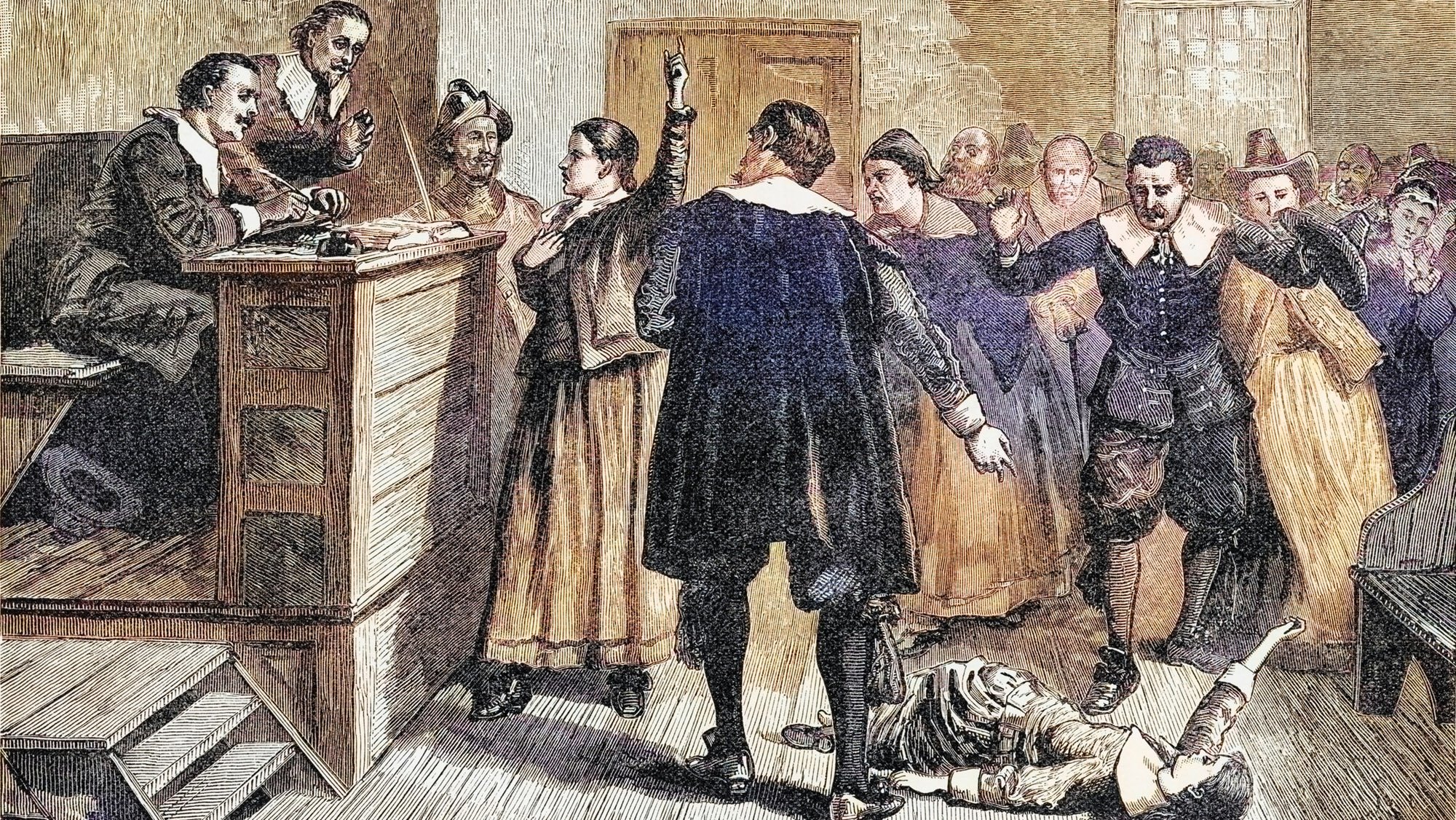
Colored print showing a woman in a red cloak pointing up in a cell with two men standing above her, approaching her with a quill and paper.
This 1880 print shows Martha Corey and her prosecutors in Salem, Massachusetts, during the witch trials. Martha Corey was accused of witchcraft, found guilty, and executed by hanging. Her husband, Giles, who defended Martha against the allegations, was also put to death. Image: Print Collector / Contributor / Getty Images

The problems for the theory didn’t end there. Ergot poisoning was thought to hit hardest among people with vitamin A deficiencies, but Salem’s residents had dairy cows and the sea nearby, and likely plenty of vitamin A. (Ironically, Burns notes, that the vitamin A argument was itself based on a discredited 1930s source that relied on circumstantial evidence and has never been replicated.) And while whole families ate from the same supply of rye, usually only one or two people per household fell ill.

The rebuttal, though methodical and logical, was little more than a momentary speed bump for the runaway popularity of the psychedelic bread story. In fact, it may have helped. 

Arguing with a claim, however insubstantial, implies that it’s worth arguing about, and a formal rebuttal in Science can make a student’s term paper look like one side of a valid scientific debate.

“It’s really hard to refute something,” Burns says. “If anything, it just sort of nails it and makes it more permanent.”

“They were eating their own”

Whatever was causing young women in Salem to convulse, the atrocities that followed are much harder to grasp. By the time the panic ended, 152 people had been formally accused, 19 had been hanged, and one man, Giles Corey, had been pressed to death with stones for refusing to stand trial. Several more died in jail.

“The people who were responsible were the adults in the room,” Burns says.

Related 'That Time When' Stories

To the modern eye, this looks like lunacy. To most people in 1692, though, witchcraft wasn’t superstition. It was an accepted fact, part of an invisible world in which Satan and his agents wreaked havoc on everyday life. Conflict with Indigenous peoples on the Maine frontier had sent traumatized refugees into the region, relating horror stories of attacks on their homes. Many colonists thought Satan engineered those attacks, too.

In a way, the people of Salem did exactly what Americans would do nearly 300 years later, when the psychedelic era latched onto the ergot theory: They explained strange behavior through the lens of what frightened them most.

In such a charged social climate, suspicion could fall on just about anyone, and it did. The accused weren’t just outcasts, Burns says. Many were fully covenanted members of the Puritan church.

“We’re not talking about going after ‘The Other,’” she says. “They were eating their own.”

Someone to blame

Burns knows the cost of Salem’s betrayals about as well as anyone. An associate editor of Records of the Salem Witch-Hunt, the definitive collection of the trials’ legal records, she is also the 10th-generation great-granddaughter of Rebecca Nurse, who was hanged on the charge of witchcraft in 1692.

Photograph of old red colonial house.
The Rebecca Nurse Farmstead still stands and is open to the public in Danvers, Massachusetts. Image: Fletcher / CC BY 4.0

Nurse, a respected member of the church in Salem Town, was tried and found not guilty. But Chief Justice William Stoughton refused to accept the verdict. He sent the jury back to reconsider a remark Nurse had made when confessed witches Deliverance Hobbs and her daughter, Abigail, were brought in to testify against her: She had said the two were “of our company.” Nurse meant that they had been jailed together, but the court heard that they were fellow witches. 

When jurors asked her what she meant, the courtroom was in such an uproar that Nurse didn’t hear the question. At the time, failing to answer an accusation was treated as a confession, and the jury returned a guilty verdict. In a later appeal, Nurse wrote that she was “something hard of hearing, and full of grief,” and didn’t realize she was being asked to explain herself.

It was the kind of injustice no mere fungus could cause.

“[Chief Justice] Stoughton was singularly, individually responsible for her execution,” Burns says.

The question of who is to blame is rarely so straightforward, though. Which might be part of the ergot theory’s appeal; it offers “one silver bullet” that tidily explains everything.

“There are just so many reasons that all came together,” Burns says.

But when pressed on why she thinks it happened, she offers an answer that’s part joke, part harsh reality: “People are mean.”

In That Time When, Popular Science tells the weirdest, most surprising, and little-known stories that shaped science, engineering, and innovation.

The post In 1976, a college paper blamed the Salem witch trials on moldy bread. It wasn’t true. appeared first on Popular Science.

  •  

You might be eating too much protein

Growing up, many of us remember dutifully taking a few more bites of protein (and, of course, vegetables) to appease our moms before we were allowed to progress to the sweet, carb-heavy goodness of dessert. Lately, it seems hard to say whether our moms would be delighted or horrified to see what has happened to protein since.

Just walk into any grocery store right now, and protein is everywhere. Protein water. Protein chips. You can even request protein foam on your favorite fancy latte. Somewhere, a bodybuilder is chugging a protein shake the size of a fire extinguisher as you read this. It’s safe to say this is not your mother’s protein.

To be fair, protein deserves at least some of its mom-and-jock-endorsed reputation. It helps build muscles, keeps you feeling full, and is an essential nutrient we truly can’t live without. Older adults, especially, have been told to eat more of it as they age. 

So, is more protein always better? According to a large review of several recent studies, the answer may be no.

“We think of protein as beneficial,” Dr. Dudley Lamming, a professor at the University of Wisconsin-Madison and lead researcher of the review, told Popular Science, “but a number of studies have started to come out showing that when you look at large populations over the course of decades, people who were eating more protein over the course of these decades were having higher rates of age-related diseases.”

A pattern in the data sparked new questions 

Lamming didn’t set out looking for a problem with protein. If anything, he was surprised by a contradiction he was noticing between population data and the conventional wisdom about protein—people who ate more protein over time were showing higher rates of cancer, diabetes, and cardiovascular disease. 

“The question is, how can this be?” he remembers wondering.

Proteinmaxxing is spiking prices for whey protein. Video: ‘Proteinmaxxing’: How this trend is spiking whey protein demands, @WKYCChannel3

Lamming’s review looked at more than 350 studies in total, most of which were conducted in mice and other lab models, examining things like lifespan, metabolic health, and cellular aging. 

But a smaller slice, about five or six randomized trials, tested protein restriction directly in people. Those human trials showed consistent short-term benefits: People lost weight, their fat mass declined, and in one study of people with type 2 diabetes, insulin sensitivity improved.

Lamming adds that these results do not appear to be associated with mere calorie reduction.

“In fact, because dietary protein is satiating, people in our studies and others actually ate more calories when they were on a protein-restricted diet,” he says. “But they lost weight, and that’s because energy expenditure increases.”

One hormone may explain what’s happening

To understand the potential connection between protein restriction and increased energy expenditure, Lamming’s review explored existing mouse studies on the topic. Findings from these studies indicate that when protein intake drops, the liver releases a hormone called FGF21. That hormone signals the brain, which in turn triggers what researchers call “beiging.”

“This is a process that essentially tells your fat tissue to stop simply storing fat, but actually to start metabolizing it and burning it for energy,” says Lamming. 

In practice, protein restriction doesn’t mean cutting protein out altogether. Most people get about 16 to 17 percent of their calories from protein; in the studies Lamming and his team reviewed, that’s typically cut by around half, down to roughly seven to nine percent.

“We’re not talking about restricting to an unhealthy level where you’re protein insufficient,” he says. “What we’re really talking about, in most cases, is restricting down to the recommended daily allowance as reported by the World Health Organization, which is about 0.8 grams per kilogram [of body weight].” 

So the average man (weighing an average of about 200 pounds) would need about 73 grams of protein a day. The average woman, on the other hand, (weighing about 170 pounds) would need 62 grams of protein a day. For reference, a small three ounce filet of salmon contains about 24 grams of protein.

You don’t necessarily have to restrict protein as a whole to achieve these benefits, either; mouse studies found that cutting back on specific amino acids, including methionine, isoleucine, and valine, may provide some of the same benefits in terms of fat mass, blood sugar control, and longevity. 

Related 'Ask Us Anything' Stories

Exercise may change the equation

This doesn’t necessarily mean everyone should be in a hurry to throw away their protein waffles. Lamming is careful to note that people who exercise routinely may be an exception.

“We actually think that dietary protein has negative metabolic health outcomes for sedentary people, like the general population, since most of the population is fairly sedentary,” he says. “But maybe people who are exercising need more protein to help build muscle, and maybe it wouldn’t have these negative metabolic outcomes.”

Although these findings are based only on mouse studies so far, they may suggest that working out might protect against the downsides of higher protein intake, Lamming says. 

“Fortunately,” he says, “a lot of the people who are very pro-protein are also people who are exercising.”

Lamming says his team plans to test these ideas—specifically, whether protein supplementation genuinely benefits those who exercise, and whether restriction benefits those who don’t—more directly in both mice and people over the next few years.

“For your typical person who’s not engaged in exercise, we would suspect, based on our research, that eating more calories in the form of protein would be detrimental,” he says. 

Lamming’s own suggestion for sedentary people: Consider skipping the protein-added version of a product when a regular option is available.

He was quick to add, however, that those who can safely exercise certainly should.

“No one’s going to argue that more exercise would be bad,” he says.

In Ask Us Anything, Popular Science answers your most outlandish, mind-burning questions, from the everyday things you’ve always wondered to the bizarre things you never thought to ask. Have something you’ve always wanted to know? Ask us.

The post You might be eating too much protein appeared first on Popular Science.
  •  

The British author who harvested mutant, jumbo peanuts from her atomic garden

In 1948, Muriel Howorth was living a relatively ordinary life in the seaside town of Eastbourne on the south coast of England when she received a letter that would completely change the trajectory of her life.

From an early age, she had wanted to take part, or as she put it, “be of use” in international affairs. During World War II, she was employed by the Ministry of Information, the government office primarily responsible for wartime publicity and propaganda in the UK. 

Howorth must have been talented at promotion and publicity, because the letter that arrived in 1948—“out of the blue,” according to her personal papers—inquired if she would like to apply her talents to making atomic energy seem more friendly.

She was well-educated, but not terribly knowledgeable about atomic science, so she borrowed a book by the radiochemist Frederick Soddy, who was born in Eastbourne, titled The Interpretation of Radium. Within a few chapters, she found herself a true believer in the promise of the atom. She would devote the rest of her life to sharing the wonders of atomic science with anyone who would listen. 

Nuclear energy gets a rebrand after WWII

The United States dropped atomic bombs on the Japanese cities of Hiroshima and Nagasaki on August 6 and 9, 1945, a key factor in the end of World War II. The scale of the destruction and the ongoing damage from nuclear fallout after these attacks was vast. Despite the devastation, when a Gallup poll was released in mid-August of 1945, 85 percent of Americans approved of the bombing.

The atom was more or less a mystery to the average American, and was seen both as something to be feared and a source of hope. The potential for nuclear energy seemed endless, and although the Soviet Union was America’s ally, establishing a lead over the Soviets in nuclear technology seemed prudent.

two women in big dresses pose wth the oranges and grapefruit in the shape of a heart.
Around 1900 when this photo was taken, nearly all grapefruits were yellow. The popular Rio red grapefruit wasn’t developed until 1984 using atomic gardening. Image: Contributor / Getty Images / Rykoff Collection

Muriel Howorth’s pro-nuclear children’s book and atomic gardening

In the years after World War II, American and European scientists and heads of state agreed that there should be a focus on more productive and peaceful uses for atomic power. The letter that Howorth received in 1948 was part of this effort. She threw herself into projects that combined science education and entertainment.

Notable among these was an elaborately choreographed pantomime titled Isotopia: An Exposition on Atomic Structure. Howorth also self-published a children’s book featuring Daddy Proton, Mummy Neutron, and their electron children. Her greatest impact as an early science communicator, though, was her work in atomic gardening. 

Irradiated peanuts and other miracles of atomic gardens

Applying radiation to agricultural plants was, in part, a response to wartime scarcity. Restricted rations had made people acutely aware of the possibility of food insecurity. Researchers hoped that exposure to gamma radiation might induce mutations that resulted in higher-yielding or disease-resistant crop varieties. Perhaps some of those crops might be more dense in nutrients, too.

As atomic ambassador, Howorth founded the Atomic Gardening Association and recruited hundreds of members—or, as she called them, “atomic mutation experimenters.” Soon, atomic gardening kits were available to the public. One could send away for packets of seeds from an irradiated plant. By planting these seeds and propagating multiple generations of the plants, home gardeners could test whether any useful-seeming mutations had arisen.

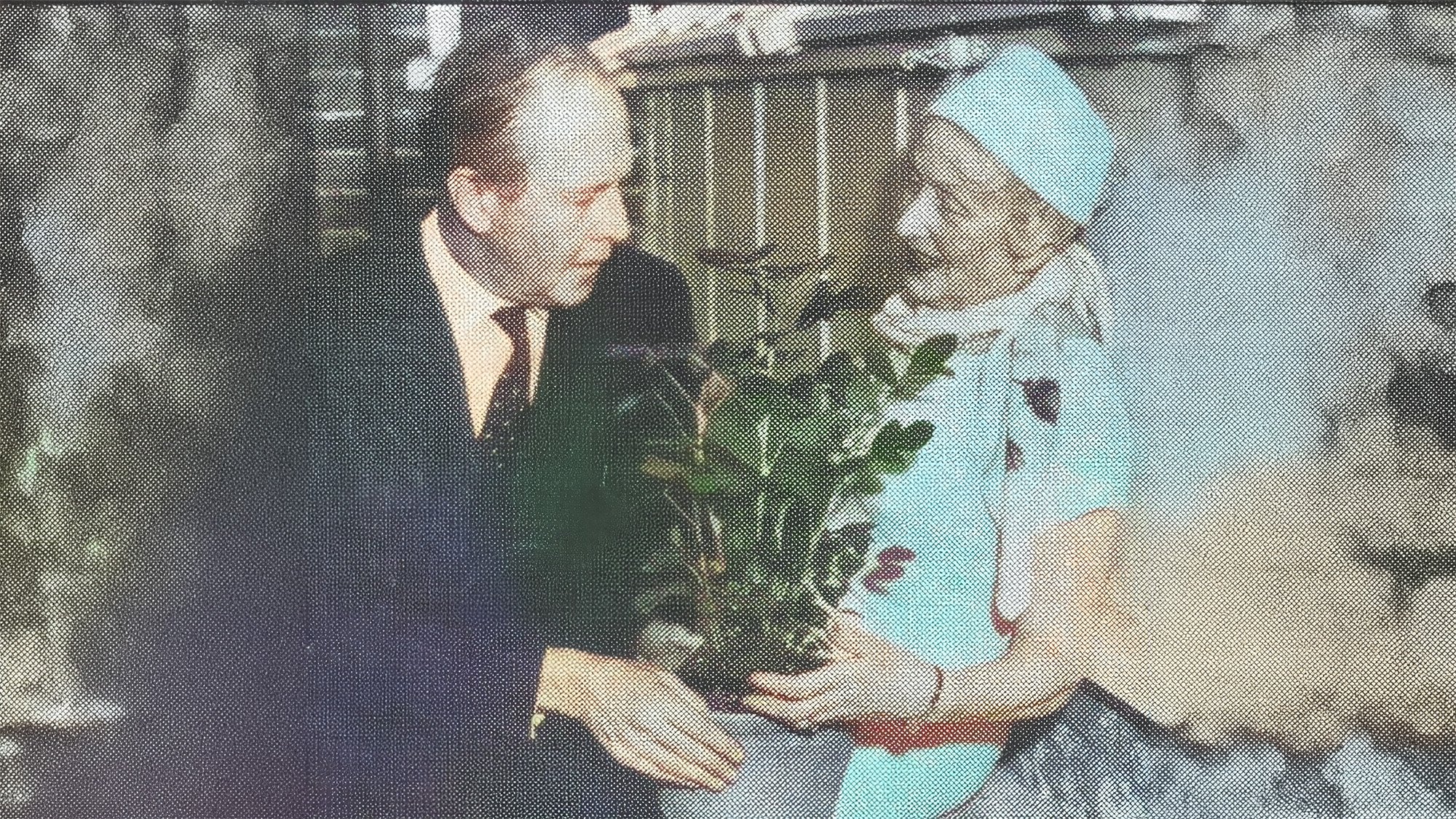
Howorth herself served a mutated variety of Carolina peanuts to some of her scientist friends in 1959. Their response was underwhelming, so she planted the rest of the peanuts in her garden, where they grew remarkably quickly and produced extremely large peanuts. She usually kept a handful of these extra-large peanuts tucked away in her handbag in case the opportunity arose to recruit a new member to the Atomic Gardening Association.

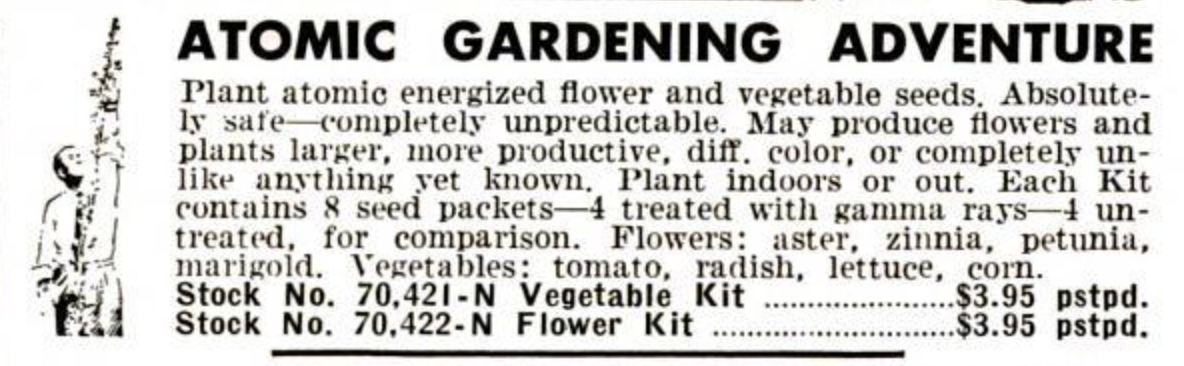
Old 1961 magazine clipping for "atomic gardening adventure"
In the June 1961 issue of Popular Science, a story promotes buying “plant atomic energized flower and vegetable seeds” as an “amazing science buy.” Image: Popular Science, June 1961 issue

Howorth’s lasting legacy to citizen science

It’s tempting to view Howorth as a kooky eccentric. Contemporary newspaper reports of her various events and projects were certainly dismissive in tone. More accurately, she represents an early effort at addressing the gap between scientific research and public understanding.

The world was far less interconnected in her day, with no internet, no omnipresent news media, and no social media platforms. Not only that, but the idea of women as integral parts of scientific research was slow to catch on, despite pioneering work by scientists like Marie Curie and Rosalind Franklin. 

Today, the same gulf exists between what scientists publish in their fields and what the average person understands. The same challenge of translating scientific language for public consumption exists for science communicators, but the tools available to them have evolved beyond recognition. You can find videos and posts by scientists explaining everything from how blimps work to what various chemical reactions look like, or from how fossils form to why black holes are so dark.

If Howorth were around today, her atomic choreography might have gone viral. As it stands, she was a wonderful example of the love of sharing knowledge with the public, and of the excitement and joy that comes with learning new things about how our world works. 

In That Time When, Popular Science tells the weirdest, surprising, and little-known stories that shaped science, engineering, and innovation.

Related 'That Time When' Stories

The post The British author who harvested mutant, jumbo peanuts from her atomic garden appeared first on Popular Science.

  •  

When’s the best time to drink coffee?

A lot of us like to start our days with a cup of coffee. Whether it’s a pour-over you make at home or a latte from your favorite coffee shop, many people need caffeine to wake up and feel alert. 

If you rely on coffee as a productivity hack, you might be wondering if there’s a time of day that would optimize its effects on the brain. It turns out the answer isn’t that straightforward. How the body reacts to caffeine depends on factors such as age, metabolism, and tolerance. So, here’s what the experts say about how to time that cup of joe. 

What effect does coffee have on the body? 

Caffeine is the central stimulant found in coffee and other foods like tea, soda, and chocolate. It helps us feel more awake by blocking adenosine, a naturally occurring chemical that builds up in the brain while we’re awake. Experiencing morning grogginess, or sleep inertia, is related to residual adenosine in the brain, though other factors like your sleep quality also play a role.  As adenosine builds up throughout the day, it makes us feel increasingly tired and helps signal to the brain that it’s time for sleep. 

Since caffeine has a similar chemical structure to adenosine, it fits into the same receptors in the brain. When caffeine binds to these receptors, it blocks adenosine from doing its job. As a result, the brain receives fewer of the signals that make us feel tired, helping us feel more awake, alert, and energized.  

Caffeine is the central stimulant found in coffee. Video: How does caffeine keep us awake? – Hanan Qasim, TED-Ed

“But this perceived energy does come at a cost,” says Dustin Lee, an assistant professor of psychiatry and behavioral science at Johns Hopkins, in an email to Popular Science. The brain adapts to these conditions incredibly well, so over time, the brain produces more adenosine receptors. 

The more receptors your brain has, the more caffeine it needs to feel alert, eventually leading to caffeine tolerance and withdrawal. “Withdrawal symptoms, which I’m sure most of us have some familiarity with, include headache, irritability, fatigue, and difficulty concentrating,” Lee explains. 

If you want to quit caffeine or miss your usual cup of joe, then you’re likely to experience these symptoms very quickly. They usually start within 12 to 24 hours after stopping caffeine, peak within 48 hours and resolve within two to nine days. 

When should you drink coffee? 

“There’s no set answer for everyone,” says Marie-Pierre St-Onge, a professor of nutritional medicine at Columbia University Medical Center, to Popular Science. It depends on your age, metabolism, and caffeine tolerance. 

“Peak caffeine absorption occurs rapidly, at about 30 to 60 minutes after ingestion,” says Lee, so a simple answer to the question would be to drink coffee about an hour before whatever activity that would benefit from caffeine’s stimulating effects. If you’re going on a run, for example, you might want to get some caffeine in before heading out, says St-Onge. That’s why its use is limited by some sports governing organizations like the National Collegiate Athletic Association. 

You shouldn’t really need caffeine right when you wake up, as your body should already be alert, says St-Onge. “If you’re starting to feel a slump a few hours after waking up, that would be when to drink coffee.” 

Related 'Ask Us Anything' Stories

There’s no one-size-fits-all answer

Both Lee and St-Onge stress that the answer to when you should drink coffee really depends on the individual. The ability to metabolize caffeine slows down with age, so the amount of time to clear caffeine from your bloodstream gets longer as you get older. Your circadian rhythm also changes as you get older, which means you might get tired earlier in the day. 

“Compounded, [these changes] make it so that you would want to consume your caffeine earlier as you get older,” explains St-Onge. 

“Caffeine dose matters just as much as the time at which you drink your cup of coffee,” adds Lee. 

A cup of coffee can actually have a wide range of caffeine—the dose can depend on the ratio of coffee to water, how you brewed your cup, and even bean type. And “tolerance has a major effect on caffeine’s effects, so the morning cup of coffee might serve more to partially reverse overnight caffeine withdrawal, so that should be taken into consideration as well,” he says. Basically, that means that for regular coffee drinkers, the first cup of the day is contributing to reversing the effects of not having had any caffeine since the day before. 

When should you not drink coffee?

“Not too close to bedtime,” says St-Onge. If you’re finding that you’re having trouble falling asleep, make sure that you’re not drinking coffee too late in the afternoon. 

Drinking coffee on an empty stomach can also be too abrasive for some people, and may lead to side effects like increased jitters and an increased urge to go to the bathroom. (Though the idea that it can lead to stomach ulcers is a myth.) If you’re someone with a sensitive stomach, try eating something alongside your cup of coffee to be safe. 

Finally, Lee says it’s important to remember that the FDA says that for most healthy adults, 400 milligrams a day—about two to three 12-fluid-ounce cups of coffee—is the amount generally not associated with negative effects. 

So, don’t fret too much the next time you’re thinking of when to have a cup of coffee. Just remember: not too late, and not too much. Then you might become dependent on the stuff.  

In Ask Us Anything, Popular Science answers your most outlandish, mind-burning questions, from the everyday things you’ve always wondered to the bizarre things you never thought to ask. Have something you’ve always wanted to know? Ask us.

The post When’s the best time to drink coffee? appeared first on Popular Science.

  •  

Electric Nose Detects When Your Food Has Spoiled

In a remarkable leap forward in food safety technology, researchers at the University of California, Berkeley, have developed a groundbreaking “electronic nose” capable of pinpointing spoiled food and detecting allergens with unprecedented accuracy. This innovative device combines a miniature array of gas sensors with sophisticated machine learning algorithms to outperform the human nose, which, while remarkably sensitive, often fails to detect early signs of food spoilage and allergen presence. The implications of this technology are vast, promising to revolutionize how consumers, retailers, and food producers monitor food freshness and safety.

The team’s new creation is composed of 16 ultra-sensitive gas sensors, each responding uniquely to specific volatile compounds released by different foods. These sensors act much like digital taste buds, capable of identifying complex chemical signatures through changes in electrical signals. By mapping these responses to known gas fingerprints, the electronic nose can distinguish between fresh and spoiled food items, along with categorizing various allergens including walnuts, peanuts, and other nuts known to trigger severe allergic reactions.

What makes this achievement especially notable is the integration of carbon nanotube technology in the sensors. Unlike traditional metal oxide sensors, carbon nanotubes offer extraordinary surface area relative to their size and maintain sensitivity at room temperature. This is crucial because many sensing materials degrade or require heating to function effectively, limiting their applications. The Berkeley team leveraged the thin, nanometer-scale layers of carbon nanotubes to create a sensor surface that is both highly selective and stable under everyday environmental conditions.

Central to the power of this electronic nose is machine learning. Lead author Carla Bassil developed models trained to interpret the nuanced electrical patterns emanating from the sensor array when exposed to gases released by seven different foods, including strawberry, blueberry, banana, walnuts, hazelnuts, cashews, and peanuts. The algorithm also discerns the freshness of common perishables such as raw chicken, milk, and eggs by detecting subtle changes in their gaseous emissions over time, reflecting degrees of spoilage after 24 and 48 hours at room temperature.

A key challenge in creating an effective gas sensor lies in the complexity of food odors, which consist of many overlapping volatile organic compounds. This electronic nose overcomes this hurdle by relying on the relative selectivity of each sensor and the pattern recognition capabilities of machine learning, enabling the system to sort through these chemical signatures and recognize distinct gas “fingerprints.” The result is a highly sensitive, objective, and scalable detection method that could transform food safety practices.

The development of multiplexed sensor arrays has historically been complex, with issues arising from manufacturing difficulties and material limitations. However, by utilizing a fabrication process known as drop casting, the team managed to deposit different sensing films onto a single chip in a single step. This scalability is pivotal for real-world adoption, allowing potential mass production of these chips at a reasonable cost and size suitable for use in household appliances or portable devices.

In terms of applications, the researchers envision integration within “smart” kitchen appliances such as refrigerators equipped with wireless connectivity and app-based interfaces. Imagine a refrigerator that could alert you via your smartphone, warning that your broccoli is nearing spoilage or that your chicken is at its last safe day for consumption. Such timely notifications could drastically reduce food waste and prevent foodborne illness.

The sensitivity of the device is particularly striking. The electronic nose demonstrated the ability to detect as little as 0.05 grams of walnut, which corresponds to approximately one hundredth of a shelled nut. This level of detection sensitivity is crucial not only for spoilage monitoring but also for allergen detection, where even trace amounts can have life-threatening consequences for sensitive individuals.

Although these findings are promising, challenges remain. For instance, the device’s performance amidst complex food environments—such as detecting walnuts hidden in salad or cakes, or isolating spoilage gases when multiple food items are stored together—is yet to be rigorously tested. Future developments will focus on enhancing sensitivity, reducing false positives, and ensuring reliability in real-world, cluttered atmospheres.

Furthermore, a portable version of the electronic nose, operable via an iPhone application, has been developed, offering exciting possibilities for on-the-go freshness and allergen detection. Such a compact and user-friendly device empowers consumers to make informed decisions at grocery stores, restaurants, and home kitchens, fostering safer, healthier food habits.

The senior author of the study, Ali Javey, emphasizes the importance of combining novel nanomaterials with advanced machine learning to solve complex sensing problems. This convergence of disciplines paves the way for a new era of digital olfaction technologies that are not only sensitive and selective but also accessible and affordable for everyday use.

Published in the journal Science Advances on June 17, 2026, this study marks a significant milestone in the fields of applied sciences and engineering, with a particular emphasis on food science and sensor technology. Supported by funding from the U.S. Department of Energy and the National Science Foundation, the research team comprises experts from UC Berkeley and collaborators from KAIST in South Korea.

As this technology continues to mature, it holds the promise of making kitchens safer and reducing the global burden of foodborne illnesses. By translating the chemical complexity of food odors into digital data streams, the electronic nose could soon become an indispensable tool for consumers worldwide, enhancing food quality and saving lives.


Subject of Research: Not applicable

Article Title: Scalable multiplexed machine learning gas sensor chips for food classification

News Publication Date: 17-Jun-2026

Web References: http://dx.doi.org/10.1126/sciadv.aec7965

References:

Bassil, C., Lee, K., Liao, X., Krishnan, D., Zhan, Y., Wijaya, T. J., Hester, E., Kim, M., Kim, I.-D., Park, I., & Javey, A. (2026). Scalable multiplexed machine learning gas sensor chips for food classification. Science Advances. https://doi.org/10.1126/sciadv.aec7965

Image Credits: Brandon Sánchez-Mejia/UC Berkeley


Keywords

Food science, Sensors, Emission detectors, Electronic nose, Machine learning, Carbon nanotubes, Food safety, Food spoilage detection, Allergen detection, Smart appliances, Gas sensors, Nanotechnology

  •  
❌