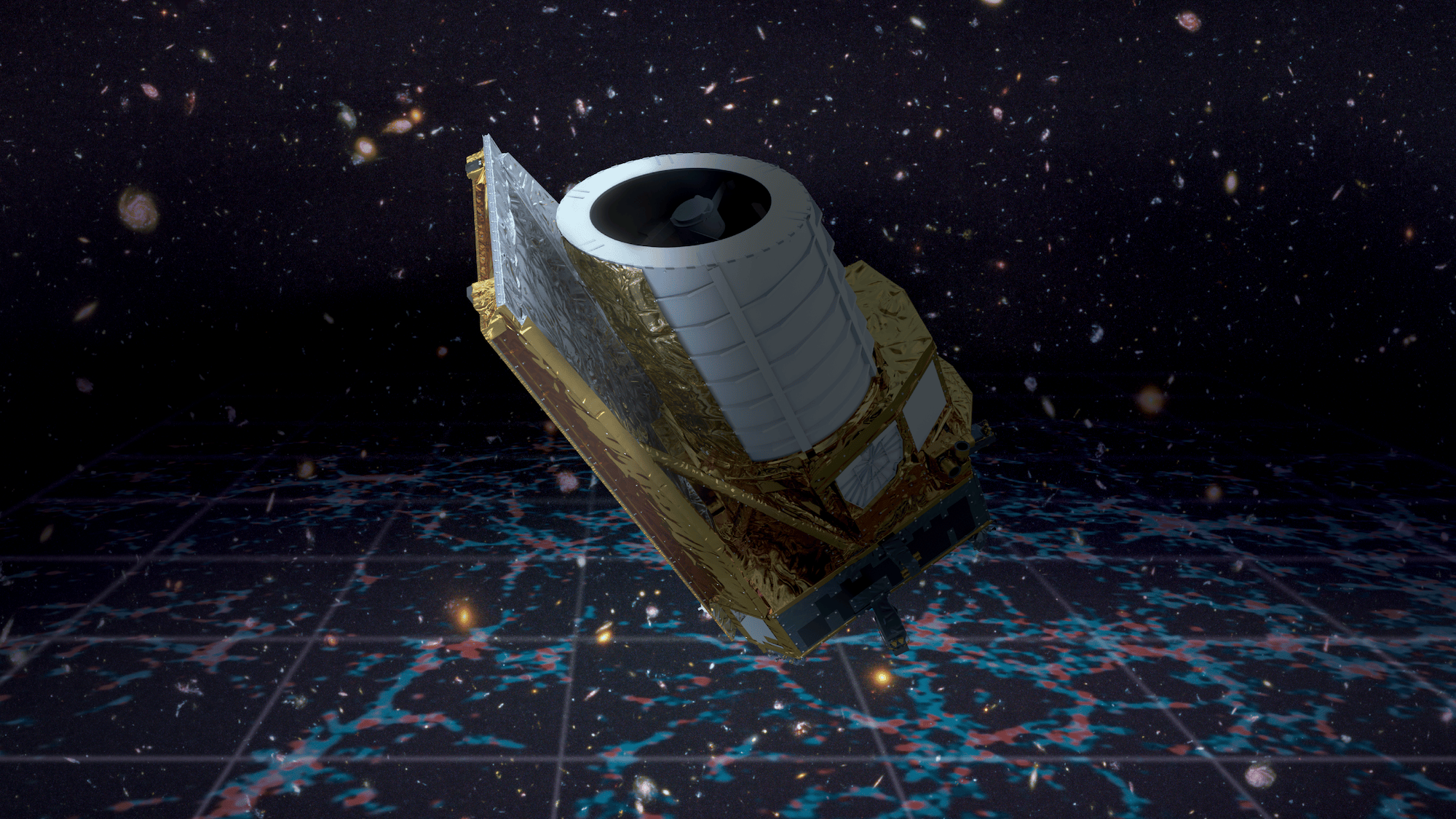
Launched in 2023, the European Space Agency’s (ESA) Euclid space telescope observes some of the most distant regions of the visible universe for signs of dark matter and dark energy. But even while focused on the “big picture,” Euclid’s onboard equipment is surprising astronomers by capturing tiny photobombers like errant comets.
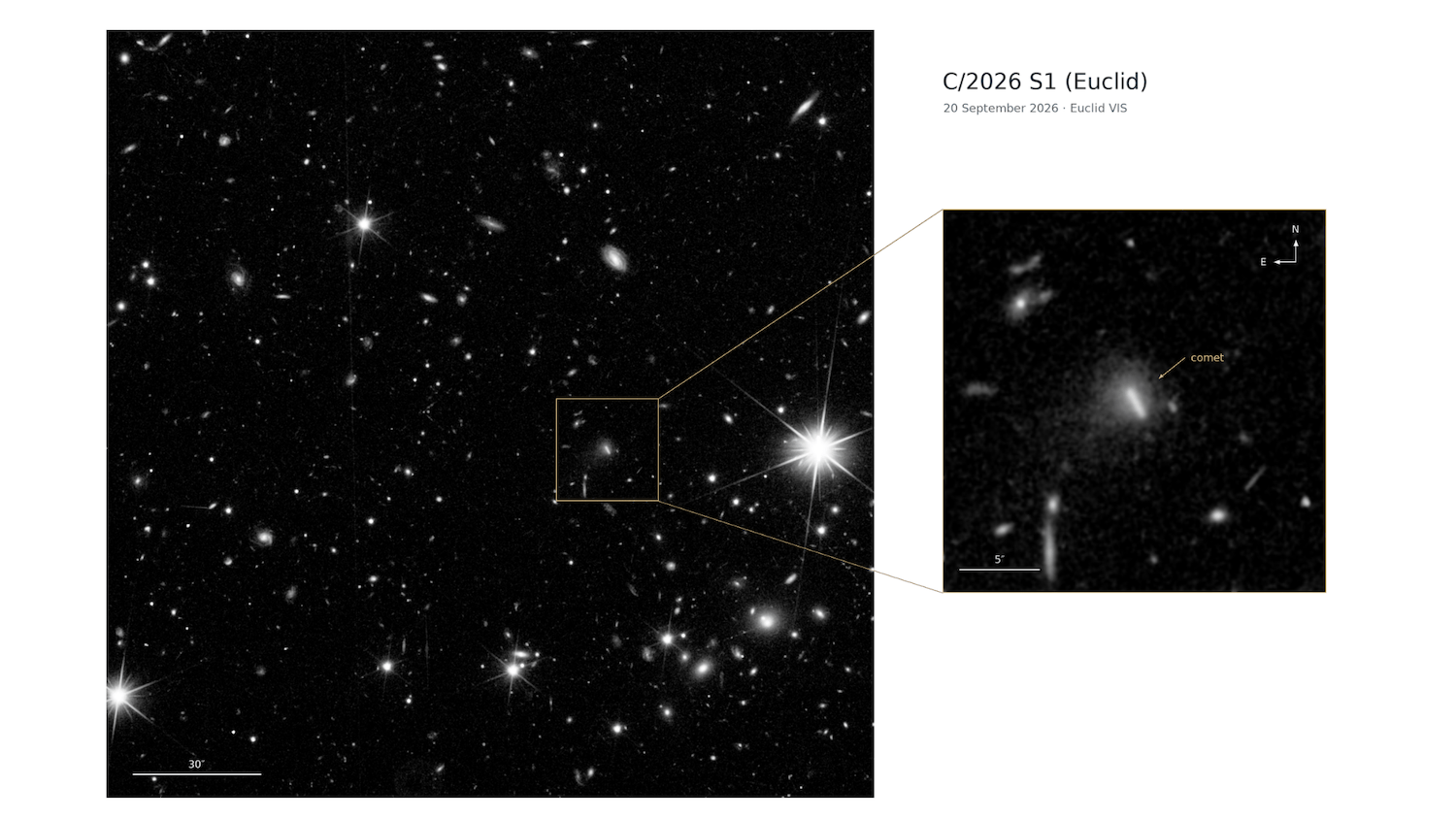
Its recent portraits of one specific dusty space rock are especially impressive, however. Euclid spotted a never-before-seen comet sailing through space more than 807.7 million miles from Earth. The telescope isn’t designed to automatically flag an image interloper. Instead, the bright blemish seen in multiple images was spotted by a moving object detection program designed by Mikko Pöntinen, an astronomer at the University of Helsinki in Finland.
“I was excited to see my software flag a ‘streak’ smeared across several images—the result of a fast-moving object,” said Pöntinen. “Further inspection revealed that it had a fuzzy cloud around it, indicative of an active object like a comet that is shedding dust and gas.”
Pöntinen quickly relayed his findings to the International Astronomical Union’s Minor Planet Center (MPC), which then passed the news along to researchers around the world. On October 8, the MPC confirmed the newly discovered comet, which is now classified C/2026 S1 (Euclid).
C/2026 S1 was seen from five different fields of view over multiple days in the Euclid Deep Field North region of the telescope’s scans. Astronomers now know the comet’s trajectory isn’t located on the same horizontal plane as the planets. Instead, its path is technically taking it over the solar system along a multi-thousand-year orbit.
Euclid’s discovery is particularly striking because the telescope’s six-year mission is specifically mapped to avoid areas of the sky that are laden with comets and asteroids.
“Very few comets are expected to be discovered by Euclid, so it was a happy coincidence,” added Euclid archive scientist Bruno Altieri.
Despite the name, the universe’s white dwarfs can glow in a wide range of colors—even green. For the first time, astronomers have spotted a star that appears green to the human eye, and the reddest ever recorded. These outlier stars help explain how certain white dwarf stars would shine in green, pink, cyan, yellow, and purple if we actually saw them up close in space. These colorful findings are described in a study recently published in the journal RAS Techniques and Instruments.
Looking for the ‘perfect radiator’
White dwarf stars are the dense remnants left behind after stars like our sun reach the end of their lifespan. For most stars, their color gives a hint to their temperature. Cooler stars appear orange, warm stars like our sun look white. The hottest glow pale blue, similar to how a blacksmith’s iron will go from red to orange to white hot. Astronomers believed that white dwarfs followed this same rule. They even earned their name after the earliest examples were surprisingly hot and glowed in a white/pale blue.
“Most stars, including most white dwarfs, behave like ‘perfect radiators,’ so their colour is set almost entirely by temperature. But nobody had really looked into what else might be possible for white dwarfs,” Mark Hollands, a study co-author and astronomer at the University of Warwick in England, said in a statement. “It turns out these incredibly dense stars can produce colours nobody expected, and some of them genuinely surprised me.”
According to the team, the key to these colors is density. The atmospheres surrounding the coolest white dwarfs can reach about the same density as water (roughly 1 gram per cubic centimeter). They are also millions of times denser than the sun’s photosphere, the lowest layer of its atmosphere. Under these higher density conditions, any trace elements present (carbon, calcium, sodium, etc.) interact with the surrounding dense helium plasma. As they interact with the plasma, they can absorb light across a wider spectrum of colors than they would at lower densities. This then shifts the star’s color away from the more typical orange, white, and blue.
Unfortunately, no white dwarf sky is close enough for its color to be seen directly. Instead, the team calculated their color from data astronomers routinely collect—a star’s spectrum. The spectrum is a “fingerprint” that’s produced when starlight splits apart by wavelength, similar to how a prism splits sunlight into a rainbow. Astronomers ran these spectra through a computer model of what colors human vision can see to check what color a star’s light would appear to our eyes.
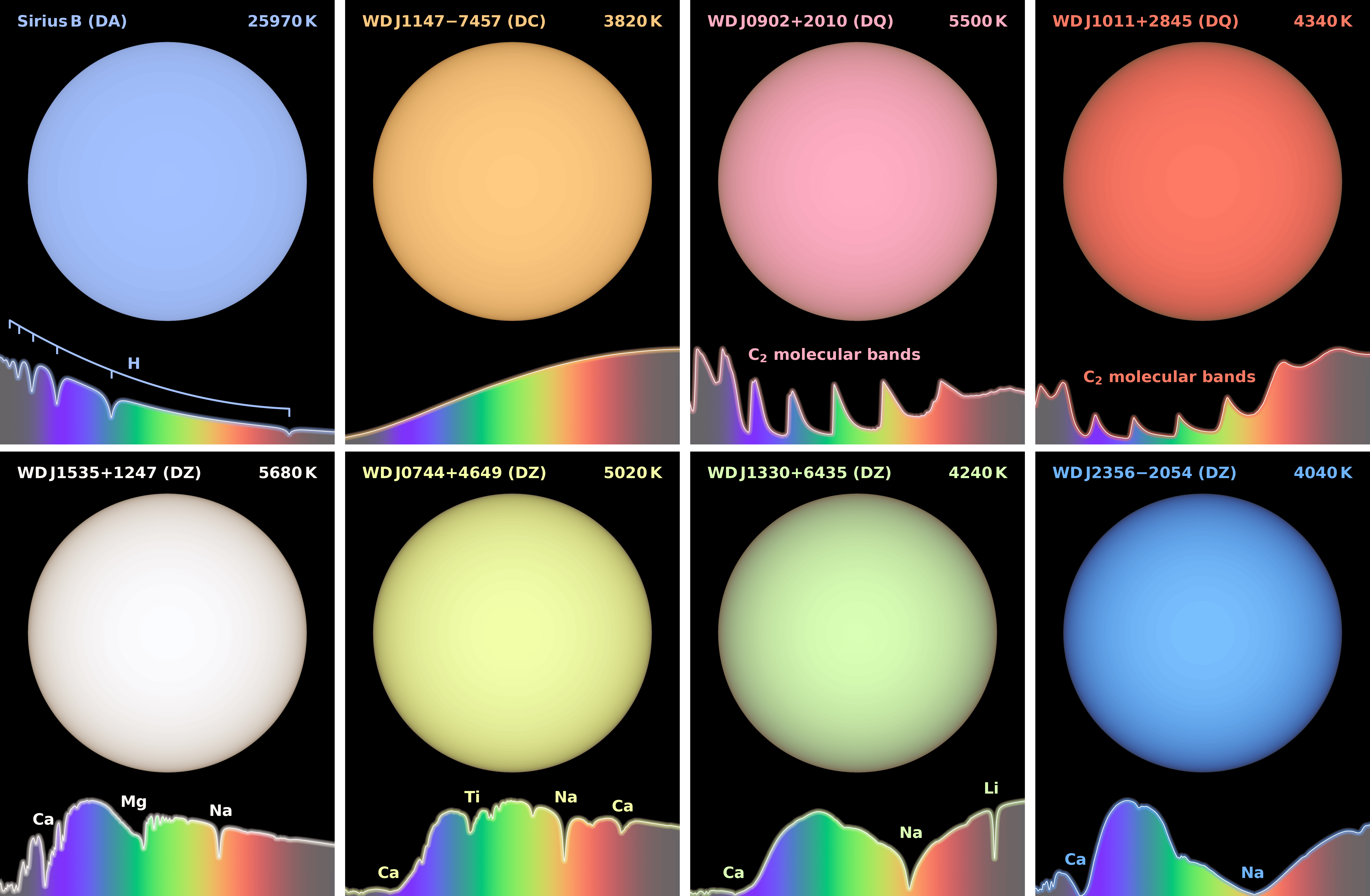
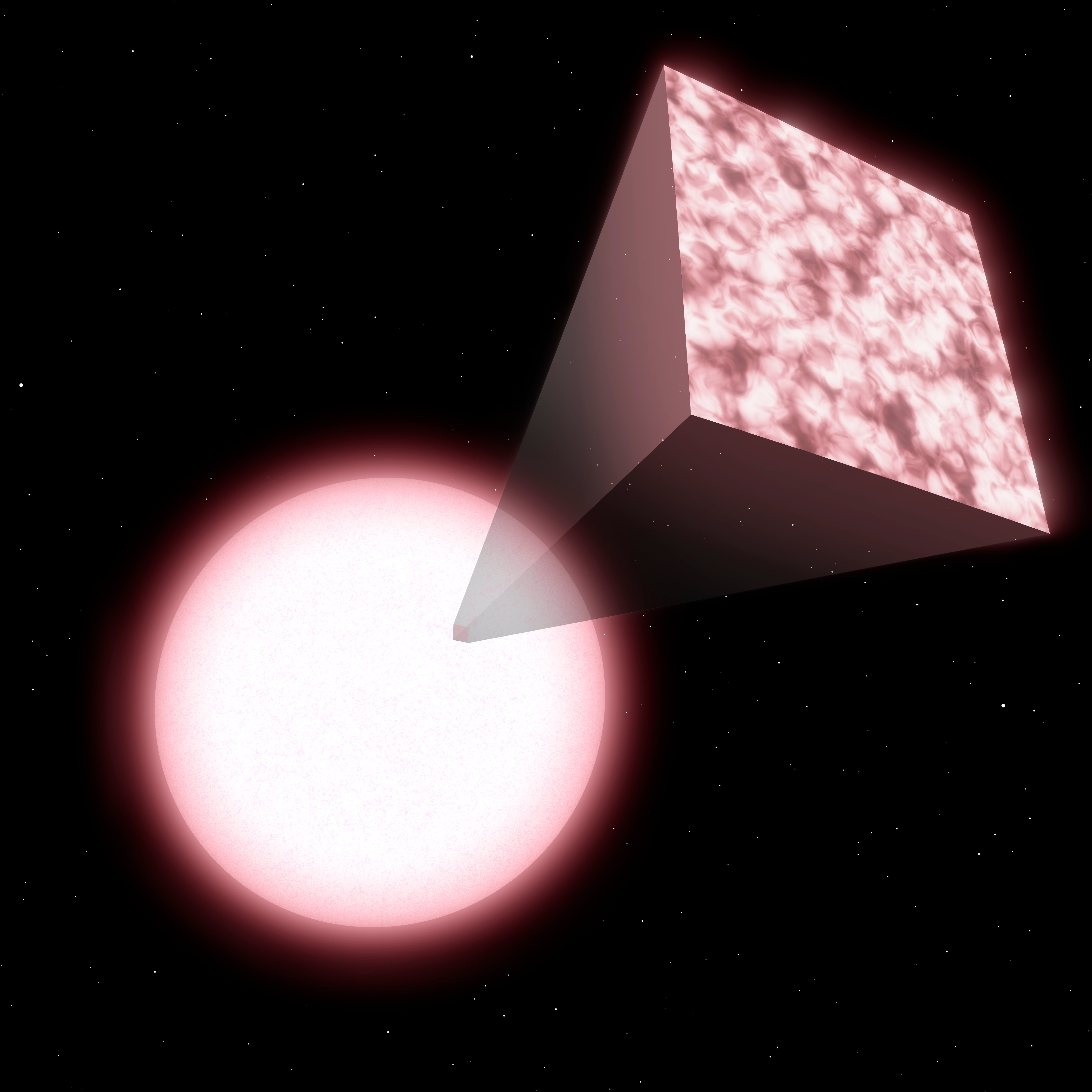
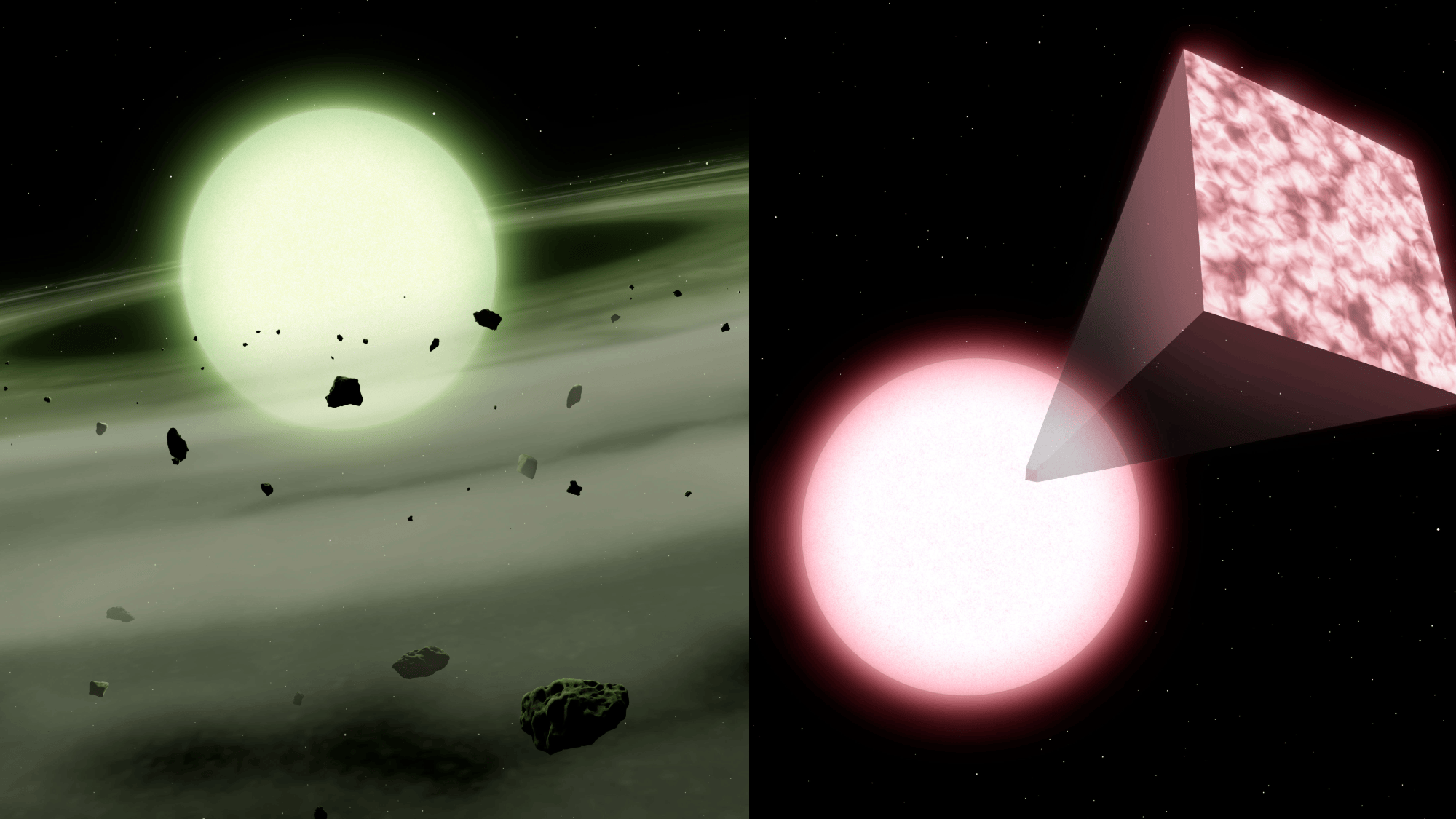
Color-accurate simulated images of white dwarfs. Top Left panels: Sirius B is the nearest white dwarf to the Solar System, with a hot hydrogen atmosphere, resulting in a pale blue colour. WDJ1147-7449 is instead among the coolest nearby white dwarfs, giving it a featureless spectrum and an orange appearance. Top Right panels: Convective envelopes in these cool white dwarfs have dredged up carbon from their cores into their dense helium-dominated atmospheres, forming diatomic carbon molecules that lead to various pink hues. Bottom panels: Accretion of rocky debris from the white dwarf planetary systems enriches their cool helium atmospheres with elements such as calcium, magnesium, and sodium. The varying amounts/compositions of accreted material and white dwarf temperatures allow for a diverse array of colours, including green. In reality all stars would be many millions of times brighter than what can be shown on-screen. Image: Mark Hollands/University of Warwick
The first green and the reddest red
The team applied this method to several white dwarfs across the cosmos. They found that their colors fall into distinct groups linked to what makes up a star’s atmosphere. Carbon-rich white dwarfs generally appear pink or purple. Stars enriched with debris from busted asteroids and comets, the remains of old planetary systems, tend to be more yellow. Cooler white dwarfs with atmospheres of mixed hydrogen and helium show a more cyan or pale blue tinge. This cyan-pale blue is caused by hydrogen molecules colliding with helium atoms inside their ultra-dense atmospheres.
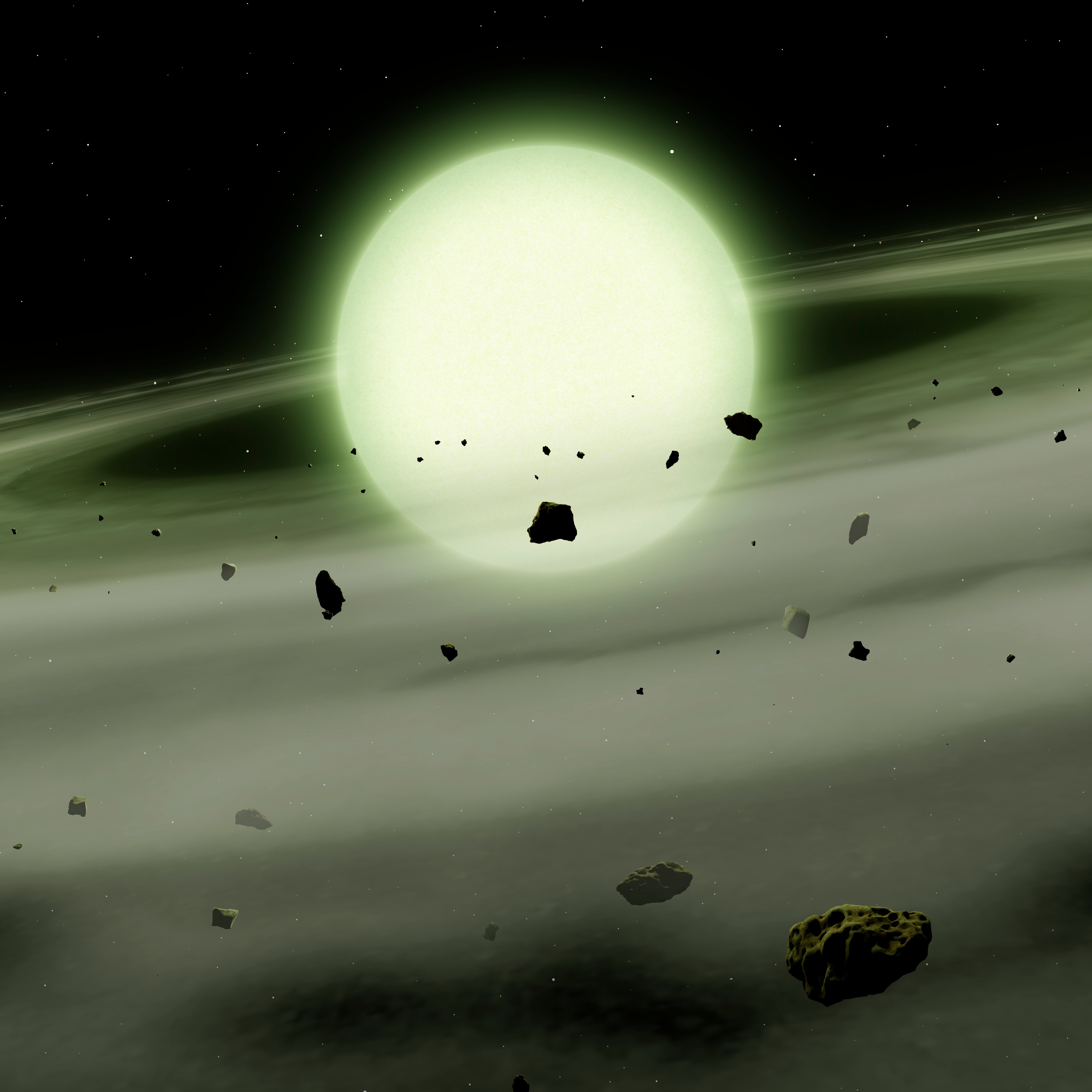
The most striking example is WD J1330+6435. This star is about 7,232 degrees Fahrenheit (4,000 degrees Celsius) and around 284 light-years away from Earth. Over time, it has gathered rocky material from its planetary system. All of this extra material enriched its atmosphere with calcium, lithium, and sodium. The result—a chartreuse green appearance in the team’s models. As far as the researchers are aware, no other star (living or dead) has ever been credibly reported as green.
Enriched from above: The cool white dwarf WDJ1330+6435 has accreted sodium-rich rocky material from its planetary system into its atmosphere. The immense atmospheric density causes the sodium to absorb light over broad range of yellow, orange, and red wavelengths, giving the WDJ1330+6435 a ghostly green appearance. Image: Mark A Garlick/University of Warwick.
“The traces of sodium in the atmosphere of this white dwarf absorb the orange part of the spectrum, leaving behind a ghostly green glow,” added Hollands. “Imagine standing on a planet and looking up at a green star. It feels like something out of science fiction.”
On the opposite end of the spectrum, the team identified what could be the reddest star ever recorded—WD J1011+2845. This white dwarf is only 48 light-years away from Earth, and has a deep convection zone. This zone is full of carbon that’s been lifted up from the star’s core to its surface. The carbon molecules then distort the star’s light so much that almost all of it is squeezed into wavelengths beyond 600 nanometres. This wavelength produces an unusual deep salmon-pink glow.
Enriched from below: The cool white dwarf WDJ0902+2010 has a deep convection zone within its helium dominated outer envelope. The convection zone has reached the white dwarf core, lifting interior carbon to the surface, and forming carbon molecules. These C2 molecules strongly absorb light across the optical range, including blue, green, and yellow wavelengths, resulting in WDJ0902+2010 appearing pink to the human eye. Image: Mark A. Garlick/University of Warwick.
What are the odds?
The team also studied 151 white dwarfs located within about 65 light-years (20 parsecs) from Earth. Only five of these showed unusual colors, two yellow and three pink. This suggests that about 1 in 30 of the universe’s white dwarfs shine with an unusually colored light.
The team then measured the color temperature of the remaining 146 white dwarfs. Color temperature is commonly used to describe light bulbs using degrees Kelvin—warm white at 3,000K, cool white at 6,000 K, etc. The median color temperature of the sample was approximately 6,800K, which our eyes perceive as white. This measurement corrects a common misconception that white dwarfs are typically blue. The hotter and bluer white dwarfs are mostly brighter, so they can be seen from further away and are over-represented in surveys that only look at a star’s brightness.
“One in thirty might not sound like a huge fraction, but across the entire population of white dwarfs in the Universe, that is still a lot of oddly coloured stars out there,” added study co-author and University of Warwick astronomer Boris Gänsicke. “Yet if we take the median across a representative population of white dwarfs, we found that the average white dwarf really is white.”
Griffith Observatory is one of Los Angeles’s most iconic landmarks. Part of the city’s sprawling “urban wilderness,” Griffith Park, the free public science center boasts dozens of exhibits and displays, including one of the first planetariums in the United States and the most-viewed telescope in the world.
But there’s a dark secret behind Griffith Observatory’s founding. It might never have been built if it weren’t for the desperation of its namesake, Griffith J. Griffith, a wealthy real estate magnate who had once been a pillar of his community. In 1906, when Griffith first proposed the observatory as a gift to the city, he was hoping to salvage his reputation after the shocking crime he had committed three years earlier: the attempted murder of his wife.
Who was Griffith J. Griffith?
Born in Wales, Griffith immigrated to the United States as a teenager in 1865, initially settling in Pennsylvania. A few years later he moved to San Francisco, where he worked as a business journalist covering the West Coast mining industry. Griffith then used his expert knowledge of mining to work as a consultant for mining companies, earning himself a fortune.
In 1882, Griffith moved to the rapidly growing city of Los Angeles and purchased 4,000 acres of the Rancho Los Feliz land grant with an eye toward development. He rented out parcels of this land for various businesses, from homes and hotels to an ostrich farm. (Although the farm eventually failed, it proved a popular tourist attraction: Some of California’s first passenger railways were built to bring sightseers to the ostriches.)
Acquaintances described Griffith as “a roly-poly pompous little fellow” and “an egomaniac.” Known for his brash personality and humor, he dressed flamboyantly, favoring a gold-handled cane and a top hat. Griffith also called himself “Colonel,” despite having never served in the military. His grandiosity led to the mocking nickname, “the Prince of Wales.”
Acquaintances described Griffith as “a roly-poly pompous little fellow” and “an egomaniac.” Image: Public Domain
Griffith’s doomed marriage
By the mid-1880s, Griffith was a member of Los Angeles high society. He rubbed shoulders with fellow wealthy developers whose names are still visible on city maps, such as the Bixbys, the Sepúlvedas, and the Mesmers.
While some of these families traced their lineages back to the colonial aristocrats of Mexico or New England, the Mesmers, like Griffith, were recent European immigrants, having come to the United States from Alsace, France. Griffith soon began courting 22-year-old Christina Mesmer, nicknamed Tina, who was considered one of the city’s most eligible young ladies.
Not only did Tina have prominent parents, she had personally inherited a major property from a childless family friend in 1885. Known as “the Briswalter tract” after the previous owner, Andre Briswalter, it was 240 acres in a prime development area just south of downtown L.A. Worth at least 35 million dollars today, the land was used by Briswalter himself for fruit orchards, but now encompasses the neighborhood of Historic South-Central.
Griffith knew that the Briswalter land would be his if he married Tina Mesmer, and made no secret of his motives. Three weeks before they were to be married, Tina informed Griffith that she had transferred partial ownership of the property to her father. It is unknown if Tina performed this transfer willingly, but Griffith wrote to her of his fear that she had become her father’s “pawn.” In the same letter, Griffith threatened to call off the wedding unless he was made sole owner.
Wishing to avoid scandal, the Mesmers relented and the wedding proceeded in 1887. However, the rocky start to the marriage was an ill omen of things to come. In public, the two presented a harmonious image of a high society couple. In private, tensions plagued their marriage, including over religion (the Mesmers were Catholic, while Griffith was Protestant).
In 1887, Christina ‘Tina’ Mesmer, a young Los Angeles socialite, married Griffith. Image: Public Domain
At home, Griffith was paranoid and menacing. Despite publicly supporting the Temperance movement, he was secretly an alcoholic, and his drinking worsened his behavior. Griffith’s paranoia reached a fever pitch after a narrow brush with death in 1891.
While the Griffiths were in a carriage on their way to the grave of Tina’s recently-deceased mother, someone fired a gun at them from another carriage, grazing Griffith’s head. The attacker, who fatally shot himself before he could be apprehended, turned out to be an investor from the failed ostrich farm, who had been ruined and owed Griffith back rent.
How the idea of Griffith Park first emerged
In 1896, despite his private troubles, Griffith was at the height of his power. Ever-ambitious, he sought a way to immortalize himself. He was also flush with cash, having sold off most of the Briswalter tract acquired from Tina, but still owed a tax debt that he hoped the city would forgive. That Christmas, the Griffiths donated more than 3,000 acres of Rancho Los Feliz to the city of Los Angeles for the formation of a public park, to be called, of course, Griffith Park.
While Griffith spoke of wanting to give back to the community and create “a place of rest and relaxation for the masses,” generosity may not have been his only motive. Critics called the huge donation a tax scheme, and pointed out that Griffith could afford to part with the land. Not only did he have Tina’s fortune, he had already rented out the most profitable parts of the Rancho Los Feliz, and what remained was no good for purposes like farming.
Griffith shoots his wife Mrs. Tina Griffith
The more his influence grew, the more unstable Griffith became. According to Tina’s later testimony at Griffith’s trial, he pulled a gun on her for the first time in May 1903, when she threatened to leave him during an argument. “He is very proud and did not want the public to know” of their marital disputes, she said.
A few months later, the Griffiths stayed at the Hotel Arcadia in Santa Monica with their only child, 15 year-old Vandell. Tina hoped that a family vacation would calm Griffith’s nerves, but Griffith was on edge. He repeatedly asked servers in the hotel restaurant to change his food and drink, believing it had been poisoned.
On the last night of the trip, Vandell Griffith went to the beach with the hotel owner’s son, leaving his parents alone in the hotel room. While Tina was packing, Griffith approached her with a gun in his hand. He forced her to kneel and started asking her about the death of Andre Briswalter years earlier.
Apparently, Griffith now suspected that the Mesmers had poisoned Briswalter, and planned to poison him next. Griffith then asked Tina if she had ever been unfaithful. She assured him that she had not, and that Briswalter’s death had been natural, but he fired off a bullet at point-blank range.
Tina Mesmer Griffith survives
Tina leapt from the window and rolled to safety, breaking her shoulder in the fall. Hotel staff soon found her and took her to a doctor. A surgeon who attended her injuries later reported that “if the bullet had struck Mrs. Griffith one-sixteenth of an inch below where it did, it would have gone through the eye socket and into the brain.”
Tina lost her right eye, and due to the risks of infection and blood loss, doctors were not sure whether she would survive. Miraculously, she did.
Police began searching for Griffith immediately, but it was three days before they found him at a nearby bar in the midst of an alcoholic bender. The subsequent trial became a massive media scandal. Tina took the witness stand wearing a veil and black glasses to hide her injuries.
A sketch published in The Los Angeles Times shows how Christina ‘Tina’ Mesmer wore a veil in the courtroom to conceal her injuries. Image: Public Domain
When she entered the courtroom, “she looked at [Griffith] casually as though he were someone she had never seen,” the Los Angeles Times reported, while Griffith remained motionless, listening intently. Tina testified for an hour before fainting from exhaustion, returning later that day for a second round of questioning. Only then did the extent of the Griffiths’ private problems become public knowledge.
The outcome of the trial
Griffith’s attorneys argued that he was not in his right mind; instead, his drinking had made him delusional, a case of “alcoholic insanity.” Griffith was fined and sentenced to just two years in prison.
Tina was granted a divorce on grounds of cruelty, one of the few legal justifications for divorce in 1903. She also received a cash settlement and full custody of Vandell, but she was unable to receive half of the estate, as she had asked for.
The couple’s properties had long been under Griffith’s name only, including what remained of Tina’s inheritance. As one of her lawyers told the Los Angeles Times, the law prevented her from obtaining “any approximation of what really should be hers.” However, Tina was left with enough to live on, and Griffith agreed to pay for Vandell’s future education as long as he didn’t attend a Catholic university.
The aftermath
After the trial, Tina moved in with her sister. Though she stepped away from city development, she devoted herself to Catholic charities and social events. She was apparently a big fan of whist, a four-player card game. She never remarried and continued to be known as “Mrs. Griffith” until her death in 1948 at the age of 86.
When Griffith emerged from San Quentin in December 1906, he appeared to be a changed man. He gave up drinking and devoted himself to the cause of prison reform, as well as improving facilities for visitors in the park that bore his name. He also came up with an idea for a second “Christmas gift” to rehabilitate himself in the eyes of the Los Angeles public: a free science center and an outdoor theater.
However, the city was now reluctant to associate with him. As one newspaper op-ed stated, Los Angeles was “neither so poor nor so lost to [a] sense of public decency that it can afford to accept this money.”
Griffith died of liver disease in 1919 without seeing this dream become reality, but he bequeathed the funds for the Observatory and the nearby Greek Theatre to the city in his will. The project would finally move forward more than ten years after his death.
It was Griffith and Tina’s son, Vandell Griffith, who oversaw the construction of the Observatory as president of the Los Angeles Park Board. (Vandell would later become a city police commissioner, and was described in a 1951 newspaper as “a dead honest man.”)
When the Griffith Observatory opened in 1935, it was an instant success, part of a new wave of interactive museums that made astronomy and other sciences accessible to the public. And it all goes back to a man who destroyed his own reputation. It’s a strange chapter in the history of Los Angeles, and a reminder that the legacies people leave can be complicated.
In That Time When, Popular Science tells the weirdest, most surprising, and little-known stories that shaped science, engineering, and innovation.
A telescope with no moving parts, stationed in the mountains of British Columbia, has produced the largest single accounting of fast radio bursts ever assembled. The Canadian Hydrogen Intensity Mapping Experiment (CHIME) and its FRB collaboration have released a second catalog logging 4,539 fast radio bursts from 3,641 distinct sources, drawn from more than five years of continuous sky-watching between July 25, 2018, and September 15, 2023.
The result, posted to arXiv in January 2026 and published in The Astrophysical Journal Supplement Series, supersedes the collaboration’s first catalog, which covered a single year of observations ending in mid-2019 and recorded 536 bursts. The new release spans roughly five times the observing period and delivers more than eight times as many detected events, cementing CHIME’s role as the dominant instrument for cataloging these millisecond-long flashes of radio energy.
A telescope that cannot look anywhere else
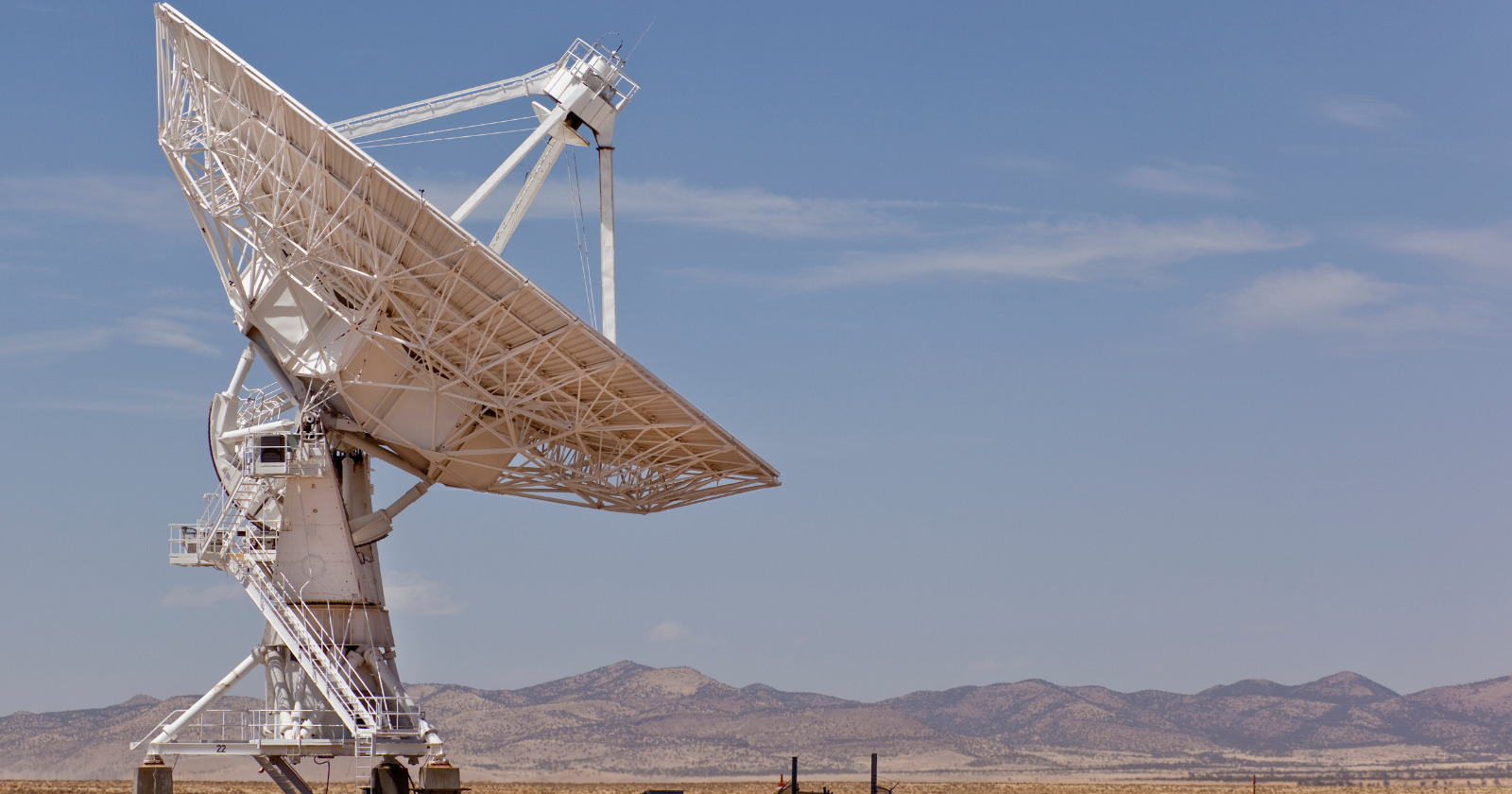
CHIME’s design is unusual for an instrument that has become the world’s leading fast radio burst detector. Located at the Dominion Radio Astrophysical Observatory near Penticton, British Columbia, it consists of four stationary half-pipe reflectors, each 100 meters long and 20 meters wide, laid side by side and oriented north-south. ICHIME has no moving parts at all — unlike dishes that swivel to track a target. Each cylinder’s focal line is strung with 256 dual-polarization antennas, for 1,024 across the array, feeding a digital signal-processing system that forms 1,024 beams electronically rather than through any physical steering.
That fixed geometry means CHIME cannot be aimed at a particular patch of sky the way a conventional radio dish can. Instead, it watches a roughly 200-square-degree strip of sky directly overhead and lets Earth’s rotation carry the rest of the northern sky through its field of view over the course of a day. The technique, known as transit observing, trades the ability to target specific objects on demand for near-continuous coverage of a wide swath of sky, night and day — precisely the kind of monitoring that catching rare, unpredictable millisecond bursts requires.
What changed since the first catalog
The collaboration’s first catalog, released in 2021, logged just over 500 bursts from a single year of data. That release established CHIME as a serious FRB survey instrument and provided the first large, uniformly selected sample for statistical study. The new catalog is a different scale of effort entirely: it folds in more than four additional years of observing time, past the original one-year window, and pushes the source count past 3,600 — a population increase that lets researchers move from spotting a phenomenon to characterizing it as a class.
Fast radio bursts are intense pulses of radio waves lasting typically a few milliseconds, first identified in archival data in 2007 and confirmed as an astrophysical population in the years since. Most detected bursts appear to flash once and never repeat from the same location, but a minority repeat, sometimes many times, from sources that can be pinpointed to host galaxies. Among the 4,539 bursts in the new catalog, 981 come from 83 known repeating sources, while the remainder appear as one-off events, at least within the observing window. That repeater fraction, drawn from a sample nearly nine times larger than before, gives researchers a substantially firmer basis for comparing the properties of repeating and apparently non-repeating bursts, including their durations, frequency structure, and the dispersion imposed on the signal as it crosses intervening plasma on its way to Earth.
Why the larger sample matters
The physical origin of fast radio bursts remains only partly settled. Magnetars — neutron stars with extraordinarily strong magnetic fields — are the leading candidate source for at least some bursts, following the 2020 detection of a burst from a magnetar inside the Milky Way. But the diversity of burst durations, brightness, and repetition behavior recorded across thousands of events suggests more than one physical mechanism, or more than one class of source, may be responsible. Larger, more uniform catalogs let researchers test that diversity statistically rather than relying on a handful of well-studied individual sources.
Because each burst’s radio signal is dispersed — delayed by different amounts at different frequencies as it passes through free electrons in space — the catalog also functions as a probe of matter distributed between galaxies. That diffuse, low-density gas is difficult to detect by any other means, and a sample of thousands of bursts at known or estimated distances allows astronomers to map its distribution across large volumes of the universe, an application sometimes described as using fast radio bursts to weigh the cosmos.
The catalog paper reports each burst’s arrival time, dispersion measure, scattering timescale, and flux density, along with a dynamic spectrum across the 400–800 megahertz band CHIME observes, at just under a millisecond time resolution. That level of detail, applied uniformly across thousands of bursts rather than compiled from disparate instruments and detection methods, is what distinguishes a catalog release from a series of individual discovery announcements.
What comes next
CHIME/FRB’s outrigger stations — companion antenna arrays built at separate sites across North America — extend the core telescope’s ability to localize individual bursts to their host galaxies with far greater precision than CHIME alone can achieve, a capability that has already been applied to a subset of local-universe bursts drawn from the same multi-year dataset. As those outriggers accumulate their own detections alongside the main array, the size and precision of future catalogs are expected to grow further, sharpening the statistical picture the second catalog has already begun to draw.
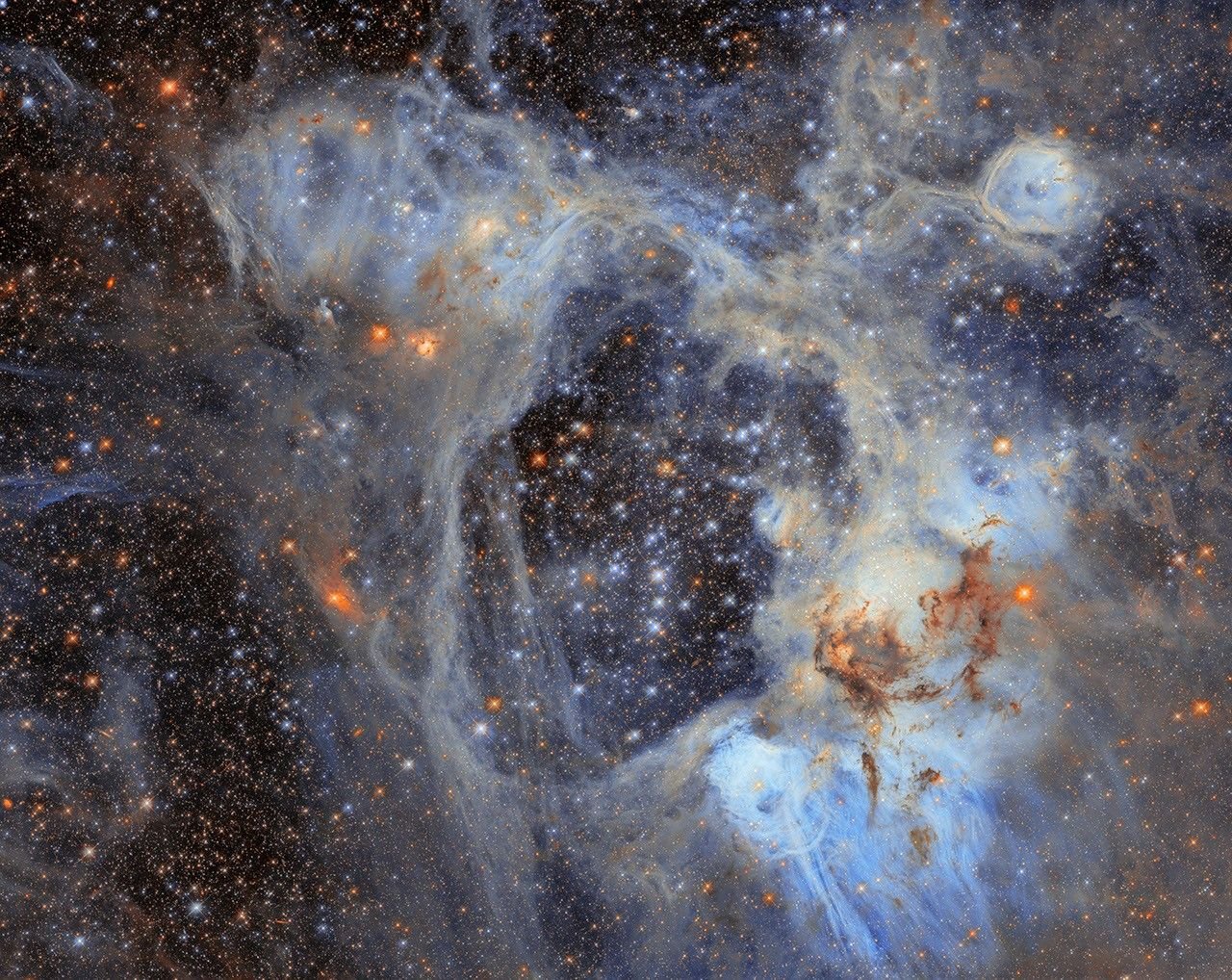
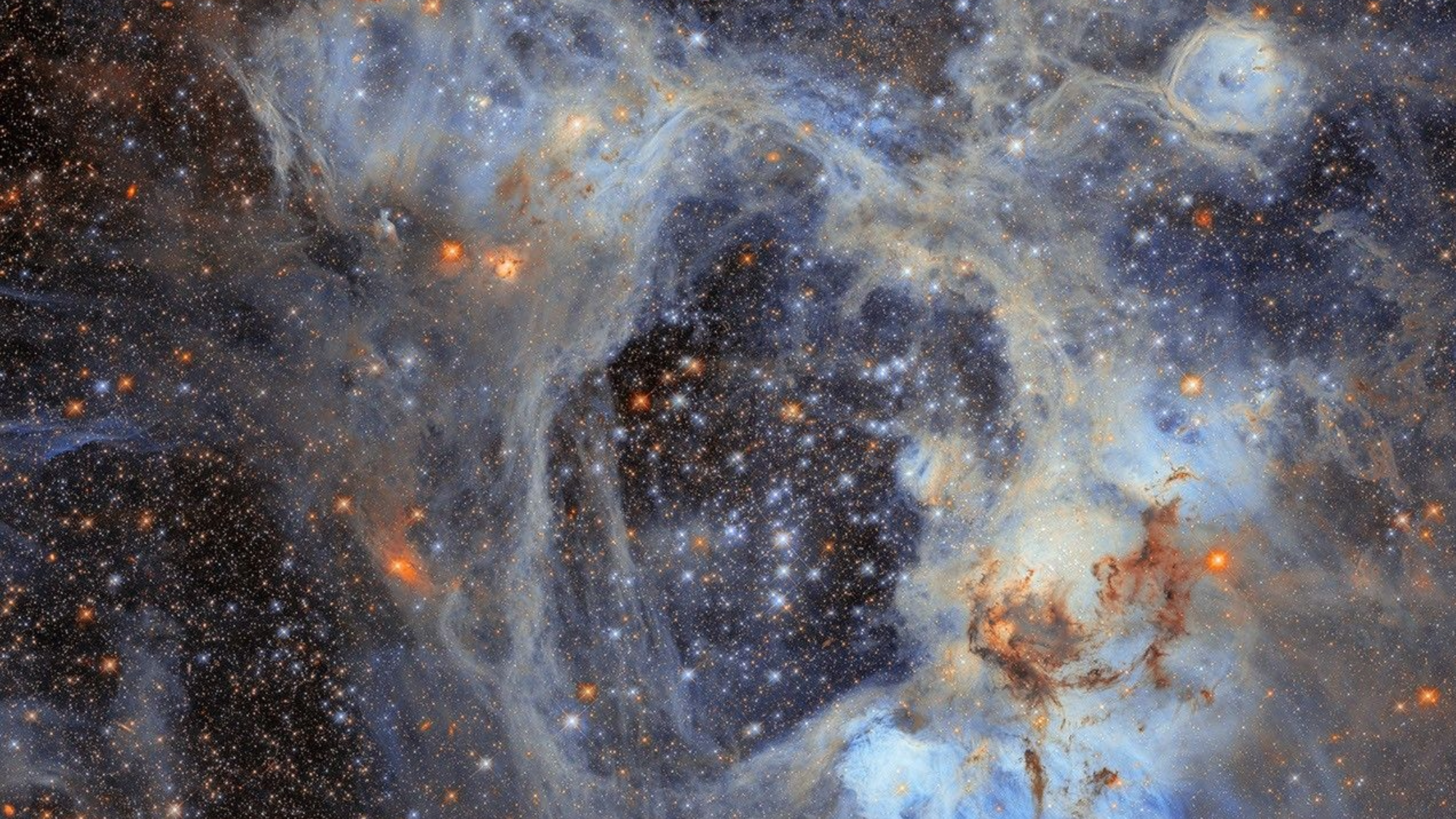
At a spry 36-years-young, the NASA/ESA Hubble Space Telescope just keeps on going. The groundbreaking observatory recently took a new image of a sprawling nebula located in the Large Magellanic Cloud (LMC). The LMC is the largest of the small galaxies that orbit our home Milky Way galaxy, and it’s only 160,000 light-years away. Since it is relatively close by, astronomers can more easily observe star birth hot spots like LHA 120-N44 (or N44).
N44 is located in the constellation Dorado. It is dominated by two main features—a large central void and an outer shell made of dense, dusty gas.
The central void is considered a “superbubble,” that spans about 210 by 140 light-years across. N44’s superbubble void was created by the powerful stellar winds and explosive supernovae from the glittery stars at the center.
The shell surrounding the superbubble is made of all of the gas that was expelled when these stars in the void were born. Once the gas was swept away, it compressed and formed a shell around the superbubble. Now, new stars are forming in this compressed gas shell, making it an interesting target for astronomers. They are using N44 to study how stars form in this type of cosmic environment.
“Their goal is to understand how long it takes from the collapse of cold gas clouds into dense knots to the moment nuclear fusion ignites in the heart of a newborn star,” NASA writes.
The gas shell surrounding N44’s superbubble has intrigued astronomers for over half a century. It is energized by ultraviolet radiation from massive stars, which makes it glow and highlights several distinct features. In the 1950s, astronomer Karl Henize first catalogued the distinct features within the nebula’s star-forming complex.
One feature is a smaller bubble (cataloged as N44F). It is an interstellar bubble blown by the intense stellar winds coming from one hot and massive star and is located in the upper-right corner of the new image.
This Hubble Space Telescope image features the picturesque nebula LHA 120-N44, or N44. The interstellar bubble N44F is at the top right corner. Image: NASA, ESA/Hubble, D. Gouliermis.
This Hubble Space Telescope image features the picturesque nebula LHA 120-N44, or N44. The interstellar bubble N44F is at the top right corner. Image: NASA, ESA/Hubble, D. Gouliermis.
The data used in this image is from observing program #14689; PI: Gouliermis. It used Hubble to survey N44 and take a census of its stars, cataloguing roughly 500,000 stars within the cluster, and some interlopers drifting in front of the nebula. Of the stars the team surveyed, roughly 30,000 are what astronomers call pre-main-sequence stars. These baby stars have not begun to fuse hydrogen into helium in their cores. Hubble’s highly-sensitive instruments were able to pick out faint objects in crowded clusters to find these young stars at work.
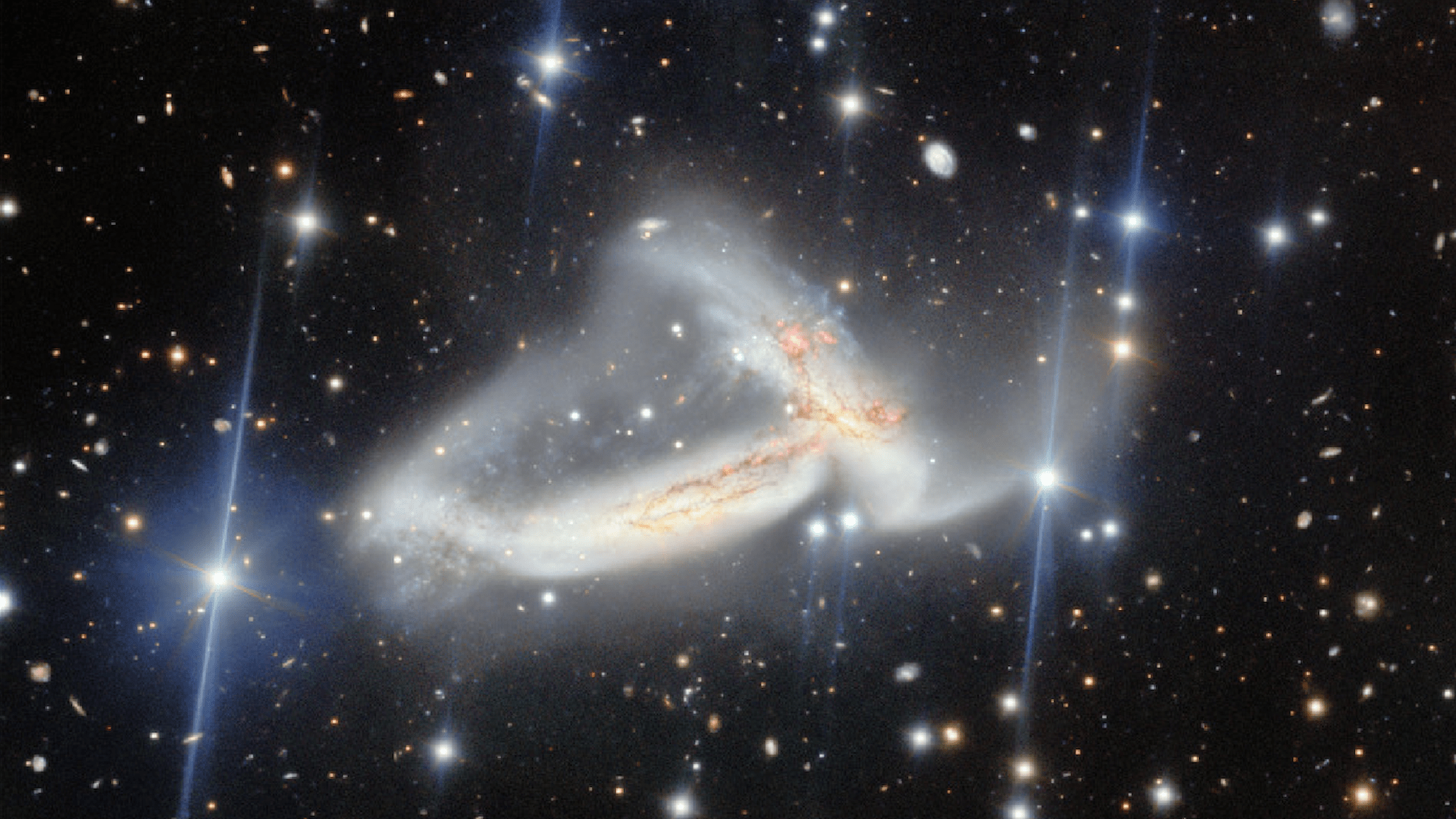
High school students interning at an observatory in Hawaii have successfully imaged a pair of colliding spiral galaxies located deep within overlapping cultural constellations. Formally classified as NGC 7253, the two galaxies are over 200 million light-years away, and reside in both Pegasus and Ka Lupe o Kawelo, or “The Kite of Kawelo.”
“NGC 7253 is a fascinating object because it’s two galaxies that are merging into one over billions of years,” said Project Hōkūlani intern Raiyan Rahman. “But we mainly picked this object because it was one of the few that actually lay within a Hawaiian constellation.”
Rahman and the other students from Waiākea High School and the Volcano School of Arts and Sciences spent one week in fall 2025 at the Gemini North Hilo Base Facility in Hilo to learn more about observatory operations, astronomy, and identify a deep space subject to study using the facility’s telescope. They selected NGC 7253 for its location inside a major navigational constellation utilized by Hawaiian sailors for generations.
Despite being separated by four million light-years, the gravitational pull inside NGC 7253 is strong enough that the two cosmic neighborhoods are on an inescapable collision course. Over a period of about one billion years, the spiral galaxies will smash into each other and merge into a single amalgamation. When this finally occurs, its spiral arms will generate a massive uptick in star formations. These newborn stellar objects will then ionize nearby hydrogen gas to form H II regions. In the image compiled by the high schoolers, these H II regions are already visible in the areas of bright pink light.
Earlier this summer, another three students from Keaʻau High School and Kamehameha Schools also participated in Project Hōkūlani. Continuing on the work of their predecessors, they decided on an official name for NGC 7253—Nā ʻUhane Māhoe Huki Pū i ke Ola, which roughly translates to “The Twin Spirits Pulling Together Creating Life.”
“After spending so much time on Maunakea, it was important to us to pick something that was both culturally and astronomically significant,” added Rahman.
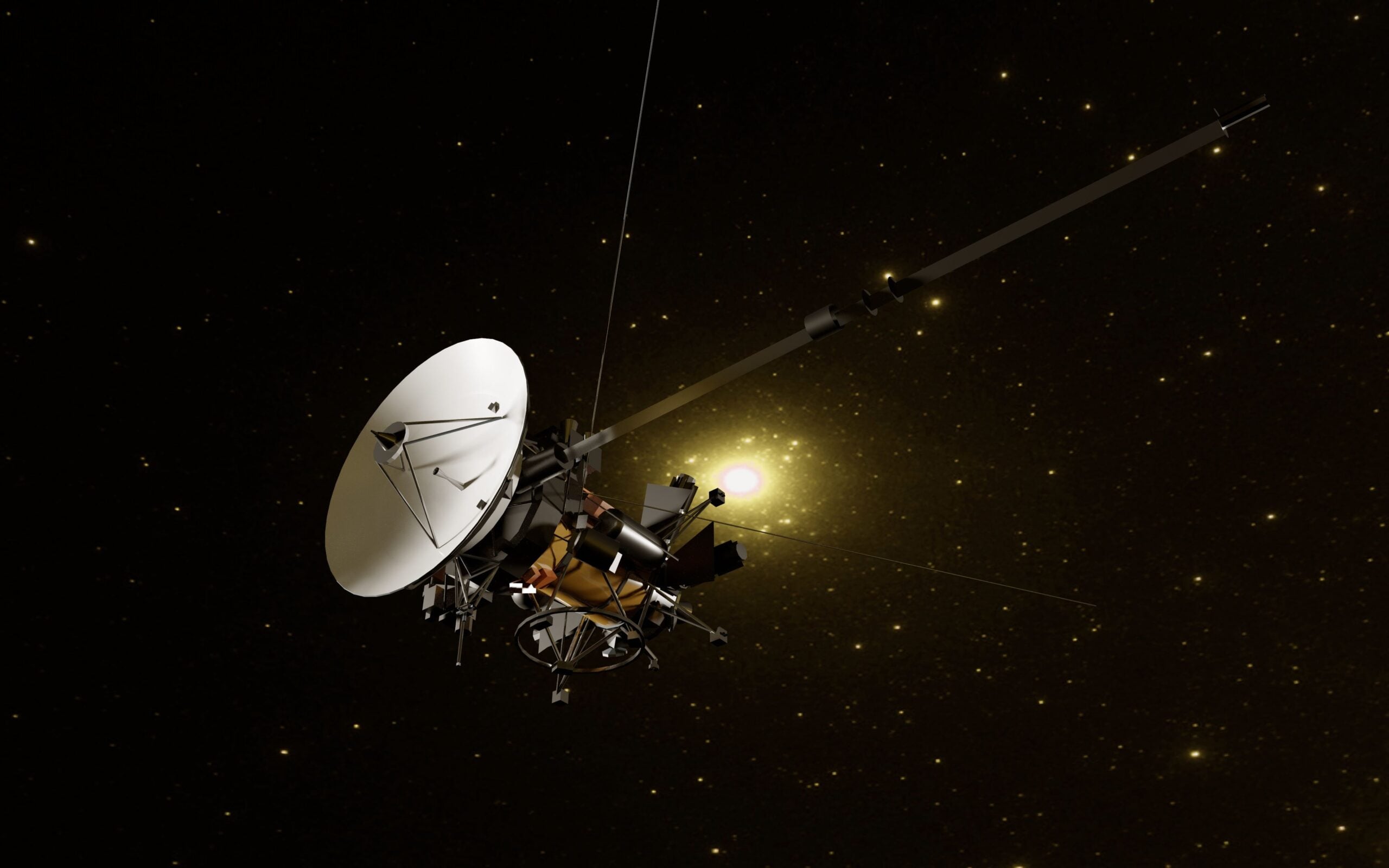
Voyager 1’s power test came back at the end of July, and by Kareem Badaruddin’s own account it went about as well as an engineer could hope. Badaruddin is the Voyager project manager at NASA’s Jet Propulsion Laboratory, and what he’s describing is the early stage of an attempt to do for Voyager 1 what a nearly identical procedure just did for its twin, Voyager 2: buy a dying power supply another year of science, on a spacecraft nobody can reach, touch, or send a spare part to.
I wrote a while back about the sliver of plutonium that’s kept both Voyagers running for close to half a century, and this is really that same story arriving at its next decision point. Voyager 1 needs the fix worse than Voyager 2 did. It has less power in reserve, it’s already lost more of its original instruments, and in February this year it came close to tripping its own emergency shutdown during a routine manoeuvre. Whether the fix behaves the same way on Voyager 1 as it did on Voyager 2 is, as of this week, still an open question, and NASA’s own engineers have said they’re not entirely sure of the answer.
A tighter margin than its twin ever had
Voyager 1 currently has two working science instruments left: a magnetometer and a plasma wave subsystem. Voyager 2 has three. Both spacecraft launched in 1977 with ten identical instrument sets, mostly built for flybys of Jupiter, Saturn, Uranus and Neptune that wrapped up decades ago, and both have been shedding instruments ever since, in an order the mission’s engineers settled on years in advance.
Voyager 1’s most recent loss came in April, when NASA switched off its Low-energy Charged Particles experiment, the instrument that had measured ions, electrons and cosmic rays almost continuously since launch. The shutdown wasn’t part of the planned sequence running ahead of schedule. It was prompted by an unexpected power dip during a roll manoeuvre on 27 February, one that brought Voyager 1 close enough to its automatic undervoltage fault protection that engineers chose to retire the instrument rather than risk a shutdown they hadn’t chosen themselves. A small motor inside the instrument, using half a watt, was deliberately left running, specifically so the whole thing could be switched back on if the power situation ever improved.
The same design, a different spacecraft
The fix both probes are attempting is nicknamed the Big Bang inside the mission, and the name refers to how it’s done rather than what it does. Rather than switching off one low-priority load at a time, engineers turn off several ageing devices at once, tape recorders and heaters that had been drawing power for decades, and replace them in the same moment with lower-power alternatives, all while keeping the spacecraft’s electronics above the temperature at which they’d fail for good. On Voyager 2, the swap went ahead in July and freed up close to ten watts a year, enough to keep its three remaining instruments running for at least another year.
Voyager 1 is next, and this is the part I find genuinely interesting rather than just procedurally interesting. Badaruddin has said plainly that although the two spacecraft were built to the same design, the team has observed real differences between them after forty-nine years of separate flight. That’s not a small caveat. It means a fix that worked cleanly on one twin isn’t guaranteed to work the same way on the other, even though the hardware started out identical. Voyager 1 is also farther out, more than 25 billion kilometres from Earth compared with Voyager 2’s roughly 21 billion, which means a command takes close to a day to arrive and just as long for confirmation to come back.
What the next few weeks decide
The power test Voyager 1 passed at the end of July checked whether the swap would draw more electricity than expected. The next hurdle is a thermal test, provisionally scheduled for the end of August, which checks whether the spacecraft’s temperature holds inside safe limits once the swap is made, since a heater or an electronic component that drops too cold in interstellar space doesn’t recover. If that goes well, the actual implementation on Voyager 1 follows, on the same cautious timeline that governs everything the mission does now, where a single command takes close to a day just to arrive.
There’s a genuinely hopeful detail sitting at the end of all this. If the fix frees up enough power on Voyager 1, NASA has said there’s a real chance the Low-energy Charged Particles experiment could be switched back on, not replaced, the same physical instrument, resuming measurements it’s been taking since 1977. I don’t want to overstate that. It depends on results NASA hasn’t published yet, and the agency has been careful not to promise it. But it’s the kind of small reversal that doesn’t happen often in a mission that has otherwise been a long, one-way process of turning things off.
What I’d watch next
Two dates sit ahead of each other on the calendar. The thermal test is due by the end of this month, and Voyager 1 is separately expected to cross one light-day from Earth in mid-November, a distance at which a signal travelling at the speed of light takes a full day to arrive. Neither date guarantees anything about the other. But together they’re a reasonable way to think about where this mission actually is: still capable of a genuine engineering surprise, still adding distance every second, and still, forty-nine years on, being managed one careful decision at a time by people who can’t see it, can’t touch it, and have learned to work within that.
On the morning of 1 July 2025, the ATLAS survey telescope at Río Hurtado in Chile detected an unusual moving point of light against the background stars. Within a few hours, follow-up observations from other telescopes had confirmed the object’s trajectory: this was not a solar-system comet on a long elliptical orbit, but a body moving through the inner solar system on a hyperbolic path, travelling too fast and at too steep an angle to have originated from any region gravitationally bound to the Sun. The object was, in other words, an interstellar visitor — only the third such object ever confirmed, after 1I/’Oumuamua in 2017 and 2I/Borisov in 2019. It was named 3I/ATLAS in honour of the survey that detected it. By the time the discovery announcement reached the broader astronomical community, a graduate student at the University of Oxford had already started running it through a predictive model he had spent the previous several years developing — and what the model returned was, by every available indication, the most remarkable interstellar visitor humanity has yet encountered.
According to the Royal Astronomical Society’s announcement of the Oxford analysis, the graduate student was Matthew Hopkins, who had defended his PhD thesis just one week before 3I/ATLAS was discovered. Hopkins had developed, with co-author Chris Lintott and colleagues at the University of Canterbury in New Zealand, what they call the Ōtautahi-Oxford Model — a statistical framework for inferring the origin and age of interstellar objects from their orbital trajectories. The discovery of 3I/ATLAS turned out to be the first real-time test of the model on a brand-new object. Hopkins ran the analysis. The result was striking enough that Hopkins, who had been planning to start a holiday, instead spent the following days comparing the data to his model’s predictions. The headline conclusion: 3I/ATLAS has approximately a two-thirds probability of being older than the solar system, with a statistical best estimate of approximately 7 billion years — making it, by the Oxford team’s analysis, the oldest comet humanity has ever observed.
What “the thick disk” actually means
As reported by Space.com’s coverage of the Hopkins-Lintott analysis, the key piece of evidence pointing toward the extreme age of 3I/ATLAS is its steep angle of approach. The Milky Way galaxy is not a uniform structure. Most of its stars, including the Sun, sit in a relatively thin disc that rotates around the galactic centre — a flat layer of younger, metal-rich stars approximately 1,000 light-years thick. Above and below this thin disc lies a substantially larger, more diffuse structure called the thick disc — a population of older stars, typically 10 to 12 billion years old, that orbit the galaxy on inclined paths and pass through the thin disc rather than residing within it. 3I/ATLAS arrived from a steep angle that traces directly back to the thick disc population. Its trajectory was the diagnostic signature that allowed Hopkins’s team to conclude, with statistical confidence, that the comet had formed around a star far older than the Sun.
The thick disc is older than the thin disc but is not the oldest component of the galaxy. The Milky Way’s stellar halo — a much more diffuse population of stars extending well above and below the disc — contains stars approximately 12 to 13 billion years old, dating to within a billion years of the Big Bang itself. Globular clusters, which orbit the galaxy in three dimensions rather than in the disc plane, contain some of the oldest known stars. But the thick disc is the oldest component dense enough to be a plausible source of interstellar comets reaching the inner solar system on observable trajectories. The previous two interstellar objects, 1I/’Oumuamua and 2I/Borisov, both originated in the thin disc and were therefore comparable in age to the Sun or younger. 3I/ATLAS is the first sample any human telescope has ever obtained from material formed in the much older star systems that populate the thick disc.
What 3I/ATLAS is made of
Per EarthSky’s coverage of the chemical composition of 3I/ATLAS, initial spectroscopic observations have identified the comet as water-ice-rich, with apparent enhancement in volatile compounds relative to comets formed within the solar system. The chemistry is consistent with formation around an older, lower-metallicity star — one whose protoplanetary disc would have contained different ratios of light elements, carbon compounds, and water than the disc that produced the Sun and its planets. Comets are, in cosmochemical terms, frozen samples of the protoplanetary disc material from which they formed. A comet from a 7-billion-year-old star system therefore preserves, in its volatile inventory and isotopic ratios, direct evidence of what the chemistry of the galaxy looked like at a substantially earlier point in its evolution than anything previously available to direct sampling.
This makes 3I/ATLAS scientifically valuable beyond its status as a single remarkable object. The comet is, in effect, a small frozen specimen of the early Milky Way, delivered to the inner solar system by approximately 7 billion years of interstellar drift. By the time it passed closest to the Sun on 29 October 2025 and closest to Earth on 19 December 2025 — at a safe distance of 168 million miles — astronomers had used Hubble, ground-based telescopes, and several space-based instruments to gather as much spectroscopic and imaging data as the brief window allowed. The comet has now passed its closest approach and is heading back out of the solar system, never to return. The data collected during its passage will be analysed for years.
What comes next
The discovery of 3I/ATLAS is, by every available indication, the leading edge of what is likely to become a substantially larger field of interstellar-object science over the next decade. The Vera C. Rubin Observatory, currently beginning operations in Chile, is expected to detect interstellar objects at a far higher rate than any previous survey — possibly several per year rather than one every few years. The statistical case for the existence of approximately one interstellar object per year passing through the solar system was already well-established from the ‘Oumuamua and Borisov detections; most have simply been too small, too dim, or too transient to be caught by existing surveys. The Rubin Observatory’s combination of wide field of view, deep sensitivity, and rapid cadence should change this. Each future interstellar visitor will be a new opportunity to test the Hopkins-Lintott statistical framework, to compare chemical compositions across objects of different ages and galactic origins, and to assemble a substantially more complete picture of what the rest of the Milky Way is made of.
3I/ATLAS itself will not be back. Its hyperbolic trajectory carries it out of the solar system and back into interstellar space on a path that will not bring it near the Sun again. Whatever further drift it makes through the Milky Way over the next several billion years — whether it eventually encounters another stellar system, drifts indefinitely between them, or is scattered into the galactic halo — is now no longer accessible to terrestrial observation. The Oxford team’s analysis, if their two-thirds statistical confidence holds up to further scrutiny, places the comet’s formation in a galactic environment approximately 2.4 billion years older than the Sun. That number alone makes 3I/ATLAS the oldest piece of material from outside the solar system that humans have ever knowingly sampled, by a margin of approximately the entire previous age range of observed comets combined.
The Earth, in any given 24-hour period, is being slowly snowed on by the rest of the solar system. The snow is not visible. The flakes are smaller than the width of a human hair. They arrive at interplanetary speeds, decelerate through atmospheric friction high in the upper atmosphere, and then drift downward at the speed of ordinary dust — taking weeks or months to reach the ground. By the time they arrive, they look indistinguishable from terrestrial dust to the unaided eye. Most fall on the oceans. Some fall on remote ice fields. A small fraction fall on cities, on rooftops, into gutters, through open windows, and onto the surfaces inside ordinary buildings. The total mass involved is, by various estimates, somewhere between 5,000 and 40,000 metric tonnes per year — a figure that has been actively debated in the cosmochemistry literature for several decades, and that depends substantially on which particles are being counted.
According to Astronomy.com’s reference figure on cosmic dust accretion, the traditional estimate of approximately 100 metric tonnes per day of cosmic dust entering Earth’s atmosphere has been the standard reference figure since the late 20th century, based on spacecraft measurements of interplanetary dust density and atmospheric entry data. The 100-tonne figure includes everything that crosses the boundary into Earth’s atmosphere — but the great majority of that material burns up at altitudes between 75 and 110 kilometres, producing the meteor streaks visible to the naked eye and the much larger number of microscopic disintegrations that occur invisibly every night. Only a fraction of the entering material survives the atmospheric descent intact and reaches the ground as a recoverable particle.
The Antarctic measurement
The most rigorous attempt to measure the surface-reaching fraction was completed in 2021 by a team of cosmochemists led by Jean Duprat at the French National Centre for Scientific Research. As reported by Space.com’s coverage of the Duprat et al. study, the team conducted six expeditions over twenty years near the Franco-Italian Concordia Station at Dome C in central Antarctica — one of the cleanest places on Earth, with very little terrestrial dust to contaminate the samples and very slow snow accumulation to preserve a clear chronological record of what had fallen in any given year. The team eventually recovered 1,280 unmelted micrometeorites and 808 cosmic spherules ranging in size from 30 to 350 micrometres — particles small enough that several thousand could fit on a postage stamp.
Scaling the Antarctic deposition rate to the full surface area of the planet, the team calculated that approximately 5,200 metric tonnes of interplanetary dust reach Earth’s surface each year — equivalent to approximately 14 tonnes per day, substantially less than the older 100-tonne atmospheric-entry figure but consistent with it once atmospheric burnup is accounted for. Approximately 80 percent of the surface-reaching dust originates from Jupiter-family comets — periodic comets that shed dust during their passages through the inner solar system. The remaining 20 percent comes from collisions between asteroids in the asteroid belt, which produce dust that drifts inward toward the Sun on long, slow trajectories.
The stardust subset
The vast majority of the cosmic dust falling on Earth is, by mass, ordinary solar system material — formed from the same disc of gas and dust that produced the Sun and the planets approximately 4.6 billion years ago. But a small fraction, found principally inside larger meteorites rather than in the surface dust itself, consists of grains that genuinely predate the solar system. These are called presolar grains, and they are among the most remarkable objects available to terrestrial science. Per Wiley Analytical Science’s review of presolar grain research and Project Stardust, presolar grains are small particles — typically silicon carbide, graphite, oxides, or nanometre-sized diamond — that formed in the outflows of dying stars before the solar system existed, drifted through interstellar space for hundreds of millions or billions of years, and were then incorporated into the molecular cloud from which the Sun and planets eventually condensed. Some of them survived the heat of solar system formation intact, embedded within larger meteoritic bodies, and have now been recovered from carbonaceous chondrite meteorites that have fallen to Earth.
A 2020 analysis of silicon carbide grains recovered from the Murchison meteorite — which fell in Australia in 1969 — found that several of the grains were approximately 7 billion years old, predating the solar system by roughly 2.5 billion years. Their isotopic signatures, particularly in noble gases and carbon ratios, are inconsistent with anything that could have formed within the solar system, and consistent with formation in the slow stellar winds of asymptotic giant branch stars — red giants in their late evolutionary phases that shed their outer atmospheres into interstellar space over millions of years rather than in a single explosive event, though a smaller subset of presolar grains do appear to have formed in supernova explosions. These grains are, in the most literal sense, material from the deaths of stars that ended before the Earth began.
Whether your bookshelf actually contains stardust
The popular framing — that the dust on ordinary household surfaces contains a small fraction of material from outer space, including possibly some genuine presolar grains — is partially confirmed and partially complicated by the available research. The confirmed part comes from Jon Larsen’s Project Stardust, a programme begun in 2009 by a Norwegian musician who became interested in the question after a small black particle landed on his breakfast table. Larsen developed magnetic-separation and microscopy techniques for identifying micrometeorites in urban dust, and has subsequently recovered and verified approximately 500 large micrometeorites from rooftops in Paris, Oslo, and Berlin. As documented in EarthSky’s coverage of the broader micrometeorite-collection literature, the demonstrated presence of micrometeorites in urban environments establishes that cosmic dust does, in fact, accumulate in human-built spaces — though typically on roofs and in gutters rather than on indoor bookshelves.
The complicated part is the inference from “cosmic dust on rooftops” to “presolar grains in bedroom dust.” Most household dust by mass is terrestrial — skin cells, textile fibres, soil, pollen, and various pollutants. The fraction that is genuinely extraterrestrial is exceedingly small, and the further fraction within that fraction that consists of presolar grains formed in dying stars is smaller still. The combined claim that the dust on a typical bookshelf contains material formed in stars that died before the Earth was born is, in technical terms, defensible only as a statistical probability — extremely small but not zero. The dust on the bookshelf is overwhelmingly the residue of the person who lives there. The microscopic remainder, in trace amounts that would require careful laboratory technique to isolate, includes the slow rain of cometary debris that has been falling onto the planet for the entire 4.6-billion-year duration of its existence, with a vanishingly small fraction of that debris consisting of grains that are older than the planet onto which they have, after billions of years of interstellar drift, finally settled.
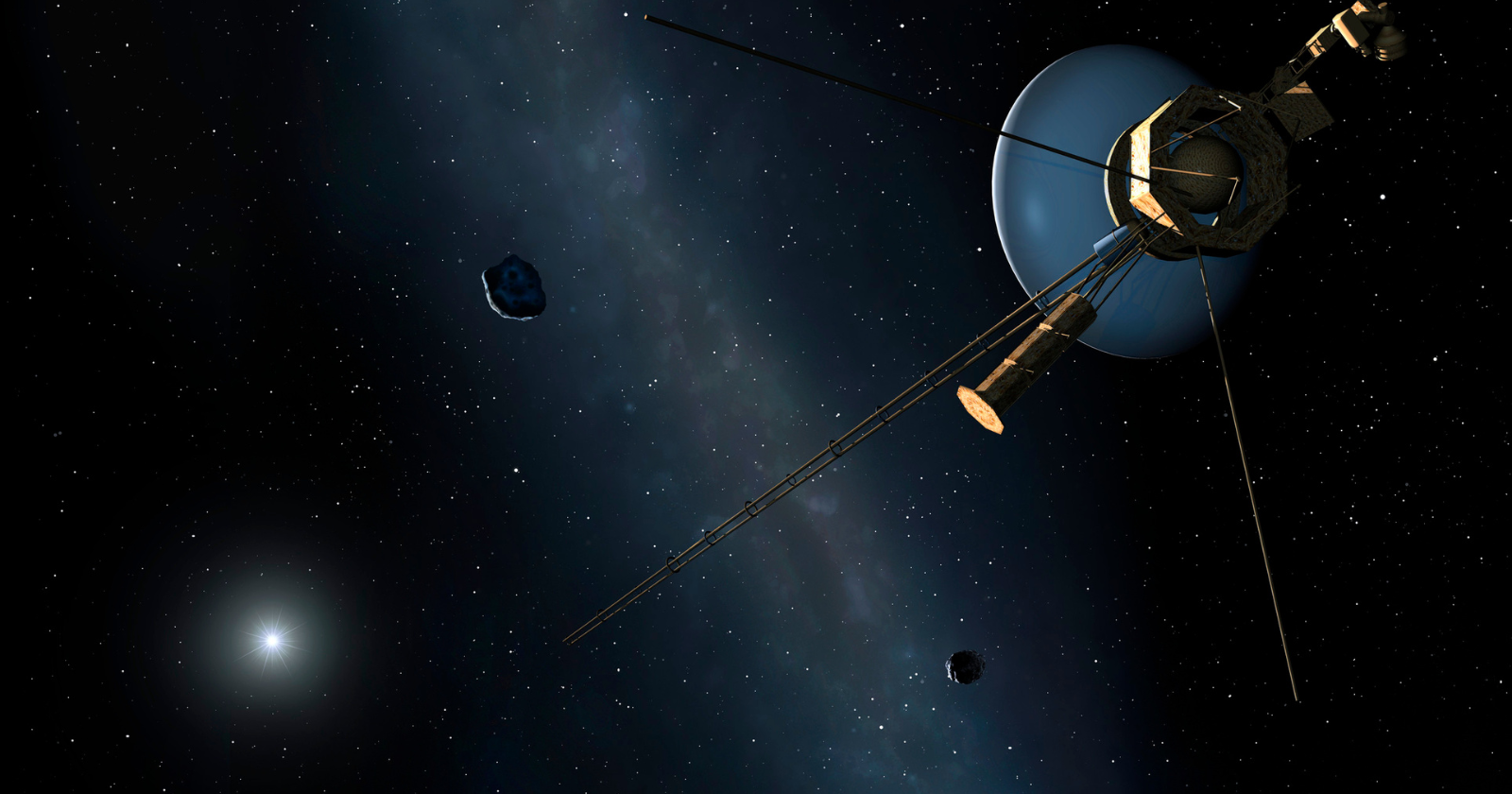
Voyager 1 is, by every available measure, the longest-running and most successful piece of deep-space hardware in the history of the species. It launched at 8:56 AM Eastern Daylight Time on 5 September 1977, atop a Titan IIIE-Centaur rocket from Launch Complex 41 at Cape Canaveral Air Force Station, on what was originally planned as a four-year mission to study Jupiter and Saturn. That four-year mission was completed in November 1980 when Voyager 1 finished its Saturn flyby. The spacecraft has been continuously operating, transmitting data, and receiving commands from Earth for the 46 years since then — an unplanned bonus mission that has, by accident of engineering durability, turned into the longest-distance human technological project ever attempted. The Voyager 1 that will cross the one-light-day threshold in November 2026 is, in essential respects, the same spacecraft that left the launch pad in 1977, with the same instruments, the same power source, the same antenna, the same onboard computers, and a slowly accumulating list of small mechanical failures that the JPL ground team has, so far, managed to work around.
According to CNN’s coverage of the upcoming light-day milestone, the threshold will be reached when Voyager 1 is approximately 16.1 billion miles (25.9 billion kilometres) from Earth, which on its current trajectory will happen on 15 November 2026. Suzy Dodd, the Voyager project manager at NASA’s Jet Propulsion Laboratory, described the operational reality in concrete terms: “If I send a command and say, ‘good morning, Voyager 1,’ at 8 a.m. on a Monday morning, I’m going to get Voyager 1’s response back to me on Wednesday morning at approximately 8 a.m.” The 24-hour one-way signal time means that all communication with the spacecraft now operates on a 48-hour command-and-acknowledgement cycle. The JPL ground team can no longer have anything resembling a conversation with the probe. Each command must be sent into the dark, with the team waiting two days to find out what happened.
Why distance becomes time
For most of Voyager 1’s mission, JPL has reported the spacecraft’s distance in kilometres, then in billions of kilometres, then in astronomical units. As the numbers grew larger, they became progressively harder to interpret. At 16 billion miles, distance loses any intuitive meaning. As reported by Popular Science’s coverage of the approaching milestone, the mission team has accordingly shifted to measuring distance in terms of how long light itself takes to cross the gap. Light-hours have been the standard unit for the past several years. Light-days are now beginning. By the time Voyager 1’s mission ends, its distance will be measured in fractions of a light-week. The progression matters because radio signals travel at the speed of light, and the time light takes to reach the spacecraft is the same as the time radio signals take. The two-day command cycle that the team is now operating within is, in effect, what running a spacecraft at one light-day’s distance looks like in practice.
The spacecraft itself is travelling at approximately 38,000 miles per hour, or roughly 11 miles per second — a substantial velocity by human technological standards, but glacial compared to light. Voyager 1 covers approximately 3.5 astronomical units (the Earth-Sun distance) per year. At its current speed and trajectory, it would take Voyager 1 approximately 73,000 years to reach the nearest star to the Sun, Proxima Centauri. The spacecraft is not, in fact, heading toward Proxima Centauri. It is heading in the general direction of the constellation Ophiuchus, and will pass approximately 1.6 light-years from a faint red dwarf called Gliese 445 in roughly 40,000 years. Voyager 1 will, by every projection, be the longest-surviving artefact of human civilisation in the universe — long after the Earth itself is no longer hospitable to the species that built it.
What is still working
Per Tom’s Hardware’s analysis of the engineering challenges facing the aging spacecraft, the Voyager 1 that will cross the light-day milestone in November 2026 is a substantially diminished version of the spacecraft that left Earth in 1977. The probe was launched with eleven scientific instruments; four are still operating. The power supply, three Radioisotope Thermoelectric Generators fuelled by plutonium-238, produced approximately 470 watts at launch and now produces roughly 250 watts, declining by about 4 watts per year. The ground team has been progressively turning off non-essential instruments and heaters since the late 1990s to extend the spacecraft’s operational life. Each shutdown decision involves a trade-off: turning off a heater saves power but risks a critical component freezing in the -270°C ambient temperature of interstellar space. Turning off an instrument loses scientific data but extends the spacecraft’s communication capability with Earth.
The recent years have been mechanically eventful. In May 2022, Voyager 1’s attitude control system began sending garbled data, and the JPL team spent months diagnosing the problem from 22 light-hours away — sending commands, waiting nearly two days for responses, interpreting the results, sending revised commands. In November 2023, the spacecraft stopped sending readable science data entirely; the team spent approximately five months working out that one of the onboard computers had a faulty memory chip, and then re-routing operations around the failed component. Both problems were eventually fixed. The 49-year-old spacecraft continues to function, but each successive year produces new failures that the ground team must work around with progressively less margin for error.
The end of the mission
The Voyager 1 mission will, by most current JPL estimates, continue functioning into the early 2030s before its power supply drops below the minimum threshold required to operate any of its remaining instruments. The spacecraft will not stop existing at that point. It will continue traveling outward at 38,000 miles per hour for an effectively unbounded duration. The Golden Record bolted to its side — the gold-plated copper disc designed by a team led by Carl Sagan, containing greetings in 55 languages, music from across human cultures, scientific diagrams, and a map showing Earth’s location relative to nearby pulsars — will continue traveling outward with it, indefinitely, until some chance encounter with a star, a planet, or another civilisation many millions or billions of years from now. The light-day milestone in November 2026 is a substantially smaller event than the eventual silence of the spacecraft, but it is a real one. For 24 hours of one-way travel time, light itself becomes a unit of measurement at the scale of a thing humans have built. Voyager 2, on a different trajectory and slightly behind its twin, is currently at 19.5 light-hours and continues outward as well. By the time the second Voyager crosses its own light-day threshold, sometime in the next decade, the first will have travelled substantially beyond.
Every 26 months, the orbits of Earth and Mars align in a particular geometric configuration that allows spacecraft to travel between them with the lowest possible fuel expenditure. The window lasts approximately one month. Miss it, and the next opportunity is more than two years away. The next such window opens in November 2026 and closes in December. SpaceX, the private launch company founded by Elon Musk in 2002 with the stated long-term goal of making humanity a multi-planet species, has been preparing for this specific window for years. Musk has publicly committed to launching up to five uncrewed Starship V3 vehicles toward Mars during the 2026 window, carrying cargo, scientific experiments contracted by the Italian Space Agency, and a small fleet of Optimus humanoid robots built by Tesla. The robots are intended to demonstrate operational capability on the Martian surface — the first robotic ambassadors of a private company on another planet, if the mission succeeds.
According to Space.com’s coverage of Musk’s most recent Mars announcement in May 2025, Musk himself has characterised the probability of meeting the 2026 deadline as approximately 50-50. The primary technical bottleneck is orbital refuelling. Starship, the largest rocket ever built at approximately 120 metres tall fully stacked, uses essentially all of its fuel reaching low Earth orbit. To travel to Mars with usable payload, each Starship must be refuelled in orbit by additional Starship tanker flights — approximately 8 to 12 refuelling flights per Mars-bound vehicle, by current published estimates. Five Mars-bound Starships would therefore require approximately 40 to 60 launches within the brief 2026 transfer window — a launch cadence that no rocket programme in history has ever achieved, and that SpaceX itself has not yet demonstrated. Orbital propellant transfer between Starship vehicles, which is the technological prerequisite for all of this, has been tested at small scale but not yet demonstrated at the level the Mars missions would require.
The history of slipping Mars timelines
The honest framing of any prediction about a 2026 Starship Mars mission requires acknowledging Musk’s track record of slipping Mars timelines. As documented by Aerospace America’s analysis of SpaceX’s Mars plan, Musk first publicly committed to landing on Mars in 2018 — at the 2016 International Astronautical Congress, where he proposed sending a variant of the Dragon capsule to the planet within two years. That mission never happened. In 2017, he revised the target to 2022, this time using the still-nascent Starship. That mission did not happen either. By 2024, the target had moved to a 2026 uncrewed mission with crewed flights potentially following in 2028 to 2030. The pattern across the eight-year sequence is roughly consistent: Musk announces an ambitious Mars timeline approximately five years in advance, SpaceX makes substantial but not complete progress on the prerequisite technologies, the announced date arrives without the mission, and a new target is announced for the next transfer window.
The 2026 target is now within a few months. Several of the prerequisite technologies — Starship V3, orbital refuelling, heat-shield durability for atmospheric re-entry at Mars-return velocities, the autonomous Mars landing system itself — remain in active development. The Wall Street Journal reported on 6 February 2026 that SpaceX had told investors it would prioritise a March 2027 uncrewed lunar landing over Mars. Two days later, on 8 February 2026, Musk himself publicly confirmed the shift in a post on X, writing that “SpaceX has already shifted focus to building a self-growing city on the Moon, as we can potentially achieve that in less than 10 years, whereas Mars would take 20+ years.” Musk added that the company would “strive to build a Mars city and begin doing so in about 5 to 7 years,” pushing the substantive Mars settlement effort back to approximately 2031-2033 rather than 2028-2030. The 2026 Mars launches remain nominally on the company’s stated agenda, but they are no longer the near-term priority. The Moon, in Musk’s revised framing, is the faster and more strategically viable destination — partly because lunar transfer windows open every 10 days rather than every 26 months, allowing the kind of rapid iteration that Mars trajectories do not permit.
If the 2026 launches still happen
The implications of a successful 2026 mission, however unlikely on the revised SpaceX priorities, would be substantial. As reported by Daily Galaxy’s coverage of the Mars launch window and its prerequisites, the five uncrewed Starships, if they reach Mars intact in mid-2027, would represent the largest delivery of mass to the Martian surface in the history of space exploration. Every previous successful Mars mission — NASA’s Viking 1 (1976), Viking 2 (1976), Pathfinder (1997), Spirit (2004), Opportunity (2004), Phoenix (2008), Curiosity (2012), InSight (2018), Perseverance (2021), and China’s Zhurong (2021) — has delivered, in aggregate, only a few tonnes of equipment to the surface. A successful Starship landing would deliver, in a single mission, more mass than the cumulative total of all previous Mars landings combined.
Whether the 2026 attempt occurs in any form is now substantially more uncertain than it was a year ago. The February 2026 pivot to lunar priority does not formally cancel the November-December Mars launches, but it does redirect SpaceX’s engineering, financial, and political capital toward the Moon. The crewed Mars mission timeline that Musk floated in 2024 — first humans on Mars in 2028 or 2030 — is now effectively delayed by at least three to five years, with the official Musk Mars-city target now sitting in the 2031-2033 window. Whether any of this happens on anything close to Musk’s stated timeline is, by his own assessment and revised priorities, highly uncertain. Whether it happens at all within the next two decades is the more substantive question on which the various Mars-relevant technologies are now converging.
What is genuinely new
The aspect of the SpaceX Mars effort that is genuinely new, regardless of whether the November launches occur, is the institutional configuration behind it. Every previous attempt to send humans or substantial cargo to Mars has been a government programme — NASA, the Soviet space programme, or China’s space agency. The SpaceX Mars effort is, for the first time in human history, a private corporation attempting to send mass to another planet on its own initiative, with its own rockets, on its own timeline, with its own payload manifest. Per SpaceX Stock’s analysis of the 2026 Mars transfer window and SpaceX’s commercial strategy, the eventual SpaceX commercial Mars programme — whether it materialises in 2026, 2031, or later — represents a structural shift in how the species approaches interplanetary travel. Mars exploration is moving from being a government activity to being a commercial activity, with all the attendant changes in funding mechanism, accountability, regulatory framework, and pace of iteration that the shift implies.
For approximately 200,000 years, anatomically modern Homo sapiens have lived on a single planet. Twelve human beings have walked on the Moon. Approximately 700 have travelled to low Earth orbit. None have travelled to another planet. The probability that this changes in the late 2020s is now genuinely uncertain — substantially less than the original SpaceX Mars timeline suggested, with the company’s February 2026 pivot to lunar priority pushing the substantive Mars settlement effort into the early 2030s at the earliest. The first Mars-bound launches, if they occur at all in late 2026, will function less as the opening of a Mars era than as a technology demonstration for a programme whose human-scale implementation is now substantially further away than the company was claiming a year ago. Whether and when the species reaches another planet remains open. The 2026 window will clarify part of the question. The full answer will take considerably longer.
Somewhere in the Chamaeleon constellation, six hundred and twenty years ago, a small dark planet about the size of Jupiter began to do something planets are not supposed to be able to do. It started eating. The material — gas and dust from a disc surrounding it, the same kind of debris field that ordinarily surrounds young stars rather than young planets — began falling onto the planet’s surface at increasingly extreme rates. By the time light from the event reached the European Southern Observatory’s Very Large Telescope in Chile in mid-2025, the planet was consuming approximately six billion tonnes of gas and dust per second. The accretion rate had increased by approximately eight times in just a few months. The planet, in astronomical terms, was binge-eating at a rate that had never been observed in any planetary-mass object before. The European astronomers who detected the event published their findings in The Astrophysical Journal Letters in October 2025, and the object they had been observing — Cha 1107-7626 — became the most extreme example yet documented of an emerging class of cosmic objects that blur the boundary between what counts as a planet and what counts as a star.
According to the European Southern Observatory’s official announcement of the discovery, Cha 1107-7626 has a mass between five and ten times that of Jupiter, sits approximately 620 light-years from Earth, and does not orbit any star. It belongs to a category of objects called rogue planets, or free-floating planetary-mass objects, which drift through interstellar space without being gravitationally bound to a parent star. The object is young by astronomical standards — approximately one to two million years old, compared to the 4.6-billion-year age of our own solar system — and still in the active formation phase, surrounded by a disc of gas and dust from which it is continuing to grow. The lead author of the study, Víctor Almendros-Abad of the Astronomical Observatory of Palermo at Italy’s National Institute for Astrophysics, characterised the discovery directly: “People may think of planets as quiet and stable worlds, but with this discovery we see that planetary-mass objects freely floating in space can be exciting places.”
What the accretion event actually was
The technical phenomenon being observed is called accretion — the process by which a young astronomical object increases its mass by pulling in surrounding material from a circumstellar or circumplanetary disc. Accretion is well-characterised in young stars, which routinely accrete material from their surrounding discs at substantial rates during their formation phases. Accretion in young planets is far less well-documented, partly because planets are far harder to observe than stars and partly because conventional planetary-formation models did not predict that planet-sized objects would undergo accretion events of stellar-like magnitude. The Almendros-Abad team’s observations of Cha 1107-7626 represent the most extreme example yet documented of stellar-style accretion behaviour in an object that falls below the mass threshold for being classified as a star.
The X-shooter spectrograph mounted on the VLT detected a marked brightening of the object in mid-2025, accompanied by spectral fingerprints — specific patterns of light emission and absorption — that indicated infalling gas was hitting the planet’s surface and creating a bright hot spot. The team had previously observed Cha 1107-7626 in earlier months of 2025 at substantially lower accretion rates. The dramatic surge between roughly April-May and June-August 2025 took the accretion rate from approximately 750 million tonnes per second to approximately six billion tonnes per second — an eightfold increase over a period of just a few months. As reported by Phys.org’s coverage of the ESO findings, the event also produced detectable changes in the chemistry of the disc surrounding the planet, with water vapour appearing during the accretion episode but not before — a phenomenon that had previously been observed during accretion events in young stars but never in any planetary-mass object.
What the discovery actually means
The implications run substantially beyond the specific case of Cha 1107-7626. The conventional dividing line between planets and stars has been understood in terms of mass: objects below approximately 13 Jupiter masses cannot sustain even the limited form of fusion (deuterium fusion) that defines a brown dwarf, and are therefore classified as planets. Cha 1107-7626 sits comfortably below this threshold. But the accretion behaviour the European team observed — the magnitude of the infalling material, the apparent role of magnetic fields in funneling that material toward the planet’s surface, the formation of a hot spot at the point of infall, and the changing chemistry of the surrounding disc — all of these are features that astronomers had previously associated specifically with young stars, not with planetary-mass objects.
The team’s interpretation, summarised in the ESO announcement, is that planetary-mass objects can possess strong magnetic fields capable of powering stellar-like accretion events. This is a substantive shift in the understanding of how planets and stars relate to each other across the lower-mass end of the stellar-substellar spectrum. As reported by Space.com’s coverage of the discovery, Almendros-Abad described the implications in stark terms: “This is the strongest accretion episode ever recorded for a planetary-mass object.” The boundary between “small star” and “large planet,” in light of the Cha 1107-7626 observations, appears to be less clean than the previous mass-based classification system had suggested.
How rogue planets exist at all
The broader category of rogue planets — free-floating planetary-mass objects without any parent star — has been one of the more striking developments in modern astronomy over the past 25 years. The first confirmed rogue planet was identified in 2000. Since then, multiple surveys have estimated that the Milky Way may contain billions of such objects, with some studies suggesting that rogue planets may actually outnumber the stars in the galaxy. They form in two main ways, depending on which population is being examined. The first formation pathway involves direct gravitational collapse of a small fragment of an interstellar gas cloud — essentially the same process by which stars form, scaled down to substellar masses. The second pathway involves planets that originally formed around stars but were subsequently ejected from their planetary systems by gravitational interactions with other planets, typically during the chaotic early phases of system formation.
Cha 1107-7626 appears to belong to the first category. Its young age (approximately one to two million years), its retention of a surrounding accretion disc, and its location within a known star-forming region in Chamaeleon all suggest that it formed in place rather than being ejected from a parent system. The team’s observations of stellar-style accretion behaviour reinforce this interpretation: the object appears to be forming through a process structurally identical to the way young stars form, just at a substantially lower mass scale. Whether this means rogue planets like Cha 1107-7626 should properly be reclassified as a kind of failed star rather than as a kind of unbound planet is a question that the discovery is now actively reopening in the planetary-formation community.
What comes next
The 2025 observations of Cha 1107-7626 are unlikely to be the last word on the object or its kind. As documented by CBS News’s coverage of the discovery, the European Southern Observatory’s upcoming Extremely Large Telescope, currently under construction in the Atacama Desert of Chile, is expected to substantially improve the ability to detect and characterise rogue planets — which are typically faint, cold, and difficult to observe with current instruments. The combined capabilities of the ELT, the James Webb Space Telescope, and the next generation of ground-based interferometers should allow astronomers to identify additional accreting rogue planets, monitor their behaviour over multi-year periods, and assemble a substantially more complete picture of how planet-scale objects can form, grow, and evolve without ever being attached to a star.
What the Cha 1107-7626 observations have already established is that the universe contains objects that conventional planetary classification did not quite anticipate. A 5-to-10-Jupiter-mass body, drifting alone in interstellar space, eating six billion tonnes of gas and dust per second, exhibiting magnetic fields and accretion behaviour previously associated only with young stars — this is the kind of object that does not fit cleanly into the previous taxonomic categories. The 620 light-years of space between Earth and Cha 1107-7626 mean that the accretion event astronomers detected in 2025 actually happened approximately six centuries ago, around the time the European Renaissance was beginning. Whatever is happening at Cha 1107-7626 right now, in the present tense of the planet itself, will not be observable from Earth for another 620 years. By the time the light arrives, the object — assuming it continues growing at anything like its current rate — may no longer be a planet at all.

 Login