
❌

Reading view

Screen Time adds Time Allowances and Ask to Browse with iOS 27

Screen Time has received one of its most substantial parental-control updates with iOS 27, iPadOS 27, and macOS 27, adding new ways for parents to manage how long children use categories of apps, which websites they can visit, and what content reaches them through Messages and FaceTime.

The features were previewed at WWDC in June and are now available as part of Apple’s latest operating-system releases. Rather than relying only on fixed app limits, the redesigned Screen Time gives parents a more flexible set of controls that can change throughout the day and adapt as a child gains access to more apps and services.

Among the additions are Time Allowances, Ask to Browse, a simpler child-device setup process, expanded Communication Safety protections, and faster controls for temporarily pausing or extending access.

Apple is also working with the American Academy of Pediatrics to adapt the organization’s Family Media Plan into guidance parents can reference when setting up devices and Screen Time.

Screen Time introduces Time Allowances by app category

Time Allowances give parents a daily amount of time that can apply across categories including Entertainment, Games, and Social Media.

That differs from managing each application individually. Parents can set time allowances for categories such as Entertainment, Games, and Social Media, then adjust those settings based on the needs of their household.

Apple provides suggested starting points based on a child’s age and guidance informed by clinical and child-development research. Those recommendations are optional, with parents able to change them based on their own household and the individual child.

The updated Screen Time also supports schedules that control which apps remain available at different periods of the day. Parents can therefore create separate access patterns around school, homework, evenings, and weekends rather than relying on one universal daily restriction.

Temporary adjustments have been made easier as well. Parents can quickly limit access to apps and the web during periods such as meals, then restore access without rebuilding their existing restrictions. When a child reaches a limit, they can request additional time from a parent to complete an activity or finish a conversation.

The redesigned interface puts device usage and the most frequently used applications closer to the front, reducing the amount of navigation required to understand how a child is spending time on a device.
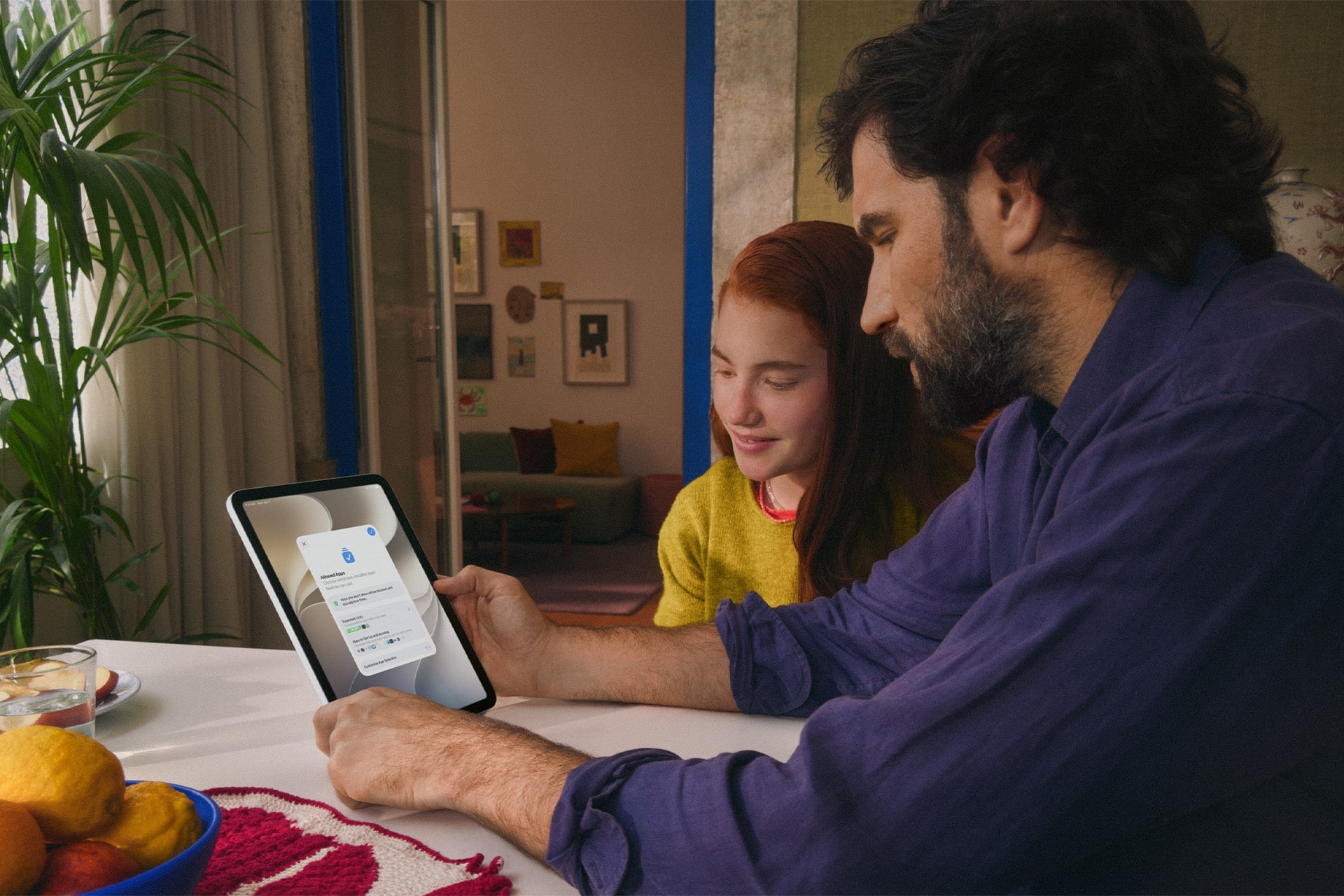
A man and a girl sit at a table looking at a tablet together. The screen displays an Apple parental controls login page. They are indoors with fruit and a plant on the table, creating a focused and collaborative atmosphere.
Image Credit: Apple Inc.

Ask to Browse extends parental approval into Safari

Ask to Browse brings a permission model already familiar from app downloads to the web.

When the feature is active, a child who attempts to visit a new website in Safari can be required to request permission first. The parent receives the request through Messages and can review it before allowing access.

The feature is available across iPhone, iPad, and Mac and works alongside existing web-content restrictions.

It complements Ask to Buy, which requires children to obtain permission before downloading or purchasing an app or making an in-app purchase. Apple has also expanded the initial setup process so a parent configuring a personal device for a child can choose which apps are available from the beginning.

Setup Assistant offers the option to provide only essential apps, use a recommended group, or manually choose which ones are permitted. More applications can then be introduced later as the parent decides the child is ready for them.

The approach gives parents a way to begin with a comparatively limited device instead of configuring a full standard account and removing unwanted access afterward.

Communication Safety expands beyond detected nudity

Communication Safety now intervenes when it detects gore or violent imagery in shared photos and videos, expanding protections that previously centered on nudity.

Apple says the feature works with content shared through areas including Messages and FaceTime, with the new protection also extending to live FaceTime calls.

Communication Safety is designed to intervene before a child views or shares detected sensitive material. Apple has previously built these protections around on-device analysis, allowing the system to identify content without requiring Apple to receive the underlying images.

Parents can also continue controlling who children communicate with. Contact-management settings can require approval before a child adds someone new and then communicates through Phone, Messages, or FaceTime.

Child Accounts remain the foundation for these controls. Apple generally requires Child Accounts for children under 13, although the applicable age can vary by state, country, or region. Child Accounts remain available for family members up to age 18.

The accounts automatically activate age-based safeguards and connect parental controls through Family Sharing.
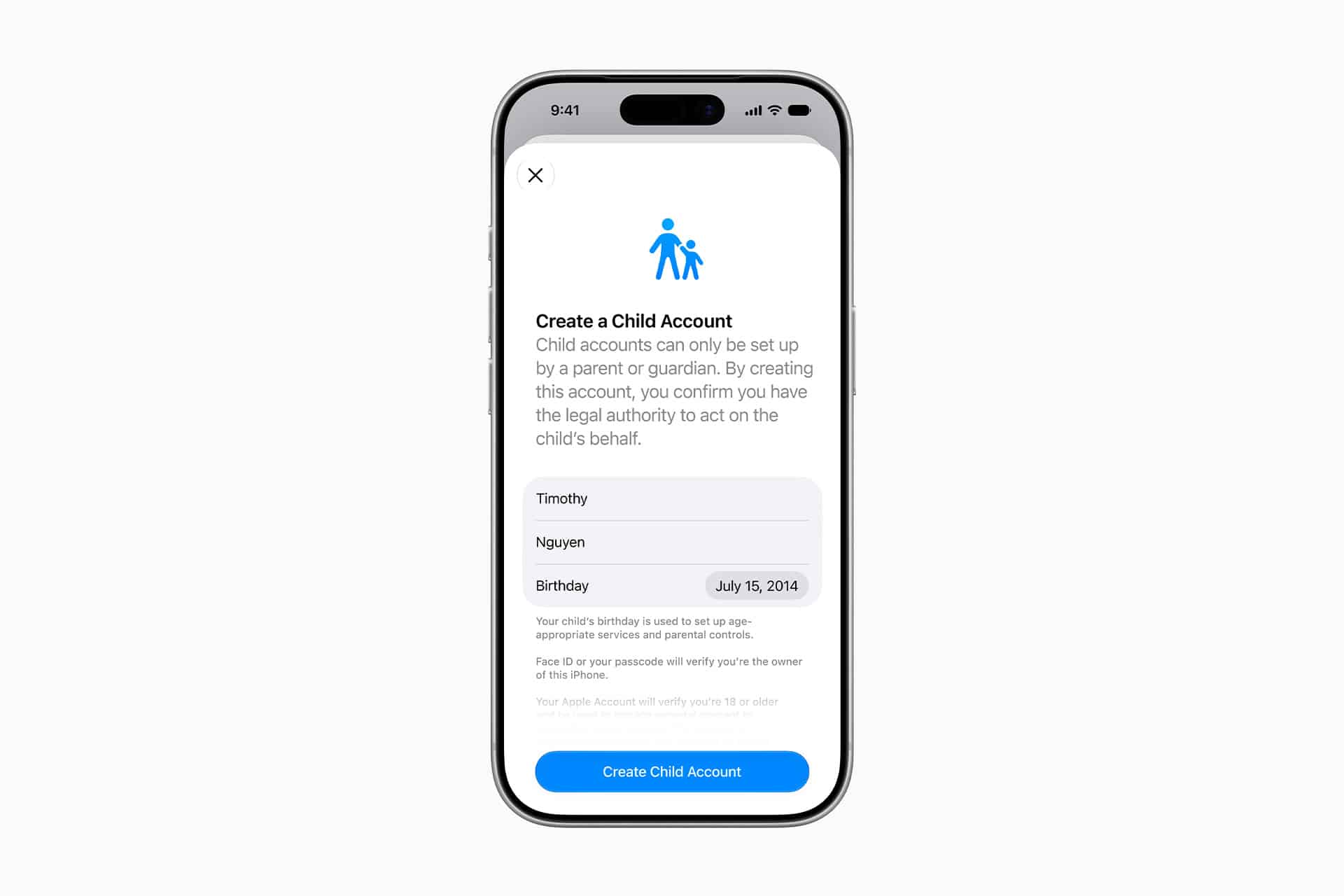
A smartphone screen displays a form to create a child account, showing fields for first name, last name, and birthday, with a blue "Create Child Account" button—ideal for setting up Apple parental controls.
Image Credit: Apple Inc.

iOS 27 requires the family’s devices to stay in sync

The new Screen Time controls arrive with one practical requirement: devices participating in the same Family Sharing setup need current software.

Apple says all devices in the Family Sharing group must be updated to the corresponding 27-generation releases — iOS 27, iPadOS 27, macOS 27, watchOS 27, and visionOS 27 — before the updated Screen Time controls can be used consistently across the family.

The family organizer, parent, or guardian must also update the parental-control configuration after the software upgrades.

That requirement is worth checking before troubleshooting a missing setting on one child’s device. If every device in the group cannot be updated, Apple says the family can continue using the previous version of Screen Time and its parental controls, but the new controls will not be available consistently across the group.

The features themselves also vary by platform. Ask to Browse and Time Allowances are available on iPhone, iPad, and Mac, while some Family Sharing and communication features extend to other devices.

Apple has launched a dedicated Child Safety site alongside the software release, collecting setup instructions, explanations of Child Accounts, Screen Time controls, communication protections, App Store age tools, Find My, and Apple Watch options for families.

The updated Screen Time controls are available now with iOS 27, iPadOS 27, and macOS 27, although individual features can vary by region, language, and hardware. For families upgrading several devices at once, checking every device in the Family Sharing group for its corresponding version 27 update is the most useful place to start.

The post Screen Time adds Time Allowances and Ask to Browse with iOS 27 appeared first on AppleMagazine.

  •  

Patrick Brammall Takes a Dark Turn in Apple TV’s Last Seen

Patrick Brammall is heading into a much darker week on television. Following the Last Seen screening in Sydney, the Colin from Accounts star arrives on Apple TV as a father whose missing daughter has left his life suspended for more than a decade. The Australian thriller premieres September 9, bringing a very different kind of emotional discomfort from the romantic comedy that introduced him to many American viewers.

In Colin from Accounts, embarrassment can become an opening for affection. Last Seen gives Brammall a character with far less room to recover from a bad decision. Ian Ridley is a former detective, now working as a police dispatcher, who receives a call he believes could finally lead him back to his daughter.

The casting offers an immediate reason to be curious. Audiences familiar with Brammall’s comic timing will be watching him carry a story built around loss, uncertainty, and a hope that could become dangerous.

Patrick Brammall Finds a Personal Connection to Ian Ridley

Brammall has described drawing on fatherhood to understand the role. In an interview with Radio Times, he explained that being the father of two young daughters gave him access to an emotional vulnerability he could bring into the performance.

He did not need to imagine the story happening to his own children. Becoming a parent had already changed how available those feelings were to him.

“Ian is like a raw nerve,” he said.

That description gives a more precise sense of the character than the familiar image of a troubled detective. Ian’s professional experience may help him interpret a crisis, but his connection to this particular call makes distance almost impossible.

The challenge for a performance like this lies in keeping both sides believable. An audience needs to understand why Ian recognizes a possibility others might dismiss, while remaining alert to how much he wants that possibility to be true.

Brammall also credited his classical theater training and casting director Kirsty McGregor with helping him move between genres. The dramatic assignment draws on an established acting background, even if it surprises viewers who associate him most closely with comedy.

Patrick Brammall | Last Seen | Description: A woman with long hair buries her face in a man's chest, appearing upset, while the bearded man holds her protectively and looks ahead with a serious expression in a warmly lit room, evoking the emotional intensity of Last Seen on Apple TV.
Image Credit: Apple Inc.

One Phone Call Reopens an Eleven-Year Absence

Maggie disappeared 11 years before the events of Last Seen. Ian has never accepted that she might be gone forever. When a teenage girl calls for help, he becomes convinced that he recognizes his daughter and begins pursuing the possibility of bringing her home.

The premise places an ordinary professional responsibility under extraordinary personal pressure. A dispatcher must listen carefully, gather information, and help someone through an emergency. Ian suddenly has to do that while confronting the possibility that the voice belongs to the person he has spent years hoping to find.

There is tension in the simple absence of a face. A voice offers clues without providing the certainty of seeing someone. Memory, fear, and recognition can arrive together, leaving very little time to sort one from another.

The emotional question extends beyond whether the caller is Maggie. Eleven years have passed for everyone involved. Even a reunion could not return the family to the day before she disappeared.

That gives the story room to explore the difference between finding someone and recovering the life that existed before their loss. It also gives Brammall something more complicated to play than determination alone: a man whose idea of rescue may be tied to a past that cannot be restored.

These are the tensions established by the premise. How the series resolves them remains part of the mystery awaiting viewers.

An Australian Production With a Substantial Supporting Cast

Last Seen adapts Ryan David Jahn’s novel The Dispatcher, with Kris Mrksa serving as writer and executive producer. The series is produced by 60Forty Films and was entirely set and filmed in Victoria, Australia.

The official cast and crew credits name Christian Schwochow as director and executive producer. Brammall is joined by Maxine Peake, Brendan Cowell, Daniel Henshall, Jessica Wren, Zahra Newman, Chloe Jean Lourdes, and Tobias Muhafidin. Executive producers also include Hakan Kousetta, Jamie Laurenson, and Joanna Werner.

For American audiences, the Australian setting gives the show an identity outside the familiar geography of U.S. police dramas. Victoria is the location of the story itself, allowing the adaptation to establish its own surroundings rather than asking local scenery to stand in for another country.

The ensemble also creates room for perspectives beyond Ian’s. A missing-person story can become claustrophobic when every event is filtered through a single person’s conviction. The dramatic interest comes partly from encountering people who have their own knowledge, loyalties, and reasons for responding differently.

Brammall carries the central search, but the relationships around him will determine whether that search feels convincing as a family story.

The Action Was a Physical Challenge

Last Seen also demanded action sequences, and Brammall has been candid about finding them harder at 50 than he once imagined.

Discussing the production with Radio Times, he credited a younger scene partner with taking on much of the physical work during an early confrontation. Asked about the possibility of doing more action, he offered a practical condition: “Give me the right stunt double and I’ll do it.”

His account brings a welcome human detail to the promotional image of a desperate father fighting his way toward an answer. Performing that desperation requires choreography, cooperation, and people prepared to absorb the physical demands of a scene.

For the character, physical vulnerability can be useful territory. Ian’s willingness to intervene does not necessarily mean he is equipped to control what follows. The possibility of getting hurt gives an impulsive decision consequences beyond moving the investigation forward.

When Last Seen Arrives in the U.S.

Apple’s official premiere announcement confirms that the first two episodes arrive together on Wednesday, September 9. The remaining four episodes follow weekly, with the sixth scheduled for October 7.

That gives the thriller a five-week release window. Viewers can begin with a substantial introduction to Ian’s situation, then follow the investigation one chapter at a time. Those who prefer watching a complete season can plan around the final episode’s arrival.

The U.S. Last Seen page provides access to the series through Apple TV. No familiarity with the source novel or Brammall’s previous work is needed to begin.

American viewers will have an unusually sharp contrast available the following day. Paramount+ has confirmed that the third and final season of Colin from Accounts arrives September 10, with all episodes released at once.

Brammall returns there alongside Harriet Dyer, his wife and fellow creator, writer, and star. Their comedy began with a car accident, an injured dog, and two strangers drawn into each other’s lives. Its farewell season places another set of complicated relationships on his schedule, with considerably more space for laughter between the difficult moments.

Six people stand together in front of a green backdrop with large white letters. Dressed in formal attire, with some smiling at the camera, they gather to celebrate the premiere of an exciting Australian thriller starring Patrick Brammall on Apple TV.
Image Credit: Apple Inc.

The post Patrick Brammall Takes a Dark Turn in Apple TV’s Last Seen appeared first on AppleMagazine.

💾

Enjoy the videos and music you love, upload original content, and share it all with friends, family, and the world on YouTube.
  •  
❌