❌

Reading view

Carbon capture is a fig leaf for fossil fuel expansion | Letters

The predicted Β£264bn cost by 2050 could be even higher, plus renewables avoid a far higher total of emissions than can be captured, writes Andrew Boswell, while Simon Oldridge calls out vested interests

Prof Myles Allen and colleagues, in their letter (12 July) on carbon capture and storage (CCS), propose licensing gasfields on condition that producers store an increasing proportion of β€œthe carbon dioxide their products generate”. Their proposal only considers CO2. Methane is excluded by choice although it leaks throughout global fossil-fuel supply chains, including during extraction, processing, liquefaction and shipping.

A growing academic literature, supported by satellite observations of major methane plumes, shows that these emissions can be very substantial, and are the dominant near-term climate impact for gas supplied as liquefied natural gas.

Continue reading...
Β© Photograph: Peter Cade/Getty Images

Β© Photograph: Peter Cade/Getty Images

Β© Photograph: Peter Cade/Getty Images
  •  

Carbon capture is vital in tackling the climate crisis | Letters

Prof Myles Allen, Stephanie Loo and Toby Lockwood, and Olivia Powis, respond to an article by George Monbiot about β€˜the great carbon capture con’

George Monbiot suggests that we can solve climate change without carbon capture and storage (The great carbon capture con: behold the wasted billions Burnham could claw back, 8 July). Physics says otherwise. The world is going to generate more carbon dioxide than we can safely dump into the atmosphere, and we can’t rely on our stressed biosphere and oceans to mop up the excess. Stopping global warming will therefore require capturing and durably disposing of carbon dioxide on a huge scale, which right now means injecting it backΒ underground.

Where George does make a good point is in questioning whether carbon dioxide disposal should for ever be paid for using public money. Why should private companies be allowed to make large profits taking carbon out of the ground while the taxpayer foots the bill to put it back? The obvious solution: require those who extract fossil fuels to pay for the disposal of the carbon dioxide their products generate. If the fraction they store rises to 100% by mid-century, fossil fuel use would cause no further warming thereafter.

Continue reading...

Β© Photograph: Richard Saker/The Guardian

Β© Photograph: Richard Saker/The Guardian

Β© Photograph: Richard Saker/The Guardian

  •  

The great carbon capture con: behold the wasted billions Burnham could claw back | George Monbiot

There are far better ways to tackle climate breakdown, but successive governments have chosen to listen to the fossil fuel companies instead

The new prime minister will be looking for money? Well, here’s Β£21.7bn lying on the ground. The government could cancel its deranged, disastrous carbon capture and storage (CCS) programme at no cost to public welfare: in fact, it would greatly reduce the harm we will suffer.

Sorry, did I say Β£21.7bn? That’s the figure the government has been putting in its press releases for spending on this programme between now and 2050. But this covers only the first phase of the project. The climate experts Dr Andrew Boswell and Simon Oldridge worked through the data produced by the government’s Climate Change Committee, which was scattered across different spreadsheets, and discovered that the projected cost of the full CCS programme between now and 2050 is Β£264bn.

Continue reading...

Β© Illustration: Eleanor Shakespeare/The Guardian

Β© Illustration: Eleanor Shakespeare/The Guardian

Β© Illustration: Eleanor Shakespeare/The Guardian

  •  

Documenting Ireland’s vanishing boglands: β€˜They hold millennia in their layers’

Photographer Shane Hynan explores the tension between the central role peat bogs play in Irish life and their wider environmental impact

β€œYou can read Ireland’s history in the boglands. They hold millennia in their layers,” says photographer Shane Hynan of his project, BeofhΓ³d (meaning Beneath in English).

The boglands, known as portachs in Irish, cover roughly 1.2m to 1.5m hectares or about 14% to 17% of the country’s total land area. The raised bogs of the Irish Midlands are made of peat that forms at a rate of 1mm a year (0.04in) in low-lying, poorly drained basins or former lakes. As the historical geographer Kevin Whelan observes in the Atlas of the Irish Rural Landscape, β€œthe bog has been etched as deeply into the human as into the physical record in Ireland – to an extent unrivalled elsewhere.”

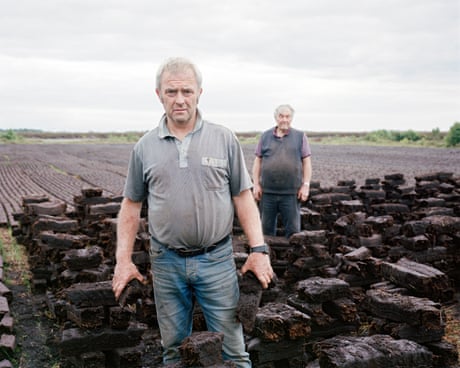
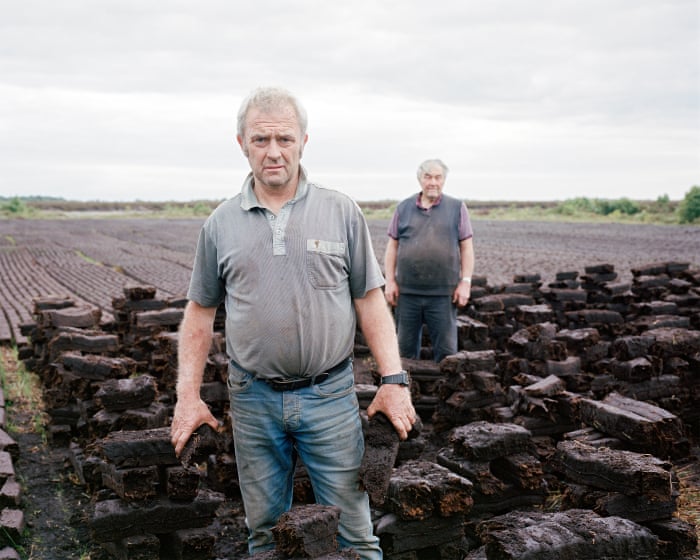
Eddie and Con footing turf for domestic use, Knockirr Bog, County Kildare, 2022.

Continue reading...

Β© Photograph: Shane Hynan

Β© Photograph: Shane Hynan

Β© Photograph: Shane Hynan

  •  
❌