
❌

Reading view

Selections from 2025: Pinpointing a Bright Fast Radio Burst with CHIME
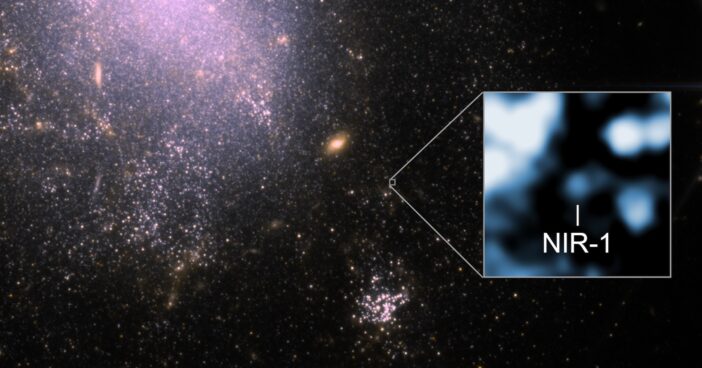
JWST image of the galaxy NGC 4141

Editor’s Note: For the remainder of 2025, we’ll be looking at a few selections that we haven’t yet discussed on AAS Nova from among the most-downloaded articles published in AAS journals this year. The usual posting schedule will resume January 2nd.

FRB 20250316A: A Brilliant and Nearby One-Off Fast Radio Burst Localized to 13 pc Precision

Published August 2025

Main takeaway:
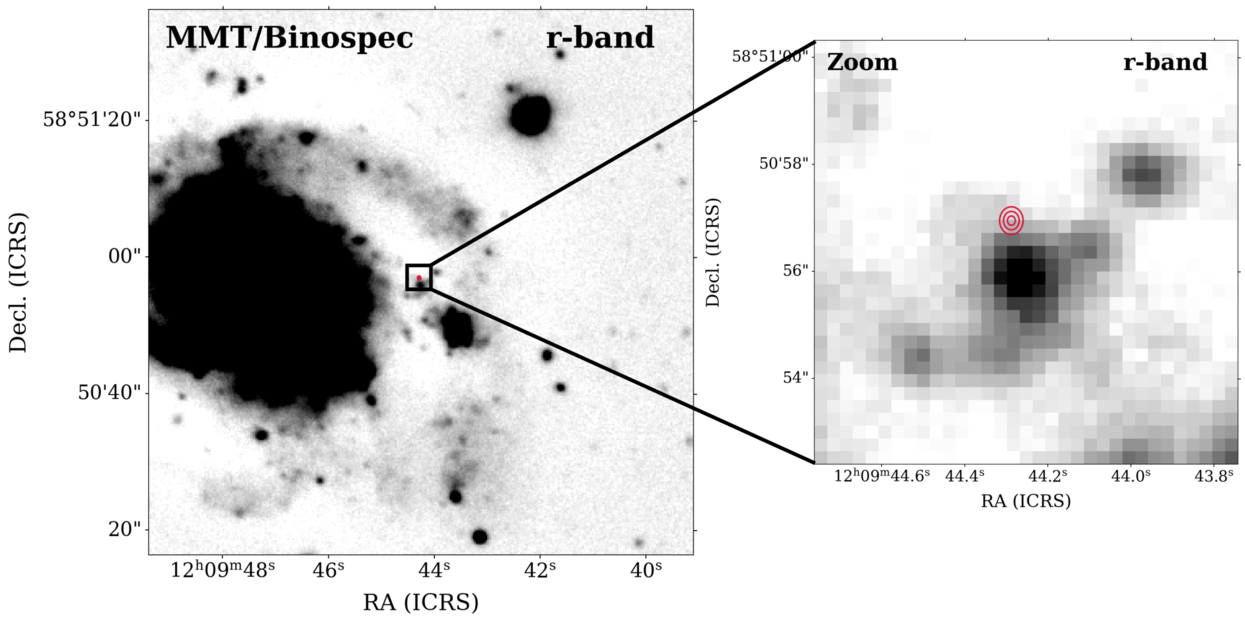
NGC 4141

MMT observation of NGC 4141 (left) and zoomed-in on FRB 20250316A’s location. The red lines show the 1-, 2-, and 3-sigma localization ellipses of the burst. Click to enlarge. [CHIME Collaboration 2025]

Discovered in March 2025 by the Canadian Hydrogen Intensity Mapping Experiment (CHIME) Outrigger array, FRB 20250316A is one of the brightest fast radio bursts ever observed. The CHIME collaboration traced the burst to the galaxy NGC 4141, 130 million light-years from Earth, and locked in on the source’s position with a precision of just 42 light-years.

Why it’s interesting:

The origins of fast radio bursts β€” bright flashes of radio waves lasting on the order of milliseconds β€” are mysterious, despite several thousand bursts having been cataloged. Among the many questions that remain is whether one-off bursts and repeating bursts arise from the same population of objects, or if they have entirely different origins. So far, FRB 20250316A appears to be a one-off burst; while it’s still possible that the source could emit another burst, the team noted that the burst’s properties don’t mesh with those of known repeating bursts. This makes the discovery and localization of FRB 20250316A an excellent opportunity to investigate the sources of one-off fast radio bursts.

More about the potential source of this burst, and prospects for pinpointing future sources:

After homing in on FRB 20250316A’s location, the CHIME collaboration embarked on a multi-wavelength follow-up campaign to learn more about where the burst came from. This campaign placed constraints on the metallicity and gas density near the source, which lies about 600 light-years from the center of the nearest star-forming region. A separate research article, published the same day as this work from the CHIME collaboration, described the discovery of a red giant star in the FRB 20250316A source region. This star may be located near FRB 20250316A’s source by chance, or it could be in a binary system with the source. With the main CHIME array in British Columbia continuing to scan for new bursts and three newly built outrigger telescopes in British Columbia, West Virginia, and California now online, we can expect many more precise localizations in the future!

Citation

The CHIME/FRB Collaboration: et al 2025 ApJL 989 L48. doi:10.3847/2041-8213/adf62f

The post Selections from 2025: Pinpointing a Bright Fast Radio Burst with CHIME appeared first on AAS Nova.

  •  

Chiming In on the Pulsar Search: Searching for Pulsars with CHIME

Pulsar diagram

Pulsars, the best timekeepers in the universe, are key to many fields within astronomy. A new survey searching for pulsars has come online and is already making discoveries.

Searching for Pulsars

Pulsars, the extremely dense cores left over from some massive stars’ deaths, act as astronomical lighthouses β€” spinning fast and emitting jets of light from their magnetic poles, they send steady pulses of light to observers on Earth. Pulsars are particularly intriguing sources, providing insights into multiple areas of astrophysics like gravitational waves, general relativity, and high-density matter properties. While more than 3,700 pulsars have been discovered to date, increasing this number will enable further exciting science.Β 

Multiple pulsar surveys have utilized single-dish radio telescopes to cover portions of the sky, and to date, these surveys have primarily focused on finding pulsars near the dense stellar population in the Milky Way’s galactic plane. While these surveys have detected many pulsars, they are limited by their small fields of view, taking longer to cover large portions of the sky, and they miss the population of pulsars that must lie within globular clusters orbiting in the galactic halo. Some low-frequency detectors address these limitations but require intense computational resources to sift through the raw data to find pulsars. How can we search for pulsars efficiently across the sky?

Introducing CHAMPSS

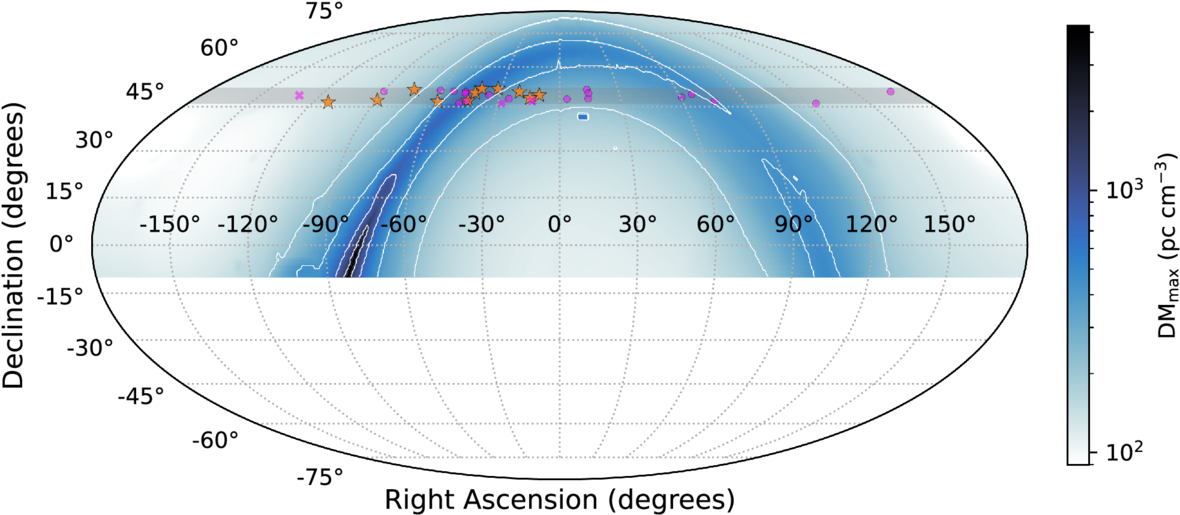
CHAMPSS pointing map

CHAMPSS pointing map showing the survey’s planned sky coverage. The orange stars correspond to the newly discovered pulsar, and the pink points denote known pulsars within the commissioning surveys. Click to enlarge. [Andrade et al 2025]

Hoping to cover the gaps in pulsar surveys thus far, researchers turned to the Canadian Hydrogen Intensity Mapping Experiment (CHIME). CHIME is a unique instrument that utilizes a set of cylindrical antennas to monitor large portions of the sky for radio sources from 400 to 800 MHz. This instrument has already made great strides in detecting transient radio events and has discovered more than 80 pulsars since its first light in 2017.Β 

With a clear opportunity to advance the pulsar search, a group of scientists developed the CHIME All-sky Multiday Pulsar Stacking Search (CHAMPSS) β€” a radio pulsar survey that covers the full northern sky daily and uses long-term data stacking to detect irregular and faint sources. Through stacking observations across multiple days, CHAMPSS builds up signals to find faint sources that would otherwise go undetected. The data processing pipeline searches in real time for strong peaks that signify a transient radio event, and follow-up analysis determines if the event is a pulsar candidate. A strong candidate then moves through further stages to confirm it as a pulsar and determine its properties.Β 

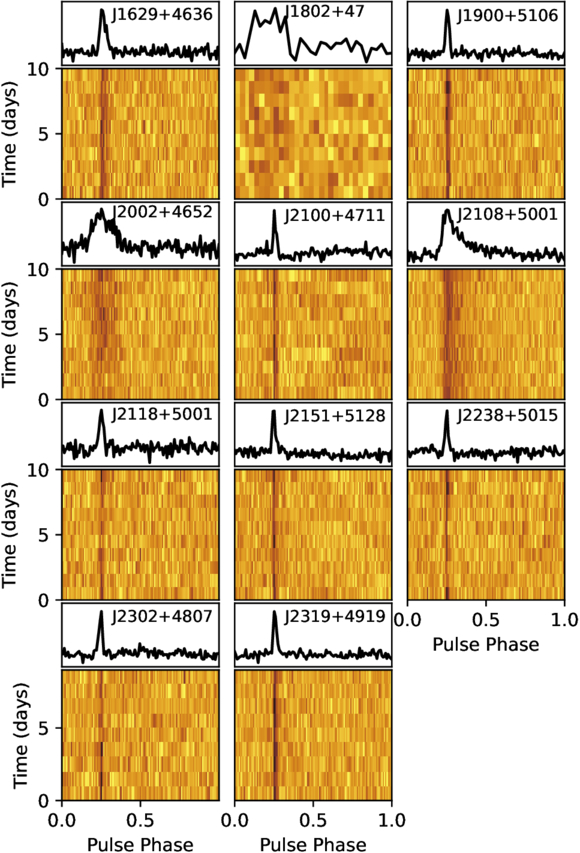
Pulsar discoveries

The 11 pulsars discovered with CHAMPSS. Click to enlarge. [Andrade et al 2025]

First Discoveries and Looking Forward

What has CHAMPSS uncovered thus far? In testing the system through multiple commissioning surveys on a small subset of the sky, the CHAMPSS collaboration has discovered 11 new pulsars with periods ranging from 0.2 to 1.5 seconds. Additionally, the collaboration tested the sensitivity of their survey by searching for known pulsars within the observed area, and they found that their predicted and detected signal-to-noise ratios for known pulsars agree well. This confirmation allows the team to advance to the next phase of the survey, and it will soon be in full swing.

CHAMPSS complements and expands upon other radio pulsar searches, discovering faint and irregular sources that are missed without repeated observations. The future of pulsar astronomy is promising, and with the advent of this survey, a new collection of pulsars will be discovered.Β 

Citation

β€œCHIME All-sky Multiday Pulsar Stacking Search (CHAMPSS): System Overview and First Discoveries,” Christopher Andrade et al 2025 ApJ 990 50. doi:10.3847/1538-4357/adeb51

The post Chiming In on the Pulsar Search: Searching for Pulsars with CHIME appeared first on AAS Nova.
  •  
❌