❌

Reading view

APOD: 2026 October 11 – Ice Fishing for Cosmic Neutrinos

APOD

Astronomy Picture of the Day

Discover the cosmos! Each day a different image or photograph of our fascinating universe is featured, along with a brief explanation written by a professional astronomer.
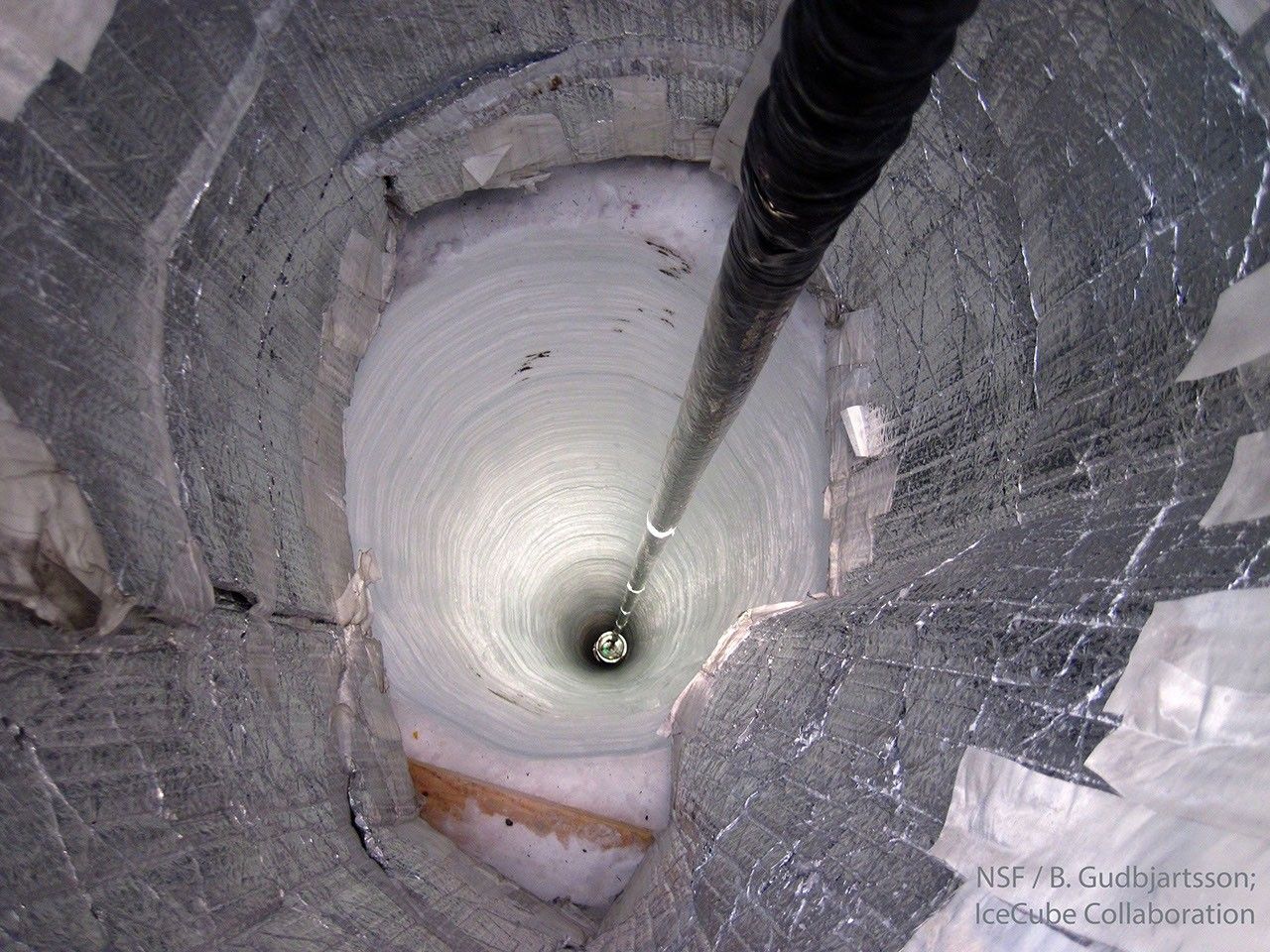
A dark cable descends into a deep carved hole of ice.  The hole is so deep that it disappears into darkness. Please see the explanation for more detailed information.

Ice Fishing for Cosmic Neutrinos

Explanation: Scientists are melting holes in the bottom of the world. In fact, almost 100 holes melted near the South Pole are now being used as an astronomical observatory. Astronomers with the IceCube Neutrino Observatory lowered a long string knotted with basketball-sized light detectors into each vertical lake. The water in each hole soon refreezes. The detectors attached to the strings are sensitive to blue light emitted in the surrounding clear ice. Such light results from fast-moving secondary particles liberated when high-energy neutrinos emitted by powerful processes out in the universe collide with ice molecules. IceCube has now detected many illuminating neutrinos. Pictured in 2010, one of the last of IceCube’s detector strings is lowered into the freezing abyss, making IceCube the largest neutrino detector ever created. In recognition of unprecedented discoveries, it was announced earlier this week that a founding leader of the IceCube Collaboration will be awarded the Nobel Prize in Physics.

Tomorrow’s picture: Moons Planet

Date: October 11, 2026
Credit: NSF, B. Gudbjartsson, IceCube Collaboration
Authors & editors: Robert Nemiroff, Jerry Bonnell, Cecilia Chirenti, Keighley Rockcliffe
A service of: ASD at NASA / GSFC,
NASA Science Activation & Michigan Tech. U.
  •  

APOD: 2026 October 10 – Lunar Farside

APOD

Astronomy Picture of the Day

Discover the cosmos! Each day a different image or photograph of our fascinating universe is featured, along with a brief explanation written by a professional astronomer.

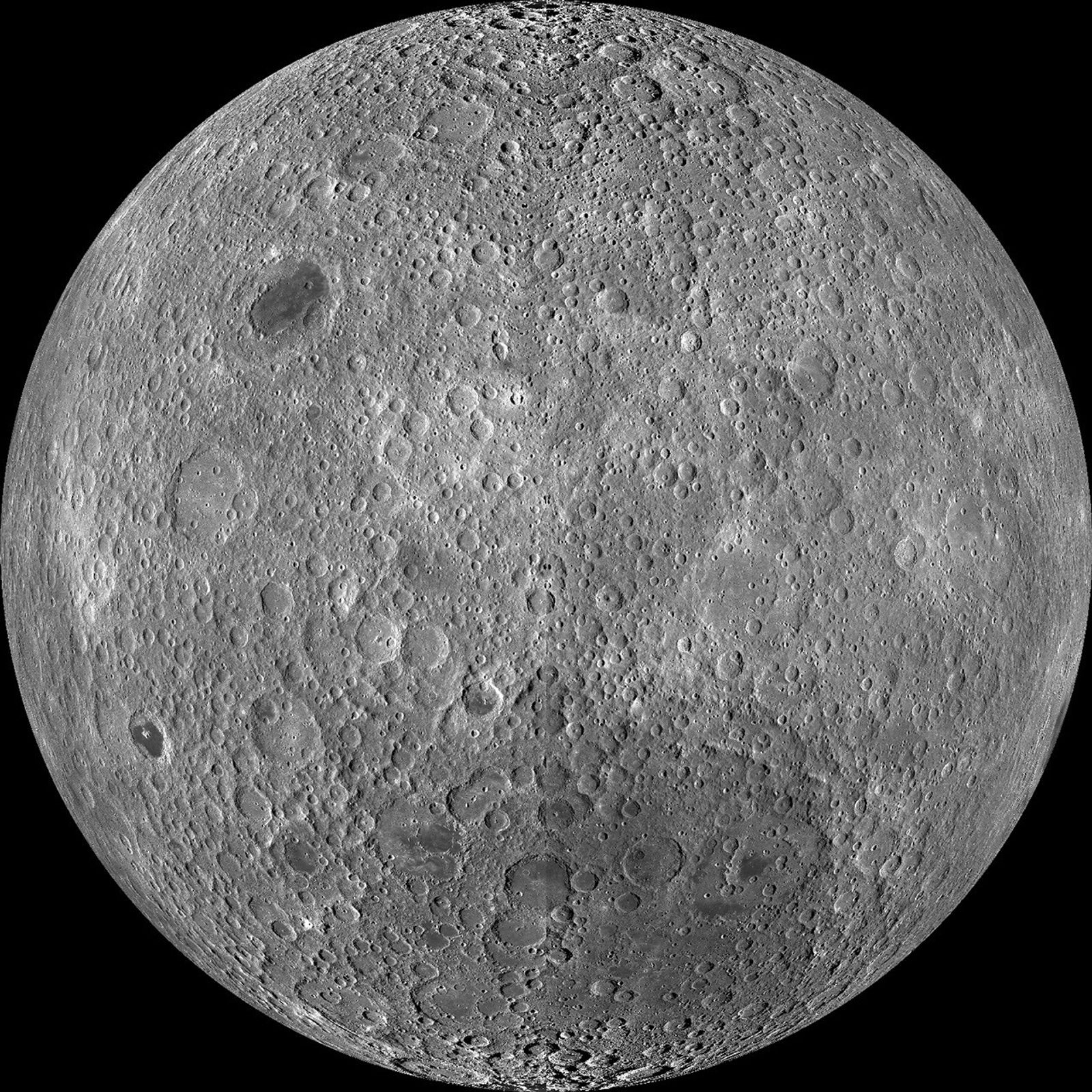
A mosaic image of the farside of the Moon.

Lunar Farside

Explanation: Tidally locked in synchronous rotation, the Moon always presents its familiar nearside to denizens of planet Earth. From lunar orbit, the Moon’s farside can become familiar, though. In fact this sharp picture, a mosaic from the Lunar Reconnaissance Orbiter’s wide angle camera, is centered on the lunar farside. Part of a global mosaic of over 15,000 images acquired between November 2009 and February 2011, the highest resolution version shows features at a scale of 100 meters per pixel. Surprisingly, the rough and battered surface of the farside looks very different from the nearside covered with smooth dark lunar maria. A likely explanation is that the farside crust is thicker, making it harder for molten material from the interior to flow to the surface and form dark, smooth maria.

Tomorrow’s picture: Sunday’s Childe

Date: October 10, 2026
Credit: NASA / GSFC / Arizona State Univ. / Lunar Reconnaissance Orbiter
Authors & editors: Jerry Bonnell, Cecilia Chirenti, Robert Nemiroff, Keighley Rockcliffe
A service of: ASD at NASA / GSFC,
NASA Science Activation & Michigan Tech. U.
  •  

APOD: 2026 October 9 – Stickney Crater

APOD

Astronomy Picture of the Day

Discover the cosmos! Each day a different image or photograph of our fascinating universe is featured, along with a brief explanation written by a professional astronomer.

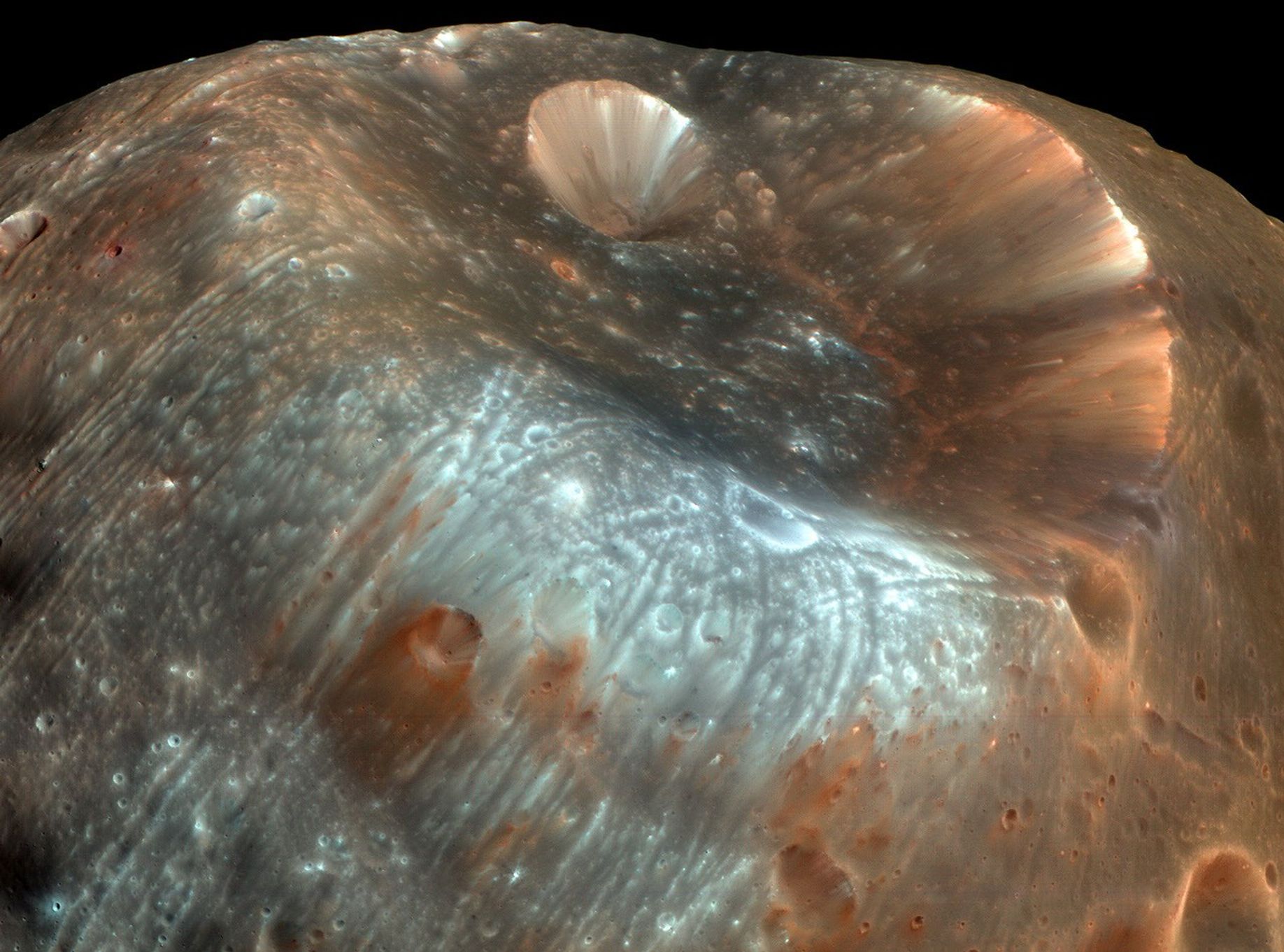
A color enhanced close-up image of Stickney Crater on Phobos.

Stickney Crater

Explanation: Stickney Crater, the largest crater on the martian moon Phobos, is named for Chloe Angeline Stickney Hall, mathematician and wife of astronomer Asaph Hall. Asaph Hall discovered both the Red Planet’s moons in 1877. Over 9 kilometers across, Stickney is nearly half the diameter of Phobos itself, so large that the impact that blasted out the crater likely came close to shattering the tiny moon. This enhanced-color image of Stickney and surroundings was recorded by the HiRISE camera onboard the Mars Reconnaissance Orbiter as it passed within some six thousand kilometers of Phobos in March of 2008. Even though the surface gravity of asteroid-like Phobos is less than 1/1000th Earth’s gravity, streaks suggest loose material slid down inside the crater walls over time. Light bluish regions near the crater’s rim could indicate a relatively freshly exposed surface. The origin of the curious grooves along the surface is mysterious but may be related to tidal stresses experienced by close-orbiting Phobos or the crater-forming impact itself.

Tomorrow’s picture: farside

Date: October 9, 2026
Credit: HiRISE, MRO, LPL (U. Arizona), NASA
Authors & editors: Jerry Bonnell, Cecilia Chirenti, Robert Nemiroff, Keighley Rockcliffe
A service of: ASD at NASA / GSFC,
NASA Science Activation & Michigan Tech. U.
  •  

APOD: 2026 September 17 – A Treasure Chest in the Carina Nebula

APOD

Astronomy Picture of the Day

Discover the cosmos! Each day a different image or photograph of our fascinating universe is featured, along with a brief explanation written by a professional astronomer.

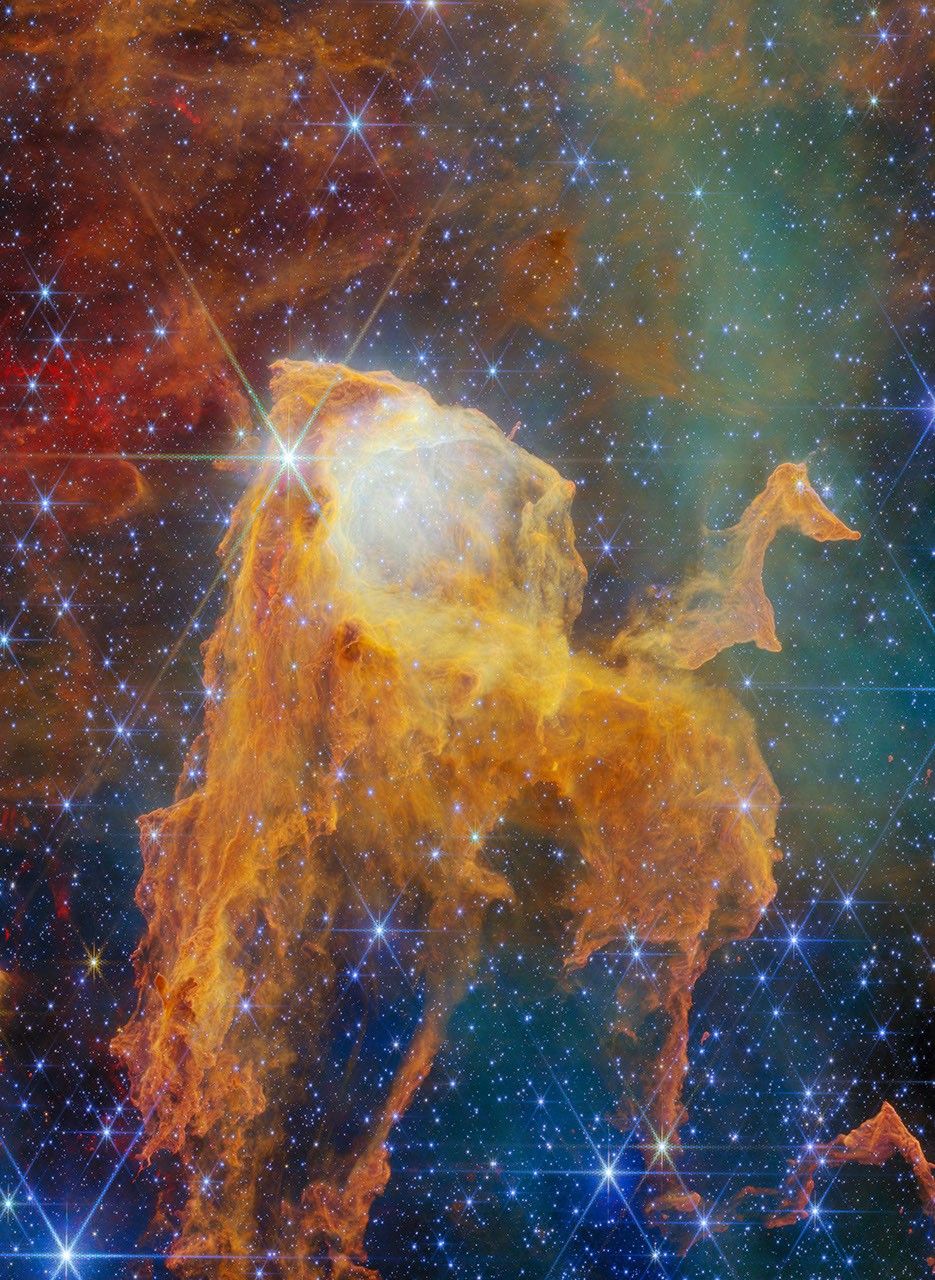
A colorful nebula resembles an open treasure chest on a field of stars

A Treasure Chest in the Carina Nebula

Explanation: This treasure chest is full of stars. The featured image was obtained with NASA‘s James Webb Space Telescope and shows a dust pillar in the Carina Nebula inside our Galaxy, roughly 7500 light-years away. It is formed by interstellar gas and dust, and shaped by powerful stellar winds and radiation from neighboring stars like the nearby Eta Carinae stellar system which is more luminous than 5 million suns. The star formation inside the pillar is excavating its head, creating the open lid of the chest. Astronomers estimate that there are about 70 stars in a compact cluster inside the pillar. This cluster is now thought to be only around 1.3 million years old. Its bounty of young stars includes a massive star approximately 19 times as massive as the Sun. More massive stars are rarer, shine brighter and evolve faster than less massive stars. They are the shiniest jewels in the treasure chest.

APOD’s main NASA site is moving : From apod.nasa.gov to science.nasa.gov/apod
Tomorrow’s picture: what’s next?

Date September 17, 2026
Credit ESA/Webb, NASA & CSA, M. Reiter; Acknowledgement: M. H. Özsaraç
Authors & editors: Cecilia Chirenti, Robert Nemiroff, Jerry Bonnell, Keighley Rockcliffe
A service of: ASD at NASA / GSFC,
NASA Science Activation & Michigan Tech. U.

The post APOD: 2026 September 17 – A Treasure Chest in the Carina Nebula appeared first on NASA Science.

  •  

APOD: 2026 September 17 – A Treasure Chest in the Carina Nebula

APOD

Astronomy Picture of the Day

Discover the cosmos! Each day a different image or photograph of our fascinating universe is featured, along with a brief explanation written by a professional astronomer.

A colorful nebula resembles an open treasure chest on a field of stars

A Treasure Chest in the Carina Nebula

Explanation: This treasure chest is full of stars. The featured image was obtained with NASA‘s James Webb Space Telescope and shows a dust pillar in the Carina Nebula inside our Galaxy, roughly 7500 light-years away. It is formed by interstellar gas and dust, and shaped by powerful stellar winds and radiation from neighboring stars like the nearby Eta Carinae stellar system which is more luminous than 5 million suns. The star formation inside the pillar is excavating its head, creating the open lid of the chest. Astronomers estimate that there are about 70 stars in a compact cluster inside the pillar. This cluster is now thought to be only around 1.3 million years old. Its bounty of young stars includes a massive star approximately 19 times as massive as the Sun. More massive stars are rarer, shine brighter and evolve faster than less massive stars. They are the shiniest jewels in the treasure chest.

APOD’s main NASA site is moving : From apod.nasa.gov to science.nasa.gov/apod
Tomorrow’s picture: what’s next?

Date September 17, 2026
Credit ESA/Webb, NASA & CSA, M. Reiter; Acknowledgement: M. H. Özsaraç
Authors & editors: Cecilia Chirenti, Robert Nemiroff, Jerry Bonnell, Keighley Rockcliffe
A service of: ASD at NASA / GSFC,
NASA Science Activation & Michigan Tech. U.
  •  

APOD: 2026 September 16 – Webb’s View of M64

APOD

Astronomy Picture of the Day

Discover the cosmos! Each day a different image or photograph of our fascinating universe is featured, along with a brief explanation written by a professional astronomer.

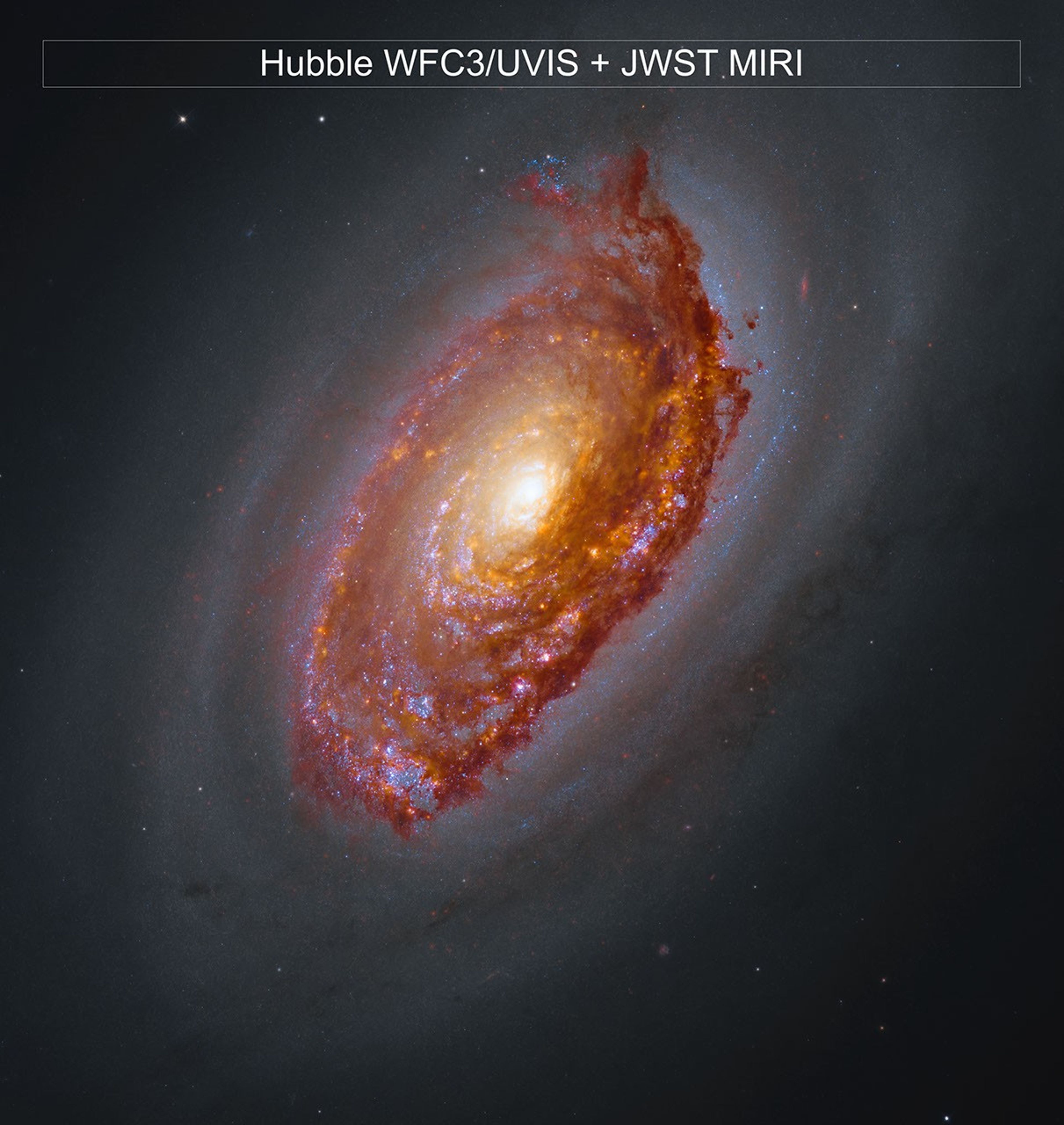
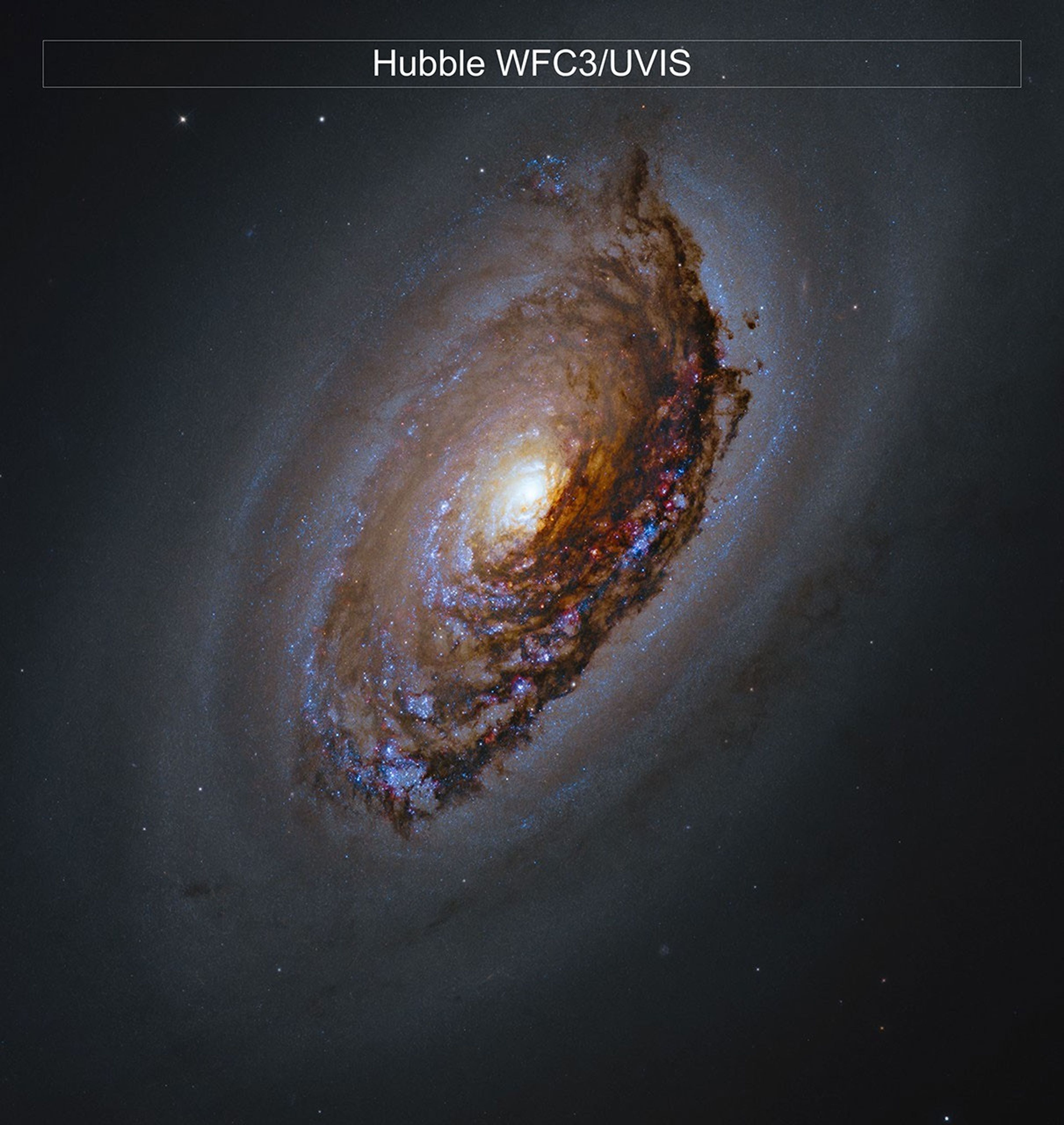
Hubble and JWST image of M64. A massive spiral galaxy glows with a yellow core, surrounded by arms full of orange-brown dust and pink and blue patches of star formation. Framed by a haze of dark dust, the galaxy shines against black space dotted with a few stars.Hubble image of M64. A massive spiral galaxy glows with a yellow core, surrounded by arms full of dark dust and pink and blue patches of star formation. Framed by a haze of dark dust, the galaxy shines against black space dotted with a few stars.

Webb’s View of M64

Explanation: Sometimes where Hubble finds darkness, Webb sees light. An example is today’s composite images of Messier 64 (M64), a nearby spiral galaxy of many names. The dark band of dust partially blocking its bright core earned it the moniker “the Black Eye Galaxy.” Webb’s Mid-InfraRed Instrument (MIRI) sees that dust, shown in red, as it absorbs and re-emits light from surrounding newborn stars. These young stars are embedded in pink star-forming regions in the Hubble-only image. M64’s inner and outer gas regions counter-rotate, creating regions of increased star formation where the two gas “currents” meet and compress. A merger between M64 and a smaller galaxy was likely the cause of the opposing motion of the outer gas. Spiral galaxies were once thought to have peaceful histories. M64 was key evidence that spiral galaxies, including the Milky Way, can and do experience mergers. Webb’s view of M64 will tell astronomers about the structure, motion, and composition of the galaxy’s dust and add context to the galaxy’s merger history and evolution.

APOD’s main NASA site is moving: From apod.nasa.gov to science.nasa.gov/apod
Tomorrow’s picture: treasure

Date: September 16, 2026
Credit: NASA, CSA, ESA, F. Belfiore (ESO), J. Lee (STScI), A. Leroy (OSU), and D. Thilker (JHU); Processing: G. Kober (NASA/Catholic University)
Authors & editors: Keighley Rockcliffe, Robert Nemiroff, Jerry Bonnell, Cecilia Chirenti
A service of: ASD at NASA / GSFC,
NASA Science Activation & Michigan Tech. U.
  •  

APOD: 2026 September 16 – Webb’s View of M64

APOD

Astronomy Picture of the Day

Discover the cosmos! Each day a different image or photograph of our fascinating universe is featured, along with a brief explanation written by a professional astronomer.

Hubble and JWST image of M64. A massive spiral galaxy glows with a yellow core, surrounded by arms full of orange-brown dust and pink and blue patches of star formation. Framed by a haze of dark dust, the galaxy shines against black space dotted with a few stars.Hubble image of M64. A massive spiral galaxy glows with a yellow core, surrounded by arms full of dark dust and pink and blue patches of star formation. Framed by a haze of dark dust, the galaxy shines against black space dotted with a few stars.

Webb's View of M64

Explanation: Sometimes where Hubble finds darkness, Webb sees light. An example is today’s composite images of Messier 64 (M64), a nearby spiral galaxy of many names. The dark band of dust partially blocking its bright core earned it the moniker “the Black Eye Galaxy.” Webb’s Mid-InfraRed Instrument (MIRI) sees that dust, shown in red, as it absorbs and re-emits light from surrounding newborn stars. These young stars are embedded in pink star-forming regions in the Hubble-only image. M64’s inner and outer gas regions counter-rotate, creating regions of increased star formation where the two gas “currents” meet and compress. A merger between M64 and a smaller galaxy was likely the cause of the opposing motion of the outer gas. Spiral galaxies were once thought to have peaceful histories. M64 was key evidence that spiral galaxies, including the Milky Way, can and do experience mergers. Webb’s view of M64 will tell astronomers about the structure, motion, and composition of the galaxy’s dust and add context to the galaxy’s merger history and evolution.

APOD’s main NASA site is moving: From apod.nasa.gov to science.nasa.gov/apod
Tomorrow’s picture: treasure

Date: September 16, 2026
Credit: NASA, CSA, ESA, F. Belfiore (ESO), J. Lee (STScI), A. Leroy (OSU), and D. Thilker (JHU); Processing: G. Kober (NASA/Catholic University)
Authors & editors: Keighley Rockcliffe, Robert Nemiroff, Jerry Bonnell, Cecilia Chirenti
A service of: ASD at NASA / GSFC,
NASA Science Activation & Michigan Tech. U.

The post APOD: 2026 September 16 – Webb’s View of M64 appeared first on NASA Science.

  •  

APOD: 2026 September 15 – A Daytime Eclipse: Moon Occults Venus

APOD

Astronomy Picture of the Day

Discover the cosmos! Each day a different image or photograph of our fascinating universe is featured, along with a brief explanation written by a professional astronomer.

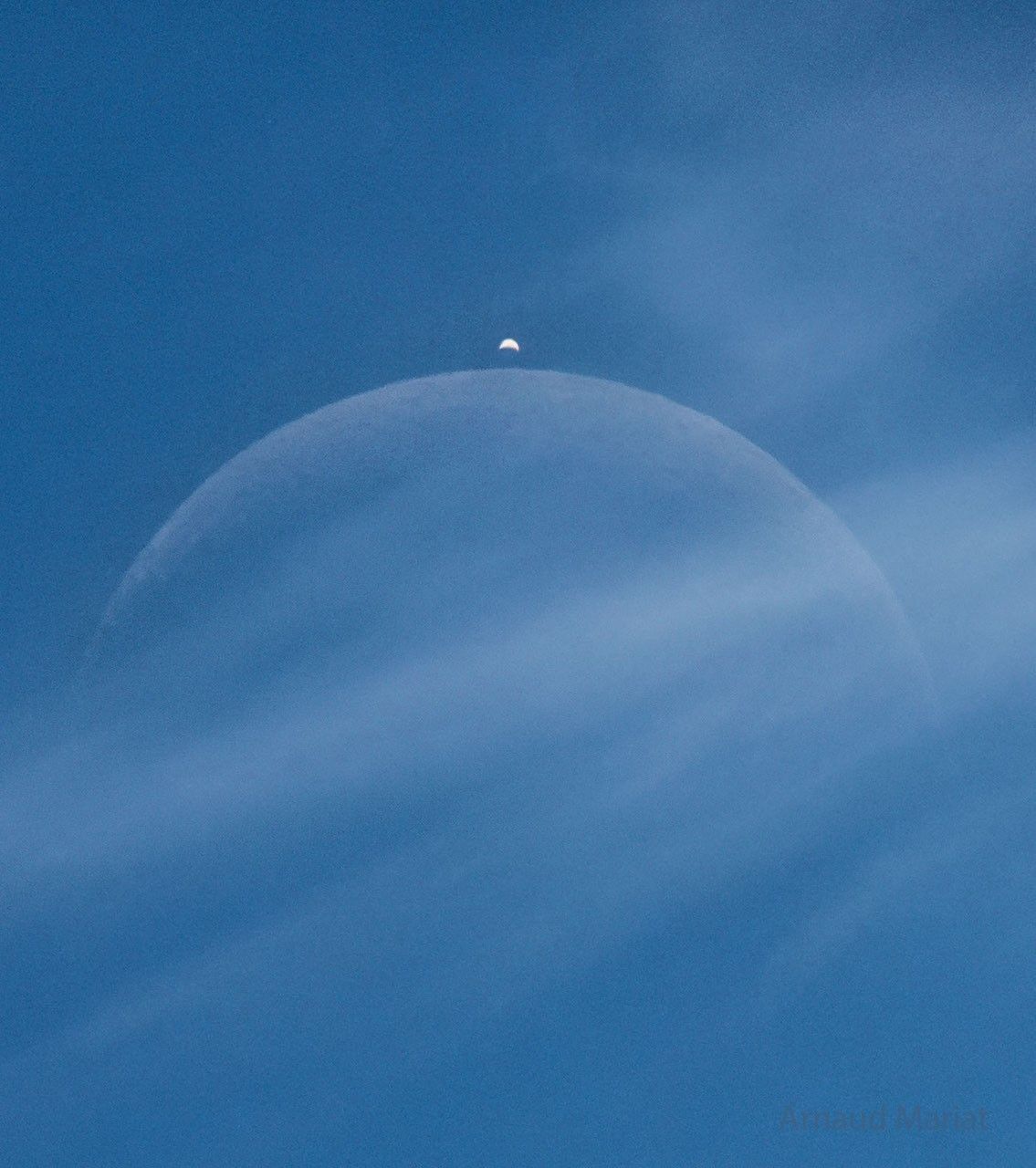
A blue sky has a light cloud crossing the middle of  the image. Two crescent objects are visible through the  cloud, a large faint crescent in the center and a brighter crescent above it.

A Daytime Eclipse: Moon Occults Venus

There was something behind the clouds. Upon close inspection, it was the Moon, which was hard to see yesterday around noon above the small village of Cessy, France. But soon, it was not only the Moon. As expected, a bright dot suddenly appeared from behind the Moon — the planet Venus far in the distance. Captured in the single featured exposure, both appeared to show a crescent phase. The Moon’s crescent was quite slight — with only about 10 percent of its face illuminated by the Sun. In contrast, Venus’s crescent was more full — showing about 25 percent illumination. Venus appeared brighter because it is nearer the Sun and because its clouds are more reflective than the dark lunar surface. An occultation of Venus by the Moon is visible to only about 10 percent of the Earth, but in yesterday’s event even most of that was experiencing daytime.

APOD’s main NASA site is moving: From apod.nasa.gov to science.nasa.gov/apod
Tomorrow’s picture: galactic eye

Date September 15, 2026
Credit & Copyright Arnaud Mariat
Authors & editors: Robert Nemiroff, Jerry Bonnell, Cecilia Chirenti, Keighley Rockcliffe
A service of: ASD at NASA / GSFC,
NASA Science Activation & Michigan Tech. U.
  •  

APOD: 2026 September 11 – M83: The Southern Pinwheel

APOD

Astronomy Picture of the Day

Discover the cosmos! Each day a different image or photograph of our fascinating universe is featured, along with a brief explanation written by a professional astronomer.

A spiral galaxy is shown in front of a dark field of stars.

M83: The Southern Pinwheel

Explanation: Beautiful and bright spiral galaxy M83 lies some twelve million light-years away, near the southeastern tip of the very long constellation Hydra. Prominent spiral arms traced by dark dust lanes and blue star clusters lend this galaxy its popular name, the Southern Pinwheel. Still, reddish star forming regions that dot this cosmic pinwheel’s spiral arms have suggested another nickname, the Thousand-Ruby Galaxy. A mere 40,000 light-years across, smaller than the Milky Way, M83 is a member of a group of galaxies that includes active galaxy Centaurus A. In fact, the core of M83 itself is bright at x-ray energies, showing a high concentration of neutron stars and black holes left from an intense burst of star formation. This sharp, groundbased telescopic view also features foreground Milky Way stars and distant background galaxies.

APOD’s main NASA site is moving: From apod.nasa.gov to science.nasa.gov/apod
Tomorrow’s picture: lunar sun catcher

Date September 11, 2026
Credit & Copyright Aldo Zanetti
Authors & editors: Jerry Bonnell, Robert Nemiroff, Cecilia Chirenti, Keighley Rockcliffe
A service of: ASD at NASA / GSFC,
NASA Science Activation & Michigan Tech. U.

The post APOD: 2026 September 11 – M83: The Southern Pinwheel appeared first on NASA Science.

  •  

APOD: 2026 September 11 – M83: The Southern Pinwheel

APOD

Astronomy Picture of the Day

Discover the cosmos! Each day a different image or photograph of our fascinating universe is featured, along with a brief explanation written by a professional astronomer.

A spiral galaxy is shown in front of a dark field of stars.

M83: The Southern Pinwheel

Explanation: Beautiful and bright spiral galaxy M83 lies some twelve million light-years away, near the southeastern tip of the very long constellation Hydra. Prominent spiral arms traced by dark dust lanes and blue star clusters lend this galaxy its popular name, the Southern Pinwheel. Still, reddish star forming regions that dot this cosmic pinwheel’s spiral arms have suggested another nickname, the Thousand-Ruby Galaxy. A mere 40,000 light-years across, smaller than the Milky Way, M83 is a member of a group of galaxies that includes active galaxy Centaurus A. In fact, the core of M83 itself is bright at x-ray energies, showing a high concentration of neutron stars and black holes left from an intense burst of star formation. This sharp, groundbased telescopic view also features foreground Milky Way stars and distant background galaxies.

APOD’s main NASA site is moving: From apod.nasa.gov to science.nasa.gov/apod
Tomorrow’s picture: lunar sun catcher

Date September 11, 2026
Credit & Copyright Aldo Zanetti
Authors & editors: Jerry Bonnell, Robert Nemiroff, Cecilia Chirenti, Keighley Rockcliffe
A service of: ASD at NASA / GSFC,
NASA Science Activation & Michigan Tech. U.
  •  

APOD: 2026 September 10 – LDN 1295: The Giraffe Nebula

APOD

Astronomy Picture of the Day

Discover the cosmos! Each day a different image or photograph of our fascinating universe is featured, along with a brief explanation written by a professional astronomer.

LDN 1295: The Giraffe Nebula

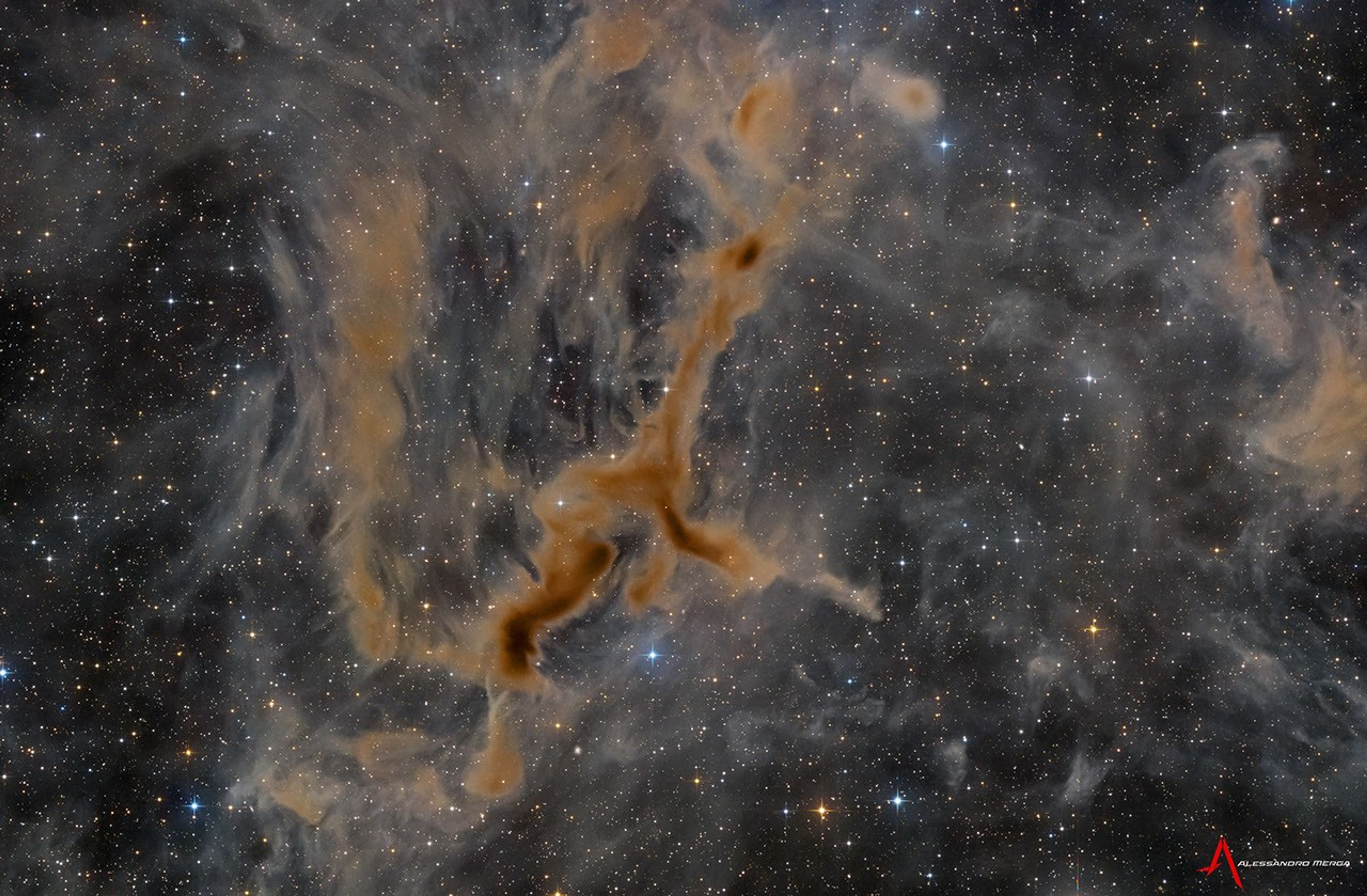
Explanation: What does this image look like to you? Many see a giraffe facing right, with neck stretched high and long legs mid-stride (but some may see a squirrel instead). The featured image shows LDN 1295, also called the Giraffe Nebula, in the constellation of the mythical queen of Aethiopia (Cassiopeia). It is an object in the Lynds Catalogue of Dark Nebulas, compiled in 1962 by American astronomer Beverly Lynds, a pioneer for women in astronomy and astrophysics. Dark nebulas are interstellar clouds of dust and gas that block the visible light of the stars behind them. These nebulas are often faint and challenging targets for astrophotographers. Why do we see animal shapes and faces in nebulas, clouds, and pretty much everywhere? It is due to pareidolia, our tendency to look for familiar patterns. Pareidolia may provide animals with an evolutionary advantage, for example in identifying (and avoiding) predators.

APOD’s main NASA site is moving : From apod.nasa.gov to science.nasa.gov/apod
Tomorrow’s picture: freewheeling

Date September 10, 2026
Credit & Copyright Alessandro Merga
Authors & editors: Cecilia Chirenti, Robert Nemiroff, Jerry Bonnell, Keighley Rockcliffe
A service of: ASD at NASA / GSFC,
NASA Science Activation & Michigan Tech. U.
  •  

APOD: 2026 August 12 – Perseids over a Little Planet

APOD

Astronomy Picture of the Day

Discover the cosmos! Each day a different image or photograph of our fascinating universe is featured, along with a brief explanation written by a professional astronomer.

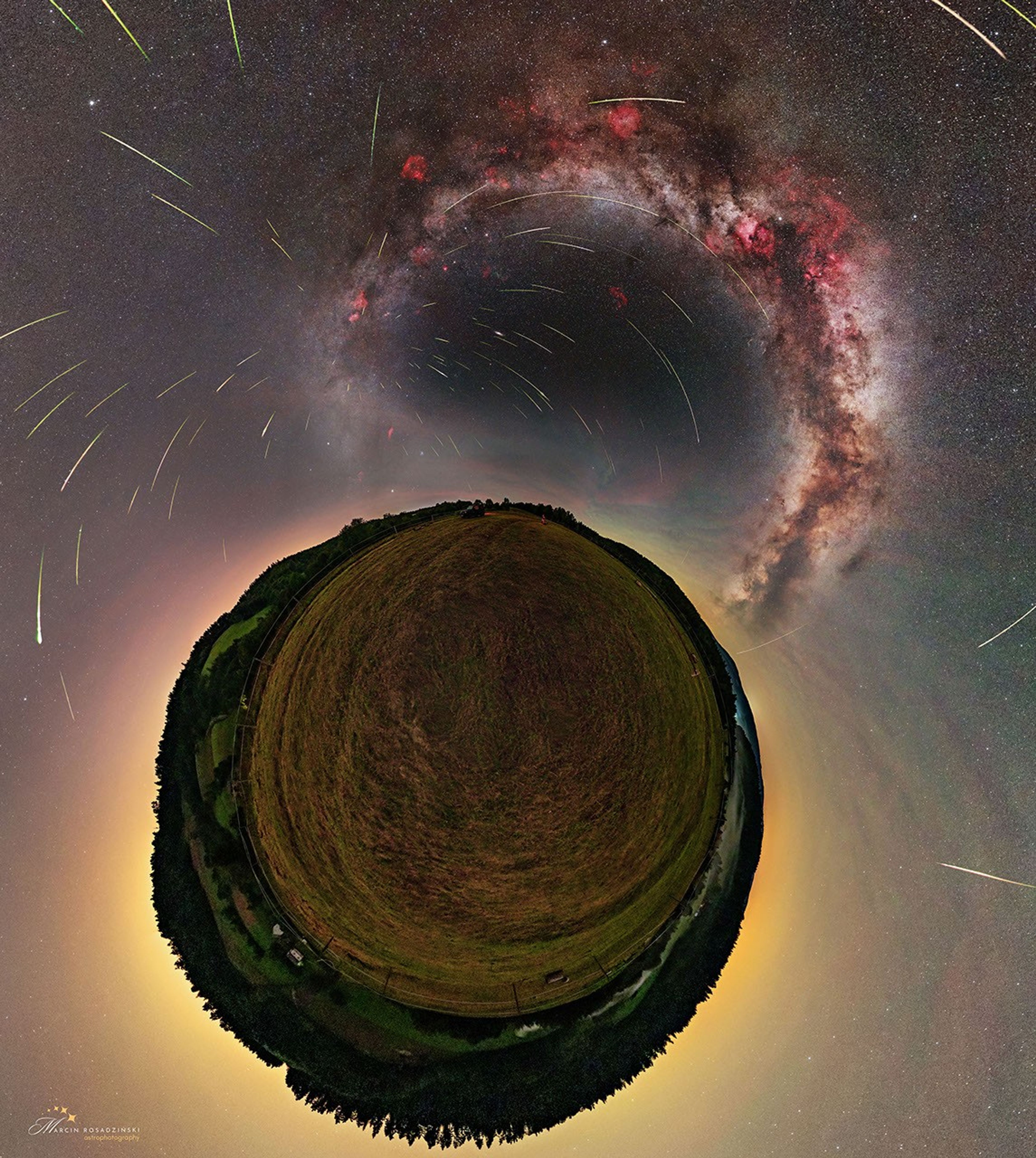
The ground is shown in a little planet perspective, surrounded by the sky with a diffuse glow. The Milky Way is visible in the sky, as well as some nebulae in red and over a hundred meteors. Most of them appear to come from the same point.

Perseids over a Little Planet

Explanation: It looks like a view from the Little Prince‘s planet. The featured image is a throwback to the 2024 Perseid meteor shower, surrounded in this projection by the Bieszczady Mountains in Poland. Visible in the sky is the arch of the Milky Way, along with several nebulas in red and over a hundred meteors pointing to the radiant. The Perseids are easily visible and quite popular in the Northern Hemisphere summer. (Watching meteor showers in the winter is less convenient for a good reason). This year they are expected to offer an even more dazzling spectacle than usual, because the peak coincides with a new moon. The 2026 Perseid meteor shower will peak tonight with as many as 50-100 meteors per hour, when the Earth’s path crosses through debris left behind by Comet Swift-Tuttle. Typically, the best times for seeing the meteors are between midnight and pre-dawn. You won’t need binoculars to see the meteors, but a lawn chair and a dark sky location help.

NASA Stream: August 12 Total Solar Eclipse.
Tomorrow’s picture: pixels in space

Date August 12, 2026
Credit & Copyright: Marcin Rosadziński
Authors & editors: Cecilia Chirenti, Jerry Bonnell, Robert Nemiroff, Keighley Rockcliffe
A service of: ASD at NASA / GSFC,
NASA Science Activation & Michigan Tech. U.
  •  

APOD: 2026 August 11 – Six Moons of Saturn

APOD

Astronomy Picture of the Day

Discover the cosmos! Each day a different image or photograph of our fascinating universe is featured, along with a brief explanation written by a professional astronomer.

A telescopic image of Saturn with rings and six moons.

Six Moons of Saturn

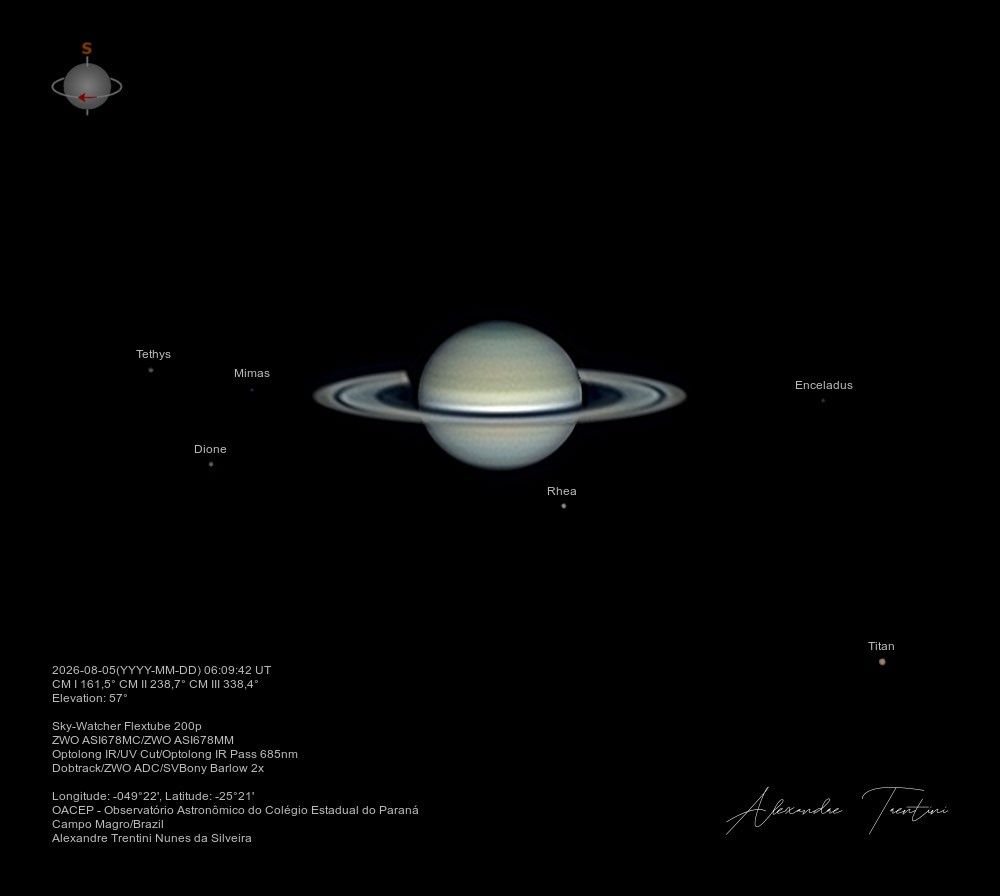
Explanation: How many moons does Saturn have? While the total will likely continue to grow, as of June 2026 the ringed gas giant had 293 confirmed moons. That’s easily more than any other planet of the Solar System, including ruling gas giant Jupiter with a mere 115 confirmed moons. Most of Saturn’s known moons are small, irregular satellites. Many are only few kilometers to a fraction of a kilometer across and grouped in tilted outer orbits. Six of its largest satellites can be seen here, though, in this sharp telescopic Saturnian family portrait taken on August 5. Larger than Earth’s Moon and even slightly larger than inner planet Mercury, Titan, with a diameter of 5,150 kilometers, is at lower right. You can also spot icy major moons Mimas, Tethys, Enceladus, Dione, and Rhea in the frame. Saturn’s first known natural satellite, Titan was discovered in 1655 by Dutch astronomer Christiaan Huygens. During the space age Voyager and Cassini discoveries have added to the swelling ranks of Saturnian moons.

NASA Stream: August 12 Total Solar Eclipse.
Tomorrow’s picture: pixels in space

Date August 11, 2026
Credit & Copyright: Alexandre Trentini
Authors & editors: Jerry Bonnell, Cecilia Chirenti, Robert Nemiroff, Keighley Rockcliffe
A service of: ASD at NASA / GSFC,
NASA Science Activation & Michigan Tech. U.

The post APOD: 2026 August 11 – Six Moons of Saturn appeared first on NASA Science.

  •  

APOD: 2026 August 11 – Six Moons of Saturn

APOD

Astronomy Picture of the Day

Discover the cosmos! Each day a different image or photograph of our fascinating universe is featured, along with a brief explanation written by a professional astronomer.

A telescopic image of Saturn with rings and six moons.

Six Moons of Saturn

Explanation: How many moons does Saturn have? While the total will likely continue to grow, as of June 2026 the ringed gas giant had 293 confirmed moons. That’s easily more than any other planet of the Solar System, including ruling gas giant Jupiter with a mere 115 confirmed moons. Most of Saturn’s known moons are small, irregular satellites. Many are only few kilometers to a fraction of a kilometer across and grouped in tilted outer orbits. Six of its largest satellites can be seen here, though, in this sharp telescopic Saturnian family portrait taken on August 5. Larger than Earth’s Moon and even slightly larger than inner planet Mercury, Titan, with a diameter of 5,150 kilometers, is at lower right. You can also spot icy major moons Mimas, Tethys, Enceladus, Dione, and Rhea in the frame. Saturn’s first known natural satellite, Titan was discovered in 1655 by Dutch astronomer Christiaan Huygens. During the space age Voyager and Cassini discoveries have added to the swelling ranks of Saturnian moons.

NASA Stream: August 12 Total Solar Eclipse.
Tomorrow’s picture: pixels in space

Date August 11, 2026
Credit & Copyright: Alexandre Trentini
Authors & editors: Jerry Bonnell, Cecilia Chirenti, Robert Nemiroff, Keighley Rockcliffe
A service of: ASD at NASA / GSFC,
NASA Science Activation & Michigan Tech. U.
  •  

APOD: 2026 August 10 – Three Galaxy Pairs

APOD

APOD: 2026 August 10 – Three Galaxy Pairs

Discover the cosmos! Each day a different image or photograph of our fascinating universe is featured, along with a brief explanation written by a professional astronomer.

Three galaxy pairs are arranged vertically in the same field of view..Three galaxy pairs are arranged vertically in the same field of view..

Three Galaxy Pairs

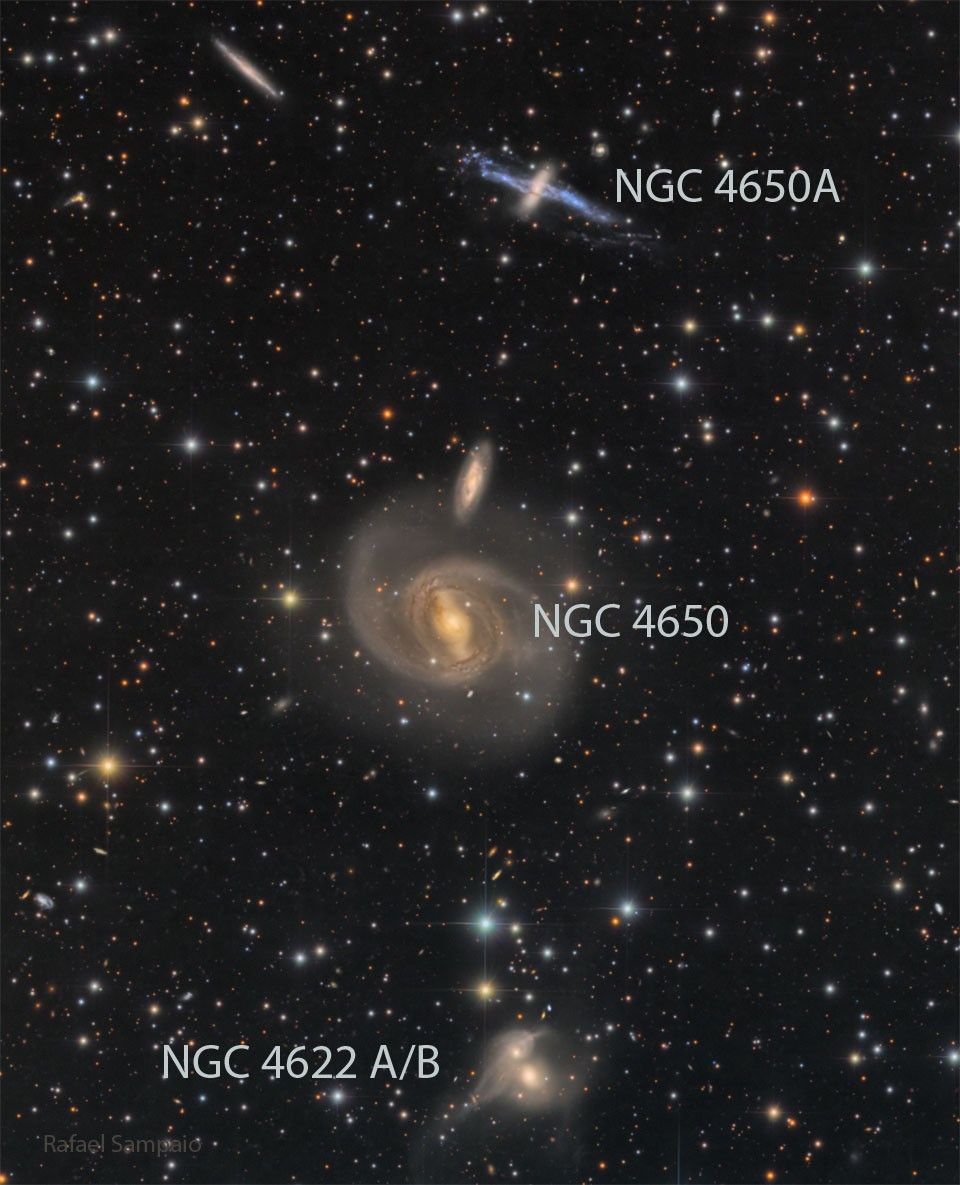
Explanation: Each of these pairs of galaxies is different. The two galaxies at the top are likely not interacting, at least presently. However, the top galaxy with the blue stripe, NGC 4650A, is a polar ring galaxy and may be the result of a past galaxy collision. The two galaxies in the middle of the featured image appear like they could be interacting gravitationally — but their relative speeds make this unlikely. Of these two, the larger galaxy, NGC 4650, is a spiral galaxy with a bright bar of stars across its center. The two galaxies at the bottom are actively interacting. Possibly in a billion years or so, NGC 4622A and NGC 4622B will merge and become one single galaxy. All of these galaxies are likely members of the larger Centaurus Galaxy Cluster.

Tomorrow’s picture: many moons

Date: August 10, 2026
Credit & Copyright: Rafael Sampaio
Authors & editors: Robert Nemiroff, Jerry Bonnell, Cecilia Chirenti, Keighley Rockcliffe
A service of: ASD at NASA / GSFC,
NASA Science Activation & Michigan Tech. U.
  •  

APOD: 2026 August 9 – Contemplating the Sun

APOD

Astronomy Picture of the Day

Discover the cosmos! Each day a different image or photograph of our fascinating universe is featured, along with a brief explanation written by a professional astronomer.

Contemplating the Sun

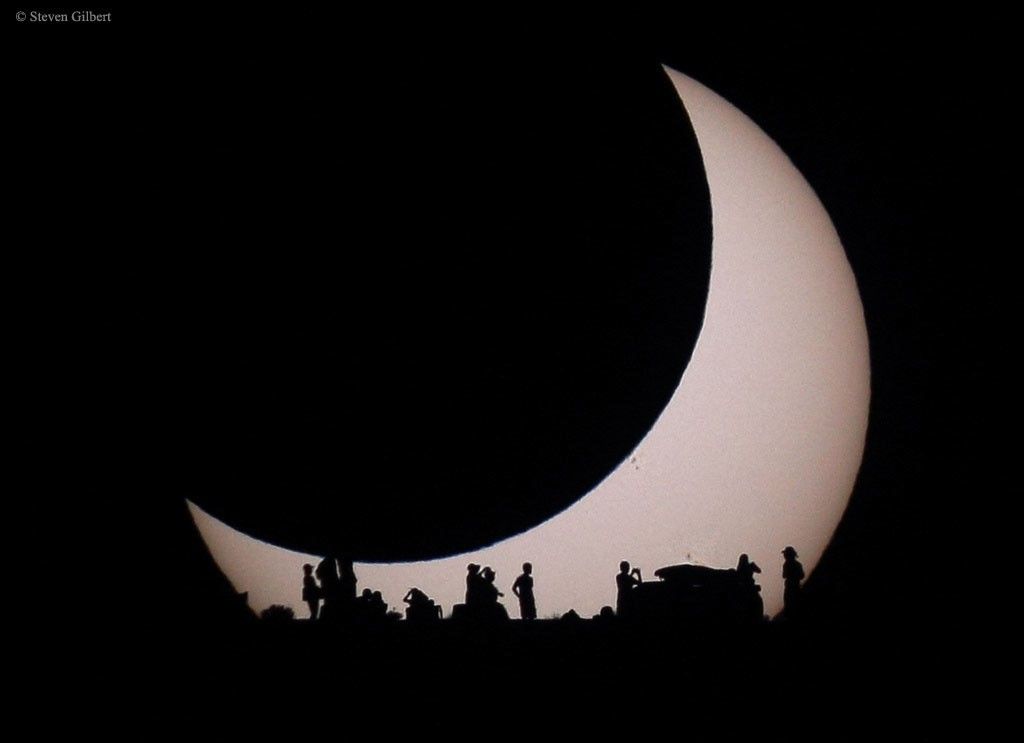
Explanation: Have you contemplated your home star recently? Featured here, a Sun partially eclipsed on the top left by the Moon is also seen eclipsed by earthlings contemplating the eclipse below. This spectacular menagerie of silhouettes was taken in 2012 from the Glen Canyon National Recreation Area near Page, Arizona, USA, where park rangers and astronomers expounded on the unusual event to interested gatherers. Also, faintly visible on the Sun’s disk, just to the lower right of the dark Moon’s disk, is a group of sunspots. A new solar eclipse will occur this week and give many people in northeastern North America, Europe, and northwestern Africa a new chance to contemplate a partially eclipsed Sun. A thin swath of Earth from Greenland to Portugal will further experience a total solar eclipse. An open question is whether any meteors from the peaking Perseids will be visible during totality.

Date August 9, 2026
Credit & Copyright Steven Gilbert
Authors & editors: Robert Nemiroff, Jerry Bonnell, Cecilia Chirenti, Keighley Rockcliffe
A service of: ASD at NASA / GSFC,
NASA Science Activation & Michigan Tech. U.

The post APOD: 2026 August 9 – Contemplating the Sun appeared first on NASA Science.

  •  

APOD: 2026 August 8 – A Messier Moment for Tempel 2

APOD

Astronomy Picture of the Day

Discover the cosmos! Each day a different image or photograph of our fascinating universe is featured, along with a brief explanation written by a professional astronomer.

Greenish cometary coma of 10P/Tempel 2 and globular star cluster M30

A Messier Moment for Tempel 2

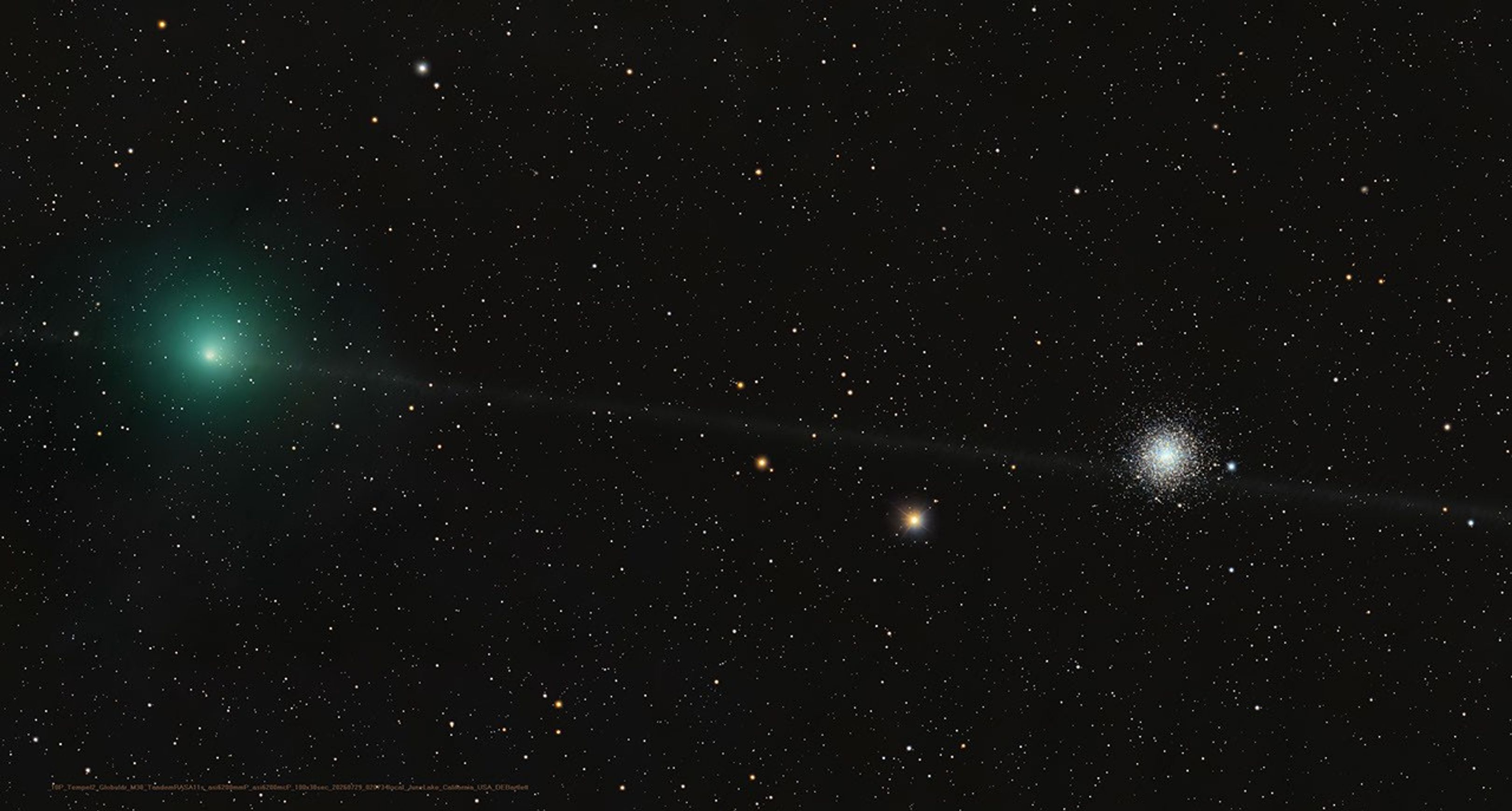
Explanation: Which of these is not a comet? You guessed it – the one on the right is a globular star cluster. The diffuse greenish coma of periodic comet 10P/Tempel 2 is at left in the frame. In fact the globular star cluster is Messier 30, also known as M30, or the 30th entry in astronomer Charles Messier’s catalog of things which are not comets. The well-known 18th century astronomer kept a list of objects he observed, now his famous Messier Catalogue of Nebulae and Star Clusters, which did not move from night to night against the background stars and so were not the comets he was hunting for. So the famous comet hunter would get the correct answer too, even though his telescope would show both 10P/Tempel 2 and distant star cluster as similar looking faint and fuzzy objects in his field of view. Recorded on July 29, this modern telescopic image captures periodic comet Tempel 2 as it briefly swept close on the sky to M30. While the periodic comet’s faint, narrow, orbital dust trail seems to pierce the globular star cluster, Tempel 2 was a mere 3.5 light-minutes away. Messier 30 is some 28,000 light-years distant.

Tomorrow’s picture: Contemplating the Sun

Date August 8, 2026
Credit & Copyright Dan Bartlett
Authors & editors: Jerry Bonnell, Cecilia Chirenti, Robert Nemiroff, Keighley Rockcliffe
A service of: ASD at NASA / GSFC,
NASA Science Activation & Michigan Tech. U.
  •  

APOD: 2026 August 8 – A Messier Moment for Tempel 2

APOD

Astronomy Picture of the Day

Discover the cosmos! Each day a different image or photograph of our fascinating universe is featured, along with a brief explanation written by a professional astronomer.

Greenish cometary coma of 10P/Tempel 2 and globular star cluster M30

A Messier Moment for Tempel 2

Explanation: Which of these is not a comet? You guessed it – the one on the right is a globular star cluster. The diffuse greenish coma of periodic comet 10P/Tempel 2 is at left in the frame. In fact the globular star cluster is Messier 30, also known as M30, or the 30th entry in astronomer Charles Messier’s catalog of things which are not comets. The well-known 18th century astronomer kept a list of objects he observed, now his famous Messier Catalogue of Nebulae and Star Clusters, which did not move from night to night against the background stars and so were not the comets he was hunting for. So the famous comet hunter would get the correct answer too, even though his telescope would show both 10P/Tempel 2 and distant star cluster as similar looking faint and fuzzy objects in his field of view. Recorded on July 29, this modern telescopic image captures periodic comet Tempel 2 as it briefly swept close on the sky to M30. While the periodic comet’s faint, narrow, orbital dust trail seems to pierce the globular star cluster, Tempel 2 was a mere 3.5 light-minutes away. Messier 30 is some 28,000 light-years distant.

Tomorrow’s picture: Contemplating the Sun

Date August 8, 2026
Credit & Copyright Dan Bartlett
Authors & editors: Jerry Bonnell, Cecilia Chirenti, Robert Nemiroff, Keighley Rockcliffe
A service of: ASD at NASA / GSFC,
NASA Science Activation & Michigan Tech. U.

The post APOD: 2026 August 8 – A Messier Moment for Tempel 2 appeared first on NASA Science.

  •  

APOD: 2026 August 7 – Rubin’s Cosmos Field

APOD

Astronomy Picture of the Day

Discover the cosmos! Each day a different image or photograph of our fascinating universe is featured, along with a brief explanation written by a professional astronomer.

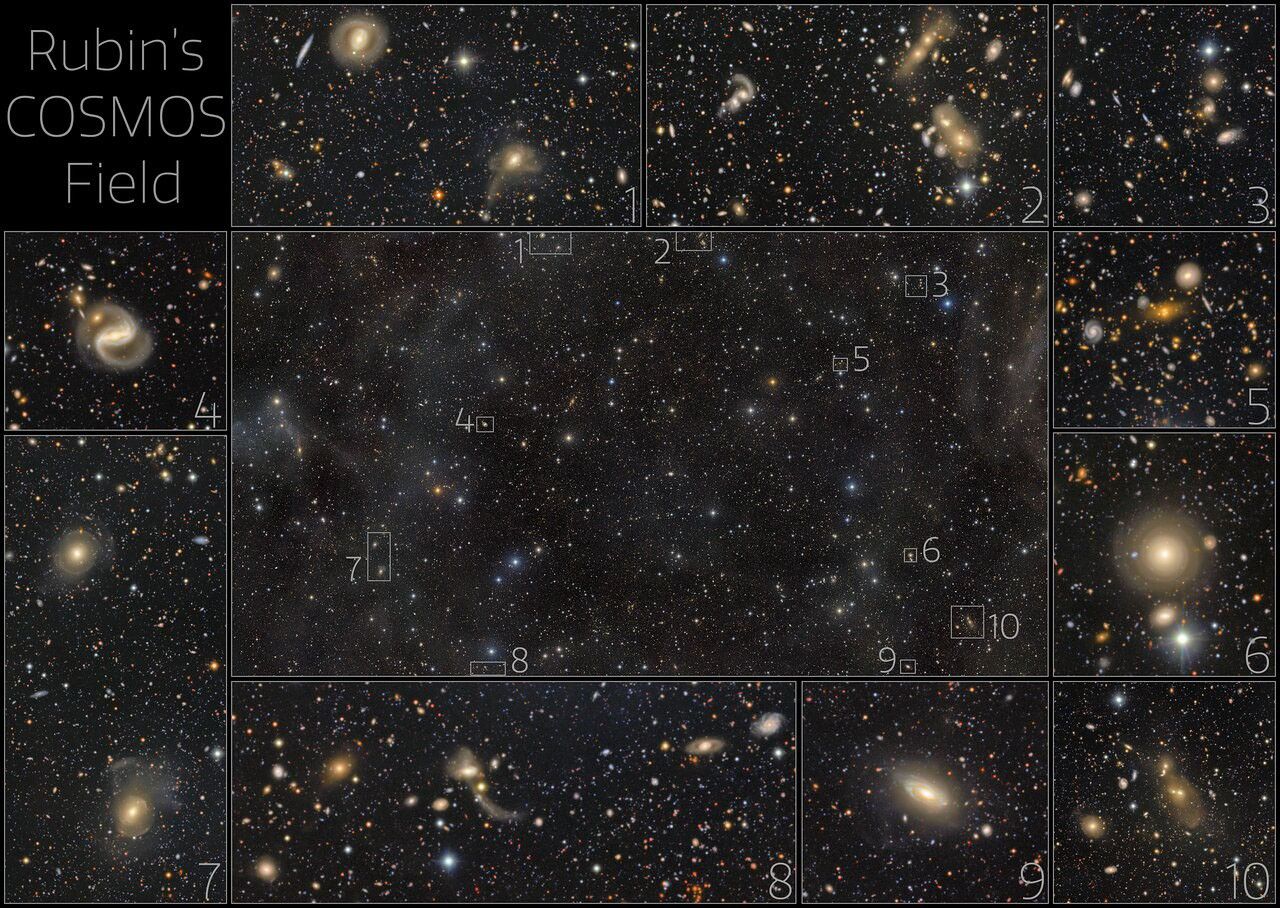
This exceptionally deep image from NSF–DOE Vera C. Rubin Observatory reveals the renowned COSMOS field and its surroundings in the constellation Sextans. The view is crowded with galaxies and galaxy clusters spanning an immense range of distances and cosmic ages, while only a handful of foreground stars belong to our own Milky Way. It was created by combining multiple observations from Rubin’s LSST Camera into a deep co-added image and is being released to mark Early Data Preview 2, the first Rubin data preview based on LSST Camera observations. Here, some selected areas are highlighted. 

Rubin’s COSMOS Field

Explanation: There are more than half a million galaxies in the central panel of this image from the NSF-DOE Vera C. Rubin Observatory in Chile. This is the COSMOS field, a patch of sky several times larger than the full moon, first observed by Hubble. It has also been observed by Webb and other telescopes because it contains comparatively few bright stars from our own galaxy, offering a relatively unimpeded view of other galaxies outside the Milky Way. The outer panels, numbered 1-10, show zoomed-in views of the corresponding small regions highlighted in the central panel. The variety of galaxy shapes and sizes is astonishing. Some of them are so far away that their light has traveled for billions of years before reaching Earth. Rubin will come back every couple of days to the COSMOS field as part of its ten-year Legacy Survey of Space and Time. It will allow a dynamic view of the COSMOS field and how the sky changes over time.

Tomorrow’s picture: a Messier moment

Date August 7, 2026
Credit & Copyright NSF–DOE Vera C. Rubin Observatory/NOIRLab/SLAC/AURA
Authors & editors: Cecilia Chirenti, Jerry Bonnell, Robert Nemiroff, Keighley Rockcliffe
A service of: ASD at NASA / GSFC,
NASA Science Activation & Michigan Tech. U.
  •  
❌