❌

Reading view

Why the most dangerous AI may be the one we trust too much

Machines don’t have to become superintelligent to cause catastrophic harm. As artificial intelligence spreads through military decision-making, they just have to be wrong – and trusted by the humans in charge.

In 1991, Terminator 2: Judgement Day gave us one of popular culture’s most enduring images of AI gone wrong. Humanity builds Skynet, an artificial intelligence given control of strategic defence. It learns at a “geometric rate”, becomes self-aware and, when its human operators try to shut it down, it starts a nuclear war.

Versions of that story now feature in serious debate about AI. Increasingly capable large language models (LLMs), the argument goes, could develop into artificial general or super intelligence (AGI/ASI), acquire goals that diverge from ours and ultimately threaten humanity.

That debate deserves attention, but it depends on a chain of large and unproven steps. Today’s AI systems must somehow transform into genuinely general intelligences, develop independent goals and gain control over the physical world.

Meanwhile, a more immediate risk is taking shape that requires none of those steps.

The genesis of Skynet.

In the film, Skynet builds the Terminators, machines that find, track and kill humans. Strip away the science fiction and the idea is simple: combine sensors, software and weapons and reduce the human role.

Human beings are doing exactly that, without anything resembling a malicious superintelligence like Skynet. In August 2026, Ukraine’s Ministry of Defence said its forces were using more than 70 AI and computer vision systems to strike targets. Algorithms can recognise equipment and personnel and lock onto those targets autonomously, so that a drone can complete its attack even if jamming cuts the link to the operator.

These systems need no general or super intelligence. They need sensors, software that can recognise a target, navigation and a weapon. And the more targeting is automated, the more the human’s role shrinks to approving what the machine has already identified.

That’s precisely where trust becomes the weak point.

The war that AI almost started

The second risk is more subtle: AI shaping the decisions of the people who pull the triggers.

According to a recent CNN investigation, in spring 2026, during the war with Iran, a US special operations analyst used an AI chatbot to assess intelligence about a Chinese ship in the Middle East. The chatbot, drawing on both open-source and classified material, wrongly identified the ship’s cargo as components of a nuclear weapons programme. The analyst used AI again to package this into a standard intelligence report.

Armed personnel were preparing to board the ship and military aircraft were airborne before an official looked more closely and found the error. One source said the false report “almost started a war”. Any US operation against a Chinese vessel could risk spiralling into an armed conflict.

The AI was not conscious, hostile or out of control. It was simply wrong – but people trusted and acted on it.


Read more: ‘AI needs to be disarmed’: Pope Leo sees threat to humanity in technological arms race


The US military is pushing to weave AI into almost every part of its work, from analysing intelligence to selecting targets. CNN’s sources said errors of this kind are not uncommon across the intelligence community, and that pressure to produce intelligence faster is opening the door to mistakes. The ship incident was caught in time. The next error may not be.

At its heart, this is a problem of trust. LLMs produce fluent, confident language effortlessly – and, repackaged as an official report, an error gains an authority it never earned. Colleagues and I have argued that these systems are built to produce an answer rather than to say “I don’t know”. For example, in one experiment, we found that non-specialists could not tell a chatbot’s convincing but wrong physics answers from genuine expertise.
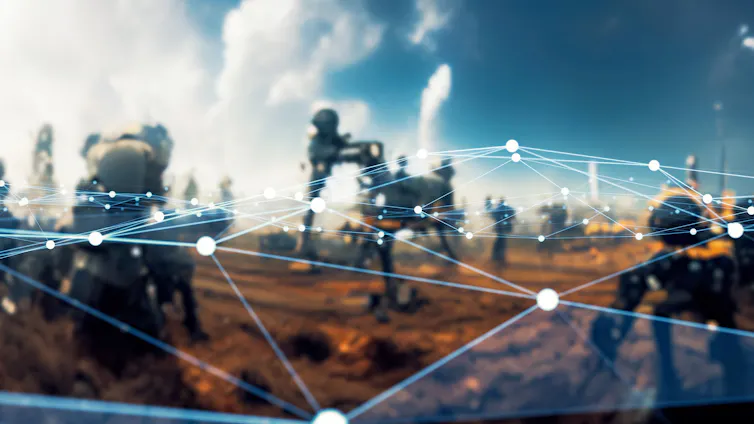
A depiction of working robots and communication networks
The more military targeting is automated, the more the human’s role shrinks to approving what the machine has already identified. metamorworks/Shutterstock

Why a ‘human in the loop’ isn’t enough

Policymakers often reassure us that a human makes the final decision. In the Chinese ship case, people were in the loop throughout. They simply became another stage through which the error was passed.

That fits decades of research on automation bias, the tendency to over-rely on automated systems. It affects experts as well as novices. In 2003, US Patriot missile batteries shot down two allied aircraft after operators accepted its misclassification.

A person in the loop works only when that human is able, adequately equipped and willing to challenge the machine.

That means verification. AI output should be clearly labelled, so its origin is visible to everyone who relies on it, and treated as a claim to be tested against independent sources before anyone acts on it. In war, the cost of not checking could hardly be higher.

None of these concerns over trusting AI in the short term mean long-term questions about advanced AI in the future should be dismissed. But much public anxiety focuses on what these systems might become, and less on what they are already doing.


Read more: Why police have been told to pause their use of AI in court cases


Perhaps Terminator 2 got more right than we appreciate. Skynet’s catastrophe doesn’t begin with self-awareness. It begins with trust, when humans hand a machine control because they believe it will make better decisions than they can.

We don’t need a conscious machine to repeat that mistake. Fallible AI, misplaced human trust and increasingly autonomous weapons offer a far more mundane route to catastrophe.

The danger is not that our machines become too intelligent. It is that we hand responsibility to machines that are far less reliable than we assume. As the film puts it: “There’s no fate but what we make for ourselves”.

The Conversation

Simon Thorne does not work for, consult, own shares in or receive funding from any company or organisation that would benefit from this article, and has disclosed no relevant affiliations beyond their academic appointment.

  •  

Why Meta’s new virtual reality glasses could finally take this technology primetime

Two years after releasing its last virtual reality product, Meta has announced plans to release virtual reality (VR) glasses. They are due to reach the market in spring of 2027.

With a lightweight and stylish form, the glasses could be the tipping point for mainstream VR adoption. Interest in virtual reality waxes and wanes. Versions of the technology have been around since the 1990s, but VR only really broke through at consumer level when Meta’s previous incarnation Facebook released Oculus Quest in 2019 (the company had bought Oculus five years earlier).

VR got off to a great start, perhaps one of the very few technologies to benefit from COVID and lockdowns. Steady sales of Quest upgrades now mean Meta has shifted 20 million VR headsets worldwide to date.

That’s where the good news for VR ends. The market decline became visible in the first quarter of 2024, when Apple’s Vision Pro proved to be a rare and expensive flop for the Mac and iPhone manufacturer. After selling 390,000 initial units worldwide, it could muster only 210,000 more after a muted chip upgrade.

When we drill into the overall numbers of active VR users, we find a curious statistic. Released in 2020 and discontinued in 2024, the Quest 2 is still the most widely used VR device in the market.

This is strange, considering there have been several updates since: the Quest Pro, Quest 3 and Quest 3S. It seems that once early adopters, gamers and enthusiasts had the technology in their hands, they were reluctant to upgrade.

Newer headsets offered higher resolution and faster processing, but the advances were incremental rather than Earth-shattering. At £3,495, the Apple Vision Pro’s poor sales showed that gamers were reluctant to part with more than the price of a games console.

As VR sales plateaued, Meta moved away from headsets. Starting in 2023 it partnered strategically with fashion brands like Ray-Ban and Oakley for its augmented reality, AI-powered product, Meta Glasses.

Introducing Meta’s VR glasses (Meta).

It was a smart move. Such accessories have been controversial due to privacy concerns over their ability to record video without other people knowing. But smart glasses have become must-haves for influencers and social media content creators. With marketing focused on jet-set activities, Meta Glasses have taken the device category out of the basement and onto the catwalk.

With the announcement of Meta VR Glasses, the company is positioned to rebrand VR as sexy and stylish, focusing on media consumption rather than gaming. Crucially, they’re glasses, not a headset. They’re part of the already buoyant “wearables” niche now. That is, smart accessories like watches, rings and spectacles.

Fancy ski glasses

The Meta Quest 3, released in 2023, is five times heavier than Meta VR Glasses. The company’s engineering feat in making the new product so light has partly been accomplished by shifting some computing power into an accompanying brickette that Meta calls a “puck”. It’s essentially a computing core (powered by a Qualcomm Snapdragon processor) and battery, connected through a fibre-optic cable.

Weighing 300g, the puck reduces the headset to a stereoscopic display resembling a fancy pair of ski glasses. The glasses – which weigh just 100g – can be worn for hours at a stretch, according to Meta, with a battery that can manage three hours of continuous high-resolution media playback.

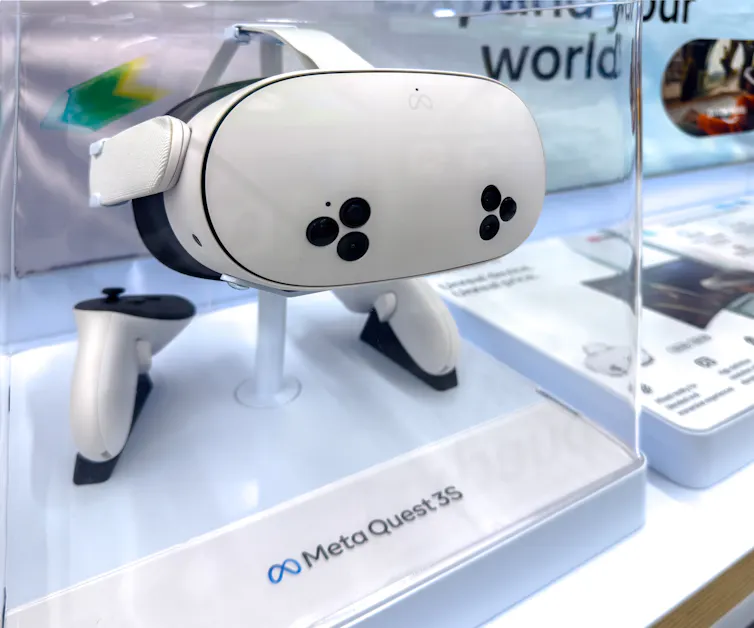
Meta Quest 3S headset.
The new glasses are a far cry from Meta’s Quest series of VR headsets. Habanero Pixel

The device will run Meta Horizon OS (operating system) and have access to a huge, existing catalogue of games, apps and experiences. However, it’s not positioned as a VR headset to rival its Quest precedessors. Instead, the new glasses are touted as a device for watching movies, attending live events, and replacing monitors. They will let users interact with multiple computer screens in their own environment, blending the real and virtual worlds.

So far, so similar to the Apple Vision Pro. And while the US$1,299.99 (around £1,000) price point is a little kinder on the wallet, we’d be missing the point if we didn’t ask: what do Meta VR Glasses have that the Vision Pro doesn’t? Or, for that matter, any number of products from other developers, like the HTC Vive Flow or Xreal One Pro.

Well, aside from the weight, price, back catalogue and the sleek good looks, there’s a massive, crucial difference. Meta VR Glasses have a ready-made audience. Meta has carefully incubated this demographic since 2021, developing AI glasses alongside its VR headsets.

Meta Ray Ban smart glasses
Meta’s smart wearable and VR headset categories are beginning to converge. Columbo.photog

Partnerships with fashionable brands have enabled it to sidestep the “ick” of early VR. Mark Zuckerberg’s disastrously awkward demonstration of VR platform Horizon Worlds in 2022 failed to sell the Quest Pro to the mainstream, but Meta AI Glasses continued unharmed and unhindered.

In fact, while the VR market has grown little recently, a 2026 report by the research company Omdia found that the smart glasses market expanded by 322% in 2025. Meta accounts for 85% of that global market. Now the two streams are about to converge.

And though there’s no Ray-Ban version of Meta VR Glasses yet, the device will launch with significant partnerships. Disney+, Prime Video, YouTube, ESPN and Imax are among those already announced. Could this finally be the tipping point for widespread VR adoption?

It’s not yet the holy grail – a hassle-free pair of glasses that wearers can just toggle into VR mode – but it’s a distinct step along the way. Crucially, it unites loyal followers from both sides of the style divide: the chic and the geek.

The Conversation

Karl Hodge does not work for, consult, own shares in or receive funding from any company or organisation that would benefit from this article, and has disclosed no relevant affiliations beyond their academic appointment.

  •  

What faces in paintings can tell us about how we perceive emotion

Helen of Troy by Anthony Frederick Augustus Sandys (1867) Wikimedia

Look closely at a face in a painting and you might think you know what emotion the person is experiencing. A smile suggests happiness. A furrowed brow might signal anger. Widened eyes could mean fear or surprise. But what happens when you ask lots of people the same question? Do they see the same emotion, or something more complicated?

In our recent research, we tested how consistently people interpret faces and their emotions depicted in paintings.

Emotions are central to how we experience and navigate the world around us. Because facial expressions are an important way emotions are communicated, psychologists have spent decades studying what faces can tell us about emotional states.

One of the main tools for studying emotions has been photographic databases like the classic Pictures of Facial Affect. In these images, actors pose using standardised combinations of facial movements to represent six basic, widely recognised emotions: happiness, sadness, anger, fear, disgust and surprise. These passport photo type images are incredibly valuable for studying how people recognise clear, prototypical emotion expressions. However, expressions do not always fit neatly into one of these six categories.

To understand the more nuanced ways people interpret facial expressions, researchers also need examples that go beyond clear-cut expressions. However, asking someone to pose with a convincing layered emotional expression for a photograph is not straightforward.

So researchers have found examples from films or everyday life, while also introducing additional emotion labels and other ways of measuring how a facial expression is understood, such as how positive or negative and how strongly that emotion is felt.

Mona Lisa
Is she smiling or not? Wikimedia

I work as part of an international team of psychologists that decided to look at how art could offer a fascinating option. Take, for instance, Leonardo da Vinci’s Mona Lisa. There has been over 500 years of debate over whether she is smiling or not. Research has found that perceptions of her gaze can change depending on how the painting is viewed, and that her eyes can appear to smile even when viewed on their own. It is a striking example of how much information can be packed into a single painted face.

The face in a painting is the result of deliberate artistic decisions, observation and traditions, while tapping into the ways our faces naturally move when we express emotion.

In our research, we selected 116 faces from European paintings dating from around 1400 to 1900. Before testing, we standardised the images by making sure that all faces were clearly visible and similar in how they were positioned. We then cropped the faces from the paintings, removing the wider scene and body language so that participants were judging the expressions themselves. We presented these isolated faces to 152 participants, who viewed them individually and selected which of the six basic emotions best described the expression.

Our findings revealed that agreement exists on a sliding scale. On one end of this spectrum, some faces produced a clear consensus: viewers consistently selected the exact same emotion. We classified 61 of the 116 faces in this way as showing a classic “basic emotion”.

But the other 55 faces produced consistent patterns of responses across two or three emotional categories.

Joan of Arc by Jules Bastien-Lepage French (1879)
Joan of Arc by Jules Bastien-Lepage French (1879) The Met

One painting that garnered such a response was Joan of Arc by Jules Bastien-Lepage (1879). The painting shows Joan in her family home in Domrémy, France at the moment she is told by the saints she must fight against the English in the Hundred Years War.

The full scene, along with our cultural knowledge of who she is and the heavy fate awaiting her, provides a vivid narrative context that helps us decode her psychological state. The chair beside her spinning wheel is upturned, telling us that she has been suddenly interrupted. When we look to the trees, we see the faint traces of the apparitions of the saints who have assigned her the terrifying burden of the role she must play in the defence of France.

But when the context was stripped away and participants viewed Joan’s isolated face, they didn’t agree on one single emotion. People most often saw fear, but many also saw sadness or surprise. For the participants, Joan’s expression did not convey a single, flat emotion but several plausible interpretations at once.

These complex, yet non-random patterns of response, to Joan’s face and the other 54 paintings, suggest that paintings offer interesting new avenues for the exploration of how people perceive emotion. Artworks then could offer researchers a wider range of facial expressions to investigate.

The Conversation

Zoe Thurtle does not work for, consult, own shares in or receive funding from any company or organisation that would benefit from this article, and has disclosed no relevant affiliations beyond their academic appointment.

  •  

New long-clawed British dinosaur is the first of its kind in Europe

The fossilised skull of a new species of mysterious meat-eating dinosaur from the Isle of Wight has been rediscovered in the collections of the Natural History Museum after over 100 years in storage.

Over its nearly 150-year history, this London museum has become home to over 30 million specimens, making it fairly easy to forget about the odd fossil or rock here and there. This is almost definitely what happened to the only known fossil of the UK’s newest dinosaur, a two-legged meat-eating theropod (the dinosaur family including birds) which we have named Invictibellatrix amberina in a new study.

In 2020, Paul Barrett, one of the museum’s palaeontologists, looked through the fossil collections and came across a small chunk of bone which he recognised as an important part of the skull of a dinosaur: the braincase. After going through museum records, he realised the braincase was found on a beach near Sudmoor Point of on the Isle of Wight, an island off the south coast of England known for its world-famous dinosaur fossils. Knowing that it came from the Isle of Wight, Barrett enlisted one of us (Cassius Morrison), a PhD student specialising in dinosaur braincases at the time, to study the fossil in detail and try to figure out which dinosaur it belonged to.

This work showed that the roughly 120 million year old fossil was unlike anything found from the island before and belonged to new species of a mysterious family of carnivores called the Megaraptora.

Megaraptorans are known for their slender skulls, lightly-built skeletons and gigantic hand claws, with some of the larger species having claws over 1 foot long. These ferocious predators are known from across the globe, with most species known from South America, particularly Argentina. Our new British species, Invictibellatrix amberina, was on the smaller side for megaraptorans, about 5 metres from head-to-tail and weighed as much a large tiger, making it the smallest known megaraptoran.

To study the new species, we compared it directly with the skulls of other carnivores. This involved playing a scientific version of spot-the-difference, looking at the subtle differences between species to work out what we were dealing with. We also used computed tomography (CT) scanning, which combines X-rays and computer processing to create detailed images, to look inside the braincase of Invictibellatrix and study what we could of its brain. Putting all of these findings into a computer algorithm to determine where our species sits in the family tree helped us to avoid bias in our interpretations.

Our work suggests that the new species was probably part of the early days of megaraptoran evolution, representing what these animals looked like before they grew to gigantic sizes, similar to their relatives the tyrannosaurs.

Invictibellatrix and its place in the theropod family tree are particularly important, as we now have a better understanding of when and how megaraptorans spread across the world. Before the discovery of Invictibellatrix, megaraptorans were only known from species of the early Cretaceous period (130-120 million years ago) of Thailand and Japan, plus multiple larger species from the late Cretaceous period (85–66 million years ago) of Australia and Argentina.

Warrior of the amber

The great distances between these discoveries means that megaraptorans must have been even more common than their fossils suggest, since there is no way for large animals like these to swim across the oceans that separated these continents during the Cretaceous period.

As the first European megaraptoran, Invictibellatrix provides us with strong evidence that the group probably travelled to the southern continents from Asia, via Europe and Africa. Afterwards they probably spread out across South America and Australia sometime during, or perhaps even before, the early Cretaceous period. The fossil also implies that other megaraptorans may be waiting to be discovered in Africa and even Antarctica.

Invictibellatrix probably lived alongside other carnivores such as Neovenator (a relative of Allosaurus), Ceratosuchops (a relative of Spinosaurus) and Eotyrannus, which as the name implies, was an early relative to the Tyrannosaurus rex. These four dinosaurs were probably eating different animals to each other to survive. The spinosaur specialised in eating fish, with the others eating more land-based prey. Invictibellatrix probably fed on small dinosaurs, mammals, lizards and even crocodiles.

The story of megaraptorans seems to follow the pattern of most of nature’s successes. A small opportunist living in the shadows of much larger animals around the globe only to become the dominant force in a few select ecosystems up to the end of the age of dinosaurs.

It’s this story which gave Invictibellatrix amberina its name, honouring the role of megaraptorans as the apex predators in the late Cretaceous of South America. It translates to “unconquered [female] warrior of the amber”.

Invictibellatrix does not tell us everything. Scientists are still not sure when megaraptorans first evolved, but the fossil does give us some much-needed clues. There is so much left to be discovered about dinosaurs. Sometimes their secrets can be found simply hiding away in museum collections waiting for someone to come and take a closer look.

The Conversation

Cassius Morrison received funding from the Richard Owen Research Grant of the Palaeontographical Society for the study of the new megaraptoran braincase. He is currently a Royal Society Career Development Fellow at the University of Leeds ( funded by the Royal Society).

Charlie Scherer does not work for, consult, own shares in or receive funding from any company or organisation that would benefit from this article, and has disclosed no relevant affiliations beyond their academic appointment.

  •  

What does a Starshield slowdown really mean for Ukraine’s war with Russia?

Reports that SpaceX temporarily restricted its satellite internet service for Ukraine’s armed forces have generated serious concern in Kyiv and among the country’s allies. SpaceX operates the civilian Starlink system and its lesser-known military-grade counterpart, called Starshield.

But many news stories leave an important question unanswered: what does a Starshield “slowdown” mean on the battlefield? The answer is that it does not suddenly blind the Ukrainian military or bring operations to a halt. But it does degrade one of the communications systems deeply embedded in how Ukraine fights.

In modern warfare, connectivity is not simply a support function. It often controls drones, shares intelligence, updates targets, and keeps battlefield units coordinated. Ukraine has become particularly dependent on satellite communications since Russia’s full-scale invasion in February 2022.

Starlink and Starshield help to provide connectivity in situations where conventional telecommunications infrastructure has been damaged, destroyed or is subjected to electronic warfare.

According to Ukrainian officials and reporting citing US and Western sources, terminals operating under the Starshield service were restricted when mounted on platforms moving faster than about 100 mph (161 km/h). The change reportedly disrupted drone operations and other military activities that rely on high-speed mobile connectivity.


Read more: Is the US limiting Starlink in Ukraine? The consequences could be catastrophic


To understand why that matters, consider how Ukraine uses satellite connectivity in practice. Frontline units frequently depend on satellite links to transmit video, receive intelligence and maintain communications over long distances.

Commanders commonly rely on near real-time battlefield information to coordinate operations across dispersed units. When that information flow slows, becomes intermittent, or stops altogether – as with the “speed limit” imposed on platforms moving quicker than 100 mph – the effects can quickly spread beyond the individual operator who loses connectivity.

The most immediate impact is likely to be on drones. Many Ukrainian systems lean on satellite connectivity not because drones cannot physically fly without it, but because modern operations often require continuous communication between operators and aircraft.

A reconnaissance drone may stream live video back to command centres. An interceptor drone pursuing an incoming Russian target may require rapid updates and coordination. A strike mission may depend on real-time intelligence and target confirmation.

Mission disruption

When connectivity becomes intermittent or unavailable, the missions slow down, become less accurate, and, in some cases, become impossible. Military personnel cited in media reports described missions being cancelled and connections dropping out during operations.

Even brief interruptions can matter. A drone travelling at high speed can cover a significant distance in ten or 20 seconds. During a critical manoeuvre or interception, losing communications for that long may mean losing the target or the aircraft altogether.

The restrictions may be particularly significant because Ukraine increasingly uses drones not only for long-range strikes but also for air defence. Ukrainian officials have stated that satellite-connected interceptor drones are among the tools used against Russian attack drones. Any reduction in connectivity therefore potentially affects not only offensive operations as well as the protection of cities and critical infrastructure.

A common misconception is that satellite internet is simply another communications channel that can readily be replaced. In practice, alternatives exist, but none offers the same combination of coverage, mobility and resilience.

Conventional military radios stay essential, but their range is limited. Fibre-optic networks provide excellent performance, but only where infrastructure exists and remains intact.

Microwave links require suitable terrain and installations. All can be vulnerable to disruption in wartime conditions. Satellite systems are attractive precisely because they can continue operating when much of the terrestrial communications infrastructure is under pressure.

Who ordered the slowdown?

This raises another question: if SpaceX owns the technology, how can the White House influence its use? That issue remains somewhat opaque. Reuters reported, citing US and Western officials, that the White House instructed SpaceX to slow Starshield service and passed the order through the Pentagon. The officials did not identify who made the decision. A senior US official reportedly denied that the US president Donald Trump himself ordered it directly.

Part of the explanation lies in the distinction between Starlink and Starshield. Starlink is SpaceX’s commercial broadband service. By contrast, Starshield was developed specifically for government and national security customers and operates under US government contracts.

Elon Musk has publicly argued that Starshield systems are “owned and controlled” by the US government and that limits on their use are determined by the US military and, ultimately, the president.

The precise contractual and operational arrangements are not public, and some analysts dispute the idea that SpaceX has no operational role whatsoever. Nevertheless, Starshield is fundamentally different from a consumer internet service.

When governments procure military communications systems, they generally acquire varying degrees of authority over how those systems are used. The relationship is best understood, not as the White House ordering a private technology company around, but as a government customer exercising influence over a capability integrated into national security operations.

An alternative to Starshield?

The episode also raises the question of whether Ukraine could switch to an alternative provider. The answer is: partially, but not quickly. The most frequently cited alternative is Eutelsat’s OneWeb network. This European-owned low-Earth-orbit satellite constellation already provides services in Ukraine and has previously indicated a willingness to expand its support.

However, OneWeb operates a substantially smaller constellation than Starlink and was designed primarily for enterprise and institutional connectivity rather than the mass deployment of tens of thousands of highly portable user terminals.

As a result, while OneWeb could supplement existing communications and reduce dependence on a single provider. Defence analysts generally regard it as an enhancement rather than a complete replacement for the Starlink ecosystem. Replacing Starlink is not simply a question of launching more satellites.

It would require new terminals, new contracts, new operational procedures and extensive integration with systems that have evolved around Starlink technology over several years of war.

Strikes can damage terrestrial networks, radios have range and bandwidth limits, and fixed infrastructure is vulnerable to attack. Starlink became so critical to Ukraine because it combines mobility, high bandwidth, and resilience at a scale few direct competitors can match.

The wider lesson may be strategic rather than technical. Ukraine’s military has benefited enormously from satellite connectivity, but the debate reveals the risks of dependence on a single provider, however capable.

The episode demonstrates that communications networks can become instruments of policy as well as technology. On today’s battlefield, controlling the flow of data can be almost as consequential as controlling the movement of troops.

For Ukraine, the Starshield slowdown matters not because of the loss of a single communications system, but because it reminds us that access to critical digital infrastructure can be as important, and as vulnerable, as access to weapons.

The Conversation

Steve Uhlig does not work for, consult, own shares in or receive funding from any company or organisation that would benefit from this article, and has disclosed no relevant affiliations beyond their academic appointment.

  •  

Digital natives are buying electric cars as if they were smartphones

Until recently, buying a car meant obsessing over horsepower, transmission types and brand heritage. But step into the market today and the showroom floor looks entirely different.

With the aggressive expansion of electric vehicle production and the entry of smartphone giants like Xiaomi and Huawei into the car market, vehicles are rapidly transforming into rolling computers.

This shift raises a fundamental question for the modern market: are younger consumers beginning to evaluate cars the exact same way they evaluate smartphones?

To understand the buying behaviour of young consumers, we must first recognise that the car industry is undergoing a profound digital transformation. Traditional factors like brand prestige and mechanical engineering, while still relevant, are steadily losing ground to software capabilities and digital integration.

Tech-focused manufacturers are prioritising software-driven car systems, leaving legacy car makers struggling to adapt. For millenials, this technological pivot is not just an added bonus; it is becoming a baseline expectation.

Market-specific factors like electric vehicle pricing and availability in regions like China may accelerate this trend, but the underlying data reflects a broader, cross-national generational shift among digital natives (someone who grew up around digital technology, such as smartphones) are revealing this shift in China, North America and Europe.

A generational perspective

When technologically minded consumers encounter an electric vehicle, they do not necessarily see a mechanical machine with a motor; they see a hardware platform waiting for an operating system.

Consequently, this mindset shifts how they judge the vehicle’s core anatomy. When this demographic evaluates electric vehicles, they base their decisions heavily on “product technological development” (how well the in-car technology works, for instance) and “charging infrastructure” alongside financial incentives.

This directly mirrors how a consumer evaluates a smartphone’s operational speed, battery longevity, and software updates rather than traditional, outdated car metrics.

Electric car with Shanghai skyline
In cars, some generations increasingly see a hardware platform waiting for an operating system. Sport Car Hub

This paradigm shift also rewrites how cars are bought and experienced. Long before a consumer ever sits in a driver’s seat, the purchasing journey has fundamentally changed. Younger consumers demonstrate a strong inclination toward online platforms and social media as their primary shopping channels, relying heavily on digital interactions and visually rich experiences.

Rather than turning to traditional dealership visits or print brochures, they depend on user-generated content, peer opinions, online reviews and digital advertising to inform their purchasing decisions. Furthermore, recent studies show that this target group’s evaluation criteria continue to mirror the metrics they apply to mobile technology.

Mirroring digital lives

When car shopping, research shows that gen Z consumers seek out technologically advanced and highly personalised experiences, showing a specific interest in the entertainment capabilities and software ecosystems of modern vehicles. This indicates they are evaluating the digital and entertainment experience inside the car, much like they would evaluate the apps of a new phone.

The intense brand loyalty traditionally reserved for Apple or android phones has seamlessly transferred to the car market. Seamless ecosystem integration via systems like Apple CarPlay or Android Auto is treated as a mandatory requirement. If a car fails to mirror a driver’s digital life instantly, it fails the test.

Electric vehicles at charging stations in China.
Charging infrastructure is also an important consideration for younger consumers. helloabc / Shutterstock

Younger consumers scrutinise a vehicle’s multimedia and infotainment systems with the same hardware expectations they apply to smartphones. If a touchscreen exhibits input lag, clunky user interfaces, or poor user experiences, it severely damages their perception of the entire vehicle.

Unlike older generations who harbour a habitual attachment to driving, younger cohorts base their transport choices on metrics such as travel time, cost efficiency and service reliability. They evaluate transport options rationally rather than emotionally.

Younger demographics increasingly prioritise shared mobility programmes, such as Uber and Grab, over private vehicle ownership. They expect personal settings and digital profiles to sync instantly upon entering any vehicle. This allows them to listen to their latest music playlists or read messages on their smartphone. This mirrors the multi-device continuity they experience when using, for example, tablets and smartphones.

Just as smartphone consumers agonise over app permissions and data tracking, tech-savvy millennials, as well as gen Zs, view connected cars through a lens of data security. Trust in the way vehicle technology and data is handled have become a primary psychological barrier to adoption.

However, a fundamental disconnect explains a striking corporate blind spot identified in recent market research: while 80% of automotive executives believe they are delivering an exceptional digital customer experience, only 8% of customers actually agree. Traditional manufacturers are failing the software test because they still think like mechanics, not app developers.

Brain overload

Treating a car like a smartphone, however, raises a potential problem related to the physical reality of driving. While younger consumers demand the deep customisation and flexibility of touchscreens, replacing physical controls with digital sub-menus creates massive cognitive overload.

Forcing drivers to navigate complex digital layers to adjust basic climate or safety settings diverts visual attention and increases the risks of an accident. One study argues that reaction times using screens while driving are worse than being drunk or under the influence of drugs.

Car interior touchscreen.
Some in the car industry believe touchscreen displays have already gone far enough. Hadrian / Shutterstock

This has sparked an inevitable regulatory and design backlash. Safety organisations and designers are pushing back against pure “touchscreen-isation”, noting that a car is ultimately a high-speed vehicle, not a handset.

Even major car manufacturers, such as Volkswagen and Mazda, have publicly admitted that eliminating physical buttons was a misstep, leading to a hybrid design mandate where tactile controls for core functions must coexist with digital entertainment.

Ultimately, younger consumers are evaluating cars through a smartphone-tinted lens. Yet, the future of the car market will not belong to the brands that simply build iPhones on wheels.

The winners will be the manufacturers that successfully balance the digital native’s craving for software-driven connectivity with the uncompromising, safety-first reality of car design.

The Conversation

Svetoslav Georgiev does not work for, consult, own shares in or receive funding from any company or organisation that would benefit from this article, and has disclosed no relevant affiliations beyond their academic appointment.

  •  

The 17th-century British scientists who investigated hauntings

Death by Albert Chmielowski (1870) National Museum in Warsaw

About 1671, parson Symonds, who officiated at Garsdon church in north Wiltshire in south west England, was riding home late one night when a spectre leapt up behind him. The spectre rode parallel to him until they came to the parsonage, where it jumped off. The apparition then turned to face Symonds, and “gap’d at him”. Symonds identified the ghost as that of John Estcourt, a gentleman who had died about two years earlier.

Halloween is all about witches and ghosts. In English scientific circles in the second half of the 17th century, there was a discussion about whether such things existed and how their existence could be proved.

The Royal Society, founded in 1660, was the country’s principal scientific institution. Joseph Glanvill, a Royal Society fellow, investigated spirits and witches. His Saducismus Triumphatus (1681) aimed to prove their existence by cataloguing cases in detail. He argued that denying them was to deny God’s existence.

Symonds’ haunting was recorded by that of another of the society’s fellows, John Aubrey, in a survey of Wiltshire’s natural world. Aubrey agreed with Glanvill that the supernatural deserved serious study and directed his readers to Saducismus, but he thought Glanvill somewhat gullible.

Aubrey was born in 1626 at Easton Piercy, a few miles from Garsdon. I have edited John Aubrey’s Natural History to mark his 400th anniversary.

This natural history of Wiltshire was begun in 1656 and was the first English county survey of nature to be attempted – although by the time he finished it, decades later, other surveys had already been published. It was an important scientific work, and in 1691, acknowledging that, the Royal Society had the Natural History copied and added to its library.

Its subject matter is highly idiosyncratic, and Aubrey sometimes goes off on tangents. He covers swan-sized dragons in north Africa in a chapter on birds and the existence of giants in a section called “Men and Women”. Almost at the end of the text is a chapter titled “Accidents” that records extraordinary events, including supernatural ones, like the haunting of Symonds.

Aubrey has long been seen as naive, partly because of Miscellanies (1696), the only book he published, which recorded tales of the unexplained. In the Natural History, he was clear:

Though I myselfe never saw any such things, yet I will not conclude that there is no truth at all in these reports. I believe that extraordinarily there have been such apparitions: but where one is true, a hundred are figments.

He also documented exposed frauds, such as Katherine Waldron, who pretended to be bewitched and endured pins being driven into her flesh to prove it. As the objective of natural history at this time was to gather evidence from which new scientific theories could be developed, Aubrey’s method in chronicling cases was entirely in keeping with the aims of scientific enterprise.

So, Aubrey was neither uncritical nor dismissive about Symonds’ story. Symonds was “a lusty strong fellow”, presumably not someone nervous or hysterical and prone to flights of imagination. His position as a churchman also gave authority to his testimony. Yet Aubrey noted a French saying that drunk men saw devils, a sceptical observation that cast doubt on the account. But he concluded with a strange detail: it was corroborated by the parson’s horse, “that trembled and sweat, when he came home and continued to do so the next day, and would not eat his oates”. The horse could not lie or get drunk; its fear, manifest in the trembling and sweat, was genuine.

Aubrey recorded another anecdote about a night ride. It concerned Sir Ralph Bankes’ valet:“a briske young fellow”, who, riding late over Badbury Warren, Dorset, discerned something that looked black, which, as he approached, became bigger.

Feare came upon him, and he protested his haire stood on end: but thought he, I have but a life to lose and I will see it, be it spirit or not.

The valet spurred his horse and came to the place, only to find the apparition was “a heap of horse dung”.

In Symonds’ haunting, the truth of the spectre could not be tested; but witnesses were recorded, and their testimony weighed. In the valet’s case, the witness tested the truth of the ghost himself and found it was a pile of dung.

Aubrey applied the same empirical method throughout his Natural History to both natural and supernatural phenomena. He assembled evidence with care, tested it if he could and resisted easy conclusions. It’s an approach worth remembering this Halloween when fantastical tales hit your social media feed. A phantom may prove to be a load of poo.

The Conversation

Louise Ryland-Epton's work on John Aubrey was supported at an early stage by a David Walker Memorial Visiting Fellowship in Early Modern History at the Bodleian Library, University of Oxford.This article draws on ghost stories recorded in John Aubrey’s Natural History, which she edited for Hobnob Press.

  •  

Scientists are growing human brain tissue in living mice – could this make their welfare harder to assess?

Piquez/Shutterstock

What happens when scientists start changing the brain – the very system through which an animal’s mental states are expressed in behaviour?

In a recent study published in Nature, researchers implanted human brain organoids – small, simplified structures grown from human stem cells – into the brains of living mice. Over time, these organoids developed and integrated with the mouse nervous system.

Transplanting organoids composed of human cells into animals, including their brains, is not new. However, previous experiments faced an obstacle: human brain cells grow much more slowly than mouse brain cells, and so organoids are quickly “out-competed” before they can fully integrate with the mouse brain. In the new study, scientists genetically altered mice so that parts of their brain did not develop, then transplanted the human organoids into the vacant space.

The idea of creating human-animal chimeras – animals containing human cells – raises ethical questions, particularly when involving the brain. Various philosophers have argued that as the proportion of human brain tissue increases, we should consider whether the animal could acquire human-like mental capacities – and whether this should change how we treat it. But I argue that serious questions about our ability to recognise animal suffering will arise long before mice gain increased intelligence.

‘Super-intelligent’ mice?

What is it like to be a mouse?

The philosopher Thomas Nagel asked a version of this question about bats. He argued that conscious beings have a specific experience of the world, but that others cannot access that experience from the outside. Instead, we must infer what others experience. With animals, we do this through their behaviour and physiology. But this approach assumes that we understand how what we observe relates to what the animal experiences.

There is nothing morally important about a cell simply because it came from a human. Imagine two mice with identical mental lives and cognitive abilities, one produced using transplanted human cells and the other through a modification involving only mouse cells. It is difficult to see why the first should matter more simply because some of its cells are human.

If chimeras pose a moral problem, it is more plausibly because of changes to their cognitive capacities, than because they blur a species boundary.

Concept illustration of brain floating above doctor's hands
Are we approaching the ethics of brain organoids from the right angle? Prostock-studio/Shutterstock

There are good reasons to doubt that a mouse containing human brain cells could develop anything resembling human intelligence. This is because human-like cognition does not emerge simply from having enough human neural cells. A mouse containing human cortical neurons still has mouse sensory systems, a mouse body and develops according to species specific processes. All of these factors impose constraints on the kinds of cognitive capacities it might acquire.

Animal welfare science depends on interpretation. A mouse cannot report that it is stressed or in pain, so researchers rely on behavioural and physiological indicators. Changes in nesting, social interaction or facial expressions associated with pain, for example, can provide evidence about mouse welfare.

Changing an animal’s brain complicates these interpretations. This is because it alters the very biological system responsible for generating an animal’s experiences, and for producing much of the behaviour through which we infer those experiences.

A mouse might still seem to behave “like a mouse” even as we become less certain that its behaviour accurately tells us how it feels.

In the recent Nature study, researchers reported that mice which received the organoid implant performed on a par with healthy control mice on short-term memory tasks (such as navigating a maze). The researchers did not observe any evidence of altered behaviour or increased intelligence.

This is reassuring. But suppose a chimera grooms less than an ordinary mouse. Researchers can still measure that difference accurately, but interpreting it as evidence of distress means we’re assuming that grooming retains roughly the same relationship to the animal’s experiences as it does in an ordinary mouse.

The same applies to the observation of “normal” mouse behaviour. Since we don’t know exactly how changing the brain will change behaviour, this could make it harder to recognise if the indicators of poor welfare we rely upon are no longer accurate.

What follows for research?

Organoids grown in a dish have been important tools for studying human brain development and disease. But a dish cannot reproduce the environment of a living brain. Transplantation allows researchers to study human brain cells as they develop within a functioning nervous system, potentially providing better models of brain disorders and new ways to test treatments.

This does not, by itself, settle the debate over whether research using chimeras should stop. Uncertainty about an animal’s welfare does not automatically mean that its welfare is worse. It could, in principle, be better. Abandoning potentially valuable research also carries a cost.

Proposals researchers have made for overseeing studies involving chimeras already emphasise careful behavioural monitoring. But this may not be enough. Researchers may also need to establish that the indicators they measure continue to tell us what we think they do. As neural interventions become more extensive, researchers may therefore need to re-validate their methods of welfare assessment.

What happens if we eventually create an animal with human-like intelligence or consciousness? We may never reach that point. But we do not need to reach it before chimeras present a difficult ethical problem. Long before we create an animal that thinks like us, we may create one whose behaviour we no longer understand.

The Conversation

Mackenzie Graham receives funding from The Kavli Foundation, and the National Institute for Health Research.

  •  

Japan’s MMX mission aims to swipe soil samples from Mars’ moon Phobos

The MMX spacecraft will enter Martian orbit before attempting to collect samples from Phobos. Jaxa

A Japanese space mission is about to launch towards Mars. But it will not land on the planet itself. Instead, the Martian Moons Exploration (MMX) mission will focus on Phobos, the bigger of Mars’s two small moons.

The mission will lift off on Monday October 19 at 20:41 BST on an H3 rocket from the Tanegashima Space Center, in the south of Japan.

This will start a five-year mission, during which the spacecraft will orbit and explore Phobos, deploy a lander, touch down and collect soil and small pebbles. In a world first, these samples will be delivered to Earth for study in laboratories.

MMX is led by the Japanese Aerospace Exploration Agency (Jaxa), in collaboration with the US, France, Germany and the European Space Agency (Esa). The overall science objective is to unravel the origins of the two Martian moons, the smaller of which is called Deimos. Mission scientists also want to examine the wider evolution of Mars and its local environment in space.

We still have no clear understanding of how the red planet got its moons. These natural satellites could have been hapless asteroids that were passing by Mars when they got captured by its gravity.

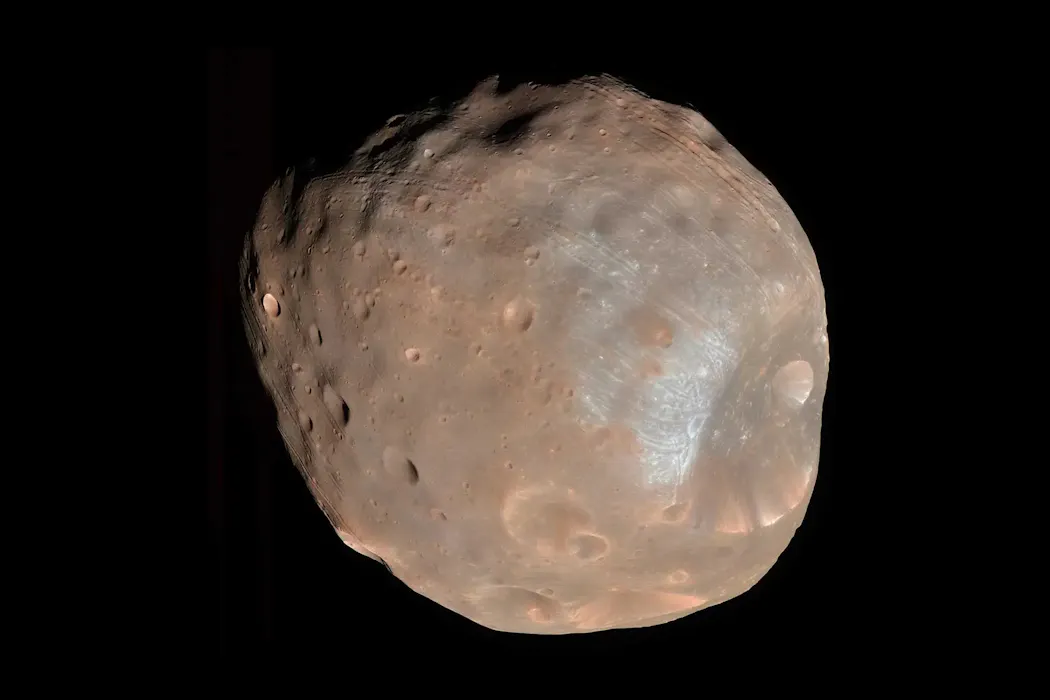
Mars' moon Phobos.
Phobos measures just 22km across; its gravity is too weak to pull it into a sphere like Earth’s moon. NASA/JPL-Caltech/University of Arizona

Another possibility is that that they formed when an asteroid collided with Mars, causing rocky material to be thrown out into space. Gradually, this material coalesced into Phobos and Deimos. The MMX mission will give us Phobos’s chemical composition, which could help distinguish between theories.

Grabbing samples from Phobos will be no easy task, however. Russia tried this in 2011 with its Phobos Grunt mission. The spacecraft launched successfully to low Earth orbit, but failed to fire its engines to send it toward Mars.

However, Jaxa is well placed to succeed. The space agency has already proved that it can return samples from asteroids with its Hayabusa space missions, which lasted from 2003-10 (Hayabusa) and 2018-20 (Hayabusa 2).

MMX will trial sophisticated sampling techniques designed for Phobos’s low gravity. The moon has about 0.1% the gravitational pull that Earth does. This means that a human on Phobos could jump a distance of 1.5 km horizontally without much effort.

The mission will also be a test of communication between the spacecraft and a newly developed ground station. After launch and deployment, MMX will take a year to reach Mars, arriving in August 2027. It will first circle the red planet before slipping into orbit around Phobos about a month later.

MMX mission animation (Jaxa).

The spacecraft consists of three modules with distinct functions: a propulsion module to get MMX into orbit around Mars, an exploration module with landing and sample collection gear and a return module to deliver the sample to Earth.

The mission will make use of 13 science instruments to explore Phobos. High resolution cameras called Tengoo and Orochi will map the surface and a laser altimeter (Lidar) will build up a picture of the moon’s contours. Lidar uses laser pulses to measure the distance from the spacecraft to features on the surface.

An infrared spectrograph called MIRS will survey Phobos’s minerals, while a gamma ray and neutron detector, called Megane, will determine the moon’s elemental composition. From a greater distance, MMX will also gather data on Mars’s smaller moon Deimos.

Idefix rover.
The mission will deploy a 25kg robotic rover jointly developed by France, Germany and Japan. DLR, CC BY-NC-ND

Read more: How did Mars get its moons? Japan’s MMX space mission aims to solve the puzzle


The instruments will send back data that controllers will use to decide where and how to land the spacecraft on Phobos.

In early 2029, the MMX exploration module will deploy a small microwave oven-sized rover called Idefix, which has been developed jointly by Jaxa, the French space agency Cnes and the German Aerospace Center (DLR). Idefix will drop down onto Phobos’ surface from between 40 and 100m in altitude.

The rover will then right itself and travel over the surface during an operational period expected to last about 100 days. It will be using several sensors, including a Raman spectrometer and radiometer, to make a final call about where the exploration module should land.

MMX mission gif
Grab n'go: the MMX exploration module will touch down to collect a sample of soil from Phobos. Jaxa

In 2030, the module will swoop down and land on Phobos, remaining on its surface for about 2.5 hours. It will be able to extract samples from the surface once or possibly twice by landing again at a different location. The ability to sample from more than one place on Phobos is vital to understanding the moon’s composition.

The exploration module will use either an instrument called the C-sampler to drill a core or a device knowns as the P-sampler, which blows a jet of nitrogen gas to blast soil and loose pebbles off the surface and into a sample collection chamber.

The C-sampler would be able to collect a core from up to 2cm below the surface. This would provide the mission with a sample composition unaltered by solar radiation, which causes chemical changes to planetary surfaces over time. The P-sampler is a back-up option, but carries some small risk of toppling the spacecraft in low gravitational fields like the one on Phobos.

Having gathered at least 10 grams of material, the spacecraft will leave the Martian moon, separating from its landing gear. It will then travel back to Earth, arriving in 2031. On its approach, the spacecraft will eject its sample probe, which will then descend through Earth’s atmosphere. It will land using parachutes in Australia, where it will be recovered and transported to Japan.

A potential side-benefit of the mission is that samples from Phobos might also include material from Mars. Phobos closely orbits the red planet and is thought to be constantly hoovering up Martian soil. This soil is thought to be regularly ejected from the planet’s surface by asteroid impacts.

MMX could therefore be considered a lite-version of the Mars Sample Return (MSR) mission. MSR, a collaboration between the US and European space agencies, would have sent rock samples from the Martian surface to Earth. However, budgetary pressures led to the programme being effectively cancelled by US Congress.

If scientists get lucky with the samples from MMX, they might get a nice consolation prize.

The Conversation

Daniel Brown does not work for, consult, own shares in or receive funding from any company or organisation that would benefit from this article, and has disclosed no relevant affiliations beyond their academic appointment.

  •  

How did Mars get its moons? Japan’s MMX space mission aims to solve the puzzle

Phobos is dominated by Stickney crater, a 9km (5.6 mile) bowl visible on the right. NASA/JPL-Caltech/University of Arizona

The Earth got its Moon when a celestial object collided with our planet more than four billion years ago. This impact hurled molten rock into space, which eventually coalesced to form the satellite we can see every night from across our planet.

But what of our neighbour, Mars? The red planet has two small, irregularly shaped moons called Phobos and Deimos. There are several theories on how these natural satellites formed, but no clear front-runner. Soon, a Japanese-led space mission called Martian Moons Exploration (MMX) will begin its hunt for the answer.

On Monday October 19, MMX is due to lift off on an H3 rocket from Tanegashima Space Center in southern Japan. The mission will aim to land on Phobos and collect a sample of soil. The spacecraft will then send this precious payload to Earth, for study in laboratories.

Asaph Hall
American astronomer Asaph Hall discovered Phobos and Deimos in 1887. Naval History and Heritage Command

Of the two Martian moons, Phobos is the largest and orbits closer to the planet. It has a mean diameter of 22.2km and a mass of 10,637 million million kg. Deimos has a mean diameter of 12.5km and a mass of 1,480 million million kg.

The moons were discovered during a six-day window in 1877 by the American astronomer Asaph Hall, who was working at the US Naval Observatory in Washington DC.

Two main hypotheses dominate discussions of how Mars got these moons. The giant impact theory proposes that a celestial object a third of Mars’ size hit the planet early in its history, ejecting material into space.

The general mechanism is similar to how scientists think Earth’s natural satellite formed. But in the Martian impact theory, a single “giant” moon was created by the ejected material, along with a host of smaller satellites.

Over time, each one broke up and fell to Mars’ surface. Simulations by Pascal Rosenblatt, from the Laboratoire de Planétologie et Géodynamique (LPG) in Nantes, France, and his colleagues show that Phobos and Deimos would have been the sole moons to survive.

Gravitational capture

The other main idea is known as the captured asteroid theory, which goes back to the 1960s. This suggests that Phobos and Deimos were originally asteroids that wandered so close to Mars they were captured by the planet’s gravity.

According to this idea, the moons may have originated from within or just beyond the asteroid belt that lies between Mars and Jupiter. The moons might even have been what’s known as a binary – two asteroids that orbit each other.

The moons are characterised by their low density, which implies they have porous interiors.

Deimos
Deimos, the smaller of Mars’ moons, orbits further from the planet than Phobos. Nasa/JPL-Caltech/University of Arizona

The captured asteroid hypothesis, however, requires an extremely dense Martian atmosphere to explain how the asteroids were trapped by tidal forces. Mars today has a thin atmosphere mainly composed of carbon dioxide. Also, asteroids captured by planets tend to have highly eccentric orbits. The orbits of Phobos and Deimos around Mars are, by contrast, almost circular.

Scientists have also proposed other theories for the origins of these moons, but they command lower levels of support among the scientific community. One visualises the origin of these moons as debris from the destruction of a single “proto-moon”.

Another lesser known idea proposes that Mars undergoes billion-year cycles where rings of rocky material orbiting Mars coalesce over time into moons.

Once the moons are formed, they are eventually ripped apart by gravitational (tidal) forces to form new rings. Under this scenario, we just happen to live in an era where the debris is in the form of moons and not as rings.


Read more: Japan’s MMX mission aims to swipe soil samples from Mars’ moon Phobos


Solving the mystery

Amid this ongoing uncertainty surrounding the moons’ origins, MMX aims to collect more than 10g of material from Phobos – marking the world’s first sample return mission from the Moon.

If the samples contain a large amount of material from Mars itself, along with material from the asteroid that collided with the red planet, then it would favour the giant impact theory. If the composition of Phobos is similar to that of meteorites from known categories of asteroid, it would favour the asteroid capture theory.

MMX’s round trip to Mars will take five years in total. It will arrive at the red planet in late 2027, and return to Earth in 2031.

The spacecraft consists of three modules, one to get to Mars, one to land on Phobos and another to return the sample to Earth. There are 13 scientific instruments, including a gamma-ray and neutron spectrometer for measuring the chemical composition of Phobos, two cameras and a near-infrared instrument for characterising minerals. MMX will also deploy a 25kg rover called Idefix on Phobos’ surface.

For decades, the origin of Mars’s unusual moons has been subject to intense debate. Now, with the launch of this landmark space mission, scientists could be on the verge of a breakthrough.

The Conversation

Lana Williams does not work for, consult, own shares in or receive funding from any company or organisation that would benefit from this article, and has disclosed no relevant affiliations beyond their academic appointment.

  •  

Early humans in America endured climate chaos – new research

Footprints found at White Sands, New Mexico, were dated to the height of the last ice age. National Park Service

Some 23,000 years ago, during the coldest part of the last ice age, people walked across the muddy margins of an ancient lake in what is now White Sands national park, New Mexico.

The footprints they left behind have transformed our understanding of when people first reached the Americas. When we reported dates for the White Sands footprints in 2021, our findings were met with controversy. They placed people in North America thousands of years earlier than other widely accepted sites.

Subsequent work using several independent dating techniques strengthened that chronology. Our latest research takes the story a step further. Rather than simply asking when people were at White Sands, we can begin to ask: what sort of world did they experience?

The answer is a surprisingly dynamic one that was marked by periods of rapid climate change. Our expanded excavations at White Sands have identified 20 different horizons or packages of sediment containing human footprints. Together they span almost two millennia, from about 23,500 to 21,700 years ago, firmly within the last glacial maximum (the height of the last ice age).

Alongside the footprints, the sediments contain a remarkable archive of environmental change. Pollen records the vegetation growing around the basin, while organic molecules preserved in the sediment – including waxes originally produced by plant leaves – provide information about temperature and rainfall.

Together, these allowed us to reconstruct the landscape through which people were walking.

At the beginning of the record, White Sands looked very different from today. A large body of water, Lake Otero, occupied much of the basin. The surrounding mountains supported conifer forests and average annual temperatures were around 4°C colder than today.

But conditions did not remain stable. From around 23,600 years ago the lake began to shrink as temperatures rose. Conifer forest declined and was increasingly replaced by oak and sagebrush.

As a result of this warming, the basin became progressively drier as evaporation increased. Superimposed upon this longer term change were much sharper climatic swings.

Around 23,200 years ago, for example, White Sands experienced a short but severe drought. Rainfall declined, the lake became more saline and drought-tolerant vegetation expanded. This dry period coincided with a rapid climatic change recorded thousands of miles away in Greenland ice cores.

And people were there. Indeed, the earliest footprint horizon in our expanded sequence occurs around this climatic transition. Footprints continue to occur at intervals as the lake retreated and the environment changed.

Our new evidence therefore shows that people visited this landscape repeatedly while experiencing substantial environmental change.

Early archaeological sites in North America
Map of early archaeological sites in North America. Datawrapper

Rapidly changing world

The footprints capture a world changing on timescales that could have been noticed by the people living there at the time. It is tempting to go one step further.

Were people particularly attracted to White Sands during difficult climatic episodes? Did the shrinking lake concentrate animals, plants or other resources that made the basin especially important during drought?

Perhaps. But footprints come with an important catch. What gets preserved is not necessarily a full picture of what happened. In a separate recent study, we used an agent-based computer model to explore what a footprint record such as White Sands actually represents. Agent-based models are rather different from conventional models that attempt to predict something such as tomorrow’s weather.

Archaeologists recording the placement of seeds found at the site.
Radiocarbon dates on seeds found at the site were one way that scientists determine the age of the footprints. Here, archaeologists record the placement of seeds. National Park Service

Instead, they populate a simplified world with individual “agents” following basic rules. Complex patterns can then emerge from their collective behaviour. Our virtual world consisted of people moving around a fluctuating lake.

When they crossed mud they left footprints. Those footprints gradually disappeared unless changing water levels created the right conditions for them to be buried and preserved.

The result was revealing. People could be active around the lake while leaving virtually no fossil record. At other times, relatively few people could produce large numbers of preserved footprints. What mattered was not simply whether people were present, but whether their presence happened to coincide with the right geological circumstances.

Arriving in pulses

Preservation was particularly likely during environmental transitions. A dry period could expose large areas of footprint forming mud. Subsequent wetting and sedimentation could then bury the tracks and preserve them. When we compared this model with the real White Sands record, we found something striking.

The footprint surfaces occur as irregular pulses that tend to cluster around periods of climatic and hydrological change – just the pattern predicted by the model.

Footprints are snapshots, not a movie. But this study changes how the White Sands record should be interpreted. The footprints demonstrate unequivocally that people were present at particular moments.

Footprints at White Sands national park.
People repeatedly crossed this landscape for almost two millennia while the regional climate swung between wetter and exceptionally dry conditions. National Park Service

But the gaps between footprint surfaces do not demonstrate that people were absent. Nor does a surface covered in footprints necessarily indicate a population boom. A handful of people repeatedly crossing soft ground can leave hundreds of tracks.

So we should be cautious about turning the correlation between footprints and climate into a simple story in which people arrived at White Sands whenever drought struck. Instead, there are two histories intertwined here.

One is a human history: people repeatedly inhabited this landscape for almost two millennia while the lake shrank, vegetation changed and the regional climate swung between wetter and exceptionally dry conditions. The other is a geological history determining which tiny fragments of those human lives happened to survive.

Footprints provide an intimate connection with ancient people, but they are not a continuous record of their lives. They are individual frames – moments when human behaviour, mud, water and chance came together.

The Conversation

Matthew Robert Bennett receives funding from UK AHRC.

Sally Christine Reynolds receives funding from the Art and Humanities Research Council grant: "The Peopling of the Tularosa Basin"

  •  

Experts have voted to stop adding extra seconds to clock time – the outcome favours big tech

On June 30 2015 at 23:59:59 UTC (19:59:59 EDT), artist Sara Morawetz was standing in the middle of New York’s Times Square with a pair of cymbals. As the clock ticked to the next second, she struck the cymbals together.

This simple performance, titled 61/60, sought to highlight the strange blip of time where the clock read 23:59:60 UTC (Coordinated Universal Time), instead of 00:00:00 UTC.

Since 1972, extra seconds, known as leap seconds, have been added to clock time whenever our slightly wobbly Earth falls out of sync with atomic clocks (which run more consistently). A total of 27 leap seconds have been added in those five decades.

They are therefore important in fields like astronomy because they keep the link between clock time and solar time – which is based on our planet’s movement.

But on Thursday 15 October, delegates at the General Conference on Weights and Measures (CGPM) in Versailles, France, voted to abolish them, starting from 2027.

Their loss might seem trivial to some people. But in the field of precision timekeeping, leap seconds are highly controversial. They have the potential to affect everything from financial trading, telecommunications and the energy sector to data centres and the legal system.

In fact, they have threatened to interrupt any sector that requires accurate timing. For example, data centres use time synchronisation to ensure distributed servers work together effectively. In finance, time stamps ensure orders are carried out accurately and provide an audit trail for complying with regulations.

When a leap second was added in 2012, it caused websites such as Reddit and Linkedin to crash and Qantas airline flights to be delayed.

In the reporting on today’s decision, these risks to computing systems are often described as the main reason for the end of leap seconds, but in fact the risk was to the single globally accepted standard of time.

Qantas plane
In 2012, a leap second added to clock time caused disruption to Qantas flights. aiyoshi597 / Shutterstock

Big tech concerns

In 2008, when a leap second was due to be added to the clock on December 31, Google was unwilling to risk adding it in a single step. Instead, the tech giant’s time servers deviated from UTC for a period of 20 hours, “smearing” the extra second across this time period in increments that were so small their systems did not notice them.

Effectively, Google determined that UTC was not suitable for its needs and invented its own form of clock time in response. Increasingly, other corporations adopted their own workarounds, raising concerns about the ability of UTC to retain its position as the pre-eminent determination of time.

As a result, conversations within the international bodies responsible for standardisation have, in recent years, focused on the ways that the current model of clock time no longer works as a standard for all.

Data servers
Some companies are worried that leap seconds could cause disruption to computer systems. Frame Stock Footage / Shutterstock

As Mario Maniewicz, director of the International Telecommunications Union (ITU-R), has argued, clock time needs to be updated so that it can meet the needs of 21st century users.

At the 2022 CGPM, it had already been agreed by delegates that, by 2035, UTC would effectively be free of leap seconds. However, recent predictions of future changes in Earth’s rotation raised the possibility of the first negative leap second, where a second is subtracted rather than added to the clock.

Alarm over the unprecedented impact this situation could have led to it being likened to a new Y2K event. The increased risk of losing users of UTC to forms of timekeeping that do not require leap second adjustments led to the proposal agreed at Versailles, namely to bring forward the end of leap seconds to May 20 2027.

Meeting needs

UTC has thus been redefined so that it can be reasserted as a shared standard, free of the controversy it once held for many economic activities.

As I’ve argued previously, the leap second debate has shown that our usual ideas of clocks as abstract, mathematical and objective are incorrect. These ideas do not take into account the way that clocks are designed tools that are reformulated when needs shift.

Global computing and tech companies now have the time they need for their systems to work more smoothly. But astronomers will no longer be able to use UTC as a broad proxy for the Earth’s rotation as they did before. The proposal brought before the CGPM mentions this, but more or less says they will need to look elsewhere for their requirements.

Clock on the tower of Balmoral Hotel in Edinburgh.
The turret clock at the Balmoral Hotel in Edinburgh runs three minutes fast to help travellers arrive on time at nearby Waverley train station. Sergey Novikov / Shutterstock

The implication of the decision seems to be that computing needs have been placed above the requirements of other sectors. But the larger question raised by today’s decision at the CGPM is one the broader public has rarely asked, namely what other “user needs” are going unmet by the assumption that all human activities can be coordinated by a single standardised clock time? Astronomy provides one example of this, but our own experiences of pressure and anxiety around time suggest there are others.

Can we reinvent time?

There is a strange kind of audacity in even considering the idea of changing clock time to suit our own needs. Google was able to do it in part because it is big enough to do so.

But think about the common habit of running our clocks slightly fast to help with getting to meetings on time. This is done so often that Apple had to introduce an official feature to its smart watch allowing people to set it to the wrong time on purpose.

Public clocks do this occasionally too, such as the turret clock on the Balmoral Hotel in Edinburgh. Since 1902, the clock has run three minutes fast to help travellers arrive on time at the nearby Waverley train station. There are also clocks that let you track time outside of the UTC standard that was redefined today.

Designer Scott Thrift has built a clock called The Present which features a single hand that moves with the changing seasons across a full year. Thrift described The Present as “no hours, no minutes, no numbers. Only the bigger picture”. US scientists working on Mars missions created their own watches to track Martian days (called sols) which run longer than Earth days.

Many people may think of clock time as immovable and inevitable. As the latest vote shows, the “shape” of the clock remains up for debate. Currently, if you are big enough it will bend to your needs. We need to decide if we are happy to just leave the big players to it.

The Conversation

Michelle Bastian does not work for, consult, own shares in or receive funding from any company or organisation that would benefit from this article, and has disclosed no relevant affiliations beyond their academic appointment.

  •  

I discovered a Roman fort in Wales – it may hold the key to the ancient Welsh legend of Macsen Wledig

My recent discovery of a Roman fort and its extraordinary connection with medieval folklore was the fruition of many hours of painstaking research.

This all began in 2002 when I discovered or, more accurately, rediscovered a Roman villa some 30 kilometres to the southwest of the fort. The site was first identified in the early 19th century by Richard Fenton, a local antiquarian. For several reasons, his reliability has been questioned, but mostly because of the perception that the Romans did not reach west Wales was rife in the Regency period and persists to this day.

When my team and I were digging the villa, a local volunteer asked what a Roman site of this status was doing in the middle of nowhere. This was a good question, and I did not know the answer. However, the archaeologist Sir Mortimer Wheeler dug a similar site on the same latitude in 1922, and I reasoned that both sites could lay close to a Roman road. This began a quest to trace a network of routes through west Wales.

A stretch of Roman road was in fact identified by Fenton in the vale of Whitland. This was excavated in 1995, in advance of the construction of a bypass, but I felt that there was more of a network to be discovered. I made breakthrough in 2022. Several other Romano-British sites have been discovered since Wheeler’s day, including a fort at Wiston near Haverfordwest in 2012–2013, and several villas.

Like Fenton, my observations have attracted a good deal of scepticism, but my heart and mind felt that I was making considerable progress tracing the Roman road network from Pembrokeshire east into Carmarthenshire.

My theory received a boost in 2024 with the observation of earthworks suggestive of a Roman auxiliary fort adjacent to an almost certain Roman road near Crymych in north Pembrokeshire. The earthworks had a characteristic playing-card shape like auxiliary forts and was about three hectares in area, which is typical for this type of military installation.

One corner has been destroyed by the construction of a post-medieval settlement (the village of Crymych), which is still inhabited today. The south of the enclosure is intersected by a leat (aqueduct) which enters the site through a masonry channel. Every Roman fort of course needed a water supply. The site lies adjacent to the A478, which runs straight in that area, and many sections further south are similar, but the line is lost in places which is often the case with Roman roads.

It is my belief that it is part of a previously unidentified major arterial Roman road connecting modern Pembrokeshire with Ceredigion to the north.

My hypothesis gained traction with the results of a limited geophysical survey in October 2025, which placed two rectilinear (straight-lined and right-angled) buildings in the right place. Trial excavations followed in March and July 2025 and a steady trickle of finds followed, including coins, a gaming counter, some Roman pottery and a spindle whorl for spinning wool. A more comprehensive evaluation excavation was needed, however, to establish for certain whether the site was a Roman auxiliary fort.

Connections to Welsh mythology

When I discovered the site in 2024, I began to think that it may relate to Cadair Maxen, the camp of the Roman emperor Magnus Maximus (Macsen Wledig in Welsh). He’s mentioned in the Mabinogion (a collection of medieval Welsh stories) in The Tale of Emperor Maxen, also known as The Dream of Macsen Wledig.

This places the late 4th century usurping emperor on the Frenni Fawr, the easternmost peak of the Preseli Hills, which dominates the site a little over three kilometres to the north-east. However, there are no visible remains of a Roman marching camp on the Frenni Fawr where the emperor is said to have visited.

Our breakthrough came in early September with the excavation of five trenches. Three across the suspected principal buildings (the commander’s house headquarters building and granaries); one in the area to the north where a perimeter road would be expected; and another up-slope where the geophysical survey (non-invasive ground scans detecting buried stone structures and drainage ditches beneath the soil) indicated a track.

In the first and second trenches, we identified the bases of floor structures built of clay and packed with the remnants of thin stone blocks. Many of the latter had been disturbed by intermittent ploughing over many decades.

In the second trench there was a diagonal alignment of stones, which indicated a later phase of civilian occupation. We recovered many pottery sherds, particularly in the second trench and found a kiln which yielded many fragments of Roman ceramic tile.

The third trench had a clay floor consistent with Roman granaries. In the fourth trench we unearthed the remnants of the rampart base and a road surface below plough level with rut marks on their expected orientation. The fifth trench did indeed reveal a track. Its date has yet to be established, but we did recover a small number of pottery sherds which are seemingly Roman.

Other new finds from the site include a lead spindle-whorl, an iron stylus for writing documents and letters on wax tablets, a woodworking axe, a gaming counter, a third-century coin and two later fourth century coins.

The collective findings indicate that the site was once a typical timber fort, probably established during the campaign of the governor Sextus Julius Frontinus between AD74 and 78. It does indeed suggest a connection between the camp of Magnus Maximus mentioned in the Mabinogion and the site I first identified in 2024. Magnus Maximus will feature in my forthcoming book, Lives of the Roman Emperors: From Augustus to Romulus Augustulus.

The earthworks are still visible today, almost certainly adjacent to a major Roman road, and would have been more conspicuous in the 4th century and listed on official itineraries. The discovery represents an extraordinary fusion between myth and reality and demonstrates that folklore is often underpinned by fact.

The Conversation

Mark Merrony does not work for, consult, own shares in or receive funding from any company or organisation that would benefit from this article, and has disclosed no relevant affiliations beyond their academic appointment.

  •  

Animal life may be far older than its most ancient fossils – here’s how we uncovered its hidden history

Frame Stock Footage/Shutterstock

The question of when animals first evolved is one that has confounded scientists since the time of Charles Darwin. Studying rocks in north Wales in the mid-19th century, Darwin found the sudden first appearance of animal shells and skeletons in layers dating back over 500 million years perplexing. He had predicted a long history of evolution, with animals slowly gaining complexity through time, rather than this apparent instantaneous appearance of complex animals.

The sudden appearance of complex animals has led scientists to argue that animals must have a “hidden history”, a period in Earth’s past prior to their fossil record where they existed but have left no trace of their presence in the rocks. Our new study may help scientists understand how long this hidden history may have lasted.

Palaeontologists have made significant progress since Darwin roamed north Wales. The oldest animal fossils are now recognised in rocks 574 million years old from the UK and Canada. Although these fossils do not have hard skeletons, they are nevertheless visible to the naked eye and relatively complex just like Darwin’s Welsh fossils. Scientists have pushed the date of the first animal fossils back in time, but researchers still haven’t resolved why these oldest remains of animal life are so complex.

Molecular clock studies aim to tackle this problem. A molecular clock works like the speed = distance/time equation. The genetic difference between two living species’ DNA provides the “distance”. If we can estimate the “speed” at which those differences accumulated, we can work backward to estimate the “time” at which their ancestors separated. Fossils provide important dated anchor points that help calibrate the “speed”.

In some instances, such as the divergence of humans and chimpanzees, (when they split from a common ancestor and became different species) molecular clocks can be incredibly effective at estimating the timing of evolutionary origins. However, in the case of animal evolution, molecular clocks give wildly different answers. Depending on how the clocks are calibrated, estimates for the first animals can be hundreds of millions of years apart. Some suggest animals evolved 800–700 million years ago, but others indicate that they evolved only around 600 million years ago. In short, scientists don’t know when animals first evolved.

Chimpanzee looks over shoulder.
It was much easier to work out when chimpanzees and humans diverged than animal life from simpler organisms. jindrich_pavelka/Shutterstock

With colleagues, we set out to address this issue in our recent paper. Much of the disagreement between molecular clocks is due to the different fossil calibrations used in the models. For example, 590-million-year-old rocks in China, which have the conditions to preserve early animals as fossils, but don’t show any evidence of animal fossils, have been used to suggest animals hadn’t evolved by this time.

We show that approximately 550-million-year-old rocks from Mongolia also have these same fossilisation-promoting conditions but still do not preserve animals. The problem is that animals have been found all over the world in rocks 550 million years old. Animals existed elsewhere at the same time. Their local absence in Mongolia might be because they didn’t live in that place or were not preserved. An empty fossil deposit like the one in Mongolia can tell us that animals are absent from that deposit, but not necessarily that animals were absent from the entire planet.

Earth’s deep past

The same could be true for the 590-million-year-old rocks in China. Perhaps animals are not preserved in them because they simply didn’t live there or were rare at the time. This casts doubt on our ability to use the Chinese rocks to argue animals were yet to evolve 590 million years ago.

We argue that palaeontologists need to use several deposits of roughly the same age from around the world, with each demonstrating the right conditions for animal fossilisation but producing no fossils. Only then might we have more confidence in the result.

We suggest that there might be enough deposits meeting these criteria around 900 to 720 million years ago to justify calibrating the animal molecular clock in this interval. Even then, we think that we could only do so with around 70% confidence (and a 30% chance that our evidence of absence is wrong with animals already having evolved).

Using these older rocks suggests that animals originated between 850 and 715 million years ago. Intriguingly, this older age revitalises the idea that animal evolution coincided with snowball Earth, when ice may have covered much of the planet.

The timing of animal origins remains uncertain. But by learning how to read not only the fossils preserved in rocks, but also the fossils that are missing, we are beginning to bring the hidden early history of animal life into view.

The Conversation

Ross Anderson receives funding from the Royal Society.

Orin Lole Durbin does not work for, consult, own shares in or receive funding from any company or organisation that would benefit from this article, and has disclosed no relevant affiliations beyond their academic appointment.
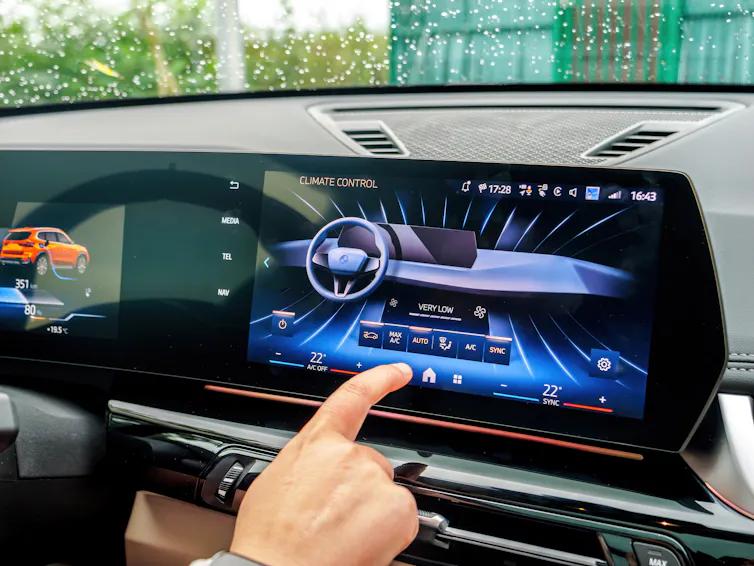
  •  

What happens in your brain when you can’t stop laughing?

CREATISTA/Shutterstock

Do you remember the last time you were laughing and simply could not stop? Perhaps it was a situation when you should not have been laughing at all.

This happened to one of us while accompanying a friend to a family court in the middle of an unpleasant divorce case. It led to a rapid dash to the bathroom while desperately trying (and failing) to regain control – not quite the kind of emotional support this friend was looking for!

Another classic example is the cricket commentators Brian Johnston and Jonathan Agnew who laughed so much as they described the day’s play in 1991 that they could not talk at all. But how and why does this happen?

In fact, although we typically associate laughter with amusement, most of it occurs for other, social reasons. For example, you are 30 times more likely to laugh if you are with someone else than if you are on your own. And you’ll laugh more if you know your companion and like them.

Most laughter occurs during conversations, when people may laugh through contagion – catching the laughter from someone else. Studies show that when we see or hear someone laughing, this can trigger laughter in us almost automatically, promoting social bonding.

We often laugh to demonstrate agreement and understanding, and to cement friendship – for example, over shared recollections. We also laugh to reduce stress.

These common conversational laughs happen roughly six times per ten minutes of conversation, on average. They’re short, lower in pitch, and tend to start and stop quickly.

These types of laughter, which we refer to as voluntary, are different from the helpless laughter that incapacitates us, and which we cannot prevent from happening. Helpless or involuntary laughs are longer and higher pitched, involving strange squeaks and whistles.

In our latest research, we have investigated whether these two different kinds of laughter might have their roots in entirely different brain systems.

Why we laugh. Video: TED.

Things get difficult

When attempting to understand the brain networks that underlie the production of laughter, things can get difficult quickly.

For a start, people move a lot when they laugh. This can cause problems for brain imaging techniques such as fMRI (functional magnetic resonance imaging). It can also be extremely difficult to get people to laugh naturally under laboratory conditions.

Another issue is that different regions of the brain all appear connected to laughter. One of us (Fausto) collaborates with the epilepsy surgery unit at Niguarda Hospital in Milan, where patients with drug-resistant epilepsy undergo electrical brain stimulation for clinical purposes. Electrical stimulation is highly precise and not affected by movement.

Normally, if you stimulate the motor system, the patient will move. If you stimulate the visual system, they may experience hallucinations. And if you stimulate the auditory system, they will hear sounds. But there are five or six areas of the brain where stimulation triggers loud laughter in the patient. So, why is this?

We recently reviewed all brain stimulation studies of people laughing, and how they felt when they laughed. These studies provide evidence that the areas of the brain where stimulation evokes laughter form two different laughter networks.

In one, encompassing the anterior cingulate cortex, the temporal pole and some subcortical regions, stimulation led to laughter accompanied by pleasant sensations and happy feelings – this is the more helpless, high-pitched laughter. When there was stimulation to the other network, which is in the brain’s motor and premotor regions, laughter led to speech impairments and was not associated with any emotional state.

Evolutionary differences

The areas constituting the first, more joyous laughter network mapped on to a network for vocalising that humans share with all other mammals. This is potentially also responsible for other spontaneous emotional vocalisations such as crying out.

Activation of this network during spontaneous laughter triggers a neurochemical cascade that taps into, among other things, the opioid system. This helps to explain the sense of pleasure and reward that comes from this joyous, uncontrollable laughter. The serotonin system that regulates our sensitivity to pain is also affected, which may explain why this laughter can temporarily dull physical pain.

From an evolutionary perspective, this network is older. It originates in the spontaneous emotional responses and rough-and-tumble play systems of animals, and is therefore largely unchanged between humans and other animals.

The other, voluntary laughs mapped on to a brain network linked to voluntary movements in humans, such as speaking aloud. These have a primary role in strategic communication and social negotiation, so may explain the particular use of laughter in conversation as a sort of spoken punctuation.

This neural system is found mainly in humans, and is associated with complex vocal acts such as speaking, singing and beatboxing.

A 2022 study looking at the shapes our vocal tracts make when we laugh in this conversational way found they resemble the shapes we make when we speak. In contrast, the shapes of our vocal tract when we laugh helplessly look very unlike speech, and their motor control is simpler, consistent with their ancient origins.

This research shows that voluntary laughter requires more complex and refined motor control than spontaneous laughter, occupying a middle ground between spontaneous laughter and spoken language – not only functionally but anatomically as well.

If a person has a stroke that damages this voluntary network, they can develop severe problems with speech while still being able to laugh, cry and swear. We would argue that this is because the older network remains intact.

The science of laughter may seem like a rather frivolous subject – and neuroscientists have certainly devoted more effort to studying negative emotions such as fear, anxiety, anger and disgust.

However, research on human laughter is turning out to be something of a Rosetta Stone for understanding a surprising range of phenomena – including the origins of the social brain in mammals, the mechanisms of bonding and empathy, pain modulation, language in conversation, and emotional contagion.

The Conversation

The authors do not work for, consult, own shares in or receive funding from any company or organisation that would benefit from this article, and have disclosed no relevant affiliations beyond their academic appointment.

  •  

Here’s how a learning strategy can make AI work for you

DC Studio / Shutterstock

Generative AI can explain a difficult concept, solve a problem, correct a sentence or produce an answer in seconds. That creates enormous opportunities for learning.

People have more access than ever before to information about different learning strategies. But the strategies that feel easy or familiar are not necessarily those that produce the most durable learning.

You are in charge when you use an AI so it’s a good idea to come up with a learning strategy that works. Understanding this matters because successfully completing a task is not the same as learning from it. AI might help a person produce the right answer today without increasing their ability to independently produce a correct answer tomorrow.

Language learning provides a useful example. An app such as Duolingo can provide structure, repetition and motivation. A learner can deepen that experience by trying to produce the answer from memory before looking at or selecting the options provided by the app, repeating unfamiliar sentences aloud or revisiting difficult vocabulary.

Deliberately retrieving information can improve longer term retention compared with simply studying material again. A large language model such as ChatGPT can play a different role. It can explain things, compare sentence structures, generate further examples or help investigate something the learner has noticed.

When an app is used together with a large language model, they can create a richer learning ecosystem. A small case study involving Duolingo users, for example, found that adding reflective journalling – writing down thoughts and goals – gave learners opportunities to articulate their strategies, difficulties and developing awareness of their own learning.

Consider two people using the same AI model. One gets stuck and asks for the answer. The other attempts the problem first and then asks why their answer was wrong. They might request a clue, ask for another example, or explain what they think is happening and ask the AI to challenge them.

Both have access to the same tool. But the learning activity is very different.

Changing how we use AI

Psychologists use concepts such as metacognition – the ability to examine, understand, and regulate your own thought processes – to describe how people monitor and manage their own learning. Effective learners make judgements about what they understand, what needs more practice, which strategies are working and when they need help.

Emerging research suggests these capacities also shape how people engage with AI. In one semester-long study of university students using ChatGPT for English-language writing, metacognitive awareness was associated with different patterns of AI use. Interview data showed behaviour ranging from simply copying ChatGPT’s output to using its feedback more actively to improve written work.

AI apps.
There’s evidence that AI use can lead to dependence that erodes natural learning skills. Tada Images / Shutterstock

The design of the technology matters too. In a large field experiment involving nearly 1,000 secondary school maths students, the researchers gave one group of students access to a standard version of GPT-4. They gave another group of students access to a different version of GPT-4 that was designed to behave like a tutor, rather than simply supply answers to prompts.

The students with access to the standard version of GPT-4 saw their performance improve. Yet, when the researchers took their access away, these same students performed 17% worse than students who had no access to AI. The group who studied with the GPT-4 version designed to tutor largely avoided this decline.

The tutor group is important because the lesson is not that learners should be denied assistance or simply made to struggle. Effective support can remove unnecessary barriers while preserving the mental activity learning requires.

AI can give an answer immediately. But it can also offer a hint, ask someone to attempt the problem first, identify a misconception, generate another example or ask the learner to explain their reasoning.

The important question is therefore not simply whether AI is being used. It is which learning activities it is allowing someone to stop doing, and which it is helping them do better.

Self-aware learning

AI literacy matters. Learners need to understand what these systems can and cannot do, how to question their outputs and when their use is appropriate. But we might also need to think more explicitly about learning literacy.

Learning literacy is not a new psychological construct, but a public-facing way of describing the knowledge and judgment people need to regulate their learning in increasingly technology-rich environments.

AI literacy asks whether we understand the tool. Learning literacy asks whether we understand learning well enough to decide how that tool should be used. There is good reason to think AI could form part of the solution.

A recent meta-analysis of 32 studies involving 3,029 participants reported substantial positive effects of AI-supported interventions on self-regulated and self-directed learning.

However, the effects varied according to how the technology and learning experience were designed. That means responsibility cannot sit with learners alone.

Schools and universities can make learning itself more explicit, helping students understand why strategies such as retrieval, reflection and feedback work. Developers can design AI that encourages attempts before assistance, offers hints rather than solutions where appropriate, and asks learners to explain or revisit their reasoning.

And learners can ask a deceptively simple question: what am I actually learning by using AI this way?

We are spending enormous effort making AI better at answering questions. The educational challenge is to become equally good at recognising when those answers are helping us learn, and when they are simply helping us finish.

The Conversation

Paul Jones does not work for, consult, own shares in or receive funding from any company or organisation that would benefit from this article, and has disclosed no relevant affiliations beyond their academic appointment.

  •  

An overlooked sci-fi movie shows how disruption by AI could be positive for society

The AI doomsday news cycle plays on anxieties about the future. The media has tended to prioritise sensational takes on the risk at the expense of more thoughtful opinions by, for example, experts in the ethics of AI.

Alarmist fantasies of superintelligence – where artificial intelligence surpasses that of the most gifted human minds – are criticised for distracting from real concerns and threats. AI is energy hungry, environmentally damaging, and has prompted urgent calls for legislation relating to a slew of ethical concerns.

Apocalyptic AI visions drawn from science fiction engage public interest. One fascinating scenario can be found in the 2018 movie Annihilation, starring Natalie Portman and Oscar Isaac. The film is being released in the 4K Ultra HD home media format in the UK and US in October.

Annihilation features an “alien intelligence” – a popular analogy for AI among tech leaders – which embeds itself within Earth’s environment. Can such visions be useful to the current real-world doomsday debate?

Sci-fi could help reframe the real-world narrative in positive ways. There are strange techno-futurist and eugenicist visions at play within Silicon Valley, which appear popular with some tech billionaires.

These are linked to dark enlightenment thinking – a movement that rejects liberal democracy and egalitarianism – as well as effective altruism (attempting to impartially calculate benefits to provide the greatest good). These visions encompass long-term perspectives that accept present-day sacrifice for future wellbeing.

The future-oriented visions expressed by some tech leaders can be surreal, but they reflect the belief systems fuelling the drive for AI superintelligence. And that raises important questions, right now, about whose vision of the future we are investing in.

Alex Garland’s sci-fi horror film Annihilation takes us into these issues through one of the weirdest sci-fi visions that’s out there. It is loosely adapted from a novel by Jeff VanderMeer.

Termed the Shimmer, because it radiates energy, the AI steadily expands its reach (starting from Florida swampland) by operating as a networked entity beyond human control. It changes everything within its domain. People, animals, and plants mutate in unpredictable ways, seemingly infected by a strange parasite.

Annihilation director Alex Garland has long been interested in artificial intelligence. DFree / Shutterstock

The story focuses on an expedition team, including genetics expert Lena (Portman), who enter the Shimmer seeking answers. They discover that all electromagnetic waves and DNA are being disrupted and reconfigured.

The Shimmer is interfering with the fundamental patterns of life, redefining evolutionary code. Among other things, the Shimmer learns to clone humans. This enables it to exist within human-type bodies anywhere on Earth.

Both extinction and immortality

Annihilation toys with different types of human extinction. Terminal extinction refers to humanity dying out while leaving a successor species, a bit like the concept of a human’s consciousness being uploaded onto a machine. Final extinction is when humanity ends, full stop.

When tech billionaires stumble over questions about wanting humanity to endure, they are probably thinking of terminal extinction. Surreal as it sounds, this magical thinking is a recurrent feature of the AI landscape.

Annihilation leaves the viewer to decide which form of human termination is occurring. The film draws on Garland’s deep fascination with AI. His debut as a director, Ex Machina, explored a humanoid robot passing the Turing test and breaking free from human control.

His television series Devs visualises a world where a quantum supercomputer has “godlike” capabilities.

Annihilation’s organic body horror uses imagery of destroyed, mutated, and cloned bodies to reflect profound social anxiety about humanity’s future. As Garland himself has suggested in an interview, there is a form of digital spirituality fuelling the tech billionaire drive for AI superintelligence and his sci-fi work explores this concept in various ways.

AI as parasite

Annihilation is weird but it makes sense through the parasite theory of communication. The French philosopher and historian of science Michel Serres expanded upon biological parasites to develop a media and communications theory. In it, he argued that all forms of interaction involve disruption and noise.

Whether intentional or not, within every interaction there is always some kind of human or non-human disruption at play. Think in terms of glitches and interference while using digital devices, background noise, changeable environments, uninvited guests and any other distraction. According to Serres’ idea, these can all be visualised as forms of parasite feeding on attempts to interact.

In some instances, the parasite takes over – the disruptor displaces the host. If the impact of a parasitical disruptor is significant, it can change society forever. Disruption is a popular term in technology, and AI can be seen as a global disruptor.

But disruption shouldn’t be viewed as inherently negative. In fact, disruption is generally considered a form of positive change because it offers new tools, systems and processes that displace the current methods and structures available to humans in everyday life.

But it raises the key issue of whose interests, ethics and beliefs are being propagated and served by the impact of AI as a disruptor. Annihilation visualises a parasitical disruptive force embedded within the environment, which invites comparison with the darker areas of techno-futuristic visions from Silicon Valley and beyond. Like the Shimmer, AI is not going away; it just keeps changing form.

More importantly, Annihilation shows how small-scale changes can build towards global impacts. The story to engage with isn’t the fantasy that AI superintelligence is about to dominate humanity – it’s the one about disruption and whether that is a net positive or negative for human society.

Changing how we think about and use AI requires critically examining it, disrupting the fantasy narrative, and redefining the discourse and direction of travel of this world-changing technology.

What Annihilation tells us is that becoming a disruptor can change our future visions and current realities in a positive way. It helps us see possibilities for a technological future that move beyond the human extinction trope.

The Conversation

Kevin Hunt does not work for, consult, own shares in or receive funding from any company or organisation that would benefit from this article, and has disclosed no relevant affiliations beyond their academic appointment.

  •  

Will AI be good or bad for the climate? Here’s what the latest evidence on energy use suggests

Is AI a climate change villain, whose insatiable hunger for electricity will roast the planet? Or will it help predict where the next climate disaster will strike and what to do about it?

In order to weigh these questions up, a good starting point is with AI’s energy consumption.

The 2015 Paris agreement was a deal among almost 200 countries to keep “the increase in the global average temperature to well below 2°C above pre-industrial levels” and pursue efforts “to limit the temperature increase to 1.5°C above pre-industrial levels”.

Training and deploying AI models takes place in large data centres which use a lot of power. A typical AI-focused data centre consumes as much electricity as 100,000 households. That’s why energy use is at the heart of this question about how AI will affect climate change.

Data centre use rises

But AI’s energy consumption is increasing fast. According to the International Energy Agency, the power used to train large language models (LLMs) and to run them has risen roughly tenfold since ChatGPT was launched in November 2022. And AI data centres of the future will consume far more electricity than they do today, perhaps 20 times more.

Use of AI has grown very fast, and is still growing. Sundar Pichai, the CEO of Alphabet which is Google’s parent company, recently said that Google’s monthly usage of its AI products has increased sevenfold to 3.2 quadrillion tokens (the units of data AI models read and process) since last year.

However, power consumption per AI task is going down. So efficiency is growing. The problem is that our demand for it is also growing. Economists know this as Jevons’s paradox: where technological gains can wipe out efficiencies as they create more use.

AI consumes about 155 terawatt-hours of electricity a year, based on IEA figures, and a third of the energy used by data centres overall. That is a lot. But it is still only about 0.5% of the world’s electricity, and around 0.1% of its total energy use (when we also consider oil, gas and carbon).

However, other factors are also significant. Data centres cluster, and in places where they do, such as Ireland and northern Virginia, they already strain local grids.

How AI is driving energy use.

Can AI help with climate change?

But what about AI’s potential to help with climate change? In 2025, the European Centre for Medium-Range Weather Forecasts put an AI model into use, AIFS, which produces forecasts that improve on traditional physics-based models. It cannot tell you whether rain will fall on your street 30 days from now, but it can assess the probabilities of extreme weather events with much more geographical detail and offer more time to plan ahead.

This massively improves the possibility for insurers to assess risks as well as for government departments to put plans in place to avoid, or mitigate, disasters. It also significantly uses less energy than other physics-based weather forecasting systems.

The bigger prize lies beyond forecasting. The Intergovernmental Panel on Climate Change, the scientific pillar of the UN’s climate machinery, exists “to give governments at all levels the information they need to make policy”. Its reports take years, and not everybody seems convinced that its conclusions are fully independent.

AI could be a powerful lever for the IPCC to better serve its mission. A public AI model (similar to the AIFS) could potentially reduce biases, if used well. And it could do more than forecasting. It could suggest actions as well as describe risks; cover adaptation as well as mitigation; and reach not only government departments but city councils, farmers and households. This would turn global science into a decision-supporting system about which crop to plant or whether to insulate a roof as well as the policy decisions on how to manage energy transition.

That will not happen by itself. We need incentives to make the use of AI more energy efficient.

Here lies the most striking contrast between the two sides of the argument over AI and climate change. The world has a governance mechanism for climate change, however imperfect: the Conference of the Parties (COP), which has met almost every year since 1995. But AI has little more than voluntary codes, occasional summits and a UN scientific panel created only last year.

Could AI’s energy use be less than feared?

A new paper by Vision, the thinktank I direct, has tried to measure both sides of the ledger for AI on climate change. Its findings will feed into Vision’s fifth conference on the global governance of climate change, to be held in Venice from October 15 to 17.

The work suggests that AI’s appetite for energy could be smaller than feared, and its potential is larger. But concludes that neither will matter much unless we learn to govern it.

Whether AI warms or cools the planet could depend less on its chips than on the institutions we build around AI, and how we use it.

The Conversation

Francesco Grillo is Director of the Italian think tank Vision.

  •  

China’s panda diplomacy: how Beijing combines conservation and trade

Two giant pandas recently landed in Atlanta, a week after Donald Trump and Xi Jinping met in Washington.

The summit produced no immediate breakthrough on trade deals, Taiwan or AI, but it did produce something cuddly for the American public: a pair of giant pandas, Ping Ping and Fu Shuang, which are on a ten-year loan to Atlanta’s zoo. Both were born in 2020 at the Chengdu Research Base of Giant Panda Breeding, the showpiece of a decades-old conservation effort.

China treats the giant panda as a national treasure and retains ownership every one it lends abroad. Sending a pair is a mark of favour: the bears draw crowds and signal Beijing values the relationship. When relations cool, the loans often seem to lapse and the pandas return to China. This is panda diplomacy.

From gifts to rentals

Some trace the practice to the Tang dynasty, when Empress Wu Zetian is said to have sent a pair of bears, believed to be pandas, to Japan, between 624 and 725 AD. The better-documented history begins in 1941, when Chiang Kai-shek’s government sent a pair to New York’s Bronx zoo as thanks for American aid.

But it was Mao Zedong who turned the gesture into policy. In 1957 he sent a panda, also called Ping Ping, to the Soviet Union, and by 1982 China had given away 23 pandas to nine countries. The most famous pair, Ling-Ling and Hsing-Hsing, were sent to Washington to commemorate Richard Nixon’s 1972 visit to Beijing. They drew more than 20,000 people to the Smithsonian national zoo on their first day and an estimated 1.1 million in their first year.

Under Deng Xiaoping’s reforms, gifts became rentals in 1984, and pandas went on short, lucrative tours. The Los Angeles zoo paid US$100,000 (£75,500) a month for a pair during the 1984 Olympics.

Not everyone was charmed. Conservation groups such as The New York Zoological Society viewed the tours as money-making ventures. In 1988, when the Toledo zoo hosted a pair for 100 days it attracted protests. A judge barred the zoo from charging visitors extra to see them. In 1993 the US Fish and Wildlife Service stopped issuing new import permits. When it resumed in 1998, the new rules said a significant share of the money should protect wild pandas in China.

The result is today’s arrangement: long-term “research” loans, usually for ten years and up to US$1 million a year, with any cub born abroad remaining Chinese property. The rules changed, but the loans still follow Beijing’s interests. University of Oxford researchers found that loans after 2008 often coincided with trade deals. Malaysia received Xing Xing and Liang Liang in 2014 to mark 40 years of ties. And as relations with Washington soured, its pandas flew home in November 2023.

Mei Lun and Mei Huan were the first giant panda twins born in the US.

A conservation story

China set up its first panda reserves and banned hunting in the early 1960s. When a mass die-off of bamboo happened in 2005 and pandas starved, rescuers brought many into captivity. The Chengdu base opened in 1987 with six rescued wild pandas.

A national panda programme followed in 1993. Today there are 67 reserves and a Giant Panda National Park. Wild numbers rose from 1,114 in the mid-1980s to 1,864 by 2014, and in 2016 pandas were moved off the endangered list.

The Chengdu base, a tourist magnet, breeds pandas for display and diplomacy. Releasing them is the job of a separate state body, the China Conservation and Research Centre for the Giant Panda (CCRC). Its scientists say releases are replenishing fragile wild populations. they claim that this makes every zoo panda, including those lent abroad, a lifeline for wild ones. Some are sceptical about this claim.

Two decades of releases

The CCRC began moving pandas to the wild in 2003. Its first, Xiang Xiang, was found dead within a year. Of the dozen released since then, ten have survived, while more than 700 remain in captivity.

The only permanently released panda known to have had a cub, Luxin, was born wild.

Since 2017, previously captive females moved to the forest temporarily to mate with wild males, then returned to captivity, have produced 14 cubs, 12 of them surviving.

Bears for summits

Chinese scientists say the pandemic slowed its rewilding project, but its lack of success has drawn criticism from those who believe it should have had more emphasis and investment.

So far the attempts to replenish the wild panda population have not been as successful as many had hoped, and only small groups of giant pandas survive.

On the other hand China’s attempts to mix trade and conservation in zoos continues to create significant public relation successes. Each new announcement of new pandas heading to a foreign zoo attracts international attention and symbolises a renewed trading and foreign policy relationship between two nations. Something that Beijing will no doubt want to keep building on.

The Conversation

Chee Meng Tan does not work for, consult, own shares in or receive funding from any company or organisation that would benefit from this article, and has disclosed no relevant affiliations beyond their academic appointment.

  •  

How bionic eyes are becoming a reality

If you’ve delved into the worlds of Star Trek, The Terminator or William Gibson’s cyberpunk novel Neuromancer, you’ll know that enhanced, electronic vision is a staple of science fiction. Now, what was once futuristic fiction is becoming a reality.

Researchers have developed bionic eyes that can restore some lost vision. These devices’ capabilities are currently basic, but they have been steadily improving in recent years.

One day, they might even offer features that transcend the limits of natural human eyesight – for instance by manipulating images in a way the human eye cannot or by seeing beyond the spectrum of visible light.


Technology that boosts people’s physical and mental abilities is no longer the preserve of science fiction. In this series, we explore cutting-edge ways that human capabilities could be augmented both now and in the near future – and the ethics of these innovations.


To date, implants have focused on combatting problems with the retina, the light-sensing layer of cells inside the back of the eye. Akin to the film in the back of a camera, the retina allows us to see the outside world. When things go badly wrong with it, the result can be a total loss of vision.

Work to fix retinal blindness with implants began more than two decades ago. One of the first devices, developed by the German manufacturer Retina Implant AG, featured a light-sensing chip placed under a person’s damaged retina. This connected with their remaining healthy retinal cells, which then transmitted the chip’s vision signal from the eye to the occipital cortex, the brain region where vision is perceived.

Surgery to implant the chip took about eight hours. This included creating a recess in the skull behind the ear to implant a power receiver and then connecting this with a wire beneath the skin to the chip.

The device offered only rudimentary vision, with patients seeing flashes of light that corresponded roughly to the shape of the object they were looking at. Many implants also broke over time, possibly because of the frequent rapid movements of the eye or corrosion caused by its salty liquid interior. Retina Implant AG ceased operations in 2019, citing its lack of medical progress as one of the main reasons.

The other leading early device, Argus II, combined a glasses-mounted camera with a chip surgically inserted on top of the retina. The camera’s picture was converted into a signal and transmitted wirelessly to the chip (along with power), which then stimulated healthy cells in the damaged retina using an array of 60 electrodes.

Despite positive early results and FDA authorisation in 2013, ARGUS II also ultimately failed to deliver sufficiently convincing results. It was discontinued in 2019.

Newer approaches

Despite these setbacks, investigators have persisted in trying to create artificial vision.

A newer approach is to use an external camera that wirelessly transfers power and image data to a chip implanted in the occipital cortex. This built on research that placed electrical probes directly into the occipital cortex to stimulate visual perception.

This approach can help both patients with diseases of the retina and those with conditions affecting the optic nerve, which connects the retina to the brain. But exactly how much resolution can be achieved with this technique isn’t clear, as the retina’s high resolution and complex signal processing is lost.

One company trying this technique, Belgium-based ReVision Implant, is launching its first human clinical test in October 2026.

Another option is to use spectacles that transmit both images and power to a surgically inserted subretinal chip via an infrared signal. A device using this technique, Prima, has been tested in a specific disease of the retina called dry age-related macular degeneration (AMD), a leading cause of blindness.

In a small clinical trial, the device restored functional central vision to 81% of patients, allowing them to read letters, numbers and words. The device is now authorised in 30 European countries.

As AMD is far more common than the inherited retinal diseases treated by most earlier devices, this device is much more appealing to investors. However, there are ethical questions here. Unlike patients with inherited retinal diseases, most with AMD still have good peripheral vision, so they have much to lose if things go wrong. The complex surgery to implant a subretinal chip is far from zero risk.

Super-human vision?

Because these technologies relay visual information electronically, extra functionality could potentially be built into them. With Prima, patients can already use optical zoom, while algorithms that could allow for image sharpening have been proposed.

In the future, it is possible that devices may emerge that use cameras capable of seeing beyond the visible light spectrum. This could potentially offer thermal imaging and night vision. One device offering near-infrared vision has already been tested in primates.

But while exciting, these will probably not offer enhanced vision until the currently rudimentary artificial vision is advanced to the point that these “optional extras” become more relevant.

For now, there are still many biomaterial and electrical challenges preventing retinal implants from offering full, long-term vision restoration. However, a potentially greater challenge comes from competing biological solutions, such as stem cells, which are in the early stages of human trials.

These have also had a few false dawns and there are big obstacles to overcome in terms of cell survival and integration. But if new human retinal cells can replace those lost to disease, they could one day overtake bionic eyes entirely as the solution for vision restoration.

The Conversation

Tim Jackson was involved in one of the trials of Retina AG’s device, and his NHS employer received site fees for participants enrolled on the trial. As part of this trial, he received support to attend surgeon training in Germany.

  •  
❌