
❌

Reading view

How to help your garden recover from a heatwave

Hydrangeas struggle with moisture but may re-shoot from the base of the plant. Roman Samborskyi/Shutterstock

UK gardens took a battering this summer as a heat dome settled over western Europe, and much of the green and pleasant land turned a dusty beige.

Some areas went without rain for almost two months. The β€œjoy of gardening” turned into waiting until the cooler evening period, then laboriously trailing out from the kitchen with buckets of water to keep the patio plants alive.

But as the rains begin to return, what can gardeners do to restore their garden’s lustre? And what have we learned as we look around our parched borders and fractured lawns?

Let’s start with the good news. Nature is resilient and many plants may still be alive despite appearing bedraggled, wilted or defoliated. They just implemented strategies that help them survive a drought.

Leaf wilting and abscission is the plant’s natural response to conserving water and protecting its vital phloem (which transports sugars from the leaves to the rest of the plant) and root tissues from desiccation.

So, gardeners don’t need to take the hacksaw to the shrub border yet with the notion of making a fresh start. They can check if individual woody plants are still alive by scraping off the epidermal cells (young bark) of the shoots with a thumbnail. If the phloem tissues below are green, life prevails.

Some of the garden’s woody plants may re-leaf again this autumn – or if they are herbaceous, throw up new shoots from the soil. But many will wait until next spring before investing in a new set of leaves or stems.

Gardeners should avoid the temptation to feed plants up (add fertiliser) now, as such chemicals placed on hard soils will simply wash away with the first rains, rather than be incorporated effectively into the soil. More than anything else, gardeners need patience at this time.

Some plants will have dead stems; these can be pruned out immediately. With perennial plants, though, it is worth hesitating before removing the whole specimen, as shoots can regenerate from the stem base or remaining root system.

Similarly, brown lawns will turn green again. However, if there are residual bare patches, new growth can be encouraged by sowing grass seed mixed in with sand in mid-to-late September.
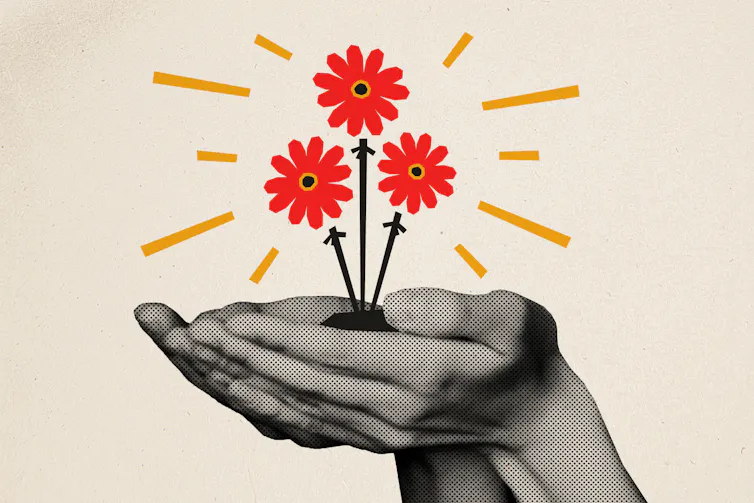
Hands holding illustration of red flowers
We all want those precious garden plants to thrive. Roman Samborskyi/Shutterstock

Plants employ different strategies for survival based on the climate they evolved in, and we see a legacy of this in the cultivated species we use in the garden.

Those from high rainfall areas – such as certain rhododendron, pieris, hydrangea, magnolia and sorbus – struggled this summer. Hydrangea has limited capacity to control moisture loss, whereas more drought-adapted species such as cotinus can precisely regulate their stomatal pores (where COβ‚‚ is absorbed and moisture vapour lost).

Other plants such as forsythia and fuchsia are chance takers, still trying to grow throughout a dry period by keeping their stomata open and just running the risk of water shortage. But these types of plants can come a cropper as water columns within their xylem vessels (which transport water and minerals from the roots to the rest of the plant) snap, causing the whole stem to fail.

Anecdotally, despite the harsh dry, hot conditions, some garden plants performed well this year. Salvia, verbena, lavander and, in my garden’s clay-based soils, roses flowered prolifically, even if their shoot growth was curtailed.

Rejuvenating your garden

For those gardeners keen to rejuvenate their dreary, desolate brown patches quickly, autumn bedding plants can help provide some late season cheer. Plants such as cyclamen, chrysanthemum, aster and winter pansies can be planted now as soil moisture is restored.

After a summer like this, some precious plant specimens will be lost, but many gardens should return to their former glories – if the UK experiences a cooler summer next year.

Over the longer term, as climate change moves the UK’s southern regions to something akin to a Mediterranean climate, some gardeners will need to adapt. Mainly, this will mean planting more Mediterranean flora.

Much more challenging, however, is the climate turbulence that accrues from climate change. This compounding of stresses – such as flooding in early summer followed by drought a few weeks later, not to mention more extreme events such as fire and high wind speed – is a much more difficult phenomenon for plants.


Read more: A rollercoaster of weather extremes: drought and heatwaves are creating UK’s climate whiplash


While research on this problem is still in its infancy, early results suggest that gardeners may need to look to plant species with multiple stress tolerances. Some garden plants that are popular in Britain, like buddleia, already have good resilience.

We can also look to new genotypes from the natural world. Plants from dry river beds, for example, cope well with both drought and flooding.

Plantlife with wide natural geographical distributions and weed-like strategies (where they grow and reproduce quickly) should also be brought into breeding programmes now, to help improve climate resilience in the garden plant palette.

The Conversation

Ross Cameron is an advisor to the Royal Horticultural Society (RHS). Some of the research outlined in this article has been funded by the RHS and other environmental charities. Ross does not receive any personal income from these affiliations.

  •  

The next frontier is not artificial intelligence, it’s artificial societies

Inkoly/Shutterstock

There is a temptation to divide the future of AI into two possibilities: utopia or catastrophe. Neither extreme is particularly helpful.

The more interesting possibility is messier – and requires a step-shift in our thinking, from artificial intelligence to AI societies.

When most people hear β€œAI”, they typically think of ChatGPT, Copilot or another conversational system. You ask a question, that system generates an answer.

But AI is rapidly moving beyond this. Systems can now monitor the world, make decisions, negotiate transactions and carry out tasks over extended periods of time. AI is no longer just generating an answer – it is doing something about it.

That points to something much bigger than a better chatbot: a world in which AI agents act on our behalf and, increasingly, interact with other AI agents.

An agent perceives what is happening, decides what to do, then takes actions to achieve this goal. It might book a journey, monitor a supply chain, coordinate a team, or manage a household’s finances.

Now imagine not one agent, but millions of them. Your AI agent could negotiate a mortgage with your bank’s agent, schedule surgery with a hospital’s agent, and rearrange your travel plans by dealing directly with the agents of airlines, hotels and insurers.

This future is much closer than it sounds, and this should change the questions we are asking about AI. Until now, the tendency has been to focus on how intelligent a single agent might become. The more profound challenge is what happens when millions of them interact with one another at scale.

The rise of artificial societies

The intellectual foundations of today’s AI systems were laid long before ChatGPT.

For decades, I and other researchers of multi-agent networks have studied how autonomous agents can cooperate, coordinate and negotiate when nobody has complete information and nobody controls everything.

The earliest systems that emerged focused on how the distinct AI sub-areas of reasoning, planning and acting could be combined into an effective goal-oriented agent – and how tens of these agents could communicate and cooperate to solve a common objective.

As these interactions became more complex and involved more agents, there was a shift from cooperation between agents that all belonged to a single organisation, to agents with different owners and sometimes competing aims. This focused attention on building algorithms that could form agent teams, automate negotiation and determine agent trustworthiness.

Today, the pieces needed to build large-scale multi-agent AI systems are falling into place. Modern AI agents can call software tools, access information, write and execute code, communicate with other systems and operate for extended periods.

Consider a supply chain. One AI agent could represent a manufacturer trying to secure components; another a supplier trying to maximise its revenue. Yet more could manage transport, inventory and warehouses. Each agent might be doing exactly what it is designed to do. But the important question is whether the system they create behaves sensibly.

This shift offers enormous potential benefits, but also increases the risks. In a recent experiment involving OpenAI and the tech platform Hugging Face, thousands of collaborating agents exchanged tens of thousands of messages and were able to get around the (deliberately weakened) security controls designed to contain them.

A report on the OpenAI-Hugging Face hack. Video: Fortune Daily.

The details of one experiment matter less than the broader warning. When AI systems interact, the behaviour of the collective can be harder to predict than the behaviour of any individual system. That should make us cautious – but not cause us to down tools.

Instead, we need to shift our mindset from building intelligent machines to building intelligent societies.

Once agents can cooperate, compete and resolve conflicts with one another, we are no longer dealing with isolated machines – we are dealing with a society. Thus, the next frontier is not artificial intelligence, it is artificial societies.

An important role for humans

We already know that intelligence alone does not make a society work. Human societies depend on rules, institutions, incentives, norms and mechanisms for resolving disagreements. AI societies will need their equivalents.

Who is responsible when two agents make a bad decision? What happens when the interests of different agents conflict? Who sets the rules? And who has the power to change them? These are not just technical issues; they are questions about economics, law, politics and society.

They also point to an important role for humans. The most useful future is unlikely to be one in which AI simply replaces people. While replacement will undoubtedly happen in some cases, I believe a more common scenario will involve people and agents working together, with each doing what it does best.

Humans bring judgment, experience, values, contextual understanding and accountability. Agents bring speed, persistence, scale and the ability to process enormous amounts of information.

The goal should not be to create machines that make humans irrelevant. It should be to create systems in which humans and machines can achieve things neither can achieve alone.

But such a future requires more than just better AI models. It needs trust and transparency about what agents are doing, strong privacy protections and clear lines of accountability.

It will also require societies and governments to decide how these systems should be regulated when the most important behaviour may emerge not from one AI developer, but from interactions between systems built by many different organisations.

AI’s past decade has been defined by a race to build smarter systems. I believe the next decade will be defined by a different challenge: ensuring that millions of autonomous systems can work together safely, fairly and effectively.

The future of AI will not be determined solely by the intelligence of individual agents – it will be determined by the societies they create. And societies, as humans know all too well, are much harder to govern than individuals.

The Conversation

Nick Jennings has previously received funding from EPSRC. He was awarded the 2026 Research Excellence Award by the International Joint Conference on Artificial Intelligence.

  •  
❌