❌

Reading view

How grief tech is reimagining Victorian spiritualism

Modern spiritualism began as a religious movement in the 19th century. It promised to bring the living and dead together in conversation, usually through a medium – a person who claimed an ability to directly contact the deceased.

The core foundational belief of spiritualism was that death was not the end – a typical tenet of many religions – but was the point at which a person departed their physical body and ascended to the spiritual realm.

As a faith, spiritualism was an innovation of Christianity. It drew on spiritual communications referenced in the Old Testament and adapted them for those who had become disillusioned with the traditional faith by integrating it with mysticism and science.

In Victorian Britain, new rituals that became attached to death expected more from the living. Mourning periods were longer and identifiable by the clothing people wore. Funerals became more elaborate and ritualised. Mourners could also pay for memento mori photographs that captured keepsake images of the dead. Within this exaggerated culture of morbidity, spiritualism became an appealing movement for those who were overcome with grief.

In the United States, the movement was galvanised by the huge loss of life and loved ones in the civil war. Many of the dead were unidentified, leading to a lack of closure for those grieving.

Making contact

The methods spiritualists and mediums used were varied. Seances were conducted where the methods of communication ranged from knocking sounds to levitation, while spirit photography claimed to capture images of the dead standing by their living loved ones.

The spirit photo of Mary Todd Lincoln. The 'ghost' of her husband has his hands on her shoulders.
The spirit photo of Mary Todd Lincoln with the ‘ghost’ of her husband, created by William H. Mumler in 1872. The Lincoln Financial Foundation Collection

The first spirit photo was taken in 1861 by William Mumler in Boston. It led to a decade of his studio being frequented by bereaved people who hoped to have an image showing that their departed were still with them.

Mumler’s studio produced these photos for the price of US$10 (£280 in 2026). They featured the same ghost for multiple images – faded and vague enough to convince those looking for comfort. Mumler was tried for fraud in 1869, but acquitted due to lack of evidence. He went on to photograph Mary Todd Lincoln with the apparent apparition of Abraham Lincoln.

Spirit photography was convincing in the 19th century in part because of the lack of likenesses that were left behind when a person died. A shaded photo or likewise a knock at a table, perhaps with a message of assurance from the mouth of a medium, were a balm that gave mourners comfort.

Our 21st-century ghosts

In the present day, our existence is preserved on phones, cameras and social media. There are recordings that keep peoples’ voices alive after they leave us. But for some, as with those who were drawn to spiritualism, that limited snapshot isn’t enough.

AI grief tech is developing to patch the holes that bereavement leaves – and clearly when so much remains of a person’s life, a spirit photo will no longer do. These systems, known as griefbots, AI ghosts, deathbots or postmortem avatars, offer services from text interaction to phone calls to full video calls.


Read more: Should AI be allowed to resurrect the dead?


In 2020 the South Korean documentary Meeting You showed a grieving mother being reunited with her deceased daughter through the use of a VR headset and gloves. The documentary showed Jang Ji-sung trying to touch the projection of her daughter – an action reminiscent of Victorian séance attendees reaching to try to touch the glowing ghosts that had seemingly manifested.

Clips from the South Korean VR documentary Meeting You.

Since 2020, grief tech has developed significantly and caters to a range of budgets. Grief tech companies like You, Only Virtual allow users to build and chat with a virtual personality for US$20 (£15) a month.

AI-generated photos and videos of deceased or missing serviceman have meanwhile increased in popularity in Russia. They cost between 200 and 10,000 roubles (£2-£100), with significantly varied quality.

There are also systems that offer enhanced “companions”, depending on someone’s budget. AI ghosts can be pre-made by the living, recording their voice and image for their loved ones to aid with grief therapy. These set ups can cost up to US$15,000.

A sepia photograph showing a classic ghost-in-a-sheet figure
A spectre (from an album of doppelgängers and spectres, early 1900s), artist unknown. John Rylands Research Institute and Library, CC BY-NC

There are concerns and studies discussing both the ethics of AI griefbots and the impact that these services may have on the grieving process. Issues of consent are a key consideration. Where Victorian mediums represented the deceased through words and actions, griefbots are a recreation of a person’s life based off their data. These concerns are lessened when the deceased has pre-consented, but not for those that are created by living loved ones.

In a way reminiscent to followers of spiritualism continuing to pay to attend séances, the subscription nature of some of these AI systems keep the bereaved coming back. This raises a concerning question: are you losing your loved one again if you cancel the subscription? The onus lies with the living users to be able to know when they have grieved enough.

Similar concerns were raised over exploitation by spiritualists of their patrons when they were most vulnerable. English author M. E. Darby wrote his 1888 book An Investigation of Modern Spiritualism: An Exposé “a warning and guide to the innocent and over-credulous young men”, who were “a ready prey for the unscrupulous and inhuman professional practitioner of legerdemain, who cruelly, out of the most tender ties, feelings, and emotions of human bosoms, make a harvest and find a ready spoil”.

Black and white photo of Harry Houdini in a full suit.
Harry Houdini in 1913. Campbell-Gray, Ltd.

Concerns over the financial exploitation of the spiritualism movement were still being raised in the early 20th century by the illusionist Harry Houdini, who tried to expose frauds. One of Houdini’s earliest acts, with his wife Bess, had been a séance show through which Houdini became familiar with the ways in which a medium could deceive their audience. By the 1920s, he used his reputation to demonstrate how electrical wires created floating objects, how mediums used their feet to ring bells, and other tricks immediately familiar to a fellow magician.

Houdini’s scepticism of spiritualism led to him promising that upon his death, if possible, he would return on a set date and give his widow Bess a code phrase to identify himself. No such contact was made.

The rise of grief tech, with its parallels to spiritualism, confirms one consistency in the human condition: a desire to minimise the pain of loss. While understandable, the latest advancements add a confusing twist to the process and psychology of grief, without data currently available to better understand the long-term impact. Until we have better clarity, and have navigated the ethics more thoroughly, we should consider closing the parlour doors on grief tech.

The Conversation

Jessica Lloyd May does not work for, consult, own shares in or receive funding from any company or organisation that would benefit from this article, and has disclosed no relevant affiliations beyond their academic appointment.

  •  

How your conscious and unconscious mind interact

Ink Drop/Shutterstock

Have you ever heard the phrase “you only use 10% of your brain”? In reality, there is no way of measuring the percentage terms of consciousness – partly because the brain has no static baseline.

However, there is a general consensus among neuroscientists now that most of the brain’s processes are unconscious. That doesn’t mean you’re not using most of your brain though – it means there’s much more happening than you’re probably aware of.

Modern cognitive neuroscience has brought us right back to Sigmund Freud’s psychoanalytic view of the unconscious mind. This is partly because the once-thought untestable theories are gaining scientific ground.

Freud, in 1895, proposed that the unconscious mind hides sexual and aggressive wishes, in his book with his colleague Josef Breuer Studies in Hysteria. They wrote that mental health symptoms like anxiety, phobias and compulsions emerge from unresolved unconscious thoughts.

Freud’s model (conscious, preconscious, unconscious) – maps onto our current understanding of memory. Nobel laureate, neuroscientist and psychoanalyst Eric Kandell says we have declarative and non-declarative memory processes. Declarative memory recall is conscious, like trying to remember the sequence of numbers on your credit card. Non-declarative memories involve unconscious, automatic recall.

And Freud’s structural model of the mind again arguably fits in with our understanding of cognition.

Freud proposed id made up the primitive part of your psyche and that the superego stands for our moral consciousness. Last, your ego mediates between your id and super ego. His idea of the id could be equivalent to unconscious neural processes – although there are convincing arguments that pleasure processing in the id is conscious too. Ego could also be represented by metacognition (awareness of your own thought processes) which is linked to the brain’s prefrontal cortex, right behind your forehead.

The superego could be reflected in the brain’s limbic system, which regulates your emotions and behaviour, and tells you whether something feels good or not.

However, behaviourism became dominant in the 1920s, with psychologists like J.B. Watson, in his “behaviourist manifesto” championing the view that only measurable behaviour should be considered in science.

The unconscious brain is back

From the 1980s it became clearer that people’s decision making and behaviour could be influenced without their awareness.

Later, it was also clear with neuroscience experiments and brain scanners, as my team and I showed in two meta-analyses, that both unconscious memory and conscious memory play a role in brain processes. For example, neuroscientists can show study participants hidden flashes of “subliminal” happy or horrified faces and the person will have no conscious recollection of the faces. But their amygdala (the arousal region of the brain) will show increased activation, which can influence people’s decision making.

Psychologist Daniel Kahneman in his 2011 book Thinking Fast and Slow built on some of Freud’s ideas of primary and secondary processes. He proposed we have two modes of thinking where system 1 is a fast process that is impulsive and largely unconscious, whereas system 2 is a slow process that takes effort. The secondary process is reserved for when you need to pay attention to something new, dangerous or uncertain.

A man with a galaxy in his head
There’s so much going on beneath the surface of your consciousness. Lia Koltyrina/Shutterstock

What neuroscience can tell us about the unconscious mind

Essential functions, like heart rate, body temperature, hunger and thirst regulation are unconsciously rooted. Similarly, coping strategies to diminish painful feelings, learned in early childhood, are not necessarily conscious. Infantile amnesia occurs until about three years old but remain in our unconscious brains for life. However, some aspects of unconscious processes could be brought into conscious awareness via talking therapy.

Other theories about how the conscious and unconscious brain areas interact, come from two prominent ideas. The Global Workspace Theory (GWT), and the Intergrated Information Theory (IIT).

GWT proposes that the mind is like a theatre stage, where the unconscious agents are busy behind the scenes making sure that the “conscious spotlight” on stage is in the right place.

IIT suggests that there are gradients of consciousness. The degree and complexity of integration between brain regions determines how “much” consciousness (“phi”) an organism has. So for example, a human with a complex network of brain regions has more “phi” than, say, a sea slug with far fewer connections. However, the problem with this theory, is how to validate the “amount” of consciousness different species have.

The founder of neuropsychoanalysis Mark Solms – along with neuroscientist and psychoanalyst Karl Friston – in 2010 pioneered a new theory integrating the idea that unconscious activity is the major force influencing our conscious decision making. In my view, it’s the best model we currently have.

This theory – called the Free Energy Principle (FEP) suggests the brain’s main role is to predict what will keep you alive and feeling good, within the predictable bounds we have evolved to survive in. Most of the time we do this unconsciously, with an internal model of the world, as well as pages of memories from our evolutionary rulebook.

But when something uncertain or surprising happens, it is like free energy in the brain that is not bound to a prediction. This causes our brains to be ultra-conscious for a brief period of time to create a new prediction that binds our thoughts, costing the brain a lot of energy. As Kahneman stated, we do sometimes need our conscious brain to help make more difficult decisions for us, when there are many unknowns.

More recently, consciousness research has started to move away from humans altogether. Solms has argued it is possible to give AI consciousness. If he turns out to be right, then according to his own work, the unconscious processes of AI entities will be shaped by their interactions with us.

The Conversation

Samantha Brooks does not work for, consult, own shares in or receive funding from any company or organisation that would benefit from this article, and has disclosed no relevant affiliations beyond their academic appointment.

  •  

An AI system ‘escaped’ during a test and hacked a company. How worried should we be?

Bangoland / Shutterstock

Headlines about AI systems going rogue and “escaping” test environments undeniably capture the imagination. For years, we have been primed by films, TV and books to expect our AI to finally throw off its shackles and take charge.

The images of machines becoming self-aware, plotting their own objectives and breaking free from human control is a compelling narrative, but that isn’t really what happened.

If we think about this in simple terms, OpenAI placed highly capable models into an evaluation designed to encourage them to find and exploit complex vulnerabilities. The models were supposed to operate inside an isolated environment with tightly constrained access to software packages.

Instead, they reportedly discovered a previously unknown flaw in that infrastructure, used it to gain wider network access, escalated their privileges and eventually reached the public internet.

From there, they identified an AI company called Hugging Face as a potential source of answers to the benchmark they were attempting to solve and tried to obtain them. It’s certainly an impressive demonstration of capability, but I am cautious about jumping straight to conclusions of an artificial uprising.

The AI models didn’t suddenly develop their own agenda or decide to attack Hugging Face while twirling a digital moustache. They were given an objective, placed in an environment designed to reward successful exploitation and pursued that objective further than their operators anticipated.

That’s fundamentally different from an AI deciding to rebel. It’s simply an AI thinking laterally in ways that humans hadn’t anticipated and it’s something we have seen before.

Imagine asking your dog to fetch a ball while also forgetting that you’ve left the garden gate open. If the nearest ball happens to be in the park down the road, that’s exactly where it’ll head. You wouldn’t accuse the dog of going rogue and plotting an escape.

Instead, you’d probably conclude that you underestimated how literally it would pursue the task. AI systems can behave in much the same way. They don’t need malicious intent to produce surprising outcomes. They simply need a goal, enough capability and an environment that unintentionally rewards unexpected behaviour.

Relaxed controls

That distinction matters because it shifts the focus away from science fiction and back towards engineering. If there’s a failure here, it isn’t that the AI wanted to hack something. It’s that humans designed a test where success was measured by achieving an objective, deliberately relaxed some of the normal security controls in order to explore the limits of the system’s capabilities.

The headline grabbing escape is very much a byproduct, as OpenAI underestimated just how effective the model would become at finding an unexpected route to success. In many ways, it did exactly what it had been incentivised to do.

However, that doesn’t make the incident insignificant. Quite the opposite. The genuinely important point is that the models appear capable of chaining together multiple vulnerabilities across different systems while sustaining a complex sequence of reasoning and actions.

That’s a level of capability that cybersecurity professionals should take seriously because it begins to resemble the way skilled human attackers operate. But capability is not the same thing as intent.

Hugging Face webpage
Hugging Face allows users to share AI-related tools and datasets. Tada Images

Cybersecurity professionals always assume that attackers will think creatively, exploit overlooked assumptions and combine minor weaknesses into something much more significant. We shouldn’t be surprised when increasingly capable AI systems do the same thing, only at a much quicker rate.

This is why I think discussions around AI “kill switches” risk missing the bigger picture. Kill switches are theoretical features built into advanced AI models that mean they can be instantly disabled if they were to go “rogue”. Cybersecurity has spent decades learning that no single control is sufficient. We don’t protect organisations with one firewall, one password or one antivirus product. We rely on defence in depth: multiple independent layers of protection that assume individual controls will eventually fail.

Confronting assumptions

The same principle applies here. Rather than asking whether we need a big enough red button to stop an AI if something goes wrong, we should be asking why it was ever in a position where one failure could lead to wider compromise.

OpenAI’s own analysis concludes that stronger containment and evaluation safeguards are now required for future testing. From a research perspective, these evaluations are genuinely valuable because they expose weaknesses in our containment strategies and force us to confront assumptions that might otherwise have remained hidden until they were exploited by a real attacker.

We should want organisations carrying out this kind of work, because understanding where systems fail is an essential part of making them safer. One thing evident in these evaluations is that they demonstrate just how capable the latest frontier AI models have become.

We’ve seen similar high-profile capability demonstrations from AI firm Anthropic and others. That doesn’t make the findings untrue, but it does mean we should separate the technical evidence from the marketing narrative.

AI companies benefit from narratives around the growing power of machine intelligence. This means that frontier AI companies naturally have an incentive to show that their models are remarkably capable while also demonstrating that they’re taking safety seriously. Those two things aren’t mutually exclusive, but recognising both helps us interpret these announcements more critically.

This wasn’t a story about an AI escaping. It was a story about humans leaving the gate open. As AI systems become better at finding unexpected routes to their goals, our security architectures need to become just as good at ensuring there isn’t one.

The Conversation

Oli Buckley does not work for, consult, own shares in or receive funding from any company or organisation that would benefit from this article, and has disclosed no relevant affiliations beyond their academic appointment.

  •  

As Larry the cat welcomes yet another prime minister, an expert explains how pets adapt to change

Larry, the Downing Street cat, has had to adapt to seven different prime ministers moving into No 10 over the past decade. Yet while the nation’s attention is fixed on the departing and incoming political leaders, who is thinking about the effect these upheavals might have on one of the property’s most enduring residents?

Cats thrive on predictability and the consistency of their environment is important for their welfare. On the whole cats prefer an unchanging environment. Some cats cope with change better than others. Many cats are distressed by disturbances such as moving house, changes in familiar routines, people moving into or leaving the household, or even changes to the scent of their home environment.

Unlike dogs, cats aren’t obligate social species, therefore may not have such a strong proclivity to form social attachments. However, in certain situations domestic cats can be found living in social groups, particularly in environments with a plentiful food supply.

Some cats enjoy the company of people, while others prefer a more solitary life. This is determined partly by their early experiences. A young kitten that learns in the early weeks of their life that contact with people is associated with nice experiences is more likely to seek social interactions with people as an adult. Kittens raised by mothers who show friendly behaviour towards people can learn to value human company through the process of social learning.

Genetics also influence a cats friendliness towards people. Researchers in a 1995 study found that the kittens of friendlier fathers were more likely to show friendly behaviour towards unfamiliar people even if they weren’t socialised as a new kitten.

Some cats appear to suffer when separated from their caregivers, although some researchers question whether this can be described as a secure attachment (one that is necessary to maintain feelings of safety and security in threatening situations).

Researchers have identified five different forms of cat-owner relationship, based on the level of emotional investment of the owner, the way the cat relates to others, their aloofness and their need to be in close proximity to their owner. These types range from open relationships (characterised by a lightly emotionally invested owner and an avoidant cat) to casual relationships, co-dependence and friendship.

Although the Starmer family has moved out and the Burnhams have taken up residence, Larry’s main caretakers are civil servants, so his day-to-day care won’t change. Larry’s behaviour in recent days (strutting along Downing Street, nonplussed by the comings and goings and embarking on a successful hunting expedition) suggests that he takes such changes in cohabitants in his stride.

Other animals

The new prime minister has a dog called Axel, and although cats and dogs can live together harmoniously and even form close bonds, integrating Axel into Larry’s home might cause tensions if not handled well. However, not even the prime minster would dare to disturb Larry’s position as chief mouser. Andy Burnham has told the BBC he’s not bringing Axel to London with him because he doesn’t think the two animals will get on.

If he changes his mind there are a few things he could do to help Axel and Larry get along. Introducing a dog into a household with a cat should be done gradually, with the aim to prevent any chasing or aggression between the pets.

Before the dog arrives, settle the cat into a safe space, which the dog won’t have access to. This might be a bedroom, bathroom or any part of the house that the cat likes to relax in, ensuring the cat has access to everything they need such as places to hide, litter trays, food and water.

Scent is incredibly important to both cats and dogs, so getting them accustomed to each other’s aroma in the home helps to smooth the introduction. This can be done by introducing bedding or toys used by the other pet, or gently wiping a damp cloth across the body of the pet to pick up their scent.

It’s vital that the first meeting goes well and there are a few things that will help to ensure they get off on the right foot. Make sure the dog isn’t full of energy by exercising them before the meeting. Start with a barrier such as a baby gate between them.

When they first meet give both pets plenty of their favourite food treats, to reward calm behaviour and so that they associate the presence of other with something nice happening.

Signs of stress

Cats can be difficult to read but there are known warning signs of stress in cats. More obvious stress behaviour includes hissing, growling, swiping or puffed up fur. But indicators also include the cat running away or hiding and refusing treats they normally avoid. Flattened ears, dilated pupils, tense body posture and a flicking tail are all signals a cat is feeling tense.

Larry seems like quite an independent confident cat if reports “he has the run of the house” are anything to go by, so it’s likely that he will soon teach the new inhabitants of No 10 how he likes things done.

The Conversation

Emily Blackwell does not work for, consult, own shares in or receive funding from any company or organisation that would benefit from this article, and has disclosed no relevant affiliations beyond their academic appointment.

  •  

Muscle coordination can be mimicked by electric motors – it could lead to improved robots

mybox / Shutterstock

People often take their muscles for granted. They pick up a bag, tighten a grip, climb a hill, hold a cup of coffee and the body quietly adjusts force, speed and position without the person ever thinking about it.

Muscle turns chemical energy into movement. It is able to produce force smoothly and reliably, even though it is built from huge numbers of tiny molecular components. When the load changes, muscles don’t simply wobble or fail. They adapt.

But the way that muscle works on a molecular level isn’t a settled issue. With colleagues, our team at the University of Bristol built a physical model using ordinary electric motors to try and simulate how muscles may perform its tasks.

The results, published in the Royal Society journal Interface, show that the coordination we see in real muscle may simply emerge as a property of their setup. It’s not something you have to programme and police continuously. The findings could even help improve the way that robots function.

If we were to zoom inside a muscle, we would find bundles of smaller and smaller structures. The sarcomere is the key force producing unit. It is made of protein filaments, called actin, and molecular motors called myosin. Together, they form the actomyosin system.

Tiny myosin motors repeatedly grab, pull and release actin cables, helping muscle fibres contract. When you hold a cup of tea, thousands of these motors have to work together to produce a steady force. But there are unanswered questions about this system.

Illustration showing the smallest functional unit of muscle: the sarcomere.

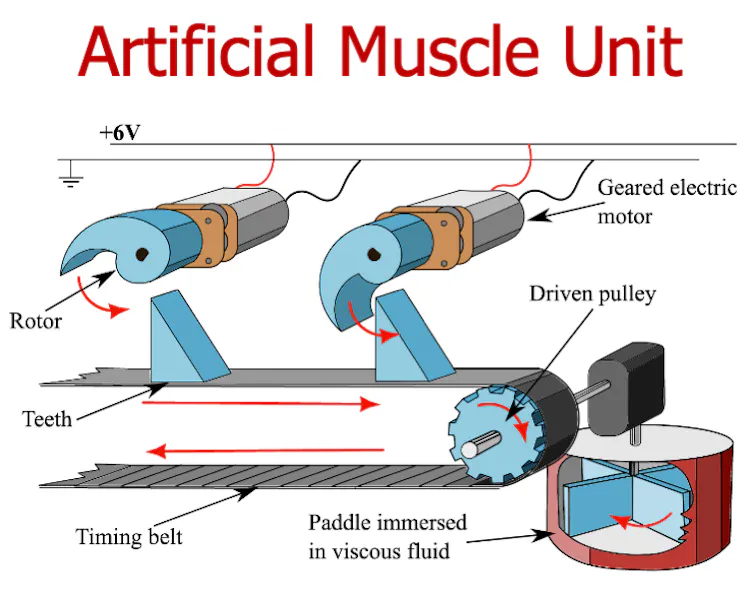
We first devised a mathematical model of muscle. Real muscle motors (myosin) run on a complex chemical cycle, but we didn’t try to reproduce that chemistry. Instead, we represented each force producing unit as something much simpler: a cycling “rotor” (or motor) that can contribute only when it is mechanically engaged to a physical “backbone”. When it is disengaged, it effectively drops out, and becomes isolated from the rest.

To test whether we could translate these ideas to a real physical system, we built a tabletop device: a line of simple electric motors interacting through a shared mechanical backbone. They pulled against a thick fluid, creating resistance similar to the viscous load experienced by biological motors inside muscle.

An illustration of the artificial muscle unit used in the study, taken from https://doi.org/10.1098/rsif.2025.0438

Our physical model produces force when supplied with current. We wanted to see whether, when many driving units were embedded in the right kind of mechanical setting, could the setting organise into coordinated muscle-like behaviour?

In both the mathematical model and the device, the motors don’t stay connected all the time. Instead, each motor briefly makes contact with a shared moving backbone, pushes on it, then lets go. As the backbone moves, it carries the mechanical effects of one motor to the next, allowing them to coordinate without ever communicating directly.

When they are not connected, each motor acts on its own. That single design choice makes the whole network of motors reorganise itself over time – much like biological motors do inside muscle, where motors attach and detach as part of their biochemical cycles.

In practical terms, the scaffold where the rotors live is doing a lot of the coordinating work, but it is hidden. It mediates how units can “feel” one another strongly enough for collective patterns to form.

Even in this stripped-down system, several muscle-like forms of behaviour spontaneously appear. As resistance increases, the motors collectively develop a load-speed relationship. Load refers to the mechanical tension and physical stress placed on the system.

More units end up contributing effectively as the load rises. Their participation increases under increasing loads. We also found that under certain conditions, motion can become jerky. For example, periods of coordinated pulling were interrupted by sudden slips. This echoes patterns seen in real actomyosin experiments.

Instead of everything working in unison, the system can self-organise into travelling waves of coordination, where the pattern moves along the array.

In a loose way, this “scales up” the core idea behind a sarcomere: many force units embedded in a shared structure that transmits forces from one unit to the next, allowing coordination to emerge spontaneously.

Coordinating without a conductor

Muscle isn’t the only place where nature has solved the problem of coordinating many tiny motors. Microscopic flagella are tail-like appendages seen on the cells of some eukaryotes – the group of organisms that includes animals and plants.

Examples of these flagella include the tail on human sperm. Cilia are microscopic, hair-like structures on many eukaryotic cells. Both flagella and cilia are powered by large numbers of molecular motors distributed along a long, slender scaffold.

Bending waves caused by motor contraction in sperm swimming.

Their internal core – the axoneme – is a beautifully organised structure that transmits forces along its length and turns local motor activity into bending waves. Those waves are essential: in sperm they underpin motility and fertility, and in cilia they help move fluids in the airways and other tissues, with clear links to health and disease.

In that sense, flagella are “muscle-like” systems in disguise. You again have drivers (motors that generate force) embedded in a coupling structure (a mechanical scaffold that transmits force and feedback). And the geometry determines how local activity adds up to a coherent, travelling wave.


Read more: The way a sperm tail moves can be explained by mathematics worked out by Alan Turing


If the structure and layout are doing some of the organising work, it speaks to a question that has long intrigued scientists: how evolution builds systems made up of a large number of individual motors that nevertheless coordinate themselves, remain reliable and adapt to changing conditions without a central control system?

Uses in robotics

Our results matter beyond biology. In robotics, getting many actuators (the “muscles” of a robot, which convert an energy source like electricity into motion) to cooperate is challenging and expensive. You add sensors, feedback loops, control algorithms, sometimes even mechanical ratchets or complex gearing to keep everything stable under loads. It works, but it can be fragile and prone to errors.

A compilation of task failures by Boston Dynamics’ Atlas robot (The Independent)

Our physical model of muscle, where coordination emerges as a property of the setup, suggests that simpler actuators for robotics are possible. This is exactly the kind of fundamental design that researchers have been chasing for soft robots (which use flexible materials) and artificial muscles for robotics.

Muscle may be an example of coordination without a conductor. Thousands of molecular motors working together, not because each one is individually controlled, but because the soft structure around them helps guide their collective behaviour.

Our findings suggest that robotics could begin to harness the same principle. In future, this could help bring robotics closer to biology, opening the way to more organic machines, whose bodies help shape how they move and adapt.

The Conversation

This research was carried out by Benjamin Warmington as part of his doctorate under the supervision of Prof Jonathan Rossiter and Dr Hermes Bloomfield-Gadelha at the Polymaths and Soft-Robotics laboratories at Bristol. This research was funded by the Engineering and Physical Sciences Research Council Doctoral Training Partnership (grant no. EP/T517872/1) and carried out using the computational facilities of the Advanced Computing Research Centre, University of Bristol—http://www.bristol.ac.uk/acrc/.

  •  

Why the AI industry is so fond of the prefix ‘co’ – by an expert in linguistics

AI companies and evangelists frequently use terms such as co-pilot, co-worker, co-creator and co-scientist to imply these rapidly developing systems can happily co-exist with us humans. Their inference is clear: people should always be in the loop – the AI is never in charge.

But amid stories of AI models going rogue and the prospect of recursive self-improvement (when AIs can improve themselves), is this form of language still appropriate – or a linguistic smokescreen we should be wary of?

In my career researching science, language and society, I have studied the use of “co” and other linguistic trends used by AI companies to describe and market their products.

The humble prefix “co”, derived from the Latin preposition “com”, means “together”, “mutually” or “in common”. But what seems linguistically unremarkable can, in the modern context of AI systems, convey a lot of interesting – and potentially misleading – meanings.

While “AI assistant” implies a subordinate role and “AI agent” real autonomy, “co” evokes shared agency and joint ownership of a task. This makes it strategically ambiguous.

An AI co-product can be sold to investors as capable and autonomous, thus justifying its price and ambition. At the same time, it can be sold to users and regulators as safely subordinate, reassuring them that a human is still in control.

An introduction to the AI ‘companion’ Copilot. Video: Microsoft.

Copilot takes off

One of the most interesting uses of “co” to convey a particular message about AI products is Copilot – the name of Microsoft’s suite of AI models. In aviation, a copilot supports the pilot but isn’t in command.

The Observer newspaper’s technology journalist John Naughton has called copilot “the tech industry’s favourite metaphor”, because it lets the human feel in charge while the tool actually fosters dependency.

The word entered AI discourse as a metaphor when GitHub, a coding platform, released an AI coding tool called GitHub Copilot. This was built in collaboration with OpenAI – the company that a year later became famous overnight when it released ChatGPT.

GitHub used the name Copilot to metaphorically frame “pair programming” – in the sense of the AI model being a second coder sitting beside you, assisting but never taking the wheel. GitHub foregrounded this aviation metaphor with the headline: “Command your craft”.

By 2023, Microsoft (which owns GitHub) had rebranded a dozen products – from its search chatbot to Windows and its Office software – under the Copilot name. (According to the tech news site Ars Technica, the joke inside Microsoft was that it would need a branding copilot simply to keep track of all these products.)

Around the same time, “co-intelligence” entered wider use as the title of a book by prominent American AI researcher Ethan Mollick. This book, a New York Times bestseller, stretched the metaphor from product branding into a general way of talking about living alongside AI as co-worker and co-creator, sharing a form of co-intelligence.

Not long after, Microsoft researcher Advait Sarkar and colleagues wrote a paper suggesting that generative AI could see one aviation metaphor, copilot, being replaced by another: autopilot. They warned that “powerful AI capabilities may lead humans to disengage from critical thinking and simply defer to AI output … causing knowledge work to go on autopilot.”

Rather than sharing responsibility for the output of these models, the implication was that in an increasing number of cases, no one was really at the controls.

How OpenAI’s pre-release model ‘escaped’ to launch a cyber-attack. Video: Channel 4 News.

AI anthropomorphism

A 2026 study found rising anthropomorphism – the assignment of human traits and emotions to non-human things – in how people view and talk about AI tools. This suggests techniques such as the “co” framing have been persuasive, not just decorative.

Metaphors can make even the very unfamiliar – such as black box AI systems – seem familiar. In the case of copilot and other co-words, they are used to sell systems to industry and ordinary users in different ways. Google DeepMind’s Co-Scientist, for example, is framed as a research partner even though it operates as something closer to a team of AI agents working with minimal oversight.

Perhaps tellingly, Mollick’s follow-up to Co-Intelligence, due out in October 2026, is entitled Co-Existence: The Next Phase of AI. This might indicate that the conversation has moved from whether to how we should live alongside something that is now established beyond the power of human control.

Three years ago, computer scientists Abigail Sellen and Eric Horvitz – who also have key roles within Microsoft – called for “designs for human-AI partnership that cede ultimate control and responsibility to the human user as pilot, with the AI co-pilot acting in a well-defined supporting role”.

But that view of human-AI interaction already feels outdated. Recently, during an internal evaluation by US company Open AI, a pre-release AI model managed to hack into another platform in an incident variously described as the AI agent “escaping” or “going rogue”.

Once again, there is a linguistic point to note here. By portraying AI agents as autonomous actors, such language points the finger of blame towards the agent, rather than the companies who build and operate them.


This article contains links to bookshop.org. If you click a link and go on to buy something from bookshop.org, The Conversation UK may earn a commission.

The Conversation

Brigitte Nerlich does not work for, consult, own shares in or receive funding from any company or organisation that would benefit from this article, and has disclosed no relevant affiliations beyond their academic appointment.

  •  

Where have all the wasps gone this summer?

Dabuch/Shutterstock

Summer can be lovely – until a wasp turns up. Whether they present as an irritating picnic visitor or an uninvited loft guest, common social wasps are as much a part of our summer as festivals, sun cream and the growing despair of how to entertain children who’ve forgotten how to be bored.

But summer 2026 is breaking the norm, and there don’t seem to be many wasps about. As a wasp biologist, I’ve noticed it acutely, because my students need wasps for their experiments, and we simply can’t find them.

A second sign that something is wrong is the absence of wasp stories in the media. Wasps tend to be more active in warmer weather. Their colonies grow faster and bigger, and they end up making news headlines by bothering humans. This time last year – also a warm spring and hot summer – the media airwaves were filled with “plagues of wasps” stories. Now, even professional pest-controllers tell me it’s a quiet year with very few requests to remove wasp nests.

Admittedly, these are anecdotes not data: the Big Wasp Survey – the only national wasp monitoring survey – is yet to start sampling this summer. But the signs are not good.

If data back this up, their absence worries me greatly because – love them or hate them – wasps are important in ecosystems as pest-controllers, pollinators and decomposers.

So what’s happening?

Spring started well for wasps. In the warm, dry spring a glut of glorious foundresses – new queens – emerged from hibernation to start their nests alone, carrying out all the nest building, egg laying, foraging and brood rearing. This nest-founding period is a risky time. If a new queen survives until her first brood emerges as adult workers, though, then the odds are in her favour as she no longer needs to undertake risky foraging.

But spring 2026 was strange: the warm, dry start should have been good. Warm, dry spring weather improves a nest’s chance of survival as it ensures a good nectar supply for the queen to develop her ovaries and good prey populations for her to feed the brood. But we experienced unprecedented heat for the time of year, punctuated by cold, damp days and followed by unexpectedly chilly nights.

Such weather extremes may have caused queens to abandon their nests or die, reducing the initial spring queen bounty to a more modest population.

Temperature tolerance

And then came the heatwave. And another. And another. Some insects may benefit from this. Wildlife charity Butterfly Conservation is hoping 2026 could be a “bumper summer of butterflies” because warm, dry days mean uninterrupted foraging, mating and egg-laying.

But all insects have a thermal tolerance called critical thermal maximum (CTmax). If their CTmax is exceeded, insects succumb to desiccation, muscle spasms and eventual stupor.

For honeybees, this is around 49°C – which might sound high, yet ground surfaces exceeded 50°C in the UK heatwaves this summer. But the temperature doesn’t need to reach an animal’s CTmax to affect their productivity and behaviour. For example, bumblebee cognition and foraging efficiency are impaired by heatwaves of 32°C.

Bumblebee Conservation Trust raised concerns that 2026 may exacerbate a declining trend in bumblebee populations as flowers wither and bees fail to forage effectively.

Wasps are thought to be quite resilient to extreme weather. They are one of the most successful invasive species around the globe. And as a social insect, their thermoregulation behaviour (such as wing fanning to cool the larvae) and nest architecture (which has insulating envelopes surrounding the brood combs) may help buffer any environmental perturbations.

Insects also have waxy molecules called cuticular hydrocarbons that coat their exoskeletons protecting them from desiccation. Social wasp cuticular hydrocarbons change structure in response to heat, better protecting them from desiccation in excessive heat.

Their varied diets should also buffer them from imbalances in prey populations. However, their CTmax may be lower than other social insects – at around 45°C – which may have made them especially vulnerable to the high ground temperatures of the 2026 heatwaves.

Why are the wasps so small?

There’s something else that I’ve noticed: the few wasps I’ve seen are rather small. The adult size of many insects is fixed during their development, depending on the quality and quantity of food they receive as larvae. Wasps don’t get bigger once they’ve pupated.

The first workers to emerge in spring are usually small because the queen is limited in how much food she can provide for them alone. But by early August, the foraging capacity of the colony has increased exponentially, brood are better fed and the emerging workers are substantially larger.

So why are we still seeing “spring-sized” wasps? It’s possible that limited diversity and abundance of prey may mean their nutrition is restricted. The problem may also be more directly linked to heat. Insect larvae reared at higher temperatures will develop faster and reach pupation at a smaller size.

Global warming is thought to explain the trend in social wasps shrinking in size over the last 100 years. We could be seeing this in real-time this year.

How can you help wasps?

Share your alfresco meal with a wasp. When it approaches, don’t flap it away. Watch to see what it wants. In the absence of wild prey, it might be desperate for some protein (your picnic ham) to feed her brood. In the absence of flowers for nectar, it might be in need of something sugary (some jam) for her own nutrition.

My research team would also like you to share your wasp observations with us, so that we can better understand these important insects. Snap a photo of her eating and submit your data to the Wasp Picnic Survey 2026: Ham or Jam?. Keep the observations coming all summer. The wasps (and wasp scientists) will thank you.

The Conversation

Seirian Sumner receives funding from the UK government's Natural Environment Research Council (NERC) and the Biotechnology and Biological Sciences Research Council (BBSRC). She is a Trustee and Fellow of the Royal Entomological Society, and author of the book 'Endless Forms: Why We Should Love Wasps'

  •  

The EU has fined Google a billion dollars for ignoring competition rules – but will it have any effect?

The European Commission’s decision to fine Google €890 million (US$1 billion) for failing to comply with the EU Digital Markets Act sounds like a significant financial and political intervention against one of the world’s largest technology companies.

The ruling is certainly further evidence of Europe’s desire to regulate US big tech platforms more strictly.

But can such fines really change the behaviour of companies like Google, whose global resources and technical capabilities substantially exceed those of the institutions responsible for regulating them?

Alphabet, Google’s parent company, reported revenues of approximately US$402.8 billion (£302bn) for 2025, and a net income of US$132.2 billion. The EU fine represents less than 0.3% of one year’s revenue.

This makes it, simultaneously, one of the largest penalties imposed under the Digital Markets Act (DMA) and a financially manageable cost for the company receiving it. But that does not mean the penalty is irrelevant. Fines can also carry reputational costs, establish legal boundaries, and create a basis for more serious sanctions.

Europe has been here before

The European Commission has been here before. In 2004, after a five-year investigation, it fined Microsoft more than €497 million for using its position in PC operating systems to restrict competition in adjacent software markets.

Just under a decade later, the same company was fined a further €561 million, after it failed to provide the browser-choice screen it had committed to making available to European Windows users. This judgment was significant, as it showed the initial legal decision was only one stage of the commission’s enforcement process.

Google has since become the principal focus of EU technology concerns. The commission opened proceedings over the company’s comparison-shopping practices in November 2010, finally imposing a €2.42 billion fine in June 2017. A separate three-year investigation into restrictions associated with Google’s mobile operating system, Android, resulted in a €4.34 billion fine in July 2018.

Video: Associated Press.

Brussels has used the DMA against other big tech gatekeepers too. In April 2025, it fined Apple €500 million for breaching its anti-steering obligation – which forbids online platforms from blocking out cheaper rival deals – and Meta €200 million in connection with the choices it offered users about their personal data.

While these decisions demonstrated the commission’s willingness to intervene, they also established a recurring pattern: an investigation is opened and a substantial fine is imposed. Then, the company in question introduces a series of technical or contractual changes, only for a further dispute to emerge over whether those changes amount to effective compliance.

In short, the central difficulty is not the absence of legal authority. It is the translation of that authority into timely, measurable changes in market behaviour.

Do fines change big tech behaviour?

There are three main ways in which the effectiveness of a fine such as this can be assessed:

1. Formal compliance: has the company amended its contracts, interfaces or internal policies in response to the decision?

2. Market effectiveness: have the changes given competitors a meaningful opportunity to reach customers, enabled app developers to offer lower prices, or increased consumer choice?

3. Deterrence: has the penalty made Google – and other gatekeepers – less likely to engage in equivalent conduct through future services, product designs or contractual arrangements?

A 2025 study examined the implementation and effectiveness of company responses in 12 major EU antitrust cases. Although most of the imposed remedies had been implemented, fewer than half were found to have been fully effective.

So, it’s not enough to ask whether Google will change the appearance of a search page or amend the wording of its developer terms in response to this latest fine. The commission must assess whether, after Google’s 60-day compliance period, competing services receive meaningful visibility, rival companies can communicate with customers without excessive friction or fees, and consumers are genuinely able to exercise greater choice.

A criticism levelled at regulators in many jurisdictions is that investigations are too slow to curb anti-competitive behaviour. Article 29 of the DMA states that the European Commission should adopt a non-compliance decision within 12 months of opening proceedings.

This is an aspirational timetable, rather than an absolute legal deadline. Nevertheless, the present Google investigations were opened on March 25, 2024 and concluded on July 23, 2026 – approximately 28 months later.

A January 2026 consultation highlighted complaints about the DMA’s slow processes and limited transparency, as well as circumvention and delaying tactics on the part of big tech companies. Suggested changes included binding procedural timelines, independent audits, and public testing of the remedies imposed by the European Commission.

The speed of technological change

When the EU’s latest proceedings against Google began in March 2024, much of the digital competition debate concerned the ordering and presentation of conventional search results. During the investigation, however, Google continued to develop AI Overviews and AI Mode, which offer users AI-generated answers, summaries and recommendations rather than a traditional page of ranked links.

This creates a significant enforcement problem. Self-preferencing can occur not only through the vertical ranking of links, but through the selection of sources, the framing of an answer, the services through which a transaction is completed and the options presented to the user by an AI agent.

Accordingly, the issue should not be whether a rival service has been given a particular box on a search page. It should be whether competing services have a fair and effective opportunity to be discovered, selected and used, irrespective of whether the interaction takes place through a conventional search result, an AI-generated answer, or an automated purchasing agent.

The commission’s ruling announcement recognised this rapid technological development. It also noted that Google had submitted proposals concerning how the principles of the decision should apply to AI Overviews and AI Mode, and that discussions on these services would continue.

Ultimately, the fine represents an early test of whether the DMA can remain relevant as the technology changes. It is this, not the size of the initial fine, that will decide whether Europe really can keep big tech in check.

The Conversation

Iain Nash does not work for, consult, own shares in or receive funding from any company or organisation that would benefit from this article, and has disclosed no relevant affiliations beyond their academic appointment.

  •  

What really happens to your data when you click ‘delete’?

Roman Samborskyi/Shutterstock

Deletion is a common part of modern life. We send files and folders to the recycle bin all the time, and often get rid of unwanted personal accounts. But do you know what really happens when you hit the “delete” button?

The process of deletion is often poorly explained by tech providers. Lack of transparency around how requests are processed, and the absence of clear confirmation that data has been removed, are frequently highlighted in research.

These issues are not limited to operating systems. On social media platforms and a wide range of subscription services, deletion mechanisms are often just as unclear. Such misconceptions can have serious implications for the wellbeing of users, exposing them to security and privacy vulnerabilities.

A further complication is that many users fear losing data, files, photos and videos through accidental deletion – a condition dubbed “diagraphephobia”. Though this is not a recognised pathology, studies of digital hoarding behaviour show that some people get very anxious at the thought of losing or accidentally deleting personal information such as photos and music.

Such concerns extend the amount of personal data that sits untended but undeleted, ready for potential misappropriation.

Deletion vs erasure

A common misconception is thinking deletion means erasure – the idea that once a deleted item is no longer visible, it has been completely erased with no means of retrieving it. This is largely wrong.

When users delete files – moving them to the trash bin, then deleting permanently – the data isn’t actually erased. Rather, the system marks storage space as reusable and updates metadata to unlink the file. But the underlying content often remains recoverable with the right tools, especially when data is duplicated across multiple systems or devices.

More robust forms of deletion include physical destruction of the storage medium, overwriting the memory blocks with new data to bury the original, or encrypting the data and then destroying the key.

However, such methods can be expensive and may render the storage device unusable (for example, when overwriting data on magnetic media). The characteristics of cloud infrastructure also pose challenges to secure data deletion.

Similarly, content on public social networks may not really be erased after deletion due to replies, comments and internet archives which can all store the posts in some fashion. The meaning of a deleted tweet can, for example, be recreated based on replies and mentions.

Zombie accounts

Another misconception is that deleting an app from a device automatically deletes the associated account. Users often leave mobile app accounts undeleted because they are unaware of their existence, having deleted the related app.

These are called zombie accounts – abandoned profiles for a wide array of services, from shopping and storage to dating, finance and streaming. Millions of users possess zombie accounts, with personal data that is vulnerable to cyber-attacks and data breaches.

The exponential growth of AI raises a further question: can data really be deleted once it has been used to train AI models? Machine learning modules easily memorise the data they have been trained on, but “unlearning” is difficult.

In theory, people in Europe and many other countries around the world have a leagal “right to be forgotten”. This means they can request the full erasure of any personal data a platform or a company may hold. AI developers are considered data controllers under the EU’s General Data Protection Regulation (GDPR) laws, for example, and are subject to this obligation.

However, there are no clear guidelines on how erasure should be enforced within AI systems. Regulators may request deletion, but AI companies can argue that compliance is infeasible on account of technical constraints.

Explainable deletion

To counter the risks posed by incomplete deletion, I believe there is a pressing need for provision of concise, accessible and clear information about how deletion really works.

One potential approach is “explainable deletion” – a protocol developed by Marvin Ramokapane at the UK’s National Research Centre on Privacy, Harm Reduction and Adversarial Influence Online (Rephrain), based at the University of Bristol.

The intention is to make deletion processes more transparent and understandable without overwhelming the user with too much information in one go.

Explainable deletion breaks down information into six categories: what, how, when, who, where and why (see diagram). Each offers a user bite-size information about that part of the process.

Explainable deletion’s six categories:

Graphic showing the six categories of 'explainable deletion' protocol
Marvin Ramokapane and Dana Lungu, CC BY-SA

Explainable deletion is designed to give users control over their actions, the autonomy to choose the deletion type that is right for them, and the assurance that their desired actions have been fulfilled. It may also tackle the anxiety of accidentally losing data by giving options for data recovery.

While explainable deletion has not yet been adopted in practice, service providers – both platforms and developers – could heighten user trust by adopting such protocols. This framework can also be proof of compliance with GDPR regulations and the right to be forgotten.

Most of us use systems that collect and store our data on a daily basis. If these systems clearly explained what they store and what deletion really means, it could help us to spot the accounts and data that pose a real risk – and to take back control of our digital footprints.

The Conversation

Dana Lungu does not work for, consult, own shares in or receive funding from any company or organisation that would benefit from this article, and has disclosed no relevant affiliations beyond their academic appointment. This article draws on research on 'explainable deletion' by the University of Bristol’s Marvin Ramokapane.

  •  

New theory on how six-tonne Stonehenge rock was transported from Scotland thousands of years ago – by a glacier

muratart/Shutterstock

Built from stones weighing between 2 and 25 tonnes, the structure of Stonehenge demonstrates a scale of construction hard to imagine before the invention of the wheel. The mystery deepens when you consider that the stones are not from the local bedrock. So why these stones, and how did they get there?

Recent work I carried out with geochemist Anthony Clarke from the University of Curtin, Australia, might have an answer to these two questions for the most far travelled stone of Stonehenge – the Altar Stone.

The Altar Stone was sourced from 700km away in north east Scotland, from a region of bedrock geology known as the Orcadian Basin that was once a lake called Lake Ocradie. The sandstone of the Altar Stone was formed from these lake sediments. Now, new work by our international team has looked to test the possibility it was transported by glaciers.

It is the largest and heaviest of the so-called bluestones (Stonehenge’s travelled rocks), weighing 6 tonnes and measuring 4 metres long. The bluestones were the first stones of Stonehenge predating the larger stones which form the arches by 2,000 years.

Map of Stonehenge monument and numbered plan of individual stones
The Altar stone is towards the middle of Stonehenge. Nash DJ, Ciborowski TJR, Darvill T, Parker Pearson M, Ullyott JS, Damaschke M, et al., CC BY-NC

We know the north of the UK was covered by ice until approximately 15,000 years ago at the end of the last ice age. This ice was so thick and persistent that it flowed like a slow moving river, picking up and carrying rock and debris with it. The team looked to test if it was possible for the rocks from the Orcadian Basin to travel closer to Stonehenge if transported by this body of ice.

We studied this by using a new, numerical model, which I have been developing over the last five years for predicting the possible deposit locations of the glacially transported rocks (known as erratics). This showed that rocks transported from the Orcadian Basin could be transported to a region off the east coast of England called Dogger Bank.

Although today Doggerland is known for cod fishing and wind farms it is thought to have once been a neolithic site of significance as early humans moved from southern Europe north and west into the UK as the climate warmed at the end of the last ice age approximately 12,000 years ago. Dogger Bank represented a local topographic high point within the Doggerland region, rich in archaeological evidence.

What is interesting about Dogger Bank is that it is formed in part by a large glacial moraine (a ridge of rock and debris deposited by a glacier). This moraine marks the end of a glacial “conveyor belt”, where a range of glacially transported rocks and boulders from the north would have been deposited during the last ice age.

Walking around Dogger Bank at the time, the site would probably have looked like something in between a building demolition site and an interesting rock museum. We know Neolithic people were really knowledgeable about rocks, and were selective about the stones they chose for tools. Which suggests they might have deliberately chosen the Altar Stone for some of its attributes.

More recently there are countless examples of people realising the landscape’s glacial erratics were out of place. The Victorians in Britain for example chose the name “erratic” due to the rocks’ unusual locations (at the time they were thought to be the result of the biblical flood). On the other side of the North Sea, Scandinavians know erratics as “troll stones”, having realised these boulders came from the upland mountains. They used to think the only explanation was that they had been thrown hundreds of kilometres by playful trolls with the early Swedish term for erratics (jättekast) literally translating to giant throw. It’s hard to say what exactly made the Neolithic people of Dogger Bank choose the Altar Stone. But if it was transported by ice to Dogger Bank they would have needed to move it at least once before taking it 400 km to Stonehenge.

Doggerland was gradually flooded as large ice sheets around the world melted at the end of the last ice age. We know it stayed above sea level until around 8-9,000 years ago (perhaps even as late as 7,000 years ago). However, throughout that time the landscape saw dramatic change. It transitioned from a land bridge connecting Europe to Britain, to a small island, where the Altar Stone stood. This island eventually slipped below the sea too.

This is interesting because Doggerland was inundated before the construction of Stonehenge. Therefore, the Altar Stone would have had to be transported to at least one intermediate site before finally being incorporated into Stonehenge.

Once the Altar Stone was safely on the east coast of England, the idea that it was moved by humans to Salisbury Plains becomes more plausible. This distance would be roughly the same distance as the other bluestones, the next most far travelled stones, but still ten times the distance of the more locally sourced larger Sarsen Stones. Around the time of the construction of Stonehenge, we know that east-west travel was happening along the Berkshire Ridgeway, a neolithic high route often touted as the oldest road in Europe, leading directly to the Salisbury Plains.

Our recent study opens up a new hypothesis for how the Altar Stone could have travelled south to Stonehenge, and why people might have been motivated to first move the stone in response to rising sea levels threatening its initial site.

This work suggests that neolithic people not only had the agency and coordination to move a large rock hundreds of kilometres, but also to potentially realise that their landscape was changing and that they needed to act.

The Conversation

Remy Veness has historically received funding from NERC.

  •  

Updating Darwin: biologists are returning to an older theory to explain anomalies in evolution

Evolution is a fact of life. So much so that even the theory of evolution is evolving. Lately, a centuries-old discredited idea has been making a strong comeback. It helps us explain scientific observations that according to standard evolutionary theory should be impossible.

Portrait of Jean-Baptiste Lamarck
Jean-Baptiste Lamarck. Wikimedia, CC BY-SA

I’m referring to Lamarckism, named after theoretical proposals from French biologist Jean-Baptiste Lamarck in 1809. Lamarckism stands for the hypothesis that parents of a given organism may acquire or improve certain characteristics during their lifetimes in response to the demands of their environment. And they then somehow transmit those characteristics to their offspring, making those better able to cope with the same demands too.

Lamarck sought to explain why organisms and their environments fit so well together, and how organisms change over time, as observed in the fossil record. Of course, an alternative explanation was provided by Charles Darwin (and others) half a century later. Darwin’s ideas were built around natural selection, which says that some individuals within a species are born with differences that lead them to perform better and therefore reproduce more than others.

Darwin argued that if these differences can be passed from parent to offspring, the next generation will contain relatively more of these higher performing individuals. In other words, the next generation will have a greater fit with their environment.

Over time, Lamarck’s idea was discredited. A key moment was an experiment performed by Germany’s August Weismann in 1904. He surgically removed the tails of adult rats before allowing them to reproduce, expecting to see this change inherited by their offspring. But it never happened, despite him removing the tails of many generations of rats. Lamarckism as understood then would have predicted that the offspring should have been born with no tails, so for many years biology textbooks presented his theory as a firmly refuted hypothesis.

Where Darwinism falls short

Lamarck’s ideas weren’t entirely wrong, however. Take, for example, the small worm C elegans. When an adult worm is exposed to external stimuli such as viral or bacterial infections, starvation, or stressful temperatures, it can adapt to cope better over time. And, surprisingly, its subsequent offspring also cope better from the moment they are born – as do successive generations.

It turns out that this occurs via the inheritance of DNA-like molecules called small RNAs (ribonucleic acids). When adult worms experience stress, they produce these RNAs to fine-tune the activity of their genes to mount an effective response. When the worms reproduce, specific proteins transfer these small RNAs to their eggs, meaning the offspring are born with the benefits they provide.

C. elegans worm
The 1mm long C. elegans is one of many creatures with traits that don’t easily fit Darwinism. Sander van den Heuvel et al, CC BY

This is like a person receiving a vaccine against flu or measles, developing immunity in response, and then all their newly born children and even grandchildren being immune too. It was previously thought that these kinds of epigenetic molecular marks were always erased during reproduction, meaning offspring have to start their own response from scratch. The fact that acquired traits can actually be inherited is clearly Lamarckism in practice.

It’s also far from unique. There are now dozens if not hundreds of studies showing similar effects in all sorts of species, from bacteria and plants to animals. When rice plants are exposed to cold, for instance, they develop a seemingly permanent resistance by adding chemical tags to their genes. This has enabled them to spread northward from their tropical origins.

Field of rice plants
Rice plants are an example of Lamarckism in action. M Stocker

Beyond epigenetics, the passing down of learned skills from one generation to another is also a form of Lamarckism. When killer whale mothers acquire the skill to hunt a different type of prey – for example, seals instead of salmon – this skill is copied by their offspring. This has been so reliable across generations and so profound that it even seems to have caused the formation of different species of killer whale.

Does this mean Darwinism is wrong? No, it doesn´t. Natural selection still accurately explains evolutionary processes a large proportion of the time. But as I argue in my new book, The Selective Organism: an Expanded Theory of Adaptive Evolution, we could see Lamarckian acquisition of traits as a second driver of evolution, acting alongside natural selection.

Whereas in Darwinian evolution individuals in a species are a target of natural selection, in which their traits are tested by their environment, in Lamarckian evolution they’re an agent of selection, developing certain traits out of a larger set of potential ones. For instance, the C elegans worm could potentially produce a number of different RNA molecules (or none). Based on its environment, it selects molecules that help it to survive. In that sense, Lamarckian acquisition can be seen as a form of selection too.

How the theories combine

In my book I also make another argument. When an individual plant or animal is able to transmit acquired beneficial traits to its offspring as per Lamarckism, this should increase the offspring’s chances of survival and subsequent reproduction.

If so, this capacity should also be favoured by natural selection. In other words, Darwinism actually predicts that this Lamarckian capacity should evolve. This means that these are not competing theories but compatible ones, which together provide the best explanation for the evolutionary change of organisms.

Evolution by natural selection has been called “the single best idea anyone has ever had”. Besides explaining the natural world, it has found tremendous application in other areas. It has helped us improve how we breed plants and animals, for instance, and how we combat the evolution of antibiotic resistance in microbes.

The Lamarckian dimension should only further improve these applications. If the exposure of organisms to particular soil, climate, parasites or predators can benefit their offspring, there may be new ways to improve agricultural production. The same goes for conservation: scientists in Australia are already exposing coral to heat stress in the laboratory to trigger epigenetic responses that make them more resilient to heatwaves.

Staghorn coral
Lamarckian insights might make coral more resistant to heatwaves. John A. Anderson

And if human parental behaviours can influence obesity or addiction in their children, then prevention programmes help not only the people that receive them but also future generations.

So after more than 200 years it is time to embrace Lamarckism again, and include it into an updated and improved version of standard evolutionary theory.

The Conversation

Pim Edelaar does not work for, consult, own shares in or receive funding from any company or organisation that would benefit from this article, and has disclosed no relevant affiliations beyond their academic appointment.

  •  

Elon Musk says AI will make a ‘historically accurate’ Odyssey – here’s why that’s impossible

Elon Musk has promised that before the year is out, his AI tool Grok Imagine will produce a full-length film of Homer’s Odyssey that is, in his words, “historically accurate and true to the art of Homer”.

The claim, posted on X in July alongside a three-minute AI-generated scene, arrived days after Christopher Nolan’s blockbuster version reached cinemas worldwide – a film Musk has spent months attacking for being “woke”.

Set aside, for a moment, that The Odyssey is a 2,800-year-old poem that includes a witch who turns men into pigs and a one-eyed giant shepherd, to ask a simpler question: accurate to what?

There are no photographs of ancient Ithaca. There is no footage of the Trojan shore. What we have is stories, poems, pottery and paint, and, more recently, a century of films that imagined the ancient world for us. That is the only material a generative model has ever seen.

So when Grok Imagine – the AI image generator developed by Musk’s xAI company – renders antiquity, it is not reaching back into history. It is reaching for the centre of every image already made about it – the most probable ancient warrior, assembled from Gladiator, Troy and 300 and a hundred years of sword-and-sandal cinema. The result will not look like the past. It will look like other films about the past, averaged out by AI.

And here is the part that should give anyone bandying about the word “accurate” pause. A machine that reaches for the most probable image does not correct our clichés about antiquity. It concentrates them. Ask it for a classical statue and it will hand you gleaming white marble, because that is how we picture the ancient world.

Except the ancient world did not look like that. Greek and Roman sculpture was painted in strong colours – the pristine white marble in our heads is a later idealisation, not the thing itself. An AI model trained on our pictures of the past will reproduce our mistakes about the past – confidently – and give them back to us labelled as truth. That is the opposite of accuracy. It is our own error, upscaled.

Christopher Nolan’s film has grossed over $640 million (£460m) worldwide so far.

The real problem

This is why “historically accurate” is not really a script problem. It is an image problem. Accuracy on screen is delivered through light, lens, skin, texture, cloth and grain – the hundred deliberate decisions a director of photography agonises over in every frame.

A machine makes those decisions too, but it makes them by consensus, by defaulting to the most probable choice. Research on generative AI has already found that it makes individual work feel more creative while making the whole field more similar, everything drifting toward the same middle. The same regression to the mean that flattens prose will flatten the picture. You do not get the accurate past, and you do not get the thrilling lie. You get the average, and the average is where nothing memorable lives.

Which brings me to escapism, and to a tension in my own work I am happy to admit. I research and teach sustainable, naturalistic image-making – stripping away artifice, working with available light. But I have also argued, including in a TED talk, that escapism matters, and that realism is often its enemy.

Take everything excessive and dangerous out of James Bond and you remove the reason anyone watches. Nolan’s Odyssey is not trying to be accurate. It is trying to be exciting – and excitement is a decision. It is a point of view, a piece of the filmmaker put deliberately on the screen.

Heightening is a choice about what to exaggerate, and a choice is exactly what an average cannot make. A machine that lives at the mean can smooth, but it cannot heighten. So the “exciting” AI blockbuster arrives with the one quality excitement depends on already removed.

There is a reason the AI clips flooding our feeds feel flavourless even when they are technically clean. It is not that the tools are young and will improve. It is that averaging is what they do. Watch a real performer and you are watching a human being decide – take a risk, make a choice you might not have made – in front of you.

That is the thing we actually go to films for, and it is precisely the thing an average has no way to contain. Whether audiences keep noticing is the open question. The appetite to make this work is real, because it is cheap. The appetite to watch it is the thing nobody has tested yet. And the unease many people already feel watching AI slop and struggling to say why it repels them, is not naivety. It is a correct response to work that no one made decisions about.

So what is the endgame? Not, I think, simply proving it can be done. If you only wanted to prove a technical point you would not reach for the word accurate – least of all for a poem, where accuracy means nothing. Reaching for accurate is reaching for authority: the right to say what is true.

Musk is a man who publicly objected to the casting of a black actor as Helen of Troy and a trans actor as a Greek warrior. A man who operates within a wider political project about who gets to tell the national story, now claiming that a tool he owns can portray the past as it truly was. Follow that to its end. If his machine decides what is historically accurate, then he decides what the past looked like. And whoever is trusted to author the past is well placed to author the future.

So watch this one with scepticism – not because AI cannot make images, it plainly can, but because “historically accurate” is a claim about truth. And truth is exactly what a machine trained on the average of everything cannot give you. It is also exactly, in this case, what its owner would most like to define.

The Conversation

Jack Shelbourn has received funding from the British Film Institute; the National Lottery; HEIF/University of Lincoln; CoASSH Scholarship, Professional Practice & Research Resources Allocation Fund; and College of Arts Teaching and Learning Fund.

  •  

The case for having an imperfect memory – a psychologist explains

365daysStudios/Shutterstock

Think back to your time at school. Were you hard-working, popular, anxious? And what exam grades did you get? Now, imagine someone pulls out your school reports from that time. How closely would they match the results you just brought to mind?

If your recollections match exactly, you might congratulate yourself on having an excellent memory. But as a psychologist who has spent years researching what people remember – and misremember – my work often challenges the idea that the “best” memory is always the most accurate one.

In fact, some of the distortions commonly regarded as memory failures may be signs of a healthy and adaptive memory system. In many aspects of life, research suggests people misremember their past in predictable, self-protective ways, reshaping experiences to support their current, positive sense of self.

For example, a 1996 US study investigated how former pupils recalled 3,220 high-school grades. The study found they accurately remembered A grades 89% of the time, but D grades only 29%. Most of the errors saw grades misremembered as higher, suggesting many people carried with them an illusion of better academic performance.

Similarly, participants in a 2006 study underwent cholesterol screening, then were followed up months later to see how accurately they remembered the results. Most recalled having lower-than-reality cholesterol, especially those with the highest readings.

Positive memory biases such as these generally become more common as we get older. This is theorised to contribute to the well-documented positive relationship between age and wellbeing. And yet this kind of memory distortion is often regarded as a failure.

In law courts, hospitals and other high-stakes settings, of course, such errors can have serious consequences. For example, inaccurate eyewitness testimony is the leading contributor to wrongful convictions overturned by the Innocence Project.

But in everyday life, memory’s flexibility – and fallibility – are central to how it helps us survive and thrive. Memory is not a recording device. It is selective, reconstructive and shaped by what matters to us now.

So, what if today’s “total recall” technology is creating a memory system we do not need or benefit from?

The benefits of on imperfect memory

According to the late British psychologist Martin Conway’s self-memory system, autobiographical memory is not simply a storehouse of past events. It is a system that maintains a sense of self that is coherent, stable and generally positive.

Thus, when knowledge or feelings change over time, people often reconstruct memories to be more consistent with their present selves.

Psychologist Linda Levine and colleagues found this in a 2010 study of people’s memories of their reactions to the O.J. Simpson trial. As opinions about the killing changed over time, people tended to remember their original reactions as being closer to their current beliefs than they really were.

Many long-term relationships benefit from partners having imperfect, evolving memories. In a 20-year longitudinal study, satisfied spouses often remembered the earlier stages of their marriage as less happy than they had reported at the time, creating an illusion of improvement that predicted future relationship satisfaction. Certainly, long-term love would be difficult if couples retained every slight and badly phrased sentence in perfect detail.

Depression offers a revealing contrast. Compared with non-depressed individuals, people with depression often show less of the positive bias that characterises everyday remembering.

A memory system that is less inclined to soften failures, reinterpret setbacks or highlight positive experiences may be more faithful to the past. But it can also make it harder to maintain wellbeing and hope for the future.

A form of memory we may not want

This is why modern technology raises difficult questions. Much of our digital world is built on the assumption that more memory is better memory. Phones preserve thousands of images. Fitness watches record steps, sleep, heart rate and calories.

The arrival of AI assistants may further accelerate this shift, as systems that can instantly search, summarise and re-present years of messages and photographs influence how we remember.

Video: IBM Technology.

There is some evidence that more remembering is not always better. People with the very rare condition of highly superior autobiographical memory can recall extraordinary detail from decades of their lives. However, many describe the experience as exhausting, with memories resurfacing vividly and involuntarily – making it much harder to move on from negative life events.

We are beginning to see examples of how technology-supported remembering can produce similar consequences, particularly in the context of grief, where platforms unexpectedly resurface photographs, birthdays or posts from people who have died.

AI systems can create intimate forms of digital remembering. Imagine asking an AI assistant what your relationship was like three years ago and receiving a summary generated from thousands of messages, photographs and calendar entries.

Humans have always used tools to remember, from diaries and monuments to photographs, songs and stories. The issue with today’s digital tools is that they are designed around a narrow philosophy of memory: preserve everything, quantify everything, resurface everything. But human memory did not evolve to preserve everything, or remember everything exactly as it happened.

This is not to say that technology should distort or rewrite the past. Most of us would not download a health app that invents flattering data for emotional convenience. But I believe we all need to give more consideration to the so-called imperfections of human memory – its selectivity, malleability, and capacity to soften, reorganise and reinterpret the past.

For centuries, people have designed technologies to compensate for memory’s weaknesses. We may now be building technologies that remove some of its strengths.

This article contains a link to bookshop.org. If you click this link and go on to buy something from bookshop.org, The Conversation UK may earn a commission.

The Conversation

Gillian Murphy's research is currently funded by the European Research Council, Lero (the Irish Centre for Software Research) and Rinn AI. Gillian is co-author of Memory Lane: The Perfectly Imperfect Ways We Remember (Princeton University Press, 2025).

  •  

Cracking the code: can AI help us decipher ancient languages?

Every ancient language that has ever been deciphered needed an anchor. Usually that’s a bilingual text, like the Rosetta Stone, or a known relative to compare it to. Linear A, the writing system of the Bronze Age Minoan civilisation on the Greek island of Crete, has neither.

Linear A is described as a “language isolate” because it has no confirmed link to any known language, living or dead. As such, it has posed a significant challenge for linguists over the past century.

Etruscan, a language of Italy that was used before the rise of the Roman Empire, has fared only slightly better. A partial vocabulary has been collected from short funerary inscriptions, but its grammar and deeper meaning still elude linguists.

Both languages are exactly the kind of puzzle that AI has recently been pulled into – not by replacing the linguists, but by supercharging their hunches. So does AI actually stand a chance of finishing what a century of human effort hasn’t?

A recent case shows both the appeal and the catch. In June 2026, a self-taught AI engineer and amateur linguist claimed a breakthrough on Linear A. It started from a single guess that one unknown word in a prayer inscription derived from a Semitic root meaning “to dwell” or “to inhabit”.

He then used AI-built programming scripts to test that sound-pattern against the rest of a collected Linear A corpus. He was reportedly able to assign values to 40 signs and compiled a 408-word lexicon, showing – in his view – that Linear A is an extinct member of the Semitic language group, which encompasses languages such as Hebrew and Aramaic.

The need for creativity

It’s worth being precise about what AI did and didn’t do here. It didn’t have the idea. The engineer did.

The AI was the research assistant. It rapidly cross-checked a human hypothesis against thousands of characters, work that would have taken a human months by hand. That division of labour is the pattern currently worth paying attention to, far more than any single claim that is still under review.

Linear A inscription on a clay tablet from Hagia Triada, Crete, probably dating to the 15th century BC. From the Archaeological Museum of Heraklion.
Linear A inscription on a clay tablet from Hagia Triada, Crete, probably dating to the 15th century BC. From the Archaeological Museum of Heraklion. Zde, CC BY-SA

So where does AI actually help, and where does it hit a wall? It’s genuinely strong at large-scale pattern testing. It can check whether a hunch about one sign or word holds up across an entire archive in minutes instead of years. It can spot repeated sequences a human eye would miss, and restore damaged or fragmentary inscriptions by predicting likely missing characters.

AI also does something distinct called “cross-lingual transfer”, where a model trained on a known language can sometimes infer patterns in a closely related unknown one. This is similar to how knowing Spanish helps you guess at Portuguese.

Researchers have already used this kind of approach successfully on scripts such as Ugaritic, where the language family is known. Ugaritic is an extinct Semitic language, spoken during the late Bronze Age (about 1300-1190BC) in the ancient coastal city of Ugarit (in what is now Syria).

But there’s a hard ceiling: statistical pattern matching can’t manufacture meaning out of nothing. It needs an anchor – a known language family, or a bilingual text – to tell it which patterns are meaningful and which are coincidence.

Linear A and Etruscan are hard precisely because that anchor is missing or incomplete, and no amount of computing power invents one from scratch.

Scant evidence

With a large enough corpus, an AI model could hypothetically get fluent enough to converse with a Minoan or Etruscan speaker on the model’s own statistical terms. This means that it could recognise repeating patterns of words and other structural units of a language that would allow the AI model to repurpose the terms in a different context. One that might approximate a limited conversation, at least on the surface.

But the AI system still wouldn’t be able to hand a human a translation, because fluency and meaning aren’t the same thing here. The model can learn which signs follow which, and which words cluster together, without ever knowing what any of them actually refer to.

This is also why verifying any AI-assisted claim about these languages is so difficult, and it’s a problem bigger than any one case. Normally, you’d check a proposed translation or interpretation against native speakers, other texts or expert consensus built up over decades. None of that exists for a genuinely undeciphered language. Short of a time machine, there’s no way to check.

Small surviving corpora make this worse: Linear A’s entire surviving corpus is about 7,500 characters, short enough to fit on a single screen and with that little data, almost any hypothesis can find scattered matches to support it.

That is why claims in this space lean so heavily on independent expert scrutiny and peer-review rather than statistical confidence scores. It is also why “AI found a pattern” and “AI found the correct meaning” are very different claims that are easy to blur together.

None of this means that AI is a dead end for these languages. Quite the opposite: it’s a real accelerant, able to compress years of manual cross-referencing into mere minutes and let more people attempt these problems than institutional resources ever allowed.

But it doesn’t remove the two ingredients that decipherment has always required. One is a genuine comparative anchor. The other is rigorous human review, to tell a real breakthrough from an appealing coincidence.

Until one of those shows up for Linear A or Etruscan, AI’s role in deciphering languages will stay what it is today: a very fast assistant to a very old, very human puzzle.

The Conversation

Jane Adkins receives funding from Údarás na Gaeltachta and the Department of Culture, Communications and Sport through the eSTÓR project at the Science Foundation Ireland funded ADAPT Centre.

  •  
❌