
❌

Reading view

Differences in human and great ape laughter reveal clues to the origin of speech
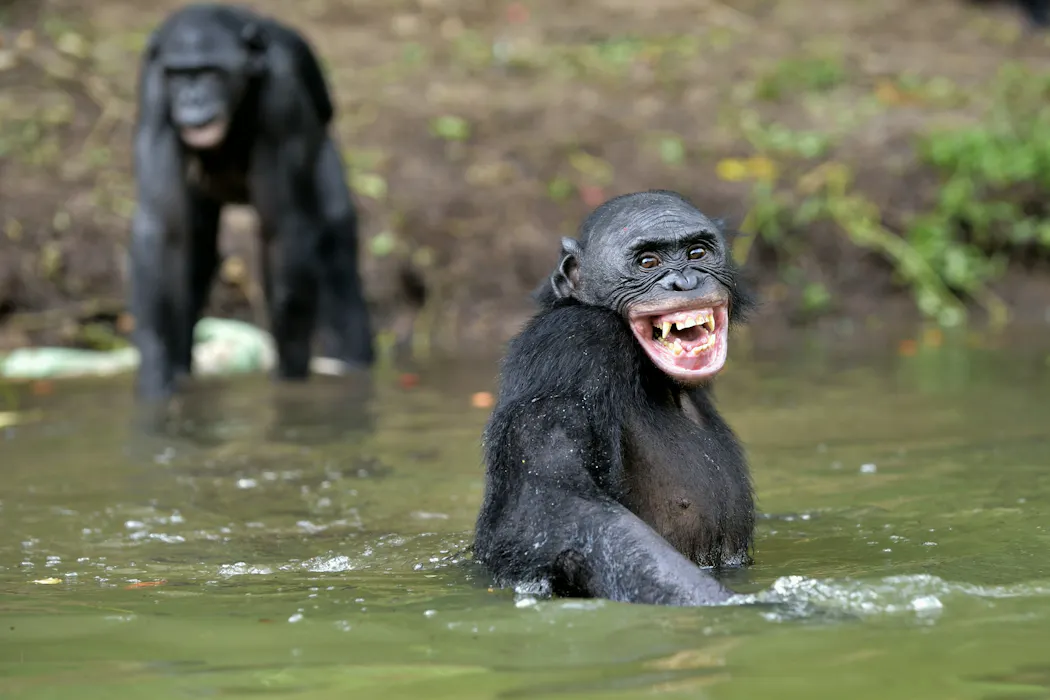
Bonobos in the water in the Democratic Republic of Congo. Sergey Uryadnikov/Shutterstock

Humans are not the only animals that communicate. Birds sing to attract mates, dolphins use signature whistles that identify individuals, and many primates produce complex vocalisations that help them coordinate their social lives.

By studying these communication systems, researchers can reconstruct some of the evolutionary steps that eventually led to one of our defining traits: language.

Language doesn’t just mean making sounds – it requires an extraordinary ability to control them. Human speech demands precise coordination between breathing, the vocal folds across the larynx, and our tongue, lips and jaw.

Humans’ closest living relatives – chimpanzees and bonobos – possess vocal tracts that are more similar to ours than scientists once believed. Yet they do not seem to have the same fine voluntary control over the structures – starting with our lips and tongue – that allow us to produce rapid sequences of speech and such diverse sounds.

This raises an intriguing question: when did our ancient ancestors begin to acquire this remarkable vocal control? One possible clue comes from an unexpected source: laughter.

The evolution of laughter

For several years, I have studied the rhythmic structure of vocalisations in non-human primates. Rather than focusing on what calls mean, I have been interested in how they are produced.

The timing of vocalisations can reveal how breathing and vocal movements are coordinated, offering a window into the mechanisms that generate them. Whether analysing the songs of Madagascar’s indris lemur or the calls of orangutans, I kept coming back to the same question: how much control do different primates have over the rhythm of their voices?

Laughter turned out to be an ideal system for exploring this question.

Chimpanzees playing and laughing. Video: Apes Like Us.

Unlike speech, our ability to laugh is shared with all the great apes. Chimpanzees, bonobos, gorillas and orangutans all produce laughter-like vocalisations during play. Although these sound quite different from our familiar “ha ha ha”, they serve similar social functions, signalling playful intentions and strengthening social bonds.

Human laughter is much more diverse, however. We can produce loud belly laughs, quiet chuckles, giggles, snorts or almost silent laughter. We laugh when we are amused but also when we are embarrassed, nervous or trying to ease social tension. This flexibility makes laughter much more than a simple emotional reflex for us.

Human laughter is highly context-dependent. We laugh differently when we are genuinely amused, when we engage in polite social interactions, when we feel awkward, or when we share an inside joke.

Together with colleagues, I analysed 140 laughter bouts from humans and the four other great ape species. Instead of asking whether laughter sounded similar across species, we examined its rhythm: how quickly each laugh element followed the previous one, and how consistent that timing was. Our results revealed a clear evolutionary pattern.

When laughing, humans show greater temporal variability than our closest relatives. Chimpanzees and bonobos produce laughter at a slower rhythm than humans, while gorillas and orangutans laugh at an even slower pace.

In contrast, human laughter consists of more rapidly repeated elements – successive vocal bursts that together form a laugh. This increased flexibility may be one of the evolutionary changes associated with the emergence of finer voluntary control over vocal production.

In other words, humans’ ability to “laugh fast” may reflect one of the key innovations that eventually made speech possible.

The link between laughter and speech

The evolution of speech may not simply have involved producing new sounds, but changing the very tempo at which vocal actions are organised. Our findings suggest traces of this key evolutionary transition are still preserved in one of our most familiar activities: laughing.

While humans and chimpanzees share a common evolutionary history, we will never hear how our ancient ancestors laughed. Fossils preserve bones not vocalisations, so the only way to reconstruct the evolution of laughter is by comparing living species and inferring the changes that occurred along the hominin lineage.

Because we found that chimpanzee and bonobo laughter differs from human laughter in rhythmic structure and temporal variability, we can use these living species to infer that early hominins may have exhibited laughter patterns which were already distinct from those of other great apes during the evolutionary transition towards modern human laughter.

Three-to-four million years ago, early hominins may already have shown some of the foundations of the flexible laughter patterns seen in humans today. Our findings suggest that increased temporal variability in laughter evolved along the hominin lineage. This may have enabled laughter to become increasingly adapted to different social contexts, from playful interactions to maintaining social bonds and signalling affiliation.

Every time we compare ourselves with our closest great ape relatives, we discover that the gap between humans and other apes is smaller than was once imagined. Yet we also uncover subtle differences that may have had profound evolutionary consequences.

Laughter is one of them. It may seem like a simple expression of joy, but hidden within its rhythm is a record of millions of years of evolution – and, perhaps, one of the clues to how our human ancestors eventually found their voice.

The Conversation

Chiara De Gregorio does not work for, consult, own shares in or receive funding from any company or organisation that would benefit from this article, and has disclosed no relevant affiliations beyond their academic appointment.

  •  

How turning front gardens into driveways has added to night-time heat

Thousands of front gardens have been paved over. 1000 Words/Shutterstock

Warm sticky nights are becoming more and more common in the UK.

Climate change is raising temperatures, but one factor that adds to that is often ignored. Walk down a city street and you see what would have been front gardens a decade or so ago have now been tarmacked over and turned into driveways.

Individually these changes might seem small, but as more and more gardens disappear this increase in hard driveways can alter the way neighbourhoods heat up during the day and cool down at night. It’s an issue that is suddenly on more people’s minds this summer as they struggle to sleep.

According to a UK’s Royal Horticultural Society (RHS) report in 2025, 42% of domestic garden space is now paved over, including 55% of front garden space.

In 2005, only about 8% of UK front gardens were fully paved. By 2015, that figure had tripled to roughly 24%.

Estimates from the RHS suggest there are 20.6 million domestic gardens (front and back) in the UK, covering around 502,757 hectares. The UK’s domestic gardens together cover an area around three times larger than all national nature reserves combined, giving them enormous potential to support wildlife.

Replacing vegetation with hard surfaces also shrinks habitat for plants and wildlife while increasing surface runoff and the risk of flooding.

The desire for more off-street parking may have contributed to this trend. The shift to electric vehicles could have created another incentive to pave front gardens, as goverment grants helped households finance home-charging points.

How paving stokes heat

Impervious surfaces including asphalt (which many driveways are made of) absorbs heat, raising ground and air temperatures. They both absorb up to 95% of incoming solar radiation during the day, reaching surface temperatures of 50-55°C, compared to 27-32°C for grass or tree-covered areas.

During the day, this heat is stored and slowly released after sunset. This is known as the urban heat island effect. The result is warmer night-time air temperatures, particularly during heatwaves. Unlike vegetation, these hard materials have little capacity to cool themselves through evaporation, and are making cities hotter.

This heat island effect can raise cities’ temperatures by 1-3°C compared to surrounding countryside. That’s why it always feels hotter in the city on summer nights.


Read more: Heatwaves: how to close the UK’s cooling divide


And the result can also cause health problems. The 2018 summer heatwave saw an estimated 399 (of 785) heat-related deaths in the Greater London area attributable to this night-time effect.

Paved front gardens eliminate evaporative cooling (the process by which plants release water vapour), which lowers air temperatures. Plants and trees provide cooling through shading and evapotranspiration (defined as the combined loss of water to the atmosphere through two processes: evaporation and transpiration). In urban environments, green spaces release moisture into the air, which humidifies the atmosphere and significantly reduces air temperature, a mechanism entirely absent in paved areas.

What needs to change?

Changing front driveways back to grass can reduce daytime surface temperatures by 1.5-2.0°C and nighttime temperatures by 0.3-0.5°C. Adding trees doubles the benefit: daytime cooling of 2.0-3.0°C and nighttime reductions of 0.5-1.0°C. Therefore, increasing urban greenery by 10% – particularly planting trees – can lower average air temperatures by around 0.5°C.

Front gardens with plants rather than driveways can also reduce flood risk by absorbing rain, filter air pollutants, support biodiversity and improve mental wellbeing. The RHS estimates that restoring plant cover in one million front gardens could save millions of litres of stormwater run-off annually.

But there are ways to have a driveway that doesn’t create so much heat. London’s De-pave Your Garden campaign offers guidance on replacing concrete with permeable paving, gravel or planting strips, an approach that has since been promoted by London boroughs including Lambeth and Ealing.

Leeds City Council’s front garden design guide encourages householders to retain at least 30% green space.

Other things could help change people’s attitudes to front gardens and their value. Financial incentives, such as council tax rebates for depaving or grants for rain gardens, could accelerate change.

In the future, public policy must recognise private gardens as green infrastructure, not merely private amenities. Updating planning permission rules to encourage a mix of plants and gravel, for instance, would help.

The United Nations identifies urban greenery as a key way to reduce heat in cities. The benefits extend beyond gardens: green roofs and balcony gardens can lower indoor temperatures by up to 11°C.

No single garden will transform a city’s climate, but when thousands of gardens are protected and restored across neighbourhoods, the combined cooling effect would become significant.

As climate projections show more frequent, longer and hotter summers, every square metre of restored vegetation matters. Domestic gardens are frontline defences against intensifying heatwaves.

By not opting for a tarmacked driveway or replanting the existing one, households can help cool their streets, protect vulnerable neighbours and reclaim a piece of Britain’s vanishing green heritage.

The Conversation

Karina Corada-Pérez does not work for, consult, own shares in or receive funding from any company or organisation that would benefit from this article, and has disclosed no relevant affiliations beyond their academic appointment.

  •  
❌