❌

Reading view

A 1952 Pan Am plane crash transformed passenger safety procedures – a former airline pilot explains how

On Good Friday, April 11 1952, a Pan American Douglas DC-4 named Clipper Endeavor took off from San Juan in Puerto Rico, bound for New York. On board were 64 passengers including six infants, plus five crew.

The flight lasted less than nine minutes before two engines lost power. Unable to make it back to the airport, the captain ditched the plane in the Atlantic Ocean, roughly 11 miles northwest of San Juan’s Isla Grande Airport.

Remarkably, all 69 people on board survived the impact. What killed 52 of them was what happened afterwards.

The airframe broke apart and began to sink, and in the ensuing chaos, many passengers refused the captain’s order to get out, remaining buckled into their seats. Investigators recorded drowning as the cause for almost all of the deaths.

The pilot told air crash investigators that he had forced some of the passengers into the water. However, the language barrier between the crew and the mostly Puerto Rican passengers had made communication harder – as did their reported fear of sharks in the water.

For 74 years, the wreckage remained hidden under 2,000 feet of water off Puerto Rico’s coast – until an uncrewed underwater vehicle owned by marine survey company Deep Sea Vision located it in June 2026.

Video: WBD US Nets Press.

As a former commercial airline pilot, the story of this tragedy holds particular interest for me – in particular, the enormous impact it had on how airline safety procedures are still done today. According to Josh Gates, a Discovery Channel presenter who was part of the search team: “It is an accident that fundamentally reshaped aviation as we know it.”

The critical 90 seconds

The US Civil Aeronautics Board’s investigation found that Clipper Endeavor should probably never have taken off. One engine that later failed had shown abnormal fuel readings and metal fragments in its oil the day before.

But the report placed greater weight on what happened after the ditching. There had been no requirement for passengers to be briefed on the plane’s emergency exits, nor to be shown how to use a life vest before a flight over water.

In short, nothing had prepared 64 people for the critical 90 seconds they had to escape the plane before it sank.

As a result of these findings, regulators soon required airlines to keep life vests and rafts accessible to passengers rather than locked away, and to give passengers on extended overwater flights a verbal briefing on life vests, emergency exits and rafts – including demonstrating how to put on a life vest.

The aim was to make sure passengers had already walked through the actions in their minds before panic could override them. A 2018 review of aviation safety research highlighted that many historical air accidents would have resulted in significantly higher survival rates, had every passenger involved read the safety card or watched the crew’s demonstration beforehand.

One apparent example of the importance of passenger safety briefings occurred in January 2009, when Captain Chesley “Sully” Sullenberger ditched US Airways flight 1549 into New York’s Hudson River after a bird strike disabled both engines. All 155 people aboard survived.

However, the official investigation into the incident told a more complicated story than the “Miracle on the Hudson” headlines suggested. About 70% of passengers had not watched any part of the pre-flight briefing, and only around ten had retrieved a life vest themselves.

The evacuation was nonetheless orderly, which investigators credited to the flight crew’s professionalism, the flotation equipment the aircraft was carrying, and ferries reaching survivors within about seven minutes. Clipper Endeavor’s passengers faced almost the same situation decades earlier, with none of that preparation and no one reaching them in time.

Video: Smithsonian Channel.

Not every incident since the 1952 Pan Am tragedy has ended so fortuitously. Knowing the safety drill is one thing – following it under real pressure is another.

When a hijacked Ethiopian Airlines jet ditched in the Indian Ocean in 1996, killing 125 of the 175 people aboard, the official investigation found that passengers in the economy cabin had inflated their life vests before the aircraft went down.

Crew members had to quickly deflate them and re-brief passengers on the brace position under extraordinary stress. Their instructions were found to have only been given in English, so investigators concluded that some passengers probably hadn’t understood them.

Passenger compliance in an emergency

During my ten years flying Airbus A320s and A330s as a commercial pilot, giving the safety briefing was never my job. That role falls to cabin crew whose professionalism rarely gets the credit it deserves.

The seatbelt sign was mine, though. My voice was the one on the PA reminding passengers to stay buckled in whenever seated – another critical piece of safety advice for as long as the plane is in the air, which Clipper Endeavor’s passengers never received. (If you are not convinced of the seatbelt sign’s importance, read this interview with the passenger who was nearly sucked out of a Ryanair flight recently.)

After each flight, pilots and crew have a debrief that may include discussion of passenger behaviour, particularly if something went wrong during boarding or an emergency. The recurring complaint among cabin crew was about what passengers do the moment an emergency actually starts: reaching for hand luggage instead of leaving it behind.

When an Aeroflot Sukhoi Superjet caught fire after a hard landing in Moscow in 2019, investigators found that passengers retrieving bags from the overhead lockers had probably slowed the evacuation of the burning cabin, contributing to the deaths of 41 people.

A separate study of real emergency evacuations found that half of those involved admitted to attempting to grab a carry-on bag on their way out, making it the most commonly reported obstruction to a fast evacuation.

A 2014 study by aviation safety scientist Brett Molesworth showed that passengers’ recall of safety messages was better if they watched more entertaining demonstrations that used humour or celebrities.

As a result, some airlines now make safety videos both entertaining and informative – such as British Airways dressing more than 40 staff in period costumes for a Regency-style safety film, and Qatar Airways using the American comedian and actor Kevin Hart.

But recall and compliance during a terrifying emergency, when passengers are prone to panic, are two different problems. This is the gap the air travel industry is still striving to solve.

The Conversation

Marco Chan does not work for, consult, own shares in or receive funding from any company or organisation that would benefit from this article, and has disclosed no relevant affiliations beyond their academic appointment.

  •  

Differences in human and great ape laughter reveal clues to the origin of speech

Bonobos in the water in the Democratic Republic of Congo. Sergey Uryadnikov/Shutterstock

Humans are not the only animals that communicate. Birds sing to attract mates, dolphins use signature whistles that identify individuals, and many primates produce complex vocalisations that help them coordinate their social lives.

By studying these communication systems, researchers can reconstruct some of the evolutionary steps that eventually led to one of our defining traits: language.

Language doesn’t just mean making sounds – it requires an extraordinary ability to control them. Human speech demands precise coordination between breathing, the vocal folds across the larynx, and our tongue, lips and jaw.

Humans’ closest living relatives – chimpanzees and bonobos – possess vocal tracts that are more similar to ours than scientists once believed. Yet they do not seem to have the same fine voluntary control over the structures – starting with our lips and tongue – that allow us to produce rapid sequences of speech and such diverse sounds.

This raises an intriguing question: when did our ancient ancestors begin to acquire this remarkable vocal control? One possible clue comes from an unexpected source: laughter.

The evolution of laughter

For several years, I have studied the rhythmic structure of vocalisations in non-human primates. Rather than focusing on what calls mean, I have been interested in how they are produced.

The timing of vocalisations can reveal how breathing and vocal movements are coordinated, offering a window into the mechanisms that generate them. Whether analysing the songs of Madagascar’s indris lemur or the calls of orangutans, I kept coming back to the same question: how much control do different primates have over the rhythm of their voices?

Laughter turned out to be an ideal system for exploring this question.

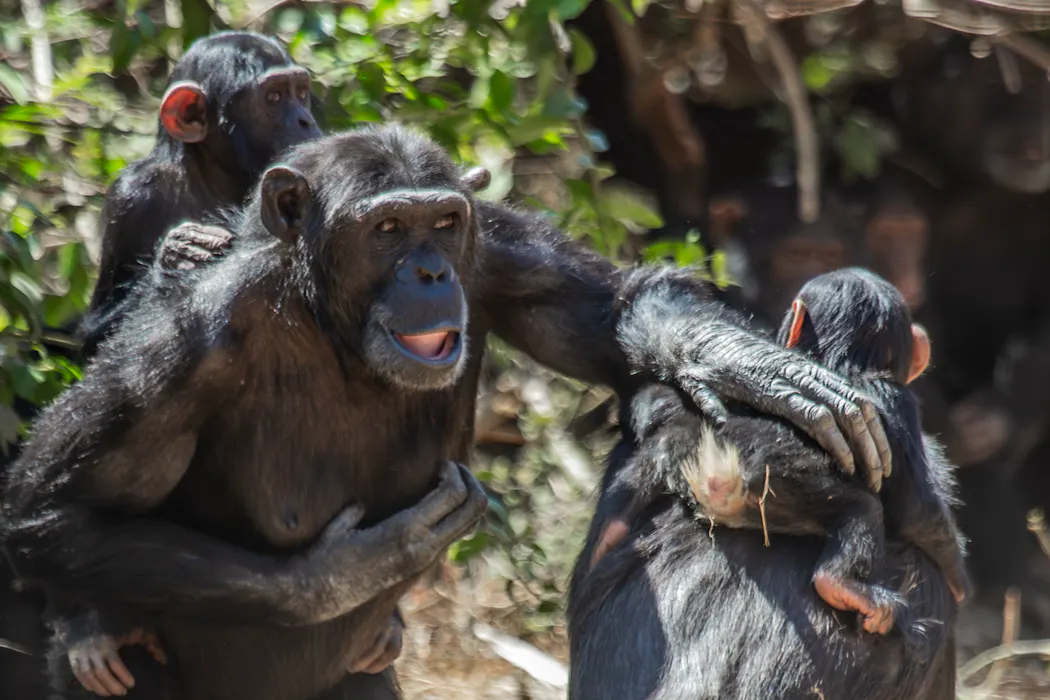
Chimpanzees playing and laughing. Video: Apes Like Us.

Unlike speech, our ability to laugh is shared with all the great apes. Chimpanzees, bonobos, gorillas and orangutans all produce laughter-like vocalisations during play. Although these sound quite different from our familiar “ha ha ha”, they serve similar social functions, signalling playful intentions and strengthening social bonds.

Human laughter is much more diverse, however. We can produce loud belly laughs, quiet chuckles, giggles, snorts or almost silent laughter. We laugh when we are amused but also when we are embarrassed, nervous or trying to ease social tension. This flexibility makes laughter much more than a simple emotional reflex for us.

Human laughter is highly context-dependent. We laugh differently when we are genuinely amused, when we engage in polite social interactions, when we feel awkward, or when we share an inside joke.

Together with colleagues, I analysed 140 laughter bouts from humans and the four other great ape species. Instead of asking whether laughter sounded similar across species, we examined its rhythm: how quickly each laugh element followed the previous one, and how consistent that timing was. Our results revealed a clear evolutionary pattern.

When laughing, humans show greater temporal variability than our closest relatives. Chimpanzees and bonobos produce laughter at a slower rhythm than humans, while gorillas and orangutans laugh at an even slower pace.

In contrast, human laughter consists of more rapidly repeated elements – successive vocal bursts that together form a laugh. This increased flexibility may be one of the evolutionary changes associated with the emergence of finer voluntary control over vocal production.

In other words, humans’ ability to “laugh fast” may reflect one of the key innovations that eventually made speech possible.

The link between laughter and speech

The evolution of speech may not simply have involved producing new sounds, but changing the very tempo at which vocal actions are organised. Our findings suggest traces of this key evolutionary transition are still preserved in one of our most familiar activities: laughing.

While humans and chimpanzees share a common evolutionary history, we will never hear how our ancient ancestors laughed. Fossils preserve bones not vocalisations, so the only way to reconstruct the evolution of laughter is by comparing living species and inferring the changes that occurred along the hominin lineage.

Because we found that chimpanzee and bonobo laughter differs from human laughter in rhythmic structure and temporal variability, we can use these living species to infer that early hominins may have exhibited laughter patterns which were already distinct from those of other great apes during the evolutionary transition towards modern human laughter.

Three-to-four million years ago, early hominins may already have shown some of the foundations of the flexible laughter patterns seen in humans today. Our findings suggest that increased temporal variability in laughter evolved along the hominin lineage. This may have enabled laughter to become increasingly adapted to different social contexts, from playful interactions to maintaining social bonds and signalling affiliation.

Every time we compare ourselves with our closest great ape relatives, we discover that the gap between humans and other apes is smaller than was once imagined. Yet we also uncover subtle differences that may have had profound evolutionary consequences.

Laughter is one of them. It may seem like a simple expression of joy, but hidden within its rhythm is a record of millions of years of evolution – and, perhaps, one of the clues to how our human ancestors eventually found their voice.

The Conversation

Chiara De Gregorio does not work for, consult, own shares in or receive funding from any company or organisation that would benefit from this article, and has disclosed no relevant affiliations beyond their academic appointment.

  •  

Nasa’s new space telescope will tackle some of the universe’s biggest mysteries

The Nancy Grace Roman telescope could help answer some of the biggest cosmic questions. Nasa

Nasa is about to launch a space observatory that could help settle some of the biggest mysteries in modern astronomy. The Nancy Grace Roman space telescope will study how the universe began, what it is made of and how it has evolved over time.

The observatory is named after Nasa’s first chief of astronomy and its first female executive. Nancy Grace Roman, who died in 2018 aged 93, made important contributions to our understanding of stars and played a crucial role in shaping Nasa’s space-based astronomy programme.

The telescope is undergoing final preparations ahead of a launch set to take place from Florida’s Kennedy Space Center in late August. It is eight months ahead of its original schedule, and under budget – a rare feat for a Nasa flagship mission.

Unlike the James Webb space telescope, which is designed to look at individual objects in extraordinary detail, Roman is built to survey the sky at scale. It will take in vast areas of the cosmos, allowing astronomers to build up a much broader picture of the universe and how it changes.

Roman has an unusual history. It began life as a “spare” spy satellite, donated to Nasa by the US government agency responsible for gathering intelligence from space.

Roman carries two main instruments, added by Nasa. These are the wide field instrument and the coronagraph. The wide field instrument will detect infrared light coming from the universe. Infrared light has wavelengths that are slightly longer than those of visible light. This allows the instrument to see through cosmic dust and look deeper into the cosmos.

Nancy Grace Roman, Nasa's first chief of astronomy, pictured at the agency's Goddard Space Flight Center in Greenbelt, Maryland, around 1972.
Nancy Grace Roman, Nasa’s first chief of astronomy, pictured at the agency’s Goddard Space Flight Center in Greenbelt, Maryland, around 1972. Nasa/Esa, CC BY

Its field of view – how much sky it sees when pointed in a given direction – is about 100 times that of the Hubble space telescope’s infrared camera, but with similar sharpness. The wide field instrument’s capabilities also mean it can survey the cosmos about 1,000 times faster than Hubble. Observations that would take Hubble centuries could be completed by Roman in a fraction of the time.

The coronagraph is designed to block the overwhelming glare of nearby stars. The idea is a bit like placing a hand in front of the Sun to make it easier to see something faint beside it.

By suppressing starlight, the coronagraph will allow astronomers to test methods for directly imaging faint planets and discs of dust and gas around other stars.

The Roman telescope is ready for launch (Nasa Goddard Space Flight Center)

Over the course of its mission, Roman is expected to detect billions of galaxies and tens of billions of stars. Roman’s combination of scale and precision gives the telescope its power. It will see enough of the sky to reveal broad cosmic patterns, while measuring galaxies and stars accurately enough to detect small but important effects.

Cosmic evolution

Modern cosmology – the study of how the universe originated and evolved – rests on a remarkably successful model. According to this model of the universe, ordinary matter – the stuff that makes up stars, planets and people — accounts for just a small fraction of everything out there. The rest of the cosmos is made up of two unseen, mysterious components.

The first is dark matter, which makes up about 25% of the universe. This form of matter neither reflects nor absorbs light, yet its gravitational pull helps hold galaxies together. The mission could help shed light on the nature of dark matter by tracking how it has shaped the formation of galaxies across different epochs of cosmic history.

Galaxies
The main model for how the universe evolved has been highly successful, but there are hints of problems. Nasa

The second unseen component is dark energy, which makes up around 70% of the universe. Its exact nature remains elusive, but dark energy is causing the expansion of the universe to accelerate. For decades, astronomers assumed that it is constant, or uniform. However, recent results hint that dark energy could be changing over time. Roman will put these competing ideas to the test.

If dark energy is constant, it points to a universe that keeps expanding forever. If dark energy changes, it could point to new physics beyond our current theories.

Roman may help address a longstanding puzzle: why we observe the universe at a moment when the densities of matter and dark energy are roughly comparable. In the early universe, matter dominated.

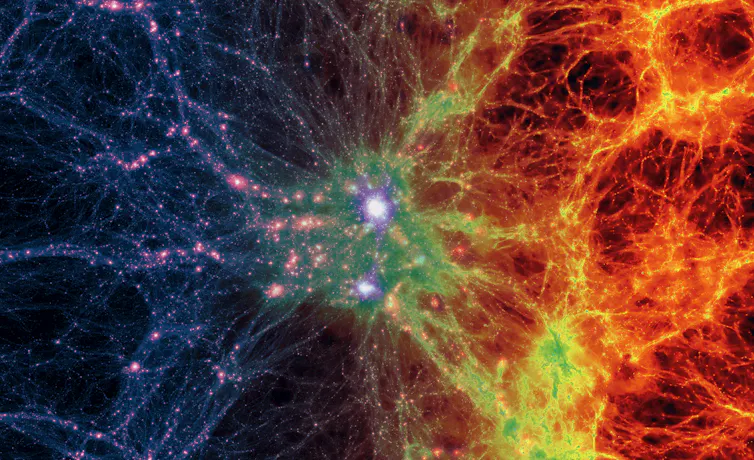
Dark matter forms part of the underlying structure of the universe, known as the cosmic web.
Dark matter forms part of the underlying structure of the universe, known as the cosmic web. Esa

In the far future, dark energy is expected to dominate completely. The present era appears to be a transition between the two – a cosmic intermission lasting billions of years, but brief in the lifespan of the universe.

This could be a simple coincidence or a clue to new insights about the cosmos. For example, it could be that dark energy is changing over time, that gravity behaves differently on cosmic scales or that some ingredient is missing from our model of the universe. Distinguishing between these scenarios would require observations across huge spans of cosmic time – exactly the kind of data that Roman will provide.


Read more: Dark energy: could the mysterious force seen as constant actually vary over cosmic time?


Beyond cosmology

Roman’s science extends well beyond dark energy. It will carry out the largest survey yet of planets beyond our solar system, detecting thousands of new worlds using a technique called gravitational microlensing.

Microlensing happens when the gravity of a foreground star briefly bends and magnifies the light from a more distant background star – acting like a natural magnifying lens passing between us and a distant object. If the foreground star has a planet, that planet can create a small extra brightening in the signal, revealing its presence.

Many of these exoplanets would be difficult to find with the two most widely used techniques to discover exoplanets – the transit and radial velocity methods. Using microlensing, Roman could find planets in wide orbits, low mass planets and even free floating worlds that are not bound to any star.

Roman is also part of a new era of survey astronomy. Its wide-field capabilities place it alongside other major missions. The European Space Agency’s Euclid space mission is mapping billions of galaxies to study dark matter and dark energy. The Vera C. Rubin Observatory, built on a mountaintop in Chile, will repeatedly scan the southern sky.

Together, these observatories will help astronomers map the universe across different wavelengths, distances and timescales.

Roman will also work together with the James Webb space telescope, identifying large-scale patterns and unusual objects across the sky, which Webb can then study in detail. This combination of breadth and depth is increasingly important in modern astronomy.

Roman’s greatest impact may come from the unexpected. With repeated observations of large areas of sky, it will detect rare events and previously unseen phenomena. For astronomers, this is one of the mission’s most exciting aspects.

By mapping the universe in unprecedented detail, the Roman telescope will provide a powerful test of our current understanding of cosmology – and potentially point the way to new physics.

The Conversation

Noelia Noël does not work for, consult, own shares in or receive funding from any company or organisation that would benefit from this article, and has disclosed no relevant affiliations beyond their academic appointment.

  •  

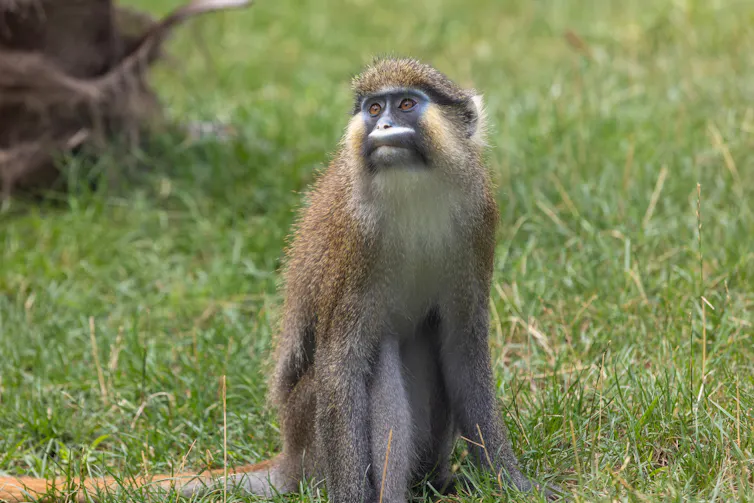
Meet Likweli – the newly named monkey that hints at Congo’s hidden secrets

Colobus congensis, known locally as 'likweli', has a dramatic black face with pinkish-orange lips. Junior Amboko, CC BY-NC

Hearing that a new primate species has been named is exciting news for scientists because primates across the world are in decline. According to the IUCN Red list, a global inventory of animal extinction risk, 44.4% of primate species are classed as endangered or critically endangered (versus 13.2% of all mammals).

In most cases when the number of primate species increases, it is because a known species has been upgraded from the status of subspecies to species, or two populations that were previously considered the same species are re-classified into two separate ones. The African monkey Likweli (Colobus congoensis), however, is a completely new addition to the primate family tree, which makes this news particularly interesting.

Likweli is a colobus monkey. The word colobus stems from the ancient Greek word κολοβός, meaning truncated, because they don’t have much of a thumb. It has an orange mouth, lives in the Democratic Republic of Congo and is part of the large subfamily colobines. Colobines are found in both Asia and Africa, but not in the Americas.

Three colobine genera are found in Africa. The olive colobus genus, has one species (a small monkey with drab olive-brown fur and a grey-black face). The red colobus genus and the black-and-white colobus genus, that Likweli belongs to. What is interesting about Likweli is that its closest relative is the black colobus (Colobus satanas), which has two subspecies – the critically endangered Bioko black colobus on the Island Bioko (20 miles off the coast of Cameron) and the Gabon black colobus on the nearby mainland. Their nearest range is 1,200km away from the range of Likweli monkeys.

Colobines have specialist digestive adaptations, including multi-chambered stomachs, that allow them to digest high fibre leaves and toxic seeds. To accommodate their large gut, many colobines are relatively large for monkeys. Likweli is smaller than the other colobus species though, and more comparable to some Asian colobines (like langurs and leafmonkeys). African colobines depend on forests and rarely come to the ground, but they can survive in small forest fragments and mangroves.

Likweli’s orange tinted mouth resembles that of some Asian langurs. But members of the Colobus genus have all black faces, making it almost impossible for human observers to recognise individuals based on their facial features. This also makes it hard to see their facial expressions. Scientists believe these monkeys’ more subtle facial expressions are related to the relatively low levels of competition within groups and less stringent social hierarchies.

Relationships between groups, however, can involve threats, loud roars and sometimes fights. Colobus males produce a loud roar to warn group members of danger, scare off predators, or during encounters with other groups of the same species. Likweli monkeys produce a similar roar although the researchers were unable to determine the sex of the callers. Likweli’s roar resembles that of the black colobus, but is distinctly different from that of other nearby colobus species.

It is not surprising that the central African region is providing new scientific discoveries. The area has been politically unstable for decades and a difficult place to conduct scientific work in. Working in these forests as a scientist means a risk of running into rebels, soldiers and professional poachers.

But the area is not only under-studied, it also represents a birthplace for many new species because the region has diverse soil including one of the largest peatlands on the globe. Plus, the landscape has been shaped and reshaped over centuries by a combination of tectonic plate movement, climatic changes, human influences and changes in its wetlands and rivers. Current climate change forecasts suggest that the area will remain suitable for colobus species in the future.

Black money with long white hair sits in tree
The Angolan colobus. Tomas Hejlek/Shutterstock

Some forests in this region contain around 20 species of primate, a value only matched by some Amazonian regions.

Most of those species are cercopithecids, the sister sub-family of the colobines. Likweli also shares its range with the striking Angola colobus, Colobus angolensis and the Lomami red colobus (Piliocolobus parmentieri). Likweli, like many red colobus species, has often been found mingled in with groups of other primates (up to six species), like guenons and sometimes Angola colobus or Lomami red colobus.

There are also apes (gorillas, chimpanzees and bonobos) in the region. Chimpanzees in other regions are well known to hunt red and black-and-white colobus monkeys for meat.

Likweli lives in small groups (a mean of six but this can range from one to 20). All Colobus species typically live in units of multiple females together with one male and their offspring. Multi-male groups are rare. Some Colobus species, like the Angola colobus, can form large aggregations of over 200 monkeys, consisting of multiple smaller one-male units travelling together.

Monkey with long facial hair sits in grass.
The moustached guenon or moustached monkey. Roberto Dani/Shutterstock

The Likweli is only the fifth new African monkey species to have been described since 1975, one of which was a local guenon, the Lesula (Cercopithecus lomamiensis). Meanwhile, Miss Waldron’s red colobus has probably gone extinct as there have been no conclusive sightings since 1978, despite intense searching after some unconfirmed sightings in 2000 and 2001.

The Likweli is already considered endangered and protection of this hotspot for biodiversity is urgently needed.

There may well be more undescribed primates (although another monkey species is unlikely) hiding in these forests. It is nice to imagine that these African forests still contain hidden secrets.

The Conversation

Amanda Korstjens does not work for, consult, own shares in or receive funding from any company or organisation that would benefit from this article, and has disclosed no relevant affiliations beyond their academic appointment.
  •  

Storms that built a graveyard: ancient monsoons created a spectacular dinosaur fossil site

Around 80 million years ago, a stretch of tropical coastline in what is now north-eastern Italy was lashed by monsoon rains and tropical cyclones. Those storms swept dinosaur carcasses, crocodiles, plants and river mud onto a tidal flat, where the tides and a film of microbes sealed everything away with extraordinary preservation.

My colleagues and I have published a new study that reconstructs the violent tropical climate behind the Villaggio del Pescatore Lagerstätte near Trieste and reveals it preserves just four decades of life, recorded almost day by day.

The Villaggio del Pescatore site near Trieste is one of the most important Late Cretaceous fossil localities in the Mediterranean. It is the only known site in the region to preserve large land animals, including dinosaurs such as Tethyshadros insularis, from the final 15 million years or so of the age of dinosaurs.

Tethyshadros insularis was a plant-eating, duck-billed dinosaur that lived in what is now north-eastern Italy around 80 million years ago. It was initially interpreted as a dwarf island species, shaped by the “island rule” – that large animals evolve smaller bodies in environments with limited space and resources.

However, the discovery of larger specimens challenged this idea. Up to 11 individuals are potentially preserved in this succession of rocks, with at least three other fairly complete skeletons still waiting to be extracted from the hard (and expensive to cut) limestone rock. Geological evidence has also revealed that the site was about 10 million years older than previously thought and was not part of a tiny, isolated island. Instead, it lay near a larger landmass connected through the ancient Mediterranean region.

Photo of a dinosaur skeleton encased in rock
Reconstruction of a Tethyshadros insularis skeleton, nicknamed Antonio, near his finding site. Tiziana Brazzatti, CC BY-ND

The fossils of tiny crocodilians named Acynodon (with shorter muzzles than modern crocodilians) have also been found at this site.

After years of research, Professor Federico Fanti of the University of Bologna and I led a multidisciplinary team of palaeontologists, physicists and geologists to determine exactly how this fossil treasure trove formed. Our findings overturn decades of competing interpretations.

In a study published in Global and Planetary Change, we show that the site was not a quiet, isolated lake or sinkhole, as previously suggested. Our results suggest it was a storm-battered tidal flatland at the edge of a tropical sea.

Villaggio del Pescatore is not simply a place where fossils happen to be beautifully preserved. It is also a record of the weather that shaped the site. We can identify individual storms and floods in the rocks, almost day by day. Very few fossil sites on Earth allow us to do that.

Reading the rock like a calendar

The fossils at Villaggio del Pescatore are concentrated in a finely layered carbonate rock, marked by thousands of paper-thin light and dark bands. For years these were interpreted as annual layers (like tree rings) laid down season by season.

Our new analysis tells a different story. Using high-resolution X-ray scans at the Elettra Synchrotron in Trieste, alongside detailed geochemical and microscopic analyses, we showed that the bands were not annual but daily. A synchrotron accelerates electrons (particles with a negative charge) to almost the speed of light. This produces powerful X-rays that can penetrate dense materials such as rock. This allowed us to examine structures inside the rocks and bones at a resolution of fractions of a millimetre.

The scans revealed that the layers were deposited by ocean tides, two pairs each day. These tides varied according to the familiar fortnightly cycle of stronger and weaker tides that still happen today. We could count these tidal layers, thanks to this unparalleled resolution.

The entire fossil-bearing rock pile, our results calculate, accumulated in only about 40 years, a single human lifetime, frozen in stone. Most fossil deposits containing several individuals average together thousands or millions of years. Here, we’re looking at a few decades.

Monsoons, cyclones and microbes

To explain why storms were so central to the preservation of the fossils, the team ran climate simulations. The models consistently placed the site at around 29° north, inside a powerful, summer-dominated monsoon belt. This was a tropical regime of intensely wet summers and recurring tropical cyclones, sustained by the greenhouse climate of the age.

Monsoon-driven floods and cyclone surges created pulses of sediment, nutrients, plant debris and animal carcasses onto the tidal flat. The tides trapped this material, and mats of microbes rapidly stabilised it. This encouraged the sediment to harden right after the carcass was deposited, before it started rotting or predators could scavenge its dead tissues. These storms were the main agents behind this preservation.

The site’s three most important Tethyshadros insularis dinosaurs show a range of fates: one buried so quickly that soft-tissue outlines survive, another bearing the cracked, sun-dried bones of a carcass that lay exposed inland before being washed in by a flood. Crocodilians such as Acynodon adriaticus, fish and shrimps were also local residents, entombed close to where they lived and died.

We propose that this combination of “ingredients”, monsoon floods, tidal trapping and microbial sealing, represents a recipe for creating exceptionally preserved fossil sites in hot, tropical greenhouse climates – precisely the kind of setting in which rapid decay would normally destroy organic remains.

The study also offers an ancient perspective on how intensifying monsoons and cyclones can reshape coastlines, ecosystems and what becomes preserved along tropical shores.

Villaggio del Pescatore has been studied for more than four decades, yet it still has new stories to tell. Understanding how extreme storms transformed this ancient coastline may also help us think about how modern coasts could respond to a warmer and more turbulent climate fuelled by high levels of CO₂.

The Conversation

Alfio Alessandro Chiarenza works for University College London, Department of Earth Sciences. He receives funding from The Royal Society as a Newton International Research Fellow.

  •  

What the sudden demise of the UK’s department of science means for the future of research

The obituaries were being written before the body was cold. Within hours of Prime Minister Andy Burnham confirming that Whitehall’s responsibilities for science and technology would be absorbed into a new Department for Business, Innovation, Science and Trade (DBIST), Sir Paul Nurse, president of the Royal Society, was on Radio 4 warning that “science isn’t a slave to business”. The trade association TechUK declared it “the wrong change at the wrong time”.

You might imagine that something ancient, ineffable and essential to British science had been ripped away. In fact, the Department for Science, Innovation and Technology (DSIT) was only born in February 2023 – a surprise late tweak to the machinery of government under Rishi Sunak’s faltering premiership.

Science has never enjoyed a settled home in Whitehall. For most of the period from 1995 to 2023, it sat precisely where Burnham has put it now: inside a business super-department. Notably, the single most important protection UK science secured in that era – a ring-fenced budget through the George Osborne austerity years – was won from inside the Business, Innovation and Science department, under then-business secretary Vince Cable.

The historian David Edgerton has long argued that Britain’s fondness for tinkering with the machinery of government is a form of displacement activity. What actually shapes the fortunes of research is money, people and demand for what they produce, not the nameplates on London’s Victoria Street.

On that test, the outlook for science is far calmer than some reactions to this latest move would suggest. Under plans published last October, the UK’s total research and development budget is locked in at £58.5 billion over the four-year spending review to 2030 – a real-terms increase.

Machinery changes move budget lines across departments; they don’t unravel them. As yet, nothing we’ve heard from the Burnham government suggests the settlement for UK Research and Innovation (UKRI) is at risk.

A US wrecking ball

If we want to be reminded what real damage to a science system looks like, we only need to glance across the Atlantic. While London rearranges the departmental furniture and dishes out new email addresses, Washington is taking a wrecking ball to the foundations of its public science system.

A 2027 budget request will halve the size of the US National Science Foundation, if passed. A draft White House rule, due to take effect in October, will hand political appointees the power to vet federal research grants against “the president’s priorities” and terminate awards mid-stream.

A predictable exodus has begun. The Nobel laureate Omar Yaghi has just left the University of California, Berkeley for Tsinghua University in China.

Top researchers consider leaving US amid funding cuts. Report: PBS NewsHour.

Set against political commissars patrolling the borders of knowledge, the UK’s science soap opera feels deeply provincial – a debate about which secretary of state sponsors oversight of a gradually swelling budget.

And the institutional layer beneath this is in better shape than doomsayers allow. UKRI’s new strategy has set a clear five-year path: priority programmes in AI, quantum and clean energy, faster funding decisions, and a welcome seriousness about experimentation with the modes and means by which we manage public investment in research.

Not everyone is happy with UKRI’s approach to prioritisation. But a funder with a published strategy, agreed budget and hard targets is a more durable asset than a three-year-old ministry. The research councils have outlasted every department that ruled over them, and UKRI will outlast this too.

Nor should the science community be spooked by closer proximity to business. When I leave my office at UCL and stroll down the Euston Road through London’s Knowledge Quarter – dubbed “the new square mile” – I pass by the Wellcome Trust, the Crick and Turing institutes, the British Library, Anthropic and Google DeepMind. Day in, day out, this dense weave of labs, firms and cultural institutions delivers what the triple helix of government, industry and academia is all about.

And we can find versions of the same story unfolding in Manchester, Sheffield, Cambridge and Glasgow. Rather than science being subordinate or “enslaved”, the UK’s world-leading universities have spent the past decade aligning themselves with agendas for regional growth and frontier technologies.

But there’s a harder truth lurking here too. Public money accounts for less than a third of UK research and development investment. The rest is financed and largely performed by the private sector.

UK science’s chronic weakness has never been the quality of publicly funded research. It is the R&D intensity of UK firms, and their ability to convert discoveries into products, services and revenue streams generated and owned in the UK.

If yoking science to industrial strategy in a single department reminds Whitehall to treat these as a single problem, some good may come of Burnham’s reorganisation.

AI policy concerns

With DSIT’s disappearance, a particular source of concern has been the future of AI policy. This at a time when the radical possibilities and risks of AI frontier models, fluctuating US export controls, and the latest “Sputnik moment” jolt from China’s Kimi K-3 demand sustained and technically fluent policy attention.

We are also seeing a sharp acceleration in the ways AI is transforming science itself – whether by cracking mathematical problems that stumped humans for the past 87 years, or collapsing decades-old models of grant writing and peer review.

Splitting AI from science just as they converge in practice would have been the least defensible element of this reorganisation. So it is reassuring that cross-government oversight of AI, including the AI Security Institute and AI public sector adoption, is moving to a new “AI taskforce” in the Cabinet Office – alongside the promotion of Kanishka Narayan to the status of AI minister attending Cabinet. Much now rests on his shoulders.

Government departments come and go. Those of us who have long advocated for research policies built on evidence rather than gut can allow ourselves a wry smile at the fuss created by this latest reorganisation – and then get back to work.

DSIT is dead, but UK science will be fine. Keep your eyes on the AI prize – and be thankful we are arguing about organograms, not survival.

The Conversation

James Wilsdon receives funding from UKRI and the Wellcome Trust, and a wider consortium of international research funders who partner in the Research on Research Institute (RoRI).

  •  

Great apes were using touch to reassure and keep the peace six million years before humans evolved – new research

Physical touch may be an important evolutionary tool to help manage social tension and keep the peace. Left: Jake Brooker/Chimfunshi Wildlife Orphanage Trust; Right: Zanna Clay/Lola ya Bonobo Sanctuary, CC BY-NC-ND

During an eight-month-long research trip to the Democratic Republic of Congo (DRC) and Zambia, we studied consolation: the way bonobos and chimpanzees comfort each other after conflicts and distress. But early on, we kept noticing something that didn’t quite fit.

The animals were exchanging a lot of friendly physical contact, embracing, touching and kissing, in competitive situations before any clear conflict or distress signals had broken out. We started wondering what all that touching was actually for.

Our new research into how great apes manage social stress suggests it could be quite important, and that this behaviour dates back at least 6 million years, long before our species evolved. Like us, our closest ape cousins, the bonobos and chimpanzees, also navigate stressful and competitive situations every day.

One example is when they discover a tree laden with ripe fruit. Everyone wants to eat and conflicts of interest can often lead to fights. But something else caught our attention. More often, apes reach out to one another with friendly touch: embracing, patting and making gentle contact.

Our colleague Edwin van Leeuwen, a Dutch biologist, had developed a feeding task to measure social tolerance across great ape groups. This task is called the peanut swing. It involves filling a bamboo trough with peanuts and swinging it over the fence so the food lands in front of the apes. This spreads peanuts evenly across a small area while researchers record who gets food, and how much. We used this test to measure whether groups could share resources peacefully in close proximity.

Because the apes watched the trough being filled, we could observe how they behaved as anticipation built. Friendly touch clustered in the minutes just before the food arrived. Previous researchers called this celebration behaviour. But discovering food is not just a cause to celebrate. It is also tense and risky.

Could friendly physical contact be helping to keep that tension at bay?

To find out, we measured a five-minute anticipation period before the food was released. We watched everything the apes did: friendly contact like kissing, embracing and patting, as well as aggression and threats. Over several months, we filmed 116 apes from five groups across 60 sessions at two African sanctuaries, Lola ya Bonobo in the DRC and Chimfunshi in Zambia.

In both species, the answer was clear. Bonobos and chimpanzees who engaged in more reassuring friendly contact before the food arrived spent significantly more time feeding peacefully alongside others afterwards. This pattern held across most groups and was strongest in the most tolerant ones. Researchers consider tolerance – the willingness to share space without aggression – to be the foundation of cooperation and social learning across the animal kingdom. Our findings suggest that pre-emptive friendly touch may be part of how that tolerance is maintained.

The patterns followed the social structure of each species. In bonobos, female-female pairs were the most likely to show friendly reassurance. This reflects how bonobo society works: females form strong alliances to counter male aggression and occupy high status positions. In chimpanzees, it was males who reassured each other most, reflecting the importance of male coalitions in their societies.

For both apes, these patterns were clearest in the more tolerant groups. In groups with more authoritarian leaders, the pattern disappeared.

Some of the most striking behaviour we saw were among the chimpanzees. During tense moments, they placed fingers, hands and other body parts inside each other’s mouths. They also held each other’s genitals. For a species known for lethal aggression, these are extraordinarily risky things to do.

Perhaps the vulnerability is itself the signal of trust. You only offer a risky contact if you are confident the other animal won’t bite. And this communicates something important about how you see the relationship.


Read more: Inside the sex lives of chimpanzees: it’s about much more than just reproduction


Female chimpanzee offers hand to male who takes it into his mouth.
Hand-in-mouth between male Sims (left) and female Careen: a vulnerable contact which is common during tense competitive periods in chimpanzees. Jake Brooker/Chimfunshi Wildlife Orphanage Trust, CC BY-NC-ND

Touch is among humanity’s oldest forms of communication. Skin-to-skin contact between infants and caregivers is one of the first channels through which attachment forms, long before language develops. A 2006 study found holding a romantic partner’s hand can reduce threat-related brain activity. A 2001 paper found that a brief touch from a stranger can increase cooperation.

Research across five European cultures published in 2015 found that the area of the body you’ll let someone touch maps almost directly onto the strength of your emotional bond with them. There’s plenty of cultural variation though. Brits are famously more guarded about casual contact than other Europeans, and touch between men in many western contexts carries particular social weight.

Perhaps most strikingly, touch before competition makes a difference. A study of negotiators found that pairs who shook hands before bargaining cooperated more, lied less and reached better joint outcomes, even in situations where cooperation came at a personal cost. A handshake may signal something important about intent before a word is even spoken.

But physical contact matters even during competition. A 2010 study of all 30 teams in the US National Basketball Association during the 2008-09 season found that the teams who touched more during games early in the season, through fist bumps, hugs and high fives, performed better and played more cooperatively later. This held even after controlling for player salaries and preseason expectations. In another 2024 study of women’s college basketball, players who received more physical contact from teammates after missing their first free throw were more likely to score on the second.

We see the same thing in genuinely high-stakes situations too. Research analysing street conflicts using CCTV found that witnessing a fight increased anxiety in bystanders. But, those who then engaged in physical contact with others showed reduced anxiety afterwards. A separate study of consolation after street robberies found that the way bystanders approached and touched victims closely mirrored the post-conflict consolation we observe in chimpanzees.

Humans, bonobos and chimpanzees all use reassuring touch but our evolutionary lineages split over 6 million years ago. The simplest explanation is that reassuring touch predates all three of us, and is certainly far older than our own species. So let’s not forget that we hold within us powerful and ancient behaviour that can help us manage our social worlds and maintain peace.

The Conversation

Jake Brooker receives funding from Templeton World Charity Foundation (Diverse Intelligences Initiative) and NWO Talent Programme.

Zanna Clay has received funding from Templeton World Charity Foundation (Diverse Intelligences Initiative) for this work.

  •  

Does dark energy really exist? Our work identifies cracks in the foundations of today’s cosmological model

According to our best understanding, the universe is expanding – and is doing so at an accelerating rate. This is believed to be caused by something called the “cosmological constant”, which was first proposed by Albert Einstein in his theory of general relativity. In recent decades, it has become better known as dark energy, which is believed to make up about 70% of the universe.

Crucial to this realisation were studies of Type Ia supernovae – exploding white dwarf stars. These are thought to emit a specific amount of light, which allows astronomers to determine their distances very accurately and thereby track the expansion of the universe. This work was awarded the 2011 Nobel prize in physics.

The accelerating expansion of the universe is thought to be due to negative pressure, an unusual property of dark energy that allows it to overcome the attractive force of gravity. Yet the exact nature of dark energy remains a puzzle. It cannot be explained by our best theory for the fundamental building blocks of the universe – known as the standard model of particle physics.

However, it is an integral part of another theory, devised to explain how the large-scale universe came to be. This is the standard model of cosmology, also called the lambda cold dark matter (ΛCDM) model.

Other observational evidence supporting the existence of dark energy includes fluctuations in the temperature of the cosmic microwave background (CMB) – the “afterglow of the Big Bang” – and the imprint of baryon acoustic oscillations (BAO) – sound waves from the early universe – in the distribution of galaxies.

But the ΛCDM model has come under increasing scrutiny as new data has emerged. A conference hosted by the UK’s Royal Society debated emerging cracks in the standard cosmological model. It has been noted that the model’s past successes may partly be due to “confirmation bias” – the unconscious tendency to favour information that supports our existing beliefs while giving less attention to information that challenges them.


Read more: Relax, the expansion of the universe is still accelerating


Flawed framework?

Most cosmologists remain unconvinced by such criticism and are instead persuaded by the multiple lines of evidence that the universe’s expansion is accelerating.

However, all such analyses, for example of the CMB or BAO, are conducted using a special solution of Einstein’s equations called the FLRW (Friedmann-Lemaitre-Robertson-Walker) framework. This is a description of space-time that assumes the “cosmological principle”, namely that the universe is, on average, homogeneous and isotropic (looks the same in all directions).

However, our recent study found evidence to falsify the FLRW framework, presenting results showing that the universe is asymmetric, or lopsided. We believe this presents a fundamental challenge to dark energy by undermining the very basis for standard analyses of cosmological data.

The observation that the universe may be lopsided is known as the cosmic dipole anomaly. This anomaly cannot be fixed by tweaking parameters in the ΛCDM model. It requires starting again from scratch to build a model of the universe based on observations, rather than on a philosophical principle.

The Nobel prize winning astrophysicist Jim Peebles has said that the cosmic dipole anomaly is about as well established as another cosmological irregularity known as the Hubble tension. However, he notes, the cosmic dipole anomaly has received only a fraction of the interest heaped on the Hubble tension.

With my collaborators, Mohamed Rameez and his PhD student Animesh Sah at the Tata Institute of Fundamental Research, Mumbai, we have also shown that the acceleration of the expansion of the universe inferred from Type Ia supernovae is not the same in all directions.

The signal from supernovae is mainly aligned with a temperature difference in the afterglow of the Big Bang – the cosmic microwave background. This temperature difference, called the CMB dipole anisotropy, is believed to be due to the local motion of the solar system.

‘Tilted observers’

The acceleration inferred from supernovae cannot therefore be due to dark energy. Rather, it is probably an illusion, because we are “tilted observers”. This is because of Earth’s specific location in the cosmos, where our neighbouring galaxies are participating in a large-scale but localised streaming motion called the bulk flow.

The relationship between the intrinsic brightness of Type Ia supernovae and their distance has been crucial to the idea of dark energy. However, this relationship may not be as robust as was first assumed.

Astronomers in South Korea found evidence that the ages of the white dwarf stars that produce Type Ia supernovae (their progenitors) affect their brightness. However, this has been challenged by another team.

When we corrected for the dependence of the intrinsic brightness on the progenitor age, the indication is that the universe is decelerating, rather than accelerating.

This is just as is expected for a universe without dark energy. But it will come as a surprise to most cosmologists who believe that there is compelling independent evidence for ΛCDM, in particular from studies of the CMB. But CMB temperature fluctuations are not influenced by dark energy. Rather, they are related to the spatial curvature of the universe, the baryon density, and the dark matter density.

Whether dark energy is still a valid inference thus depends on whether the distribution of matter in the universe is indeed isotropic – exactly the same in all directions. Observations suggest otherwise. If these findings are confirmed, they could signal a paradigm shift in cosmology.

The Conversation

Subir Sarkar receives funding from the UK Research & Innovation councils and from the Indian Ministry of Science & Technology.

  •  

How was the first language formed?

Nine-year-old Eva was watching an episode of the children’s show Horrible Histories about the stone age recently when a question popped into her head. The cave men were speaking a broken form of English, but Eva thought that didn’t sound right and she wondered: how was the first language formed?

She joined our host Eloise to get some answers from anthropologist April Nowell on The Conversation’s Curious Kids podcast.

In each episode of The Conversation’s Curious Kids, a child joins host Eloise to ask a top researcher their burning question.

To listen to season two, follow us wherever you get your podcasts, or listen on the Yoto Player via the Discover section on the Yoto interactive audio platform for kids.

You can also listen back to season one and read lots of answers to questions sent in by children around the world in our Curious Kids series.

Got a question? Pop it in an email, or record it and send us the audio to curiouskids@theconversation.com.


This season of The Conversation’s Curious Kids is supported by the University of Southampton in the UK, a world-leading research-intensive university with a global network of international students and campuses in Malaysia and Delhi.


Disclosure statement

April Nowell does not work for, consult, own shares in or receive funding from any company or organisation that would benefit from this article, and has disclosed no relevant affiliations beyond their academic appointment.
Credits

This episode of The Conversation’s Curious Kids was hosted and mixed by Eloise Stevens. The producer was Katie Flood and the executive producer was Gemma Ware. Credits in this episode to Horrible Histories, Pysched for Nature and Wild Ambience.

Correction

Part of the script in this podcast initially suggested Neanderthals had made circles, zigzags, and arrow symbols in a cave around 40,000 years ago. This has been amended to make it clear that markings made by Neanderthals found in caves in France and Spain were of dots, tracings made by fingers and a symbol that looks a bit like a hash tag, and they were from around 50,000 years ago.

The Conversation
  •  

Why do some people who trust in science also believe in scientific conspiracy theories?

Pro-science protesters at the second annual Portland March for Science, Oregon 2018. Png Studio Photography/Shutterstock

In a world where trust in institutions is mostly in decline, levels of trust in science remain relatively high. Yet at the same time, belief in scientific conspiracy theories, such as hushed-up effects of vaccines or aeroplane “chemtrails”, is also widespread.

What explains this apparent contradiction? Our work suggests we need to ask a different question – not how much people trust science, but which sources inform their understanding of what science is and how it works.

In our recent study of 843 US residents, we found that people who picture scientific progress as the work of lone geniuses, and who learn about science mainly from podcasts and documentaries, are markedly more drawn to conspiracy theories – whatever their level of education.

This fits the bigger picture very well. In a 16-country survey, 70% of respondents believed at least one false or unproven health claim. High trust in science and widespread conspiracy beliefs appear to coexist in the same populations.

We fear that trust in science is compatible with believing almost anything, so long as it is expressed in plausibly scientific terms. This can lead to some people refusing vaccines, trusting miracle cures or dismissing climate warnings – all while remaining convinced that science is on their side.

The ‘lone genius’ trope

At school, science is almost always presented as a linear sequence of achievements, or in the form of impersonal theories. The human side of discovery is largely stripped out.

In contrast, most science-focused films and documentaries build their narratives around biographies of exceptional individuals.

These often yield a familiar plot. Society is facing an intractable problem. A genius arrives with the exact solution – but is ignored and mocked until, after much personal pain, everyone realises he (for it is invariably a man) was right all along.

From the martyrdom of Giordano Bruno, the Renaissance friar burned at the stake partly for defending an infinite universe, to A Beautiful Mind, the Oscar-winning portrait of the mathematician John Nash, this lone-genius arc has permeated popular depictions of science for centuries.

Original trailer for A Beautiful Mind (2001). Video: HD Retro Trailers.

Many conspiracy theorists seek to exploit this trope – in part to suggest that those who recognise it must be unusually smart too, living in a world where everyone else is “naive” or “brainwashed”.

Yet these lone genius plots leave out nearly everything that makes science work. Namely, the rather boring and complex processes of accumulation and evaluation, from peer review to replication and endless disagreements, through which reliable knowledge emerges from a crowd of people and institutions.

Research also shows that people presented with academic research “in the making”, without definitive conclusions, often read any hesitations or equivocations as scientific weakness, rather than honesty.

Most people trust science without understanding its technicalities. This means trust can easily be attached to shared cultural markers of “scientificity”: technical vocabulary, charts, credentials, fancy equipment, numbers quoted to impressive precision. In other words, whoever displays the right cues sounds plausibly scientific.

Consider the example of Corrado Malanga, an Italian chemist who developed an elaborate theory of aliens harvesting human souls, and his collaborator Filippo Biondi, a radar researcher. Using satellite radar, the pair claimed in March 2025 to have discovered an elaborate hidden city up to two kilometres beneath the Khafre pyramid in Egypt.

Archaeologists quickly and widely dismissed these claims, in part because this kind of radar cannot see more than a few metres underground. Yet Biondi went on to present their “discovery” at length on The Joe Rogan Experience, one of the world’s most popular podcasts, in January 2026 – attracting many millions of views and listens to this widely disputed “scientific account”.

A recent analysis examined 8.7 million Twitter (now X) posts that shared supposedly fact-checked news stories. It found that references to scientific entities – through use of terms such as scientist, university or study – were associated with an increase in sharing. However, this was especially true of “low-veracity content, and when users lean politically to the right”.

A protestor holds up a placard reading
Protesting the Canadian government’s COVID vaccine mandate and other restrictions in the capital, Ottawa, in 2022. Gary A Corcoran Arts/Shutterstock

More likely to endorse conspiracy theories

There are two threads intertwining here: a story about how science progresses, and the informal media where it mostly lives.

In our recent study, published in Current Psychology, we measured participants’ “genius mentality” (the propensity to believe that progress comes from exceptional individuals overturning consensus through intuition) and also their science media preference (whether they favoured podcasts and documentaries over expert-vetted sources).

We found people who scored higher on either metric were more likely to endorse conspiracy theories. These correlative effects were stronger than either education or political orientation, factors usually considered major drivers of such beliefs.

We also observed an interesting moderation effect: among people with little or even moderate trust in scientists, a high belief in the genius mentality markedly increased conspiracy belief. Among those who trusted scientists most, it made almost no difference.

From our research, we believe standard remedies, fact-checks and appeals to “trust the science” miss a deeper problem. They may correct claims one at a time, but leave untouched core beliefs (and misunderstandings) about how science works.

A more durable approach is to make the collective machinery visible: to explain why debate, peer review and the slow building of consensus, rather than individual intuition, are what make science reliable.

Some science education researchers argue that the goal should not be to turn everyone into a scientist, but a “competent outsider” – people who can correctly evaluate where knowledge comes from and how it has been produced.

We believe a school science education should not only introduce theories, but explain how the scientific community works on a daily basis. Children need to learn how knowledge emerges from many people cooperating and challenging each other within shared criteria – and that any consensus which survives this process is a strength, not groupthink.

Our ambition is to protect against future conspiracy theories before they emerge, rather than simply trying to correct the last one.

The Conversation

Michele d'Errico receives funding from the Irish Research Council.

Taha Yasseri receives funding from Research Ireland and Workday Inc.

  •  

Geometry, football and the World Cup final

Spain will play Argentina in the Fifa World Cup final on Sunday. The highly anticipated match takes place in New Jersey’s MetLife Stadium, with the teams vying for the most coveted prize in football.

Attacking flair and physicality will no doubt play a role. But we could also see an underappreciated element of football come to the fore: geometry.

In their 2-0 World Cup semi-final win over France, Spain formed neat passing triangles around the French players. This sometimes made it look as if Spain had extra people on the field.

Wherever a Spanish player received the ball, two teammates appeared at different angles – with their French opponents seemingly always arriving a fraction too late.

The triangle mattered not because it was neat, but because it gave Spain choice and France uncertainty. Each pass forced a French defender to commit to one possible future: press the ball, block the inside route, or protect the space behind. By the time that choice was made, the ball had often moved and the geometry had changed again.

Spain were not simply finding space. They were controlling when and where the next space would appear.

Forcing choices

Put three attackers in a straight line and one defender can often block both supporting players. But move one supporting player sideways and the passing lines separate.

The defender must choose which route to close. Press the ball and a pass can go around them. Protect the inside route and the outside may open. If another defender steps across, a Spanish player can attack the space left behind.

A useful football triangle does not need equal sides or 60-degree angles. Its best shape changes with defenders’ positions, body orientation, ball speed and the space available.

A narrow triangle is easy to squeeze because one defender may block both lanes. A wide one makes the pass travel farther, giving an opponent more time to intercept it.

In their semi-final match against France, Spain found the middle ground again and again – close enough for quick combinations, but far enough apart to stretch France’s press.

A pitch made of probabilities

Football geometry is a problem of time as well as space. A passing lane is not open simply because no defender is standing in it. The key question is whether the ball reaches the receiver before an opponent reaches the interception point.

A diagram shows where players are – but a useful model of the game asks where players can get to. Research using player-tracking data estimates control of the pitch from players’ position, direction, speed and acceleration. The result is a constantly changing map of who is most likely to reach each area first.

Pedro Porro’s 58th-minute semi-final goal offered a compact example when, after exchanging passes with teammate Dani Olmo, he continued his run to score Spain’s second. The first pass shifted the defenders’ focus. Porro’s movement created a new angle for the return.

A living network

Three-player combinations make this idea even harder to defend. Spain’s strength was not just one triangle, but the speed with which several overlapped. A midfielder could be one corner of multiple shapes, connected to a defender, full-back, winger and another midfielder.

Passing-network research describes players as points and passes as links. Yet a final network diagram for a given football match misses something important: Spain were rebuilding those links with every movement and first touch they made.

The value of a pass is not only where the ball goes, but how it changes what could happen next. That is why ten sideways passes are not automatically better than one pass that removes two defenders.

The shape that conquered basketball

Triangles are not unique to football. Under head coach Phil Jackson (1987-1998), US basketball team the Chicago Bulls made frequent use of a tactic called Tex Winter’s triangle offence. This places three players on one side of the court to create passing, cutting and scoring routes.

The sport was different but the principle was the same: triangles preserve alternatives. Close one route and another remains; follow the ball and space opens elsewhere.

In their match against Spain, France’s problem was not simply a lack of running. Pressing works only when several defenders move together and close connected passing options.

After the match, Kylian Mbappé said there had been “a lack of communication” in France’s pressing. Spain kept moving before France could reorganise.

A triangle on a tactics board does nothing by itself. Its power depends on players scanning before receiving, opening their bodies, and using the first touch to preserve the option of more than one next action.

The deeper contest was between Spain’s speed of reconfiguration and France’s speed of recognition. Spain kept changing the problem faster than France could solve it. The triangles were visible – but their real advantage was control over what could happen next.

Will we see a similar approach deployed in the final? Argentina will no doubt be closely studying their opponent’s tactics from other matches. But geometry will still play a prominent role – and may even prove a deciding factor.

The Conversation

Conor Boland does not work for, consult, own shares in or receive funding from any company or organisation that would benefit from this article, and has disclosed no relevant affiliations beyond their academic appointment.

  •  

The Large Hadron Collider is being upgraded so that it can unlock the secrets of the Higgs boson

Deep beneath the French-Swiss border, the world’s largest scientific instrument has fallen silent. After years of smashing proton particles together at nearly the speed of light, Cern’s Large Hadron Collider (LHC) has stopped operations and entered a long shutdown.

While no particle collisions are taking place at the LHC, thousands of scientists, engineers and technicians are dismantling parts of the machine, installing new technologies and preparing one of the most ambitious upgrades ever attempted in experimental physics.

When it switches on again, around 2030, it will become the High-Luminosity Large Hadron Collider (HL-LHC), capable of delivering roughly seven times more data than the collider that discovered the Higgs boson.

For me, this shutdown marks another milestone in a project that has shaped much of my scientific life. I first became involved in the High-Luminosity collider long before the Higgs boson particle was discovered in 2012. Over nearly two decades I have had the privilege of contributing to the programme on both sides of the Atlantic.

In the United States, I served as upgrade coordinator for the Compact Muon Solenoid (CMS), a key experiment at the LHC. The CMS is built at one of the points within the Large Hadron Collider where separate beams of proton particles collide. CMS then captures data from these collisions so that it can be analysed by Cern physicists. I helped lead the international effort preparing CMS for the HL-collider era.

Today, in Oxford, I work on another LHC experiment called Atlas. Atlas and CMS work in broadly similar ways, but having two machines like this helps ensure significant discoveries by one experiment are cross-checked by a counterpart with a separate team of scientists. Here, my colleagues and I are building silicon pixel detector modules for its upgraded inner tracker. This will form a vital part of the HL-LHC upgrade.

A few months ago, I watched the first complete pixel ring assembled in Oxford. It was strikingly beautiful: a delicate arrangement of silicon sensors, electronics and support structures whose elegance reflected years of painstaking engineering.

For the first time, the detector we had imagined through countless design reviews, prototypes and production meetings had become real.

Our contribution is just one part of a detector being built by teams across the world. Thousands of components must come together before the High Luminosity collider is ready to explore a new frontier in particle physics.

The LHC has already transformed our understanding of nature. Its discovery of the Higgs boson confirmed the mechanism that gives elementary particles their mass. The Higgs had been the last missing piece in the standard model of particle physics. This is the best theory to explain elementary particles and the three fundamental forces that govern their interactions. But, as is often the case in science, answering one question opened many others.

Investigating the Higgs

Many of the most important questions now are no longer about whether the Higgs exists, but whether it behaves exactly as predicted. Tiny deviations from the standard model could point towards entirely new particles or forces. Such discoveries would help us understand mysteries such as dark matter or why the universe contains far more matter than antimatter.

The challenge is that these clues are incredibly subtle. Rather than requiring much higher collision energies, they demand vastly more collisions. The HL-LHC will increase the collider’s luminosity – the number of proton collisions it produces – by about a factor of seven over its lifetime.

Imagine replacing a camera that takes one photograph every second with one that captures seven. Each image looks much the same, but together they reveal details that would otherwise remain invisible.

For Higgs physics, that extra data will be transformative. The Higgs boson is remarkably elusive. Some of its most interesting decays – where it transforms into other particles – are so rare that they have remained just beyond the reach of today’s LHC. Others have only recently emerged as tantalising hints.

One example is the decay of the Higgs boson into two muons (a muon is an unstable, subatomic particle). This decay is a rare process that tests whether the Higgs couples to second-generation lepton particles. Another is the decay of the Higgs into charm quark particles. This is one of the most difficult Higgs measurements because it must be extracted from an overwhelming background of ordinary particle collisions.

These processes test one of the Higgs boson’s most fundamental properties: whether it interacts with lighter particles exactly as predicted by the standard model. Any deviation from those predictions, even a small one, could be evidence that new particles or forces are influencing the Higgs behind the scenes.

And perhaps the most ambitious goal of all is observing Higgs boson pairs, which would allow us to measure, for the first time, the Higgs self-coupling – the strength with which the Higgs field interacts with itself. That interaction determines the shape of the Higgs field that fills all of space and is thought to have played a key role in the evolution of the universe moments after the Big Bang.

These are exactly the kinds of measurements that motivated the design of the upgraded LHC. Achieving them requires a revolution not only in the accelerator itself but also in the detectors that record the collisions.

Particle web

At the High Luminosity LHC, every crossing of the proton beams will produce up to 200 simultaneous proton-proton interactions, several times more than today. Untangling this dense web of particles demands detectors that are faster, more precise and far more resistant to radiation than anything built before.

At the heart of the Atlas and CMS experiments, entirely new silicon tracking detectors are replacing the existing ones. They must survive radiation levels that would quickly destroy previous generations of sensors while measuring particle trajectories with extraordinary precision. Achieving this has required years of advances in silicon sensor technology, ultra-fast electronics, cooling systems and lightweight mechanical structures.

One of the most innovative features of the upgraded detectors is the addition of precision timing. New timing detectors – the High Granularity Timing Detector in Atlas and a similar system in CMS – will measure the arrival time of particles with a precision of only a few tens of trillionths of a second. Although hundreds of collisions occur almost simultaneously, they do not happen at exactly the same instant.

By adding time as a fourth dimension to particle tracking, these detectors will allow physicists to associate each particle with the correct collision, making it possible to reconstruct rare Higgs events hidden within an enormous background of overlapping interactions.

One of the greatest rewards of working on these detectors is seeing the next generation of physicists preparing to use them. The students helping to assemble today’s detectors will spend much of their careers analysing the data they eventually collect.

When the HL–LHC begins operating, it will not simply extend the scientific programme of the Large Hadron Collider. It will usher in a new era of precision Higgs physics. Whether it reveals subtle cracks in the standard model or confirms our current understanding with unprecedented accuracy, it will shape particle physics for decades to come.

The Conversation

Daniela Bortoletto is a member of the Atlas experiment at the Large Hadron Collider.

  •  

How turning front gardens into driveways has added to night-time heat

Thousands of front gardens have been paved over. 1000 Words/Shutterstock

Warm sticky nights are becoming more and more common in the UK.

Climate change is raising temperatures, but one factor that adds to that is often ignored. Walk down a city street and you see what would have been front gardens a decade or so ago have now been tarmacked over and turned into driveways.

Individually these changes might seem small, but as more and more gardens disappear this increase in hard driveways can alter the way neighbourhoods heat up during the day and cool down at night. It’s an issue that is suddenly on more people’s minds this summer as they struggle to sleep.

According to a UK’s Royal Horticultural Society (RHS) report in 2025, 42% of domestic garden space is now paved over, including 55% of front garden space.

In 2005, only about 8% of UK front gardens were fully paved. By 2015, that figure had tripled to roughly 24%.

Estimates from the RHS suggest there are 20.6 million domestic gardens (front and back) in the UK, covering around 502,757 hectares. The UK’s domestic gardens together cover an area around three times larger than all national nature reserves combined, giving them enormous potential to support wildlife.

Replacing vegetation with hard surfaces also shrinks habitat for plants and wildlife while increasing surface runoff and the risk of flooding.

The desire for more off-street parking may have contributed to this trend. The shift to electric vehicles could have created another incentive to pave front gardens, as goverment grants helped households finance home-charging points.

How paving stokes heat

Impervious surfaces including asphalt (which many driveways are made of) absorbs heat, raising ground and air temperatures. They both absorb up to 95% of incoming solar radiation during the day, reaching surface temperatures of 50-55°C, compared to 27-32°C for grass or tree-covered areas.

During the day, this heat is stored and slowly released after sunset. This is known as the urban heat island effect. The result is warmer night-time air temperatures, particularly during heatwaves. Unlike vegetation, these hard materials have little capacity to cool themselves through evaporation, and are making cities hotter.

This heat island effect can raise cities’ temperatures by 1-3°C compared to surrounding countryside. That’s why it always feels hotter in the city on summer nights.


Read more: Heatwaves: how to close the UK’s cooling divide


And the result can also cause health problems. The 2018 summer heatwave saw an estimated 399 (of 785) heat-related deaths in the Greater London area attributable to this night-time effect.

Paved front gardens eliminate evaporative cooling (the process by which plants release water vapour), which lowers air temperatures. Plants and trees provide cooling through shading and evapotranspiration (defined as the combined loss of water to the atmosphere through two processes: evaporation and transpiration). In urban environments, green spaces release moisture into the air, which humidifies the atmosphere and significantly reduces air temperature, a mechanism entirely absent in paved areas.

What needs to change?

Changing front driveways back to grass can reduce daytime surface temperatures by 1.5-2.0°C and nighttime temperatures by 0.3-0.5°C. Adding trees doubles the benefit: daytime cooling of 2.0-3.0°C and nighttime reductions of 0.5-1.0°C. Therefore, increasing urban greenery by 10% – particularly planting trees – can lower average air temperatures by around 0.5°C.

Front gardens with plants rather than driveways can also reduce flood risk by absorbing rain, filter air pollutants, support biodiversity and improve mental wellbeing. The RHS estimates that restoring plant cover in one million front gardens could save millions of litres of stormwater run-off annually.

But there are ways to have a driveway that doesn’t create so much heat. London’s De-pave Your Garden campaign offers guidance on replacing concrete with permeable paving, gravel or planting strips, an approach that has since been promoted by London boroughs including Lambeth and Ealing.

Leeds City Council’s front garden design guide encourages householders to retain at least 30% green space.

Other things could help change people’s attitudes to front gardens and their value. Financial incentives, such as council tax rebates for depaving or grants for rain gardens, could accelerate change.

In the future, public policy must recognise private gardens as green infrastructure, not merely private amenities. Updating planning permission rules to encourage a mix of plants and gravel, for instance, would help.

The United Nations identifies urban greenery as a key way to reduce heat in cities. The benefits extend beyond gardens: green roofs and balcony gardens can lower indoor temperatures by up to 11°C.

No single garden will transform a city’s climate, but when thousands of gardens are protected and restored across neighbourhoods, the combined cooling effect would become significant.

As climate projections show more frequent, longer and hotter summers, every square metre of restored vegetation matters. Domestic gardens are frontline defences against intensifying heatwaves.

By not opting for a tarmacked driveway or replanting the existing one, households can help cool their streets, protect vulnerable neighbours and reclaim a piece of Britain’s vanishing green heritage.

The Conversation

Karina Corada-Pérez does not work for, consult, own shares in or receive funding from any company or organisation that would benefit from this article, and has disclosed no relevant affiliations beyond their academic appointment.

  •  
❌