❌

Reading view

Don’t change lanes – the maths of holiday traffic jams

ClimbWhenReady/Shutterstock.com

Millions of people will take to the roads this holiday season, only to end up spending frustrating hours sitting in traffic jams. Congestion costs drivers time, fuel and patience – while also increasing pollution and placing huge pressure on transport networks.

If you’ve ever found yourself staring enviously at the lane next to you, convinced it’s moving faster, you’re not alone. Most of us instinctively believe that changing lanes will get us home sooner. But mathematics suggests this intuition is usually wrong.

As an applied mathematician, much of my research is driven by one question: how can we predict and control the behaviour of complex systems operating under uncertainty? And this can apply as much to holiday traffic as it does to emerging quantum technologies.

We tend to think traffic jams need a trigger: an accident, roadworks or a lane closure. Yet some of the most frustrating queues have no obvious cause at all. These are known as phantom traffic jams – stop-start waves that travel backwards through traffic even though every vehicle is moving forwards.

In 2008, Japanese researchers asked 22 drivers to drive around a circular track while maintaining a constant speed and safe distance from the vehicle in front. Within minutes, tiny and unavoidable differences in braking and reaction times grew into a stop-start wave that travelled continuously around the circuit, despite there being no obstacle anywhere on the road.

The explanation is surprisingly simple. One driver brakes slightly more than necessary. The driver behind reacts a little later and brakes a little harder. The next driver does the same.

In this way, the initial tiny disturbance grows as it travels backwards until drivers hundreds of metres behind are forced to stop completely, even though nobody can identify what caused the queue in the first place.

The mathematics behind traffic

Rather than modelling every driver individually, mathematicians treat traffic as a continuous flow – borrowing ideas from fluid dynamics, where the movement of vehicles is analysed much like the flow of water through a pipe.

One of the simplest relationships in traffic flow theory is q = ρv, where q is the traffic flow (the number of vehicles passing a point each hour), ρ is the traffic density (amount of cars on the road) and v is their average speed.

This deceptively simple equation explains a counterintuitive phenomenon. Initially, adding more vehicles obviously increases the overall traffic flow, as more vehicles pass along the road.

But once the road becomes too crowded, everyone is forced to slow down. Eventually, this reduction in speed outweighs the increase in number of vehicles such that the overall flow is reduced.

The equation shows there is an optimal traffic density that maximises the number of vehicles passing through the road each hour. Beyond that point, adding more cars reduces the efficiency of the road – and increases the time it takes everyone to get to their destination.

The same mathematics explains why constantly changing lanes is rarely worthwhile.

A lane change creates a small disturbance that neighbouring drivers must react to. If many drivers behave in the same way, these disturbances accumulate and increase the likelihood of traffic waves. So, what feels like a clever decision for one driver can ultimately make conditions worse for everyone.

Can maths help reduce traffic jams?

In my research on probabilistic mathematical methods, I develop approaches that combine prediction, coordinated decision-making and feedback to keep complex systems stable, even when the available information is incomplete or “noisy” (full of extraneous data).

In traffic, the disturbances we seek to prevent are the stop-start waves that create phantom traffic jams. In other complex systems, they might be power failures, communication bottlenecks or unstable autonomous systems.

How phantom traffic jams form. Video: SotonTRG.

Rather than designing solutions for one specific application, applied mathematicians develop general mathematical frameworks. That’s one reason why ideas originally developed for engineering systems can also help us think differently about traffic – with each of our mathematical tools playing a different role:

  1. Signal processing transforms measurements from road sensors, cameras and connected vehicles into useful information.

  2. Stochastic modelling accounts for uncertainty arising from driver behaviour, weather conditions and changing traffic demand.

  3. Machine learning identifies patterns in all this data, and forecasts where congestion is likely to develop.

  4. Control theory then closes the loop by determining how traffic systems should respond, whether by adjusting traffic-light timings, introducing adaptive speed limits, recommending alternative routes or coordinating fleets of autonomous vehicles.

Rather than optimising the journey for one driver, the objective becomes improving the performance of the entire traffic network.

Perhaps the most striking demonstration came in 2018, when researchers repeated the Japanese circular-track experiment with one key difference. They replaced one of the human-driven vehicles with a single autonomous car, programmed to accelerate and brake smoothly.

Remarkably, that one vehicle, less than 5% of the traffic, was enough to dampen the stop-start wave around the entire circuit, improving traffic flow and reducing fuel consumption for every driver involved.

Tips for your next car journey

Traffic congestion is unlikely ever to disappear completely. Population growth, increasing travel demands and the unpredictability of human behaviour will always put pressure on our roads.

But mathematics is helping us move away from reacting to congestion, towards preventing it.

One important aspect is understanding how large networks of interacting agents can make coordinated decisions using only local information, without requiring every component to know the state of the entire system. These ideas are central to the design of intelligent transport systems, where connected vehicles and infrastructure must cooperate to improve traffic flow.

In the meantime, if you’re about to set off on holiday in your car, here are three driving tips all backed up by strong mathematical evidence. If everyone adopts them, this should reduce the time you spend in traffic queues.

  • Maintain a safe following distance;

  • Accelerate and brake smoothly;

  • Resist the temptation to keep switching lanes in search of tiny gains.

Applied mathematics shows the fastest way to your destination isn’t to drive more aggressively. It’s to help keep the entire system stable.

The Conversation

Randa Herzallah have received external research funding from the Leverhulme Trust ("Control of Behavioural Dynamics"), the Engineering and Physical Sciences Research Council (EPSRC), and Isansys (ECG-derived biosignals PhD studentship, 2016–2019)

  •  

Why power banks in hold luggage pose such a risk on holiday flights

Skrypnykov Dmytro / Shutterstock

Airline passengers are being warned not to pack power banks in their hold luggage ahead of the summer holiday travel period.

Devices with rechargeable batteries, like mobile phones, laptops, tablets, and smartwatches can be plugged into power banks on the go, where charging sockets may not be available. However, power banks are not danger-free or environmentally friendly.

The warning has come from the UK’s Civil Aviation Authority (CAA), which believes that many travellers still aren’t aware of the rules – or the fire risk.

Passengers on UK flights must take power banks – and other items containing lithium batteries – with them into the cabin. They must never be used to charge another electronic device while on the plane. Additionally, only two power banks per person are allowed on a flight.

Consider a scenario where you are about to take off on a flight. You have settled into your seat, started using your mobile phone, and put it in airplane mode. All of a sudden, an unusual hissing sound comes from your bag; smoke starts rising, and within seconds, there is a fire inside your luggage.

This actually happened on a flight between South Korea and Hong Kong in January 2026, when a power bank caught fire in mid-air. The accident on this flight is not a rare occurrence; hundreds of fires, explosions and other safety incidents involving lithium batteries and power banks have been recorded by the US Federal Aviation Administration (FAA).

The main reason for accidents involving power banks is the lithium-ion battery, the most common battery type used in them. The lithium-ion battery has a tendency to overheat, which can trigger a thermal runaway in which the temperature rises rapidly, leading to the battery’s explosion.

A lithium battery fire broke out on an Air China flight in 2025 (NBC News).

Such an explosion can occur for many reasons, including poor design, manufacturing issues, and improper use. In 2017, a family in the UK woke to smoke filling their home. The cause of the fire was a power bank charger, plugged into an electrical outlet. It overheated and set itself ablaze. Their rooms were burned down.

From a scientific point of view, the answer is obvious: heat is the sworn enemy of lithium-ion batteries. Each time you recharge or discharge a power bank, chemical reactions produce heat in the battery. And if that heat is not properly controlled – whether due to inadequate design or excessive environmental temperature – a thermal runaway occurs (an uncontrolled, self-heating chain reaction).

In 2026, an Australian man left a power bank in his vehicle on a hot day in Mount Nathan in Queensland. The extreme heat caused the battery to explode, starting a fire. Luckily, no one was injured in the incident.

Electric shocks

Fire and explosions are not the only hazards associated with these gadgets. They can also cause a dangerous electrical shock to users. This is despite the fact that they are operating at lower direct current voltage.

If the power bank becomes faulty due to being dropped, getting wet or because of manufacturing defects, the circuitry inside may fail. This would cause the device to shoot a surge of electricity into the user’s body.

In May 2026, a 75-year-old woman in the US died when her power bank exploded while charging it.

China, which manufactures many of the world’s power banks, has seen manufacturers recall hundreds of thousands of devices due to defects. Some of these faults have been blamed on downstream suppliers.

Another alarming trend has been the rise of counterfeit power banks.

I have spent a great part of my career and life caring about the environment and developing eco-friendly technologies, and the widespread use of power banks is a serious concern due to their negative environmental impact. The manufacturing and disposal of power banks may generate large amounts of electronic waste that can pollute soil, water and air.

Moreover, the extraction of lithium and other materials for power-bank production poses environmental and societal risks. For example, lithium mining in Chile’s Atacama desert has resulted in pollution and friction with indigenous communities.

As a scientist and professor of engineering, I urge people to be aware of the potential dangers posed by power banks and how these risks can be mitigated. By adhering to precautions, such as charging devices on hard, non-flammable surfaces, we can ensure the safe usage of these devices.

In addition, it is vital to understand the significance of responsible innovation and sustainability to ensure that technologies can be safely developed and deployed.

Your power bank is a powerful tool, but it demands respect. Treat it with the caution it deserves.

The Conversation

Amor Abdelkader does not work for, consult, own shares in or receive funding from any company or organisation that would benefit from this article, and has disclosed no relevant affiliations beyond their academic appointment.

  •  

New UK defence plan fails to deliver on space, despite the military’s growing reliance on satellite systems

The defence investment plan sets out the UK government’s funding choices for the British armed forces. Over a year late, it allocates an additional £15 billion to the ministry of defence.

Its priorities are the nuclear deterrent and submarine programmes, a sixth generation fighter jet and an expansion of autonomous systems and guided weapons.

Across land, sea and air, the defence investment plan points towards a force that depends more on space-based systems, not less. So it is disappointing that the new plan is unclear on its long-term plan for space.

Both the 2025 strategic defence review and the 2026 defence investment plan tend to speak of space-based capabilities in the broadest terms, providing no clear sense of direction in many areas.

The newest planp is following the tradition of past defence reviews by approaching space as a list-making exercise, where generic capability categories are listed as desirable and important but no prioritisation is made. The DIP does not offer any rationale for which specific capabilities the UK military should develop first.

Some space-based capabilities remain sovereign – operationally controlled by the UK. Others are acquired from external providers: allied countries such as the US, or commercial entities.

Limited defence budgets mean that many space services rely on a mixture of sovereign and external systems. These include satellite communications, space control (ensuring freedom of action in space and denying it to others) and intelligence, surveillance and reconnaissance. This is a broad category and includes many different kinds of imagery and other data gathered from spy satellites.

Political leaders have a responsibility to explain the trade-offs and why they are made. But the defence investment plan does not explain which specific space services the UK armed forces will demand from its allies and from commercial third parties, or how the rest of the force will operate within those constraints.

High-intensity warfare

The headline treatment of space – across one and a half pages – appears positive. Space is recognised as “critical national infrastructure” by the UK government, in line with years of established policy.

Space infrastructure is seen in the defence investment plan as “the central nervous system of modern, high-intensity warfare”. The defence investment plan allocates £3.2 billion to space capabilities up to 2030 and promises at least £9 billion more between 2030 and 2035.

But most near-term spending remains concentrated in satellite communications, with £2.3 billion allocated to the Skynet satellite system, which provides secure communications to the British military. Delayed by two years, the Skynet 6A satellite is scheduled for launch in 2027.

Plans were underway for Skynet satellite systems that would cover the wideband and narrowband frequency ranges respectively. The narrowband system has now been cancelled, but the defence investment plan does not explain the operational consequences of this move, or what will replace it.

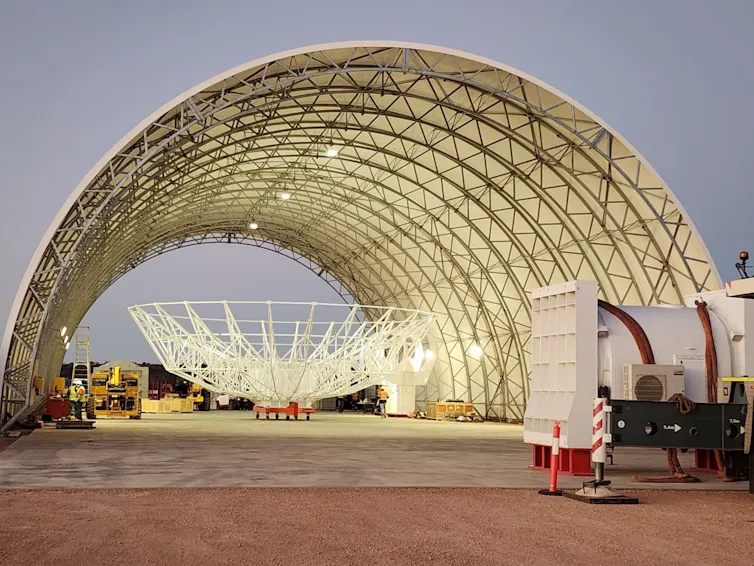
Darc will be networked with similar installations in the US and Australia. The image shows a reflector being assembled for Darc in Australia. Mike Kortum, Four Sea Group Inc.

The planned Deep Space Advanced Radar Capability (Darc), along with Skynet, is one of the few specific space related programmes named in the plan. It will provide radar coverage of the geostationary belt, a region of space where satellites orbit at the exact speed of the planet’s rotation.

Darc will monitor satellites, space debris and potential space-based threats from other nations. Based in Wales, Darc will be networked with similar installations in the United States and Australia to provide global coverage.

A worrying omission in the defence investment plan is the relationship between its £880m allocation for intelligence, surveillance and reconnaissance and space control and the existing Istari programme. Istari is described as a £970 million multi-satellite programme to support global surveillance and intelligence for military operations.

One of the satellites under the Istari programme, Tyche, launched on August 16 2024. Tyche is the ministry of defence’s first sovereign optical imagery satellite. Another Istari satellite programme, called Oberon, is expected to provide two synthetic aperture radar satellites for day and night, all-weather 3D radar imagery.

Yet the defence investment plan does not clarify whether the £880 million allocated for intelligence, surveillance and reconnaissance in the plan continues, replaces, or accelerates specific capability types within Istari – or whether it will go to services acquired from external providers.

New or old?

It remains unclear how much of the £3.2 billion for space represents new spending or restates earlier commitments in the 2021 integrated review, the 2021 national space strategy, the 2022 defence space strategy and the 2023 national space strategy in action.

The UK requires a much clearer account of what space services its future force assumes responsibility for, which of those services it must own or control, and which it is willing to access through allies or its commercial providers.

Much of the defence investment plan’s wider logic amounts to a rediscovered faith in old 1980s-era reconnaissance-strike battle doctrines. It prioritises finding and neutralising the enemy’s command and control, logistics, and reconnaissance capabilities using long-range precise weaponry.

The issue is not that this model is the wrong way to organise combat forces, but that it is highly dependent on space infrastructure. This will require multiple integrated technologies that are able to convert raw operational data into actionable intelligence, not least from space.

The defence investment plan recognises this in rhetoric but does not explain how the UK will secure access to the required space infrastructure.

The consequence is that British military operations will continue to depend on a “central nervous system” that is not sovereign. That places greater weight on UK diplomacy, foreign policy, and contracting mechanisms to ensure continued access to US, European, and transnational commercial space infrastructure.

More spending on space is not always the answer given other pressing needs. Rather, detail is lacking about what the UK military intends to invest in with its existing funding. It is also unclear whether UK government understands the strategic consequences of Britain’s reliance on allies and commercial third parties for essential military space infrastructure.

The defence investment plan was a moment in which the government could have converted five years of strategy documents into a modestly funded order of clear, specific capability development priorities. The government declined to do so.

Until it can, the £3.2 billion buys continuity rather than direction: a communications programme, a new ground radar, a small down payment on divergent types of intelligence, surveillance and reconnaissance, and another list. Admitting the limitations would set a more grounded foundation for public and professional debate on British defence policy in the space age.

The Conversation

The authors do not work for, consult, own shares in or receive funding from any company or organisation that would benefit from this article, and have disclosed no relevant affiliations beyond their academic appointment.

  •  

Are we finally about to get decent wifi on trains and planes?

Wifi on the go is often unreliable – on buses, trains and, increasingly, planes. Whether via cellular or satellite systems, connectivity at speed suffers from highly variable signal coverage and strength. This leads to delays, degraded data speeds and service interruptions.

To address these issues, the UK government has announced a major upgrade to wifi connections on hundreds of intercity trains.

They will use low Earth orbit (LEO) satellite communication systems such as Starlink (a subsidiary of Elon Musk’s SpaceX company) and OneWeb (part of the of French Eutelsat group). Operating much closer to Earth than traditional satellites, these systems can provide near-global coverage and higher-speed communications.

So, as LEO networks are rapidly adopted for air, rail, road and maritime transport, how will this change our experience of wifi on the move?

Trains

At present, train wifi largely depends on aggregating terrestrial 4G and 5G signals along each route, with the available bandwidth shared between passengers. As a result, wifi often degrades in rural areas, tunnels and other locations where signal coverage is limited.

Such challenges are even harder on high-speed trains operating at speeds of 150mph (250km/h) and more, with some services in China reaching 220mph.

One technical fix is dedicated trackside communication networks that use advanced technologies to deliver ultra-fast, low-lag connectivity even at such high speeds. But they are still constrained by limited coverage and significant installation costs.

In contrast, LEO satellite systems could offer near-global coverage without requiring costly deployment trackside infrastructure. Following successful trials on LNER, South Western Railway and Great Western Railway services in 2025, the UK government recently announced a £57 million, five-year rollout of LEO satellite connectivity across nationalised mainline rail services.

Video: The Independent.

Up to 1,400 trains will receive satellite-enabled connectivity, with onboard wifi availability increasing from around half of UK train journeys up to 90% by the early 2030s.

Integrating LEO systems with existing terrestrial wifi networks should combine the strengths of both technologies. When one link becomes unavailable or degrades, alternative connections can seamlessly take over, reducing service interruptions and improving the reliability and quality of onboard wifi.

Planes

Since German airline Lufthansa introduced the first commercial in-flight internet service in January 2003, wifi on planes has expanded rapidly.

Today, approximately 70% of airlines worldwide offer onboard internet connectivity. Their wifi is provided either by air-to-ground or satellite communication systems.

Air-to-ground systems use an antenna mounted on the plane’s underside to connect to a network of land towers. While this approach ensures relatively low delays, coverage is limited to regions with terrestrial infrastructure so is unsuitable for most oceanic routes.

The preferred option for long-haul and transoceanic flights is using an antenna mounted on top of the aircraft to communicate with satellites. But maintaining reliable inflight connectivity remains challenging due to rapidly changing conditions and frequent satellite handovers at high speed (upwards of 500mph).

Climbs, descents and turbulence can all disrupt an antenna’s alignment with satellites. Continuous satellite tracking and antenna steering is needed to maintain accurate beam alignment throughout the flight.

Video: CNBC.

In recent years, LEO satellite systems have accelerated midair wifi provision, in some cases delivering “superfast” inflight internet speeds exceeding 100 megabits per second. With signals travelling up to 3,000 miles, though, transmission delays are still unavoidable.

As technologies such as electronically steered antennas and AI-driven network management mature and satellite capacity continues to expand, onboard wifi should become comparable to terrestrial broadband for most passengers. This will enable in-flight video streaming and cloud-based services with minimal disruption.

Buses

Many long-distance coaches use roof-mounted antennas with onboard routers to share a cellular connection among their passengers. Wifi performance thus depends heavily on mobile network coverage and capacity, and can degrade in rural areas, tunnels, or simply when the coach is full.

Connectivity has been enhanced with the transition from 4G to 5G networks. However, since coach and bus wifi relies on a shared cellular connection, passengers often have a better experience using their own mobile connectivity.

This means wifi provision on local bus services has slowed in recent years. In 2025, 13% of buses in England offered free wifi, down from a peak of 32% in 2020.

On rural and long-distance routes, where mobile coverage is limited or unavailable, reliable wifi can be essential not only for passengers but for operational services such as ticketing and CCTV.

With LEO satellite networks emerging as a promising solution, several UK bus and coach initiatives – including trials by Transport for Wales from 2024 – are exploring hybrid 5G-satellite systems. These can seamlessly switch between cellular and satellite links to reduce coverage blackspots and provide more consistent connectivity along rural routes.

Ferries

Ferries and cruise ships operating more than a few tens of kilometres from land rely on satellite communications. These have evolved from low-bandwidth systems used primarily for safety, navigation and crew communications in the 1980s and ’90s, to broadband passenger wifi services supported by geostationary satellites orbiting around 22,000 miles above the Earth.

Maintaining stable satellite communication at sea is particularly challenging. Ships roll, pitch and yaw because of the waves and wind. This can misalign satellite antennas, leading to performance degradation and temporary communication interruptions.

Harsh maritime conditions including salt corrosion, high humidity and heavy rainfall can also damage electronic devices, reducing the strength of high-frequency satellite signals.

Furthermore, the ship’s large steel structure can cause signal degradation and coverage dead zones. This makes onboard wifi provision especially difficult on large cruise ships with multiple decks, thick walls and narrow corridors.

LEO satellite technology has, however, significantly improved wifi provision at sea. As of 2025, more than 25,000 commercial and passenger vessels worldwide were using LEO satellite broadband services, primarily through Starlink.

And as with other modes of transport, this rate of adoption is projected to continue increasing rapidly. The prospect of seamless wifi coverage, whichever way you travel, should soon be a reality.

The Conversation

Li Zhang does not work for, consult, own shares in or receive funding from any company or organisation that would benefit from this article, and has disclosed no relevant affiliations beyond their academic appointment.

  •  
❌