
❌

Reading view

The EU has fined Google a billion dollars for ignoring competition rules – but will it have any effect?

The European Commission’s decision to fine Google €890 million (US$1 billion) for failing to comply with the EU Digital Markets Act sounds like a significant financial and political intervention against one of the world’s largest technology companies.

The ruling is certainly further evidence of Europe’s desire to regulate US big tech platforms more strictly.

But can such fines really change the behaviour of companies like Google, whose global resources and technical capabilities substantially exceed those of the institutions responsible for regulating them?

Alphabet, Google’s parent company, reported revenues of approximately US$402.8 billion (£302bn) for 2025, and a net income of US$132.2 billion. The EU fine represents less than 0.3% of one year’s revenue.

This makes it, simultaneously, one of the largest penalties imposed under the Digital Markets Act (DMA) and a financially manageable cost for the company receiving it. But that does not mean the penalty is irrelevant. Fines can also carry reputational costs, establish legal boundaries, and create a basis for more serious sanctions.

Europe has been here before

The European Commission has been here before. In 2004, after a five-year investigation, it fined Microsoft more than €497 million for using its position in PC operating systems to restrict competition in adjacent software markets.

Just under a decade later, the same company was fined a further €561 million, after it failed to provide the browser-choice screen it had committed to making available to European Windows users. This judgment was significant, as it showed the initial legal decision was only one stage of the commission’s enforcement process.

Google has since become the principal focus of EU technology concerns. The commission opened proceedings over the company’s comparison-shopping practices in November 2010, finally imposing a €2.42 billion fine in June 2017. A separate three-year investigation into restrictions associated with Google’s mobile operating system, Android, resulted in a €4.34 billion fine in July 2018.

Video: Associated Press.

Brussels has used the DMA against other big tech gatekeepers too. In April 2025, it fined Apple €500 million for breaching its anti-steering obligation – which forbids online platforms from blocking out cheaper rival deals – and Meta €200 million in connection with the choices it offered users about their personal data.

While these decisions demonstrated the commission’s willingness to intervene, they also established a recurring pattern: an investigation is opened and a substantial fine is imposed. Then, the company in question introduces a series of technical or contractual changes, only for a further dispute to emerge over whether those changes amount to effective compliance.

In short, the central difficulty is not the absence of legal authority. It is the translation of that authority into timely, measurable changes in market behaviour.

Do fines change big tech behaviour?

There are three main ways in which the effectiveness of a fine such as this can be assessed:

1. Formal compliance: has the company amended its contracts, interfaces or internal policies in response to the decision?

2. Market effectiveness: have the changes given competitors a meaningful opportunity to reach customers, enabled app developers to offer lower prices, or increased consumer choice?

3. Deterrence: has the penalty made Google – and other gatekeepers – less likely to engage in equivalent conduct through future services, product designs or contractual arrangements?

A 2025 study examined the implementation and effectiveness of company responses in 12 major EU antitrust cases. Although most of the imposed remedies had been implemented, fewer than half were found to have been fully effective.

So, it’s not enough to ask whether Google will change the appearance of a search page or amend the wording of its developer terms in response to this latest fine. The commission must assess whether, after Google’s 60-day compliance period, competing services receive meaningful visibility, rival companies can communicate with customers without excessive friction or fees, and consumers are genuinely able to exercise greater choice.

A criticism levelled at regulators in many jurisdictions is that investigations are too slow to curb anti-competitive behaviour. Article 29 of the DMA states that the European Commission should adopt a non-compliance decision within 12 months of opening proceedings.

This is an aspirational timetable, rather than an absolute legal deadline. Nevertheless, the present Google investigations were opened on March 25, 2024 and concluded on July 23, 2026 – approximately 28 months later.

A January 2026 consultation highlighted complaints about the DMA’s slow processes and limited transparency, as well as circumvention and delaying tactics on the part of big tech companies. Suggested changes included binding procedural timelines, independent audits, and public testing of the remedies imposed by the European Commission.

The speed of technological change

When the EU’s latest proceedings against Google began in March 2024, much of the digital competition debate concerned the ordering and presentation of conventional search results. During the investigation, however, Google continued to develop AI Overviews and AI Mode, which offer users AI-generated answers, summaries and recommendations rather than a traditional page of ranked links.

This creates a significant enforcement problem. Self-preferencing can occur not only through the vertical ranking of links, but through the selection of sources, the framing of an answer, the services through which a transaction is completed and the options presented to the user by an AI agent.

Accordingly, the issue should not be whether a rival service has been given a particular box on a search page. It should be whether competing services have a fair and effective opportunity to be discovered, selected and used, irrespective of whether the interaction takes place through a conventional search result, an AI-generated answer, or an automated purchasing agent.

The commission’s ruling announcement recognised this rapid technological development. It also noted that Google had submitted proposals concerning how the principles of the decision should apply to AI Overviews and AI Mode, and that discussions on these services would continue.

Ultimately, the fine represents an early test of whether the DMA can remain relevant as the technology changes. It is this, not the size of the initial fine, that will decide whether Europe really can keep big tech in check.

The Conversation

Iain Nash does not work for, consult, own shares in or receive funding from any company or organisation that would benefit from this article, and has disclosed no relevant affiliations beyond their academic appointment.

  •  

What the sudden demise of the UK’s department of science means for the future of research

The obituaries were being written before the body was cold. Within hours of Prime Minister Andy Burnham confirming that Whitehall’s responsibilities for science and technology would be absorbed into a new Department for Business, Innovation, Science and Trade (DBIST), Sir Paul Nurse, president of the Royal Society, was on Radio 4 warning that “science isn’t a slave to business”. The trade association TechUK declared it “the wrong change at the wrong time”.

You might imagine that something ancient, ineffable and essential to British science had been ripped away. In fact, the Department for Science, Innovation and Technology (DSIT) was only born in February 2023 – a surprise late tweak to the machinery of government under Rishi Sunak’s faltering premiership.

Science has never enjoyed a settled home in Whitehall. For most of the period from 1995 to 2023, it sat precisely where Burnham has put it now: inside a business super-department. Notably, the single most important protection UK science secured in that era – a ring-fenced budget through the George Osborne austerity years – was won from inside the Business, Innovation and Science department, under then-business secretary Vince Cable.

The historian David Edgerton has long argued that Britain’s fondness for tinkering with the machinery of government is a form of displacement activity. What actually shapes the fortunes of research is money, people and demand for what they produce, not the nameplates on London’s Victoria Street.

On that test, the outlook for science is far calmer than some reactions to this latest move would suggest. Under plans published last October, the UK’s total research and development budget is locked in at £58.5 billion over the four-year spending review to 2030 – a real-terms increase.

Machinery changes move budget lines across departments; they don’t unravel them. As yet, nothing we’ve heard from the Burnham government suggests the settlement for UK Research and Innovation (UKRI) is at risk.

A US wrecking ball

If we want to be reminded what real damage to a science system looks like, we only need to glance across the Atlantic. While London rearranges the departmental furniture and dishes out new email addresses, Washington is taking a wrecking ball to the foundations of its public science system.

A 2027 budget request will halve the size of the US National Science Foundation, if passed. A draft White House rule, due to take effect in October, will hand political appointees the power to vet federal research grants against “the president’s priorities” and terminate awards mid-stream.

A predictable exodus has begun. The Nobel laureate Omar Yaghi has just left the University of California, Berkeley for Tsinghua University in China.

Top researchers consider leaving US amid funding cuts. Report: PBS NewsHour.

Set against political commissars patrolling the borders of knowledge, the UK’s science soap opera feels deeply provincial – a debate about which secretary of state sponsors oversight of a gradually swelling budget.

And the institutional layer beneath this is in better shape than doomsayers allow. UKRI’s new strategy has set a clear five-year path: priority programmes in AI, quantum and clean energy, faster funding decisions, and a welcome seriousness about experimentation with the modes and means by which we manage public investment in research.

Not everyone is happy with UKRI’s approach to prioritisation. But a funder with a published strategy, agreed budget and hard targets is a more durable asset than a three-year-old ministry. The research councils have outlasted every department that ruled over them, and UKRI will outlast this too.

Nor should the science community be spooked by closer proximity to business. When I leave my office at UCL and stroll down the Euston Road through London’s Knowledge Quarter – dubbed “the new square mile” – I pass by the Wellcome Trust, the Crick and Turing institutes, the British Library, Anthropic and Google DeepMind. Day in, day out, this dense weave of labs, firms and cultural institutions delivers what the triple helix of government, industry and academia is all about.

And we can find versions of the same story unfolding in Manchester, Sheffield, Cambridge and Glasgow. Rather than science being subordinate or “enslaved”, the UK’s world-leading universities have spent the past decade aligning themselves with agendas for regional growth and frontier technologies.

But there’s a harder truth lurking here too. Public money accounts for less than a third of UK research and development investment. The rest is financed and largely performed by the private sector.

UK science’s chronic weakness has never been the quality of publicly funded research. It is the R&D intensity of UK firms, and their ability to convert discoveries into products, services and revenue streams generated and owned in the UK.

If yoking science to industrial strategy in a single department reminds Whitehall to treat these as a single problem, some good may come of Burnham’s reorganisation.

AI policy concerns

With DSIT’s disappearance, a particular source of concern has been the future of AI policy. This at a time when the radical possibilities and risks of AI frontier models, fluctuating US export controls, and the latest “Sputnik moment” jolt from China’s Kimi K-3 demand sustained and technically fluent policy attention.

We are also seeing a sharp acceleration in the ways AI is transforming science itself – whether by cracking mathematical problems that stumped humans for the past 87 years, or collapsing decades-old models of grant writing and peer review.

Splitting AI from science just as they converge in practice would have been the least defensible element of this reorganisation. So it is reassuring that cross-government oversight of AI, including the AI Security Institute and AI public sector adoption, is moving to a new “AI taskforce” in the Cabinet Office – alongside the promotion of Kanishka Narayan to the status of AI minister attending Cabinet. Much now rests on his shoulders.

Government departments come and go. Those of us who have long advocated for research policies built on evidence rather than gut can allow ourselves a wry smile at the fuss created by this latest reorganisation – and then get back to work.

DSIT is dead, but UK science will be fine. Keep your eyes on the AI prize – and be thankful we are arguing about organograms, not survival.

The Conversation

James Wilsdon receives funding from UKRI and the Wellcome Trust, and a wider consortium of international research funders who partner in the Research on Research Institute (RoRI).

  •  

Why do some people who trust in science also believe in scientific conspiracy theories?

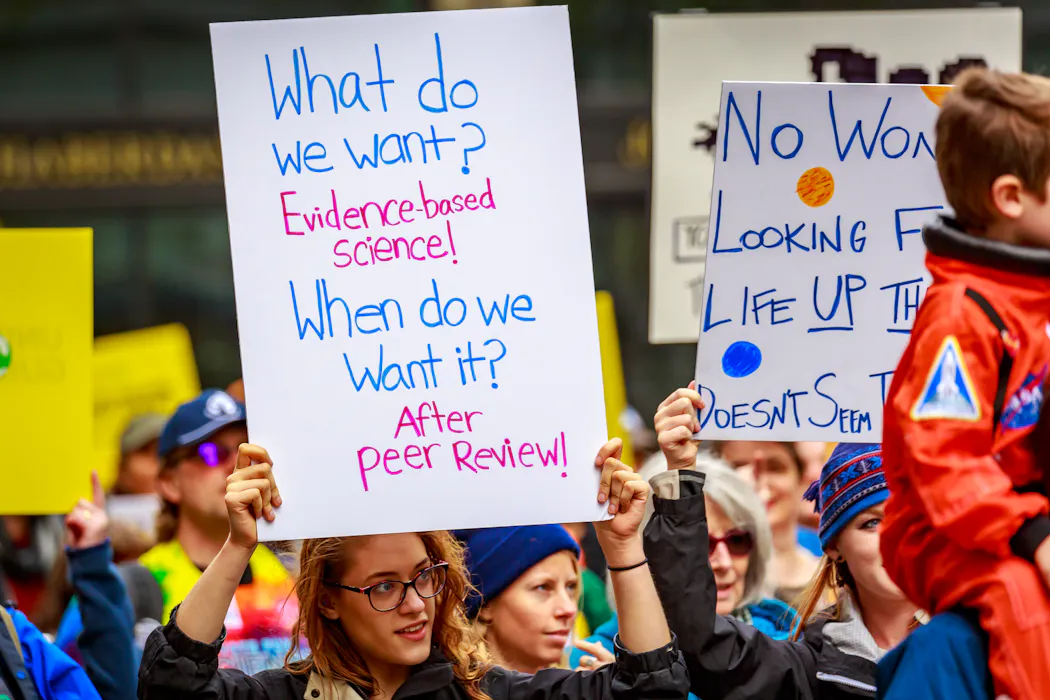
Pro-science protesters at the second annual Portland March for Science, Oregon 2018. Png Studio Photography/Shutterstock

In a world where trust in institutions is mostly in decline, levels of trust in science remain relatively high. Yet at the same time, belief in scientific conspiracy theories, such as hushed-up effects of vaccines or aeroplane “chemtrails”, is also widespread.

What explains this apparent contradiction? Our work suggests we need to ask a different question – not how much people trust science, but which sources inform their understanding of what science is and how it works.

In our recent study of 843 US residents, we found that people who picture scientific progress as the work of lone geniuses, and who learn about science mainly from podcasts and documentaries, are markedly more drawn to conspiracy theories – whatever their level of education.

This fits the bigger picture very well. In a 16-country survey, 70% of respondents believed at least one false or unproven health claim. High trust in science and widespread conspiracy beliefs appear to coexist in the same populations.

We fear that trust in science is compatible with believing almost anything, so long as it is expressed in plausibly scientific terms. This can lead to some people refusing vaccines, trusting miracle cures or dismissing climate warnings – all while remaining convinced that science is on their side.

The ‘lone genius’ trope

At school, science is almost always presented as a linear sequence of achievements, or in the form of impersonal theories. The human side of discovery is largely stripped out.

In contrast, most science-focused films and documentaries build their narratives around biographies of exceptional individuals.

These often yield a familiar plot. Society is facing an intractable problem. A genius arrives with the exact solution – but is ignored and mocked until, after much personal pain, everyone realises he (for it is invariably a man) was right all along.

From the martyrdom of Giordano Bruno, the Renaissance friar burned at the stake partly for defending an infinite universe, to A Beautiful Mind, the Oscar-winning portrait of the mathematician John Nash, this lone-genius arc has permeated popular depictions of science for centuries.

Original trailer for A Beautiful Mind (2001). Video: HD Retro Trailers.

Many conspiracy theorists seek to exploit this trope – in part to suggest that those who recognise it must be unusually smart too, living in a world where everyone else is “naive” or “brainwashed”.

Yet these lone genius plots leave out nearly everything that makes science work. Namely, the rather boring and complex processes of accumulation and evaluation, from peer review to replication and endless disagreements, through which reliable knowledge emerges from a crowd of people and institutions.

Research also shows that people presented with academic research “in the making”, without definitive conclusions, often read any hesitations or equivocations as scientific weakness, rather than honesty.

Most people trust science without understanding its technicalities. This means trust can easily be attached to shared cultural markers of “scientificity”: technical vocabulary, charts, credentials, fancy equipment, numbers quoted to impressive precision. In other words, whoever displays the right cues sounds plausibly scientific.

Consider the example of Corrado Malanga, an Italian chemist who developed an elaborate theory of aliens harvesting human souls, and his collaborator Filippo Biondi, a radar researcher. Using satellite radar, the pair claimed in March 2025 to have discovered an elaborate hidden city up to two kilometres beneath the Khafre pyramid in Egypt.

Archaeologists quickly and widely dismissed these claims, in part because this kind of radar cannot see more than a few metres underground. Yet Biondi went on to present their “discovery” at length on The Joe Rogan Experience, one of the world’s most popular podcasts, in January 2026 – attracting many millions of views and listens to this widely disputed “scientific account”.

A recent analysis examined 8.7 million Twitter (now X) posts that shared supposedly fact-checked news stories. It found that references to scientific entities – through use of terms such as scientist, university or study – were associated with an increase in sharing. However, this was especially true of “low-veracity content, and when users lean politically to the right”.

A protestor holds up a placard reading
Protesting the Canadian government’s COVID vaccine mandate and other restrictions in the capital, Ottawa, in 2022. Gary A Corcoran Arts/Shutterstock

More likely to endorse conspiracy theories

There are two threads intertwining here: a story about how science progresses, and the informal media where it mostly lives.

In our recent study, published in Current Psychology, we measured participants’ “genius mentality” (the propensity to believe that progress comes from exceptional individuals overturning consensus through intuition) and also their science media preference (whether they favoured podcasts and documentaries over expert-vetted sources).

We found people who scored higher on either metric were more likely to endorse conspiracy theories. These correlative effects were stronger than either education or political orientation, factors usually considered major drivers of such beliefs.

We also observed an interesting moderation effect: among people with little or even moderate trust in scientists, a high belief in the genius mentality markedly increased conspiracy belief. Among those who trusted scientists most, it made almost no difference.

From our research, we believe standard remedies, fact-checks and appeals to “trust the science” miss a deeper problem. They may correct claims one at a time, but leave untouched core beliefs (and misunderstandings) about how science works.

A more durable approach is to make the collective machinery visible: to explain why debate, peer review and the slow building of consensus, rather than individual intuition, are what make science reliable.

Some science education researchers argue that the goal should not be to turn everyone into a scientist, but a “competent outsider” – people who can correctly evaluate where knowledge comes from and how it has been produced.

We believe a school science education should not only introduce theories, but explain how the scientific community works on a daily basis. Children need to learn how knowledge emerges from many people cooperating and challenging each other within shared criteria – and that any consensus which survives this process is a strength, not groupthink.

Our ambition is to protect against future conspiracy theories before they emerge, rather than simply trying to correct the last one.

The Conversation

Michele d'Errico receives funding from the Irish Research Council.

Taha Yasseri receives funding from Research Ireland and Workday Inc.

  •  

Why an EU ruling about a traffic app could have major implications for big tech companies

Alexandros Michailidis/Shutterstock

Many of the biggest online platforms have long argued they aren’t publishers of the content their users upload, merely hosts. The likes of Google, YouTube, Meta and TikTok claim they simply store and display information created by others, so should not be seen as legally responsible for it.

But a recent ruling by the Court of Justice of the European Union (CJEU) makes that argument harder to maintain – at least in cases where the platform’s algorithm is deciding which content gets pushed, ranked or amplified.

The case relates to Coyote, a French driving assistance company which stores traffic reports submitted by users and redistributes them to the wider network. The question being tested was whether Coyote merely hosts its users’ information, or also controls (and benefits from) how that information is circulated.

The significance of this case – brought by the Conseil d’État, France’s highest administrative court and the government’s chief legal adviser – extends far beyond driving apps. It clarifies when a provider may lose the legal right of “intermediary immunity” for the user information it stores and circulates.

Traditional book, newspaper and magazine publishers have always been held responsible for their content. A defamatory article generally exposes the publisher to liability, since it chose to make the material available.

In contrast, technology companies have been treated as neutral intermediaries – closer to a corner shop stocking newspapers than a publisher producing content, with clear limits to their liability.

For these companies, the Coyote judgment is significant because it sharpens the boundary between neutral hosting and algorithmic control. A platform that merely stores user content is likely to remain legally protected. But one that decides, in its own interest, how that content is disseminated may no longer be.

One important caveat: as this case is from the CJEU, it does not apply to users in the UK and elsewhere outside the EU. However, it will affect British and international companies that have a significant audience within the EU. So, no technology platform can dismiss the issue simply because it is headquartered outside Europe.

What the court decided

A hosting provider is protected under Article 6 of the EU Digital Services Act (DSA) if it lacks actual knowledge of illegal content – and then acts expeditiously once notified about it.

The question in the Coyote case was whether a service that stores and retransmits user-generated information still counts as a neutral host when its algorithm decides how that information circulates.

A Coyote user explains how the app works. Video: Loic Le Mur.

The court concluded that a platform can have no knowledge of a specific message’s content, yet can still have legal responsibility for its dissemination. Where a platform’s algorithm determines – in its own interest – the conditions, manner or priority with which information is disseminated, then the “safe harbour” of being a neutral host falls away.

This outcome was anticipated in 2019 by technology law experts Jennifer Cobbe and Jatinder Singh, who argued that algorithmic curation complicated the assumption that platforms are passive, neutral hosts.

The ruling does not doom every algorithm. Simple categorisation, such as showing all posts by one user or from the past 24 hours, remains close to traditional hosting. But ranking or promoting content in the platform’s own interest does not.

None of this makes these platforms automatically liable. Losing the exemption only opens the door to being sued – claimants must still prove the platform’s conduct actually caused harm.

Potential impacts of the Coyote ruling

1. For social media content

A social media company may remain protected when it stores user content or displays it in ways that are largely user-directed or chronological. But algorithmic feeds are different.

“For You” pages, recommendation systems, trending modules and paid amplification systems all decide what content is shown to which users and in what priority. When that decision is made in the platform’s commercial or service interest, Coyote makes it harder to describe the platform as merely hosting the content.

The same reasoning may matter for extreme or graphic material. If a platform simply stores content uploaded by a user, the hosting exemption could still apply. But where a recommender system repeatedly pushes that material to users because it drives engagement, Coyote gives claimants a stronger argument that the platform was not passive.

The content does not always need to be unlawful in itself. But claimants would still need to demonstrate both liability and harm.

2. For paid search

When a platform sells priority, decides how a sponsored result is displayed, and presents that result to users because doing so serves its own commercial interest, it becomes harder to argue that the platform is merely storing or neutrally indexing third-party information.

This matters because online advertising has become a major route for fraud and consumer harm. Following the Coyote ruling, claimants harmed by paid advertisements may have a stronger argument that the harm arose at least in part because the provider sold, ranked and prioritised that information.

But they would still need to prove the advert was unlawful, that the platform’s role fell outside immunity, that the promotion caused their financial loss or other harm.

3. In libel cases

A newspaper that publishes a defamatory allegation can be liable because it has chosen to publish it. In contrast, a hosting platform where a user makes and uploads such an allegation has not been treated in this way.

However, if the platform’s recommender system promotes that post or pushes it into feeds, the CJEU ruling gives claimants a clearer argument that the platform should be held responsible for increasing the audience reach of the allegedly defamatory content.

Changing the terrain

The Coyote judgment does not abolish hosting immunity – but it does change the terrain. It makes clear that the “safe harbour” argument depends not only on where information came from, but what the provider does with it.

The more a platform determines dissemination in its own interest, the harder it is to maintain that it is merely hosting, according to this groundbreaking ruling. And this, remember, holds for international as well as European technology companies.

The Conversation

Iain Nash does not work for, consult, own shares in or receive funding from any company or organisation that would benefit from this article, and has disclosed no relevant affiliations beyond their academic appointment.

  •  

What will AI do for us? Young adults in lower-income countries feel more positive about its potential – new survey

i_am_zews/Shutterstock

Young people in low- and middle-income countries appear generally more optimistic about how AI can enhance their work prospects and social lives than their western peers, according to our new survey of people in ten countries in Africa and South Asia.

While debates in higher-income countries often focus on job losses, misinformation and mental health risks, many of the 1,864 young adults we surveyed (all aged 18-35) placed more emphasis on the opportunities artificial intelligence tools present for them. In particular, nearly 80% of our participants expect AI to deliver improved education and learning for them.

Until now, there has been little evidence of how young people in middle- and low-income countries use AI, and how they feel about this technology – for good and bad. The 2026 youth AI survey – run by global charity Restless Development and academics from the universities of Makerere in Uganda and Cambridge in the UK – seeks to correct this imbalance.

It comes immediately after the UN Independent International Scientific Panel released its preliminary report on AI. Commenting on the need for more science about AI’s use around the world, the UN’s secretary general, António Guterres, admitted: “The world cannot govern what it cannot understand.”

Our responses were collected in Angola, Kenya, India, Nepal, Nigeria, Sierra Leone, Tanzania, Uganda, Zambia and Zimbabwe – with the UK included for comparison. Two-thirds of respondents said they use AI every day, with Meta AI the most common tool, followed by Claude.

The extent of AI use is striking given the obstacles many young people encounter. In every African country surveyed except Nigeria, more than half said high data costs limit their access. Weak internet connections and a lack of digital skills were also raised, with many relying on basic-feature phones. By contrast, UK participants said ethical concerns played a stronger role in limiting their AI usage.

AI work opportunities

While few respondents (14%) said they earn income directly from AI tools yet, half expected AI to improve their employment and economic opportunities within the next five years.

Currently, AI’s main work-related uses among our respondents are learning new skills and job searches. In almost every lower-income country, young people held broadly positive attitudes about AI’s future role in their working lives – although many (32%-50% per country) expressed concerned about its impact on their future income.

How will your income be affected by AI?

Chart showing breakdown of how worried respondents are by AI across 11 surveyed countries.
Sonal Gupta/Youth AI Survey 2026, CC BY-SA

Among those from lower-income countries, more than seven in ten thought AI would bring them better education and learning opportunities in the near future. A 28-year-old self-employed man in Nepal commented: “AI has the potential to empower young people in developing countries like Nepal by improving access to knowledge, digital skills, and economic opportunities.”

Our sentiment analysis found respondents to be most positive in Tanzania and Zambia, with young women there even more upbeat than young men. In the UK, young men diverged from their international peers in feeling more negative towards AI and work.

Biggest AI concerns

Some respondents described AI tools as “Americanised”, built around western norms and unable to grasp local nuance. They worried this could lead to their languages being further marginalised.

“These AI tools are fed major languages that are spoken worldwide, unlike Shona,” said a 25-year-old student in urban Zimbabwe. Shona is spoken by around 14 million people mainly in southern Africa, but is severely underserved by AI and other technology tools.

A Ugandan respondent was similarly critical about provision for her native language, Luganda – the country’s most widely spoken Indigenous language. “AI barely knows the spellings, grammar and how to interpret sentences. It’s not even familiar with our culture at all, which increases mistakes when we get to things concerning our own world.”

What most concerns you about AI?

Chart showing respondents' main AI concerns across 11 surveyed countries.
Dark blue to light green reflects large to small proportions of respondents expressing ‘high levels of concern’ about the issues listed on x-axis. Sonal Gupta/Youth AI Survey 2026, CC BY-SA

Despite the widespread belief that AI would improve education and training, some held strong reservations. A 21-year-old female student in rural Uganda said: “Slowly by slowly, AI is making us dumb. We can no longer think for ourselves.”

The more often these young people use AI, the more worried they appear to be about it. The biggest concerns highlighted by daily users were around who owns their data and the power of AI companies.

Concern about AI’s environmental impact and the welfare of AI workers followed a similar pattern of higher usage co-existing with higher concern. Mental health is the only domain where non-users worry slightly more than daily users.

Gender differences

Significantly more young men (38%) than women (23%) reported having “a lot” of AI knowledge. This probably reflects a combination of diverging gender self-confidence, which tends to emerge from school age, and different levels of AI use. “AI is scary but helpful too,” said one female homemaker in urban Nepal.

Almost twice as many men than women use AI to search for work (33% vs. 17%). This difference is probably rooted in gendered access to data and technology, as well as differing social roles – such as the tendency for women to do more care work.

What have you used AI for in the past month?

Chart showing breakdown of how  respondents used AI in past month, across 11 surveyed countries.
Note: the bars sum to more than 100% because many respondents have multiple uses for Al. Sonal Gupta/Youth AI Survey 2026, CC BY-SA

In most of the ten lower-income countries surveyed, young women expressed greater concern about AI than men – with their biggest concern being over who owns their data. In the UK, 68% of young women were strongly concerned about data ownership, compared with 29% of men.

What young people want from AI

Many of our participants stressed the need for cheaper data and internet connections that work well. But they also want AI tools that fit their lives and culture – and speak their language. Until then, most recognise that talk of AI “leapfrogging” traditional stages of economic and social development is just that – talk.

Some efforts to make AI more inclusive and relevant for lower-income countries are underway. These include initiatives for “frugal AI”, as well as regional collaborations such as Masakhane for African languages and QuechuaBase in Peru.

How can AI be made safer?

Chart showing breakdown of how respondents believe AI can be made safer, across 11 surveyed countries.
Note: the bars do not sum to 100% because survey participants selected multiple responses. Sonal Gupta, CC BY-SA

Most of our participants framed AI safety as much more of a governance problem than a technical one. Many countries are establishing new AI policies, shaped in part by global forums such as the UN-led AI for Good summits. Overwhelmingly, our respondents agreed that governments, not tech companies, should be setting the rules when it comes to AI regulation and privacy protection.

The Conversation

Anna Barford receives funding from UKRI. She has previously been funded by the British Academy, Leverhulme Trust, ESRC, the Asian Development Bank, the Mastercard Foundation, and a philanthropic gift to the University from Unilever. She is a co-director of the Business Fights Poverty Institute and does consultancy work for the International Labour Organization.

Anthony Mugeere works as a Research Fellow for the Advocates Coalition for Development, Uganda's leading thinktank specialising in advocacy and analysis on climate change. He has received funding from the British Academy and the Mastercard Foundation to conduct research on climate change and young people.

Giulia Occhini does not work for, consult, own shares in or receive funding from any company or organisation that would benefit from this article, and has disclosed no relevant affiliations beyond their academic appointment.

  •  

If AI is addictive, where does the responsibility lie – with big tech or its users?

When I talk to my son, an engineering student, and we have a question or disagreement, he immediately turns to ChatGPT as his primary source of information and confirmation.

He is not alone in this. The use of generative AI tools has exploded across different demographic groups. For many people, these tools can be entertaining, informative and beneficial. However, they also have a dark side.

Generative AI is not formally recognised as addictive right now – the medical evidence is still being gathered. But there is a significant amount of data showing heavy use of chatbots and other systems that produce text, images and video leads to neural patterns and behaviour that are associated with addiction.

In light of Meta’s and YouTube’s recent legal defeat in a landmark social media addiction trial, I believe it’s time to ask whether a similar logic applies to generative AI – and how it could be addressed. The starting point would be to identify who carries responsibility for overuse of generative AI.

The science on this is not settled, and there are some who counsel caution when using the term addiction. They propose the use of other expressions such as “problematic use”. However, in a recent paper, our team of researchers suggest there is strong evidence to suggest that generative AI has addictive properties.

Much-discussed examples include emotional dependency on chatbot companions, compulsive engagement with them, and the loss of real-world acquaintances and friends.

A key factor here is that, as in all cases of addiction, the behaviour has negative consequences for the user which may affect both their personal and professional lives.

If we follow the argument that generative AI is a candidate for addictive behaviour, then we also need to look at responsibility. Societies tend to find ways to deal with harm by holding people or groups responsible for fixing it. Those who could be accountable include legislators, regulators, industry and health systems.

Historical examples

Historical precedents such as smoking might offer insights into how the area of generative AI addiction could evolve.

Older readers may remember when the Marlboro Man would appear before any feature movie in their local cinemas. It eventually transpired that not only was smoking addictive and bad for your health, but that tobacco companies knew this. Nevertheless, it was publicly denied.

This led to lengthy and high-profile litigation, eventually resulting in large-scale financial payouts and changes to the industry. These changes included the plain packaging of tobacco products and gruesome warning labels on them.

Gambling could be following a similar trajectory – and now social media companies may be taking their first steps into a similar process.

A key question is whether the makers of a product – be it tobacco, gambling or social media – are aware of its addictive properties. Another important factor being considered is whether certain companies may even use the allegedly addictive properties of their products for corporate advantage.

AI is not tobacco, of course, but there may be parallels to be studied.

In our research, we have identified four groups of stakeholders that are now being called upon to address the challenges linked to the possibility of addiction to generative AI.

The first is governments and regulators. These have a key role to play in highlighting the problems, setting the rules of engagement, and creating incentives for other parties to engage with the topic.

They can do this by requiring labelling, restricting advertising, applying liability law and providing research funding – along with many other mechanisms.

But the most important role in addressing potential addictive behaviour associated with generative AI would be held by big tech companies that develop and own these technologies – and stand to benefit financially from them.

These companies own and have access to user data, which would be needed to ascertain the features that support or alleviate addiction. They are also the parties that would benefit financially from addiction by increasing user numbers and engagement, the main currency of the digital age.

In addition to these two groups, academic researchers have an important role in collecting and interpreting data, and providing the evidence needed to recognise addiction and addictive features – in ways that allow for evidence-based political or legal debate.

Finally, civil society organisations such as user or patient groups can help by providing support, advocating for members’ interests, and establishing early-warning structures.

The point is that none of these interested parties can address the problem on their own. They need to collaborate.

Someone else’s problem

A key problem at the moment is the lack of structured debate about responsibilities – everybody assumes it is someone else’s problem. But there is ample precedent showing how greater engagement from those involved with the issue may be achieved.

With tobacco, the World Health Organization (WHO) formed the Framework Convention on Tobacco Control – a treaty-based mechanism that brought together governments, public health bodies, researchers and civil society to evaluate evidence and draw up common rules. The International AI Safety Report shows comparable international consensus-building activities are already happening in other aspects of AI.

Some responsibility also falls on the users of AI, who should try to avoid or control their own potentially harmful behaviour. But appeals to individual moderation or mindfulness have been shown with other addictions to be insufficient.

While the harms associated with smoking or alcohol misuse are well known, society still relies on age limits, packaging rules and advertising restrictions. Generative AI is being integrated into the everyday fabric of our society. The choices we now make will determine what acceptable use looks like for years to come.

The Conversation

Bernd Stahl does not work for, consult, own shares in or receive funding from any company or organisation that would benefit from this article, and has disclosed no relevant affiliations beyond their academic appointment.

  •  
❌