
❌

Reading view

Differences in human and great ape laughter reveal clues to the origin of speech

Bonobos in the water in the Democratic Republic of Congo. Sergey Uryadnikov/Shutterstock

Humans are not the only animals that communicate. Birds sing to attract mates, dolphins use signature whistles that identify individuals, and many primates produce complex vocalisations that help them coordinate their social lives.

By studying these communication systems, researchers can reconstruct some of the evolutionary steps that eventually led to one of our defining traits: language.

Language doesn’t just mean making sounds – it requires an extraordinary ability to control them. Human speech demands precise coordination between breathing, the vocal folds across the larynx, and our tongue, lips and jaw.

Humans’ closest living relatives – chimpanzees and bonobos – possess vocal tracts that are more similar to ours than scientists once believed. Yet they do not seem to have the same fine voluntary control over the structures – starting with our lips and tongue – that allow us to produce rapid sequences of speech and such diverse sounds.

This raises an intriguing question: when did our ancient ancestors begin to acquire this remarkable vocal control? One possible clue comes from an unexpected source: laughter.

The evolution of laughter

For several years, I have studied the rhythmic structure of vocalisations in non-human primates. Rather than focusing on what calls mean, I have been interested in how they are produced.

The timing of vocalisations can reveal how breathing and vocal movements are coordinated, offering a window into the mechanisms that generate them. Whether analysing the songs of Madagascar’s indris lemur or the calls of orangutans, I kept coming back to the same question: how much control do different primates have over the rhythm of their voices?

Laughter turned out to be an ideal system for exploring this question.

Chimpanzees playing and laughing. Video: Apes Like Us.

Unlike speech, our ability to laugh is shared with all the great apes. Chimpanzees, bonobos, gorillas and orangutans all produce laughter-like vocalisations during play. Although these sound quite different from our familiar β€œha ha ha”, they serve similar social functions, signalling playful intentions and strengthening social bonds.

Human laughter is much more diverse, however. We can produce loud belly laughs, quiet chuckles, giggles, snorts or almost silent laughter. We laugh when we are amused but also when we are embarrassed, nervous or trying to ease social tension. This flexibility makes laughter much more than a simple emotional reflex for us.

Human laughter is highly context-dependent. We laugh differently when we are genuinely amused, when we engage in polite social interactions, when we feel awkward, or when we share an inside joke.

Together with colleagues, I analysed 140 laughter bouts from humans and the four other great ape species. Instead of asking whether laughter sounded similar across species, we examined its rhythm: how quickly each laugh element followed the previous one, and how consistent that timing was. Our results revealed a clear evolutionary pattern.

When laughing, humans show greater temporal variability than our closest relatives. Chimpanzees and bonobos produce laughter at a slower rhythm than humans, while gorillas and orangutans laugh at an even slower pace.

In contrast, human laughter consists of more rapidly repeated elements – successive vocal bursts that together form a laugh. This increased flexibility may be one of the evolutionary changes associated with the emergence of finer voluntary control over vocal production.

In other words, humans’ ability to β€œlaugh fast” may reflect one of the key innovations that eventually made speech possible.

The link between laughter and speech

The evolution of speech may not simply have involved producing new sounds, but changing the very tempo at which vocal actions are organised. Our findings suggest traces of this key evolutionary transition are still preserved in one of our most familiar activities: laughing.

While humans and chimpanzees share a common evolutionary history, we will never hear how our ancient ancestors laughed. Fossils preserve bones not vocalisations, so the only way to reconstruct the evolution of laughter is by comparing living species and inferring the changes that occurred along the hominin lineage.

Because we found that chimpanzee and bonobo laughter differs from human laughter in rhythmic structure and temporal variability, we can use these living species to infer that early hominins may have exhibited laughter patterns which were already distinct from those of other great apes during the evolutionary transition towards modern human laughter.

Three-to-four million years ago, early hominins may already have shown some of the foundations of the flexible laughter patterns seen in humans today. Our findings suggest that increased temporal variability in laughter evolved along the hominin lineage. This may have enabled laughter to become increasingly adapted to different social contexts, from playful interactions to maintaining social bonds and signalling affiliation.

Every time we compare ourselves with our closest great ape relatives, we discover that the gap between humans and other apes is smaller than was once imagined. Yet we also uncover subtle differences that may have had profound evolutionary consequences.

Laughter is one of them. It may seem like a simple expression of joy, but hidden within its rhythm is a record of millions of years of evolution – and, perhaps, one of the clues to how our human ancestors eventually found their voice.

The Conversation

Chiara De Gregorio does not work for, consult, own shares in or receive funding from any company or organisation that would benefit from this article, and has disclosed no relevant affiliations beyond their academic appointment.
  •  

Don’t change lanes – the maths of holiday traffic jams

ClimbWhenReady/Shutterstock.com

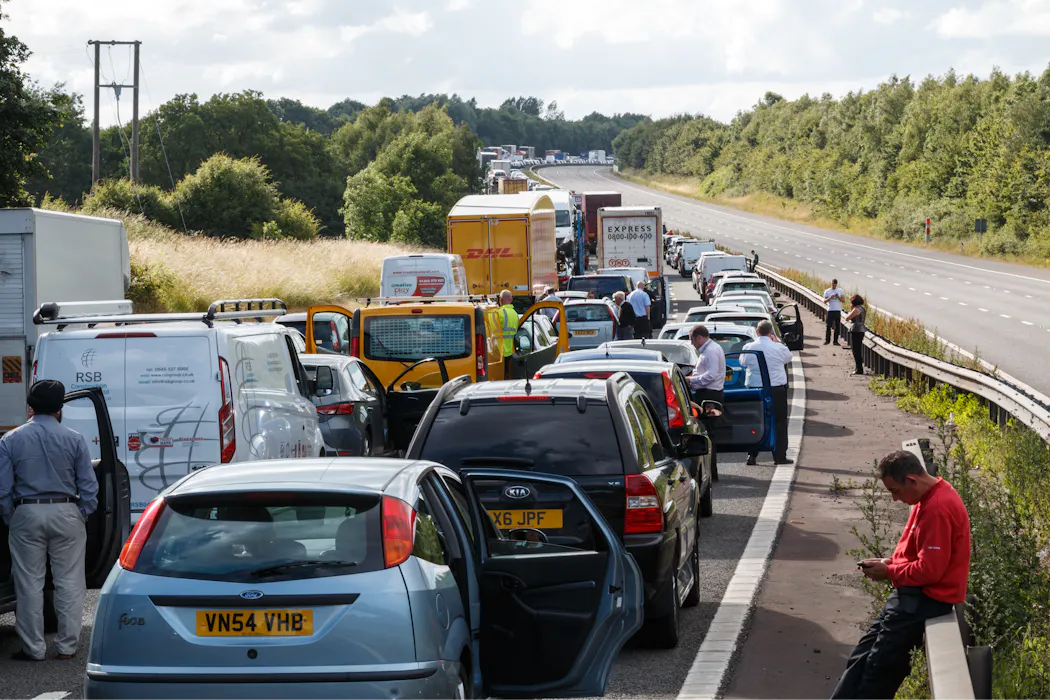
Millions of people will take to the roads this holiday season, only to end up spending frustrating hours sitting in traffic jams. Congestion costs drivers time, fuel and patience – while also increasing pollution and placing huge pressure on transport networks.

If you’ve ever found yourself staring enviously at the lane next to you, convinced it’s moving faster, you’re not alone. Most of us instinctively believe that changing lanes will get us home sooner. But mathematics suggests this intuition is usually wrong.

As an applied mathematician, much of my research is driven by one question: how can we predict and control the behaviour of complex systems operating under uncertainty? And this can apply as much to holiday traffic as it does to emerging quantum technologies.

We tend to think traffic jams need a trigger: an accident, roadworks or a lane closure. Yet some of the most frustrating queues have no obvious cause at all. These are known as phantom traffic jams – stop-start waves that travel backwards through traffic even though every vehicle is moving forwards.

In 2008, Japanese researchers asked 22 drivers to drive around a circular track while maintaining a constant speed and safe distance from the vehicle in front. Within minutes, tiny and unavoidable differences in braking and reaction times grew into a stop-start wave that travelled continuously around the circuit, despite there being no obstacle anywhere on the road.

The explanation is surprisingly simple. One driver brakes slightly more than necessary. The driver behind reacts a little later and brakes a little harder. The next driver does the same.

In this way, the initial tiny disturbance grows as it travels backwards until drivers hundreds of metres behind are forced to stop completely, even though nobody can identify what caused the queue in the first place.

The mathematics behind traffic

Rather than modelling every driver individually, mathematicians treat traffic as a continuous flow – borrowing ideas from fluid dynamics, where the movement of vehicles is analysed much like the flow of water through a pipe.

One of the simplest relationships in traffic flow theory is q = ρv, where q is the traffic flow (the number of vehicles passing a point each hour), ρ is the traffic density (amount of cars on the road) and v is their average speed.

This deceptively simple equation explains a counterintuitive phenomenon. Initially, adding more vehicles obviously increases the overall traffic flow, as more vehicles pass along the road.

But once the road becomes too crowded, everyone is forced to slow down. Eventually, this reduction in speed outweighs the increase in number of vehicles such that the overall flow is reduced.

The equation shows there is an optimal traffic density that maximises the number of vehicles passing through the road each hour. Beyond that point, adding more cars reduces the efficiency of the road – and increases the time it takes everyone to get to their destination.

The same mathematics explains why constantly changing lanes is rarely worthwhile.

A lane change creates a small disturbance that neighbouring drivers must react to. If many drivers behave in the same way, these disturbances accumulate and increase the likelihood of traffic waves. So, what feels like a clever decision for one driver can ultimately make conditions worse for everyone.

Can maths help reduce traffic jams?

In my research on probabilistic mathematical methods, I develop approaches that combine prediction, coordinated decision-making and feedback to keep complex systems stable, even when the available information is incomplete or β€œnoisy” (full of extraneous data).

In traffic, the disturbances we seek to prevent are the stop-start waves that create phantom traffic jams. In other complex systems, they might be power failures, communication bottlenecks or unstable autonomous systems.

How phantom traffic jams form. Video: SotonTRG.

Rather than designing solutions for one specific application, applied mathematicians develop general mathematical frameworks. That’s one reason why ideas originally developed for engineering systems can also help us think differently about traffic – with each of our mathematical tools playing a different role:

  1. Signal processing transforms measurements from road sensors, cameras and connected vehicles into useful information.

  2. Stochastic modelling accounts for uncertainty arising from driver behaviour, weather conditions and changing traffic demand.

  3. Machine learning identifies patterns in all this data, and forecasts where congestion is likely to develop.

  4. Control theory then closes the loop by determining how traffic systems should respond, whether by adjusting traffic-light timings, introducing adaptive speed limits, recommending alternative routes or coordinating fleets of autonomous vehicles.

Rather than optimising the journey for one driver, the objective becomes improving the performance of the entire traffic network.

Perhaps the most striking demonstration came in 2018, when researchers repeated the Japanese circular-track experiment with one key difference. They replaced one of the human-driven vehicles with a single autonomous car, programmed to accelerate and brake smoothly.

Remarkably, that one vehicle, less than 5% of the traffic, was enough to dampen the stop-start wave around the entire circuit, improving traffic flow and reducing fuel consumption for every driver involved.

Tips for your next car journey

Traffic congestion is unlikely ever to disappear completely. Population growth, increasing travel demands and the unpredictability of human behaviour will always put pressure on our roads.

But mathematics is helping us move away from reacting to congestion, towards preventing it.

One important aspect is understanding how large networks of interacting agents can make coordinated decisions using only local information, without requiring every component to know the state of the entire system. These ideas are central to the design of intelligent transport systems, where connected vehicles and infrastructure must cooperate to improve traffic flow.

In the meantime, if you’re about to set off on holiday in your car, here are three driving tips all backed up by strong mathematical evidence. If everyone adopts them, this should reduce the time you spend in traffic queues.

  • Maintain a safe following distance;

  • Accelerate and brake smoothly;

  • Resist the temptation to keep switching lanes in search of tiny gains.

Applied mathematics shows the fastest way to your destination isn’t to drive more aggressively. It’s to help keep the entire system stable.

The Conversation

Randa Herzallah have received external research funding from the Leverhulme Trust ("Control of Behavioural Dynamics"), the Engineering and Physical Sciences Research Council (EPSRC), and Isansys (ECG-derived biosignals PhD studentship, 2016–2019)

  •  
❌