❌

Reading view

What makes the ideal digital icon? A psychologist explains

wavebreakmedia/Shutterstock

Digital icons are everywhere – and usually, we interpret these visual symbols in the blink of an eye. Who today doesn’t know that a wastebasket means “delete” and a magnifying glass means “search”?

Yet icons’ meanings can be deeply shaped by culture, experience and technological history. So what seems obvious to one person may be confusing to another.

They were originally designed to make computers look friendlier and less intimidating to the few people who had access to them. For example, the icons below first appeared in 1975 in the Pygmalion visual programming system.

Years later, they attained much wider visibility thanks to the Xerox Star 8010, a pioneering office computer that introduced many graphic interface concepts that are still used today.

Alt text
The Xerox 8010 Star’s icons. stardock.com

Research my colleagues and I conducted examines how people perceive, understand and evaluate digital icons – including which visual characteristics make icons easier to learn and use. Pygmalion’s pioneering icons worked because they relied on existing knowledge of the office world.

This meant they reduced cognitive effort by relying on recognition rather than recall. The icons looked like the physical objects they were representing – and critically, objects the computer’s users were already familiar with.

Five secrets of a good icon

The designer Susan Kare, creator of many of the original Macintosh icons, said a good icon should either be instantly recognisable or so easy to remember that a user only needs to learn it once.

To Kare, designing icons was about solving “the little puzzle of making an image fit a metaphor”. More than 40 years later, that challenge remains.

Research, including work by my colleagues and me, suggests the most successful icons tend to share key characteristics that guide us from seeing to understanding almost instantaneously. Here are five of them.

1. They depict things we already know

Early computer icons worked because they borrowed from the office world that people already knew: folders, bins, documents, calculators, floppy disks. Psychologists refer to those as “concrete” icons because people to use their knowledge of the everyday world to interpret them.

However, only a limited number of functions can be represented as identifiable objects, and getting a close fit between pictures and functions is not always easy. The more complex the meaning becomes, the harder it is to design concrete icons.

To test this, can you guess the meaning of these four icons? (Answers at the end of the article.)
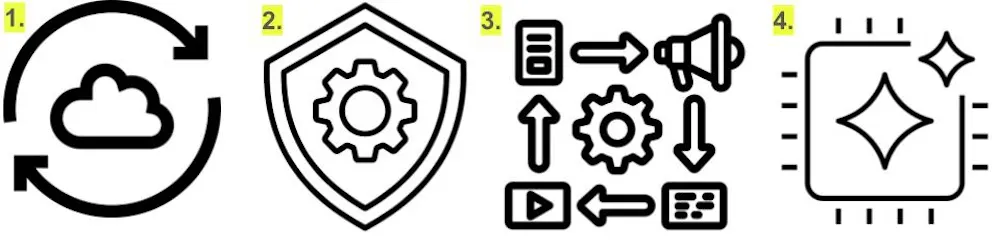
Alt text
Icon credits: Freepik/Flaticon; Kartini 1/The Noun Project; Elzicon/Flaticon; IconPai/The Noun Project.

2. They mean what we think they mean

Psychologists talk about “semantic distance” – how closely an image matches its intended meaning. An abstract symbol for “privacy settings” or “cloud syncing” has a much larger semantic distance than using a bin to mean “delete”.

As digital functions become more complex, designing icons that communicate their meaning quickly becomes increasingly difficult.

3. They feel familiar

Another important feature of successful icons is consistency of use over time – which leads to familiarity. The icons shown below are widely used even though the objects depicted are no longer so widely in use. This highlights the point that icons are partly informative signs and partly shared learned conventions, whose success is based on collective familiarity.

Take the floppy disk “save” icon (below left). Younger users recognise the meaning without ever having seen the physical object that the icon originally represented. The same is true of traditional telephone handsets and perhaps even envelopes (now widely used to denote “email”). While the objects have been superseded, the icons remain.

Alt text
Icon credits: Yogi Aprelliyanto/Flaticon

4. They look good

A well-designed object can have a positive effect on our behaviour – and the digital world is no different. Well-designed icons are more likely to attract downloads, help us perform tasks more efficiently, and learn better and faster. They even make digital environments feel more pleasant to use.

Think of the difference between an app icon that feels cluttered and amateurish and one that looks clean, balanced and professional. Even before we know what the app does, the icon’s design can influence expectations of how well the app will work.

5. They are tested with real users

Although icons and symbols are on the rise as a global visual language, it’s important not simply to assume that icons work globally – and to understand what makes a good digital icon across languages, cultures, ages and digital experiences.

This is why the International Standards Organisation (ISO 9186) demands comprehensibility testing – because symbols should be understood without explanatory text whenever possible.

A bridge between perception and meaning

As we spend more of our lives in digitally mediated environments, icons do two jobs simultaneously. They help us interact with technology more efficiently, and shape how we feel about the experience.

A digital icon is not simply a small picture. It is a bridge between perception and meaning. The best icons make interfaces feel less intimidating, more intuitive and more approachable – creating a global visual language that crosses barriers of language and culture.

In other words, good icons do more than help us find our way around a digital world. They help make that world feel understandable, welcoming and human.

Icon quiz answers: 1. cloud syncing; 2. privacy settings; 3. algorithmic recommendations; 4. generative AI.

The Conversation

Irene Reppa does not work for, consult, own shares in or receive funding from any company or organisation that would benefit from this article, and has disclosed no relevant affiliations beyond their academic appointment.

  •  

Europe wants to limit its reliance on foreign tech – but funding is limited and the proposed rules are weak

The Commission's plans include bolstering Europe’s semiconductor industry. metamorworks / Shutterstock

Europe is taking decisive steps to strengthen its control over the technology that underpins its societies. It is concerned about the digital infrastructure that sits behind everything from energy grids and water supplies to public transport, healthcare and the apps in people’s phones.

The European Commission has now published its package of measures for “tech sovereignty”, with the aim of building up its capabilities in digital technology.

The proposals rely heavily on private investment and may struggle to match global tech spending.

The plans include bolstering Europe’s semiconductor industry, expanding cloud computing, building up capabilities in AI, promoting open source software and setting out a plan for integrating digital technologies into energy systems. This last objective would support a sustainable expansion of data centres.

The backdrop is stark. Around 80% of Europe’s digital infrastructure and technology comes from outside the EU. An estimated €264 billion (£228 billion) a year is spent on cloud and software services that are mostly non-European.

Europe produces only about 10% of global semiconductors (the technology behind computer chips). In cloud computing, European providers hold roughly 15% of the market, while three US firms account for around 70%.

These imbalances were long seen as a natural outcome of globalisation. But in a world of geopolitical tension, they increasingly represent a strategic vulnerability. Export controls, sanctions and political pressure risk rippling through digital supply chains. The recent US ban on foreign access to advanced AI models sends a small yet clear signal.

What once looked efficient now looks risky. At the same time, the EU stresses that this is not about isolationism.

Henna Virkkunen
Finnish politician Henna Virkkunen has been tasked with boosting Europe’s control over strategic technologies. Alexandros Michailidis / Shutterstock

Hidden dependencies

A central shift proposed by the European Commission’s digital sovereignty package is to make digital dependencies visible and measurable. Through tools such as sovereignty risk assessments for cloud and AI services, organisations are pushed to look beyond performance and price and at the level of “sovereignty” a service or product provides.

Questions of ownership, jurisdiction, supply chains, data location and the ability to switch providers here become central when procuring digital services. The Computer & Communications Industry Association, which represents tech companies such as Amazon, Meta and Google, said the plans would undermine the EU’s goals of bolstering its digital infrastructure. On the other hand, European counterparts say the language in the tech sovereignty plans is soft.

This changes the role of buyers – especially in the public sector. Governments would no longer be just customers. Instead, they would start to shape markets. Through procurement and infrastructure investment, they can influence which technologies succeed and how digital ecosystems evolve.

Aerial view of construction of new data centre and AI hub in the suburbs of Columbus city, Ohio.
The Commission wants to ensure that the expected expansion of data centres is environmentally sustainable. Snehit Photo

However, open source software should enable re-use, transparency and compatibility between different IT systems. It provides an alternative to closed, vendor-controlled systems. It allows organisations and governments to collaborate on shared building blocks rather than repeatedly purchasing proprietary solutions from tech companies.

Public sector demand for open technologies has been shown to stimulate competition and economic growth. In this sense, the sovereign technology agenda is not just about building alternatives but about reshaping the rules of the digital economy.

The EU is trying to give organisations more freedom to switch between different technology providers and negotiate with them. This shifts the control back towards users – helping ensure continuity even in times of crisis.


Read more: Europe wants to end its dangerous reliance on US internet technology


Ambition faltering?

Turning this vision into reality will not be straightforward. Much of the content of the tech sovereignty plan relies on encouragement rather than binding measures, especially around open source software and procurement. This creates a risk that “sovereignty” becomes more of a political label than an operational shift, with uneven implementation across Europe.

Nor is this the first attempt at promoting a similar vision of change. Earlier initiatives – in the form of the Tallinn, Berlin and Strasbourg declarations, to more recent EU legislation – have outlined similar ambitions but these have struggled to materialise. Without clearer requirements, there is a risk of repeating this pattern.

Another challenge is fragmentation. If member states interpret sovereignty differently, the result could be a patchwork of approaches that weakens impact. Coordinated action is needed to grow both supply and demand across Europe. Public procurement will be central, but not sufficient. Organisations also need capabilities – the knowledge and structures to assess dependencies and act strategically.

Current frameworks tend to focus on evaluating technology providers, rather than whether organisations themselves can make and sustain sovereign choices.

This is where mechanisms like Open Source Program Offices (OSPOs) matter as promoted by the package. These support the governance and development of open technologies. Strengthening such capabilities may prove as important as policy itself.

The Commission’s funding levels for its tech sovereignty package raise further questions. Through an envisaged public-private (mostly the latter) funding model, around €2 billion (£1.7 billion) is calculated for open source over seven years, €120 billion (£103 billion) to semiconductors, €200 billion (£172 billion) to data centres – significant, but modest compared to the money invested in global technology platforms and the digital economy. Practical constraints remain: switching systems is costly, alternatives may lag behind, and shortages in skills and cybersecurity capacity add pressure.

National policies reflect these tensions. Sweden’s recent cloud computing strategy, for example, recognises the need to reduce dependencies but remains cautious in how far it goes – illustrating how national differences could limit Europe’s collective impact.

Whether the EU’s package of measures can succeed will depend less on ambition and more on implementation, and whether the supply and demand for sovereign tech is able to nudge. Negotiations to follow will show how things fall out.

Ultimately, this is not just a European issue, but one for any government or organisation. It is about who controls the digital systems modern societies depend on – and how those systems remain resilient, secure and aligned with public values in an uncertain world.

The Conversation

Johan Linåker does not work for, consult, own shares in or receive funding from any company or organisation that would benefit from this article, and has disclosed no relevant affiliations beyond their academic appointment.

  •  

How to deal with disappointment – by an expert in this misunderstood emotion

LightField Studios/Shutterstock

When disappointment strikes, is your instinct to try to shake it off, forget about it and move on? My research and experience of many workplaces suggests this might be exactly the wrong response.

My interest in the science of disappointment began more than 15 years ago as a workplace consultant. I was struck by how often clients described episodes that left them feeling disappointed as deeply personal and unsettling experiences – and by how little research there was to help me respond meaningfully. That prompted me to do a PhD on the subject.

Disappointment often reflects a gap between expectation and reality. It can involve grieving a future we had already begun to live in our minds.

My subsequent research with colleagues revealed a telling pattern. In the workplace, disappointment is frequently generated at a systemic level by unrealistic targets – yet lands on individuals as a sense of personal failure.

In many walks of life, it is commonly dismissed as an unwanted and unhelpful emotion. But our research tells a different story. Disappointment can be an important fuel for creativity. It surfaces what we truly desire, clarifies what matters to us, and points us toward what we are not yet willing to accept.

Whether in our professional or personal lives, disappointment is a signal worth learning to read. Here are some ideas for when you next come up against it.

1. Don’t get ahead of yourself

When we are waiting on a significant decision – a job offer, test result or relationship turning point – our emotional response is prepared long before the answer arrives. The same outcome can feel entirely different depending on what we anticipated would happen. The wider the gap between expectation and reality, the greater the disappointment.

In the workplace, severe disappointment in not getting a job or missing out on a promotion can stem from the loss of a working future we had already begun to imagine. If that future does not materialise, we grieve it – even if it never fully existed.

2. Beware the success trap

Success can quietly raise the bar for future failure. One of our respondents illustrated this dynamic neatly. Exceed your work target by 10% one year, they observed, and your manager is unlikely to reward you with a lighter load the next. Rather, the target is raised again, making falling short more likely – and the disappointment more acute because of your past success.

The same pattern can play out in social situations. Think of a friend who often picks up the bill. Over time, a generous gesture becomes expected behaviour. Then, on the one occasion they don’t pay, this becomes a moment of disappointment that people notice and remember. That disappointment is not proportionate to what actually happened, but to the gap with what was expected.

3. Try not to blame yourself (or anyone else)

People rarely experience disappointment in a neutral way. Rather, they tend to interpret it through one of two familiar patterns.

The first is internal: “I am the problem.” This assumes they did not try hard enough or were simply not good enough. Disappointment is treated as a sign they are a flawed or bad person.

The second interpretation is external. The fault is with others who did not recognise the person’s value and did not live up to expectations. The instinct is to blame and get angry with them.

Our research on disappointment in organisations shows both responses miss the point. Blaming ourselves or others can be a way of avoiding something harder to confront: that expectations are unrealistic or based on inaccurate assumptions.

4. The Ikea effect

Environments shape expectations. In workplaces, many people are encouraged to aim high and improve continuously. Organisations often promote ideals of progress, achievement and fulfilment.

These ideals can be motivating, but they can also create a perfect scenario that reality struggles to match. From this perspective, disappointment can be a structural feature of systems that rely on high expectations and idealised outcomes.

But there’s a personal aspect too. Research on what psychologists call “the Ikea effect” shows the more effort we invest in something, the more we value it – rather like a flatpack piece of furniture that we have built ourselves. At work, we routinely pour time, energy and identity into projects, roles and relationships. So, when things don’t go as hoped, we are losing something very personal.

And because failure at work is often witnessed by colleagues and managers, the stakes feel higher. The loss can become entangled with how others see us, and how we see ourselves.

Left unexamined, such feelings can calcify into something more damaging than the original disappointment: a diminished appetite for risk, a reluctance to invest fully in what comes next, and a growing suspicion that doing so is simply not worth it.

5. Be realistic, not idealistic

Moving from trying to eliminate disappointment to tolerating it can make it less destabilising and more informative. As a manager, this might mean developing the habit of noting, at the outset of a project, what a realistic rather than an ideal result would look like.

Similar patterns can appear in relationships too, where expecting things to feel perfect all the time can make an otherwise good relationship seem lacking.

Research consistently shows that naming difficult emotions reduces their intensity, and that workplaces where disappointment can be discussed honestly tend to be psychologically safer, more creative and better at learning from setbacks than those where such feelings are expected to be quietly moved past.

6. Accept disappointment, don’t dismiss it

Disappointment is uncomfortable because it confronts us with limits: to what we can control, to what organisations can deliver, or to what relationships can provide. An understandable instinct is to try to move past this quickly.

But a more constructive approach is to reflect on where our expectations come from, how they are formed, and whether they can be moderated in ways that benefit us. If disappointment is a signal that our expectations and reality are out of alignment, then understanding this may be one of the most important forms of resilience we can develop.

The Conversation

Annette Clancy does not work for, consult, own shares in or receive funding from any company or organisation that would benefit from this article, and has disclosed no relevant affiliations beyond their academic appointment.

  •  
❌