
❌

Reading view

How firelight may have shaped the origins of spoken language

PeopleImages/Shutterstock

When asked about the greatest innovation of humans, people will often say language or fire. A new paper suggests that these innovations may be more interlinked than we previously assumed.

Understanding how human language evolved is one of the hardest problems in science to unpick, since writing is a relatively recent innovation. Also, the vocal tracts and brains of our ancestors did not fossilise as they were made of soft tissue. We are left, then, with indirect evidence about how humans and other apes communicate today.

One of the most prominent theories about the origins of human language is that our ancestors started to communicate using gestural language. This theory is based on our understanding of the abilities of apes, as evidence suggest both chimpanzees and gorillas have gestural communication systems.

We also know that one of the best strategies for communicating when you don’t have a shared language is gesture. We often do this when communicating on holiday with someone who doesn’t speak our language; we point, mime and emote to get our message across.

Some of my previous research has shown that we do this because gestures or sign languages are often more iconic than words in spoken languages. This means their meaning is easier to guess for someone without any previous knowledge of the gesture or language being spoken; perfect for creating a new language from scratch.

Did fireside storytelling aid the evolution of human language?

If human language started with gestures, then why are the vast majority of languages today spoken? One reason for this shift might lie in the limits of gestural language. You need a light source to see a gesture, and communication would have been necessary for our ancestors after dark.

An article by researchers at the University of St Andrews argues that by the dim light of a campfire, we might find an explanation for why we moved from gesture to spoken language. While a light source, firelight is potentially too dim for us to rely on it for the meaningful bits of early gestural language. For fully expressive stories in the dark, we would need spoken language but still keep gestural elements to emphasise and emote our speech.

The study highlights how storytelling links to some of the features of human language that make it unique. Stories have complex structures and are often displaced in time and space, meaning they talk about things not immediately present, in the past, or sometimes not even real.
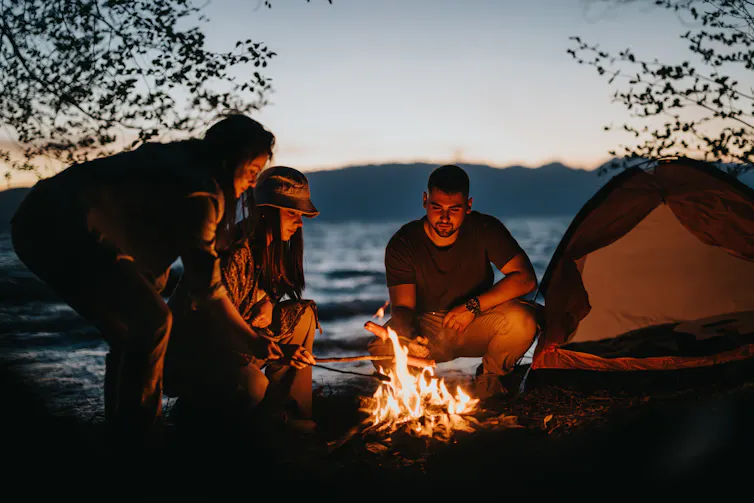
Three adults tend to a campfire
Going back to where the story of human language started. Gorgev/Shutterstock

The article suggests that social storytelling is what enabled us to surpass the communicative abilities of other living apes, into the rich, expressive tapestry of human language. Storytelling aids our social bonds and helps us understand the world and how to behave. It can help us develop our imagination, identities and cultural belief systems.

The idea that language emerged for social bonding is not new; however, the authors of the new article highlight that fireside context might have been crucial. They argue that the colour spectrum of fire is well suited for human vision without suppressing the melatonin that helps us sleep, like modern screen light can.

The study also highlights that human neurons synchronise to the frequency of flickering firelight, which the authors argue can improve shared social experience and bonding through connected rhythmic activities that can promote empathy.

How about storytelling today?

Other research, reviewed in my own work, has shown that stories from our early oral traditions share similar traits to one another. This is thought to happen because the social transmission of stories acts like evolution. Instead of survival of the fittest, we get survival of the most memorable aspects of stories as they are shared. Stories survive when they have more social, human-oriented content, counterintuitive elements, create negative emotions and have elements of survival.

Researchers think this happens because swapping stories about social bonds, unexpected dangers and survival are advantageous for our evolution.

Storytelling is still one of the primary ways we understand the world even now, through the news and social media. This content is full of human interest, negative emotions and surprise.

Storytelling in the modern world is now often about getting the most clicks and attention. It is often about keeping people up past their bedtime looking at the melatonin suppressing blue light of our screens.

I’m left wondering, after reading about the potential fireside origins of our language, that we might feel more connection and trust by going back to sharing stories around a fire.

The Conversation

Hannah Little receives funding from the British Academy and the Royal Society.

  •  

How studying astronauts could help tackle ageing on Earth

Vladi333/Shutterstock

Astronauts who undergo long-duration spaceflight aboard the International Space Station often return with health problems that resemble some age-related conditions in people on Earth.

Remarkably, some of this decline reverses within months of their return but others persist. This raises an intriguing question: what can be learned from these rapid changes and could they help prevent or reverse aspects of age-related decline on Earth?

That question has turned space into a laboratory for ageing research. Spaceflight reproduces many features of ageing. Astronauts also experience unusual conditions, including very low gravity, increased radiation and disrupted sleep. Even so, changes that usually develop over decades on Earth can appear within weeks or months in space, giving scientists an opportunity to observe some ageing-related processes in fast-forward.

A 2026 study, which tracked four astronauts during the nine-day Axiom-2 mission, examined chemical markers attached to DNA that can be used to estimate biological age. This is an estimate of how old the body appears to be based on molecular changes, rather than the number of years a person has lived.

The astronauts’ estimated biological age increased during the mission and began to fall after they returned to Earth. This does not mean that they physically aged by years in a matter of days. With only four participants, the study cannot provide firm conclusions, but it shows how rapidly the body can respond to the conditions of spaceflight.

Why would leaving gravity behind affect the body in ways that resemble ageing? On Earth, muscles, bones, and the cardiovascular system and other organs are adapted to function under the constant pull of gravity. That continual mechanical load helps keep these systems healthy, although their function often declines later in life. In space, many of those demands disappear.

When muscles age in fast-forward

Skeletal muscle provides one of the clearest examples. Astronauts lose muscle mass and strength at a startling rate in very low gravity, even while exercising for around two hours a day to attempt to limit the effects.

Some of the biological processes involved may overlap with those associated with sarcopenia, the age-related loss of muscle strength and mass that increases the risk of frailty, falls and loss of independence.

Scientists are still working out how closely muscle loss in space resembles sarcopenia, because similar effects can arise through different biological processes. The crucial difference is timescale. That compression is exactly what drew our team to space.

Through our UK Space Agency-funded MicroAge mission, we sent lab-grown human muscle constructs to the International Space Station.

These miniature muscles, roughly the size of a grain of rice, were engineered from human muscle stem cells. Using lab-grown tissue, rather than relying solely on the limited number of astronauts available for study, allowed us to compare muscle adaptations in very low gravity with those seen during ageing on Earth. It also allowed us to carry out early tests of possible ways to protect muscle. If some of the same mechanisms are involved in both settings, space could provide a useful opportunity to study years of biological change over the course of months for a single mission.

Our follow-up mission, MicroAge II, will explore the biology of this decline in greater detail. It focuses on mitochondria, the structures inside cells that produce most of the energy those cells need. Problems with mitochondria are recognised as one process involved in muscle ageing on Earth.

MicroAge II will investigate whether similar changes to their structure and function also contribute to rapid muscle loss in space. Why does any of this have significance beyond the space station?

Loss of muscle mass and function is one of the most consequential aspects of growing older. It underlies frailty, falls and the loss of independence that many people fear, yet effective treatments remain limited. Testing potential interventions in populations that age over decades is inevitably slow. Space research will hopefully help scientists identify relevant biological processes and test early ideas more rapidly.

Experiments in space cannot replace final clinical studies involving older people, however. Any treatment suggested by this work would still require extensive testing on Earth to establish whether it is safe and effective but would identify potential drug candidates far more quickly.

The Conversation

Samantha Jones receives funding from UK Space Agency.

Anne McArdle currently receives research funding from the Medical Research Council, the Biotechnology and Biological Sciences Research Council and UK Space Agency.

  •  

Europe’s stone age hunters made sea voyages to Malta – thousands of years before evidence of sails

The ability to cross oceans has long been a marker of human endeavour, but when did the seas change from being barriers to movement into the maritime highways we know today?

For many years the answer was thought to lie in the Neolithic period – the time when humans made the profound transition from hunting and gathering to practising agriculture and living in settled societies.

Our team’s discovery of the presence of European hunter-gatherers on the tiny Mediterranean island of Malta, reported last year, has overturned this view. It showed that people reached Malta from their starting point in Europe (presumably Sicily) at least 8,500 years ago.

In a new study, we show that these populations were engaging in repeated long-distance sea journeys of at least 100km, well before the advent of farming.

Researchers have known that the occasional very ancient sea crossing must have been made. The most famous example may be the colonisation of Australia, tens of thousands of years before the present.

However, sustained, long distance sea voyaging – particularly to small and remote islands – was long thought to have been beyond the capabilities of hunter-gatherers, who are dependant on the bounty, or deprivation, of natural resources.

This was also the case for Europe’s last hunter-gatherers, in the period of time known as the Mesolithic, the era before the Neolithic. During the Neolithic, a new population introduced agriculture to Europe from Anatolia (which comprises most of the landmass of modern Turkey).

Enter the recent findings from the site of Latnija, on Malta. Did the surprising presence of European hunter-gatherers on Malta reflect a one off, accidental crossing – or perhaps people who somehow became marooned on the island? Conversely, was this Mesolithic presence a reflection of something altogether different, and more complex?

Shifting seas

To explore these possibilities, we investigated whether Malta could support a viable forager population size that could have lived in isolation for the 1,000 year occupation of the island during the Mesolithic.

First, we explored the impacts of changing sea levels since the Last Glacial Maximum (the height of the last ice age), from around 21,000 years ago. This was when waters began to rise from their lowest levels of around 130m below modern sea level. By doing this, we were able to track changes in the size of Malta and its connectivity with surrounding islands and land masses.

During the Last Glacial Maximum, Malta was connected to Sicily by a land bridge, and this connection remained as sea levels continued to rise until around 14,000 years ago, when the land bridge began to be inundated. Continued sea level rise meant that within less than a thousand years, Malta had become far smaller and remote from Sicily, needing a long-distance sea crossing for connectivity.

By the time of the Mesolithic occupation, Malta had almost reached its present configuration, with no significant difference in distances to Sicily. Having understood how sea level rise impacted the size and accessibility of Malta, we next explored how its specific ecological conditions impacted its ability to support forager populations. Since hunter-gatherers are reliant on what nature provides, their population sizes have a direct relationship with ecological productivity.

Accordingly, we modelled the relationship between population density among contemporary forager populations and what’s known as net primary productivity – effectively the baseline of wild resources available to hunter-gatherers. We then extrapolated these findings back into the past using high resolution computer models of past climates (palaeoclimate models).

The location of Malta within the Mediterranean sea. NormanEinstein, CC BY-SA

This enabled us to calculate the total population size that could be supported first on the combined landmass of Malta and Sicily, and then as separate islands as sea levels rose.

Our upper estimates for the total population sizes suggest that after the inundation of the land bridge to Sicily, the total population size that could be theoretically supported on Malta dropped rapidly to 319 people by 13,800 years ago.

There is no evidence yet that people were living on Malta this early, but our models showed that any populations present would have continued to drop in size as sea levels rose until around 9,000 years ago, when it could have accommodated around 170-144 people.

Finally, we compared these findings to thresholds, informed by conservation genetic studies, for the long-term viability and stability of a population. These thresholds suggest the need for an effective (reproducing) population size of 1,000 or more, equivalent to a total population size of 2,500-3,000 (because the total population size includes both younger and older people who are not reproducing).

Long distance voyages

This suggests that Malta was incapable of hosting an isolated, viable population that could have lived continuously through the 1,000-year time frame during which it was settled by Mesolithic hunter-gatherers.

Consequently, we can rule out the persistence of a population stranded on Malta as sea levels inundated the land bridge to Sicily. We can also exclude a single, perhaps unintended, voyage leaving marooned mariners on Malta.

The only alternative is that these Mesolithic hunter-gatherers were making repeated, long distance sea voyages between at least Malta and Sicily, the closest land mass, to maintain the genetic connections that ensured at least a millennium of Mesolithic viability on Malta.

These insights are reshaping our perceptions of late European hunter-gatherers and the sophistication of their societies. To maintain repeated, long-distance overseas connections, they must have had, and conserved, an extensive knowledge of land, sea and sky, as well as the technological know-how for building and preserving sea craft.

We don’t know for certain what type of vessels the hunter-gatherers were using, although we know that dug-out canoes existed at this time. The crossings to Malta occurred several thousand years before the earliest evidence for sails – making the achievement even more impressive.

From wayfinding to getting food at sea overnight, they then had to be able to live sustainably on a small, semi-arid island, which required a finely-tuned knowledge of diverse food sources shaped by the seasons.

With these implicit capabilities, we can then start to ask, where else did they go? There is already evidence of connectivity between Europe and North Africa during this time. Previous work using ancient DNA found the distinctive signature of European hunter-gatherer ancestry in people living in pre-Neolithic Tunisia.

All this suggests we may be looking at a hitherto unknown web of overseas links that marked the beginning of the connected world we know today, centuries before the first farmers reached the central Mediterranean.

Understanding how these groups remained ecologically resilient, while also shaping ecosystems to their needs, may yet prove to have important lessons for humanity’s current and future challenges in a rapidly warming world. As we continue to unravel Malta’s unprecedented hunter-gatherer past, we hope to shed light on this lost ecological knowledge.

The Conversation

The authors do not work for, consult, own shares in or receive funding from any company or organisation that would benefit from this article, and have disclosed no relevant affiliations beyond their academic appointment.

  •  
❌