❌

Reading view

AI translators are getting more fluent – but communication is never just a matter of words
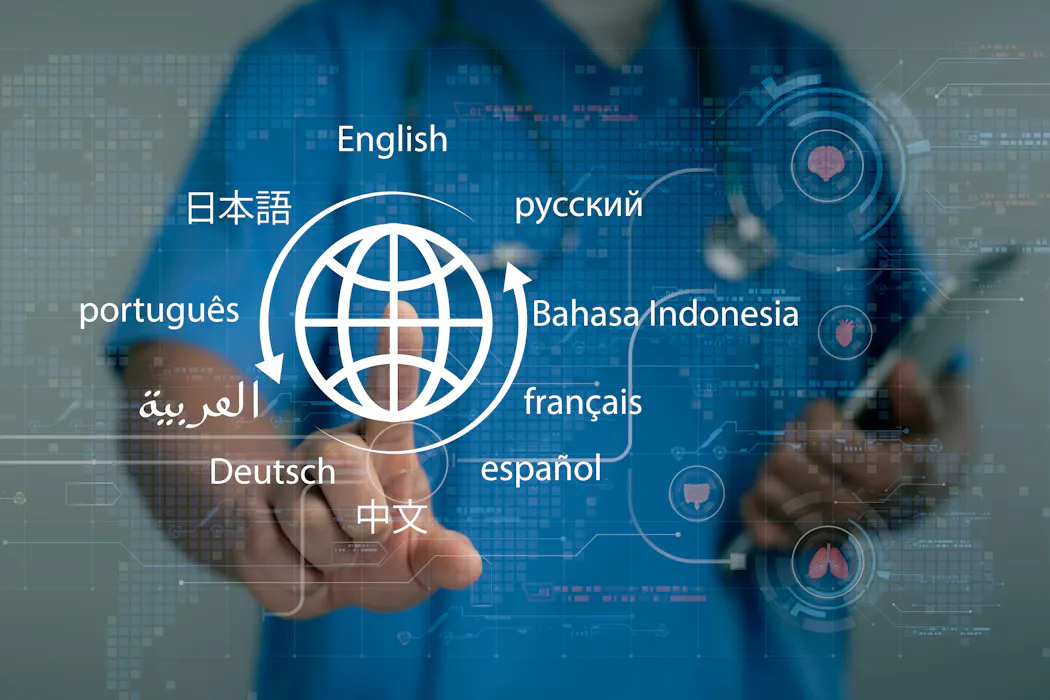
raker/Shutterstock

Speak into a phone and an app can render your words in another language in seconds. AI-powered speech translation can be fast, convenient and fluent. But fluency does not guarantee that people will understand one another.

In the most recent census, 880,000 people in England and Wales (excluding tourists and other short-term visitors) said they could not speak English well, and 161,000 not at all. That’s more than a million residents who may need language support in their daily lives, including when trying to access essential public services.

The linguistic range is vast. London alone is home to more than 250 languages. Tight budgets and a shortage of interpreters for some languages can make it difficult to secure an interpreter with the right dialect and expertise for a pressing legal, health or social care matter.

Notice we say “interpreter”, not translator. In professional language services, translation typically deals with written texts, while interpreting facilitates spontaneous communication between users of different spoken or sign languages, whether face-to-face, by telephone or via video.

In a conversation, each person responds to what has come before and shapes what will follow. Added meaning emerges as they hesitate, restart or refer back to earlier points. Words are only part of this exchange – tone, pace, pauses and non-verbal cues can all shape how an utterance is understood.

Imagine a doctor asking a patient if they have missed any of their treatment sessions. The patient gives a hesitant “no” – perhaps because they are embarrassed, unsure or genuinely cannot remember.

On the surface, this reply sounds simple enough, whether the patient says nie in Polish, hayır in Turkish or hapana in Swahili. But would an AI-powered translation device spot the subtle inference in the hesitation?

AI systems work best when conditions are relatively stable: speech is clear, speakers take turns, and people say exactly what they mean. But human interaction is rarely so tidy.

In contrast, a professional interpreter would almost certainly understand the full meaning and context of this answer. They would preserve the hesitation, flag any ambiguities, and allow doctor and patient to repair a possible misunderstanding before it has any serious consequences.

As researchers in the field of public service interpreting, we are therefore concerned that any increase in adoption of AI translation services is done with due consideration for the skills and sensitivities that could be lost in the process.

Complexities of human interaction

Automated speech translation can offer some practical advantages, including on speed and availability. A 2024 survey of more than 2,500 workers across UK health and social care, legal and emergency services and the police found that a third of them had used machine translation at work.

Such systems use a process in which speech recognition converts verbal communication to text, machine translation renders it in another language, then text-to-speech software produces spoken output in the listener’s tongue.

Yet the appeal of instant solutions can obscure the complexities of human interaction, and the potentially serious consequences for those involved if communication goes wrong. In an asylum interview or a Mental Health Act assessment, for example, a language-related error could significantly affect a person’s health, legal status or liberty.

One approach is to reserve automated speech translation for apparently straightforward interactions. However, even a routine exchange is rarely low risk in some public services: an appointment booking may reveal alarming symptoms; a housing enquiry may uncover domestic abuse; a casual conversation with a social worker may raise a safeguarding concern.

We therefore believe technology should be introduced according to the risks of the specific interaction, with human oversight and a plan for escalation if the level of risk changes.

At the same time, human involvement does not automatically guarantee quality. Good interpreting depends on qualified professionals, effective procurement and public-service staff who know how to work with interpreters. So any responsible approach to language access means investing in both professional expertise and the systems that support it.

Video: Wired.

A hybrid future?

AI speech translation is likely to become ever-more accurate, fluent and useful. It could support qualified interpreters and, when none is immediately available, provide a temporary fallback. Ruling out its use altogether is both unrealistic and undesirable.

The more constructive questions concern when and where it is appropriate; who should supervise its use; when a human interpreter is essential; and who should be held accountable when an AI system causes harm.

It is also important to be realistic about how these systems may perform amid growing linguistic diversity. Some languages, dialects and accents are much better represented in training and test data than others. Research has documented systematic inequalities in language-technology performance worldwide as well as disparities in speech-recognition error rates within a single language.

The risks in public services are therefore uneven. Output for under-represented languages and varieties may be less accurate – and these are often the same languages for which expert interpreters may be unavailable.

As society learns to live with AI, it is important to cultivate communicative environments where technology supports and operates under human oversight, rather than replacing human expertise.

However fluent technology becomes, communication is never simply the transfer of words. Meaning emerges as an interaction unfolds: through what people say, how they say it, what they leave unsaid – and, crucially, their ability to repair misunderstandings.

These are distinctly human capabilities. Any responsible use of AI should strengthen rather than displace them.


AI has long been discussed as a threat to jobs and livelihoods. But what’s the reality? In this series, we explore the impact it is already having on different occupations – and how people really feel about their AI assistants.


The Conversation

Lucas N Vieira receives funding from UK Research and Innovation. He is the author of Translate: Multilingual Access to Critical Services in the Age of AI (Cambridge University Press, May 2026).

Natalia Rodríguez Vicente does not work for, consult, own shares in or receive funding from any company or organisation that would benefit from this article, and has disclosed no relevant affiliations beyond their academic appointment.

  •  

As Larry the cat welcomes yet another prime minister, an expert explains how pets adapt to change

Larry, the Downing Street cat, has had to adapt to seven different prime ministers moving into No 10 over the past decade. Yet while the nation’s attention is fixed on the departing and incoming political leaders, who is thinking about the effect these upheavals might have on one of the property’s most enduring residents?

Cats thrive on predictability and the consistency of their environment is important for their welfare. On the whole cats prefer an unchanging environment. Some cats cope with change better than others. Many cats are distressed by disturbances such as moving house, changes in familiar routines, people moving into or leaving the household, or even changes to the scent of their home environment.

Unlike dogs, cats aren’t obligate social species, therefore may not have such a strong proclivity to form social attachments. However, in certain situations domestic cats can be found living in social groups, particularly in environments with a plentiful food supply.

Some cats enjoy the company of people, while others prefer a more solitary life. This is determined partly by their early experiences. A young kitten that learns in the early weeks of their life that contact with people is associated with nice experiences is more likely to seek social interactions with people as an adult. Kittens raised by mothers who show friendly behaviour towards people can learn to value human company through the process of social learning.

Genetics also influence a cats friendliness towards people. Researchers in a 1995 study found that the kittens of friendlier fathers were more likely to show friendly behaviour towards unfamiliar people even if they weren’t socialised as a new kitten.

Some cats appear to suffer when separated from their caregivers, although some researchers question whether this can be described as a secure attachment (one that is necessary to maintain feelings of safety and security in threatening situations).

Researchers have identified five different forms of cat-owner relationship, based on the level of emotional investment of the owner, the way the cat relates to others, their aloofness and their need to be in close proximity to their owner. These types range from open relationships (characterised by a lightly emotionally invested owner and an avoidant cat) to casual relationships, co-dependence and friendship.

Although the Starmer family has moved out and the Burnhams have taken up residence, Larry’s main caretakers are civil servants, so his day-to-day care won’t change. Larry’s behaviour in recent days (strutting along Downing Street, nonplussed by the comings and goings and embarking on a successful hunting expedition) suggests that he takes such changes in cohabitants in his stride.

Other animals

The new prime minister has a dog called Axel, and although cats and dogs can live together harmoniously and even form close bonds, integrating Axel into Larry’s home might cause tensions if not handled well. However, not even the prime minster would dare to disturb Larry’s position as chief mouser. Andy Burnham has told the BBC he’s not bringing Axel to London with him because he doesn’t think the two animals will get on.

If he changes his mind there are a few things he could do to help Axel and Larry get along. Introducing a dog into a household with a cat should be done gradually, with the aim to prevent any chasing or aggression between the pets.

Before the dog arrives, settle the cat into a safe space, which the dog won’t have access to. This might be a bedroom, bathroom or any part of the house that the cat likes to relax in, ensuring the cat has access to everything they need such as places to hide, litter trays, food and water.

Scent is incredibly important to both cats and dogs, so getting them accustomed to each other’s aroma in the home helps to smooth the introduction. This can be done by introducing bedding or toys used by the other pet, or gently wiping a damp cloth across the body of the pet to pick up their scent.

It’s vital that the first meeting goes well and there are a few things that will help to ensure they get off on the right foot. Make sure the dog isn’t full of energy by exercising them before the meeting. Start with a barrier such as a baby gate between them.

When they first meet give both pets plenty of their favourite food treats, to reward calm behaviour and so that they associate the presence of other with something nice happening.

Signs of stress

Cats can be difficult to read but there are known warning signs of stress in cats. More obvious stress behaviour includes hissing, growling, swiping or puffed up fur. But indicators also include the cat running away or hiding and refusing treats they normally avoid. Flattened ears, dilated pupils, tense body posture and a flicking tail are all signals a cat is feeling tense.

Larry seems like quite an independent confident cat if reports “he has the run of the house” are anything to go by, so it’s likely that he will soon teach the new inhabitants of No 10 how he likes things done.

The Conversation

Emily Blackwell does not work for, consult, own shares in or receive funding from any company or organisation that would benefit from this article, and has disclosed no relevant affiliations beyond their academic appointment.

  •  

Muscle coordination can be mimicked by electric motors – it could lead to improved robots

mybox / Shutterstock

People often take their muscles for granted. They pick up a bag, tighten a grip, climb a hill, hold a cup of coffee and the body quietly adjusts force, speed and position without the person ever thinking about it.

Muscle turns chemical energy into movement. It is able to produce force smoothly and reliably, even though it is built from huge numbers of tiny molecular components. When the load changes, muscles don’t simply wobble or fail. They adapt.

But the way that muscle works on a molecular level isn’t a settled issue. With colleagues, our team at the University of Bristol built a physical model using ordinary electric motors to try and simulate how muscles may perform its tasks.

The results, published in the Royal Society journal Interface, show that the coordination we see in real muscle may simply emerge as a property of their setup. It’s not something you have to programme and police continuously. The findings could even help improve the way that robots function.

If we were to zoom inside a muscle, we would find bundles of smaller and smaller structures. The sarcomere is the key force producing unit. It is made of protein filaments, called actin, and molecular motors called myosin. Together, they form the actomyosin system.

Tiny myosin motors repeatedly grab, pull and release actin cables, helping muscle fibres contract. When you hold a cup of tea, thousands of these motors have to work together to produce a steady force. But there are unanswered questions about this system.

Illustration showing the smallest functional unit of muscle: the sarcomere.

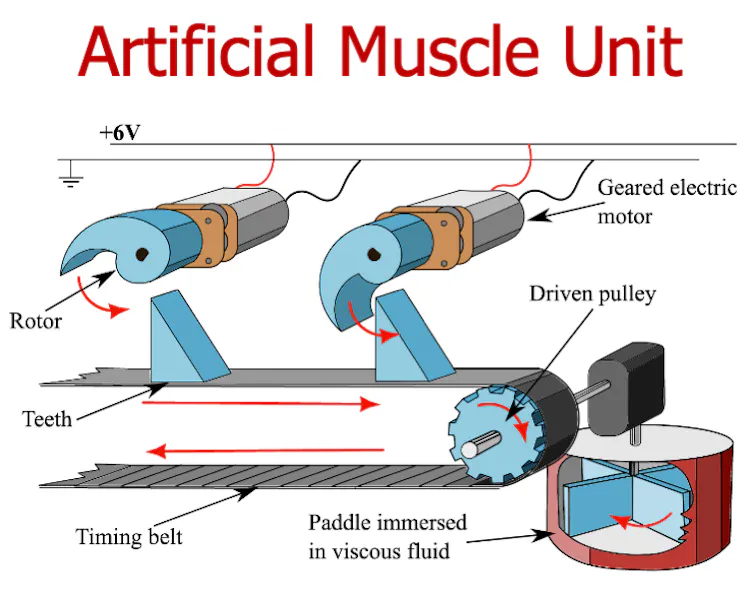
We first devised a mathematical model of muscle. Real muscle motors (myosin) run on a complex chemical cycle, but we didn’t try to reproduce that chemistry. Instead, we represented each force producing unit as something much simpler: a cycling “rotor” (or motor) that can contribute only when it is mechanically engaged to a physical “backbone”. When it is disengaged, it effectively drops out, and becomes isolated from the rest.

To test whether we could translate these ideas to a real physical system, we built a tabletop device: a line of simple electric motors interacting through a shared mechanical backbone. They pulled against a thick fluid, creating resistance similar to the viscous load experienced by biological motors inside muscle.

An illustration of the artificial muscle unit used in the study, taken from https://doi.org/10.1098/rsif.2025.0438

Our physical model produces force when supplied with current. We wanted to see whether, when many driving units were embedded in the right kind of mechanical setting, could the setting organise into coordinated muscle-like behaviour?

In both the mathematical model and the device, the motors don’t stay connected all the time. Instead, each motor briefly makes contact with a shared moving backbone, pushes on it, then lets go. As the backbone moves, it carries the mechanical effects of one motor to the next, allowing them to coordinate without ever communicating directly.

When they are not connected, each motor acts on its own. That single design choice makes the whole network of motors reorganise itself over time – much like biological motors do inside muscle, where motors attach and detach as part of their biochemical cycles.

In practical terms, the scaffold where the rotors live is doing a lot of the coordinating work, but it is hidden. It mediates how units can “feel” one another strongly enough for collective patterns to form.

Even in this stripped-down system, several muscle-like forms of behaviour spontaneously appear. As resistance increases, the motors collectively develop a load-speed relationship. Load refers to the mechanical tension and physical stress placed on the system.

More units end up contributing effectively as the load rises. Their participation increases under increasing loads. We also found that under certain conditions, motion can become jerky. For example, periods of coordinated pulling were interrupted by sudden slips. This echoes patterns seen in real actomyosin experiments.

Instead of everything working in unison, the system can self-organise into travelling waves of coordination, where the pattern moves along the array.

In a loose way, this “scales up” the core idea behind a sarcomere: many force units embedded in a shared structure that transmits forces from one unit to the next, allowing coordination to emerge spontaneously.

Coordinating without a conductor

Muscle isn’t the only place where nature has solved the problem of coordinating many tiny motors. Microscopic flagella are tail-like appendages seen on the cells of some eukaryotes – the group of organisms that includes animals and plants.

Examples of these flagella include the tail on human sperm. Cilia are microscopic, hair-like structures on many eukaryotic cells. Both flagella and cilia are powered by large numbers of molecular motors distributed along a long, slender scaffold.

Bending waves caused by motor contraction in sperm swimming.

Their internal core – the axoneme – is a beautifully organised structure that transmits forces along its length and turns local motor activity into bending waves. Those waves are essential: in sperm they underpin motility and fertility, and in cilia they help move fluids in the airways and other tissues, with clear links to health and disease.

In that sense, flagella are “muscle-like” systems in disguise. You again have drivers (motors that generate force) embedded in a coupling structure (a mechanical scaffold that transmits force and feedback). And the geometry determines how local activity adds up to a coherent, travelling wave.


Read more: The way a sperm tail moves can be explained by mathematics worked out by Alan Turing


If the structure and layout are doing some of the organising work, it speaks to a question that has long intrigued scientists: how evolution builds systems made up of a large number of individual motors that nevertheless coordinate themselves, remain reliable and adapt to changing conditions without a central control system?

Uses in robotics

Our results matter beyond biology. In robotics, getting many actuators (the “muscles” of a robot, which convert an energy source like electricity into motion) to cooperate is challenging and expensive. You add sensors, feedback loops, control algorithms, sometimes even mechanical ratchets or complex gearing to keep everything stable under loads. It works, but it can be fragile and prone to errors.

A compilation of task failures by Boston Dynamics’ Atlas robot (The Independent)

Our physical model of muscle, where coordination emerges as a property of the setup, suggests that simpler actuators for robotics are possible. This is exactly the kind of fundamental design that researchers have been chasing for soft robots (which use flexible materials) and artificial muscles for robotics.

Muscle may be an example of coordination without a conductor. Thousands of molecular motors working together, not because each one is individually controlled, but because the soft structure around them helps guide their collective behaviour.

Our findings suggest that robotics could begin to harness the same principle. In future, this could help bring robotics closer to biology, opening the way to more organic machines, whose bodies help shape how they move and adapt.

The Conversation

This research was carried out by Benjamin Warmington as part of his doctorate under the supervision of Prof Jonathan Rossiter and Dr Hermes Bloomfield-Gadelha at the Polymaths and Soft-Robotics laboratories at Bristol. This research was funded by the Engineering and Physical Sciences Research Council Doctoral Training Partnership (grant no. EP/T517872/1) and carried out using the computational facilities of the Advanced Computing Research Centre, University of Bristol—http://www.bristol.ac.uk/acrc/.

  •  

What really happens to your data when you click ‘delete’?

Roman Samborskyi/Shutterstock

Deletion is a common part of modern life. We send files and folders to the recycle bin all the time, and often get rid of unwanted personal accounts. But do you know what really happens when you hit the “delete” button?

The process of deletion is often poorly explained by tech providers. Lack of transparency around how requests are processed, and the absence of clear confirmation that data has been removed, are frequently highlighted in research.

These issues are not limited to operating systems. On social media platforms and a wide range of subscription services, deletion mechanisms are often just as unclear. Such misconceptions can have serious implications for the wellbeing of users, exposing them to security and privacy vulnerabilities.

A further complication is that many users fear losing data, files, photos and videos through accidental deletion – a condition dubbed “diagraphephobia”. Though this is not a recognised pathology, studies of digital hoarding behaviour show that some people get very anxious at the thought of losing or accidentally deleting personal information such as photos and music.

Such concerns extend the amount of personal data that sits untended but undeleted, ready for potential misappropriation.

Deletion vs erasure

A common misconception is thinking deletion means erasure – the idea that once a deleted item is no longer visible, it has been completely erased with no means of retrieving it. This is largely wrong.

When users delete files – moving them to the trash bin, then deleting permanently – the data isn’t actually erased. Rather, the system marks storage space as reusable and updates metadata to unlink the file. But the underlying content often remains recoverable with the right tools, especially when data is duplicated across multiple systems or devices.

More robust forms of deletion include physical destruction of the storage medium, overwriting the memory blocks with new data to bury the original, or encrypting the data and then destroying the key.

However, such methods can be expensive and may render the storage device unusable (for example, when overwriting data on magnetic media). The characteristics of cloud infrastructure also pose challenges to secure data deletion.

Similarly, content on public social networks may not really be erased after deletion due to replies, comments and internet archives which can all store the posts in some fashion. The meaning of a deleted tweet can, for example, be recreated based on replies and mentions.

Zombie accounts

Another misconception is that deleting an app from a device automatically deletes the associated account. Users often leave mobile app accounts undeleted because they are unaware of their existence, having deleted the related app.

These are called zombie accounts – abandoned profiles for a wide array of services, from shopping and storage to dating, finance and streaming. Millions of users possess zombie accounts, with personal data that is vulnerable to cyber-attacks and data breaches.

The exponential growth of AI raises a further question: can data really be deleted once it has been used to train AI models? Machine learning modules easily memorise the data they have been trained on, but “unlearning” is difficult.

In theory, people in Europe and many other countries around the world have a leagal “right to be forgotten”. This means they can request the full erasure of any personal data a platform or a company may hold. AI developers are considered data controllers under the EU’s General Data Protection Regulation (GDPR) laws, for example, and are subject to this obligation.

However, there are no clear guidelines on how erasure should be enforced within AI systems. Regulators may request deletion, but AI companies can argue that compliance is infeasible on account of technical constraints.

Explainable deletion

To counter the risks posed by incomplete deletion, I believe there is a pressing need for provision of concise, accessible and clear information about how deletion really works.

One potential approach is “explainable deletion” – a protocol developed by Marvin Ramokapane at the UK’s National Research Centre on Privacy, Harm Reduction and Adversarial Influence Online (Rephrain), based at the University of Bristol.

The intention is to make deletion processes more transparent and understandable without overwhelming the user with too much information in one go.

Explainable deletion breaks down information into six categories: what, how, when, who, where and why (see diagram). Each offers a user bite-size information about that part of the process.

Explainable deletion’s six categories:

Graphic showing the six categories of 'explainable deletion' protocol
Marvin Ramokapane and Dana Lungu, CC BY-SA

Explainable deletion is designed to give users control over their actions, the autonomy to choose the deletion type that is right for them, and the assurance that their desired actions have been fulfilled. It may also tackle the anxiety of accidentally losing data by giving options for data recovery.

While explainable deletion has not yet been adopted in practice, service providers – both platforms and developers – could heighten user trust by adopting such protocols. This framework can also be proof of compliance with GDPR regulations and the right to be forgotten.

Most of us use systems that collect and store our data on a daily basis. If these systems clearly explained what they store and what deletion really means, it could help us to spot the accounts and data that pose a real risk – and to take back control of our digital footprints.

The Conversation

Dana Lungu does not work for, consult, own shares in or receive funding from any company or organisation that would benefit from this article, and has disclosed no relevant affiliations beyond their academic appointment. This article draws on research on 'explainable deletion' by the University of Bristol’s Marvin Ramokapane.
  •  

What happens inside a tennis player’s brain as they try to return a 148mph serve?

The fastest serve so far at this year’s Wimbledon tennis championships was struck by the Argentinian Thiago Agustín Tirante on the opening day.

His serve of almost 148mph (238km/h) was still some way under the Wimbledon record of 153mph, set by Frenchman Giovanni Mpetshi Perricard in 2025. And despite Tirante giving his opponent less than a fifth of a second to play each serve, he lost the match in straight sets.

Which means his rocket serves were successfully returned on lots of points. Our emerging understanding of how the human brain works can help explain how this feat is achieved.

Whether you’re a player or a spectator, the ability to see a tennis ball travelling that quickly across the court is a marvel of human physiology. At nearly 150mph, the ball is travelling faster than anyone can watch it move.

By the time your brain has processed the sight of the ball leaving the racket, it is already well on its way to the other end of the court. Yet professional tennis players return these high-powered serves with astonishing accuracy.

The reason is that they do not rely on reaction alone. Returning a tennis serve depends on one of the brain’s most remarkable abilities: predicting the future.

Predicting the future

Tennis players – and spectators – face the same basic problem: the visual information arrives in their brain slightly late.

Before a player becomes aware of a tennis ball hurtling across the court, light reflected from its surface has to be detected by their eyes’ retinas, converted into electrical signals, then transmitted along the optic nerves to the brain. There, the visual cortex begins analysing its colour, shape, speed and direction.

Even under ideal conditions, this takes around a tenth of a second. During that time, a ball travelling at nearly 148mph will have covered several metres.

For a spectator, this delay is rarely noticeable. The brain’s predictions are so accurate that the ball appears to move smoothly across the court, despite what you are seeing being a fraction of a second out of date.

But the player standing at the other end of the court needs to do a lot more than just watch the ball. They must move their body to that specific point on the court, position their racket and time their swing with great precision if they want to be in with a chance of winning the point.

In fact, much of this process begins before the ball has even left the opponent’s racket. It is an extraordinarily complex system.

How the brain works it all out

As the server prepares to strike the tennis ball, the receiver is already gathering information. The height and position of the ball toss, the rotation of the server’s trunk, the movement of their shoulder and forearm, the angle of the racket face and the speed of the swing all provide clues about what is about to happen.

Elite players have, of course, spent many thousands of hours learning to recognise these subtle biomechanical cues. Their brains combine the latest cues with all that previous experience to estimate the likely speed, direction and spin of the serve – before the ball has even crossed the net.

Central to this is the cerebellum, a densely folded structure tucked beneath the back of the brain. Although best known for coordinating movement and balance, advances in brain imaging and computational neuroscience have revealed it is also one of the brain’s great prediction engines.

Rather than simply responding to sensory information as it arrives, the cerebellum continuously generates internal models of how the body and external world behave. As fresh visual information reaches the brain, these models are updated almost instantaneously, allowing movements to be adjusted before conscious awareness has caught up.

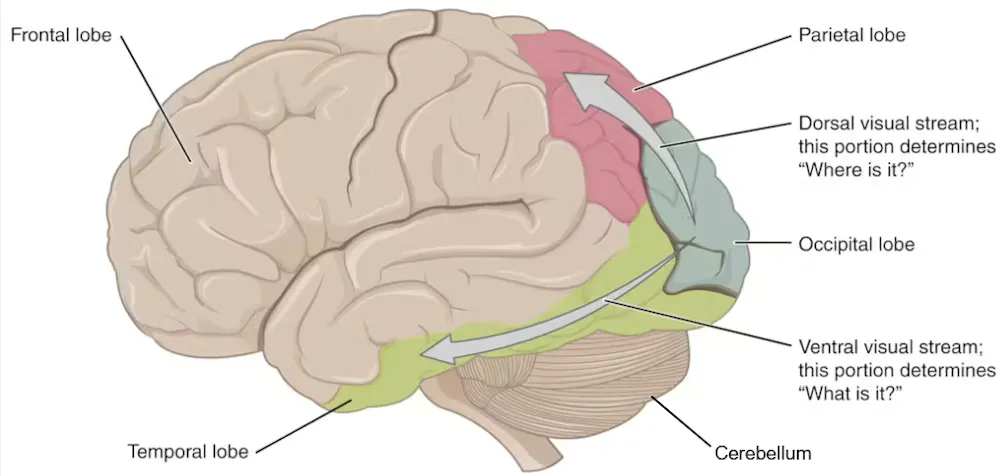
But the cerebellum does not work alone. A specialised region of the visual cortex, known as area MT or V5, is exquisitely sensitive to movement, and calculates the speed and direction of the ball as it crosses the player’s visual field.

This information travels along the dorsal visual stream – often called the brain’s “where pathway” – to the posterior parietal cortex, where the ball’s position is integrated with information about the player’s own body.

The brain’s two visual streams

Illustration of a human brain showing its two visual streams.
OpenStax College/Anatomy & Physiology, Connexions website via Wikimedia., CC BY-NC-SA

From there, premotor regions begin preparing possible movements. The supplementary motor area helps organise their sequence, and the primary motor cortex sends commands to the muscles of the trunk, shoulder, arm and wrist.

At the same time, the frontal eye fields and the superior colliculus (a small structure in the midbrain that rapidly redirects the eyes towards objects of interest) generate rapid eye movements towards where the ball is expected to be next – rather than where it was a fraction of a second ago.

This is why the fastest returns in tennis are not simply feats of lightning-fast reflexes. They are the product of a brain that is constantly making, testing and refining predictions. The players who appear to have more time have become exceptionally good at anticipating what will happen next.

Tennis and beyond

Neuroscientists are still trying to understand why some tennis players acquire these remarkable predictive skills faster than others. Is it simply a matter of hours spent on court, or are some brains naturally better equipped to build the internal models that underpin elite performance?

For now, the answer appears to be a combination of both.

Understanding how the brain predicts movement has implications far beyond tennis. Similar neural mechanisms help us catch a falling glass before it hits the floor, judge when it is safe to cross a busy road, or drive through traffic.

These predictive systems are becoming an important focus of neuroscience research. Insights into how the cerebellum and wider motor networks anticipate movement are helping researchers improve rehabilitation after neurological injury, understand disorders of movement and coordination, and design robots capable of interacting more naturally with an unpredictable world.

Meanwhile, insights from neuroscience might also help hone a future Wimbledon tennis champion.

The Conversation

Michelle Spear does not work for, consult, own shares in or receive funding from any company or organisation that would benefit from this article, and has disclosed no relevant affiliations beyond their academic appointment.

  •  
❌