❌

Reading view

Star Trek at 60: the secret of this pioneering series was its exploration of humanity, not aliens

When Star Trek first appeared on television screens 60 years ago, audiences expected science fiction to offer aliens, monsters and futuristic technology. What they encountered was something far more ambitious.

From its very first broadcast episode on September 8 1966, Star Trek established that its true subject was the exploration of humanity itself. For all its reputation as an action-packed space adventure, the franchise has endured because it repeatedly returned to a universal question: what does it mean to be human?

In that first episode, entitled The Man Trap, the alien antagonist survives by appearing to each observer as the person they most wish to see. Dr Leonard “Bones” McCoy meets a lost love from his past; others see figures shaped by memory, expectation, desire and longing.

The creature, soon dubbed the “salt vampire” by fans of the series, is not simply a shape-shifter. Its power lies in exploiting human perception. Rather than asking viewers to fear an alien with superior strength or advanced weaponry, the episode asks a more profound question: can we trust our experience of reality?

Preview of The Man Trap, the first Star Trek episode to air in September 1966. Video: RetroAlexander.

Sixty years on, this question looks remarkably prescient. Modern neuroscience increasingly suggests that perception is not a passive recording of the external world. According to theories of predictive processing, the brain continually generates expectations and compares them with incoming sensory information.

The philosopher Andy Clark has described the brain as a “prediction machine”. Neuroscientist Anil Seth argues that our experience of reality can be understood as a form of “controlled hallucination”, generated by the brain but constrained by evidence from the senses.

Long before such ideas were articulated, The Man Trap imagined a world in which people confront the same reality, but perceive it in profoundly different ways – based not only on what they see, but what they want to see.

This insight links the episode to a much older intellectual tradition. The ancient Greek philosopher Plato’s allegory of the cave imagined people mistaking shadows for reality, confusing appearance with truth.

The USS Enterprise crew’s first alien encounter offers a 20th-century variation on the same theme. They actively participate in their own deception because the creature reflects their hopes, memories and desires.

This helps explain why The Man Trap feels strikingly contemporary. In today’s world, shaped by algorithmically curated information, political polarisation and increasingly personalised media environments, disagreement is often less about opinions than competing versions of reality itself.

The nature of humanity

Star Trek’s memorable debut was not an isolated exploration of a philosophical problem. It was the beginning of a broader inquiry into the nature of humanity.

The Devil in the Dark (first aired March 1967) explores empathy and the challenge of understanding the unfamiliar. The apparently monstrous Horta is revealed to be an intelligent life-form protecting its offspring, forcing viewers to reconsider assumptions about difference and otherness.

The Enemy Within (October 1966) shifts the inquiry inward, splitting Captain James T. Kirk into opposing aspects of his personality and challenging the assumption that human beings can divide their virtues from their vices.

The episode argues that the qualities that make Kirk an effective leader – courage, decisiveness and resolve – are inseparable from darker instincts such as aggression and desire. Rather than presenting humanity as a triumph over these impulses, the episode suggests that human identity itself depends upon their integration.

The City on the Edge of Forever (April 1967), regarded by many as the series’ masterpiece, shifts the focus to ethics. Kirk discovers that saving the woman he loves would alter history catastrophically, forcing him to choose between personal happiness and moral responsibility.

Together, these and many more of the 79 original Star Trek episodes form a remarkable investigation into human nature. The progression reveals a series less interested in strange new worlds than the human beings who encounter them.

The City On the Edge of Forever is regarded as one of the series’ finest episodes. Video: Robin Sellex.

Philosophical inquiry

While many science-fiction programmes have aged with their technologies, Star Trek has endured because its deepest questions remain unresolved. We still debate perception, identity, empathy, consciousness and moral responsibility, because they are permanent features of human existence.

At its best, Star Trek engaged science fiction as a form of philosophical inquiry. Alien civilisations became thought experiments about prejudice and empathy. Time travel became a vehicle for exploring ethics. Artificial intelligence became a means of questioning consciousness and identity. The future it imagined served as a laboratory for understanding ourselves.

The closing moments of The Man Trap illustrate this perfectly. Reflecting on the death of the salt vampire, Kirk recalls his conversation with the archaologist Robert Crater, who has long been working on the planet, about the fate of the American bison – driven to the brink of extinction by humans.

This comparison transforms what might have been a conventional monster story into something morally complex. The creature is dangerous yet is also the last of its kind. Is it merely a predator, or the victim of a larger tragedy?

The episode, like many others, offers no simple answer. Crater views the creature from a perspective of compassion and preservation. Kirk simply sees an immediate threat to his crew. Both are responding to the same reality, yet they arrive at different conclusions.

The original Star Trek’s lasting legacy is not technological prophecy, but a sustained exploration of what it means to be human. Its enduring achievement lies not in predicting mobile phones, iPads or video calls, but in recognising that the most fascinating and vexing mystery remains humanity itself.

The final frontier, it suggests, lies not among the stars but within ourselves.

The Conversation

Stephen McVeigh does not work for, consult, own shares in or receive funding from any company or organisation that would benefit from this article, and has disclosed no relevant affiliations beyond their academic appointment.

  •  

What makes the ideal digital icon? A psychologist explains

wavebreakmedia/Shutterstock

Digital icons are everywhere – and usually, we interpret these visual symbols in the blink of an eye. Who today doesn’t know that a wastebasket means “delete” and a magnifying glass means “search”?

Yet icons’ meanings can be deeply shaped by culture, experience and technological history. So what seems obvious to one person may be confusing to another.

They were originally designed to make computers look friendlier and less intimidating to the few people who had access to them. For example, the icons below first appeared in 1975 in the Pygmalion visual programming system.

Years later, they attained much wider visibility thanks to the Xerox Star 8010, a pioneering office computer that introduced many graphic interface concepts that are still used today.

Alt text
The Xerox 8010 Star’s icons. stardock.com

Research my colleagues and I conducted examines how people perceive, understand and evaluate digital icons – including which visual characteristics make icons easier to learn and use. Pygmalion’s pioneering icons worked because they relied on existing knowledge of the office world.

This meant they reduced cognitive effort by relying on recognition rather than recall. The icons looked like the physical objects they were representing – and critically, objects the computer’s users were already familiar with.

Five secrets of a good icon

The designer Susan Kare, creator of many of the original Macintosh icons, said a good icon should either be instantly recognisable or so easy to remember that a user only needs to learn it once.

To Kare, designing icons was about solving “the little puzzle of making an image fit a metaphor”. More than 40 years later, that challenge remains.

Research, including work by my colleagues and me, suggests the most successful icons tend to share key characteristics that guide us from seeing to understanding almost instantaneously. Here are five of them.

1. They depict things we already know

Early computer icons worked because they borrowed from the office world that people already knew: folders, bins, documents, calculators, floppy disks. Psychologists refer to those as “concrete” icons because people to use their knowledge of the everyday world to interpret them.

However, only a limited number of functions can be represented as identifiable objects, and getting a close fit between pictures and functions is not always easy. The more complex the meaning becomes, the harder it is to design concrete icons.

To test this, can you guess the meaning of these four icons? (Answers at the end of the article.)

Alt text
Icon credits: Freepik/Flaticon; Kartini 1/The Noun Project; Elzicon/Flaticon; IconPai/The Noun Project.

2. They mean what we think they mean

Psychologists talk about “semantic distance” – how closely an image matches its intended meaning. An abstract symbol for “privacy settings” or “cloud syncing” has a much larger semantic distance than using a bin to mean “delete”.

As digital functions become more complex, designing icons that communicate their meaning quickly becomes increasingly difficult.

3. They feel familiar

Another important feature of successful icons is consistency of use over time – which leads to familiarity. The icons shown below are widely used even though the objects depicted are no longer so widely in use. This highlights the point that icons are partly informative signs and partly shared learned conventions, whose success is based on collective familiarity.

Take the floppy disk “save” icon (below left). Younger users recognise the meaning without ever having seen the physical object that the icon originally represented. The same is true of traditional telephone handsets and perhaps even envelopes (now widely used to denote “email”). While the objects have been superseded, the icons remain.

Alt text
Icon credits: Yogi Aprelliyanto/Flaticon

4. They look good

A well-designed object can have a positive effect on our behaviour – and the digital world is no different. Well-designed icons are more likely to attract downloads, help us perform tasks more efficiently, and learn better and faster. They even make digital environments feel more pleasant to use.

Think of the difference between an app icon that feels cluttered and amateurish and one that looks clean, balanced and professional. Even before we know what the app does, the icon’s design can influence expectations of how well the app will work.

5. They are tested with real users

Although icons and symbols are on the rise as a global visual language, it’s important not simply to assume that icons work globally – and to understand what makes a good digital icon across languages, cultures, ages and digital experiences.

This is why the International Standards Organisation (ISO 9186) demands comprehensibility testing – because symbols should be understood without explanatory text whenever possible.

A bridge between perception and meaning

As we spend more of our lives in digitally mediated environments, icons do two jobs simultaneously. They help us interact with technology more efficiently, and shape how we feel about the experience.

A digital icon is not simply a small picture. It is a bridge between perception and meaning. The best icons make interfaces feel less intimidating, more intuitive and more approachable – creating a global visual language that crosses barriers of language and culture.

In other words, good icons do more than help us find our way around a digital world. They help make that world feel understandable, welcoming and human.

Icon quiz answers: 1. cloud syncing; 2. privacy settings; 3. algorithmic recommendations; 4. generative AI.

The Conversation

Irene Reppa does not work for, consult, own shares in or receive funding from any company or organisation that would benefit from this article, and has disclosed no relevant affiliations beyond their academic appointment.

  •  

Birds masturbate, and that’s perfectly normal

mycteria/Shutterstock

For captive animals, engaging in natural behaviour is a pillar of the animal welfare framework. But when it comes to sex, one important behaviour has been largely ignored, and sometimes even punished: masturbation.

Solo sex is surprisingly common across the animal kingdom. It is well documented in primates. Tortoises are surprisingly vocal during their solo lovemaking endeavours, if not very graceful. Camels masturbate by rubbing their penises in the sand and porcupines make inventive use of all sorts of objects.

Our new study could change how other scientists view masturbation in birds and improve their welfare.

Masturbation also seems to be common in birds. A quick internet search brings up an abundance of video clips on social media and dedicated posts on bird-keeping forums, largely from worried or bemused hobbyist bird keepers.

It has often been treated as an abnormal problem behaviour in captive birds (particularly parrots). Folklore husbandry has assumed it is the undesirable outcome of stress, bad health or poor environment. Bird keepers often therefore discourage masturbation via punishment or veterinary interventions such as diet or care changes and, sometimes, even drugs and surgery. Despite the welfare implications, masturbation in birds had been largely unexplored by the scientific community.

We set out to change that, by investigating the distribution and evolutionary history of masturbation in birds for the first time. We studied 120 species of bird across 22 major groups, gathering data from the scattered scientific literature, online reports and community forums, and surveys of bird experts.

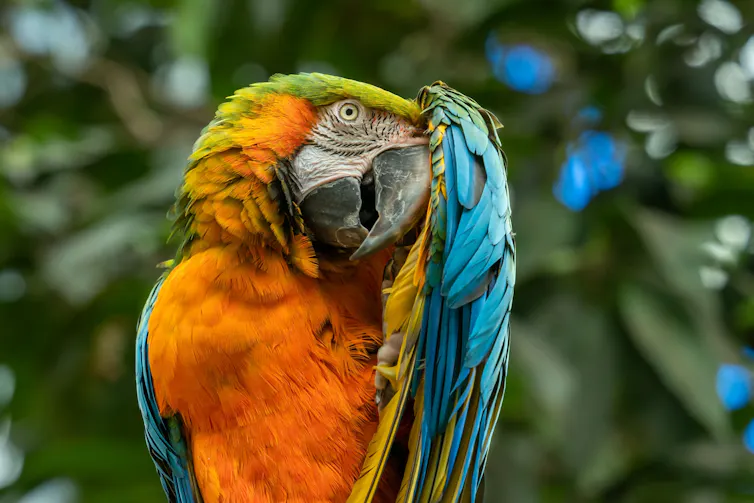
Colourful parrot ducks behind wing.
There’s no need to shame parrots for solo sex. Wirestock Creators/Shutterstock

Our study found that masturbation is widespread across birds with a strong evolutionary history, meaning that it’s an ancient trait probably similar in closely related species. Although we found more records of masturbation in male birds, it occurs in both sexes and across all age groups.

Solo sex also seems to be linked to species that mate with multiple partners, supporting the idea that it might help to increase reproductive success when there is a high degree of competition over fertilisation. For instance, in males it may flush out old sperm to leave newer (better condition) sperm for mating. In females it may increase sexual arousal to help with sneak mating with males other than their partner.

Wild behaviour

Crucially, we discovered that masturbation is actually less common in captivity than the wild, and more common in birds reared by their own parents than by humans. What this tells us is that masturbation in birds is neither an unnatural behaviour, nor a consequence of captivity. Given this finding, it is important that birds are not prevented from masturbation. Of course, as with any behaviour, there may be extreme cases where chronic masturbation could indicate underlying health or husbandry issues.

Avian self-pleasure is usually a rather inelegant affair, in which a bird rubs their cloaca (a shared orifice for both excretion and reproduction) against an object, like a branch, twig or toy. This is often accompanied by a lot of flapping and self-satisfied vocalisation.

One potential reason for the lack of scientific studies exploring avian masturbation may be because the cloaca is thought to have fewer nerve clusters, and therefore lower sensitivity, than our own genitals.

Clearly however, birds are getting some satisfaction from masturbation, so perhaps there is more to a bird’s sensations during sex than has previously been recognised. Further exploration of this could have important implications for both welfare and captive breeding programmes. While sexual pleasure may not be exactly the same experience as for mammals, it is wildly premature to dismiss the idea that birds also feel pleasure.

The Conversation

The authors do not work for, consult, own shares in or receive funding from any company or organisation that would benefit from this article, and have disclosed no relevant affiliations beyond their academic appointment.

  •  
❌