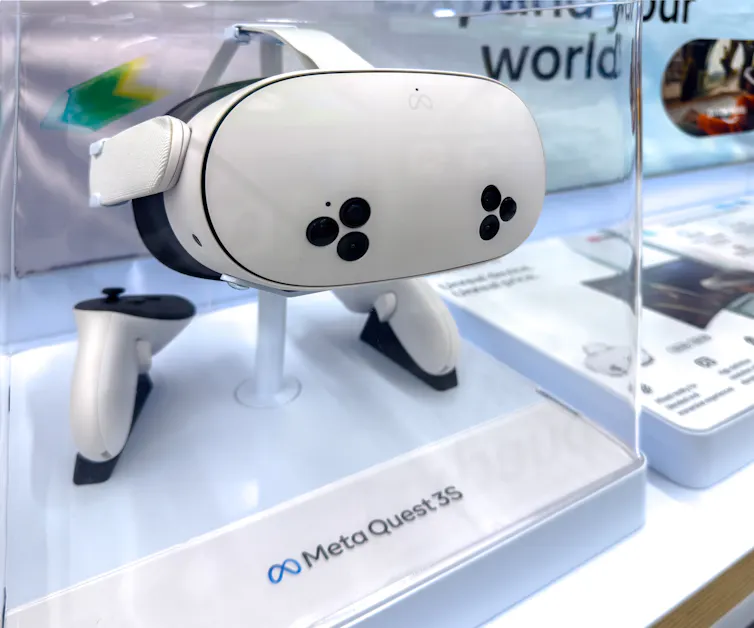
Two years after releasing its last virtual reality product, Meta has announced plans to release virtual reality (VR) glasses. They are due to reach the market in spring of 2027.
With a lightweight and stylish form, the glasses could be the tipping point for mainstream VR adoption. Interest in virtual reality waxes and wanes. Versions of the technology have been around since the 1990s, but VR only really broke through at consumer level when Meta’s previous incarnation Facebook released Oculus Quest in 2019 (the company had bought Oculus five years earlier).
VR got off to a great start, perhaps one of the very few technologies to benefit from COVID and lockdowns. Steady sales of Quest upgrades now mean Meta has shifted 20 million VR headsets worldwide to date.
That’s where the good news for VR ends. The market decline became visible in the first quarter of 2024, when Apple’s Vision Pro proved to be a rare and expensive flop for the Mac and iPhone manufacturer. After selling 390,000 initial units worldwide, it could muster only 210,000 more after a muted chip upgrade.
When we drill into the overall numbers of active VR users, we find a curious statistic. Released in 2020 and discontinued in 2024, the Quest 2 is still the most widely used VR device in the market.
This is strange, considering there have been several updates since: the Quest Pro, Quest 3 and Quest 3S. It seems that once early adopters, gamers and enthusiasts had the technology in their hands, they were reluctant to upgrade.
Newer headsets offered higher resolution and faster processing, but the advances were incremental rather than Earth-shattering. At £3,495, the Apple Vision Pro’s poor sales showed that gamers were reluctant to part with more than the price of a games console.
As VR sales plateaued, Meta moved away from headsets. Starting in 2023 it partnered strategically with fashion brands like Ray-Ban and Oakley for its augmented reality, AI-powered product, Meta Glasses.
Introducing Meta’s VR glasses (Meta).
It was a smart move. Such accessories have been controversialdue to privacy concerns over their ability to record video without other people knowing. But smart glasses have become must-haves for influencers and social media content creators. With marketing focused on jet-set activities, Meta Glasses have taken the device category out of the basement and onto the catwalk.
With the announcement of Meta VR Glasses, the company is positioned to rebrand VR as sexy and stylish, focusing on media consumption rather than gaming. Crucially, they’re glasses, not a headset. They’re part of the already buoyant “wearables” niche now. That is, smart accessories like watches, rings and spectacles.
Fancy ski glasses
The Meta Quest 3, released in 2023, is five times heavier than Meta VR Glasses. The company’s engineering feat in making the new product so light has partly been accomplished by shifting some computing power into an accompanying brickette that Meta calls a “puck”. It’s essentially a computing core (powered by a Qualcomm Snapdragon processor) and battery, connected through a fibre-optic cable.
Weighing 300g, the puck reduces the headset to a stereoscopic display resembling a fancy pair of ski glasses. The glasses – which weigh just 100g – can be worn for hours at a stretch, according to Meta, with a battery that can manage three hours of continuous high-resolution media playback.
The new glasses are a far cry from Meta’s Quest series of VR headsets.Habanero Pixel
The device will run Meta Horizon OS (operating system) and have access to a huge, existing catalogue of games, apps and experiences. However, it’s not positioned as a VR headset to rival its Quest precedessors. Instead, the new glasses are touted as a device for watching movies, attending live events, and replacing monitors. They will let users interact with multiple computer screens in their own environment, blending the real and virtual worlds.
So far, so similar to the Apple Vision Pro. And while the US$1,299.99 (around £1,000) price point is a little kinder on the wallet, we’d be missing the point if we didn’t ask: what do Meta VR Glasses have that the Vision Pro doesn’t? Or, for that matter, any number of products from other developers, like the HTC Vive Flow or Xreal One Pro.
Well, aside from the weight, price, back catalogue and the sleek good looks, there’s a massive, crucial difference. Meta VR Glasses have a ready-made audience. Meta has carefully incubated this demographic since 2021, developing AI glasses alongside its VR headsets.
Meta’s smart wearable and VR headset categories are beginning to converge.Columbo.photog
Partnerships with fashionable brands have enabled it to sidestep the “ick” of early VR. Mark Zuckerberg’s disastrously awkward demonstration of VR platform Horizon Worlds in 2022 failed to sell the Quest Pro to the mainstream, but Meta AI Glasses continued unharmed and unhindered.
In fact, while the VR market has grown little recently, a 2026 report by the research company Omdia found that the smart glasses market expanded by 322% in 2025. Meta accounts for 85% of that global market. Now the two streams are about to converge.
And though there’s no Ray-Ban version of Meta VR Glasses yet, the device will launch with significant partnerships. Disney+, Prime Video, YouTube, ESPN and Imax are among those already announced. Could this finally be the tipping point for widespread VR adoption?
It’s not yet the holy grail – a hassle-free pair of glasses that wearers can just toggle into VR mode – but it’s a distinct step along the way. Crucially, it unites loyal followers from both sides of the style divide: the chic and the geek.
Karl Hodge does not work for, consult, own shares in or receive funding from any company or organisation that would benefit from this article, and has disclosed no relevant affiliations beyond their academic appointment.
Did you click on this article out of your own free will? Or was it predetermined by the cosmic evolution of particles, unfolding in an unbroken chain reaction set in motion by the big bang? Perhaps you think random quantum processes or unconscious brain activity were responsible? Whether you are philosophically inclined or not, the topic of free will is something most of us have pondered at some stage.
Research has shown that people tend to believe in free will, at least in some form. A more important question, perhaps, is whether it matters. This is the exact conundrum that researchers in psychology and experimental philosophy have been trying to answer recently. What would ultimately happen if people gave up on the idea of free will?
It may seem like a dangerous idea; something that could result in chaos and depression. And indeed, research has largely found that when you manipulate people to doubt free will, bad things happen – including an increase in behaviour such as cheating and aggression. This suggests that even if free will doesn’t exist, as many scientists and philosophers assume, it might be better for us to pretend that it does. But newer research by me and others suggests that doubting the existence of free will may not have such bad consequences, after all.
Philosophers have argued for centuries about what free will is and whether we have it. Positions vary widely, and it is impossible to give the subject full coverage here. At one end of the debate are libertarians, who contend that at least some of our choices and actions are not causally determined. At the other end are hard determinists who argue that every thought, action or event is a result of past events and the laws of nature.
When people talk about a disbelief in free will, determinism is usually the position that springs to mind. Yet, determinism is one of many positions within a family of views that dismiss the notion of free will. A position that has emerged more recently is called free will scepticism. While this position rejects the idea that humans possess genuine free will (but not necessarily agency), only some sceptics reject it because of determinism, while others argue that free will is impossible in an indeterministic or random universe.
But whichever tribe you identify with, what are the actual consequences of your beliefs? Before looking at some of the issues with recent experiments, let’s first explore how researchers began manipulating beliefs in the first place.
The Insights section is committed to high-quality longform journalism. Our editors work with academics from many different backgrounds who are tackling a wide range of societal and scientific challenges.
The benefits of believing in free will
The first piece of research to experimentally manipulate free will beliefs was conducted by Kathleen Vohs and Jonathan Schooler in 2008. This work, which is now a seminal paper in the area, comprised two experiments. In the first experiment, the researchers asked participants to read text taken from Francis Crick’s classical book The Astonishing Hypothesis. Participants were allocated to read either an anti-free will version or a neutral one.
In the group that was manipulated to not believe in free will, the text stated that free will was illusionary and behaviour was driven by unconscious brain activity. For example, the text included sentences such as “everything people are and do is the product of simple, physical processes in their brains” and “although we appear to have free will, in fact, our choices have already been predetermined for us and we cannot change that.” In the control condition, the text did not mention free will and instead discussed research on consciousness.
After reading the text, all participants completed a mental-arithmetic task on a computer. They were told that a “programming glitch” meant that the solutions/answers to the task that they were meant to solve themselves would be visible. Participants were therefore encouraged to press the spacebar, which would ensure the solutions remained hidden. Therefore, whether or not participants decided to keep the answers hidden was used to indicate cheating.
The researchers speculated that those reading the anti-free will text would press the spacebar less so than the control condition. And this is what they found. To confirm these findings, they ran a second experiment with some slight methodological changes. This second experiment essentially found the same thing: participants made to disbelieve in free will cheat more.
This paper led to a proliferation of studies seeking to examine other outcomes associated with free will beliefs. Roy Baumeister and colleagues investigated the link between the belief in free will and aggressive behaviour. After a free will belief manipulation, participants completed a cooking task and were told that the individual they were preparing food for disliked spicy food. Therefore, the amount of hot sauce administered by the participant served as the measure of aggression. Consistent with the researchers’ prediction, participants whose belief in free will had been weakened slathered on more hot sauce. The researchers therefore concluded that belief in free will is related to aggression. That said, they only looked at the direct consequences of manipulating people doubt free will rather than capturing the exact thought process of why they used more hot sauce.
The consequences of this programme of work were clear: if we make people disbelieve in free will, negative outcomes will follow. Consequently, even if we believe free will is an illusion, people should be shielded from this information as a society. However, there are some issues with these manipulation studies and the catastrophic conclusions derived from this line of research.
Are these conclusions premature?
An important issue concerns the beliefs that these manipulations are targeting. As mentioned earlier, many arguments against free will exist, and each argument aligns itself to a different philosophical position. The texts given to participants typically make claims related to the inevitability of events, the nature of science and the role of consciousness.
They are an amalgamation of philosophical positions that have their own ramifications. One idea that is commonly used in manipulations is the suggestion that people’s thoughts, desires, and wills are ineffectual – that the brain prepares for action before we consciously decide to do something. So when you reach for that chocolate bar at the end of a hard day, it’s not a result of conscious choice – unconscious brain processes are entirely to blame.
But this is not the only way think about a lack of free will; and it’s not something a sceptic would endorse. Many sceptics believe that thoughts and desires do influence how people behave but, importantly, the cognitive processes that underlie them (including genetics and past experiences) are either determined or due to chance. This suggests your desire was at play when you ate that chocolate bar – you can have agency without having full, God-like control deserving of ultimate moral responsibility. In this view, free will is more of a metaphysical concept whereas agency is involved in day-to-day events.
This is an important but subtle difference. Telling people that their thoughts have no say in what they do might lead to feelings of demotivation, disillusionment and alienation. It may even lead them to immoral behaviour. But these consequences are likely a result of far-fetching, dramatised arguments that pose direct threats to agency, and not a general, sceptic approach.
Suppose the manipulations do weaken belief in free will, but only according to a sceptical position that maintains some belief in agency. Will it still lead to dramatic, abhorrent outcomes? Recall that the experiments with the mathematical task, with cheating behaviour represented by the number of keypresses that did or did not occur.
The most that can be concluded from this experiment is that weakening belief in free will can influence cheating in a fictitious mental arithmetic task. The study did not find a relationship between belief in free will and other, more socially relevant, ways of deceptiveness, such as fraud, infidelity, academic dishonesty and so forth. To assume people cheating in a controlled laboratory experiment, which has no real-life consequences, would also commit these other forms of cheating appears far-fetched.
Similarly, the cooking study showed that beliefs about free will can affect how much hot sauce participants allocate in a laboratory setting. It is possible that the same manipulation could also increase verbal hostility or confrontation, and perhaps even aggression or threatening conduct. However, these conclusions remain completely speculative – we just don’t know.
For argument’s sake, let’s assume that they do lead to bad things in real life. We may still question just how meaningful the findings are. Researchers talk a lot about the “effect size” of a finding, which basically tells us the magnitude or size of the effect. A large effect size indicates a finding has practical significance, whereas a small effect indicates limited practical application. Researchers obviously strive for the former.
To get a sense of the effect size in free will belief research, a 2022 paper reviewed studies administering manipulations to free will beliefs. It found that these manipulations only had a small effect size. What’s more, it showed that the strongest effects happened directly after the manipulation instead of at the end of the experiment. This indicates that manipulation effects may not only fade after the experiment, but wane over the course of the experimental session – we don’t think about whether we have free will constantly. Not only that, but the review found that changes in free will beliefs did not have any meaningful, lasting change in behaviours.
A final issue has to do with replication, the confirmation of scientific findings in other studies. Whether a finding is replicated is one of the major principles in science. Repeating an experiment and consistently finding the same thing can increase confidence about an initial finding. And a replication crisis has recently engulfed psychology.
This is also the case for free will research. For example, some researchers have failed to change participants’ belief in free will. Others, despite successfully changing free will beliefs, have found difficulty replicating the consequences. For example, one study could not replicate the findings regarding cheating on the mathematical task. These difficulties question the credibility of the original findings and pose serious challenges to the assumption that negative consequences come about from a disbelief in free will.
Can a disbelief be good?
We have seen different reasons why it may be premature for researchers to conclude that disbelieving in free will has negative consequences. But we may also question whether these negative outcomes are to be expected anyway, and whether adopting a sceptical position can actually have societal benefits.
One view is that beliefs about free will make no difference to how people think and behave. Think about meaning in life, something which research has supposedly showed to be weakened by a disbelief free will. Imagine that a person’s meaning is strongly attached to their career. This person harbours the ambition to become a lawyer and after years of dedication, finally achieves her dream. Would the belief that she lacked free will affect her meaning and how she perceived this success?
Not necessarily so. She was still the one that got up early, arrived home late and dedicated hours to studying. The pride in her accomplishment does not evaporate in the knowledge that she was not the ultimate controller. She may be thankful for her upbringing, the education she received and her family support. There can still be meaning and gratitude. People ascribe meaning to all sort so things – intelligence, athleticism and beauty – none of which have got anything to do with free will.
What’s more, I conducted a study that specifically looked at meaning in life across people holding a range of views about free will. One group read a text passage denouncing free will (a traditional free will disbelief manipulation); and a second read neutral text (a control condition). I also had a third group which did not receive a manipulation but was selected by identifying as free-will sceptics.
All participants reported on how meaningful their life was. As would be expected, those manipulated to disbelieve in free will showed lower meaning than the control, supporting previous studies. But crucially, the sceptic group had the same sense of meaning and purpose as the control.
This indicates that, as suggested earlier, the manipulations claiming to make people doubt free will are not doing so in accordance with a sceptical perspective. More importantly, this suggests that the meaning in life of people taking sceptic views is unaffected by their philosophical position.
Further supporting this, a 2024 paper examined the views of free will sceptics exclusively and found that 41% (out of 164) claimed that their disbelief had no effect on their life at all. And the most reported consequences were indeed positive, including having compassion for others, being less controlling and more relaxed.
Does this mean a sceptical position could in fact provide societal benefits? One of the most debated consequences of free will beliefs concerns morality and responsibility. In the current legal system, retributive punishment is predicated on the assumption that the criminal was morally responsible for their action and acted out of their own free will. Supporting this view, research has found that participants with a stronger belief in free will are actually less empathic towards wrongdoers, and hand out harsher sentences. Yet, if free will does not exist, it would seem unduly harsh to punish an individual based on an act they were not responsible for.
Gregg Caruso and Derk Pereboom are prominent free will sceptics who question the morality of punitive decisions. They suggest that instead of punishing people because they are morally responsible for their actions, more empathetic, non-punitive approaches can be adopted in line with sceptical beliefs. For example, their quarantine model seeks to isolate offenders and provide rehabilitation until they no longer pose a risk to society – regardless of their level of responsibility. Seen in this way, a disbelief in free will could potentially overhaul a legal system that’s at odds with the view that free will does not exist.
Holding the belief that people can freely determine their circumstances may also lead to other harmful outcomes, such as social inequalities, injustice, a lack of empathy, hatred and victim blaming. For example, a belief in free will can promote the idea that poor people are somehow deserving of their abhorrent conditions and are living in situations of their own making. These perceptions can change if the notion of free will is relinquished. Because people are not morally responsible for their own situations, a greater deal of compassion and empathy could be shown towards those underprivileged. So there could indeed be positive outcomes of declining to believe in free will.
Researchers have claimed that making people disbelieve in free will can have dramatic negative consequences. A disbelief in free will may indeed lead to bad things; however, due to various methodological issues, it is premature to make this conclusion. In fact, it could turn out that disbelieving in free will is actually a good thing.
To hear about new Insights articles, join the hundreds of thousands of people who value The Conversation’s evidence-based news. Subscribe to our newsletter.
Tom St Quinton does not work for, consult, own shares in or receive funding from any company or organisation that would benefit from this article, and has disclosed no relevant affiliations beyond their academic appointment.

 Login