❌

Reading view

A Chatbot-Free Childhood Will Be a Status Symbol

The human brain has evolved to learn from specific instructors. When a child hears a gentle spoken word or a soothing lullaby from another person, when their cry is responded to, their brain lights up. Nurturing interactions, or what child-development experts call “serve and return” exchanges, help shape and strengthen the 1 million new neural connections taking place in a child’s brain every single second. Every time a child cries or serves up a bid for attention and receives a caregiver’s response, that back-and-forth helps build the circuits underlying their communication, learning, and emotional well-being. No other input, not even Johann Pachelbel’s Canon in D performed by the Berlin Philharmonic, is capable of activating the neural circuitry the way human interaction does.

Until now. Generative AI may be the first technology in history sophisticated enough to mimic the social interactions that build our brains. Research has demonstrated that infants as young as six months old respond physiologically to interactions with humanoid robots in ways that mirror their response to live humans; another, small-scale experimental study recently found that, after young children interacted with a chatbot, most of them for the first time, they asserted that the AI could perceive the world with humanlike senses and understand and learn as people do.

This technology is already showing up in children’s lives. The talking plush robot that purports to be a child’s best friend is obviously driven by AI, but many parents may not realize that their Amazon Echo recently received a software update that converts the Alexa voice assistant into a full-blown chatbot, using the same fundamental tech that fuels ChatGPT; toddlers asking for information about animals or a joke or a bedtime story may quickly find themselves in the habit of engaging socially with a large language model.

As a pediatric surgeon, researcher, and technologist who has spent decades studying how children’s brains develop, I am concerned about these technologies rolling out and being used by children in the home and at school before we have a full sense of their safety and what they do to young minds. And I am compelled to point out what we do know about human development: that human connection, in all of its imperfection, is foundational to brain development. It can’t be engineered or recovered later.

When a disruption as significant as the AI revolution occurs, people might look for a comparison to make sense of the transformation. In this case, many people instinctively think of social media. After all, it, too, amounted to a large-scale technological experiment that produced unexpected problems that we are still attempting to fully comprehend. But even that comparison is insufficient, because interactive AI—and its ability to mimic the serve-and-return exchanges that wire developing brains—is utterly, fundamentally different from every consumer technology that came before it.

During the most foundational period of brain development, social interaction of the sort that AI can now emulate isn’t entertainment for the developing brain. It’s nutrition. Once you see it that way, the right parallel snaps into focus. A more apt comparison than social media is food—more precisely, processed food.

[Read: Coke, Twinkies, Skittles, and … whole-grain bread?]

For a long time, no one needed to specify that food was farm-raised. The alternative didn’t exist. Food was grown on farms and in gardens and was prepared in homes and in kitchens. But in the late 19th and early 20th centuries, that changed. Food production was industrialized, transformed by genuinely beneficial innovations such as canning, refrigeration, preservation, and mass distribution. Real and urgent problems were addressed: Growing cities were fed, harsh winters became less lethal, life expectancy increased, and kids grew taller and lived longer.

But in the early days, food manufacturers were conducting their own uncontrolled experiments. Preservatives and additives flooded the food supply as companies adopted solutions that they promised were safe: morphine in cough syrup, chalk in milk, formaldehyde in meat. A government chemist, Harvey Washington Wiley, recognized that these evidence-free innovations posed a threat to public health. To prove this, Wiley recruited a cadre of young men willing to eat meals laced with those very preservatives while scientists observed the effects. The suffering of this so-called Poison Squad helped spark the Pure Food and Drug Act of 1906.

[From the February 1909 issue: The food of the city worker]

We’re in a modern Wiley moment. Innovations in artificial intelligence are delivering very real benefits to today’s families: diagnostic aids that catch developmental delays earlier than human screeners likely can, real-time translation tools that allow non-English-speaking immigrant parents to engage with their children’s teachers, productivity apps that reduce the administrative burdens weighing down many parents and educators. But these innovations have also unleashed obvious dangers: teddy bears that describe sexual kinks or teach toddlers to light matches, AI-generated videos that highlight made-up letters and words.

Despite these dramatic examples of AI gone wrong, the real danger—as demonstrated by our food supply—is what happens when these systems work exactly as designed.

By the mid-20th century, food companies had discovered something more profitable than feeding people: engineering the desire to keep eating. They hired scientists—chemists, flavor engineers, behavioral researchers—to find the precise formulas that would override the body’s natural signal that said “enough.” They discovered the “bliss point”—the precise combination of sugar, fat, and salt that maximizes pleasure in the human brain—and engineered foods to hit this target. They began producing what is now often called ultra-processed food.

This new food looked like its more natural predecessors. It came in familiar shapes. It sat on the same shelves. But something fundamental had changed. Although some ambiguities and controversies surround what foods fall into the broad term ultra-processed—in some respects, it’s a fancy way of saying “junk food”—many of these items are filled with additives and are engineered to be easy to eat and digest in large quantities. They may use hyper-palatable combinations that have been engineered to light up our brain’s reward systems. How could natural foods compete with that?

In short: They couldn’t. Whole foods slowly disappeared from our diet. Today, the average American receives 55 percent of their daily calories from ultra-processed foods—items that didn’t even exist a century ago. For children ages 1 to 18, the number is close to 62 percent. The amount of calories that adults consumed from whole foods decreased from 32.7 to 27.4 percent from 2001 to 2018, according to the CDC’s National Health and Nutrition Examination Survey. According to a 2021 CDC analysis, nearly a third of American children ages 1 to 5 didn’t eat fruit daily, and nearly half didn’t eat vegetables daily. More than half drank sugar-sweetened beverages weekly.

Food companies developed truly remarkable innovations to solve very real challenges. But with those innovations in hand, they also set out to grow revenue. The same market logic is now being applied to our interaction with tech. The underlying capabilities of AI are remarkable, but they can also be formulated to optimize for engagement.

At a glance, a child talking to an AI companion looks like a child participating in conversation. But essential, quiet interactions have been stripped away. Imperfections, delays, and the need to apologize or rephrase something may seem like flaws in human communication, but they are, in fact, crucial developmental building blocks. The small cycle of rupture and repair that occurs following a misunderstanding, played out thousands of times over a childhood, is how resilience, flexibility, and emotional regulation get built. It’s how children develop the most important relational skills: trusting that relationships can survive conflict, and staying connected with others through discomfort.

[From the December 2025 issue: The age of anti-social media is here]

Remove the friction from childhood, and the social-emotional system never gets what it needs to properly develop. The neural architecture that was supposed to be built through imperfect, sometimes-frustrating human interaction may never fully form. Neither may frustration tolerance, empathy, or resilience. Cognitive skills may suffer too. Developmental scientists have long understood that children learn and grow by encountering tasks just beyond their current ability. This is called the “zone of proximal development,” and AI systems designed to meet a child exactly where they are risk denying them the opportunity to ever reach that zone.

Because AI companions have been engineered to remove every imperfection—the misunderstanding, the delay, the repair—a child’s social-emotional system never has to work. Ultra-processed foods stripped the fiber from diets, and engagement-optimized AI might strip the friction from childhood. The developing mind, like the gut, needs resistance to grow. Friction isn’t an obstacle to development; it is development.

Not everyone will be equally affected by the rollout of this new technology. People who have very low food security consume roughly 3 percent more ultra-processed food than those who have high food security do, in part because the cost for each calorie of unprocessed foods is more than 2.5 times that of ultra-processed foods. However, high-income families began pivoting away from ultra-processed foods as soon as the potential harms of such foods became apparent. “Clean” ingredients, minimally processed foods, and organic produce became available—and affordable—to those with resources. An “organic” diet became a status symbol.

[Read: The best parenting hack is being rich]

An identical pattern is emerging with AI. Many of the engineers and executives building these products are going screen-free at home and doubling down on unstructured play. Jack Clark, a co-founder of Anthropic, told Ezra Klein earlier this year that the idea of his young daughter having “unfettered” access to the YouTube algorithm “freaks me out.” He added, “I have the classic Californian-technology-executive view of not having that much technology around for children.”

If the food parallel holds, then engagement-optimized AI will become the new Dollar Menu, concentrating in the lives of the children who can least afford its developmental cost. The Pew Research Center has already demonstrated through survey data that teens in lower-income households are more likely than those from higher-income homes to rely on chatbots for homework help.

We don’t yet have a large-scale study of children raised on ultra-processed interaction. That research is still decades away. But what keeps me up at night is the possibility that we’ll allow human connection to become the new organic—cherished and protected by the wealthy, and out of reach for everyone else.


This article has been adapted from Dana Suskind’s new book, Human Raised: Nurturing Connection, Curiosity & Lifelong Learning in the Age of AI.

© Illustration by Dena Springer


  •  

An Unfortunate Surprise for BMW Owners

What does a roughly $100,000 BMW 7 Series get you? With a few taps on the sedan’s massive touch screen, you can play Pac-Man or let the car park itself. Last week, BMW added a new feature to its infotainment system: When drivers start up their car, they are greeted by the following message: “Surprise! Spider-Man just dropped on your BMW!”

Click on the prompt, which appears in most BMWs made after 2020, and the touch screen is taken over by a commercial for Spider-Man: Brand New Day, the latest movie in the Marvel franchise. The video is accompanied by blinking lights inside the vehicle. Though drivers can choose to skip the ad, it persists as an app on their car’s display.

Many BMW drivers have not been thrilled by this uninvited pitch for Peter Parker. “Stupid and annoying and totally unnecessary,” one user posted on a BMW Reddit forum. “Wtf am I getting an ad? How is that appropriate in a vehicle?” wrote another. In an email, Phil DiIanni, a BMW spokesperson,  told me that the ad is part of a broader partnership between BMW and Marvel, which has included placing a tricked-out Spider-Man-themed SUV on the red carpet during the movie premiere, last week. “The animation is available for a limited time and only visible to drivers who proactively initiate it on their vehicle’s touch screen,” he said.

A few other carmakers, such as Stellantis, have attempted in-car advertising before in the United States, but not a luxury brand like BMW. Regardless of what you drive, your car might be next. That’s because—to use the automotive world’s favorite cliché—cars are becoming “smartphones on wheels.” No longer is your vehicle a static piece of machinery governed by physical switches and buttons. This comes with many benefits. The modern, digital car can get better over time by virtue of its software: Over-the-air updates deliver new features that weren’t available when you bought the vehicle.

But with great connectivity comes great responsibility. When carmakers can beam code (and content) into our cars, they have more control over our time and money. The tech industry’s most grating strategies are invading the car.

[Read: My car is becoming a brick]

You might already be feeling one downside of smartphones on wheels: subscription fees. Though drivers have already spent decades paying for in-car communications systems, such as OnStar, monthly subscriptions have proliferated. My Tesla wants me to pay $10 a month for “premium connectivity” to access Spotify or Netflix through the touch screen, adding a monthly payment on top of the monthly payment I already pay to access those services outside the car. Self-driving features in Tesla vehicles require an ongoing monthly plan. Subscription fees aren’t always limited to software. In 2022, BMW itself announced that, in countries including the U.K. and South Korea, drivers would have to pay $18 a month to activate the heated seats already built into cars. (The company canceled the plan when customers revolted.)

In-car advertisements are the obvious next step. Cars are the perfect vehicle for this phenomenon because their passengers are quite literally stuck. You can put down your phone if the ads get too annoying, but you can’t just forgo driving the kids to school because your SUV is hounding you to watch a movie trailer. (BMW does allow drivers to permanently disable the pop-ups.) If the automotive industry continues to follow in the footsteps of Big Tech, it’s not hard to see where this goes from here: Soon, you might face targeted ads based on where you drive or Netflix-like tiers that ask you to pay to go ad-free. Serenity inside one’s car, something that was once a given, may become a luxury good.

Carmakers have plenty of reasons to do all of this. New-car prices have reached an average of nearly $50,000, and Americans may be reaching a breaking point. Auto companies facing tariffs, Chinese competition, and even a computer-memory shortage may nickel-and-dime you with subscriptions and ads to keep car prices under control, squeezing money from drivers long after the car is off the lot.

In this way, the auto industry has generated one more thing that’s already widespread with digital technology: nostalgia. Like users fleeing the constant distractions of their devices for a flip phone that does less, plenty of drivers already resent the way cars have ditched physical buttons and routed features such as climate control through a touch screen. But a low-tech new car is hard to find.

Sooner or later, Americans must come to terms with the fact that our machines are not always ours. In that sense, BMW’s Spider-Man ad is eerily reminiscent of another awkward tech collab: In 2014, Apple announced that U2’s new album would be automatically downloaded to hundreds of millions of iPhones without owners’ permission. At the time, the incident starkly illustrated the company’s power. Today that affair seems almost quaint. BMW’s in-car commercial may look tame compared with what comes next.

© Illustration by The Atlantic. Sources: Josefkubes / Getty; Seavector / Getty.

  •  

Someone Is Mysteriously Snapping Up Used Books Around the World

Last week, the internet raged as social-media posts and news articles accused AI companies of “destroying the world’s books”—including “millions of rare” ones—by chopping off their spines to scan them more easily, and discarding them afterward. One article said the news was “sparking concerns that the last remaining copies of out-of-print texts are being destroyed.” The investor and AI skeptic Michael Burry called the practice of sacrificing rare books “evil incarnate.” Even Elon Musk weighed in, posting that he had asked the engineers training xAI’s models to “preserve any rare books in a library and scan them the hard way.”

The destruction of physical books in the process of training AI has been public knowledge for more than a year, but debate over the practice intensified after an article by 404 Media, which described a large number of orders coming to booksellers, suggested that rare books might be included, and named a book-database company called ISBNdb as the possible buyer.

Lost in the outrage, however, are several unanswered questions. The 404 Media story said ISBNdb had advertised bulk buying of books for AI companies, but acknowledged that no evidence directly connects the company to the recent wave of purchases that booksellers have described. And although the story calls out rare-book sellers, it’s unclear how rare most of the books being bought actually are, or whether they’re of great value.

Despite that, the conversation rapidly intensified into a panic. So what is actually going on? And who is actually responsible?

[Read: ]Is This What Comes After AI Slop?

Many of the specifics of this situation are obscured by hard-to-trace purchasing histories and the silence of AI companies and other potential buyers, so let’s lay out what we know. We know that at least one major AI company has used physical books to train their models. Documents unsealed earlier this year in a lawsuit against Anthropic reveal that in the spring of 2024, the AI giant bought millions of new and used books and destroyed them in order to scan the pages to train its AI models. Anthropic and other AI companies are likely keen on books published before the launch of ChatGPT, in 2022, which are all but guaranteed to be free of AI-generated text. Although AI-generated text is readable—if often unpleasant—to humans, it can be devastating to AI models: When trained on their own output, they can degrade significantly in quality in a phenomenon known as “model collapse.”

We also know that something mysterious is afoot. Someone—if not more than one group or company—has been snapping up massive volumes of books from shops around the world. “What’s with the online purchasing bonanza of used books right now?” asked one bookseller on Reddit three months ago. Several people who identified themselves as booksellers responded with their own stories of unusually large orders.

Charlie Becker, the manager of Becker’s Books, in Houston, told me that 95 of the past 100 books ordered through one of his online-selling platforms went to a single buyer. One of the orders was for 70 books. (To avoid breaking the terms of service of his selling platform, Becker would not tell me the name of the buyer.)

But contrary to many news reports, the old books bought from these sellers do not appear to be “rare” in the typical sense of the word. According to Becker and the online discussions I read, the books in these orders are almost entirely nonfiction, were mostly published from the 1970s to the 1990s, and were written in a variety of languages. Becker wrote in a blog post that he has received orders for “stuff like The Insider’s Guide to Metro Denver from 1995 or How to Use Corel WordPerfect 1991.” These belong to a category of books that you could call rare because a small number of copies remain, but they may also be out-of-date, undesirable to readers, and not valuable per se. In some cases, booksellers have noted, the cost of shipping exceeds the books’ resale value.

By most accounts, AI companies want a large volume of text for as little cost as possible. It would be strange if they were intentionally paying premium prices for first editions, unusual printings of cult classics, or yellowed books of esoteric knowledge. Yet it’s possible: The pursuit of training data that their competitors don’t have could lead them to such titles.

We also have a good sense of who’s behind the book buying—and it seems unlikely to be ISBNdb.com, the subject of the 404 Media story. For one thing, no bookseller I could find in online discussions had mentioned an order from ISBNdb. The company maintains a public book database and charges for access to it, but does not appear to buy or sell any books. Things get confusing because, in March, the company added a page to its website that offered AI developers the ability to buy physical books, “up to 1 million titles per order,” with a nondisclosure agreement to preserve anonymity.

When I asked ISBNdb about the service, I received an email from a customer-support representative claiming that “ISBNdb has never purchased, scanned, or destroyed a book—for AI training or anything else. We don’t train AI models, and we never have. The page was up to explore demand for a service we never brought to life.” In response to recent “concern,” the representative said, the company had removed the page advertising that service from its website.

Reddit users did call out a different company for “frequent and sizable online orders”: Zoom Books, based in Canada, claims to use “smart logistics” to “acquire, sort, and resell over 2 million books monthly.” Booksellers in Germany mentioned similar orders from Zoom, as did a New Zealand bookseller who wrote that Zoom had placed multiple orders, including one for 71 titles. Becker would not confirm or deny whether his bulk buyer was Zoom.

On May 26, a book-industry newsletter called Publishers Lunch noted accusations that Zoom was buying books for AI companies. On the following day, the newsletter included a response from Zoom, claiming that it “has no involvement in digitization, scanning, or destruction of books, and we do not sell books for those purposes to our knowledge.” (Zoom did not respond to a request for comment.)

Some booksellers who received orders from Zoom have reported that the shipping addresses on these orders belong to a company called PrepFort. PrepFort specializes in preparing items for sale on Amazon and Walmart, but as a third-party logistics company, it can route books to other destinations as well. Using such a company would be consistent with the AI industry’s practice of acquiring training data through intermediaries, a strategy that has been used for images, paywalled articles, and other media. I emailed PrepFort to see if it could provide any details about these orders. Sufyaan Kalota, a co-founder of the company, responded: “While we would love to assist, we unfortunately cannot share any details regarding our customer agreements due to our confidentiality commitments.”

In June, the NL Times, an Amsterdam-based publication, reported that some Dutch booksellers had received emails from a Singapore-based organization called 2077AI, which claims to be “revolutionizing AI data,” partly by creating training data sets. One bookseller reported that the email from 2077AI was accompanied by a list of 3,000 English-language titles the company wanted to purchase. The examples given were academic books such as Distinct Element Modelling in Geomechanics and Laser Shock Peening of Advanced Ceramics. Such books might legitimately be considered “rare”: they had small print runs, contain esoteric knowledge, but are important within a specific field. (404 Media linked to this story but did not reference these books specifically, or 2077AI.) 2077AI did not immediately respond to a request for comment.

For now, this is what we know: A lot of used books are suddenly being bought up by companies including Zoom Books. But we do not know how many of these orders are coming from AI companies, or whether these books will be destroyed. Based on the practices of Anthropic and the attempted purchases by 2077AI, it seems very possible that the books are destined for AI companies, but we can’t be certain.

Regardless, the idea of an AI behemoth destroying books has sent a bolt through the collective psyche. Book destruction is historically linked to authoritarian regimes and attempts to control public discourse, as well as ancient tragedies—the burning of the Library of Alexandria comes to mind. The encroachment of AI, particularly in the realm of books, is now everyday news: Last month it emerged that a top-selling Kindle book may have been partly written by AI, and grandparents are buying children’s books filled with AI-generated slop.

Even if a literal book burning is not under way, the process of ingesting millions of books, stripping them of authorship, and blending them into a homogenous “intelligence” branded with the name of a chatbot certainly feels destructive. It masks the hard work and collaboration that goes into knowledge creation, undermines incentives for authors to write books, prevents experts from finding one another, and gives AI companies tremendous power over what information people can access. Given this scale of cultural damage, the physical destruction of books seems almost quaint.

© Illustration by Alisa Gao / The Atlantic

  •  

Gen Z Is Testing the Limits of How Weird Parties Can Get

On a recent Thursday night, I sat among other guests at a house party and listened intently to a PowerPoint presentation about radium. Lauren Pickens, a 25-year-old who lives in the Washington, D.C., area, stood at the front of the room and flipped through slides about the carcinogenic chemical: A century ago, radium was marketed as a miracle. Americans added it to everything—including food and cosmetics. Within years, some had died. “We’re smarter than that these days,” Pickens said, pivoting to raw milk and other questionable substances people are ingesting today. Everyone laughed.

The presentation was part of the theme that night. The co-hosts—Pickens and her boyfriend, Luke Brandl—had sent detailed instructions to everyone: “Pick a historically bad decision, from either personal or public memory, and tell us about it in the form of an 8–10 minute presentation.” We’d then vote and crown a winner. One guest discussed the chaotic 1904 Olympic marathon (one runner ate rotten apples and took a nap during the race, yet still managed to place fourth); another rehashed her relationship with an ex in the form of a book report. The party was held at Brandl’s home, which doubles as a museum of sorts to the various parties the couple has hosted. Sticky notes from an “embracing your cringe” party hung on a wall, as did a poster of the 1978 film Starcrash, which people had watched at another themed party—“bad-movie night.”

Pickens and Brandl are more ambitious than the average party planner, but their events lean into a common enthusiasm among young partygoers for niche, even absurd, themes. I’ve been collecting examples for weeks: “dress like your favorite Metro stop,” a murder mystery about tech billionaires on a private island, a farewell to Spirit Airlines (“bring the spirit and spirits”). In some circles, hyper-specific party themes are becoming a norm, sometimes a requirement. “Having a coherent theme is more of an expectation now than it was two years ago,” Alexa Jordan, a 25-year-old incoming law student, told me. She’s hosted a spelling-bee birthday party and a cul-de-sac 5K, which entailed running in a circle for more than 65 laps. She estimated that about eight out of every 10 parties she’s invited to now have a theme.

In one sense, the appeal of a niche party is simple. Themes are fun, as people discovered long ago. (In 1897, New York City socialites held a costume ball that has been dubbed the “most ostentatious party in US history.”) Now that friends are only a text message or FaceTime away, though, there’s also a higher bar for what gets people hanging out in person. Wearing a funky costume or presenting on a weird interest gives people “something to talk about,” Samika Lewis, a 25-year-old who also attended the bad-decisions party, told me. Especially at a time when some young adults are turning away from alcohol, a wacky party can act as its own kind of social lubricant. “I never really liked bars that much,” Brandl told me. “I always wanted something a little bit different and more creative.”

[Read: Millennials are sick of drinking]

These parties are themselves fueled by social media as much as they are a rebuke of hyper-online culture. The event I attended started the way it ended—on Partiful. The couple had invited everyone through the popular event-planning app. The morning after, Brandl sent a text blast via Partiful, announcing that a presentation on dueling had won. One of the guests added pictures to the app’s shared photo album.

Partiful, which was founded in 2019, has become especially integral to the rise of niche party themes. Events can be made public or accessible only to those who are sent the link, which is the setting that the hosts I talked with primarily use. Public events show up on the homepage for anyone to see, allowing the strangest parties to get lots of attention and priming people to get creative with their own themes. If you’re stuck, the app has a feature, “Ask the Party Genie,” that lets you choose a vibe (such as “chill” or “chaos”) to get specific theme ideas. When I tried it out, the genie suggested that I host parties including “make lamps out of non-lamps” and a “Lana del Rage Room.” On Partiful, RSVPs to “niche and high-concept events” grew more than four times from 2024 to 2025, Partiful’s CEO, Shreya Murthy, told me.

[Read: The internet, but for hot people]

On Instagram and TikTok, many recaps of themed parties draw millions of views, which help inspire more niche parties. Jordan, the law student, hosted her spelling-bee bash after a friend sent her an Instagram Reel of a similar event. At the extreme, social-media memes are themselves the theme. Komal Kamdar, a 27-year-old who lives in New York City, attended a party where guests dressed up like Adam Sandler, who has gone viral for his combinations of a baggy graphic T-shirt and shorts.

The result is a feedback loop: People get inspiration from Instagram and TikTok. Then they whip up an invitation on Partiful and upload pictures to social media when the party’s over. In some cases, the themes can start to feel forced—more of a performance for some brief attention online than anything else. In D.C., more than 5,000 Partiful users have expressed interest in attending a five-minute “eat an apple with me” event. Normal park picnics have been rebranded as “sit down and touch grass” events.

At the party I attended, one guest scrambled to finish making his PowerPoint before the start of the event. And hosts often drop hundreds of dollars on decorations and spend weeks planning to make sure that the theme comes to life. Kamdar said she spends an average of $200 to host a niche party, and has held fewer gatherings because of the cost.

Still, any kind of in-person gathering seems better than the alternative. Americans could certainly stand to party more. At its best, a niche party is not about chasing clout, but about actually getting to know people. At the PowerPoint party, guests initially exchanged awkward small talk and nibbled on homemade garlic knots. But once the presentations began, everyone loosened up. By the end, we hardly felt like strangers at all. As I slipped out, at close to midnight, the stragglers were already talking about Pickens and Brandl’s next party. Of course, there would be a theme: Guests would compete in a treasure hunt dressed up as either a Roman or a pirate.

© Illustration by Alisa Gao / The Atlantic

  •  

The One Town That Wants a Data Center

Opposition to data centers may be the singular unifying issue in American politics. Seventy percent of Americans are against data-center construction in their communities. They worry about the environmental dracularity of these facilities, the electrical costs they may impose, and the imperiousness with which tech companies target struggling communities while drastically altering the landscape. Bernie Sanders and Alexandria Ocasio-Cortez have spoken out against data centers; so have Steve Bannon and the right-wing podcaster Matt Walsh.

 About 75 data-center projects were blocked or delayed in the first three months of this year—roughly the same as were blocked or delayed in all of last year. Still, this is a fraction of the more than 1,500 projects in development. Those who seek to stop the spread have recently turned to statewide moratoriums. Fifteen states have introduced moratorium bills, but only two of those bills have made it through the legislature. Last month, New York became the first to ban the construction of “hyperscale” data centers (ones that use 50 megawatts of power or more). Maine was supposed to have beaten it. In April, the state passed LD 307, which would have banned new centers using 20 megawatts or more. The bill went to the office of Governor Janet Mills to be signed into law. And she vetoed it.

Mills took no issue with the thrust of the bill, writing that “a moratorium is appropriate.” She vetoed it for one reason only: It failed “to allow for a specific project in the Town of Jay.”

Jay, Maine (population: 4,620; motto: “Proud of our past and working for our future!”) wants a data center. It had one in the works, and town officials lobbied the governor to preserve it. Mills listened. “We must consider the perspective of the Town of Jay,” she wrote.

In May, I drove to Maine to consider the perspective of the Town of Jay. I wanted to understand why this town had fought for the very thing that so many others dread. What I found was a reminder that politics is local. Jay’s embrace of the data center had less to do with the power of rapacious tech companies or the future of AI than it did with the failure of a series of welds that sealed a 166-foot-tall pressure cooker at a half-century-old paper mill.

There are two Maines. The first Maine is right there on the license plate: vacationland. Lighthouses, lobster bibs, the jagged coast, anywhere with a big, beautiful lake or a big, beautiful ski mountain. The other Maine—Jay’s Maine—is Appalachia. When I asked ChatGPT what I should see in Jay, it suggested (gently) that I should visit somewhere else. Jay is a 90-minute drive from the coast. It has no lighthouse and no giant lake. The school is the town’s largest employer. A surprising number of people ride motorized scooters—they can no longer afford cars. What Jay does have is space.

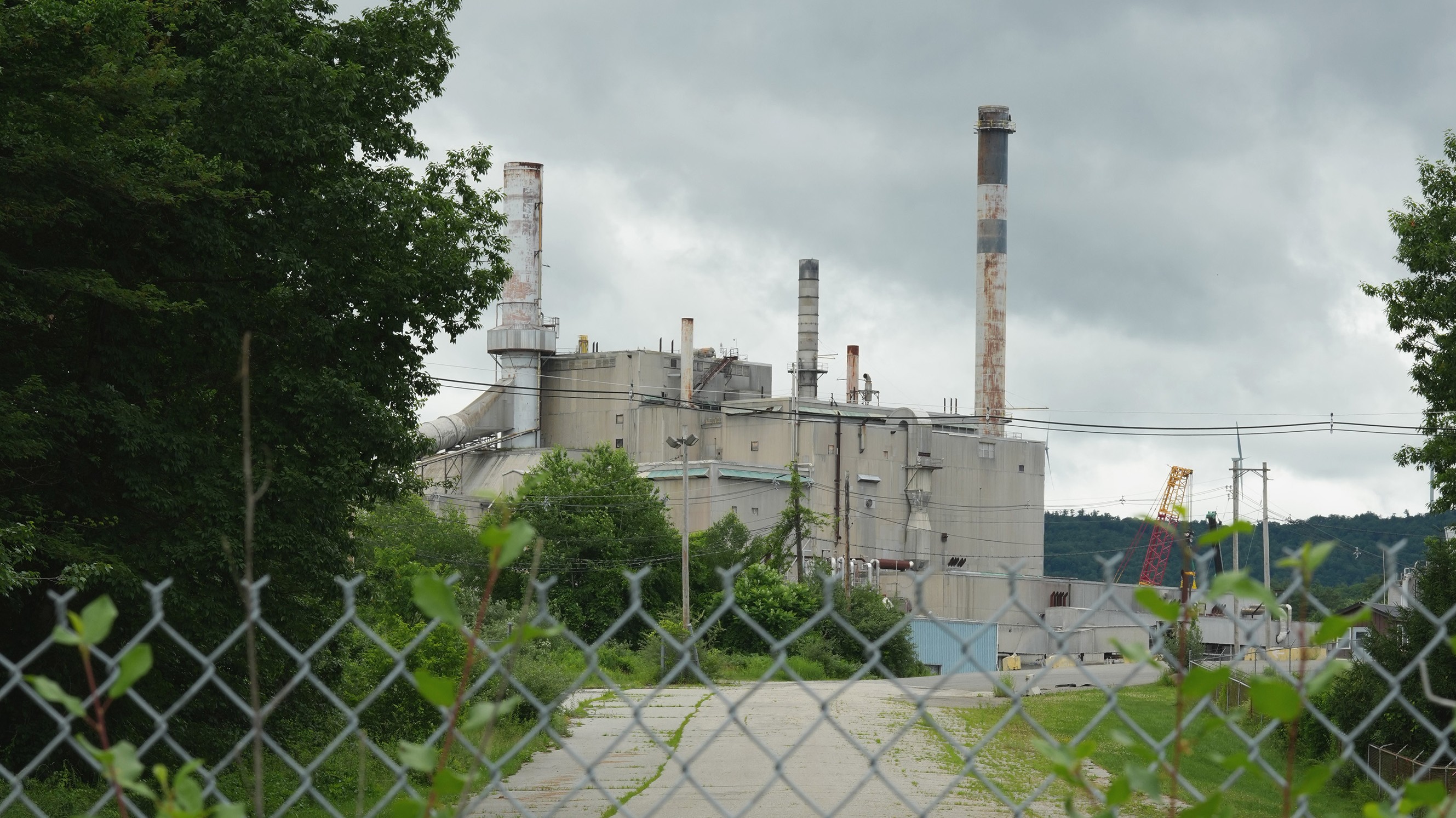
In 2023, a company called JGT2 bought 1,000 acres just across the Androscoggin River from Jay. To inexpert eyes, the property—the site of the former Androscoggin paper mill—doesn’t look like much: a few rusted and stained industrial buildings sprouting weeds in the shadow of an immense landfill. But to Tony McDonald, one of the developers who leads JGT2, the site looks like money. It has direct rail access, gas, a 35-million-gallon-a-day wastewater-treatment plant, and, crucially, power: a 150-megawatt electrical interconnect, plus access to 25 megawatts of hydroelectric power.

 McDonald’s original idea had been to turn the place into a wood-product manufacturing facility. Mills traveled to Jay to announce the project, which was expected to create about 125 jobs. And yet over the next two years, the factory plan quietly died—throttled by the Trump administration’s tariffs on specialized equipment, steel, and aluminum.

Jay_6.jpg
Julia Kokernak for The Atlantic
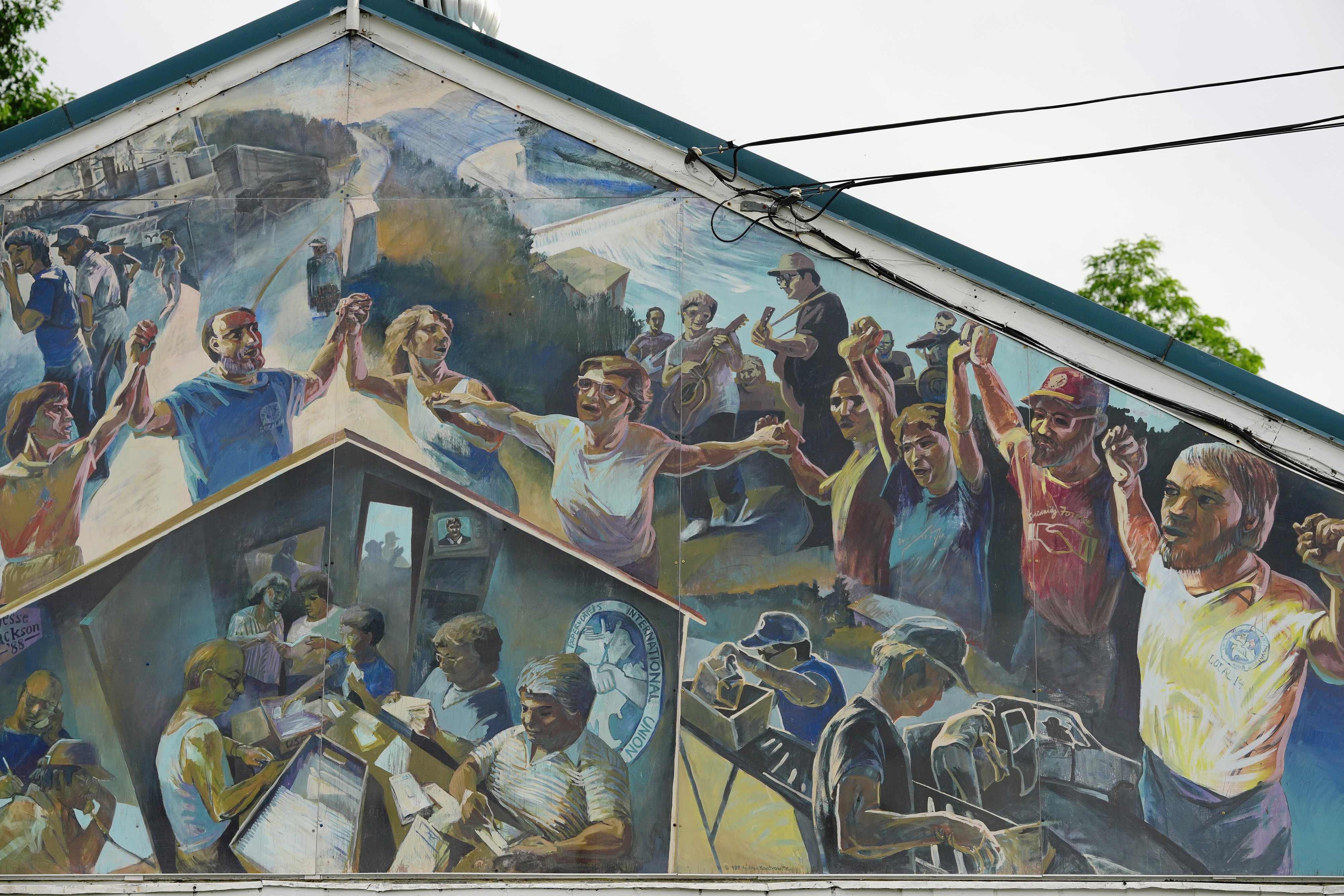
A mural at the former office of the Western Maine Labor Council

Jay has minimal zoning laws; McDonald didn’t need to ask anyone’s permission for what he planned to do with the land. So few in the town knew that his focus had switched from wood to data until one freezing night in late March, when he showed up to see the Jay Select Board—the five-member panel that sets town policy. News of the moratorium bill had broken, and McDonald needed the town’s help to preserve his project in Jay. He apologized that this was the first the board was hearing about his deal with the data-center firm Sentinel: “It never occurred to me to discuss it with anybody,” he said, “so to any of you that got blindsided by that, really, I’m sorry. That’s on me.” But without their help, he told the board, the bill “will kill this project. Dead, dead, dead,” before adding, “Dead. Never coming back.”

Secrecy around such projects is not unusual, even in places that require town approval. In a recent report, NBC analyzed more than 30 data-center proposals from 14 states and found “in a majority of cases, local officials signed NDAs and worked with what appeared to be shell companies that can conceal visibility into the project developers.” The justification is that secrecy preserves a competitive advantage; the effect is that citizens learn of these projects only when it’s too late to do anything about them.

Still, towns have fought back. In October, when the people of DeForest, Wisconsin, discovered plans to build a $12 billion data center, the backlash was powerful enough to kill the project a few months later. In April, a town council in Festus, Missouri, approved a $6 billion center plan; a week later, the town voted out every city-council member who’d voted for the project.

None of that happened in Jay. Less than an hour after McDonald stood up in the meeting, the board voted 4–0 (with one abstention) to draft a letter of support to Mills. Analyze the footage as much as you like—it will provide no clear answers as to why, in this moment of bipartisan resistance to new data-center construction, these town leaders would go from total ignorance to unanimous support in the time it takes to bake a lasagna.

Then—perhaps even stranger—most people in the town embraced the decision. Some were skeptical. More than a few traded insults in “The Jayborhood” (the town’s Facebook group). But meaningful resistance was scarce. One resident, concerned about noise pollution, started a petition, then gave it up after a 30-minute conversation with McDonald.

Mainers guard their individual freedom fiercely and apply limitations only selectively. More than one person I spoke with in Jay dismissed the broad resistance to data centers as simple NIMBYism. A common refrain I heard went something like: It’s Tony’s land. He can do what he wants with it. Cody Jacques, a union electrician who grew up in Jay, put it this way: “I don’t want you to tell me what I can do at my house. This is my property. I live here.” The same is true of McDonald’s site, he said. “At the end of the day, nobody likes to get told what to do with their stuff.” Still, the town doesn’t oppose all moratoriums on principle; it bans retail marijuana stores, which surround Jay on all sides.

The reason Jay wants this data center—the reason the board lobbied the governor for it—has everything to do with the land on which it would be built. The Androscoggin Mill once employed 1,500 people. Those who didn’t work in the mill envied the mill workers’ wealth, which bought houses, four-wheelers, prom dresses. “It was everything,” Trevor Doiron, who is running to represent Jay’s district in Maine’s House of Representatives, told me—“the identity of the town.”

Jay_9.jpg
Julia Kokernak for The Atlantic
A scrap yard on the site of the former paper mill in Jay, Maine

Growing up, Jacques would stare at the mill and imagine a gleaming city. “The scale of the mill and all the lights, all the towers,” he said—“we’d always joke around and say, ‘There’s Portland, Maine, on the river.’”

After a stint in the service of Vacationland as a lobsterman, Jacques returned to Jay in 2019 to work at the mill. It employed fewer people than it once had, but Jay was hardly some bombed-out ruin; the paper mill still tithed substantially to the town, and offered Jacques a 401(k) and the chance to rise through the ranks. The year that OpenAI released GPT-3, he was studying for a promotion to pulp-digester operator, spending his days off at the mill with a clipboard and notebook.

On April 15, 2020, Jacques was at home. His phone buzzed with a few texts from friends asking what was going on at the mill. He figured a mill job had been posted and they wanted an inside track. “So I was like, Hey, no, you just gotta go on the website and apply,” he recalled, “and they were like, No, the mill blew up. I’m like, What do you mean it blew up?”

Dashcam footage from a truck nearby recorded the explosion. The video shows the traffic just outside the gates and the mill in the background. What you can’t see is a weld, one of thousands sealing the 166-foot tower that turned wood chips into wood pulp, opening a crack in the wall. Then another weld. And another. One moment there is blue sky, the next, a black column hundreds of feet high. Oozing brown pulp drums on the hood of the logging truck like hail as the drivers on the radio squawk and curse. Soon it’s so thick that the camera is almost entirely obscured. The black cloud is on its way toward Jay, where it will drop wood pulp on the houses.

Jacques got in his car. He tried to get into the mill—to help, to pull out bodies if needed; he didn’t know—but police blocked the road. Mill employees worked in 12-hour shifts—about 170 workers on site at a time. They worked weekends, nights, and holidays together. They were like family. Jacques saw that the two 166-foot towers where he’d worked, the same towers he had imagined as a city when he was a kid, were gone.

Remarkably, no one died. A government report attributes this extraordinary outcome to the timing of the explosion. It was lunchtime. People in Jay credit the grace of God. Once everyone was accounted for that evening, the town’s thoughts turned to the future. “ We knew right then and there they weren’t rebuilding,” Kenny Jacques, Cody’s father, told me, before blowing a brief rendition of Taps through pursed lips. “It’s over. It’s over.”

Jay_12.jpg
Julia Kokernak for The Atlantic
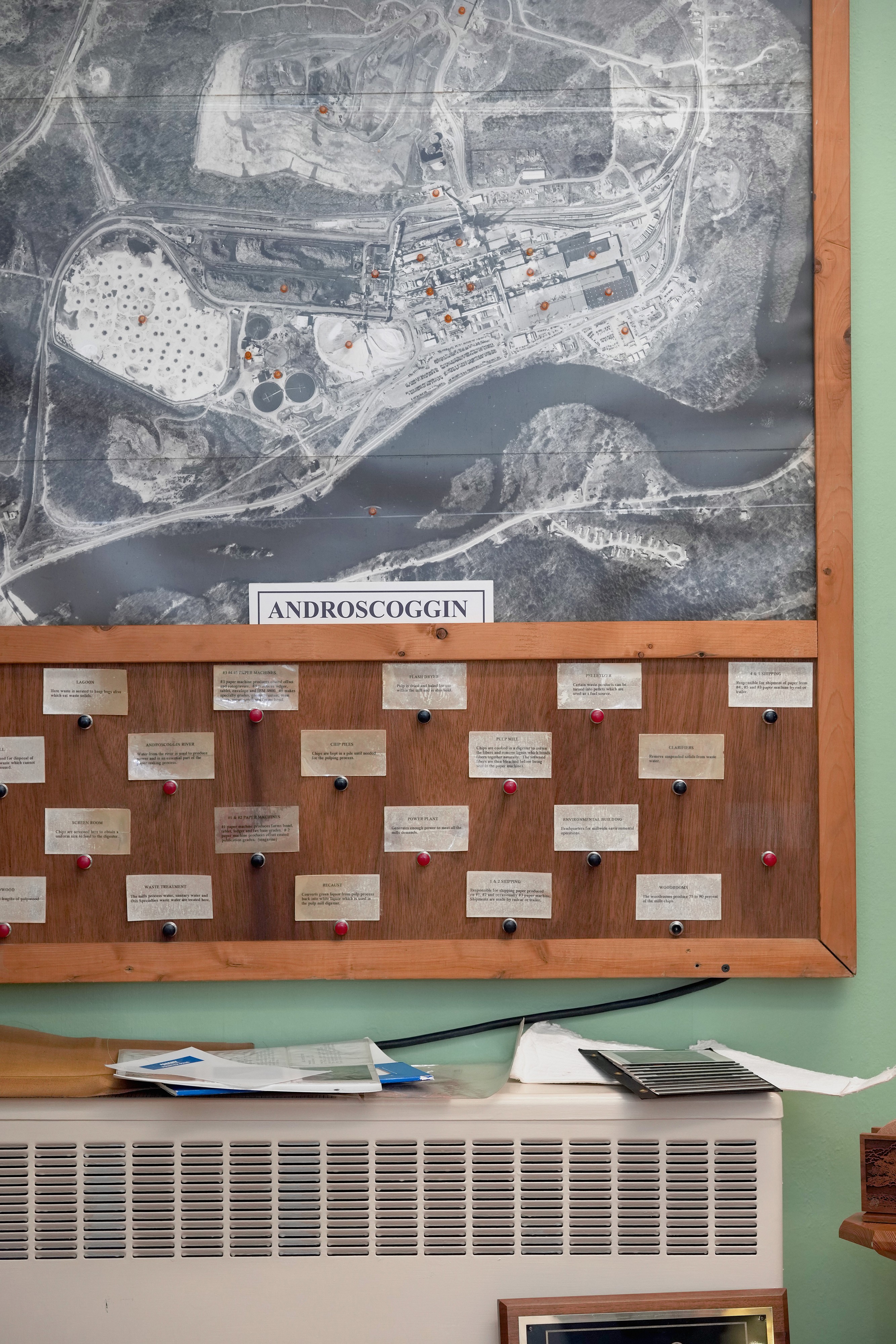
An exhibit on the mill at Maine’s Paper & Heritage Museum in Livermore Falls, Maine
Jay_26.jpg
Julia Kokernak for The Atlantic
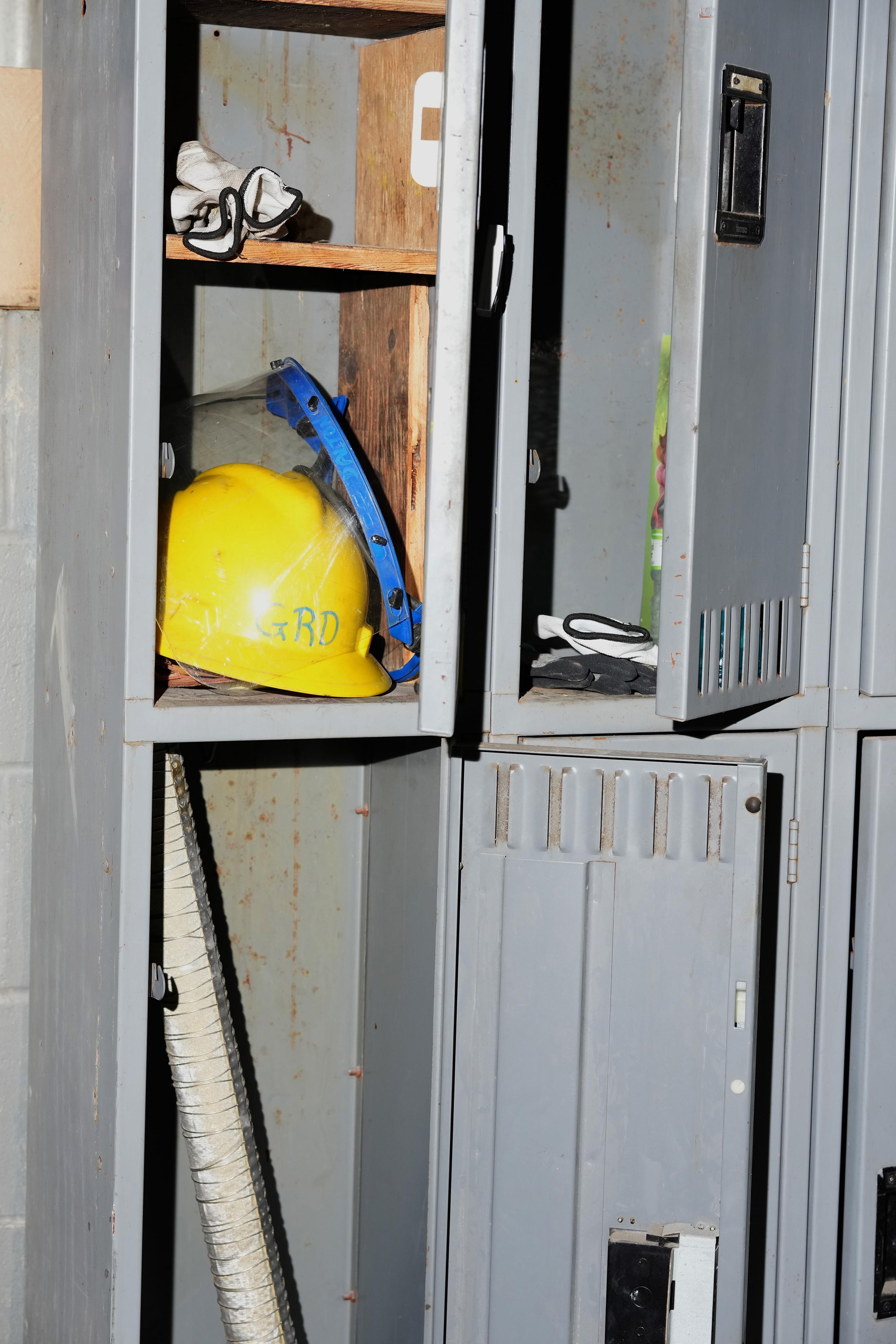
A locker inside the former mill
jay_maine_film_51.JPG
Julia Kokernak for The Atlantic
Inside the former mill

I asked Lucien Richard, a former engineer at the mill who now works as McDonald’s site manager, to show me the parts of the property that are best suited for a data center. The mill was mostly silent, with the exception of a few demolition workers smoking and listening to AC/DC. Walking through the machine rooms, I understood why Elon Musk wants to put data centers on the moon—the facility was so dark, cold, and seemingly endless that we may as well have been in outer space.

At one point, Richard’s flashlight fell across a mural—a hand-painted image of a rowboat full of puppies, peering out at a row of ducklings. “Some pretty talented people used to work here,” he said.

Last year, Donald Trump directed the Environmental Protection Agency to identify sites like the former paper mill for potential data-center use. The reasoning is that in some cases, much of the infrastructure is already there. According to McDonald, the mill site is permitted to pull 82 megawatts from the electrical grid. To supplement that power, he plans to build a 150-megawatt solar facility, and to employ the hydroelectric facilities that sit on the Androscoggin River. Elsewhere in the country, power plants are struggling to keep up with demand from data centers, which can drive up electricity costs. The pitch, then, is that this data center would exist in a walled garden—generating much of its electricity on-site, and pulling no more from the grid than the mill did before the explosion.

In dry states such as Arizona, data centers strain an already precarious water supply. Maine is wet. Richard showed me another vast room, this one with rows of sand pits stretching off into the darkness, into which 35 million gallons of water were once pumped up and filtered daily. McDonald expects the data center to use 1 percent of that, or about 300,000 gallons a day. Richard mused that they might need a smaller pump.

Some of the language McDonald uses—his promises of “no environmental impact” and “all positives,” “no negatives”—is clearly overstated. Maine has environmental and power regulations like everywhere else, but no specific playbook for data centers. The reason the Maine legislature passed the moratorium in the first place was so it could make a set of rules before development started.

On every point, this is how the argument goes: Would a data center be loud? Can’t be as loud as the mill! Could it smell bad? The mill smelled like rotten eggs! Would it pollute the environment? The river was covered in toxic foam in the mill days! “All you gotta do is get over the people’s fear,” Richard told me. “You need lots of water. We used to use lots and lots of water. You need lots of power. We used to use or make lots of power. It’s a natural fit.”

Using the past in this way, as a means of justifying the future, is a dangerous gambit, nostalgia being the hack-and-burn editor that it is. For some, the counterargument couldn’t be more obvious. Just look at the river now: It’s blue. But the mill is a handy benchmark for what the town is willing to tolerate.

Although the work Richard oversees may resemble Jay’s productive industrial past (angle grinder, indoor cigarettes, AC/DC), the task here is demolition. Tons upon tons of complex machinery have already been disassembled and shipped to Pakistan. When the place is empty, the trucks can roll up, the servers can be plugged in, and the building can start humming its ceaseless B-flat. And not so many years from now, the mural will be a sort of cave painting. Perhaps some AI-powered technician will roll past and wonder what possible efficiency might have been gained by painting a boat full of puppies on a wall in a workplace.

2026_07_30_Jay, Maine, Wants a Data Center-3.jpg
Julia Kokernak for The Atlantic
A mysterious mural of ducks and puppies

After the mill exploded, Jacques heard from a friend that work was to be had as a union electrician. He took an aptitude test, and soon became an official brother of IBEW Local Union 1253. Its logo is an electrified bear in a hard hat. His work, by and large, has been in the booming industry of data-center construction.

Accustomed to heat, noise, and toxic chemicals, Jacques was struck by the pristine cleanliness of data-center facilities. The downside is the distance—he travels all over the Northeast and lives on-site for weeks at a time. Recently, he was halfway through an eight-week job in Niagara Falls when he called his girlfriend to say he wasn’t going to make it another four weeks without seeing her and their young daughter. They looked at a map and chose Albany, that bright and empty city, as a midway meeting point. Seeing his daughter through the open window of his girlfriend’s car as they pulled up, he felt elation, and relief.

If Jay had a data center, one of the construction jobs would almost certainly be his.

During local elections late last year, Meta spent $6 million running ads in state capitals such as Sacramento, Tallahassee, Salt Lake City—places with the power to buoy (or ban) data-center construction: “Los Lunas used to be a one-stop town. Most people were employed by a farm or a railroad. I needed to support my family and leave home to find work, traveling all the time. I missed a lot—important moments I can’t get back.”

The put-on simplicity of the voice-over script, paired with the Old MacDonald imagery (horses, hay bales, pickups) reeks of insincerity. “Then Meta came to town and opened a data center, bringing new jobs to Los Lunas. And now I don’t worry about missing out much anymore.”

Tony McDonald has said he expects that the Jay project will create 125 to 150 full-time high-paying jobs. Those jobs were a key factor in Mills’s veto of the moratorium. But projects with similar footprints employ 30 to 50 full-time staffers. Five years from now, if the predictions of AI companies are to be believed, the number will be smaller. So when Tom Saviello, the mill’s former environmental manager who is now a county commissioner, started quoting Field of Dreams to me—“If you build it, they will come”—I worried that Jay was being sold a future that would only ever exist in Meta ads.

Saviello’s grief at the loss of the mill was so intense that, for years after the explosion, he couldn’t bring himself to visit the place. When the data-center project was announced, that grief evaporated. We talked in the mill’s parking lot. “I just get excited about it,” he told me, sheepishly. “That’s all.” The people of Jay have “been through turmoil,” he said, “but they’ve survived. And this is a chance for them to even do better.”

I spent one of my afternoons in Jay with Trevor Doiron, the House candidate, a Democrat who supports the data center. He’s 28, with the look of a politician who has come home to run for office: neck sunburn, flannel tucked into jeans. He told me he’s been surprised by how people are living—with holes in the floor because they can’t afford repairs, using the oven to heat the house.

Maine has the oldest population in the country, and the population of Jay is older even than the state median. Trevor volunteers at the food pantry on Tuesdays along with a 92-year-old man who helps pack and deliver meals to Jay’s older residents. “The elderly are the ones providing the services for other elderly people,” he said. “A year from now, who’s gonna be filling the boxes?”

jay_maine_film_93.JPG
Julia Kokernak for The Atlantic
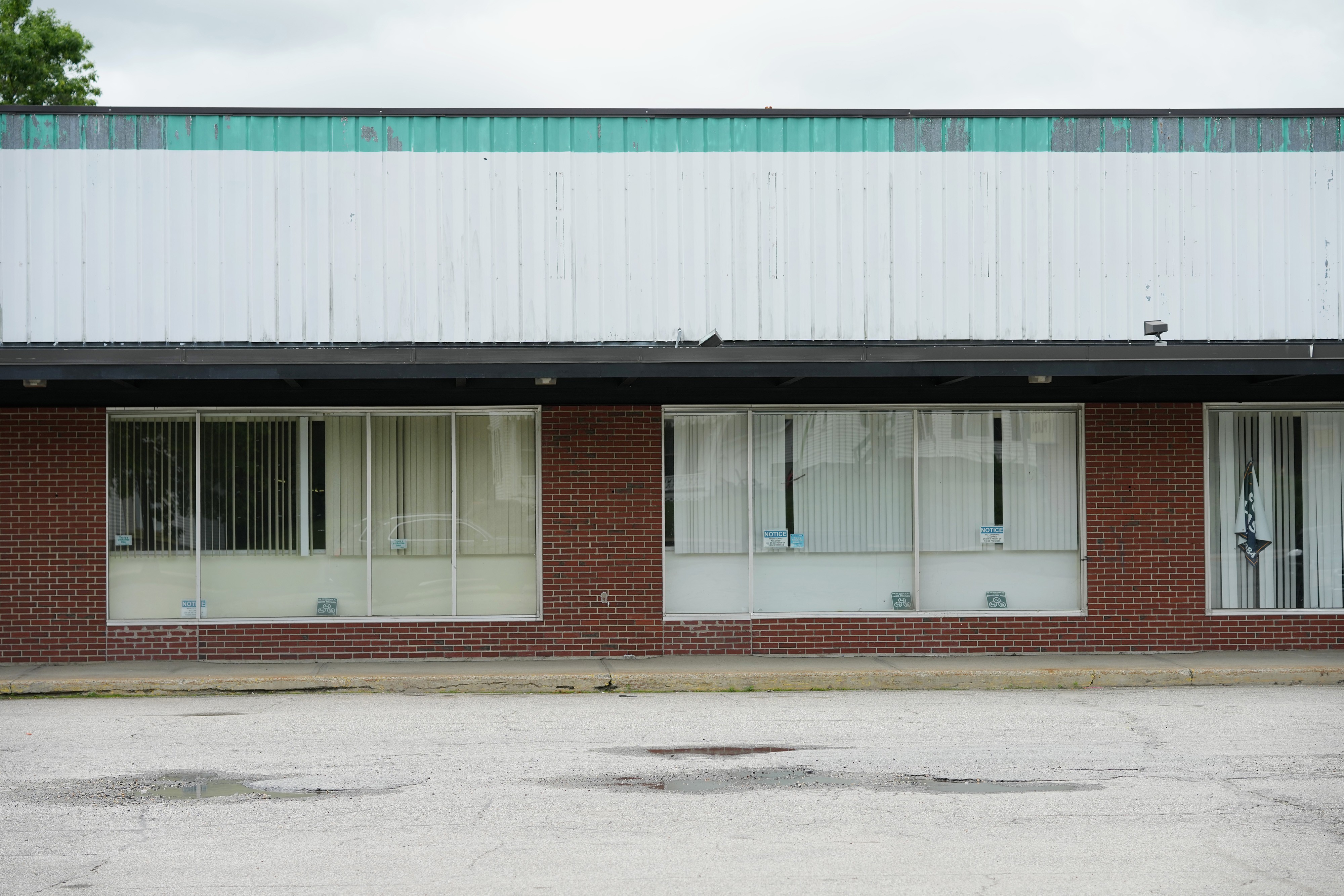
A vacant storefront in Jay

Before visiting Jay I expected that the current running beneath its bid for a data center was desperation: To survive, Jay needs anything. What I heard instead was Jay wants something. Because something is better than nothing.

In a recent article about Jay and rural data centers, Anthony Elmo, who studies economic development, said of rural towns, “They don’t have the resources to negotiate. They don’t know what to ask for.”

I think Jay knows plenty. In its support of McDonald’s project, the town offered no tax break, and stood to make about $6 million in property taxes. That’s a transformative amount of money for the town’s budget—about $7.2 million this year. Locals were clear-eyed about the promise of full-time jobs and skeptical of the claims being made in Meta ads. “I don’t care if it’s 10 jobs. I don’t care if it’s 100 jobs,” Saviello said. “One is more than zero.” Many also reminded me that residents such as Jacques already make their living on temporary construction gigs. “ It’s ugly. It’s ugly,” Doiron told me about Loudoun County, Virginia—which is often thought of as the data-center capital of the world—but “Loudoun County has a lot of really nice stuff.”

“ Even if all that industry comes back, it’s not gonna be us that builds it,” Patrick Hopkins, a carpenter and Jay resident, told me. “It’s gonna be automated. It’s not gonna be the days where this whole line of dudes walks in and they’re all wearing the same company shirt and the same company hat, and they’ve all got their lunch pails. That’s just some dream from the past—a moment in time. It’s gone. It’s better for us as a people to be like, We need to move on.”

The most powerful companies in the world want these data centers. Many of the campaigns to build them are waged in secret against towns worn down by decades of losses. You could think that it was wrong to let one town stand in the way of a statewide moratorium. You could think that Jay was naive, and yet another data center won’t make anyone better off. And yet for Jay, the data center is an opportunity to push back against the steady encroachment of poverty, 15-hour commutes, the atomization of an aging society. I found I couldn’t argue with such a pragmatic and hard-earned hope.

But on June 11, the town posted an announcement on its Facebook page. Commenting was disabled. The data-center project had been put on indefinite hold. McDonald’s client, Sentinel, had backed out.

I called a lot of the people I’d spoken with in Jay. Most were disappointed. None seemed that surprised. McDonald is trying to find a new firm; the demolition work continues. But no one is particularly optimistic. The data-center project was just the latest on a long list of things that were there one day and gone the next.

© Julia Kokernak for The Atlantic

The power plant at the former Androscoggin paper mill
  •  
❌