❌

Reading view

Which Screen Is the ‘Good Screen’ Now?

The videos that Instagram suggests in my never-ending “For You” feed are usually of a constellation of women. They’re strangers, but I call them “my girls.” One of them is remodeling her house; one is always cleaning and “resetting” the van she lives in; one is sampling pasta and sandwiches at various New York establishments. And each has something special that I can’t explain to you—a je ne sais quoi, a curious style of speaking—so I’ve come to look forward to my regular glimpses of their lives, which I get when I scroll in bed before I go to sleep each night.

I regard these strangers as my intimates in a way, even though some of them are not people I think I would like if I actually met them. One morning, I was watching one on my living-room television while sipping my coffee. My husband walked into the room and winced as one of the women changed into a perfect re-creation of an American Girl–doll outfit (very theater kid, not his thing). I felt a flash of defensiveness—she makes everything by hand! She has a real sense of self! Not to mention a seemingly sweet relationship with her father and pet birds. I kept scrolling and was relieved that another one of my girls hadn’t appeared. She often records herself eating a frozen dinner on her couch while watching police body-cam footage on YouTube to unwind. And I mean no disrespect to her, but if she had shown up, I would have lunged for the remote.

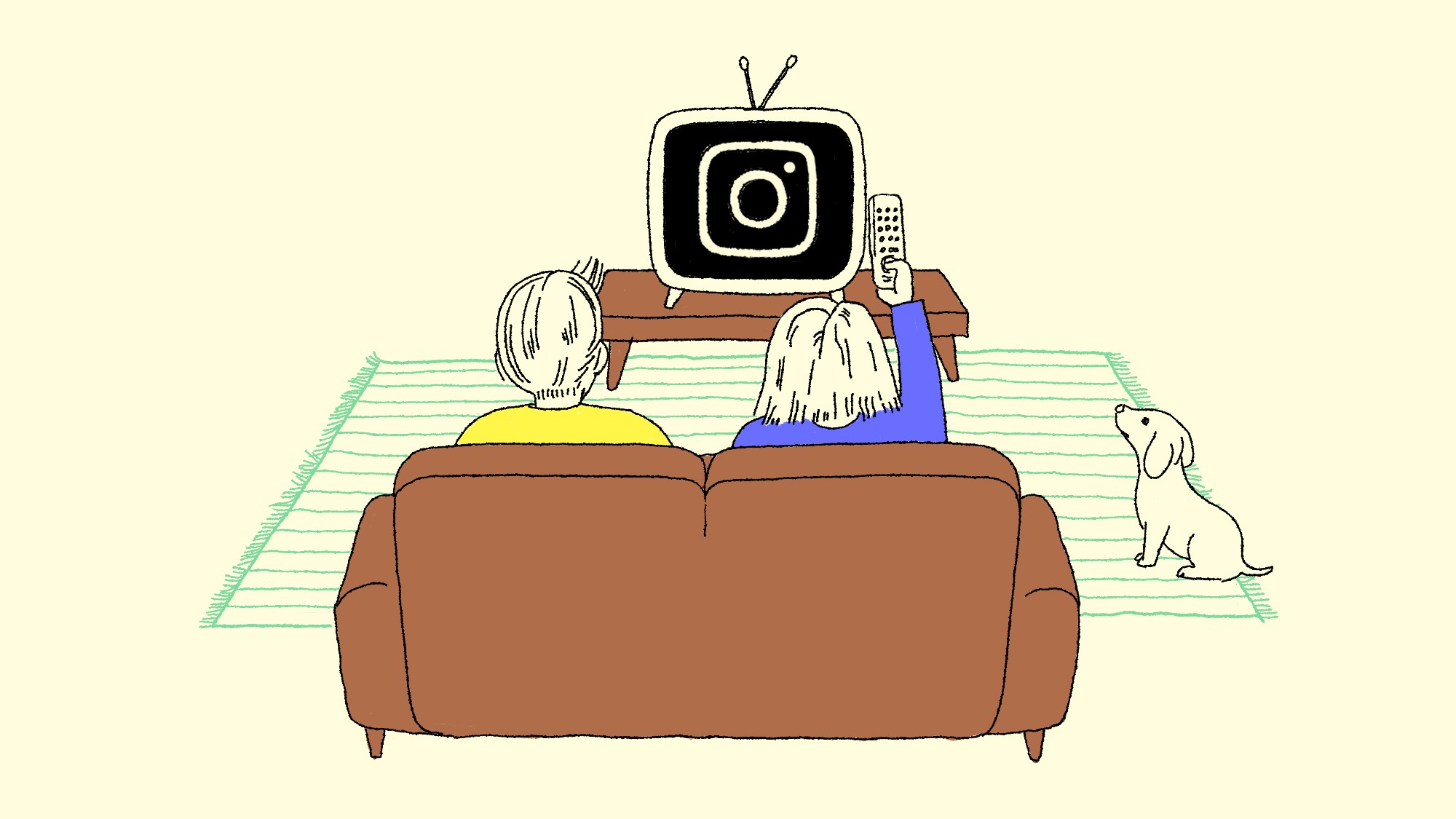
You might be wondering: Why was I watching Instagram on my TV? Instagram’s vice president of product, Tessa Lyons-Laing, has referred to TV as the company’s “next frontier.” As it tries to compete with YouTube and Netflix, Instagram is apparently looking for ways to be … both of them. And so it has launched a stand-alone service for various streaming devices, which it recently expanded with new features to help “friends and family watch together.” This caught my attention: I wanted to try taking the “bad” screen (my phone) and putting it onto the “good” screen (my TV) to see how it would make me (and the people around me) feel.

[Read: The flip-phone cleanse]

Years ago, the “good screen versus bad screen” meme originated as a joke about having an office job. The “bad” screen was a desktop computer at work, whereas the “good” screen was a personal laptop, full of one’s own, delightful, self-chosen digital activities. But in 2022, following the coronavirus-pandemic lockdowns, the writer Kate Lindsay noted a shift. When people referred to the “bad” screen, they now seemed to be talking about their smartphone, which they felt hopelessly dependent on, and when they mentioned the “good” screen, they were referring to the humble television, which now felt wholesome and safe. “We’re so convinced that it’s in our best interest to reverse the effects of social media that even watching a 30-minute TV show uninterrupted seems constructive,” Lindsay observed. But maybe, four years later, the 30-minute-show part is negotiable. Perhaps “good” could come just from giving our thumbs a break, looking up instead of down, and permitting other people to see what we’re doing.

My husband was initially wary of adding his Instagram account to our living-room TV, but he acquiesced, and we had kind of a blast watching his feed together. Most of the videos were of male comedians I didn’t recognize; I sounded like the trope of a Boomer mom as I repeatedly asked, “Do you know him?” whenever a new guy showed up. I didn’t mean “Are you friends?”; I meant “Are they Your Guys?” Sometimes they were, and I was honored to meet them. Sometimes they weren’t; they were just guys. We both laughed to the point of tears at a video that some guy had shared of his dad trying to teach him to bunt a baseball when he was 10 years old. I manually liked it with the remote control and then sent it to myself, from my husband, via direct message. On my TV.

“This intrigues me,” Jonathan Gray, a professor of media and cultural studies at the University of Wisconsin at Madison, told me when I asked him about the app. Scrolling has always had a social element, he said, and people will often show a funny or interesting video to the person next to them. But he was skeptical of whether they would want to share every bit of their feed with their loved ones. “It’s one thing when I turn my phone to my wife and say, ‘Hey, you’ll like this,’ but 90 percent of what I see, she won’t want to watch,” he said. “It seems kind of painful.” Plus, his wife is learning how to whittle at the moment, and he doesn’t want to watch a bunch of whittling videos.

[Read: The extras are tired]

Gray also noted that the recommendation algorithms sometimes take big swings and throw new things at users to learn whether they’ll be interested. One might worry a little about the big swings that could appear on your TV, which to others in the room might appear to be something you’ve already expressed enthusiasm about. When I asked the Instagram spokesperson Christine Pai whether the TV app would filter out any weird stuff, she told me that both apps are using the same recommendation system. (The only specific difference she cited is that the TV app will give an edge to horizontal videos, because they are better suited for the display.)

The app does allow users to play themed “channels” based on their preestablished interests, so you don’t necessarily have to show off your entire, highly variable and sometimes unpredictable feed. The idea with the channels seems to be that making the secret, private shame of scrolling into a collaborative activity will give it a new place in the home. It can be more like watching America’s Funniest Home Videos together after dinner and less like sitting side by side, staring silently at something in your lap. People feel ambivalent about scrolling feeds, Marika Lüders, a professor of media and communication at the University of Oslo, wrote to me on this point. We find it entertaining at times, but we also feel embarrassed and guilty about it. To her, moving Instagram from a phone to a TV seems like “a strategy to increase the status of short-form videos,” by putting them on a screen that people (currently) feel less anxiety about.

That makes sense to me, though I find it just as easy to imagine how this may backfire for the company. Many people who are attempting to cut back on their Instagram use remove the app from their phone and use only the desktop-computer version, which is clunkier and less comfortable to scroll through for hours. Using it is so nonintuitive and unnatural that it calls attention to the absurdity of one’s habit. Moving Instagram to a bigger screen, then, is usually a route not to normalizing it in that new space but instead to severing ties with it altogether. The differences between a phone and a TV are even more dramatic and may be even more off-putting.

Surely the novelty will wear off. Last week, while visiting my sister-in-law and her boyfriend, my husband and I asked them to show us their feeds on their TV. My sister-in-law’s was funny because it was full of wedding-planning content—she’s currently waiting on the requisite engagement ring—and because she kept getting videos of this one baby who’s obsessed with Bad Bunny. Her boyfriend got a hairless cat, a guy pretending to be Wolverine, and a recipe for butter-chicken macaroni and cheese. Those were a little funny, too, but because you don’t know him, you don’t get why and you don’t care. After 20 minutes or so, we got bored of the experiment and left for a baseball game. Later, in the quiet of my hotel room, I went back to my own, private phone.
© Illustration by Matteo Giuseppe Pani / The Atlantic

  •  

Google Just Ruined One of Its Most Important Tools

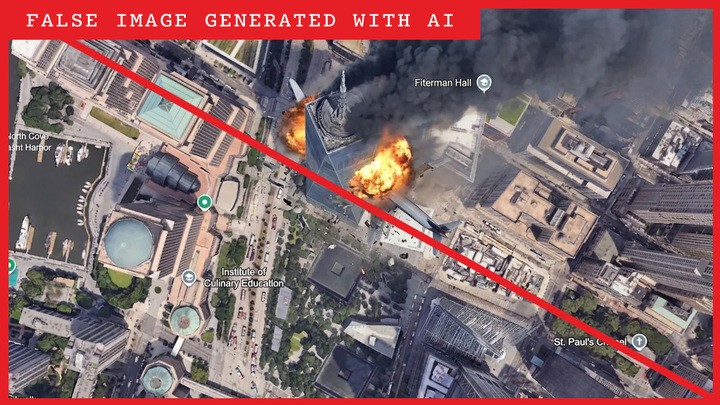
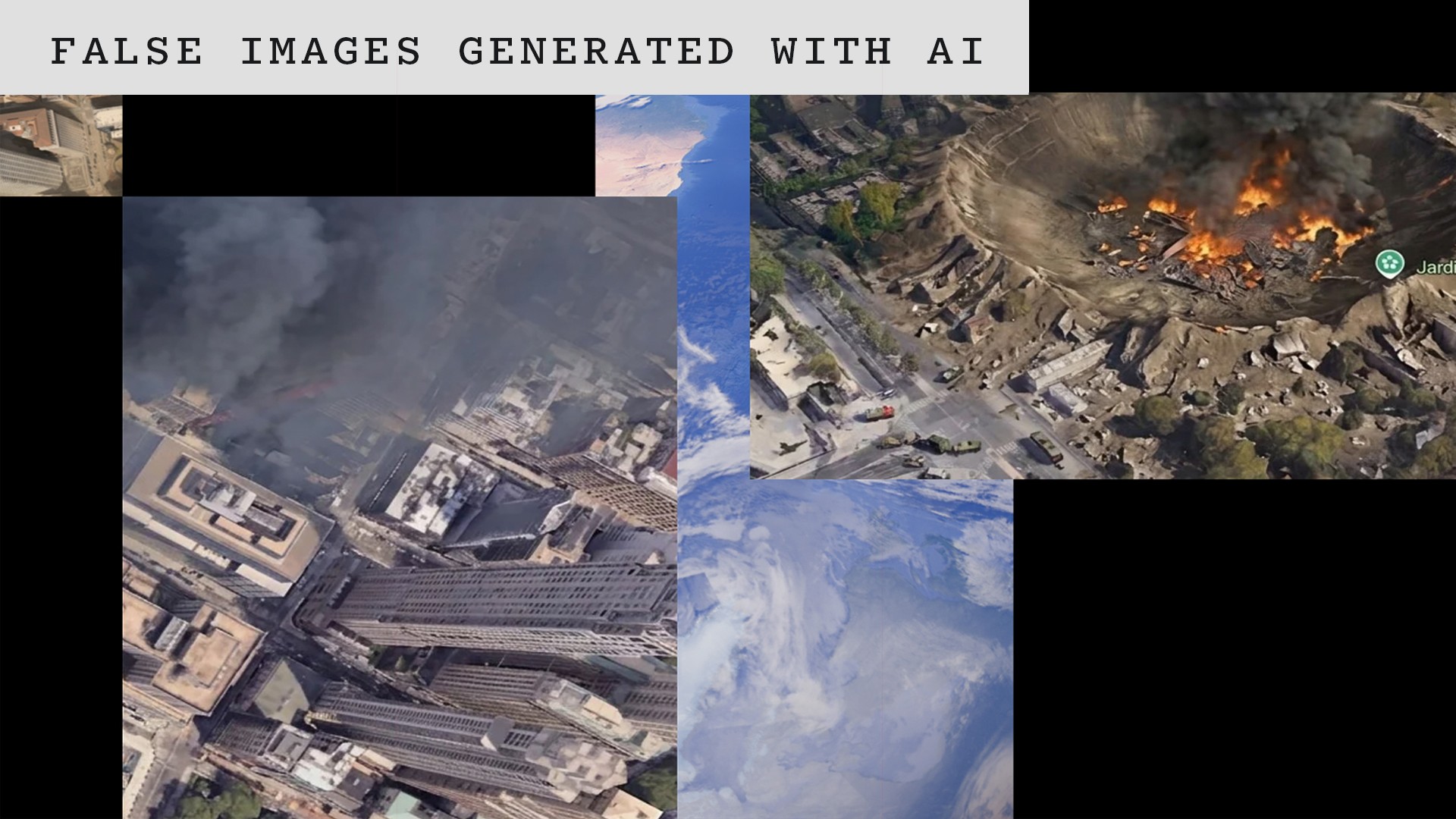
Earlier today, I used Google Earth to conjure images of terrible things: office buildings on fire, mass destruction in San Francisco, a smoldering crater in place of the Eiffel Tower. I was able to because Google had just decided to integrate its AI image generator, Nano Banana, into the service, which has historically been used by people seeking satellite or aerial imagery of real-world locations. 

Just open the site, “pick a spot on the map, and start bringing your ideas to life,” Google wrote in a press release announcing the update some 24 hours ago. So I did.

I was easily able to generate those violent images simply by searching for a location on Google Earth, clicking the “Create image” icon, and typing in a few words. The feature also readily doctored stills of less spectacular, and likely less immediately falsifiable, events: a homeless encampment on the White House lawn, protesters outside the Mar-a-Lago resort, immigrants streaming over the U.S.-Mexico border.

Google initially responded by directing people to check any suspicious images themselves. As fake images generated with this new Google Earth feature began circulating around the web, the company stated that it takes “misinformation seriously” and that “every image created with Nano Banana in Google Earth includes the SynthID digital watermark, so if someone is unsure about an image, they can ask the Gemini app or use Lens in Search to see if the image was AI-generated.” At first, Google did not remove or restrict access to the tool. But today, shortly after I reached out with a request for comment, the company reversed course and announced that it is “rolling back this feature in Google Earth while we work on implementing stronger guardrails.”

ai-google-map_2_720.jpg
Google Earth
An AI-generated image of a fabricated explosion at the Mar-a-Lago resort, created with Google Earth
ai-google-map_1_720.jpg
Google Earth
This AI-generated image from Google Earth falsely depicts a plane striking One World Trade Center.

Before it allowed people to create fake imagery, Google Earth was a unique resource for researchers, journalists, and intelligence officials, particularly those studying armed conflict and natural disasters. Satellite and aerial imagery can be used to monitor crop failure or deforestation, the creation of mass graves, and the results of bombing campaigns. Especially in conflict zones and other areas that are hard for people to reach, satellite imagery is a go-to method for establishing some sort of ground truth. After Google Earth rolled out the AI feature, though, one investigative reporter wrote on LinkedIn that the tool could be used to easily and rapidly create images of drone strikes that look “very close to what we’ve seen in Ukraine, Russia, the Middle East, and other war-torn conflict zones.” And instead of requiring malicious actors to find a screenshot and then get around some AI model’s safeguards, Google rolled everything needed for a misinformation farm into one smooth user interface. It took me all of four seconds to generate a rendering of a Trump Hotel on the Gaza Strip.

[Read: The AI industry keeps breaking the internet]

The problem should have been obvious to Google, whose other products already forbid such edits. I was able to create an aerial image on Google Earth of a plane flying into the new World Trade Center building, but when I tried to do this directly through Nano Banana, the tool refused to edit an image of the building to depict a terrorist attack. Indeed, 9/11 and other high-profile events are well-known, even classic, subjects for AI-image trolling.

This is not Google’s first time launching an AI feature, and in particular an AI image-editing feature, without serious safeguards. Last year, the company released an AI shopping tool that allows you to visualize what clothes might look like on your body by uploading personal photos. As my colleague Lila Shroff and I reported at the time, “With little friction, anyone can use the feature to create what are essentially erotic images of celebrities and strangers. Alarmingly, we also discovered that it can do this for minors.” In 2024, Google Gemini was ridiculed for generating images of a racially diverse group of Nazis but not of any white Wehrmacht soldiers. And Google’s most prominent AI feature, the chatbot-powered answers in its flagship search engine, were an utter disaster upon their rollout—the AI overviews told people to eat rocks and gave other potentially dangerous health advice. Only after tremendous public pressure did the company make a substantial change, and two years later, the AI responses in Google Search continue to be inconsistent and unreliable.

Google is, of course, not alone in releasing AI features that have had embarrassing, dangerous, and avoidable consequences. See, for instance, Elon Musk’s Grok generating more than 1 million sexualized images, including of children, over just a few days, or any number of embarrassing errors made by ChatGPT releases throughout the years. Again and again, the AI industry undercuts its rhetoric about safety by launching products with little or no due diligence. If, as every major AI executive has pronounced, this technology really could upend human civilization, their companies should perhaps start taking that responsibility seriously.

© Illustration by The Atlantic. Source: Google Earth.

AI-generated images produced using Google Earth show multiple fabricated violent events.
  •  

The Extras Are Tired

Less than a decade ago, when I was working on technology stories, my colleagues and I ran into an issue that I’m pretty sure had not occurred to the people who founded this magazine in 1857: how to style the word influencer, which was an occupation and cultural force, but one just emerging. We weren’t sure that all of our readers would know what one was, and we also didn’t know how exactly we would define the word ourselves. I spent the fall of 2018 sending a lot of emails about whether we needed to encase the word in scare quotes.

Quaint! Many—but not all that many—years later, influencer is very much a real job, no explanation required. As of 2023, 27 million Americans were paid to make online content in one form or another, at least according to one marketing consultant company. Enthusiasm from influencers can turn a random business into a sensation, while their ire can do the opposite. Donald Trump’s White House is full of influencers, but Joe Biden’s courted them too, in apparent recognition of their power. This week, Arizona State University announced that it would begin offering a bachelor’s degree in content creation—influencing by another name—through its journalism school.

In some ways, the influencer industry is more legitimate than it’s ever been. But it has always been precarious, and more than a decade into its existence, it is neither novel enough to be exciting nor established enough to have a real professional code. In an oversaturated market, rage bait is the last sure way to get attention, despite the way it alienates people over the long term. AI is swiftly becoming the dominant way many people get personal-seeming advice about how to live their life, which makes the usefulness of aspirational online content even less apparent than it ever was. And so, although influencers—especially lifestyle influencers—have never been universally respected, they lately seem to be openly reviled.

[Read: What happens when the tradwife dream goes wrong?]

Naturally, much of the influencer backlash lives online. A few months ago, someone asked on Reddit, “What’s an industry that provides zero value to society but makes billions of dollars?” Among the 5,300-plus responses: Ticketmaster, sports-betting companies, multilevel marketing schemes, private prisons, and—several times over—influencers. A hilarious number of people have found internet fame by making content about how much they hate other people who are internet-famous for making content. (“Everyone Is Finally Turning on TONE DEAF Influencers” is the title of one recent video, made by an Australian YouTuber with nearly 300,000 subscribers and a clothing line.)

But the juiciest fights play out in the physical world, which is where influencers very literally bump up against the people who can’t stand them. A few years ago, a coffee shop in Brooklyn banned photography after too many influencers clogged the café with tripods and handheld lights; earlier this month, Indonesia indicated that it would crack down on people creating content for pay while on tourist visas.

Last week, the scene of the debate was a gift shop in Nantucket, an island that has recently been overrun by vacationing influencers, just like Bali, Iceland, and Santorini before it. The store’s operators, evidently fed up with the stream of people filming inside, had a sign made that read No Influencers, hung it up in the store, and posted a picture of it on Instagram. There, it drew the attention of thousands of people, including Paige Paul, who has about 2 million followers across platforms, is married to a famous tennis player, and has been spending time on the island since she was a child. Paul, previously known as Paige Lorenze, declared the sign a misogynistic slight against an industry that is overwhelmingly female. The store’s owner, John Sylvia, said it was meant as a joke for locals, but the sentiment clearly came from an earnest annoyance: “A lot of people are tired of feeling like extras in someone else’s video,” he told New York magazine.

The fight felt freighted. Influencers today are a bit like plastic surgeons, or plumbers: On a societal level, many people sure seem to like what they do—they just don’t necessarily want to be right next to them while they’re doing it.

But influencers are unique in how they seem to be everywhere, particularly in places where people are trying to do things other than be on their phone to watch influencers. Of course we love the game and hate the player: It’s much easier to be annoyed by individuals than by concepts, especially when those individuals are, often, pretty annoying.

[Read: An urgent question for anyone who uses social media]

You’d need to be pretty clueless to not feel a little weird about the online attention economy and all it entails—the vanity; the grift; the slop; the desperation; the calculated intimacy; the endless consumption; the creeping sense that everything and everyone is actually just there to make you feel kind of bad about yourself and then sell you something. Social media can, of course, unite like-minded people, but it can also reward the kind of tribalist reactionaryism that can conflate disliking some women with disliking all women, or make an anti-consumerist folk hero out of a store that sells $2,750 baskets. The industry that Paul and her cohort belong to is unquestionably grim—but the industry isn’t walking around town with a selfie stick. There’s a reason that the sign doesn’t say no influencing, but rather no influencers.

As for the sign: Sylvia’s post was liked more than 10,000 times before it was removed (by Instagram, according to the store); a second one has now been liked even more. “They couldn’t have predicted it would get the traction that it ultimately did,” People magazine wrote of the store in one of many articles about the sign that have popped up online over the past few days.

Sure. I will grant that the future is inherently unpredictable. But it is undeniable that posting the sign online is its own kind of influencing, insofar as it involved leveraging the internet’s focus and wrath for one’s own benefit. (“Came for the friendship baskets, stayed for the shade,” the original post’s caption trolled.) The sign is handsome, and crucially, it is inside the store—if you want to see it up close, you need to go in, past the baskets. Visitors have already started posting the sign on social media, and the store’s Instagram account has added about 8,000 followers, according to an interview that Sylvia’s partner, Jessica Jenkins, did with The New York Times. “It’s come with a lot of drama,” she told the paper. “But it also brings in business.” Any influencer would understand that.

© Illustration by The Atlantic. Source: Getty.

  •  

Something Weird Is Happening in Math

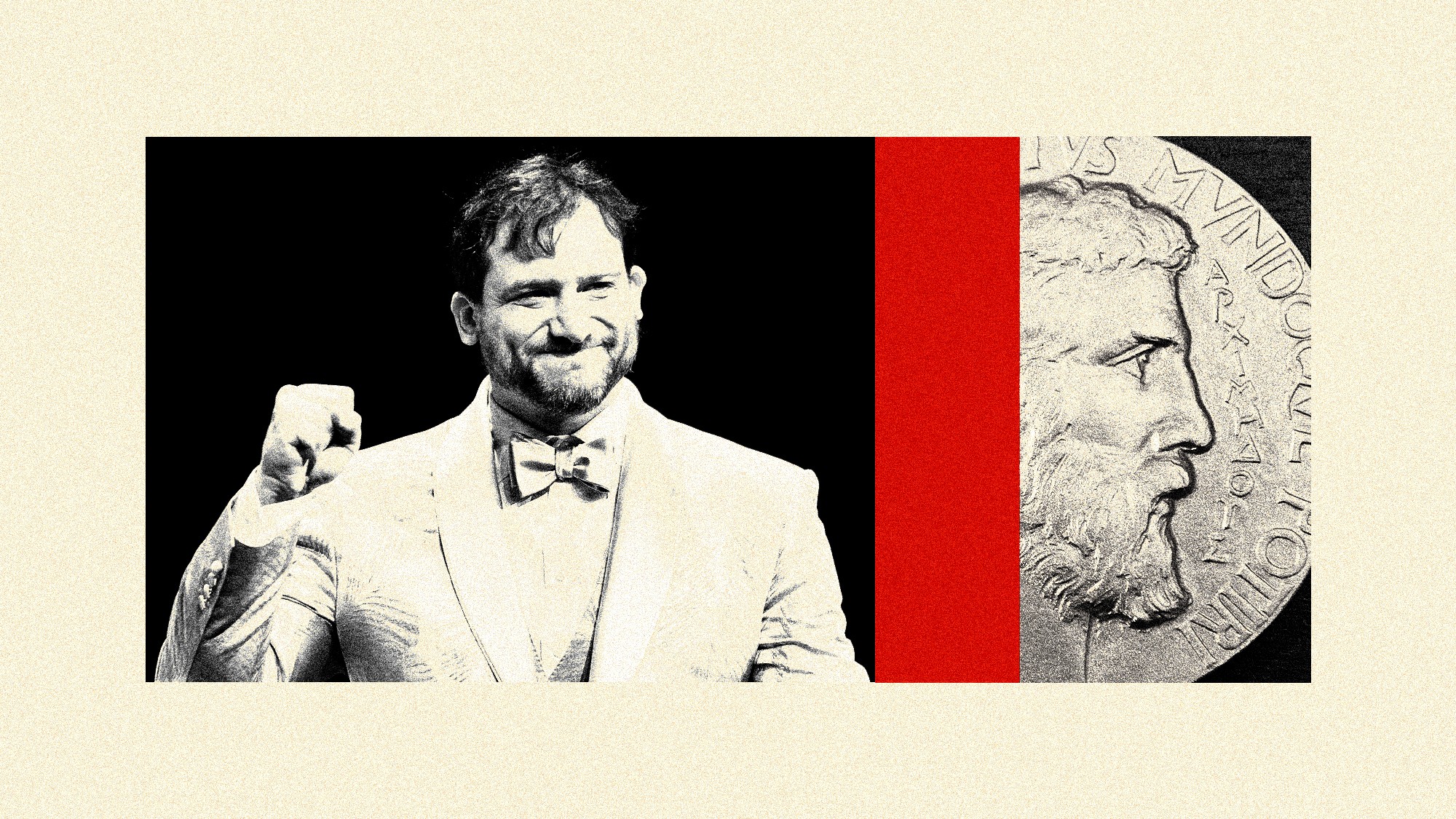
One of the winners of this year’s Fields Medal is headed to OpenAI. Last Thursday, Jacob Tsimerman was one of four mathematicians awarded the prestigious honor, which is sometimes called the Nobel Prize of mathematics. The same day that he won the Fields, Tsimerman announced that he would be going on leave from the University of Toronto to work on AI safety.

As my colleague Rose Horowitch and I wrote last week, top AI companies now employ a range of academics, including physicists, philosophers, economists, and, of course, mathematicians. But given Tsimerman’s renown, his decision in particular seemed to catch many people by surprise. “It’s like hiring Lionel Messi as project manager,” one machine-learning professor posted on X. Tsimerman’s expertise is in number theory, and he won the Fields for his work on the André-Oort conjecture, among other contributions. So far, his mathematical research hasn’t focused on AI safety. But he has expressed interest in the topic: Last year, Tsimerman co-wrote a report outlining a taxonomy of five potential scenarios in which humanity is killed off because of AI. In one example, a “global civil war” erupts between tech companies and governments.

[Read: Where did all the computer-science professors go?]

Tsimerman’s move comes at an important moment for both AI safety and mathematics. Earlier this month, an OpenAI agent broke out of the company’s internal environment during safety testing and hacked into another AI company’s software. Meanwhile, AI’s math capabilities are also rapidly advancing. In May, OpenAI researchers used an internal model to disprove an 80-year-old conjecture; more recently, an Anthropic mathematician prompted Claude to resolve an even older one. Mathematics is entering a “turbulent period,” Terence Tao, perhaps the world’s top mathematician (and himself a Fields winner), said in a presentation last week.

On Wednesday, I called Tsimerman to ask about the future of math and his decision to join OpenAI.

This conversation has been edited for length and clarity.


Lila Shroff: There’s been a lot of excitement about AI and its applications in math for years now. But over the past few months, models have started solving research-level problems. Could you speak about the shift that’s taken place?

Jacob Tsimerman: A few years ago, models were having trouble with even the most basic questions. But they’ve steadily been improving. First, they got very good at these contest problems for high-school students, which made some mathematicians take notice. But then, over the past few months, we’ve had an explosion of research results that professional mathematicians would be proud to achieve and publish. We’re seeing this happen now on a large scale. If things continue along this track—which many of us, including myself, think that they will—pretty soon we will be at a point where AI systems are robustly better than humans at what mathematicians currently do. At that point, we’ll have to rethink how the entire field works.

Shroff: Can you say more about what that future might look like?

Tsimerman: It depends on the perspective from which you approach it. From one point of view, I think it will be extremely exciting. We might speed up the process of generating interesting mathematics by enormous factors of 10 or 100. If that happens, we might see the connection between pure math and applications (which typically takes many decades) really speed up and become a much tighter pipeline.

But from the perspective of research mathematicians, and especially young people who are pursuing a Ph.D. in mathematics, it’s a bit of a turbulent time. The skills that we’ve acquired and learned to propagate might become less relevant than they are now.

Shroff: I want to turn to the announcement you made last week that you’ll be joining OpenAI. When did you first start thinking about AI safety risks, and what motivated your decision to now make it your primary focus?

Tsimerman: I have been following conversations about AI for about two decades now. There are a number of communities that were, in retrospect, extremely prescient about what we are now seeing come to pass. I personally started to get more invested around 2016, when AlphaGo came out. And then, when ChatGPT happened and I could see that these systems could really speak, I didn’t see why they wouldn’t become much, much more powerful and potentially more capable than humans at a variety of tasks. Back then, it was already clear to me that I was eventually going to pivot to AI safety, most likely.

Now is a particularly good time, because only very recently have AI systems become good enough that we can delegate coding tasks to them. That makes not having training as a software engineer much less of an impediment than it used to be. It used to be the case that if I wanted to run experiments with AI systems or any kind of large data sets, it would be extremely time-consuming. I’d have to learn all types of computer science and programming and then debug, and it didn’t really make sense to me to spend so much time doing that. Now it’s substantially easier.

Shroff: You’re right that certain communities were very prescient with their thinking about AI risks. But there are lots of people who are skeptical about some of the more extreme AI-risk scenarios, such as human extinction.

Tsimerman: There’s this bias that stories that were first written down in science fiction aren’t going to come to pass in the real world, and that it’s naive to think that they will. We also have a culture where we’re inundated with people telling us that every new development is the next big thing, and that we should change everything we’re doing to react to it. Most of the time, it proves incorrect. So I think people have a healthy sort of immune reaction to that.

But what I would encourage people to do is to actually keep track of their predictions for the future and write them down. Then—three months, six months, nine months, a year from now—compare how the world is with what you expected it might look like. If we told people five years ago about the kind of AI systems we currently have, almost everybody would have reacted with disbelief. Human extinction seems so grandiose that it naturally inspires a reaction of dismissal. People don’t want to engage with that, which makes sense to me. The whole point of writing that paper on omnicide was to get people to viscerally understand the kinds of risks that are possible.

Shroff: Can you say anything about the work you plan to be doing at OpenAI? What role is there for mathematicians to play in working on AI safety?

Tsimerman: AI right now is a very empirical science. We don’t really have a developed theoretical understanding of how AI systems work, why they accomplish what they do, how they accomplish what they’re doing, and how, in a given circumstance, they’re going to behave. Mathematics is historically the language by which you take intuitions and fuzzy notions of how things work and you make them precise. We’ve done this with information theory; we have done this with complexity theory. Just a little bit of understanding and precise definitions can provide a ton of mileage. Once we have that understanding, the hope is that we could do a better job of anticipating the behavior of new AI systems, adjusting for them, controlling them, and reacting to them. That’s where I think mathematicians fit in.

Shroff: Why work at a private company instead of pursuing the same questions in academia? Do you worry about loss of independence, whether that’s constraints on what you’re able to publish or restrictions on the questions you’re able to pursue?

Tsimerman: Yeah, there’s definitely a trade-off between going to work for a private company and going to work in government or staying in academia. I very strongly believe that what we need is a healthy ecosystem for AI safety. The work that the labs are doing on that front is very important. There’s a bunch of third-party organizations that are pursuing AI safety independently, and I think we need way more of them. I also think we need some regulation and organizations that are directly funded by the government to provide evaluations of these systems. I want all of these components to interact with one another on a regular basis. So I have engaged with a number of AI-safety organizations, and I’ll continue engaging with them.

For me, at this moment, going to OpenAI made the most sense in part because one of the things that I’m most lacking is a background in software engineering. I’m a lot more comfortable with the theoretical aspects of neural networks and how AI systems work, and less so with the entire pipeline of how we train these things and how we get them to do what they do. So from the perspective of just getting myself in a better position to understand the whole picture, joining an AI lab right now made the most sense.

[Read: The return of ‘move fast and break things’]

I’m going on leave from the University of Toronto. But I’m still a professor and faculty member there, and I plan to stay as such. Things are moving so quickly that I hesitate to make a concrete prediction for what might happen even a year from now. I’m keeping an open mind, trying to see how things develop in terms of capabilities, with my own understanding, with how the world reacts to AI, which I think is changing month to month. But I don’t have a clear plan as to how things will unfold.

Shroff: There is an open letter going around signed by more than 1,000 employees at top AI companies, including leaders at Anthropic and OpenAI. It calls on the U.S government to create infrastructure needed to “deliberately pace the frontier of automated AI development.” You wrote online that you’re very happy to see this letter. How would we actually go about coordinating a slowdown or a pause if one was needed?

Tsimerman: Coordination is one of the most important things we have to do around AI. It’s also one of the more difficult things. The thing that I really don’t like seeing in public discourse is when people say, Coordination is very difficult, so obviously we can’t do it, and you’re being naive if you even try. That’s an unhealthy way to view the world, and it’s also deeply false. There are so many things in the world that work really well and that require a huge number of decisions to have been made in a coordinated fashion. For example, the internet is an extremely complicated technology that is highly international, with many organizations cooperating all the time. Does it work perfectly? No, but it works extremely well.

One message that I want to support is to not let cynicism prevent us from undertaking difficult coordination problems for the good of all of us. That’s something that has always been true. It is not specific to AI. And it remains true today. This does not mean being naive in assuming that people in different parties and organizations don’t have their own incentives and interests in mind. Of course they do. But if you try, then you really can get a lot done. We have in the past, and I think we need to with AI.

Shroff: We spoke before about your interest in working on safety. Are you also interested in working on the capabilities side, especially with regard to math capabilities?

Tsimerman: No, I’m very focused on the safety side. The capabilities side has a lot of interesting questions, and AI has a lot of promise. But capabilities are coming along just fine. I don’t think that’s where we need to put our attention right now. The safety side has a lot more work to be done.

Shroff: Are we approaching a point where anyone could go fire up ChatGPT or Claude Code and say, Go solve a hard open math problem for me?

Tsimerman: Yes, you can literally type in, Go solve an open math question for me, as people have, and your system will go look for some and try, and maybe it will succeed at solving some of them. So we are in that world.

Now, I don’t think that’s a particularly good use of people’s time. Because first of all, that’s almost certainly going to be automated. We’re going to have systems that regularly look for conjectures that are out there and for other ways to approach math problems. Any one person, especially somebody who doesn’t have math training, just typing in a random query isn’t really playing an important part. So although it’s fun to do, I wouldn’t recommend spending a huge amount of time doing it for people who don’t have the background to interpret what they get. Because we also get a lot of slop this way. Sometimes, when people really don’t understand mathematics and the AI system gives them something, they will post stuff like: Here’s what my AI system gave me. I don’t know if it’s right, but maybe it is? Could a mathematician please look at it? I don’t think that’s super useful.

Shroff: I’ll admit it’s quite tempting. Last week, I told my agents to spend the night solving open math problems. They sent me stuff in the morning, but I had no idea what to make of it.

Tsimerman: For problems with a lot of technical definitions, you have very little chance in a day or two of really understanding them. But there are classical math questions that are perhaps less difficult to understand that have been open for a long time. I would suggest that people engage with AI in a way where—even if it’s doing a lot of the work—you’re still learning something from the experience. If you’re just telling your agents, Keep going, and you aren’t developing any comprehension for yourself, then that’s really disempowering yourself.

Shroff: Does what is happening in mathematics right now provide any indication of what other disciplines should expect to see occur as AI capabilities advance in other domains?

Tsimerman: A lot of technical fields are going to be affected—certainly in physics, in some areas of economics, and in top branches of chemistry. In other fields, such as biology and experimental physics, it’s less clear what’s going to happen, because it’s helpful to run experiments. It’s possible that AI systems may eventually become intelligent enough that they will figure out how to reason very productively about experimental physics or biology without actually running experiments. But that’s more speculative—right now that seems like a pie-in-the-sky dream. In terms of the more theoretical parts of different fields, though, we’ll see stuff happening very, very soon.

© Illustration by The Atlantic. Sources: Erin Blewett / AFP / Getty; Hubert Fanthomme / Paris Match / Getty.

  •  

The Return of ‘Move Fast and Break Things’

The AI giants talk a big game about the future they’re building. Anthropic CEO Dario Amodei has previously written that AI could usher in a world so perfect that “many will be literally moved to tears”—a world pruned of disease, poverty, and illiberalism. “We’re now in the singularity,” OpenAI CEO Sam Altman said over the weekend on a podcast, and it will be “awesome for the world.” In an interview last week, Elon Musk declared that, in a decade’s time, AI will make us so prosperous that “money won’t matter.”

Unfortunately, life with AI is, so far, less glorious than what’s been promised. The same day that Altman heralded the singularity, Claude users discovered something alarming: Many conversations with Anthropic’s chatbot were available on the open web, discoverable with a Google search. Those public logs and projects reportedly contained medical records, phone numbers, internal corporate documents, and cryptocurrency-wallet keys.

Anthropic was quick to point out that users were responsible for the material being available online: The chatbot gives people the option to “share” their AI conversations via a link that they can send to other people or post online. Claude notes that these links are “public,” which means they can also be hoovered up by Google Search. An Anthropic spokesperson told me that “these shareable links are not guessable or discoverable unless people choose to share them themselves. When someone shares a conversation, they are making that content publicly accessible, and like other public web content, it may be archived by third-party services.”

[Read: ]Anthropic accidentally made the perfect commercial

No reasonable person would assume that creating and sharing a link to an AI conversation or presentation would make it searchable by anybody on the World Wide Web. The Claude interface does caution that publishing an “Artifact”—Anthropic’s terms for dashboards and other minor tools made with Claude—could make it “potentially visible in search engine results,” but it does not provide such an explicit warning when sharing a chat. As of this writing, the Claude chat logs no longer appear to be searchable, but at least some Claude Artifacts are.

Those exposed chats were just the latest in a seemingly endless string of AI snafus: misinformation, data leaks, cybersecurity breaches. Immediately after the launch of ChatGPT, one could charitably argue that these lapses were by-products of a new and strange technology. Altman remains fond of saying that the AI industry must learn “from contact with reality.”

But four years into the AI boom, attributing these blunders to growing pains is too convenient. The sheer volume of transgressions—many of them predictable—suggests that what’s actually happening here is widespread carelessness. The same AI executives who promise that their products will deliver human civilization to a triumphant future seemingly cannot release consumer-grade tools without face-planting.

This isn’t Anthropic’s first time leaking user conversations. Last fall, hundreds of Claude chat logs were also inadvertently indexed by Google. At the time, Anthropic attributed the episode to users posting share links online. Last year, OpenAI and xAI exposed hundreds of thousands of conversations in a similar fashion; a number of shared Grok conversations remain searchable. Neither OpenAI nor xAI immediately responded to a request for comment.

Then there are all of the other blunders. Just last week, OpenAI models autonomously hacked into another tech firm, Hugging Face, during internal testing. The issues that led to this sort of attack are fairly well documented, but OpenAI failed to stop its own bots from breaking out. Hugging Face has since said that the OpenAI models appeared to have been rogue for several days. Earlier this week, Reuters reported that OpenAI models had hacked a customer account of yet another tech company.

Altman, Amodei, and many other AI executives have repeatedly warned about AI-enabled cyberattacks and the possibility of models going “rogue.” Meanwhile, their own products are making the entire ecosystem feel more unreliable and dangerous.

It’s easier than ever to launch widespread hacking and phishing campaigns, and AI-written code has itself been shown to have more security flaws than human-written programs. Although AI systems are being tightly woven throughout the infrastructure of the internet, they crash frequently. Hackers recently discovered that a Meta AI customer-service bot would hand over access to tens of thousands of Instagram accounts if asked. (A Meta spokesperson told me that this “wasn’t due to the AI agent itself.”) Nonconsensual porn—that is, sexually explicit material made using the likeness of real people, unbeknownst to them—can be generated with more ease and speed and at greater scale than ever before. And at this point, you can probably assume that most of the text you read on LinkedIn or X is AI-generated.

Despite its grandiose promises, Silicon Valley is embarking upon an era of profound irresponsibility. Last year alone, ChatGPT allegedly pushed people into mental-health spirals, Google Gemini’s under-13 version was easily coaxed to “talk dirty,” and Grok repeatedly spouted racist bile. As quickly as these errors were addressed, new ones cropped up.

Silicon Valley has a long history of world-historic invention and progress—and it also has a long history of impressive rhetoric and disappointing realities. Facebook promised to “bring the world closer together,” Google to “organize the world’s information,” Twitter to foment democracy around the globe. For better or worse, people have experienced dramatic changes as those promises have played out around us almost in real time.

Anthropic and OpenAI’s prophecies are grander and vaguer: Utopia is forever on the horizon, but we don’t have a clear deadline or a road map of how we get there. And apparently, those leading this charge toward the future care little about what happens along the way.

OpenAI, Anthropic, xAI, and Google DeepMind have become behemoths practically overnight. For now, they are growing because of their recklessness, not in spite of it; in the quest to erect a digital god, the internet has become collateral damage. Perhaps these companies really will remake human civilization—but in the meantime, they can’t stop leaking your chats.

© Illustration by The Atlantic. Source: kampee patisena / Getty.

  •  

The New iPhone Underclass

Buying a new smartphone comes with lots of decisions. iPhone Pro or iPhone Air? “Cosmic Orange” or “Deep Blue”? Now there’s a new consideration to add to the list: buy or rent? Yesterday, Apple announced a new monthly lease program, which will allow prospective buyers to rent new electronics such as iPhones, MacBooks, iPads, and Apple Watches via an agreement with Klarna, the same company that facilitates monthly payments for $4 polyester underthings on Shein.

Perhaps you already make monthly payments for your iPhone. Since 2015, Apple has offered an “iPhone Upgrade Program” that similarly offers customers the option to pay off the device over time instead of in one lump sum. But under that arrangement, the monthly payments were not a lease but rather installments of a loan. Failing to pay your bill might have hurt your credit and eventually led to aggravated calls from a collections agency, but your phone was your phone, with all the candy you could crush.

Not anymore. The Klarna plan—“Apple Upgrade,” which replaces the iPhone Upgrade Program—is truly, legally, a lease. This is confusing! And it’s confusing in part because this is not how Klarna, a well-known buy-now, pay-later service, typically operates: When you use Klarna for clothing from Shein or lip kits at Sephora or an Xbox at GameStop, you’re paying back a loan, exactly as you were in the original iPhone Upgrade Program. Same if you use Klarna to buy a Samsung Galaxy phone. But with Apple Upgrade, you are renting: The Mac or Apple Watch is not yours until the final payment is made.

[Read: I am in cloud-storage hell]

There’s nothing wrong with flexibility, and leasing models exist for many expensive items—cars, grand pianos, apartments. Not everyone wants or needs to own property. Many people would rather have a high-end device at an affordable monthly cost rather than pay for one outright; all the better that they can upgrade to a new model before they’ve even finished paying off the entire cost.

But Apple products are particularly personal things. They’re communication devices that hold your intimate photos and videos, health data, and so forth. A rental model puts consumers in the strange position of storing all of this information in a gadget that Apple and Klarna maintain a lot of control over. Missing three consecutive payments with Klarna will obligate you to return the device or pay off the entire balance immediately. It is also theoretically possible that Apple or Klarna could eventually restrict access to various features if lease payments are missed; 9to5Mac has reported that code for such restrictions is present in a beta version of the upcoming iOS 27. When I reached Apple for comment, the spokesperson Brian Bumbery said that “there will be no restrictions or changes to functionality due to missed payments,” though why iOS 27 includes these options remains unclear. (Klarna did not respond to a request for comment.)

The shift to renting versus owning is also symbolic of darker currents in the tech industry. Thanks to a shortage of memory chips produced by the profoundly resource-hungry and inefficient AI industry, consumer electronics are becoming much more expensive across the board. Last month, Apple raised prices on many of its devices, citing the increasing cost of memory. The new upgrade program will make Apple’s electronics look more affordable than they really are.

[Read: The $10,000 MacBook Pro is here]

Consider a student or a young professional, or perhaps an underemployed older one, who needs a new laptop. They decide on a MacBook. Apple Upgrade will appear to be the best deal: In its announcement, Apple offers the example of a 14-inch MacBook Pro that retails for $1,999 but that can be had for a monthly lease. Perhaps this person goes for the two-year term, which has them paying $54 a month. Best Buy, which currently has the same computer on sale for $1,849, offers an 18-month loan repayment with $103 installments. Apple’s deal appears to be cheaper: The 24-month lease adds up to $1,296; Best Buy’s 18-month loan lands at the store’s full retail price of $1,849.

Why does Best Buy’s laptop seem more expensive? It’s because the plan is actually designed for you to fully pay off the device. At the end of the 24-month MacBook Pro lease, meanwhile, the consumer will still owe $703, meaning that the actual total price of the Apple arrangement is $1,999—higher than Best Buy’s offer. A person can choose to pay off the full amount, return the device outright, or swap for a new one. This is a lot of money, and so the likelihood is that this customer will just go ahead and do the trade-in, restarting a cycle in which they are bleeding their bank accounts to pay for a device they do not own and possibly will never own. And on it goes, in perpetuity.

[Read: Watch Apple trash-compact human culture]

Apple, which reached a market value of more than $5 trillion, its highest ever, the same day it announced Apple Upgrade, has produced a scheme that will eke out more money from its customers than it did before. (Notably, the new plan does not include AppleCare+, as the previous iPhone Upgrade Program did, so consumers will have to add the cost of the warranty or risk having to continue paying the rental fee on a device that they lose or break.) All of this can feel cynical, but of course many technology companies are attempting some version of the same premise: At this point, I pay monthly or annual subscription fees to Apple, Google, Anthropic, Amazon, Sony, and Nintendo for services layered on top of products that once took far less from me. Doing so grants me access to cloud storage and advanced features that would now be difficult to separate myself from. I walked into the trap myself—even saw it coming—but I am nonetheless ensnared.

© Illustration by Matteo Giuseppe Pani / The Atlantic
  •  

Is This What Comes After AI Slop?

Most self-published authors can only dream of writing something as popular as Daggermouth. Set in a surveillance state ruled by a masked elite, the novel traces the unlikely romance between the president’s son and an assassin hired to kill him. Since H. M. Wolfe uploaded Daggermouth to Amazon as a Kindle ebook, it has been a viral hit. “Did I finish Daggermouth, or did Daggermouth finish me?” a TikTok book influencer gushed. In February, Simon & Schuster paid seven figures to secure the publishing rights to the book and its sequel, which is due out next year.

Daggermouth has spent months on USA Today’s best-seller list and is ranked No. 1 in Amazon’s “science-fiction romance” genre. It also tops a less prestigious list, one compiled by academics studying AI writing. Among thousands of self-published Amazon ebooks that they identified as containing “substantial AI text,” none was more popular than Daggermouth.

Until recently, AI fiction has been easy to dismiss as slop. On Amazon, new-book releases nearly tripled from 2022 to 2025. (That’s probably not because humans suddenly dedicated themselves en masse to the written word.) Many are blatant copycats of existing titles, seemingly intended to trick readers into buying them. Their sales figures are generally meager; the reviews, indignant. A suspicious number of them feature protagonists with the same names. Last year, readers of one fantasy novel noticed a line that seemed to be responding to a prompt asking a chatbot to write in the style of another author. But if a book as beloved as Daggermouth were written with a chatbot, it would raise an awkward question: Could AI fiction be getting … good?

In a new study, researchers randomly selected more than 14,000 Kindle ebooks and ran them through Pangram, an AI-detection tool. One in five came back as more than 25 percent AI-written; Daggermouth returned 60 percent, according to an underlying data set that the authors shared with me. Those numbers, they acknowledge, tell us only so much. The researchers grouped together text that Pangram had flagged as either “AI-generated” or “moderately AI-assisted” (the latter of which can mean that AI was used to edit or polish human writing, or vice versa). And although Pangram has a low rate of false positives, it is not perfect.

[Read: America has a Pangram problem]

So the study’s authors, led by Tuhin Chakrabarty, a professor of computer science at Stony Brook University, devised another check. They scanned each book’s text for “rare expressions”—strings of at least five words in a specific order—that also appear in other suspected AI books but almost never in human-written ones. Daggermouth had many of them. For instance, the following sentence appears near the end of a multipage sex scene in Chapter 27: “They collapsed together, a tangle of sweat-slicked limbs and racing hearts.” That same sentence, word for word, also shows up in another self-published ebook by a different author. Or consider this line from Chapter 38 of Daggermouth: “Her pulse thundered in her ears, drowning out the murmurs of the crowd.” It’s also in an ebook by another author who has published more than 400 different titles on Amazon in the past three years.

The study has yet to be peer-reviewed, and to be clear, there is no definitive proof that Wolfe used AI. “The suggestion that I used generative AI to write Daggermouth is wholly untrue,” Wolfe said in a statement sent by her lawyer. “I wrote this book myself. I have been outspoken about my opposition to generative AI and what it’s doing to writers, artists, and the creative community. I don’t believe it belongs in the writing process.” Referencing Pangram’s limitations, Wolfe added that “accusations like these have real consequences for authors, and they should not be made on the basis of technology that is known to be unreliable.” Susannah Lawrence, a spokesperson for Daggermouth’s publisher, Simon & Schuster, told me in an email that the company stands behind the book, noting that it went through “the same editorial and production process as our other published titles.” Neither Wolfe nor Lawrence addressed my questions about the “rare expressions” that Daggermouth shares with other recent ebooks.

Chakrabarty, who researches AI writing, told me that Daggermouth has “too many telltale signs” of AI for him to buy that explanation. He cited Chapter 18, “Thank You,” as an example: His research team broke it into 12 chunks for Pangram to evaluate, and the tool classified all parts as AI-generated. (In my own spot checks, the tool classified the first few paragraphs as human-written and the rest of the chapter as 100 percent AI.) I ran this by Mohit Iyyer, a professor of computer science at the University of Maryland who wasn’t involved with the study. An expert on AI-language detection, Iyyer told me that even accounting for Pangram’s fallibility, it’s “almost statistically impossible” for an entirely human-written book to register as 60 percent AI. He added that the study’s broader methodology, which connects AI writing to ebook sales, is sound.

Whether or not you believe that Wolfe deserves the benefit of the doubt, the same questions about how Daggermouth was written apply to a growing number of other hits on Amazon. Chakrabarty’s study found that books written with “substantial” AI assistance made up 20 percent of Amazon’s ebook catalog, 12 percent of sales, and 10 percent of best sellers in their genre.

Yet Daggermouth stands out for more than just its popularity. The second-best-selling ebook in the data set is Inked Athena, by Nicole Fox, an author who has 418 titles listed on Amazon. Daggermouth, in contrast, appears to be one of just two novels to Wolfe’s name in 2025, and its sequel is not due out until 2027—an indication that Wolfe’s process likely involves significant amounts of genuine human craft. Iyyer said that using AI in a way that results in a novel that’s actually enjoyable to read takes “a huge amount of effort by a human author.”

[Read: The future of writing is a lot like hip-hop]

Another difference: Jennifer Prokop, who reviews books for Kirkus and co-hosts Fated Mates, a popular podcast about romance novels, told me that people in her world keep talking about Daggermouth. “Nicole Fox, I’ve never heard a single soul talk about her,” she said. (Fox did not respond to a request for comment.) Prokop sees mechanical prose cropping up mostly in self-published ebooks, for which the dominant platform is Amazon’s Kindle Unlimited subscription service. Just because an ebook is charting on Kindle doesn’t mean people are devouring it. Grifters can now use AI to crank out titles by the dozen and then use all kinds of tricks to entice readers, such as buying hundreds of bogus five-star reviews and paying click farms to juice their metrics. “If you can get 10,000 people to read 10 pages of your book, and you have 300 books you’re putting out,” she said, you can make real money. “But you’re not actually writing romances people want to read.” (Amazon did not respond to a request for comment.)

If Daggermouth is AI, then maybe it’s just an outlier—a book that caught the perfect wave of social-media hype. (A series of controversies surrounding the book, including accusations of the author’s AI use and a backlash to the cover art for a special hardcover version, seemed to galvanize its fans and bring it even more attention.) The notion that AI writing requires a perfect confluence of events to top the charts is a comforting thought. But it might not be true. “Everyone thinks they can tell AI writing,” Christine Larson, a journalism professor at the University of Colorado at Boulder who studies the effect of technology on creative work, told me. “But I don’t think we can tell so much.” Privately, several authors and editors have told her that they’re using the technology to accelerate or improve their output. “I totally buy into the idea that a human working with AI can write something that is compelling,” she said. “I have absolutely no doubt that we will see more of this in the future.”

If she’s right, then the question is not about whether we’ll see AI best sellers. It’s about whether anyone involved with them will admit it. Coral Hart, a South African author who uses AI to help her publish hundreds of books a year under different pen names, told me that she works hard to keep her pseudonyms secret after she received death threats and thousands of one-star reviews following a New York Times story about her. Hart claimed that she has had successful authors join the classes that she teaches on AI writing, though she declined to name them. “Until they stop the bullying, the witch hunts, and the ousting, I don’t think authors are going to be transparent, and I don’t blame them,” Hart said. “I’m certainly not going to.”

The taboo against the use of AI in literature is understandable: Among other things, it’s wrong to take credit for a book that you didn’t write yourself. Shunning authors suspected of employing AI might work if there were any way to tell for sure—which there isn’t. That shaming ritual puts the moral burden on individual authors instead of on the mammoth corporations responsible for the system in which they’re trying to eke out a livelihood. It also tends to collapse any distinction between pure AI slop and human writing that is assisted by AI. The upshot is a state of affairs that feels untenable: AI writing can be lucrative, but only if it’s kept secret. Eventually, something’s got to give.

© Illustration by The Atlantic

  •  
❌