
 Login

The Feel-Good Story of the World Cup Is Too Good to Be True
Every World Cup propels a breakout star into the firmament; this year’s might just be a seemingly random German soccer fan who goes by Freddy. In the World Cup’s opening week, his X posts extolling a Taco Bell as “the holy land” and chronicling his rapturous 1 a.m. visits to a Waffle House and a Buc-ee’s have attracted more attention—from Americans, at least—than most of the actual matches.
Freddy from Germany is the standard-bearer of an emergent social-media genre: A World Cup visitor from overseas encounters American culture and excess—and loves it. The Spanish soccer wunderkind Lamine Yamal loaded up a grocery cart at a Walmart in Georgia. “Why did no one tell me ranch sauce is like crack?” a Swedish fan posted on X from an Indiana diner. “EUROPE WE NEED RANCH ASAP.” A Japanese man raved about Texas Roadhouse steak. Freddy’s Buc-ee’s post showed customers flowing into the cavernous convenience store, its cartoon-beaver logo a towering beacon that illuminated the night sky. In another photo, a row of pumps stretched, like a horizon, beyond both sides of the frame. Freddy was overawed: “DUDE LMAO THIS IS A GAS STATION😭😭😭,” he wrote.
Americans, of course, are eating it up with a spork. “This is genuinely making me patriotic,” one wrote of a video showing a rotund New Jersey–deli guy dancing with a visitor from London and giving him a chicken-parm sandwich on the house. Another observed: “It’s sick to see how many Europeans came over here to actually enjoy US culture. Saw a guy look at a Buc-ee’s gas station the same way I’d look at Stonehenge.” The caption on a video of an Italian’s astonished reaction to unlimited soda refills captured the half-winking exceptionalism in a familiar meme: “The European mind cannot comprehend this.”
The videos have been covered in the media as a refreshing antidote to our polarized political moment and as an indication that American greatness resides at least partly in conveniences we take for granted. It’s a nice thought. But not all of the videos, or the people behind them, are quite what they seem.
Take the Swedish soccer fan who swooned over ranch dressing. Elsa Thora, a photogenic 24-year-old blonde, has been featured in a number of news stories about foreign soccer fans’ American exploits, exuding a gee-whiz gusto for the country’s food and culture. “I feel like I’m in a movie,” she posted, holding bags of Hostess Twinkies and cheese-stuffed Combos outside a convenience store. “OK so Amish people are real,” she marveled.
What many of the news stories have failed to mention is that Thora is not new to the social-media spotlight. She’s a star on the adult platform OnlyFans and a fixture in the British tabloids, where she’s made headlines for expressing her desire to have sex in space, to birth Elon Musk’s first baby on Mars, and to sleep with a player from every English Premier League soccer club. (“Three down, 17 to go,” she told The Irish Sun in 2024.) She already has some 388,000 followers on Instagram. When I reached her by phone, on her way to Los Angeles, she told me that she works in digital marketing but that the trip to the States was just for fun and the love of soccer. She acknowledged that her posts here have raised her social-media profile but insisted that she isn’t trying to monetize them: Her enthusiasm for American culture is genuine, she said.
Thora may have more to gain from gushing than an ordinary soccer fan, but at least she’s a real person who’s really here for the World Cup. The same cannot be said for Nobunaga, a user whose viral X post purports to recount a Japanese visitor’s experiences at an American hibachi restaurant. “I witnessed a ritual I have never seen in eight hundred years of being Japanese,” begins a deadpan story that goes on to describe the chef building a flaming volcano of onion rings and hurling a shrimp through the air for the narrator to catch with his mouth.
The post is part of a series in which Nobunaga takes on the persona of a samurai traveling around the world and into space. (The account shares a name with Oda Nobunaga, a powerful 16th-century samurai.) Running the posts through Pangram, an AI-detection tool, yields a consistent verdict of “100% AI.” Nobunaga told me via X message that the aim of the stories is comedy, not “realism, journalism, or persuasion.” But at least in the context of the World Cup, some of the account’s audience seems to have taken its American-restaurant reviews at face value. “I am enjoying your posts with enthusiasm and a few tears,” a woman, whose X bio identifies her as a Trump supporter and patriot, replied to the hibachi post.
Between the influencers and the AI-slop accounts lies a spectrum of inauthenticity. The New Jersey–deli guy, for instance, is real, but the Parkwood Deli’s 400,000-follower Instagram account suggests that the shop is canny about marketing his old-school charm. And in fact, the deli first posted the clip of his interaction with the London couple on Instagram in April, which suggests it had nothing to do with the World Cup, despite its current popularity. (Parkwood Deli did not respond to my request for comment.)
Also real is the Japanese man who praised Texas Roadhouse for its steak. The account’s owner, who told me his name is Keisuke Yamanaka, really does enjoy Texas Roadhouse, and he isn’t a professional influencer. But he also isn’t in the United States for the World Cup, and the image he posted wasn’t his own, he acknowledged. “To be completely honest, when I posted the tweet, I never imagined it would reach millions of people,” Yamanaka said. “I simply wanted to share a restaurant recommendation with Japanese fans traveling to the United States for the World Cup.”
Then there’s Freddy. A month ago, he had an unremarkable social-media presence, posting almost exclusively in support of the legendary Portuguese forward Cristiano Ronaldo. An April post on X about his upcoming trip to the World Cup in the United States got a modest 60 likes. Then he landed in Atlanta, his starting point for a road trip to Houston with his unnamed companions, and his profile achieved liftoff. He snapped those pictures of the Taco Bell and got 48,000 likes. On June 8, he bestowed a 10/10 rating on his Waffle House visit—109,000 likes. And then, on June 10, the Buc-ee’s blockbuster: 305,000 likes, more than 25 million views.
Suddenly Freddy was a rock star. He started taking requests for places to visit next. He hit up a Bass Pro Shops that he said had a shooting range inside it. By June 12, he was fending off fake Freddies who had sprung up on Instagram and TikTok to try to cash in on his newfound fame. In New Orleans, he was given free tours of the Saints and Pelicans facilities. A sign on the highway at the Louisiana border reads Welcome to Louisiana; below it was a hand-painted banner: Welcome Freddy. In Houston, Freddy hype took on a life of its own. The police department posed with him for a photo op. The mayor met him at an Astros game. The American-football star J. J. Watt bought him a lavish hotel stay and a care package full of swag. By Tuesday, he was at NASA’s Johnson Space Center getting a personal tour of the Orion capsule from the astronaut Anne McClain. Freddy did not take a time-out from the ride of his life to respond to my request for comment.
Posts like Freddy’s and Thora’s tell a story that’s flattering to Americans—that unfettered consumerism has gotten a bad rap; that, contrary to conventional wisdom, there is such a thing as American culture; that it deserves celebration, even adoration. But telling people what they want to hear is exactly what today’s attention economy is designed to do. Algorithms don’t guarantee that those posts will reflect reality. As long as the demand for the content is genuine, the supply doesn’t have to be.
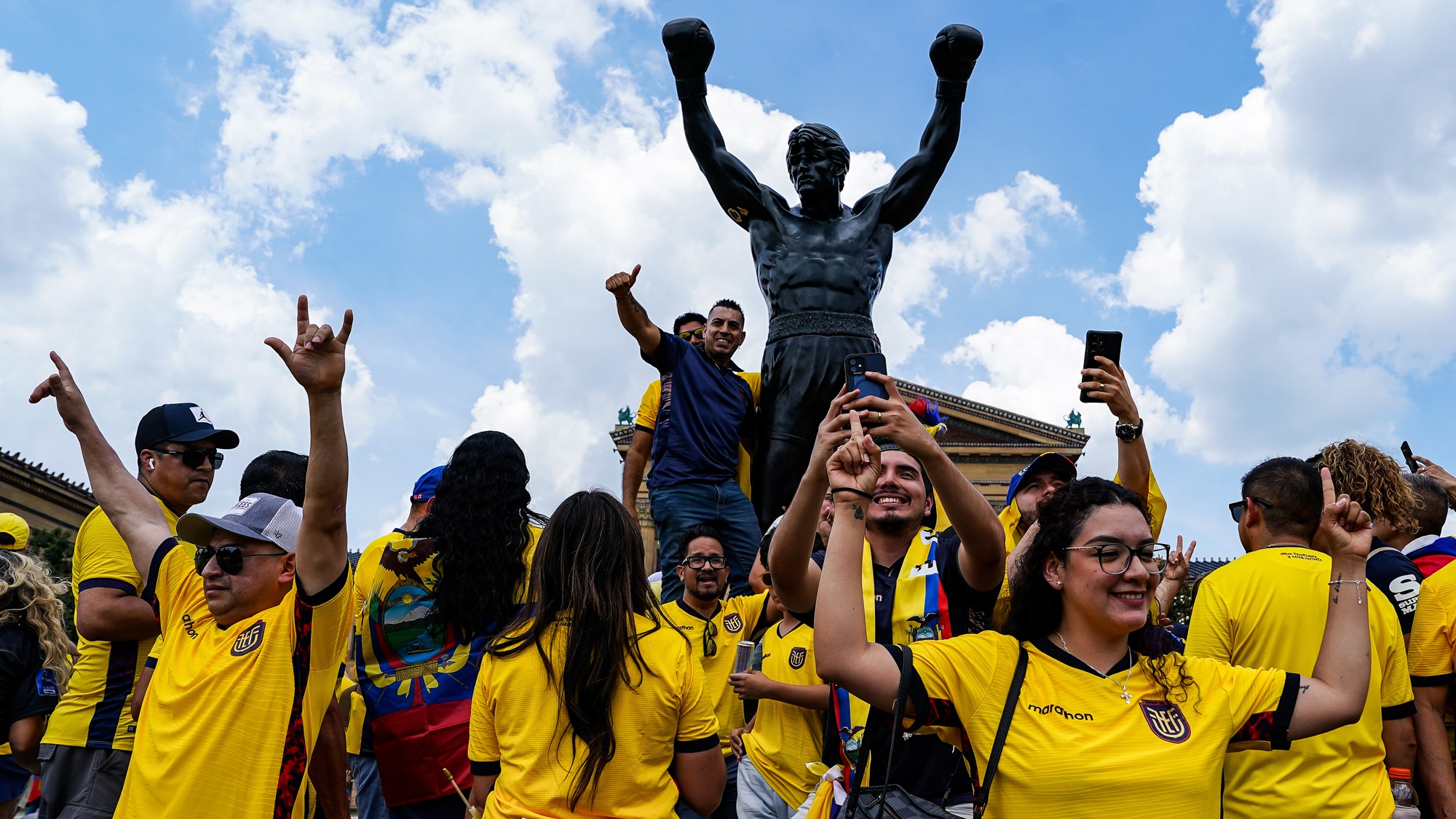
No doubt at least some of the mutual enthusiasm between Americans and visiting football fans is sincere. Bostonians joined Scotland’s “Tartan Army” as it marched through their city, blaring bagpipes and drinking its pubs dry. Philadelphians embraced a crowd of raucous Ecuadorans who draped their national team’s yellow jersey over the city’s beloved Rocky statue (a classic blunder, as it turns out). It’s probably not a coincidence that so much American hospitality has been showered on Freddy, the character whose story feels the closest to authentic of the bunch. I verified with spokespeople for both the Houston police and mayor’s office that his interactions with them really happened.
Yet even Freddy is keeping close control of his own story and has studiously stayed anonymous, at least to online fans. He has been careful not to show his face in any of his posts and has not disclosed his real name. Whatever his initial intentions for posting through his World Cup trip, his great American adventure has gathered a momentum that professional influencers dream of. When Freddy found the care package from Watt in his hotel room, he was moved. “This is all so insane... I genuinely don’t understand how it got to this point,” he posted. “We’re just normal World Cup tourists.😭😭” If that was ever true, it isn’t anymore.
© Daniele Porcelli / Getty

