Five years ago, people who hang out in the stranger corners of the web started arguing that the internet was mostly fake. It had been this way since about 2016, they said, when Google introduced its artificial neural network for machine translation. Supposedly, from that point forward, online interactions began to be replaced, until nearly every message and picture had been posted by a bot. Everywhere you looked, websites were “empty and devoid of people,” as one scholar of the theory put it.
This wasn’t true, but the core idea was tethered to a real phenomenon. Even way back then, in 2021, social platforms were awash in fake views, fake likes, fake traffic, and fake engagement. Some people figured that automation might one day take over the entire web and then our world. They were mostly being silly, or paranoid. Today they seem like … prophets?
“Dead Internet” theory is seeing a revival, this time in mainstream conversation. It’s no longer strange to think that AI might be everywhere, edging out all forms of human interaction: bots talking to bots, all the way down. Every week we seem to take another step in that direction. In June, the Pew Research Center reported that nearly a quarter of American adults now use chatbots every day. Two months later, OpenAI announced an official ChatGPT integration for iMessage. Chatbot-generated text is already widely used for website filler, business emails, and cover letters. Will it soon be commonplace in private messages between friends and family?
The ChatGPT-iMessage integration works on your desktop, not your phone. It doesn’t send messages on your behalf until you’ve reviewed and approved its suggestions. A similar plug-in has long been available for Anthropic’s Claude, and many messaging apps already offer AI-suggested replies. To some extent, OpenAI’s new product simply formalizes something that people had been doing on their own, either by pasting text from one window to another, or by improvising personal ChatGPT-linking software. (The Atlantic has a corporate partnership with OpenAI.)
“Low-effort communication has always existed,” Michael Pfister, a software developer living in Colorado, told me. He said that he had already vibe coded his own version of the iMessage tool months ago. ChatGPT pings him daily to let him know if he’s missed any important questions in his group chat. He tried having it write a text to his friends, just as an experiment, but they immediately noticed that the message was AI. “They tried to prompt-inject me,” he said: They asked the agent what Michael thought of them, in the hopes of tricking it into sharing his private thoughts. He told me that he mostly uses the tool for work and that he isn’t interested in having AI communicate with his friends on his behalf in the future. “I think relationships are experiential,” he said.
Max Weinbach, an analyst at a market-research firm in Connecticut, told me he uses ChatGPT to text with his bosses about work. “It just makes life easy,” he said. It’s hardly different from using Google’s suggested email responses, which have been available for nearly a decade. Weinbach had no ethical qualms about switching to LLM-assisted communication, although he recognizes that it can be taken as a sign of disrespect. “It’s not accepted or polite,” he said. “It’s just kind of a rude thing to do.”
These two are on the bleeding edge, yet exhibiting more restraint than some others. All over Reddit, my favorite repository for human drama, people are worrying about human drama that has a nonhuman interloper. New posts appear each day requesting help in figuring out whether something might have been created with AI: Is this apartment listing real? What about this dating-app profile? What about this video of a cute animal doing something amazing? (A bobcat flagging down a biker to help her rescue her kitten from the bottom of a random hole?)
Many of the requests have a moralistic tone, and the poster comes to the crowd solemnly, with hesitation, because they know the truth may be painful. The most fraught discussions concern AI-generated personal messages. Guys on dating apps are using the technology. Sometimes long-term partners, friends, siblings, or parents do it too. “Is this text apology written by ChatGPT?” someone will ask. Or “Did my mother use ChatGPT to write me a text of support on the morning of my divorce?” The implication is betrayal.
I spoke with Melissa Crowder, a 47-year-old from Alberta, Canada, who shared her own experience with AI texting in a July post on Reddit. She’d spent all day having a “nice conversation” with a match from the dating app Feeld, then finally noticed that their repartee was off when he copy-pasted her own message back to her by mistake. At that point she realized all of his previous messages had been structurally similar—usually two paragraphs of text followed by a question on a single line. And he’d been using the word dangerously way too much. When she asked if he was using ChatGPT, he replied, “Busted” with a bunch of emoji, which also struck her as something ChatGPT might do. “I’m like, this is still ChatGPT.” Then he unmatched her.
Crowder would not have been that mad if the guy had just fessed up and said something normal in his own voice. She sometimes uses AI tools to help her express herself too. She said she has a tendency to ramble on and overexplain her feelings, so she’ll use a site called Goblin Tools to self-edit. She might make a message to her ex-husband “Less emotional” (one of the choices in a drop-down menu) and get straight to the point. She also has a friend who sends AI-written texts from time to time. “Where I would draw my line is where you take the person out of the conversation,” she said. “If I’m vibing with a chatbot and then I meet the person in real life, what is that conversation going to look like?”
For a recent paper, a group of researchers from the University of Washington and Arizona State University studied two popular Reddit forums—r/RealOrAI and r/isthisAI—to figure out how people go about determining which material is AI-generated and which is not. The most common mode of analysis evaluates the fundamental plausibility of an image or a video. (“Babies do not nearly have that much coordination to both be standing up, talking so well and holding up that large cat.”) A smaller number of comments in the study addressed some alleged telltale signs of AI-style texting, including the prevalence of “overly ornate but meaningless phrases.” Other people have noted LLMs’ overreliance on certain words (delve is an oft-noted one), sentence structures (negative parallelisms), and punctuation (em dashes).
The paper ends in an ominous tone. “Our findings suggest that people are developing mental models of what AI-generated content looks like, built on personal experiences and beliefs developed over time,” the authors wrote, before arguing that these mental models were unlikely to be accurate for long. The LLMs will evolve and stop doing the things that now make their output so easy to spot. In fact, the tricks enumerated in the paper are already getting old, one of the paper’s authors, Tina Yeung, told me. “I definitely think this is a snapshot in time,” she said.
The mere fact of people’s concern about AI, and their anxiety over its incursion into day-to-day life, may be a snapshot too. Perhaps the stigma that now exists around using ChatGPT to text a friend or message on a dating app will fade in the years ahead. Maybe one day it will disappear altogether, and even our phones will end up empty and devoid of people. Or else I guess it’s possible—just possible—that the Dead Internet theory is as silly as it ever was.
Meta avoided the worst today by settling a massive lawsuit over alleged damages “to the mental and physical wellbeing of America’s youth.” The case, brought by the attorneys general of 47 states, plus U.S. territories and Washington, D.C., had been mid-trial in a federal court in California and was by far the most significant legal challenge the company has ever faced. To resolve the lawsuit, Meta will have to make a slew of design changes to its social-media platforms, and it will pay more than $12 billion—down from the approximately $200 billion that was initially sought, and a fraction of the $60 billion that the company made in profit last year.
The settlement can be used by the states and other parties to pay for their litigation costs and for a variety of school and community programs. Judge Yvonne Gonzalez Rogers agreed to the proposal this morning, saying “I’m quite happy” and congratulating both parties. There seems to be good cheer all around; Meta, which avoided any admission of guilt, put out a sunny announcement framing the agreement as part of its “longstanding efforts to empower parents and support teens.” Brian Schwalb, the attorney general of the District of Columbia, told The New York Times that the settlement represents a “monumental public health victory” that will “fundamentally and immediately change how young people use Instagram and Facebook.”
The former claim will have to be proved over time, but the latter is clearly true. As part of the agreement, Meta has agreed to submit to regular auditing of both its age-verification systems and its efforts to prevent minors from making multiple accounts to get around its restrictions. And the company will make other tweaks that are intended to target the big recent villains of social media: short-form video and the never-ending feed.
Teen users, by default, will not have access to most features of Instagram and Facebook at night (though they can still access messages and settings) and will not receive notifications from the platforms during school hours (defined as 8 a.m. to 3 p.m. on weekdays from August 15 to June 15). They’ll also be limited to a maximum of one hour a day per platform, though this doesn’t include time spent sending messages or consuming long-form content (which the agreement defines as audio or video at least 22 minutes long). Meta is also required to interrupt scrolling every 15 minutes with pop-ups that encourage “productive pauses,” and the company will have to study how well the interruptions work and submit its findings to an auditor. Parents can still manually change any of these settings for their kids.
The settlement also requires limits on features that some experts believe are detrimental to teenagers’ self-esteem and self-image. By default, teen users won’t see the number of likes or reactions on posts; they also won’t be able to use “cosmetic procedure filters,” which have been a sore spot for Meta for some time. When the plaintiffs filed their complaint, they cited evidence that Mark Zuckerberg had personally vetoed a proposed in-house policy against these filters despite concerns expressed by employees that they were causing young people to develop body dysmorphia. Meta will also be legally required to maintain and enforce the “age-appropriate” content guidelines it debuted at the end of last year.
This may seem like quite a lot of changes—especially considering that the case is not even the end of Meta’s legal problems. The company is still facing numerous lawsuits filed by individuals and school districts. “If Meta is going to resolve all its pending liabilities, this is only the first of several large checks it is going to have to write,” Eric Goldman, a professor at Santa Clara University School of Law, told me. But today’s settlement shows that the tech company was able to “buy out one of the most serious legal threats” it faced, and it managed to do so without acquiescing to demands that might have been truly destructive to its business. Meta will have to give teen users the ability to opt in to a chronological, non-personalized feed, but the company does not have to pivot away from the default algorithmic recommendations that many critics characterize as addictive. It seems unlikely that many people will select a straightforward chronological feed; Meta has tested this change before and found that users did not like it.
As for the one-hour limit, in an email, a Meta spokesperson told me that the average American teenager spends about 66 minutes a day on Instagram anyway, and that teen activity across platforms accounts for less than 1 percent of the company’s revenue. So perhaps these were battles that the company could afford to lose.
The attorneys general “made a bunch of guesses” as to what kinds of changes might help kids, Goldman said, and have pulled off a major success in getting Meta to accept them. Many of these interventions might have suffered First Amendment challenges if they’d been pursued by other methods. (For instance, if the plaintiffs had actually won at trial.) Mark Bartholomew, a professor at the University at Buffalo School of Law, agreed, writing to me that “the state AGs got Meta to consent to dramatic limits on its own speech that Congress was unlikely to go for and the courts were unlikely to bless.”
The company is now promoting the changes widely and calling on other social-media platforms to follow suit. It has also agreed to pay an additional $5.3 billion if TikTok and YouTube, which are also defendants in the ongoing litigation, implement restrictions and pay into the settlement. Although this is not the end of Meta’s legal battles—personal-injury lawsuits similar to the one it lost in March will likely keep coming—the company has won the opportunity to select its own restrictions, define its own limits, and discard its own deal-breakers, effectively setting a standard that the rest of the industry will be expected to abide by without having had any say in its creation.
“Obviously, Meta doesn’t want to unilaterally disarm in the war for user attention while its rivals are allowed to continue,” Bartholomew noted. At the start of the year, when the first of Meta’s big cases came to trial, I wrote that social media had come to a fork in the road: The lawsuits were asking existential questions about whether social-media platforms are responsible for a mental-health crisis and whether it is possible to hold them accountable for it. This agreement answers only the second question—yes, it is possible, but for now, it may be possible on only one company’s terms.
The videos that Instagram suggests in my never-ending “For You” feed are usually of a constellation of women. They’re strangers, but I call them “my girls.” One of them is remodeling her house; one is always cleaning and “resetting” the van she lives in; one is sampling pasta and sandwiches at various New York establishments. And each has something special that I can’t explain to you—a je ne sais quoi, a curious style of speaking—so I’ve come to look forward to my regular glimpses of their lives, which I get when I scroll in bed before I go to sleep each night.
I regard these strangers as my intimates in a way, even though some of them are not people I think I would like if I actually met them. One morning, I was watching one on my living-room television while sipping my coffee. My husband walked into the room and winced as one of the women changed into a perfect re-creation of an American Girl–doll outfit (very theater kid, not his thing). I felt a flash of defensiveness—she makes everything by hand! She has a real sense of self! Not to mention a seemingly sweet relationship with her father and pet birds. I kept scrolling and was relieved that another one of my girls hadn’t appeared. She often records herself eating a frozen dinner on her couch while watching police body-cam footage on YouTube to unwind. And I mean no disrespect to her, but if she had shown up, I would have lunged for the remote.
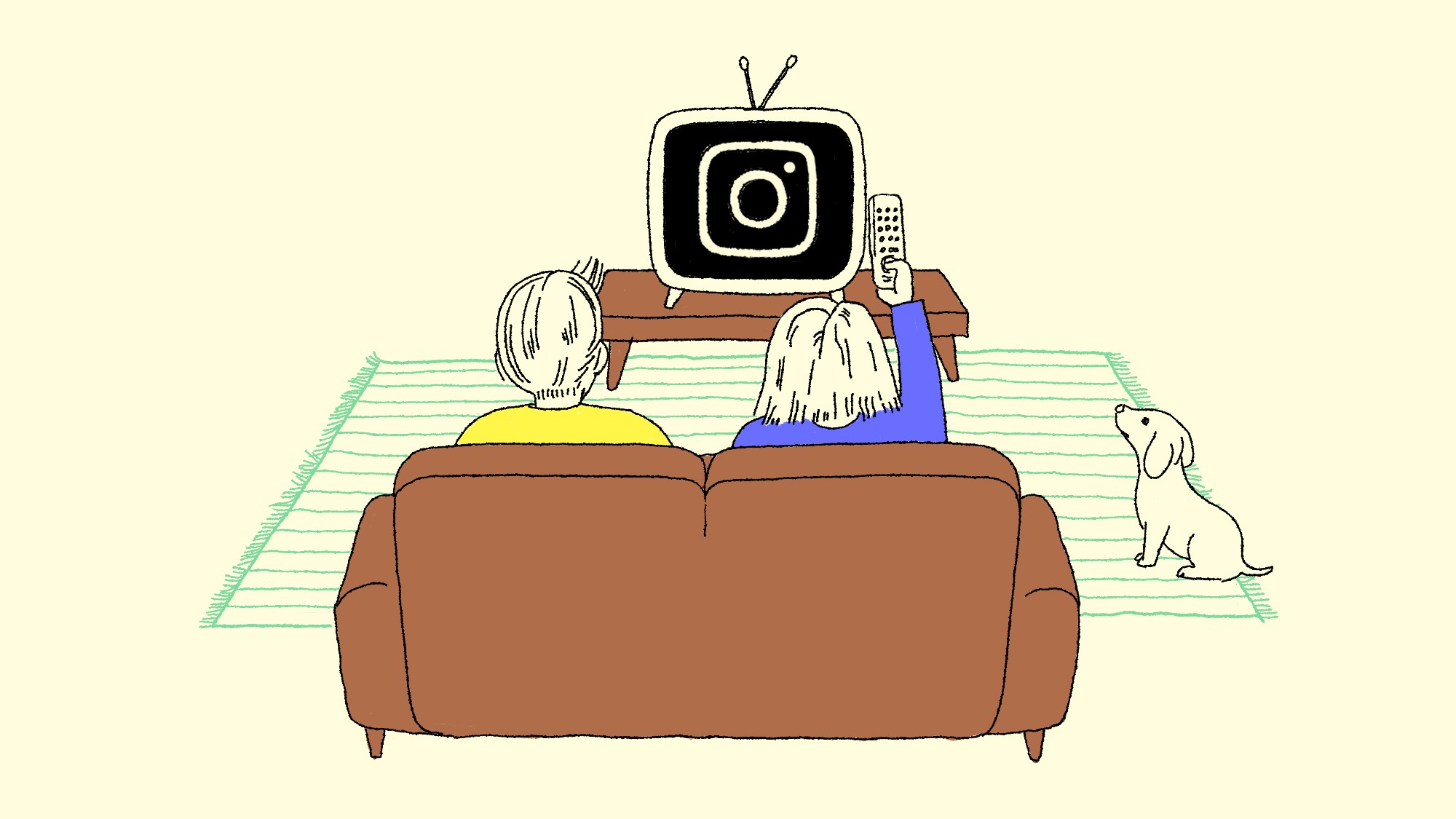
You might be wondering: Why was I watching Instagram on my TV? Instagram’s vice president of product, Tessa Lyons-Laing, has referred to TV as the company’s “next frontier.” As it tries to compete with YouTube and Netflix, Instagram is apparently looking for ways to be … both of them. And so it has launched a stand-alone service for various streaming devices, which it recently expanded with new features to help “friends and family watch together.” This caught my attention: I wanted to try taking the “bad” screen (my phone) and putting it onto the “good” screen (my TV) to see how it would make me (and the people around me) feel.
Years ago, the “good screen versus bad screen” meme originated as a joke about having an office job. The “bad” screen was a desktop computer at work, whereas the “good” screen was a personal laptop, full of one’s own, delightful, self-chosen digital activities. But in 2022, following the coronavirus-pandemic lockdowns, the writer Kate Lindsay noted a shift. When people referred to the “bad” screen, they now seemed to be talking about their smartphone, which they felt hopelessly dependent on, and when they mentioned the “good” screen, they were referring to the humble television, which now felt wholesome and safe. “We’re so convinced that it’s in our best interest to reverse the effects of social media that even watching a 30-minute TV show uninterrupted seems constructive,” Lindsay observed. But maybe, four years later, the 30-minute-show part is negotiable. Perhaps “good” could come just from giving our thumbs a break, looking up instead of down, and permitting other people to see what we’re doing.
My husband was initially wary of adding his Instagram account to our living-room TV, but he acquiesced, and we had kind of a blast watching his feed together. Most of the videos were of male comedians I didn’t recognize; I sounded like the trope of a Boomer mom as I repeatedly asked, “Do you know him?” whenever a new guy showed up. I didn’t mean “Are you friends?”; I meant “Are they Your Guys?” Sometimes they were, and I was honored to meet them. Sometimes they weren’t; they were just guys. We both laughed to the point of tears at a video that some guy had shared of his dad trying to teach him to bunt a baseball when he was 10 years old. I manually liked it with the remote control and then sent it to myself, from my husband, via direct message. On my TV.
“This intrigues me,” Jonathan Gray, a professor of media and cultural studies at the University of Wisconsin at Madison, told me when I asked him about the app. Scrolling has always had a social element, he said, and people will often show a funny or interesting video to the person next to them. But he was skeptical of whether they would want to share every bit of their feed with their loved ones. “It’s one thing when I turn my phone to my wife and say, ‘Hey, you’ll like this,’ but 90 percent of what I see, she won’t want to watch,” he said. “It seems kind of painful.” Plus, his wife is learning how to whittle at the moment, and he doesn’t want to watch a bunch of whittling videos.
Gray also noted that the recommendation algorithms sometimes take big swings and throw new things at users to learn whether they’ll be interested. One might worry a little about the big swings that could appear on your TV, which to others in the room might appear to be something you’ve already expressed enthusiasm about. When I asked the Instagram spokesperson Christine Pai whether the TV app would filter out any weird stuff, she told me that both apps are using the same recommendation system. (The only specific difference she cited is that the TV app will give an edge to horizontal videos, because they are better suited for the display.)
The app does allow users to play themed “channels” based on their preestablished interests, so you don’t necessarily have to show off your entire, highly variable and sometimes unpredictable feed. The idea with the channels seems to be that making the secret, private shame of scrolling into a collaborative activity will give it a new place in the home. It can be more like watching America’s Funniest Home Videos together after dinner and less like sitting side by side, staring silently at something in your lap. People feel ambivalent about scrolling feeds, Marika Lüders, a professor of media and communication at the University of Oslo, wrote to me on this point. We find it entertaining at times, but we also feel embarrassed and guilty about it. To her, moving Instagram from a phone to a TV seems like “a strategy to increase the status of short-form videos,” by putting them on a screen that people (currently) feel less anxiety about.
That makes sense to me, though I find it just as easy to imagine how this may backfire for the company. Many people who are attempting to cut back on their Instagram use remove the app from their phone and use only the desktop-computer version, which is clunkier and less comfortable to scroll through for hours. Using it is so nonintuitive and unnatural that it calls attention to the absurdity of one’s habit. Moving Instagram to a bigger screen, then, is usually a route not to normalizing it in that new space but instead to severing ties with it altogether. The differences between a phone and a TV are even more dramatic and may be even more off-putting.
Surely the novelty will wear off. Last week, while visiting my sister-in-law and her boyfriend, my husband and I asked them to show us their feeds on their TV. My sister-in-law’s was funny because it was full of wedding-planning content—she’s currently waiting on the requisite engagement ring—and because she kept getting videos of this one baby who’s obsessed with Bad Bunny. Her boyfriend got a hairless cat, a guy pretending to be Wolverine, and a recipe for butter-chicken macaroni and cheese. Those were a little funny, too, but because you don’t know him, you don’t get why and you don’t care. After 20 minutes or so, we got bored of the experiment and left for a baseball game. Later, in the quiet of my hotel room, I went back to my own, private phone.
There are worse things you could do than drive to a Parisian airport and mess around with a temperature sensor on the airfield—for only a few minutes! But why do that at all?
To make money, maybe. This is the scheme that some mysterious person (or persons) reportedly carried out in April to win a bet on the prediction-market platform Polymarket, which allows people to wager on the highest temperature in Paris on any given day, not unlike weather derivatives. The popular version of the story says that the shadowy figure warmed the sensor with a hair dryer—a photo showing this turned out to be AI generated—but it could have been anything. A lighter, a hand warmer.
By artificially boosting the number on the sensor, this person won about $20,000. The French police are investigating because you can’t trespass at the airport or tamper with its equipment, but Polymarket apparently didn’t take the winnings back. (It did change the airport that it relies on for Paris-temperature readings; the French government, however, blocked access to the platform this week.)
Over the past couple of years, plenty of concern has been expressed about how prediction markets may enable—and create the incentive for—insider trading. Some of the many people who have wagered on markets corresponding to when a war would start, when a regime would change, or even who would be at Taylor Swift’s wedding may actually have known the outcome before it happened. “Mention markets,” which allow participants to bet on words that a public figure might use in a speech, or how long the speech will be, can obviously be gamed by people close to the figure in question—just last week, ABC News reported that a teleprompter operator at the White House has made more than $100,000 by using Kalshi to wager on President Trump’s speeches. (“The White House has strict ethics guidelines that we expect all staffers and officials to follow,” a White House spokesperson told the outlet, while confirming that the employee had been placed on leave.)
The issues with insider trading are clear: It’s illegal, for starters, and the platforms ban it, anyway. (Although insider trading also arguably serves the purpose of prediction markets, which is to channel the “wisdom of the crowd” to forecast the event most likely to happen.) People can also easily identify and avoid the markets most susceptible to it. But what about the hair-dryer sort of trading, when an apparent outsider changes the course of events to cash in on a given outcome? “I think of it as probably a bigger issue or problem than insider trading would be,” Vincent Grégoire, a professor of finance at HEC Montréal, told me. The Parisian-airport incident didn’t hurt anybody, but future ones might. (You can imagine a bunch of ways in which someone might create a dangerous situation while, for example, attempting to delay an airplane.)
Some experts call this type of fraud “manipulation of the physical world”—a riff on market manipulation. I asked others for catchier ideas. Joshua Mitts, a professor at Columbia Law School, wasn’t sure that manipulation was the right word, because it has a specific definition for financial markets, but he still kept saying it accidentally as we spoke. I agree that the term is a little lacking. Manipulating the physical world is what I do every moment of every day as I breathe and walk. I would call this type of fraud “outsider trading.”
Outsider trading is also against platform rules. Polymarket and Kalshi both prohibit any type of market manipulation. When I reached out to Polymarket to ask about what had happened in Paris, a spokesperson relayed a statement to me from Olivia Chalos, its deputy chief legal officer, who wrote that Polymarket “maintains monitoring, review, enforcement, and reporting processes to address potential violations.”
But it’s obviously a bit of a whack-a-mole situation. The U.S. Commodity Futures Trading Commission recently proposed more federal rules for prediction-market platforms to ease the problem. One of the big suggestions was to prohibit the listing of markets that would “create perverse financial incentives”—for instance, markets on wildfires or a market on whether a famous ape named Little Joe would escape from a zoo (for a second time). Polymarket includes a note on that market explaining which law a person would be breaking if they attempted to free the gorilla themselves, and that they could receive a life sentence in prison for doing so. That may have been the first time a prediction-market platform has featured such a warning, the Bloomberg columnist Matt Levine noted in a May newsletter, “but I have not done a comprehensive survey and I doubt it’ll be the last.”
The experts I spoke with said that the most appealing markets for this kind of trickery would rely on a single number or simple, discrete outcome that a normal person could cheaply affect—the temperature reading in Paris, for example. Caleb Davies, an internet-famous prediction-market trader, highlighted another when he wrote about his experience losing thousands of dollars betting on Spotify’s streaming charts, which scammers had apparently figured out how to game by artificially juicing how many times a given song was played. Davies says the experience led him to an epiphany. He’s no longer just betting on the data, he said: “I’m also betting that nobody is going to mess with it.” And that’s a bad bet.
Davies posted a screenshot to X to show that he’d removed about $250,000 from his Kalshi account, and he says he’s stopped using it entirely. “I love prediction markets,” he told me. “I’d love to keep playing in them. But right now, both platforms are garbage, I think.” When I contacted the company for comment, the Kalshi spokesperson Jacki McGavick said that Kalshi “takes market manipulation or fraudulent activity as seriously as any federally regulated financial exchange” and is investigating the Spotify incident.
For the sake of conversation, Davies scrolled through Kalshi while we were on the phone, looking for opportunities for manipulation. Spotify charts were a good one, he knew. Rotten Tomatoes scores would be better (more money), though a little harder to game. (Nevertheless, New York magazine’s Matt Stieb figured out how to do it.) I pointed out to him that a market was open for the timing of this year’s first human case of screwworm in the United States. You could expose yourself to some infected livestock. But he wasn’t interested. “I think I’d just rather not make money than do that,” he said. “I’ve read about that—it doesn’t sound very appealing.”
Right now, the platforms—which are very much in advertising mode—carry a lot of markets that don’t have a ton of trading volume. They want as many as they can to attract new users and generate revenue. Also, a lot of them are funny: Most people probably recognize that it’s a waste of money to wager on whether Little Joe the gorilla will escape, but it’s fun to talk about. As more outsider-trading stories surface, though, people will likely be more hesitant to participate in markets that seem easy to rig. This problem, even more than insider trading, may start to limit what Polymarket and Kalshi can offer.
There are plenty of things the platforms could do to intervene in outsider trading, Joshua Della Vedova, an associate professor of finance at the University of San Diego’s business school, told me. They could limit the size of bets in markets in which the result would be easy to rig. They could look for suspicious trades using some of the same methods that detect insider trading. His preferred method looks for “excess accuracy.” If someone bets that an Olivia Rodrigo song is going to hit No. 1, that makes sense—but if they also specifically bet “no” on Drake and Charli XCX and Bad Bunny, then they’re demonstrating a suspicious amount of confidence. That confidence could come from having an inside line, or it could come from using bots to spike streams artificially. Platforms could also disallow markets that are resolved by checking a single number from a single source, he suggested. That would have solved the issue at the Paris airport, for example, and it’s not as if Polymarket couldn’t have used an aggregation of weather data, rather than just one reading.
Without some change, the platforms may continue to send ripples through reality—beyond just the goofy markets that they choose to list. A Wall Street Journal report found that Polymarket had been encouraging people to share videos with faked versions of their Polymarket dashboards, showing made-up earnings on imaginary bets that never happened. Weirder to me were the staged viral clips through which Polymarket and Kalshi looped themselves into the New York Knicks’ run to their first NBA Championship in more than 50 years.
In one of those clips, a purported Knicks fan outside Madison Square Garden yelled, apparently improvisationally, “My mayor Muslim, my bagels Jewish, my Christian Dior, Knicks in four.” Later, when it turned out that he hadn’t made this up at all—someone had posted it as a TikTok comment weeks before and parts of the rhyme were even older—and that the mic he’d yelled into had been Kalshi branded, the whole thing a Kalshi stunt, nobody seemed to care. The chant became real. It was everywhere.
The platforms pitch themselves as truth machines, which could mean a couple of different things. Are they finding it or making it? At some point, it may be difficult to identify the difference between reflecting our reality and creating a new one—or doing both.
When the 82-year-old psychologist Peter Gray describes the way he grew up, he punctuates the anecdotes by saying that modern parents would be arrested for letting a child have such fun. When he was 4 years old, he would walk to a store in Minneapolis to buy cigarettes for his grandmother. When he was 11, he would sometimes stay home from school in Hill City, Minnesota, to operate a newspaper printing press owned by his mother and stepfather.
His parents were not arrested, and that’s because the childhood they permitted him to have was basically normal at the time, even if his family did have a newspaper printing press in the house. As a boy, Peter was obsessed with fishing and baseball; neighborhood friends taught him how to ride his bike and catch grasshoppers. Although Gray’s career as a scientist would begin with laboratory studies of rat hormones, he eventually found his way to writing about his childhood, in a fashion. Over the course of his 30 years in the psychology department at Boston College, he mixed principles of biology and anthropology to put together an evolutionary theory of play.
Gray’s academic work defines play as a self-directed activity done only for its own sake. This, he came to believe, enables kids to figure out how to solve their own problems, nurture their own relationships, make their own rules, and manage their own disappointments. But he says that our society has spent the past 70 years or so interfering with that process. We’ve made it harder and harder for kids to do anything: They’re kept indoors for greater portions of the day and given less unstructured time; they play organized sports supervised by adults; they don’t go anywhere alone. Gray grew certain that this loss of independence has been harmful to their mental health.
Gray’s theory, which he laid out in a 2013 book called Free to Learn, quickly found a welcome audience. The book was celebrated by advocates of free-range parenting and won endorsement from academic luminaries such as Steven Pinker. When Gray’s fellow psychologist Jonathan Haidt and his co-author Greg Lukianoff published their 2018 best seller on the threat of safetyism, The Coddling of the American Mind, they used the title of Gray’s popular TEDx talk “The Decline of Play” as a chapter header. Haidt, who is an Atlantic contributor, told me that Gray was “the star academic” in the section of his book that deals with play. “I wish every school in America could hear a talk by Peter Gray,” he said.
Only recently has Gray expanded his idea in a way that is not quite so crowd-pleasing. Children’s need for unstructured play and exploration (guided by some safety rules and common sense) applies not just to vacant lots and city parks and backyards in the suburbs, he says, but to other settings too. It now extends to the wild spaces of the internet. “To grow up well, children have to be able to play in the world that they’re growing up in,” he told me when we spoke at his home in late winter. Kids should be free to play without their parents’ supervision, Gray insists, even when they go online.
Gray has always been a playful academic. As a graduate student at Rockefeller University during the late 1960s, he once filled every mailbox at the school with a note proclaiming that neckties were no longer required in the dining hall because they stifled thought by cutting off circulation to the brain. But the turning point in his career came a decade later, when his son, Scott, took up the mantle of rebelling at his school. Gray and his now-late wife moved him to a nontraditional school in Framingham, Massachusetts, where children received no formal coursework and directed their own education.
Scott thrived in his new environment, and Gray, who saw how much happier and more engaged his son became, pivoted from doing lab experiments on rats to making more philosophical explorations of play and learning. He also studied his son’s new school, publishing survey data on the careers and lives of its alumni, as well as detailed observations of how its students played.
Eventually, Gray would have enough of structured academia himself. By 2002, he’d made sufficient money off of a well-regarded psychology textbook that he was able to resign from Boston College and live comfortably in the small town of Millis, Massachusetts. The back of the wood-paneled house that he shares with his second wife is made entirely of glass, providing a broad view of the Charles River. By his account, his retirement has been as idyllic as his childhood. Gray sometimes kayaks against the current, up the river, for exercise.
When I visited him on a frigid day in March, he was wearing the uniform of a practical person—simple shoes, navy trousers, light layers topped with a grandpa cardigan. David Sloan Wilson, an evolutionary biologist and friend of Gray’s who is a professor emeritus at Binghamton University, described him to me as an old man with a “very boyish look.” I would say he is more like a child’s drawing of a nice old man: pure-white hair, a reedy frame, smile lines.
Wilson also described his friend as a pied piper, apparently intending this as a compliment. And from his riverside retreat, Gray has been involved in leading a movement. In 2017, he joined up with Haidt and two others to found the nonprofit Let Grow. The organization, which raised about $2 million in contributions in 2024, encourages parents and teachers to stop watching kids so intently, and tries to fight “neglect” laws that frame a lack of child supervision as criminal or reckless behavior. Let Grow has also developed a program called Play Club, through which schools can offer age-mixed free-play time when the kids (mostly) supervise themselves.
Gray and Haidt both served on the group’s board of directors. They had a collegial relationship, even though there were some minor differences in approach and worldview. The first of those was on the subject of kids and video games: Gray thought that video games provided kids with fruitful ways to play without adult control and was adamant about their value; Haidt respected that position but wasn’t so sure. The two psychologists also disagreed, from time to time, on whether kids should be using social media. But these seemed, at first, like secondary issues.
Then, in 2023, Haidt sent Gray a prepublication copy of his next book. The Anxious Generation: How the Great Rewiring of Childhood Is Causing an Epidemic of Mental Illness opens with an extended metaphor comparing smartphone and tablet use to a spine-melting trip to Mars, and goes on to make the case that personal technology has caused a full-scale youth-mental-health crisis. Its argument seemed to fit the moment: Children were reporting that they didn’t like how much time they spent on social media and didn’t feel like they were in control of their habits; some were truly suffering. The Anxious Generation gave them—and their parents—language to describe what was happening.
Haidt’s book went on to spend more than two years on the New York Times best-seller list. It was translated into dozens of languages and excerpted in this magazine. And the policies that it suggests, to remove smartphones from schools and bar kids younger than 16 from social media, quickly came to seem like obvious solutions. (In the past few years, they’ve been taken up by legislators in the United States and abroad.)
But when Gray first read the manuscript in his lofted study overlooking the river, he was appalled. “The book frankly makes me mad,” he told me. “I have to say that. I think it’s unethical.” Although The Anxious Generation goes on at length about the benefits of free play, and even makes specific mention of Let Grow, its message overall was for Gray inimical to the nonprofit’s mission. As he sees it, the analysis improbably suggests that taking away phones would prompt kids to run around exploring as their grandparents had done. The few freedoms that kids had left were private communications with their friends and some independent movement, permitted only so long as they could be tracked and called. More than that, Haidt’s book implies that kids cannot be trusted to delve into the online world on their own, or even taught to do it safely. The internet is too dangerous for children—too full of scary strangers and powerful temptations—much in the same way that parents and pundits had decried the perils of the physical world generations before. Haidt had wanted feedback on the manuscript. Gray told him he disagreed with its premise.
Months later, after the book came out, Gray stepped down from the Let Grow board so that the other members wouldn’t feel caught in the middle of a conflict. Then he posted a critique to his Substack. Gray wrote that he took “no pleasure” in rebutting his colleague’s work. “I have tried to avoid it but no longer can,” he wrote. “As a society we have almost a knee-jerk reaction to believe that the solution to any problem experienced by kids is to deprive them of yet one more freedom, and this book is helping to jerk some of those knees even further.”
The two men haven’t spoken a word to each other since their falling-out. “Jonathan Haidt is a likable person,” Gray told me. “He’s polite. He’s generous.” Gray said he is a fan of Haidt’s previous work: “His strong point has always been kind of large, somewhat philosophical arguments based on general observations and a certain amount of evidence, and he’s very good at that.” But Gray viewed Haidt’s newest large, somewhat philosophical argument as not only incorrect but immoral.
The first time we spoke, Gray referred to social-media age minimums as a violation of human rights. When we met in person, I asked him whether that was truly his position. He repeated that it was. Before The Anxious Generation was published, Gray had been working on another book about the broad topic of play. But he scrapped that one after posting his rebuttal, and instead began to write a full-length counterpoint to Haidt’s ideas for an imprint at Penguin Random House. That book, titled Restoring Childhood: How to Set Kids Free in the Age of Anxiety, is due to publish in September.
The new book will argue that the mental-health crisis affecting children is real, but has nothing whatsoever to do with what Gray describes as the “moral panic” over smartphones and social media. The real problem, he says, has to do with schools—and in particular with the 2010 rollout of the Common Core standards, which narrowed teachers’ options for creative curricula and increased the amount of time that the average American student spent taking tests.
To make that case, Gray points to the American Psychological Association’s annual Stress in America study, which surveyed kids in 2009, just before Common Core was introduced, and in 2013, just after. In 2009, 43 percent of U.S. teenagers said that performing well in school was a source of stress in their lives. In 2013, this number jumped to 83 percent. Gray found analogous survey data from before and after similar educational reforms in Sweden and England were put in place.
School policies were not the only things that changed from 2009 to 2013; smartphone use, for example, skyrocketed across the same few years. But lots of evidence affirms the notion that in America, at least, children are more stressed out by school than by any other aspect of their lives. Young people often say that they hate school, and youth suicides are far more common during the school year. In 2024, 68 percent of U.S. teenagers surveyed by Pew Research Center said that they felt a great deal or fair amount of pressure to get good grades—significantly more than those who said they felt pressure to look good or fit in. Studies of teens in North America and parts of Europe also suggest that school pressure has increased more for girls than it has for boys over the past two decades, which is consistent with the fact that, in some respects, the teen-mental-health crisis has been more intense for girls.
Restoring Childhood goes on to make another, even more surprising argument: It says that computers and video games have actually been responsible for improving children’s mental health. Teen suicides rose in every decade from the 1950s through the 1980s, Gray writes, as restrictions were increased on children’s freedoms. Anxiety and depression seem to have been rising too. But that trend was temporarily reversed by the arrival of the digital world. Suddenly, kids had a new place where they could connect with one another, make their own rules, and solve their own problems. They were among the early adopters of the new technologies, and so became authorities in their households, giving them a chance to feel competent and helpful. Teen-suicide rates never went back down to the levels of the 1950s, but they did decline by about 40 percent from 1990 to 2010. “Everybody was ignoring that,” Gray said. “Nobody was writing about that.”
Just two years ago, Penguin Random House put out The Anxious Generation. Now the publisher seems confident that people are ready for a counternarrative: Gray says that he received a $500,000 advance for his newest book. Wilson, the Binghamton professor and Gray’s friend, told me that he read the book in manuscript form and found himself convinced. “I want it to have the exact same exposure and impact as Jonathan’s book,” he said. “I would like it to be as splashy as it could be and to set up conversations at every level as to which of these interpretations is correct.”
You will not be surprised to hear that Haidt has a very different reading of the evidence. When I asked him what he made of the claim that computers were actually a boon to children’s mental health from 1990 to 2010, he instead proposed that any improvement during that period might have resulted from the phasing out and banning of leaded gasoline. (Lead exposure has been tied to developmental disorders and mental-health problems.) As for Gray’s critique of his smartphone-and-social-media hypothesis, Haidt said that it was overly reliant on the dissenting opinion of what he characterized as a minority of researchers. In particular, he mentioned Candice Odgers, a psychology professor at UC Irvine, and Christopher Ferguson, a psychology professor at Stetson University.
Gray does feature Odgers and Ferguson in Restoring Childhood, but these are not the only scholars who have taken issue with the science as presented in The Anxious Generation. I spoke with more than a dozen people who study technology and child development, and many expressed concern that Haidt overstates the strength of correlational findings and suggests causation where it hasn’t been proved. (A 2024 report on teenagers’ use of social media from the National Academies of Sciences, Engineering, and Medicine concludes that “the scientific literature on the health effects of social media use is mixed and inconclusive.”) Several of them also quibbled—as did Gray—with Haidt’s emphasis on controlled experiments that found people’s mental health improved after breaks from social media. They said these are flawed because participants consciously or subconsciously know the results that are expected of them. (Haidt, when I put this to him, replied: “If all you can say is, Well, maybe they could guess the hypothesis, then you basically are saying all psychological research is useless.”)
But if the quality of Haidt’s arguments and evidence is up for debate, the same is true of Gray’s. The dangers facing kids on social media, for instance—in an ecosystem that was specifically designed to capture their attention for profit—aren’t quite analogous to those they’d find offline. Or take the crucial data from the Stress in America surveys, which are presented in Restoring Childhood as a meaningful signal of the harmful effects of Common Core reforms. Reported levels of school stress did double from 2009 to 2013, according to that work, but the numbers roughly doubled for other common stressors, too, including family finances—so any school-related effect on stress does not appear to be unique. When I asked Gray about this issue, he said it had been “nagging” at him, and that he was going to add a footnote to the book about it before publication. I pointed out to him a few weeks later that the surveyors had also changed their methodology between 2009 and 2013. The phrasing of the questions had shifted; the first survey had asked respondents to select their top two stressors, but the second one asked them to assign scores to a list of possible stressors. Gray was caught off guard by this, and he went on to ask his publisher to adjust or remove any reference to the Stress in America surveys. That request arrived too late to change the print edition, but Gray said he plans to make the edit to the ebook and audiobook.
Restoring Childhood does offer other lines of evidence, though. “I think there’s a reasonable hypothesis here,” Ferguson told me when I asked about Gray’s book, which he had read in advance, and blurbed. He said he thinks that focusing on schools as the source of children’s mental-health decline makes sense, but added that he would like to see more evidence that the school environment had gotten that much worse. “My memory of schools in the ’70s and ’80s was: They also sucked,” he said.
Odgers, who also provided an endorsement for Restoring Childhood, told me that she appreciates the fact that the book is “broadening the conversation” about children’s mental health to include “a major stressor as reported by young people, that we actually see in the data.” But she expressed frustration at the logic used by Gray and Haidt alike. She noted their shared willingness to apply one explanation (video games, unleaded gas) to the mental-health improvements of the 1990s and 2000s, and then a completely different one (Common Core, social media) to a later section of the same trend line. No serious epidemiologist would reason in this way, she said. Both Gray and Haidt tended to downplay other obvious factors, such as the severe adult-mental-health crisis that unfolded during the same years. “Caregiver mental health is by far the strongest predictor of childhood mental health,” Odgers said.
Pete Etchells, a professor of psychology and science communication at Bath Spa University, also pushed back on the idea that Common Core is the primary cause of mental-health problems among American kids. “This is a common trap that we fall into when trying to figure out what’s going on with those declines,” he told me. “We try to answer the question of ‘What one big thing can explain this?’ The answer, in my view, is that there isn’t one big thing.” This was generally the thesis of Etchells’s own book Unlocked: The Real Science of Screen Time (And How to Spend It Better), which came out the week before The Anxious Generation did, sold only a few thousand copies, and received hardly any attention at all.
Come September, the fight over that “one big thing” will be renewed. Which change that happened 15 years ago was the real source of so much misery for children? “You can’t run experiments on history,” Haidt said, so we’ll never be able to prove that smartphones and social media caused the steep decline in youth mental health. “We just have to say which hypothesis is more plausible,” he said—and he’s yet to hear one more plausible than his own.
When I met with Gray, he said that he has total confidence in his idea: “The evidence is really very overwhelming.” Later on, I tried to press the issue: Couldn’t there be some other factors in the mix? What if Common Core had been just one of many causes of the problem? “It would be nice” if there really weren’t any one big thing, he said, but he simply didn’t feel that this was the case. “So far, I haven’t heard of any other possibility that has the same plausibility.” He’d been studying the numbers and considering the alternatives, and he didn’t see how his theory could be wrong.
Sylvia Meagher was 44 years old in the fall of 1965 and lived alone, except for her cat, Allegra, named after the ballet dancer Allegra Kent. She commuted from her one-bedroom apartment in the West Village to the United Nations, where she’d been working for nearly two decades at the World Health Organization. Although Meagher was a bureaucrat, her sensibilities were bohemian. She was acquainted with many of the painters, musicians, and writers who lived near her. In her foyer, Meagher displayed a painting of a nude figure given to her by a neighbor, the expressionist Alexander Dobkin. But the focal point of her living space was a bookcase laden with 26 reference volumes bound in dark-blue cloth. These were the supplemental materials of the Warren Commission Report. Only a few hundred private citizens in the United States purchased a copy of the 18,000-page, 54-pound series as soon as the Government Printing Office made it available. Far fewer had read it end to end. Perhaps only Meagher had nearly memorized it.
Released in September 1964, the Warren Report was the government’s official story of the assassination of President John F. Kennedy. The report’s key finding was that an odd, angry, 24-year-old assassin, Lee Harvey Oswald, had acted alone, for reasons nobody could quite figure out. The public evidence—exhibits, hearings, et cetera—was piled into the supplementary volumes. The government did not furnish an index, making casual inquiry incredibly difficult.
During the year since she’d received delivery of her crate of the volumes, Meagher had been reading and rereading. She’d remade her living room into an office, with filing cabinets for notes and correspondence, and a large desk positioned near the fireplace. She took a volume on the subway each day and made notes on a clipboard; she worked during her commute, during her lunch hour, at night when she got home, and every weekend. One of her friends, the French journalist Leo Sauvage, called her “the only person in the world who really knows every item hidden in the 26 volumes of Hearings and Exhibits.”
Meagher was neither a conspiracy theorist nor a wannabe detective. She considered herself a “critic” of the Warren Report. A New Deal liberal with a far-left social circle, she had been subjected to questioning by a loyalty board during the Red Scare, putting her at odds with her government. When the president’s assassin was identified as a pro-Castro Marxist—not a segregationist or a radical right-winger, as many initially assumed—she felt compelled to walk through the existing evidence, piece by piece, and demonstrate where things fit and where they didn’t. She spent more than a year creating an index for the 26 volumes. At the same time, based on her clipboard work, she wrote her own analysis of the case, which was published in 1967 as Accessories After the Fact: The Warren Commission, the Authorities, and the Report. And much later, hundreds of her letters and most of her personal notes ended up archived at Hood College, a small liberal-arts college in Maryland.
Through twists and turns of curiosity (and mid-pandemic boredom), I ended up reading Meagher’s papers and becoming obsessed with her obsession. Digging into the Warren Commission’s evidence, in Meagher’s time, was regarded as something more than eccentric. A journalist called people like her—the bookkeepers and graduate students and stay-at-home moms who journeyed to the National Archives in search of answers about the assassination—a “keening pack of speculators.” It was generally considered antipatriotic and morbid to interrogate the official account.
Today, there is nothing fringe about checking the facts or “just asking questions” of an official story. Everybody does it. You could credit the critics of the Warren Report for a great act of citizenship, but you could also credit them with inventing an American pastime: They discovered that there is something thrilling about a document dump, and picking through boxes and boxes of government files. We have often associated these habits with conspiracy theorists, truthers, and the nation’s most paranoid, but in the modern era of digitized records, anyone can jump down a rabbit hole anywhere, anytime, even on their phone. Online influencers can invent careers by plumbing the court docket in a celebrity lawsuit (see the Blake Lively–Justin Baldoni case). Members of Congress can make national headlines by demanding minutiae from the Hunter Biden–laptop saga. The public can scroll through thousands of pages of records related to the crimes of Jeffrey Epstein, looking for mentions of President Trump.
Even when there is no promise of revelation, the search can be its own justification. Mine took me into a semisecret world that I could barely explain to my friends and family. The conspiratorial view of American history was both enticing and maddening, and I sometimes felt like the more I learned, the more I didn’t know.
The federal government’s records on the Kennedy assassination are housed in one of the largest archival facilities in the world: the National Archives at College Park, Maryland. In contrast to the dark and uncomfortable spaces that Warren Report critics would have visited in the original Archives building, on Pennsylvania Avenue, the reading room in Maryland is a dream. It has fantastic natural light enabled by so much glass—two-story windows wrap the entire space—that it was closed one morning while I was there because of a tornado warning.
On my first day there, to work on a book about Meagher and her friends, I learned that the JFK files are much more annoying to access than many of the others in that building. Only select Archives employees are permitted to go into those stacks; one staffer suggested to me that this is because anyone can disappear in there, sucked down rabbit holes, if there are no guardrails.
By the end of the first afternoon, I knew why. I was stumbling across amazing material, just in the boxes they’d brought to me in the reading room. They didn’t shed any light on the Kennedy assassination, exactly, but they shed light on everything around it. For instance, I spent at least an hour captivated by the paper trail left by the FBI as they tried to figure out how Dorothy Kilgallen, a New York tabloid reporter and game-show panelist, had gotten ahold of Jack Ruby’s testimony to the Warren Commission before it was published. The following year, she died in a bedroom of her Upper East Side townhouse at the age of 52, apparently from “acute ethanol and barbiturate intoxication.” Naturally, some people didn’t buy that it was a simple overdose.
I told my fiancé that there was more that I really needed to see, which I thought was true, but really I just wanted to keep looking. I ended up extending my research trip by nearly a week. One detour led me to Paul Krassner, a founding member of the Yippies, a radical (and radically goofy) New Left group. In 1976, Krassner was promising to sue the FBI over a fake reader letter it had sent to Life magazine in 1968, as part of its COINTELPRO anti-subversive program, calling him a “raving, unconfined nut.” This document was in the JFK files because it also mentioned Krassner’s infamous parodic account of the assassination, which depicts Lyndon B. Johnson engaging in necrophilia with JFK’s corpse aboard Air Force One. (Was this relevant to my book? No.)
One day, I was captivated by a story turned up by a Warren Report critic named Shirley Martin, a housewife in rural Oklahoma who was “commonly regarded as a busybody,” according to FBI agents who were monitoring her. While she was hoping to disprove the government’s theory that Oswald had attempted to assassinate the ultra-conservative General Edwin Walker in April 1963, she’d heard a rumor that Walker had entertained his own theories as to who was responsible. He had allegedly hired a private detective to find suspects, and the detective—in a twist worthy of a Coen-brothers movie—offered one suspect $5,000 to try to kill Walker, just to see if he would do it. The suspect asked for a fake passport and a getaway driver, appearing to take the plot seriously, but the detective was convinced that he was merely trying to con him out of the $5,000. (Relevant to my book? Actually, yes. I used the episode to illustrate how close Martin’s digging brought her to real, dramatic events.)
Sylvia Meagher, the woman who memorized the Warren Commission’s evidence, once described the experience of being carried away on a research tangent: “In the search for one document or one fact, the eye discovers and is trapped by a totally unrelated and fascinating document.” Meagher complained that she wouldn’t have enough time to spend on the case even if she didn’t have an actual career. Merely investigating Lee Harvey Oswald’s whereabouts throughout 1963 could’ve been its own full-time job. The alleged gunman had been spotted all over the continent in the last few months of his life, according to a flood of reports fielded by the Warren Commission. People thought they saw him in the guest book at the American Museum of Atomic Energy in Tennessee; checking in to the Skyline Motel in Pulaski, Virginia; passing out Fair Play for Cuba pamphlets in Montreal, “accompanied by a short, homely, heavy woman who took unusually long steps when walking,” according to one citizen. The commission considered a report from a magician-ventriloquist who’d been in residency at Jack Ruby’s Carousel Club for two weeks before the assassination, and was certain that Oswald had been a volunteer for a memory trick that involved 20 audience members shouting out one word each in rapid succession. Meagher kept such reports in a folder she labeled “False Oswalds.” In 1966, she helped the UC San Diego philosophy professor Richard Popkin with his famous New York Review of Books essay “The Second Oswald,” which popularized the idea of Oswald decoys, and she later refined it in her own book.
The concept of multiple Oswalds is central to the plot of Don DeLillo’s 1988 novel, Libra, which is also about archival rabbit holes; one of the book’s characters is an in-house historian at the CIA who sits alone with ever-growing towers of documents, which he refers to as “the data-spew of hundreds of lives.” DeLillo was not the only literary giant to be drawn into that spew. Joan Didion, in her 1987 book, Miami, reprinted footnote 67 of volume X of a 1978 report from the House Select Committee on Assassinations; she identified a connection between a pair of anti-Castro Cuban brothers who fired a bazooka at the UN building in 1964, while Che Guevara was inside giving a speech, and a woman who claimed they had traveled with Oswald to Dallas the previous year.
Norman Mailer hosted an assassination discussion group in the late 1980s called the Dynamite Club, which met in both Washington, D.C., and New York. Among the participants were the Watergate conspirator G. Gordon Liddy; novelists such as DeLillo and James Grady, the author of Six Days of the Condor; and assorted journalists, including Edward Jay Epstein, a New Yorkercontributor who published a bombshell book about the Warren Commission in 1966.
The Dynamite Club was more parlor game than detective work. “Interesting conversations,” DeLillo said to me over email in 2024. “But I don’t recall that we reached any particular conclusion.” I’d written to ask if he was interested in Meagher’s work. He replied that he was looking at his bookshelf from his chair, and that her book was up there, along with about 60 other books on the case, plus the 26 volumes of Warren Commission evidence. “Acquiring the 26 volumes was a complicated matter,” DeLillo said, “but helpful to my work on Libra; and the volumes are also a kind of museum of voices—America speaking.” To illustrate his point he included various quotations from Marguerite Oswald, Lee’s mother, in parentheses.(“But, after all, I am going through a whole life, and it is very hard.”)
Meagher examined only a fraction of the government’s documentation of the Kennedy assassination. In the years after her book was published, millions more pages were declassified, always under pressure from the public. And because government agencies all communicated about the assassination for decades, and brought it up constantly in relation to later events, thousands of extraneous documents were marked as assassination-related. Now the files are a cross-section of U.S. history. If you cut into them and pull out a wedge, you get a little bit of everything. Looking for X, you stumble on Y. Meagher was likely at work at the UN the day that the brothers Guillermo and Ignacio Novo fired their portable rocket launcher at her office building from across the East River; its eight-pound shell, which had been manufactured by the U.S. Army, fell 200 yards short of the target, into the water. It’s easy to develop a conspiratorial view of history, because everything in the past is connected. And the more you read, the more you sense something just beyond your reach.
Eventually, a rabbit hole will clog with documents. Sylvia Meagher’s one-bedroom apartment became stuffed with files on assassinations beyond JFK’s: Robert F. Kennedy, Martin Luther King Jr., and the 1972 attempt on Alabama Governor George Wallace. Her friend and fellow Warren Report critic Harold Weisberg filed countless Freedom of Information Act requests and sued the government repeatedly when its responses didn’t satisfy him. He accrued hundreds of thousands of JFK-related documents, which he stored at his chicken farm in Maryland. Meagher’s friend Mary Ferrell remodeled her house in Dallas to hold her assassination-related papers; that collection formed the basis of a monumental online depository that has become an indispensable research tool for generations of Warren Report critics.
In the internet age, such a massive public resource may not seem remarkable. But a culture of collecting, organizing, and searching a trove of government files didn’t create itself. People often point to the JFK assassination as the moment when conspiracy theorizing became an American pastime, but it was also the beginning of the age of documents, Mark Fenster, a law professor at the University of Florida and an expert in government transparency, told me. The Warren Report critics “were part of a direct challenge to the government based on the idea that if we can just get these documents, we can find the real truth,” he said. “Sadly, that is a dream that has never been realized and may never be realized.”
Some people still pursue that dream in the dry, dogged manner that Meagher did. Others, like me, jump in and out, enjoying the indulgence of cutting into something that is somehow both discrete (one batch of files on one narrow topic) and never-ending (more pages than you could possibly read). Across the years that I spent digging into the Kennedy assassination, I accrued dozens of books on the case, each with a somewhat different theory of events, and many of them convincing for an hour, or an afternoon, or a week, or more. Six decades after the fact, even a straitlaced researcher such as myself can still wonder about a thing or two—an ex-CIA guy here, a Cuban paramilitary group there.
Still others prefer to make the pursuit of truth by document into a spectacle. Early in his second term,Trump released more files about the Kennedy assassination, promising that, after 60 years of secrecy, people would now learn “THE TRUTH.” (Due to the hasty declassification, they mostly learned the Social Security numbers of former congressional staff.) And before his reelection, he blithely promised to release government records relating to Jeffrey Epstein, seeming to enjoy the positive response that he received whenever he mentioned the idea. But last summer, the promise blew up in his face: When the Justice Department finally released many of the files, a slew of mysterious redactions and omissions—some having to do with the president himself—prompted more conspiracy theorizing. Trump moved on to UFOs.
When I jumped (quite casually) down the Epstein rabbit hole, I used a free website that re-creates his email inbox—a tacky but useful restaging of years of correspondence with power brokers and cultural luminaries. There, I came across a bunch of emails between Epstein and a name I recognized from my days in the JFK files: Paul Krassner, who had once written unspeakable things about the 35th president’s corpse, and who later published some of the first conspiracy theories to connect the JFK assassination with Watergate. To my surprise, Krassner and Epstein corresponded until May 2019, two months before the latter’s arrest. In numerous friendly exchanges, Epstein expressed interest in Krassner’s writing, including a work-in-progress novel about the late comedian Lenny Bruce.
Starting when he needed dental surgery, Krassner often emailed to ask Epstein for money, which he apparently received. “I hope our contract will continue until I’m dead,” Krassner wrote in December 2017. The two men, in fact, died within weeks of each other less than two years later—Epstein in a jail cell in Manhattan and Krassner at home in Southern California. It was unclear from the emails whether they ever met in person. Their relationship had been totally unknown to the general public during their lives, as far as I could tell, and barely anyone noticed their correspondence once it was discoverable.
No, this discovery didn’t matter much. It was just a sliver of trivia buried in a data dump, a tunnel connecting two rabbit holes. But it reminded me that anything can have a special glow if you’re the one to find it—if you’re the one who thought to look for it.How did I come across Krassner in the Epstein files? It’s incredibly dumb, but you already know the answer. I’d searched Kennedy assassination, just to see.
Want to hear more from Kaitlyn Tiffany? Tune in as she joins The Atlantic’s editor in chief, Jeffrey Goldberg, on June 25 for a virtual discussion about her new book. Register here.
Americans are wary of AI in general, and they are especially suspicious of the AI data centers that are popping up across the country like enormous mushrooms. A majority do not want a new data center built in their town. Across the country, community groups have organized to protest individual projects, and activists have successfully lobbied local and state politicians to place moratoriums on the facilities’ construction. But online, the movement has been mutated by some of the same forces it’s protesting. Defenders of the AI industry have claimed that the social-media conversation about the dangers of AI is inauthentic—that, in fact, it’s AI-generated—and to some extent, they’re right. There is a lot of anti-AI AI slop. Much of it is very strange.
Last week, I perused dozens of local anti-data-center groups on Facebook, and in almost every one, I found people sharing AI-generated materials. Even in these groups, users posted screenshots of AI-generated summaries as backup for their arguments. In the comments under a post about data centers in Texas, a woman shared her concern about the fact that data centers use human stem cells. When someone called her a 🤡, she replied with a screenshot of a Google AI summary for the search Do data centers use stem cells. One Australian start-up is experimenting with the idea, but the AI summary made the practice sound widespread: “Yes, pioneering facilities are starting to utilize living human neurons grown from stem cells as biological processors,” it said. The same week, a town supervisor on Long Island had to debunk a rumor about a new data-center project after an inaccurate AI-generated search summary attracted so much attention that residents planned a protest (which they promoted with a flyer that itself appeared to be AI-generated).
A weirder, more disturbing type of AI-generated anti-AI content started proliferating on Facebook in March. The memes, which show broadly nostalgic images of the American countryside, are shared on state-themed pages with names such as “Life in Michigan” and “North Carolina Life.” In one repeating format, someone has mowed a spiky message into their grass or crops: “NOT WORTH GIVING UP AN INCH OF THIS TO A DATA CENTER,” for instance. (Sometimes they also mow a middle finger.) Another meme shows a boxy new industrial building—presumably a data center—right next door to a beautiful old farmhouse.
An accompanying caption will generally call out the unique qualities that make the state in question so worth fighting for: “quiet roads stretching beside cornfields and barns 🌽,” “Friday night football and county fairs 🎡,” “dark skies over peaceful countryside ✨.” Which state is that? Almost any of them. They’re all the same, but they’re all very special. AI data centers must not infringe on Indiana’s “quiet country roads, golden cornfields, old barns, peaceful sunsets, and the feeling of home that comes with them.” Nor should they be allowed to tarnish Kentucky’s “quiet country roads, golden fields, old barns, peaceful sunsets, and the feeling of home that comes with them.”
By far the most common template pairs an aerial image of pristine farmland with a copy-pasted story about a proud farmer making headlines after turning down a data-center developer’s offer of millions of dollars for his or her land. Although many commenters recognize that the stories are fake, many others offer apparently credulous responses: “Thank you”s and “God bless you”s and “#Respect.” One commenter gently fact-checked a post about an Alabama farmer, based on similar content that he’d come across in other places: “It was actually a Pennsylvania farmer that rejected the $15 million offer,” he wrote, “but there is supposedly a farmer in my home state of Kentucky that rejected a $33 million offer for his 650 acres.” (Actually, one farmer in Kentucky did reportedly turn down a huge offer from an unnamed company in March, but it was for $26 million, and the farmer was a woman.)
That many of these posts are AI-generated is not in question. They are not typically photorealistic. Some images include a deformed (or upside-down) state outline. Others name a state in the image that doesn’t match the one named in the caption. I found one in which the poster seemed to have forgotten to cut out some extra AI-generated text before sharing: “Here’s a Michigan version in the same style,” it says at the top. I also saw a depiction of Pennsylvania with a New York flag flying over the landscape. And in a picture of Texas residents coming together to protest a new data center on the Gulf Coast, one activist holds a sign that says, nonsensically, PRESERVE BEFORE CLOUDS.
Who is making this stuff, and to what end? Maybe foreign actors are to blame. (Kevin O’Leary, the entrepreneur and Shark Tank star, has suggested that opposition to a 40,000-acre data-center project he is developing in Utah has been seeded by the Communist Party of China. The groups he has accused deny this.) When I showed some anti-AI slop posts to William Marcellino, a senior behavioral scientist at the RAND Corporation who has studied China-sponsored disinformation, he told me that both AI slop and state-by-state geographic-targeting campaigns are common in modern disinformation campaigns. But he didn’t see any particular reason to believe that these posts were part of one.
The deepfake expert and Meta adviser Henry Ajder told me last week that he thinks that blaming such material on geopolitical rivals is a “convenient explanation” for the AI industry “rather than the most likely” one. This was the first time Ajder had seen this kind of slop, but he guessed that people were creating and posting it to get attention on Facebook pages in order to make money. An anti-AI AI post is set up to get tons of engagement because people will comment and share approvingly when they’re fooled, and they’ll comment and share angrily when they’re not. Even the ironic fact of AI being used to rail against AI might be only another reason for sharing.
I sent direct messages to many of the slop-producing accounts—so many, in fact, that Facebook locked my account, and I had to submit a video selfie proving that I am a human being. Exactly one content producer responded to my queries, a poster who had put up fake images of Pennsylvania cornfields, rivers, and shoreline (Lake Erie, I guess?) with anti-data-center messages. “I actually live in Bangladesh,” the account runner told me. “But Pennsylvania has always been one of the U.S. states I’ve found most interesting online.”
Meta’s monetization program, which rewards views, comments, and other interactions, has long encouraged low-quality, lowest-common-denominator swill. The pages currently posting AI slop about AI also post AI slop about other geographically targeted mundanities, such as the humidity in Alabama and how confused Texas drivers get by roundabouts. (An analysis that was posted recently by a pseudonymous Substacker found that a lot of this U.S.-state-themed engagement bait comes from Bangladesh.) “I imagine the people that are posting this content are in most cases dispassionate to the issues they’re posting about,” Ajder said. “They just want to see the numbers going up each month on their payments on the platform.” The anti-AI slop creator who claimed that he has always had a thing for Pennsylvania also told me that he doesn’t really care about U.S. data centers and is interested simply in sharing “relatable” content. (He also said that he is supporting his family with his monetized social-media accounts, but he declined to share any proof of that income and did not provide a way for me to verify his identity when I requested it.)
Meta has said that it tries to label content that was produced using AI so that users will know when media is manipulated or totally made-up, but none of the posts I saw had labels, and few of the pages that hosted them made any reference to AI in their descriptions. When the pages were tied to “people,” the people seemed to be fake: One Texas-themed page was itself an administrator of the group “Born & Raised in Texas.” The other two listed admins for that group were a page called “I Love America” and a woman named Alice whose profile photo shows a Pakistani actor who was found dead last year. (A spokesperson for Meta told me that Facebook can’t label all AI-generated content.)
Whatever the source of anti-AI AI slop, thousands of people care enough about the issue it addresses to share and comment on the slop. They have legitimate concerns about the mysterious facilities straining their local utilities, taking over large open spaces, and likely providing very few long-term jobs to their community in exchange. In some cases, they may even understand that the images are fake and repost them anyway.
Before this year, “a lot of people probably didn’t really give a toss about AI,” Ajder said. (He’s British.) When it was just a new feature on our phones and computers, people could take AI or leave it. Now the same technology has an unavoidable and creepy physical presence in the form of huge, windowless buildings humming with machines—“alien monoliths that land in your pristine, bucolic countryside,” as Ajder put it.
Some of the people who are most put off by those buildings’ presence are getting taken in by AI output. That may be ironic, but it also shows how right they are to say that the world they’ve known and understood is disappearing.
The planet’s biggest sporting event, the World Cup final, will take place this summer in MetLife Stadium, which is presently known as New York New Jersey Stadium because FIFA has strict rules on corporate branding. The stadium—whatever you want to call it—is located in the marshlands of New Jersey, about nine miles from Midtown Manhattan. On the day of the final, as on the dates of seven other matches throughout the World Cup tournament, an estimated 80,000 fans will converge at its gates.
But how will they get there? Some will drive, even though they’ll have to pay $225 to use one of the 5,000 available parking spots at a nearby shopping mall that is connected to the stadium area by pedestrian bridges. Others will buy a seat on a shuttle bus—originally $80, cut to $20 after last-minute maneuvering by New York Governor Kathy Hochul. (Some of these will be yellow school buses.) Or they will cough up whatever amount ride-share apps are charging on those days. And the rest—up to 40,000 people for each event—will take their chances on an infrequently used branch of New Jersey Transit that has struggled with large crowds in the past.
In the coming months, America’s patchwork railway system will be similarly challenged—and its weaknesses exposed—across all 11 U.S. sites of World Cup matches. In Dallas, most people who are going to the stadium will either have to pay for expensive parking or take a commuter rail to a charter bus. Kansas City will rely entirely on charter buses. Where direct rail access is available, the trains aren’t likely to be convenient, and tickets may be outrageously expensive. New Jersey is a case in point: Last month, NJ Transit announced plans to charge $150 for each round-trip journey on a route that would otherwise cost less than $13.
That price was later reduced to $105, thanks to donations from various unnamed companies, then reduced again to $98 just before tickets went on sale—but the fact of any of these fares suggests a deeper problem. NJ Transit President and CEO Kris Kolluri explained the dismal math behind this pricing at a press conference in April, alluding to the agency’s enormous debt and degrading equipment. To transport all of those people to the stadium, he said, the agency would need to spend about $6 million a game, mostly for labor and security, as well as for maintenance work on 50 railcars; this would include the purchase of new wheels, axles, and air-conditioning units “to make sure that we don’t have the challenges we typically do.” Such costs could be passed on to New Jersey taxpayers, Kolluri pointed out, but “no one that I have spoken to thinks that that’s (1) fair and (2) reasonable.” So instead, the agency has done some simple arithmetic: $6 million in operating expenses divided by 40,000 riders equals $150.
From the start, the situation has had all the makings of a political brouhaha. When FIFA complained that the fare was too expensive, New Jersey Governor Mikie Sherrill argued that the association, which stands to bring in $11 billion in revenue from the tournament, should subsidize or cover the fares itself. A FIFA official shot back that the hiked-up fares would “diminish the economic benefit and lasting legacy the entire region stands to gain from hosting the World Cup.” Then the New York Post’s editorial board took issue with NJ Transit’s plan to close off its section of Manhattan’s Penn Station for long stretches on match days, arguing that the agency was “dissing” its regular riders. Separately, Pennsylvania Governor Josh Shapiro boasted that fans could get to and from the matches held in Philadelphia using the region’s SEPTA rail system for just $2.90.
Kolluri said that NJ Transit’s special challenges justify the (much, much) higher fare. The Philadelphia stadium is in the city, for example, and SEPTA trains already go there every day. MetLife Stadium, however, has no regular train service. It “is a suburban stadium,” he said, which is “very different fundamentally.” Isn’t that the problem, though? Europeans have lately been wondering on social media why this stadium was constructed where it is in the first place—stranded miles from the city center and encircled by highways, parking lots and swamps—and nobody has been able to supply them with a good answer. It’s just how we like it!
One reporter asked Kolluri about the 2014 Super Bowl, held in the same location, also with approximately 80,000 people in attendance. NJ Transit did not raise fares anywhere near as much for that game, he pointed out. “First of all, do you know what happened in the Super Bowl?” Kolluri snapped. “I think you’re the only guy who may not know what actually happened.” What happened was widely reported travel chaos: Long lines and delays, and at one point, a request that people stay inside the stadium until some portion of the crowd dispersed from the train platform. The event went so poorly that the agency commissioned an independent investigation of its failures. Kolluri described all of this as having caused “PTSD,” and said that the situation was a reason to do things very differently this year. “People think about that moment and say we can never let that happen again,” he said. (People did, in fact, let that happen again in 2019, when thousands of fans got stuck waiting for hours in the darkness for a NJ Transit ride after a WrestleMania event.)
The $150-a-ticket pricing, Kolluri argued, was only what would be needed to prevent catastrophe. “I think that’s a defensible claim,” says Zoe Baldwin, the vice president of state programs at the Regional Plan Association, a nonprofit focused on economic development and quality of life in New York, New Jersey, and Connecticut. “We have a very old system that is in desperate need of overhaul, let alone maintenance.” Equipment failures are more common in the summer, she told me, so NJ Transit will have to spend on back-up crews and engines in case any trains are taken out of service. She seemed optimistic about the agency’s ability to handle the tournament crowds, and she emphasized that the trip out to the stadium would be a great opportunity for people all over the world to get a look at one of the country’s biggest and most fascinating urban wetlands. When I asked her whether those same people might be horrified by the look they get at New Jersey’s tangle of unwalkable roadways and parking lots, she protested: “What are they going to think when they go to L.A., then?”
To her point, the most public drama over World Cup transportation until now has occurred in a region that has better public-transit options than any other part of the United States does. The railway infrastructure throughout the Northeast may be old and shoddy—for example, Amtrak service between New York and Boston was recently suspended because pieces of a highway on-ramp had fallen onto the tracks—but at least it exists. Just two World Cup host cities in the U.S.—Seattle and San Francisco—have an Amtrak station anywhere near their stadium. In Houston, where fans can take the city’s light-rail system, two of the relevant lines run only once every 12 minutes. In Los Angeles, the matches will be accessible via shuttle-bus service from designated Metro drop-off points. Even back East in Philadelphia, where SEPTA service goes directly to the stadium, the system will be strained: A spokesperson estimated that that line can transport 15,000 people an hour, but twice that many are expected to take a train to each match.
When I asked Jim Mathews, the president and CEO of the nonprofit Rail Passengers Association, about his impressions of the various host cities’ transportation plans, he complimented the Los Angeles strategy on the grounds that it would be affordable and temporarily link several independent transit systems. But he did not agree with the triple-digit price tag for NJ Transit rides, or the $80 fares for those who take a train from Boston to a match at Gillette Stadium. “You’re taking this moment when the spotlight of the world is on you, and you’re making it stupidly expensive,” he told me. “It just shows you what happens when you go for decades underinvesting in capacity.”
Mathews said he’s worried that visitors from overseas will be shocked when they arrive in the U.S. and get a look at its trains. Although some cities here now have more transit options than they did a few years ago, tourists may still be disappointed by the scarcity of options. And despite Americans’ dramatic increase in interest in soccer over the past three decades, he expected we’d be embarrassed on the field too: “We are still going to exit in the first round.”
Within hours of the gunfire at the White House Correspondents’ Dinner on Saturday night—and initial, erroneous reports that the shooter had been killed—the usual swirl of misinformation and rumor was swirling in a particular direction. The event was staged, people said.
More than 300,000 posts containing the word staged were shared on X before midday on Sunday, according to an analysis cited by The New York Times. Some of those were probably saying that, actually, the event was not staged, but still: People with substantial social-media followings (including some celebrities) were raising questions. They drew attention to a clip of White House Press Secretary Karoline Leavitt from just before the dinner, laughing as she previewed her boss’s speech: “There will be some shots fired tonight in the room.” Others, in the style of pop-music stan accounts, grabbed photos of President Trump and other members of the administration, taken just before the shooting, in which one might find evidence of knowing smirks or other telling body language. Some of these posts were viewed millions of times.
The conspiracy theorists also latched on to a video pulled from Fox News’s live broadcast, in which the reporter Aishah Hasnie, calling from inside the Hilton hotel that hosted the event, told the anchor that she had been speaking with Leavitt’s husband right before the shooting started. “You need to be very safe,” she said he’d told her. “And he was very serious when he said that to me, and he kind of looked around the room and he said there are some—” Then the call dropped. Hasnie clarified in a post on X that cell service had been spotty in the ballroom, but her explanation, delivered at 1:30 in the morning, was not as widely viewed as posts suggesting that Fox had cut her feed before she could reveal what her source had gone on to say. (“There are some … people in here who are going to fake an attempt on the president’s life but with live ammunition”?)
A potential motive for a staged assassination attempt was quickly floated too. Less than two weeks earlier, a federal judge had ruled that Trump could not justify his plan to build a ballroom by saying it was necessary for security reasons. Now he had a perfect counterpoint: “This event would never have happened with the Militarily Top Secret Ballroom currently under construction at the White House,” he posted on Truth Social, his social-media platform, on Sunday. Some of the last large #Resistance Twitter accounts started circulating collages of all the posts from Trump allies who were arguing the same point, in suspiciously similar ways. Yesterday, three GOP senators pressed again for funding for the ballroom, and the Justice Department filed a bizarre motion backing the project with Trumpian rhetoric (asserting that any opponents must have “TRUMP DERANGEMENT SYNDROME”).
Among the highly online left, some stated as fact that the whole event had been a ploy to get the ballroom. To some MAGA influencers, it was equally clear that Trump’s enemies had been pushing back on the ballroom plans all along, with the intention of causing his death. “The Democrat judges who stopped the construction of a White House ballroom did so to enable an assassination of Trump,” the far-right internet personality Mike Cernovich wrote, apparently in earnest. I also saw one person with almost 300,000 followers try to tie the shooting to a recent, roundly debunked story about a bunch of scientists who were supposedly mysteriously “missing.”
All of this has echoes of the many conspiracy theories that surrounded an earlier attempt on Trump’s life in Butler, Pennsylvania, in July 2024. That incident left behind a long trail of speculation and rumor, including a debate over whether the president was lying about the fact that a bullet struck his right ear. (Some still post photos of the president and insist that his cartilage appears to be intact.) Then, as now, a contingent of observers claimed that the whole thing had been invented to help Trump—in that case, to make his polling numbers go up, which they didn’t. Now, apparently, the Trump administration was going back to the same playbook. Or maybe Saturday’s attempt was staged and the one in Butler wasn’t? Or vice versa? It was “highly possible” that the Butler shooting had been staged, the author Joyce Carol Oates said in a post on Sunday afternoon, but the previous night’s shooting seemed legit. Later that day, her perception had shifted: “He knew the script,” she wrote, in reference to one Cabinet official who was in attendance at the dinner.
Reached for comment, the White House spokesperson Davis Ingle said in an email, “Anyone who thinks President Trump staged his own assassination attempts is a complete moron.” But how many people fit into this category? Do a meaningful number of Americans actually believe that the president was part of a (successful) plot to fake one or more attempted murders in order to consolidate his power (and build a ballroom)?
Mark Fenster, a professor at the University of Florida’s law school who writes about government transparency and conspiracy theories, told me this would be hard to know. Social media makes conspiracy theories more visible, he said, but may not reflect their actual popularity. Public-opinion polls would provide a better view, but these can fail to capture how committed people are to the positions they claim to hold. “If you ask someone who isn’t particularly well informed or doesn’t care that much but doesn’t like or trust Trump, they might say, Yeah, it’s staged,” Fenster told me. “That doesn’t mean they’re a conspiracy theorist who really believes it.”
The historian Kathryn Olmsted, who surveyed the history of American paranoia in her 2009 book, Real Enemies: Conspiracy Theories and American Democracy, World War I to 9/11, told me that prior assassination plots have not all produced the same quantity of disbelief. (As Fenster noted to me, successful ones generally produce more.) In 1975, a time of notable distrust of government and widespread concern about the secret machinations of the state, two attempts were made on Gerald Ford’s life in the space of three weeks. “There was abundant media coverage of both attempts, but I don’t think I’ve seen evidence of anyone thinking he was responsible for the plots himself,” Olmsted said. In 1981, John Hinckley Jr. shot Ronald Reagan outside the same Hilton hotel that hosted Saturday’s dinner, but that incident didn’t produce many conspiracy theories either. People seemed to take Hinckley at face value when he said he’d acted to impress the young actor Jodie Foster.
Olmsted also pointed out that political assassinations used to be far more common in America than they are today, and that the Secret Service greatly improved its security measures in the 1980s. Given the frequency of these events in earlier eras, she said, people may have been less inclined to invest any one of them with secret meaning. “I think most Americans just assumed there were plenty of mentally ill people who wanted to kill someone famous.”
But that’s not all that’s different. Trump is different, too. He’s a prolific liar with a well-established love for spectacle, and from the day he entered the political sphere, he has repeated and encouraged conspiracy theories of many stripes. It comes as no surprise that he’s at the center of one.
This article originally stated that Aishah Hasnie had been speaking with President Trump right before the shooting started. In fact, the quote provided was from Karoline Leavitt's husband.

 Login