❌

Reading view

America’s Hypocritical Take on Intellectual Property

Encyclopedia Britannica, the publisher of Chicken Soup for the Soul, and Strike 3, an adult-film company, may not seem to have much in common. But they all agree on one thing: They want payment for the use of their work in training AI models. In the past year, each of them has brought a lawsuit against the big AI companies, claiming that their content was used to train models without permission.

And they’re not alone. More than 130 lawsuits have been brought against OpenAI, Google, Amazon, Meta, xAI, Perplexity, Nvidia, Suno, and other developers of generative AI over their use of copyrighted work, with some plaintiffs seeking damages in the amount of billions of dollars. Last week, in a lawsuit filed by The New York Times against OpenAI, documents emerged showing that OpenAI developers had hacked the Times’ paywall to download articles. In the same documents, an executive from Microsoft, which at the time had an exclusive partnership with OpenAI, said the operation looked like “an astonishing theft of unprecedented proportions.”

[Read: ]Someone is mysteriously snapping up used books around the world

OpenAI and the other AI companies defend their practices by claiming to be making a “fair use” of copyrighted work: Broadly, they claim their models “transform” the work they are trained on, resulting in something new and different from the original. Whatever the outcome of these lawsuits, the rulings may determine how much control creators and publishers have over their intellectual and creative work in the future.

Because these lawsuits feature big names and big numbers, their filings draw widespread media attention. But a potentially significant development went largely unnoticed recently. In early September, the Trump administration asked a judge to rule in favor of the AI companies in more than a dozen of these lawsuits.

The message came from the Department of Justice, which filed a statement of interest, or SOI, that claimed that any ruling in favor of creators would be “erroneous” and “a misunderstanding of fair use doctrine.” Ultimately, DOJ argued that America’s “AI dominance” is a matter of national security, and that no law should impede or delay its development.

DOJ’s statement was so broad that even political allies of the Trump administration were dubious. The conservative attorney and political strategist Mike Davis wrote a Fox News opinion piece in which he called for DOJ to withdraw its SOI. “In a free market, businesses pay for the inputs they need,” Davis wrote. “AI companies can and must do the same.”

Over the past two years, the Trump administration has adopted an aggressive pro–tech industry stance on copyright, perhaps influenced by Donald Trump’s former AI czar, the tech investor David Sacks, who has posted on X that AI models “would be crippled” if companies have to license training data. Last year, Trump fired the head of the U.S. Copyright Office after she published a report that lightly suggested that AI training might not always be fair use. Multiple government sources reportedly believed her firing occurred under pressure from the tech industry. (She was reinstated four months later when a federal-appeals court ruled that Trump hadn’t had the authority to fire her.)

And earlier this year, the Trump administration restated its pro-fair-use position in an AI-policy framework that said the government believed AI training did not violate copyright law, but that it supported “allowing the Courts to resolve this issue.” The recent SOI indicates that the government may have since decided to take a more active role in resolving the question.

Generally speaking, an SOI is a way for the executive branch of the federal government to influence the judicial branch by advocating for national goals in relation to a lawsuit. The Obama administration used SOIs as part of its campaign to defend civil rights. For example, the Obama DOJ filed one in 2015 with a court in Boise, Idaho, to dissuade a judge from condoning the arrest of a person sleeping on the street. In 2023, the Biden DOJ filed an SOI to defend the rights of transgender people who were barred by a new Kentucky law from receiving certain kinds of medical care. Lawyers involved in these cases have noted the extraordinary power of DOJ’s SOIs, which sometimes seem to produce quick and decisive results.

Trump has filed far more executive orders than recent presidents, and his DOJ has filed many SOIs, all of which has raised some concerns. Christine Bartholomew, a law professor at the University of Buffalo, told me that the large number of SOIs and executive orders may jeopardize the ability of the courts to work through cases and “develop responses independently.” Traditionally, SOIs express the executive branch’s point of view on a legal matter—but they can also be used to dictate a certain interpretation of the law. When we have “the Department of Justice saying, Here’s how you should interpret this,” Bartholomew said, “you worry a bit about the separation of power.”

DOJ did not respond to a request for comment on its SOI. The statement lacks evidence in support of its biggest claim. It says AI companies should be allowed to use copyrighted books and videos for reasons of national security, because AI can be used for “analyzing intelligence information,” “enhancing weapon systems (such as drones and robotic ships),” and “providing recommendations on the battlefield (such as where to target missile strikes).” Systems classified as “AI” can be used for these things, but it’s unclear how a collection of George Saunders short stories or a Bad Bunny music video would assist in target selection on a battlefield.

Making a more relevant point, DOJ also observes that large language models can “help national security officials analyze and draw inferences” from “real-world facts such as those conveyed in New York Times articles.” In other words, they can use ChatGPT for accessing public information, as millions of other people do—a weak case for disregarding copyright law altogether. DOJ provides no evidence of LLMs being more helpful than a Google search, or even a single anecdote in which an LLM gave the military an important insight.

Finally, DOJ’s statement also puts the government in a hypocritical stance on intellectual property. Two months ago, after Anthropic claimed that Chinese AI companies had been training AI models on the outputs of American AI models, U.S. Treasury Secretary Scott Bessent announced that it was “unacceptable” for Chinese AI companies to do this, and called it “IP theft.” The NSA, FBI, and Cybersecurity and Infrastructure Security Agency have also condemned the Chinese AI companies for the same activities. The government’s full line of reasoning is thus: It’s okay for the work of every author and publisher to be used by AI companies freely, but it’s not okay for the work of American AI companies to be used in the same way.

Judges aren’t required to follow the SOI’s recommendations, but they might feel some pressure to do so, especially given Trump’s attempt to impeach a judge last year who ruled against part of his immigration policy, and his general willingness to insult and fight the courts. Bartholomew told me the question of how a judge will regard an SOI “becomes much trickier when administrations are willing to call out particular judges or particular decisions that they disagree with.”

In the coming months, judges are expected to rule on some of the claims in cases against OpenAI, Stability AI, Nvidia, and other AI companies. These cases include the ones brought by The New York Times and other news publishers against OpenAI. If the Trump administration and AI companies get their way, these lawsuits could redefine what it means to do creative or intellectual work—and determine how much ownership and control a journalist, a musician, or anyone else has over their work.

© Illustration by Matteo Giuseppe Pani / The Atlantic. Source: Getty.


  •  

Someone Is Mysteriously Snapping Up Used Books Around the World

Last week, the internet raged as social-media posts and news articles accused AI companies of “destroying the world’s books”—including “millions of rare” ones—by chopping off their spines to scan them more easily, and discarding them afterward. One article said the news was “sparking concerns that the last remaining copies of out-of-print texts are being destroyed.” The investor and AI skeptic Michael Burry called the practice of sacrificing rare books “evil incarnate.” Even Elon Musk weighed in, posting that he had asked the engineers training xAI’s models to “preserve any rare books in a library and scan them the hard way.”

The destruction of physical books in the process of training AI has been public knowledge for more than a year, but debate over the practice intensified after an article by 404 Media, which described a large number of orders coming to booksellers, suggested that rare books might be included, and named a book-database company called ISBNdb as the possible buyer.

Lost in the outrage, however, are several unanswered questions. The 404 Media story said ISBNdb had advertised bulk buying of books for AI companies, but acknowledged that no evidence directly connects the company to the recent wave of purchases that booksellers have described. And although the story calls out rare-book sellers, it’s unclear how rare most of the books being bought actually are, or whether they’re of great value.

Despite that, the conversation rapidly intensified into a panic. So what is actually going on? And who is actually responsible?

[Read: ]Is This What Comes After AI Slop?

Many of the specifics of this situation are obscured by hard-to-trace purchasing histories and the silence of AI companies and other potential buyers, so let’s lay out what we know. We know that at least one major AI company has used physical books to train their models. Documents unsealed earlier this year in a lawsuit against Anthropic reveal that in the spring of 2024, the AI giant bought millions of new and used books and destroyed them in order to scan the pages to train its AI models. Anthropic and other AI companies are likely keen on books published before the launch of ChatGPT, in 2022, which are all but guaranteed to be free of AI-generated text. Although AI-generated text is readable—if often unpleasant—to humans, it can be devastating to AI models: When trained on their own output, they can degrade significantly in quality in a phenomenon known as “model collapse.”

We also know that something mysterious is afoot. Someone—if not more than one group or company—has been snapping up massive volumes of books from shops around the world. “What’s with the online purchasing bonanza of used books right now?” asked one bookseller on Reddit three months ago. Several people who identified themselves as booksellers responded with their own stories of unusually large orders.

Charlie Becker, the manager of Becker’s Books, in Houston, told me that 95 of the past 100 books ordered through one of his online-selling platforms went to a single buyer. One of the orders was for 70 books. (To avoid breaking the terms of service of his selling platform, Becker would not tell me the name of the buyer.)

But contrary to many news reports, the old books bought from these sellers do not appear to be “rare” in the typical sense of the word. According to Becker and the online discussions I read, the books in these orders are almost entirely nonfiction, were mostly published from the 1970s to the 1990s, and were written in a variety of languages. Becker wrote in a blog post that he has received orders for “stuff like The Insider’s Guide to Metro Denver from 1995 or How to Use Corel WordPerfect 1991.” These belong to a category of books that you could call rare because a small number of copies remain, but they may also be out-of-date, undesirable to readers, and not valuable per se. In some cases, booksellers have noted, the cost of shipping exceeds the books’ resale value.

By most accounts, AI companies want a large volume of text for as little cost as possible. It would be strange if they were intentionally paying premium prices for first editions, unusual printings of cult classics, or yellowed books of esoteric knowledge. Yet it’s possible: The pursuit of training data that their competitors don’t have could lead them to such titles.

We also have a good sense of who’s behind the book buying—and it seems unlikely to be ISBNdb.com, the subject of the 404 Media story. For one thing, no bookseller I could find in online discussions had mentioned an order from ISBNdb. The company maintains a public book database and charges for access to it, but does not appear to buy or sell any books. Things get confusing because, in March, the company added a page to its website that offered AI developers the ability to buy physical books, “up to 1 million titles per order,” with a nondisclosure agreement to preserve anonymity.

When I asked ISBNdb about the service, I received an email from a customer-support representative claiming that “ISBNdb has never purchased, scanned, or destroyed a book—for AI training or anything else. We don’t train AI models, and we never have. The page was up to explore demand for a service we never brought to life.” In response to recent “concern,” the representative said, the company had removed the page advertising that service from its website.

Reddit users did call out a different company for “frequent and sizable online orders”: Zoom Books, based in Canada, claims to use “smart logistics” to “acquire, sort, and resell over 2 million books monthly.” Booksellers in Germany mentioned similar orders from Zoom, as did a New Zealand bookseller who wrote that Zoom had placed multiple orders, including one for 71 titles. Becker would not confirm or deny whether his bulk buyer was Zoom.

On May 26, a book-industry newsletter called Publishers Lunch noted accusations that Zoom was buying books for AI companies. On the following day, the newsletter included a response from Zoom, claiming that it “has no involvement in digitization, scanning, or destruction of books, and we do not sell books for those purposes to our knowledge.” (Zoom did not respond to a request for comment.)

Some booksellers who received orders from Zoom have reported that the shipping addresses on these orders belong to a company called PrepFort. PrepFort specializes in preparing items for sale on Amazon and Walmart, but as a third-party logistics company, it can route books to other destinations as well. Using such a company would be consistent with the AI industry’s practice of acquiring training data through intermediaries, a strategy that has been used for images, paywalled articles, and other media. I emailed PrepFort to see if it could provide any details about these orders. Sufyaan Kalota, a co-founder of the company, responded: “While we would love to assist, we unfortunately cannot share any details regarding our customer agreements due to our confidentiality commitments.”

In June, the NL Times, an Amsterdam-based publication, reported that some Dutch booksellers had received emails from a Singapore-based organization called 2077AI, which claims to be “revolutionizing AI data,” partly by creating training data sets. One bookseller reported that the email from 2077AI was accompanied by a list of 3,000 English-language titles the company wanted to purchase. The examples given were academic books such as Distinct Element Modelling in Geomechanics and Laser Shock Peening of Advanced Ceramics. Such books might legitimately be considered “rare”: they had small print runs, contain esoteric knowledge, but are important within a specific field. (404 Media linked to this story but did not reference these books specifically, or 2077AI.) 2077AI did not immediately respond to a request for comment.

For now, this is what we know: A lot of used books are suddenly being bought up by companies including Zoom Books. But we do not know how many of these orders are coming from AI companies, or whether these books will be destroyed. Based on the practices of Anthropic and the attempted purchases by 2077AI, it seems very possible that the books are destined for AI companies, but we can’t be certain.

Regardless, the idea of an AI behemoth destroying books has sent a bolt through the collective psyche. Book destruction is historically linked to authoritarian regimes and attempts to control public discourse, as well as ancient tragedies—the burning of the Library of Alexandria comes to mind. The encroachment of AI, particularly in the realm of books, is now everyday news: Last month it emerged that a top-selling Kindle book may have been partly written by AI, and grandparents are buying children’s books filled with AI-generated slop.

Even if a literal book burning is not under way, the process of ingesting millions of books, stripping them of authorship, and blending them into a homogenous “intelligence” branded with the name of a chatbot certainly feels destructive. It masks the hard work and collaboration that goes into knowledge creation, undermines incentives for authors to write books, prevents experts from finding one another, and gives AI companies tremendous power over what information people can access. Given this scale of cultural damage, the physical destruction of books seems almost quaint.

© Illustration by Alisa Gao / The Atlantic

  •  

Why Would Meta Download So Much Porn?

Editor’s note: This work is part of AI Watchdog, The Atlantic’s ongoing investigation into the generative-AI industry.


Amid tech companies’ ongoing efforts to vacuum up as much data as possible to train AI models, Meta has taken public posts from its own platforms, scraped massive amounts of content from the rest of the internet, and pirated millions of books to train its AI models. Now the company is being accused of downloading much more illicit material: huge volumes of porn, nonconsensual celebrity nudes, blueprints for 3-D-printable handguns, and millions of passwords acquired by hackers.

Strike 3, the parent company of Vixen Media Group, a prolific producer of adult films, is suing Meta for allegedly downloading 2,973 of its copyrighted videos. But in its efforts to collect evidence about these purported downloads, Strike 3 also captured information relating to many other files that Meta may have acquired over the course of two years: They include images from “Celebgate,” a 2014 hack that resulted in the leak of private photos belonging to Jennifer Lawrence, Kirsten Dunst, and others, plus several collections of deepfake celebrity porn featuring the faces of Natalie Portman, Scarlett Johansson, Elizabeth Olsen, Gal Gadot, and others.

Strike 3’s file-transfer lists include ordinary movies and TV shows, alongside dozens of videos from GirlsDoPorn, which was shut down after six people associated with the site were charged with sex trafficking. Meta allegedly downloaded several individual episodes from the website and two “GirlsDoPorn MegaPack” archives. Strike 3 also presents evidence that Meta made some content publicly available in addition to downloading it.

When I reached out to Meta, a spokesperson told me via email that “these claims are bogus.” Meta also noted in a court filing that Strike 3, which regularly files lawsuits against people who download its work illegally, “has been labeled by some as a ‘copyright troll.’”

This is a complicated case. Piracy can be hard to track with precision, and both parties are clearly conflicted: Strike 3, in seeking damages, wants Meta to look bad, and Meta would prefer not to be associated with this kind of content. Yet if Strike 3’s data are accurate, they would show that participating in mass piracy is a by-product of modern tech development—whether or not any of the material collected is explicitly used to engineer AI models or other programs.

[Read: The hypocrisy at the heart of the AI industry]

Although Meta acknowledged the possibility that employees, contractors, or even visitors to Meta’s offices may have used the company’s networks to download the porn in question, its defense in court was that the material was accessed for “personal consumption” rather than as part of a company project. But neither the sheer volume nor the pattern of downloads looks like personal consumption. The file-transfer logs produced by Strike 3 show sequences of files that are unrelated except for a certain keyword or concept. For example, two files that were transferred consecutively on June 2, 2023—“Bajillion Dollar Properties S01E07” and “First Time Home Buyer Anal Fantasy”—are both loosely themed around real estate, but the similarities likely end there. Judge Eumi Lee, who denied Meta’s motion to dismiss the case, cited other such juxtapositions, such as consecutive downloads of “Teenage Mutant Ninja Turtles (1987-1996)” and a video labeled “Teen Sex Sessions 2 (2012).”

Strike 3 has argued that the content could be used for AI training. A Meta spokesperson told me, “We don’t want this type of content, and we take deliberate steps to avoid training on this kind of material.” In its legal defense, Meta pointed out that its terms of service prohibit users from using its AI products to generate images containing pornography. Even if Meta isn’t building a porn-generating bot, however, tech companies can use “unsafe” content to test guardrails for their systems—effectively telling the software what not to generate. (Lee noted that Meta’s terms of service are irrelevant to the question of whether it wants to acquire porn.)

It’s also possible that Meta is compiling an archive of material for no precise purpose, just as Anthropic acquired millions of books that it says it had no intention of using for AI training but wanted to keep for its “research library.” As AI-training techniques advance, there is no telling what kind of content a company might find useful in the future.

Nineteen of the allegedly downloaded files contain models of functional handguns that can be produced with 3-D printers. A file labeled “5.7 million passwords list” purportedly contains 5,718,107 passwords from accounts that were hacked from 2015 to 2019. The downloads also include password-cracking tools that can be used by hackers to break into people’s accounts. Other files include the movies BlacKkKlansman, The Banshees of Inisherin, and everything made by Studio Ghibli from 1979 to 2020; music by Dua Lipa, Elton John, and Paul McCartney; radio shows and podcasts such as The Howard Stern Show and 1619; and software including Microsoft Windows, Adobe Photoshop, Ableton Live, and NBA 2K23.

The files were downloaded through BitTorrent, a system that allows people to share files among themselves. When you download files via BitTorrent, you typically share those files with other people at the same time; if nobody is sharing the files, then nobody can download them. According to Strike 3’s data, which lawyers from the company told me it regularly gathers in an effort to track the illegal distribution of its intellectual property, devices on Meta’s networks also made some of Strike 3’s videos available to others—a practice known as “seeding”—for as long as three months after fully downloading them.

Meta additionally used BitTorrent to acquire large quantities of copyrighted books around the same time, as shown in testimony from another lawsuit. Some Meta employees were uncomfortable with this activity. According to court documents, Jelmer van der Linde, a former Meta employee who was asked to download books to train the company’s AI models in 2024, told his supervisor in a work chat message that it seemed like a “very very dark grey area. Legally, ethically …” He added that torrenting “copyrighted material is not very legal either.” He was transferred to a different project, and another developer downloaded the books instead. He has since left Meta and now works at the Ellison Institute of Technology in Oxford.

[Read: The unbelievable scale of AI’s pirated-books problem]

To verify Strike 3’s data, I reached out to Tom Chothia, a professor of cybersecurity at the University of Birmingham who has studied BitTorrent. He reviewed a technical description of Strike 3’s data-collection methods and told me that, assuming the records weren’t tampered with, “they have established that people at Meta were uploading” Strike 3’s videos.

One thing that complicates the case is that most of the torrenting did not occur over Meta’s corporate networks. Strike 3’s data show sequences of related file transfers across several networks, including Meta’s. Strike 3 argues that the other networks were used remotely in a coordinated way, perhaps to make the activity harder to trace. Meta has called the patterns a coincidence. But Lee found them compelling, writing that Meta’s coincidence theory “strains belief” and that the activity is likely indicative of “algorithmically coordinated behavior.”

Nearly 300 of the transfers were traced to a private residence in Mountain View, California. Strike 3 claims that this was the home of a Meta contractor’s father, and that the file transfers stopped when the contractor stopped working for Meta. In response, Meta argued that these downloads were “plainly indicative of personal consumption.” According to Strike 3’s logs, the files downloaded to the residence include, in addition to porn, Russian-language books, Chinese movies, and a wide variety of cracked software, among other things.

Unfortunately, in the AI era, illegal mass-downloading by tech companies is not uncommon. Other lawsuits have revealed that OpenAI and Anthropic have also used BitTorrent to download copyrighted books. Whether they have uploaded those books as well, or what other content they may have downloaded through BitTorrent, is not yet clear.

BitTorrent is a strange world in which to find respectable megacorporations. It is dominated by media piracy, and very little legitimate file-sharing occurs. But if AI models are intended to replace human creators, then they have to be trained on as much human-created content as possible. BitTorrent is perhaps the fastest and cheapest way to download high-quality work in large quantities. AI companies have claimed that their models can create original work, but so far, the development of artificial intelligence has involved a lot of theft of other people’s intelligence.

© Illustration by Akshita Chandra / The Atlantic

  •  

Generative AI Is an Engineering Disaster

Editor’s note: This work is part of AI Watchdog, The Atlantic’s ongoing investigation into the generative-AI industry.


As they scramble to keep their systems online, AI companies are making things expensive for the rest of us. Large language models such as ChatGPT and Claude are so resource-hungry that tech companies may be purchasing 70 percent of the world’s supply of high-end computer memory, causing a shortage. As a result, the prices of computer memory and storage are skyrocketing: Hard drives that I bought for my reporting two years ago for $350 each were $800 when I checked two weeks ago, and are now out of stock. The prices of some laptops have gone up as much as 50 percent, and low-cost computers are being hit the hardest. Affordable entry-level computers may “disappear by 2028” according to one forecast. And the memory shortage is expected to continue for years.

The memory is being put into data centers, which tech firms are expanding at incredible speed. They are planning to multiply total U.S.-data-center capacity by a factor of eight over the next few years. The demand for electricity at these sites is already so great that some companies are repurposing jet engines to power them.

The problem is not simply that AI is being deployed so widely or quickly. Other computer technologies have seen similarly massive growth without triggering such a large spike in electricity or a shortage of computer components: Video and music are now streamed around the globe, accounting for many terabytes of internet traffic daily; the smartphone boom required the manufacturing of billions of devices that are now transferring huge amounts of data; billions of household devices are also now part of the Internet of Things; and whole industries have moved their operations to cloud software, which is hosted not in the sky but in, yes, data centers.

[Read: The $10,000 MacBook Pro is here]

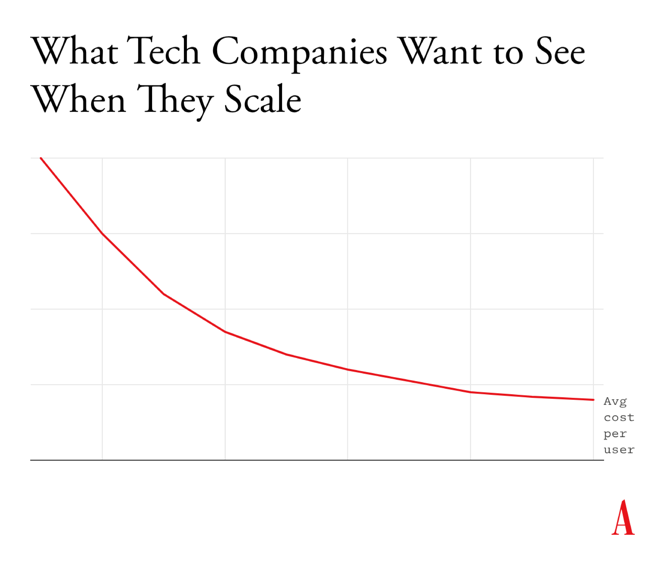
The problem with generative AI, in the industry’s own jargon, is that it does not scale. The cost of growing from, say, a thousand users to a million is a key factor that venture capitalists examine when they evaluate start-ups. They want to see that the cost of adding each new user decreases over time, so that the company can support millions of users and make increasing profits. This is achieved partly through the careful engineering of computer systems that can efficiently handle more users who want to post photos, hail Ubers, or stream music.

With generative AI, the work of building efficient, scalable systems has not been done. And the problem is exacerbated by the ever-larger generative-AI models, which have grown from 175 billion parameters in 2020 to more than 1 trillion today, according to independent estimates (the actual sizes of the models powering products such as Claude and ChatGPT are secret). The large in large language model should not be a selling point. But the industry’s observation that bigger models tend to outperform smaller ones has given rise to a totemic belief in “scaling laws” that suggest any problem can be solved by simply making models bigger. “Maybe with 10 gigawatts of compute, AI can figure out how to cure cancer,” OpenAI CEO Sam Altman wrote on his blog in September.

Yet the returns are diminishing. The bigger an AI model is, the less it improves with each added parameter, and so it must be made bigger at a faster rate just to sustain steady progress. I asked a few AI researchers whether they could name any other real-world software that scales so poorly. None of them could think of any. Even outside the world of software, it’s hard to find a comparable example, given that economy of scale is the principle that has made light bulbs, cars, and clothing so affordable. By economic and engineering measures, generative AI might be the worst technology ever deployed.

[Read: Welcome to a multidimensional economic disaster]

But with the massive investment behind the current bloated approach, there may not be much will to change. Ilya Sutskever, a co-founder and former chief scientist at OpenAI, said in a November interview that companies take the brute-force approach “because it gives you a very low-risk way of investing your resources.” It’s harder, he argued, to invest in research that would reengineer a product currently accruing trillion-dollar valuations. Those who suspect we are in an AI-driven bubble economy have pointed out that the profitability of these companies remains an open question, largely because of the high cost and inefficiency of the technology.

Efficiency is a core principle of computer science. One of the first things undergraduates learn is that writing a program that sorts a list of 50 words is easy. But if you give that program 50 million words, it will likely run out of memory or take hours to finish. Much of computer science is learning the clever coding techniques that prevent this from happening. Many of these techniques take advantage of repeating patterns in the data so that as the program receives more input, it takes less time or memory to process each additional bit. Such efficiency is one reason that modern smartphones and computers are so capable and affordable. This is called logarithmic scaling, and it looks like this when you graph it:

graph showing what tech companies want to see when they scale

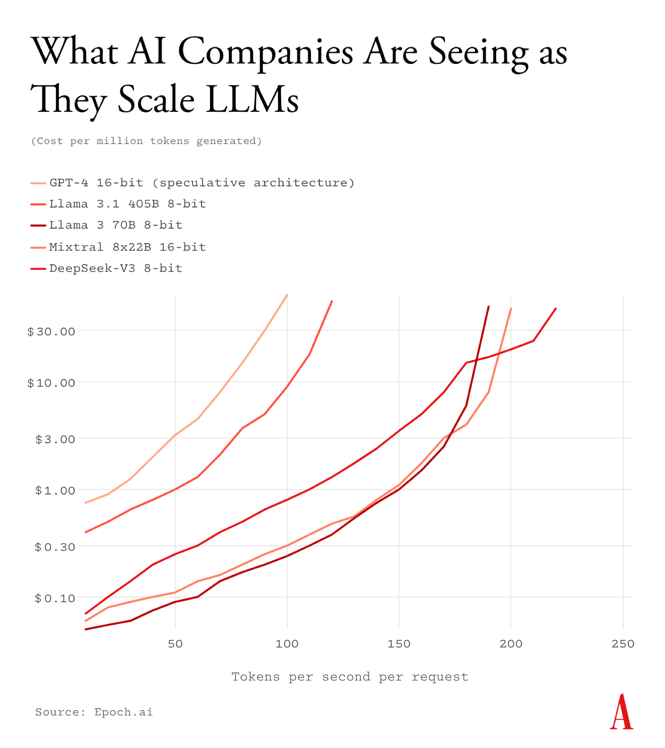
Large language models do not scale logarithmically. When they’re given more words to process, they get slower and use more memory—the time and resources increase faster as the input grows. In technical terms, LLMs scale quadratically. Any computer-science student knows that this is very bad.

Epoch AI, an organization that tries to determine the costs of operating AI models, published a graph last year, which is reproduced here with permission. It shows the exponentially increasing costs of serving more “tokens”—the words users type to chatbots—with several public AI models.

graph showing what AI companies are actually seeing as they scale LLMs

AI does not have to be built this way. Traditionally, the goal of AI was to solve problems in ways that simulated human mental processes. Researchers observed their own thinking and tried to implement their mental habits in code. This approach has mostly been abandoned, partly due to the difficulty of discerning and articulating the rules of human thought, but it did have the benefit of consuming far fewer resources and data.

Today’s approach to AI doesn’t try to describe the rules of human thought; instead, it gives a computer millions of examples to imitate. The huge quantity of examples is one reason that large models can perform better than small ones when generating language, images, and music—they have more material to draw from. Some researchers want to bring back the old, more efficient approach and combine it with the modern approach, but so far these projects have not drawn nearly as much attention or funding as the models that power chatbots.

Chatbot companies are aware that their products are inefficient. Some have found techniques for improving performance, but they have not yielded significant gains. Occasionally, companies claim to have made breakthroughs—Anthropic CEO Dario Amodei has called them “compute multipliers”—but they are usually described in vague terms, and there is no evidence that the basic problems of quadratic scaling and exploding model size have been overcome. (Anthropic declined to comment on the record when I reached out to ask about this.)

Some researchers are working on extremely small models that require fewer data and less computing power. I spoke with Alexia Jolicoeur-Martineau, an AI researcher at Microsoft who independently designed one of these, and asked her about the industry’s brute-force approach. “It’s a bit insane,” she told me. “At some point you have to learn to be a bit more efficient.”

Last year, Jolicoeur-Martineau won a $50,000 prize for her paper on a “tiny recursive model” that doesn’t consume huge quantities of computing resources. “The idea that one must rely on massive foundational models trained for millions of dollars by some big corporation in order to achieve success on hard tasks is a trap,” she wrote. Her model isn’t a substitute for an LLM—it’s designed to solve logic problems in fields such as biology and electrical engineering, rather than generate language—but it can do some of the tasks that much larger AI models are currently being used for.

Yet we seem stuck with LLMs, perhaps because they have been so aggressively marketed. They are now being added to everything, whether you want them or not. In 2024 and 2025, they were integrated into both Windows and MacOS, which means that more computing power is now needed to run a basic personal computer. Smartphones are also being sold with upgraded hardware as companies anticipate new AI features. Inefficient AI is also being added to common programs such as Adobe Photoshop and Microsoft Word, meaning that computers need to be more powerful to run this software.

[Ted Chiang: No, artificial intelligence is not conscious]

This is all especially bad because computers are no longer improving at the rate they used to. Since the 1950s, manufacturers have learned to make microchips steadily faster, smaller, and cheaper, a trend known colloquially as Moore’s Law. But in the past few years, components have gotten so small that manufacturers have run into molecular-level limitations on shrinking them any further, which has slowed progress significantly.

Instead of shrinking components, manufacturers have been focused on developing new hardware that is tailored to AI. This has provided occasional incremental improvements in performance, but none has come close to keeping up with the exponential curve of AI’s increasing demands.

Ultimately, inefficiency may be of little concern to the people within the tech industry who believe that they are replicating intelligence itself. There is an almost-religious conviction among many in Silicon Valley that something mindlike could arise from LLMs, which are ultimately just statistical language-generating software—this, despite the software’s inability to recall basic facts, its lack of common sense, and its complete dissimilarity to a biological brain. Even Yann LeCun, one of AI’s “godfathers,” told The New York Times recently that “LLMs are not a path to superintelligence or even human-level intelligence.” But the mythological lure of AI is so strong that many engineers believe that nothing should stand in their way. Not even the basic task of writing efficient software.

© Mario Tama / Getty

  •  
❌