
 Login

Study Finds: Scientists Built Cancer Kill Switch That Turns On With Flash Of Light
Cancer has a dirty trick: it can put itself to sleep. When tumor cells slip into a kind of biological hibernation, they become hard to kill, shrugging off treatment and lying low until conditions improve, then waking up and bringing the disease back. For decades, researchers have struggled to shut down this hiding strategy without causing serious harm elsewhere in the body. A team in Switzerland has now built a molecule that flips on and off with flashes of light, giving scientists a precise new way to probe, and possibly disrupt, the way sleeping cancer cells hide.
Behind this cellular sleep state, at least in certain cancers, sits a protein called the glucocorticoid receptor, a sensor inside cells that reacts to stress hormones. When it switches on, it can push cancer cells, especially in some solid tumors such as lung cancer, into a drug-resistant, dormant state. The obvious fix would be to destroy the receptor outright, but there is a catch: the same receptor does important jobs all over the body, including calming inflammation. Removing it everywhere would cause real damage. What was needed was a way to hit the receptor inside a tumor and leave the rest of the body alone.
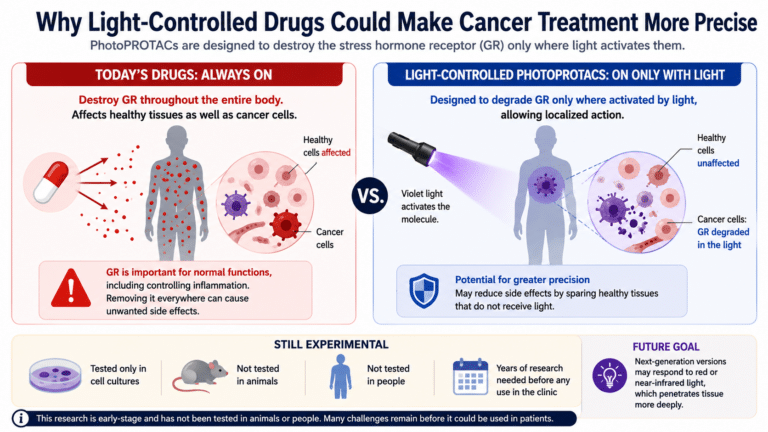
That is what the team set out to build. Their solution, described in the journal Proceedings of the National Academy of Sciences, is a class of molecules called photoPROTACs: drug-like compounds engineered to destroy the stress hormone receptor, but only when a specific color of light switches them on. Shine the right light on them, and they go to work. Keep them in the dark, and they stay idle.
A Kill Switch for a Stress Hormone Receptor
It helps to know what a PROTAC is. A PROTAC is a molecule that grabs onto a specific protein inside a cell and tags it for destruction by the cell’s own waste-disposal system. It works like slapping a “delete me” sticky note on an unwanted protein. PROTACs have stirred huge excitement in medicine because they can eliminate proteins that ordinary drugs cannot touch.
Conventional PROTACs have a problem: they are always on. Once taken, they work throughout the entire body, destroying their target in cancer cells and healthy cells alike. For a receptor this important to normal health, that is a dealbreaker.
To get around it, the team embedded a light-sensitive part directly into the PROTAC molecule. By adding a chemical structure that physically changes shape depending on the wavelength of light hitting it, they created a molecular switch. In one shape, called the E-form, the molecule has the right geometry to do its job and destroy the receptor. In the other, the Z-form, it bends into a configuration that leaves it far less active. The switch runs both ways: one wavelength turns the molecule on, another turns it off.
Building the Light-Activated Cancer Switch
Researchers built and tested several versions of these light-switchable molecules, hunting for the best balance of stability and responsiveness. Two lead compounds, KH-5-306 and KH-5-309, stood out. Both flipped almost completely between their active and inactive shapes under different wavelengths of light and showed no signs of wearing out after repeated exposure.
Inside cells, both compounds destroyed the stress hormone receptor in their active E-form at very low doses. Switched to the inactive Z-form, the effect dropped sharply, though the inactive form still held on to some activity. Because the Z-form naturally drifts back toward the active E-form at body temperature, researchers kept it locked in place during experiments by hitting the cells with brief bursts of ultraviolet light every 30 minutes, a lab-only workaround they confirmed did not harm the cells or disturb the biology under study, and not a method meant for patients.
Additional tests confirmed the receptor destruction ran through the cell’s normal disposal machinery: when a separate inhibitor blocked that machinery, the photoPROTACs stopped working. The compounds also left a closely related receptor alone, even at higher doses, a sign the molecules were hitting their intended target and not damaging look-alikes. And the effect proved temporary. When the active compound was washed away after 12 hours, receptor levels started climbing back within 24.
Waking Up Sleeping Lung Cancer Cells
With the chemistry checked, researchers moved to a test closer to real medicine. They took human lung cancer cells and treated them with dexamethasone, a common steroid that switches on the glucocorticoid receptor and nudges these cells into a dormancy-like state. That setup mirrors a real problem: dexamethasone is routinely given to cancer patients to manage inflammation and treatment side effects, yet it may quietly push tumor cells toward this drug-resistant sleep.
After confirming that dexamethasone triggered the expected dormancy response, the team tested whether the lead photoPROTAC, KH-5-309, could reverse it. Cells treated with the active E-form saw the dormancy-linked gene activity roll back toward normal, and a sweep across thousands of genes confirmed the shift toward a more active state. By contrast, the inactive Z-form left those genes essentially untouched, behaving in this experiment as a neutral control on par with no treatment at all.
What’s Next for Light-Controlled Cancer Treatment
Researchers are candid about the limits. The biggest obstacle to reaching real patients is the kind of light involved. The wavelengths that switch these compounds on do not travel far into living tissue, so the current version could not reach a tumor buried deep in the body. Developing compounds that respond to longer, redder wavelengths, such as near-infrared light that penetrates tissue more deeply, is a key goal for future work rather than a solved problem.
For now, the strongest promise is in the lab: studying cancer biology in cell cultures, tissue slices, and lab-grown miniature organs called organoids, where light can be aimed precisely and repeatedly. Those tools give scientists a way to study how stress hormone signaling drives cancer behavior that existing drugs cannot match.
Cancer’s ability to play dead has long been one of the most frustrating barriers to lasting cures. This is early-stage work, years from any use in the clinic, but a well-aimed flash of light that disrupts cancer’s hiding strategy is the kind of proof-of-concept result that hands researchers a fresh grip on a stubborn problem.
