❌

Reading view

Mercury is the Solar System’s smallest planet, but its metallic core fills about 85 per cent of its radius, leaving a rocky shell so thin that cooling has crumpled the surface into cliffs hundreds of kilometres long

Representative view of a rocky, cratered world

Mercury is the smallest planet in the Solar System, but most of the distance from its centre to its surface passes through metal. NASA puts the radius of Mercury’s metallic core at about 2,074 kilometres, compared with a planetary radius of 2,440 kilometres. That is roughly 85 per cent of the planet’s radius.

The percentage needs reading carefully. It describes radius, not volume, and it does not mean the remaining 15 per cent is all crust. NASA estimates that Mercury’s combined rocky mantle and crust are about 400 kilometres thick. There is also evidence that part of the core remains molten or liquid, which helps explain how such a small world still generates a magnetic field.

I find the surface consequence more revealing than the ratio itself. As Mercury lost interior heat, the planet contracted. Its rigid outer shell had to fit around a slightly smaller interior, so parts of the crust broke and were pushed over neighbouring ground. The result is a global population of long, curved cliffs that record the cooling of the planet below them.

A small planet built around a large core

Mercury’s bulk density is second only to Earth’s among the planets. Yet Earth gains much of its density from the intense pressure produced by its greater mass. Mercury is genuinely rich in metal for its size.

Its internal arrangement is not simply a solid iron ball wrapped in stone. Measurements of Mercury’s gravity, rotation and magnetic field from NASA’s MESSENGER spacecraft indicate a layered interior, including a metallic core that is at least partly liquid. The exact composition and boundaries of those layers remain subjects of active modelling.

The reason Mercury ended up with so much metal is also unsettled. Proposed explanations have included the loss of rocky material during an early collision, extreme heating near the young Sun and formation from unusually metal-rich starting material. None has closed the case by itself. The core size is measured far more securely than the story of how it formed.

Cooling turned contraction into cliffs

Materials generally contract as they cool. On Mercury, that gradual loss of interior heat reduced the planet’s volume enough to deform its outer shell. Because the crust could not slide neatly into a smaller sphere, compression forced blocks of rock up and over one another along thrust faults.

Planetary geologists call many of the resulting landforms lobate scarps. “Lobate” describes their rounded, lobe-like shape, while a scarp is a steep slope or cliff produced by fault movement. These are not mainly cliffs carved by rivers, waves or glaciers. They are the surface expression of crustal shortening.

The scale can be hard to read in spacecraft photographs with no trees or buildings for comparison. NASA reports that the largest scarps extend for hundreds of kilometres and rise more than 1.5 kilometres in places. A traveller approaching one would face a landform longer than many terrestrial mountain ranges, even though Mercury’s entire diameter is only 4,880 kilometres.

MESSENGER found a larger contraction than expected

Mariner 10 revealed Mercury’s great scarps during three flybys in 1974 and 1975, but it photographed less than half the planet. MESSENGER changed the picture after becoming the first spacecraft to orbit Mercury in 2011.

Using global photographs and topographic measurements, the mission team mapped almost 6,000 ridges and scarps. A 2014 analysis concluded that Mercury’s radius had decreased by as much as seven kilometres as the interior cooled, a substantially larger contraction than researchers had inferred from the incomplete Mariner 10 coverage. NASA’s global map of those structures shows them spread across the planet rather than confined to one basin or hemisphere.

Seven kilometres is small beside Mercury’s present radius, about three-tenths of one per cent. Across a whole planet, however, that change is enough to build thousands of faults and folds. The cliffs are an accumulated record of strain, not evidence that the planet suddenly collapsed.

Some faults may be geologically young

The broad contraction began billions of years ago. The harder question is when it stopped, if it has stopped at all.

During MESSENGER’s final 18 months, the spacecraft flew lower and returned sharper images. Researchers identified small, crisp scarps that should not have survived for billions of years under constant impacts from meteoroids. A 2016 study interpreted some as younger than 50 million years, a short interval in planetary geology.

A later 2023 paper in Nature Geoscience, led by Benjamin Man, mapped small troughs called grabens on top of larger contraction structures. The researchers identified 190 examples they regarded as certain. They measured them at roughly 10 to 150 metres deep, generally less than one kilometre wide and tens of kilometres long.

The team estimated that the grabens were about 300 million years old or younger because continued impact debris would otherwise have softened or buried such shallow features. Their distribution was consistent with prolonged contraction and activity on the larger faults into geologically recent times.

This is evidence, not a direct measurement of a fault moving today. The 2023 result is one study, not settled consensus about present activity, and no seismometer has yet recorded a Mercury-quake. The careful claim is that the planet appears to have cooled and contracted for much longer than an old, small world might suggest.

BepiColombo is almost ready to take the next look

MESSENGER ended with a planned impact on Mercury in April 2015. The next orbital investigation is now approaching. According to the European Space Agency’s current mission schedule, BepiColombo’s European and Japanese orbiters are due to enter Mercury orbit together on 21 November 2026 and separate in December.

The mission carries a laser altimeter, cameras, a magnetometer, radio-science equipment and instruments designed to examine surface composition and temperature. Combining topography with gravity and magnetic measurements should improve estimates of the core’s structure and Mercury’s rocky shell. Higher-resolution surface observations may also reveal whether the smallest scarps and grabens are more widespread than MESSENGER could see.

BepiColombo will not make billions of years of cooling easy to reconstruct. It will give researchers a second global orbital dataset, collected with different instruments, for testing whether Mercury’s thin shell is still adjusting to the metal-rich world beneath it.

The cliffs make the interior visible

Mercury’s core cannot be photographed directly, and the planet’s surface gives few obvious hints of an interior that fills 85 per cent of its radius. The cliffs connect the two. Their lengths, heights, ages and fault geometry preserve part of the history of heat leaving the core and mantle.

That history is still incomplete. The measured contraction is real, the young-looking structures are real, and the possibility of present tectonic activity remains open. Mercury’s grey surface is not merely an old impact record. It is also the outer skin of a planet that has spent billions of years fitting itself around a slowly cooling core.

The post Mercury is the Solar System’s smallest planet, but its metallic core fills about 85 per cent of its radius, leaving a rocky shell so thin that cooling has crumpled the surface into cliffs hundreds of kilometres long appeared first on Space Daily.


  •  

Saudi Arabia sits on the world’s largest sand desert and yet imports sand by the shipload from Australia and Scotland, because the wind-rounded grains of the Empty Quarter are too smooth to bind in concrete and modern construction can only use the jagged sand pulled from riverbeds and quarries

Saudi Arabia sits on the world's largest sand desert and yet imports sand by the shipload from Australia and Scotland, because the wind-rounded grains of the Empty Quarter are too smooth to bind in concrete and modern construction can only use the jagged sand pulled from riverbeds and quarries

Saudi Arabia sits on the Rub’ al Khali, an unbroken sea of dunes roughly the size of France, and still puts sand on ships from Perth and the Firth of Forth to pour into its concrete. In 2023, according to World Bank trade data reviewed by Autonocion and OkDiario, the kingdom bought around $138,600 worth of Australian construction sand — about the price of a mid-range pickup truck, hauled across the Indian Ocean because the grains under Saudi feet are the wrong shape to hold a building up.

The problem is not the quantity. It is the geometry of each grain.

Why desert sand fails the concrete test

Concrete is mostly aggregate — sand and gravel — held together by a thin film of cement paste. For the paste to lock, the grains have to bite against one another edge to edge, wedging into the cement and into each other like pieces of a rough jigsaw. River sand and crushed quarry sand do this well because they are geologically young: recently broken from larger rock, jagged, angular, sharp-faced.

Desert sand behaves in the opposite way. Wind does not fracture grains; it polishes them. Over thousands of years of rolling and bouncing across dunes, each grain wears down into a smooth, near-spherical pellet. Dropped into a wet concrete mix, the grains act like ball bearings, sliding past one another instead of interlocking. The cured block ends up riddled with microscopic voids and weak seams.

You can build a garden wall with it. You cannot build a supertall tower.

Rub al Khali dunes

Ren Wei, a postdoctoral fellow at the Norwegian University of Science and Technology, put the same problem plainly in a EurekAlert release on his team’s work: “The challenge is that desert sand is so fine-grained that it is not suitable as a fastener in concrete. In other words, the concrete will not be hard enough to be used in various construction projects.” His team has spent years trying to give the useless stuff a second life by binding it with wood lignin under heat and pressure — a workaround that only exists because ordinary Portland cement will not.

The scale of what sits under Saudi feet

The Empty Quarter covers roughly 650,000 square kilometres of the southern Arabian Peninsula. Some of its dunes climb more than 250 metres, taller than most skyscrapers the kingdom is trying to build. Every major construction site in Saudi Arabia sits within trucking distance of a dune field that could, in raw volume, bury the project many times over.

And yet the trade ledgers keep filling. The same World Bank data show Saudi Arabia imported roughly $1.22 million in non-metal-bearing natural sands in 2023, with the Australian line item nested inside. A separate category — silica and quartz sands used mainly in glass and specialist applications — brought in about $5.23 million, sourced from China, Belgium, the United States, India and the UAE.

The dollar figures are almost comically small. That $138,600 from Australia is not a fortune. The point is that a budget code exists at all. A country sitting on one of the largest sand deposits on Earth has a purchase order for sand shipped from Fremantle.

Salt, corrosion, and the second reason engineers refuse dune sand

Shape is only half the objection. Desert and beach grains often carry enough chloride to slowly corrode the steel reinforcement inside concrete — a slow-motion disaster for anything load-bearing. Reporting on the paradox by Ecoticias notes that salt content is one of the reasons even coastal sand cannot simply be substituted in.

Engineers have spent years trying to make dune sand behave. A team at Imperial College London developed Finite, a concrete alternative made from desert sand. There are patents for crushing and re-fracturing dune grains under enormous pressure just to give them edges again. None of it has displaced the cheapest fix on the table: put good sand on a boat.

What Dubai’s palm actually stands on

The clearest illustration is next door in the Emirates. The Palm Jumeirah, finished off the Dubai coast in 2006, was built out of roughly 94 million cubic metres of sand and rock. That sand did not come from the desert a few miles inland. It was dredged from specific patches of Persian Gulf seabed where the grain size was right, placed by GPS-guided vessels using a technique called rainbowing — spraying sand in an arc through the air onto the growing island. Dutch and Belgian dredging firms ran the operation around the clock for years.

The Burj Khalifa tells the same story going up. Its roughly 330,000 cubic metres of concrete were mixed with sand sourced from outside the UAE, because the local dunes could not deliver the required strength. The paradox of desert cities importing the material they appear to be standing on is baked into every Gulf skyline.

Burj Khalifa concrete construction

A global shortage of the ordinary

Saudi Arabia’s predicament is a sharper version of a shortage the whole planet now shares. Humans pull about 50 billion tonnes of sand and gravel out of the Earth every year, making them the most-extracted solid materials on the planet and, by UN accounting, the second-most-exploited natural resource after water. Demand for construction sand alone is projected to climb by up to 45 percent by 2060.

Nature replaces sand through erosion on geological timescales, far slower than construction crews dig it out. The UN Environment Programme calls the difference the sand gap, and it now stretches from Cambodian riverbeds to Sicilian beaches, with organised sand-mining operations documented across India and West Africa.

The mining is not a small business. A recent Eos editors’ vox on river-sand mining lays out the downstream damage: channel incision, collapsed banks, saltwater intrusion into aquifers, and delta shorelines that stop being replenished from upstream. The concrete in a Gulf tower is often paid for, ecologically, by a river mouth several thousand kilometres away.

Space Daily has covered the same paradox from the angle of Arabian geology, tracing how thousands of years of aeolian polishing wore the grains beyond usefulness. What changes when the story is told through trade data is the scale of the workaround: every megaproject is, somewhere in its bill of materials, a sand story with a very long supply line.

Why the Empty Quarter’s sand ended up so smooth

The Arabian Peninsula was not always this dry. Research published in the Nature family of journals has documented recurrent humid phases across Arabia over the past 8 million years, with rivers, lakes and grasslands appearing and disappearing on cycles tied to orbital changes. During dry stretches — including the last several thousand years — wind takes over as the dominant sculptor of the surface, and the grains it moves get progressively rounder.

The Empty Quarter’s sand is the end product. Sediment that has been reworked so many times by wind that its edges have been worn down almost to the atomic. The same grains that make the dunes photograph beautifully at sunset are the grains that will not bond to cement. Comparative morphology studies of construction sands — the sort catalogued in the Nature journal literature on sand sources — consistently rank aeolian dune grains at the bottom of the pile for angularity and surface texture.

The workarounds nobody has scaled yet

Ren Wei’s team at NTNU and the University of Tokyo have made a prototype they call Botanical Sand Concrete, or Sandcrete. Equal parts desert sand and powdered wood are combined at 180 °C in a double-plate hot-pressing machine, and the lignin in the wood — the same natural polymer that stiffens tree trunks — melts and glues the smooth grains together. New Atlas reported on the material last year, noting the blocks meet Japanese Industrial Standards for pavement bricks.

It is not a structural concrete. Wei has been careful about that. The team envisions indoor use and pavement stones, and points out that any environmental gain evaporates if Sandcrete itself has to be shipped across continents. “The production process is relatively simple, so in principle the material can be made in many places,” he told reporters covering the study’s release. “But we need to test more, including how it can withstand cold, before it can be used in Norway.”

Manufactured sand — crushed rock milled into angular fragments — behaves more like river material and is expanding inside Saudi Arabia’s domestic supply chain. Recycled concrete from demolished buildings can be crushed and reused. Neither has yet displaced the bulk carrier.

Where the sand actually comes from now

Australia ranks as the world’s second-largest sand exporter behind only the United States, shipping roughly $273 million worth in 2023 by the Observatory of Economic Complexity’s accounting. Ports like Jebel Ali in Dubai and Dammam in Saudi Arabia handle graded construction and silica sand quietly, in bulk carriers that look no different from the ones bringing in cars and electronics.

Scotland’s contribution is smaller in tonnage but old in reputation. Silica sand from quarries in the Scottish lowlands has moved into Middle Eastern markets for decades, prized for its consistency and low impurity content, and it turns up in specialist concrete mixes and glass production across the Gulf.

The pressure on riverine sources has begun to reach places that once looked untouched. A 2026 explainer in the Milwaukee Independent describes Great Lakes deposits being eyed as global sand shortages ripple into North America, with infrastructure projects from Southeast Asia to the Middle East pulling on inland reserves that were previously considered safe.

NEOM and the sand appetite still to come

Saudi Arabia’s ambitions are not slowing the appetite. NEOM, the Red Sea Project, Qiddiya, the Diriyah Gate redevelopment — each is one of the largest construction sites on the planet, and each is hungry for the angular, water-eroded sand the region does not have. The Red Sea Project’s plan for a large archipelago along the coast will need dredged marine aggregate on a scale that rivals the great Gulf reclamation schemes.

THE LINE, NEOM’s proposed 170-kilometre mirrored city, would be one of the most concrete-intensive projects in human history if built anywhere near its original specification. Every cubic metre of that concrete needs grains with corners.

The supply lines lengthen with the ambition. The polished dunes stay where they are, drifting slowly in the wind, useless to a cement mixer and unlikely to change.

A material paradox that keeps repeating

Saudi Arabia’s sand imports get passed around online as a fun bit of trivia, the kind of fact that sounds invented. It stops being a paradox the moment you understand how sand actually forms. Wind makes beautiful dunes and terrible concrete. Water makes ugly gravel and skylines.

Life Signs has spent time this year on other quiet contradictions in the natural world — honey that stays edible for three thousand years because of the chemistry of its own preservation, or sharks that will not breed until the 22nd century. The desert-sand paradox belongs on the same shelf. The material that seems most abundant is exactly the material that will not do the job, because the process that piled it up is the process that ruined it.

The bulk carriers keep coming. Ships loaded in Fremantle and Grangemouth cross into Dammam and Jeddah, offload sand that spent geological ages tumbling in rivers or sitting in a quarry, and the sand is poured into towers rising a few kilometres from dunes 250 metres tall. Somewhere in the Empty Quarter tonight, wind is rolling another grain half a millimetre across the crest of a dune, wearing off another atomic layer, making it that much smoother, and that much more useless for the city being built next door.

The post Saudi Arabia sits on the world’s largest sand desert and yet imports sand by the shipload from Australia and Scotland, because the wind-rounded grains of the Empty Quarter are too smooth to bind in concrete and modern construction can only use the jagged sand pulled from riverbeds and quarries appeared first on Space Daily.

  •  

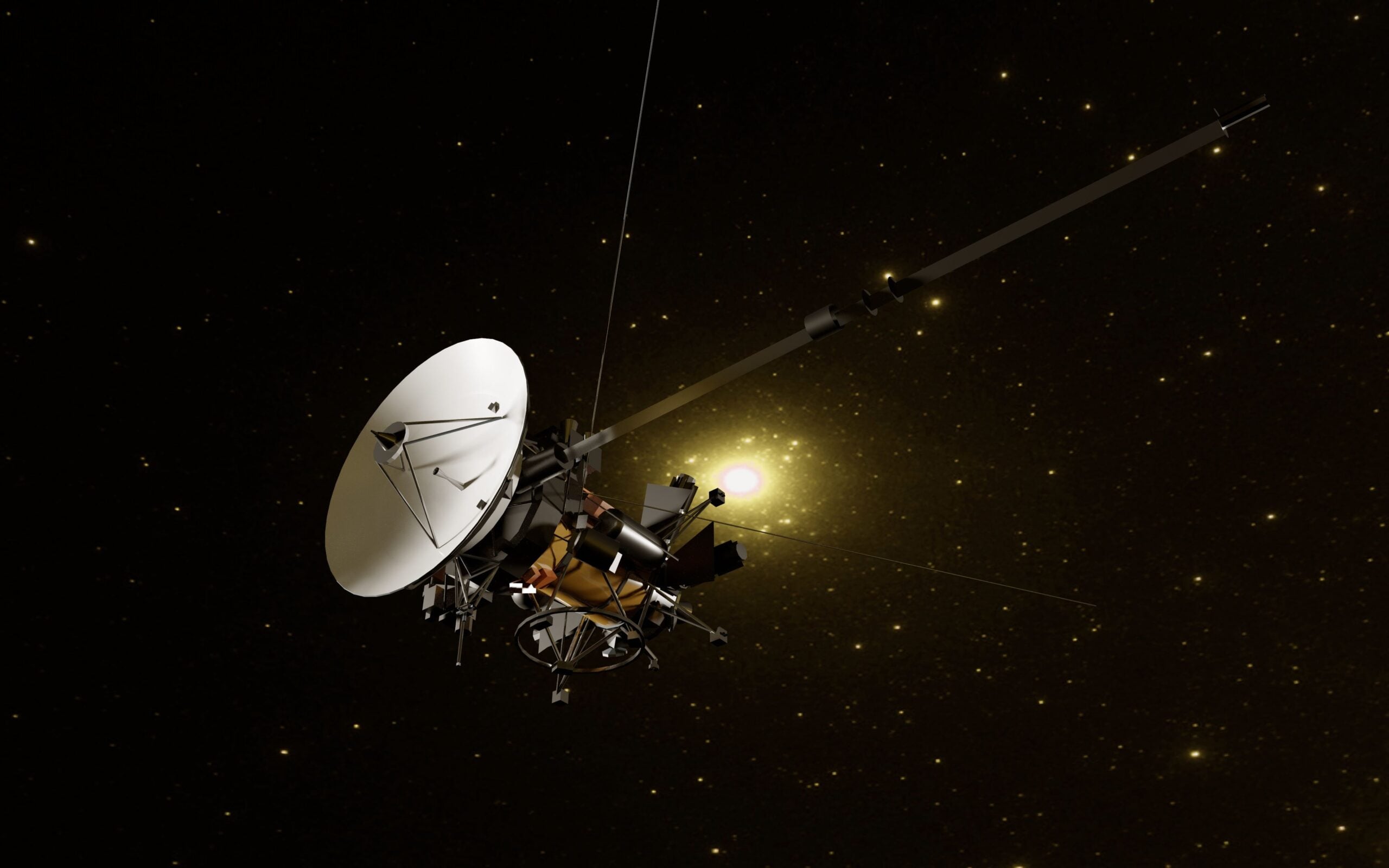
Voyager 1 is down to two working science instruments, and the fix that just bought its twin, Voyager 2, another year of power is now being tested on a probe NASA says no longer behaves quite like its sibling

Artist concept of a Voyager spacecraft against a starfield

Voyager 1’s power test came back at the end of July, and by Kareem Badaruddin’s own account it went about as well as an engineer could hope. Badaruddin is the Voyager project manager at NASA’s Jet Propulsion Laboratory, and what he’s describing is the early stage of an attempt to do for Voyager 1 what a nearly identical procedure just did for its twin, Voyager 2: buy a dying power supply another year of science, on a spacecraft nobody can reach, touch, or send a spare part to.

I wrote a while back about the sliver of plutonium that’s kept both Voyagers running for close to half a century, and this is really that same story arriving at its next decision point. Voyager 1 needs the fix worse than Voyager 2 did. It has less power in reserve, it’s already lost more of its original instruments, and in February this year it came close to tripping its own emergency shutdown during a routine manoeuvre. Whether the fix behaves the same way on Voyager 1 as it did on Voyager 2 is, as of this week, still an open question, and NASA’s own engineers have said they’re not entirely sure of the answer.

A tighter margin than its twin ever had

Voyager 1 currently has two working science instruments left: a magnetometer and a plasma wave subsystem. Voyager 2 has three. Both spacecraft launched in 1977 with ten identical instrument sets, mostly built for flybys of Jupiter, Saturn, Uranus and Neptune that wrapped up decades ago, and both have been shedding instruments ever since, in an order the mission’s engineers settled on years in advance.

Voyager 1’s most recent loss came in April, when NASA switched off its Low-energy Charged Particles experiment, the instrument that had measured ions, electrons and cosmic rays almost continuously since launch. The shutdown wasn’t part of the planned sequence running ahead of schedule. It was prompted by an unexpected power dip during a roll manoeuvre on 27 February, one that brought Voyager 1 close enough to its automatic undervoltage fault protection that engineers chose to retire the instrument rather than risk a shutdown they hadn’t chosen themselves. A small motor inside the instrument, using half a watt, was deliberately left running, specifically so the whole thing could be switched back on if the power situation ever improved.

The same design, a different spacecraft

The fix both probes are attempting is nicknamed the Big Bang inside the mission, and the name refers to how it’s done rather than what it does. Rather than switching off one low-priority load at a time, engineers turn off several ageing devices at once, tape recorders and heaters that had been drawing power for decades, and replace them in the same moment with lower-power alternatives, all while keeping the spacecraft’s electronics above the temperature at which they’d fail for good. On Voyager 2, the swap went ahead in July and freed up close to ten watts a year, enough to keep its three remaining instruments running for at least another year.

Voyager 1 is next, and this is the part I find genuinely interesting rather than just procedurally interesting. Badaruddin has said plainly that although the two spacecraft were built to the same design, the team has observed real differences between them after forty-nine years of separate flight. That’s not a small caveat. It means a fix that worked cleanly on one twin isn’t guaranteed to work the same way on the other, even though the hardware started out identical. Voyager 1 is also farther out, more than 25 billion kilometres from Earth compared with Voyager 2’s roughly 21 billion, which means a command takes close to a day to arrive and just as long for confirmation to come back.

What the next few weeks decide

The power test Voyager 1 passed at the end of July checked whether the swap would draw more electricity than expected. The next hurdle is a thermal test, provisionally scheduled for the end of August, which checks whether the spacecraft’s temperature holds inside safe limits once the swap is made, since a heater or an electronic component that drops too cold in interstellar space doesn’t recover. If that goes well, the actual implementation on Voyager 1 follows, on the same cautious timeline that governs everything the mission does now, where a single command takes close to a day just to arrive.

There’s a genuinely hopeful detail sitting at the end of all this. If the fix frees up enough power on Voyager 1, NASA has said there’s a real chance the Low-energy Charged Particles experiment could be switched back on, not replaced, the same physical instrument, resuming measurements it’s been taking since 1977. I don’t want to overstate that. It depends on results NASA hasn’t published yet, and the agency has been careful not to promise it. But it’s the kind of small reversal that doesn’t happen often in a mission that has otherwise been a long, one-way process of turning things off.

What I’d watch next

Two dates sit ahead of each other on the calendar. The thermal test is due by the end of this month, and Voyager 1 is separately expected to cross one light-day from Earth in mid-November, a distance at which a signal travelling at the speed of light takes a full day to arrive. Neither date guarantees anything about the other. But together they’re a reasonable way to think about where this mission actually is: still capable of a genuine engineering surprise, still adding distance every second, and still, forty-nine years on, being managed one careful decision at a time by people who can’t see it, can’t touch it, and have learned to work within that.

The post Voyager 1 is down to two working science instruments, and the fix that just bought its twin, Voyager 2, another year of power is now being tested on a probe NASA says no longer behaves quite like its sibling appeared first on Space Daily.

  •  

In 1868, French astronomer Pierre Janssen pointed a spectroscope at a solar eclipse in India and saw a yellow line that matched no known element on Earth, and the gas he identified in the Sun’s chromosphere — named helium, after helios — would not be found on this planet for another 27 years, when a Scottish chemist finally coaxed it from a lump of uranium ore

In 1868, French astronomer Pierre Janssen pointed a spectroscope at a solar eclipse in India and saw a yellow line that matched no known element on Earth, and the gas he identified in the Sun's chromosphere — named helium, after helios — would not be found on this planet for another 27 years, when a Scottish chemist finally coaxed it from a lump of uranium ore

On 18 August 1868, a French astronomer named Pierre Janssen stood in Guntur, on the eastern coast of India, and watched the Moon slide across the Sun. Totality ran for roughly six minutes, an exceptionally long window by the standards of eclipse work. He pointed a spectroscope at a solar prominence — one of those enormous loops of glowing gas that arc off the Sun’s edge — and split its light into a rainbow of thin coloured lines. Among them was a bright yellow line at 587.5 nanometres that matched nothing in any laboratory on Earth.

The gas that produced that line would not be isolated on this planet for another 27 years.

When it finally was — coaxed from a lump of uranium ore by a Scottish chemist named William Ramsay in 1895 — it was named for the place where it had first been seen. Helios. The Sun. Helium is the only element on the periodic table first discovered somewhere other than Earth.

1868 solar eclipse spectroscope

What Janssen actually saw

The instrument Janssen carried to Guntur was a spectroscope — a prism, essentially, mounted so that sunlight passing through it fanned out into a spectrum. Nine years earlier, the German physicist Gustav Kirchhoff, working with the chemist Robert Bunsen, had shown that each element, when heated, emits light at its own signature set of wavelengths. Sodium glows a particular yellow. Hydrogen glows a particular red. If you could split the light of a distant object and read the pattern, you could read its chemistry.

Astronomers had been waiting for a total eclipse to try this on the Sun. The corona and the pink prominences at the Sun’s edge are normally drowned out by the glare of the disk. Only when the Moon covers that disk do they become visible, and on most eclipse days that window is two or three minutes at best.

Janssen got six. In the spectrum of a solar prominence he saw a bright yellow line sitting near, but not quite on, the familiar sodium doublet. According to the account preserved by Science Friday, the line was so bright that Janssen suspected it might be observable in ordinary daylight, without waiting for another eclipse.

He was right, and he did not wait long to prove it. By ten o’clock the next morning, 19 August 1868, he was observing prominences against the undarkened Sun, using the spectroscope alone to isolate their light from the glare — a result documented in Françoise Launay’s study of the Guntoor observations in the Journal of Astronomical History and Heritage.

The Englishman who arrived at the same line

Five thousand miles away in England, Joseph Norman Lockyer had been working on the same problem — how to see prominences without an eclipse — and had arrived at the same technique independently. On 20 October 1868, two months after Janssen’s observations in India, Lockyer saw the same yellow line in ordinary daylight.

Both men’s reports reached the French Academy of Sciences on the same day. The Academy struck a commemorative medal carrying both their profiles, with Apollo’s chariot crossing the face of the Sun.

Lockyer went further than Janssen in one respect. After failing, with the chemist Edward Frankland, to reproduce the line in the laboratory, he proposed that it came from an element that did not exist — or had not yet been found — on Earth. He gave it a name: helium, from helios, the Greek word for the Sun.

Naming an element on the basis of a single unexplained line was audacious, and Lockyer knew it. In print he mostly called the line D3, after its position beside the sodium D1 and D2 lines. For the next quarter century, plenty of chemists refused to accept there was an element behind it at all.

solar prominence chromosphere

Why chemists would not accept it

The problem was not that Lockyer’s spectroscopy was wrong. The problem was that no one could put the gas on a bench.

Nineteenth-century chemistry was built on samples you could weigh, dissolve, heat, and combine. An element you could only see in the light of a body 150 million kilometres away was, to many working chemists, not really an element at all. It was a line. The line might belong to some familiar element behaving strangely at high temperature. It might belong to something in the Earth’s atmosphere that the light had passed through on its way to the spectroscope. It might belong to an instrumental artefact.

The 27-year figure also flattens a middle chapter. As Space Daily has noted in its account of the gap between helium’s detection and its terrestrial isolation, the Italian physicist Luigi Palmieri recorded the same 587.5-nanometre line in Vesuvian lava in 1882. That was the first sighting of helium in earthly material. What nobody had, for another thirteen years, was the gas itself.

Janssen, meanwhile, kept chasing eclipses. In 1870, hoping to observe totality from Algeria while Paris was under siege in the Franco-Prussian War, he escaped the city by balloon. Clouds obscured his view.

The uranium ore that finally settled it

The gas came out of a rock.

In 1895, in London, William Ramsay was hunting for argon in minerals when he turned to cleveite, a variety of uraninite that released an unknown gas when treated with acid. An American chemist, William Francis Hillebrand, had already noticed the gas a few years earlier and taken it for nitrogen. Ramsay ran it through a spectroscope.

There was the yellow line.

Ramsay sent a sample to Lockyer for confirmation. Lockyer wrote of watching the discharge tube light up: “When I received it from him, the glorious yellow effulgence of the capillary, while the current was passing, was a sight to see.” The element named for the Sun had been sitting inside a lump of ore dug out of a Norwegian mine.

What Ramsay was really seeing, though no one at the time understood it in these terms, was radioactive decay. Uranium and thorium atoms in the Earth’s crust break down slowly over hundreds of millions of years, and one product of that decay is an alpha particle — which, once it captures a pair of electrons, is a helium atom. The helium in Ramsay’s flask had been accumulating in the ore since the rock formed.

The sequence that followed rearranged the periodic table, though helium was not the element that cracked it open. Argon came first: Ramsay and Lord Rayleigh announced it in August 1894, and it fit nowhere in Mendeleev’s 1869 chart. Helium, isolated seven months later, told Ramsay that argon was not an anomaly but the second member of a family. Working with Morris Travers, he pulled neon, krypton and xenon out of liquefied air in the summer of 1898, and took the 1904 Nobel Prize in Chemistry for the whole column.

The chemistry of a solitary yellow line in an Indian sky turned out to be the chemistry of an entire family of elements no one had suspected existed.

Why helium was hiding on Earth

Helium is the second most abundant element in the universe — roughly 24% of ordinary matter by mass, behind hydrogen’s 75%. Almost everything else, from the iron in blood to the oxygen in the air, makes up the remaining one to two per cent.

On Earth it is vanishingly rare. Helium makes up about 5 parts per million of the atmosphere, roughly 0.0005%. The reason is gravity. Helium atoms are so light and so fast that in the thin upper atmosphere a steady fraction of them exceed escape velocity and drift off into space. The Earth cannot hold on to them.

What helium exists here is trapped underground, produced by the same radioactive decay that filled Ramsay’s flask and captured in the same geological formations that trap natural gas. Nearly all commercial helium is separated from that gas, a by-product of drilling for methane. The United States, Qatar, Algeria and Russia dominate supply, and the chain is brittle: when Qatar was blockaded in 2017, laboratories and hospitals began running down stocks within weeks.

The strange thing about the element named for the Sun is that most of what modern civilisation uses it for happens near absolute zero. Liquid helium boils at 4.2 kelvin, about −269°C, lower than any other substance. That makes it the only practical coolant for the superconducting magnets inside MRI scanners, NMR spectrometers, and particle accelerators like the Large Hadron Collider. A conventional hospital MRI holds somewhere between 1,500 and 1,700 litres of liquid helium in a cryostat wrapped around its main magnet. Let the magnet warm and it loses superconductivity, and the machine stops working.

Spacecraft use it too. Rocket engines are purged with helium before and after firing to clear residual fuel and oxidiser, and liquid hydrogen tanks are pressurised with it. The Saturn V used helium to pressurise the tanks that carried Apollo to the Moon. SpaceX’s Falcon 9 uses helium for the same job, stored in composite overwrapped pressure vessels; the failure of one such vessel inside the second-stage liquid oxygen tank destroyed a Falcon 9 and the Amos-6 satellite on the pad at Cape Canaveral on 1 September 2016, during propellant loading ahead of a static fire test.

Balloons are the least of it.

The eclipse legacy

Janssen’s 1868 observation began a tradition. Total solar eclipses became laboratories. In 1919, British teams organised by Frank Watson Dyson and Arthur Eddington photographed stars near the eclipsed Sun from two sites, Príncipe off West Africa and Sobral in Brazil, and measured the deflection of their light by the Sun’s gravity. The error bars were wide and the precise confirmation would take decades more, but the result supported Einstein’s general theory of relativity and made him a public figure almost overnight.

The son of Norman Lockyer, W. J. S. Lockyer, was quoted in The New York Times after the 1919 result, dismissing its practical importance: the discoveries, he said, did not personally concern ordinary human beings, and only astronomers were affected. General relativity is now the correction that keeps GPS satellites accurate. Every smartphone navigation fix depends on it.

Eclipses had produced, within a fifty-year span, a new element and a new theory of gravity. And the technique Janssen used — splitting the light of a distant object to read its chemistry — is now the backbone of astronomy. Every exoplanet atmosphere characterised by the James Webb Space Telescope, every distant quasar analysed for its composition, every star sorted by spectral type, is being read by the method he pointed at a solar prominence in Guntur.

The gas he identified is now leaking, atom by atom, out of the Earth’s atmosphere and back into space. Some of it drifted up from balloons at children’s birthdays. Some of it boiled off from MRI machines in hospital basements. Some of it vented from rocket pads at Cape Canaveral. All of it is going the same place — up, and out, and eventually back toward the Sun that gave it its name.

The post In 1868, French astronomer Pierre Janssen pointed a spectroscope at a solar eclipse in India and saw a yellow line that matched no known element on Earth, and the gas he identified in the Sun’s chromosphere — named helium, after helios — would not be found on this planet for another 27 years, when a Scottish chemist finally coaxed it from a lump of uranium ore appeared first on Space Daily.

  •  

Some of the loneliest people in their fifties aren’t the ones without partners or children, they’re the ones surrounded by people who only know the version of them that shows up when everyone else needs something

Some of the loneliest people in their fifties aren't the ones without partners or children, they're the ones surrounded by people who only know the version of them that shows up when everyone else needs something

The people most likely to describe themselves as lonely in midlife surveys are often the ones with the fullest calendars. They have adult children who call on birthdays, colleagues who invite them to dinners, a spouse who has slept beside them for twenty-five years, and a phone that lights up all day with requests. And still, when the house goes quiet, something feels missing in a way that partnership and parenthood were supposed to have solved.

The loneliness of the useful person is a specific kind. It doesn’t announce itself as absence. It shows up as a low, background hum of not-quite-being-met, even in rooms full of people who love you.

The version of you that gets invited

By the time most people reach their fifties, they have accumulated decades of evidence about which parts of themselves the world rewards. The competent one. The calm one. The fixer. The listener who never quite becomes the one being listened to. The parent who solves logistics for three generations at once. Each role, taken alone, is fine. Stacked over thirty years, they harden into something else: a public self so well-practised that the private self starts to feel like a stranger even to its owner.

Loneliness is not simply about being alone; it is the perceived gap between the connection you want and the connection you have. It is about being unknown while surrounded.

The person in their fifties who is celebrated as reliable, capable, or endlessly generous is often the person whose inner weather nobody has asked about in years. Their usefulness is what gets invited into rooms. Their interior does not.

How instrumental relationships quietly replace intimate ones

Relationships fall on a rough spectrum. On one end are instrumental relationships, built around what a person does or provides. On the other are expressive relationships, where the point of the relationship is the person themselves. Most social lives contain both. The trouble starts when the ratio tips, slowly, over decades, until nearly every relationship a person has is instrumental in some way.

A woman in her fifties may have twelve people who call her regularly. Her mother needs help with medical appointments. Her adult son needs a co-signer. Her boss needs the report by Friday. Her husband needs her to remember his sister’s birthday. Her friend needs to vent about her divorce. None of these people are villains. Each of them loves her, in the way people love a reliable source. But not one of them, on any given Tuesday, is calling to ask how she actually is and then waiting for the real answer.

The pattern is not new, but its recognition is recent. In caregiving populations, a specific phenomenon has emerged: social alienation, distinct from loneliness, in which a person’s role so completely defines their contact with others that the person underneath the role disappears from view. A 2025 study of caregivers of stroke patients in China found that caregivers experience high levels of social alienation, with living arrangements, caregiving burden, and loneliness all significantly predicting the depth of that alienation. The caregivers weren’t isolated in the ordinary sense. They were embedded in family. They were simply no longer being met as themselves.

Why the fifties are the decade this bill comes due

Several life stages converge in the fifties in ways that intensify the useful-person trap. Parents are aging and often need active help. Adult children are launching, or failing to launch, and either state generates demands. Careers reach the phase where seniority means being the person others come to. Marriages, if they have lasted this long, have often settled into a division of labour where each partner handles a fixed set of tasks and stops asking the other about anything outside that division.

The result is a person whose days are structured almost entirely around what other people need from them. There is nothing wrong with any single demand. There is something quietly corrosive about the cumulative one.

Grandparent caregiving offers a useful case. A scoping review of grandchild caregiving and depression found mixed effects, with the relationship between caring for grandchildren and mood depending heavily on whether the grandparent felt they had chosen the role or been assigned it, and on how much of their identity remained outside it. The finding that matters here is simple: the same activity can be nourishing or depleting depending on whether the person doing it feels seen inside it.

The tell, the childhood pattern, and what being met actually requires

There is a small experiment worth trying, though it is not really an experiment. Ask a person in their fifties, in a moment of genuine attention, what they have been thinking about lately. Not what they have been doing. What they have been thinking about.

The pause tends to be long. Often the first answer is a logistical update, because logistics is the language most of their relationships operate in. If you wait past the logistics, something else usually surfaces: an old regret they have not spoken aloud in a decade, a fear about a parent, a question about whether the second half of life is going to feel any different from the first. The material is right there, close to the surface. It has simply not been invited out in a long time.

In a recent piece on the lie of omission, Space Daily explored how people can spend years telling only the safe true things about themselves, until friendships of a decade contain nothing that would let either person recognise the other in a crisis. The useful person’s loneliness is often built out of exactly this material. Every conversation was pleasant. Every conversation was true. None of them touched the parts that most needed touching.

Not every fifty-something who ends up in this position started in the same place, but a striking number of them describe a common childhood: they were the calm one, the one who did not add to their parents’ load, the one whose emotional needs got quietly filed under “can wait.” They learned early that being low-maintenance was rewarded and being needy was expensive.

Building on attachment theory, the babies in Mary Ainsworth’s Strange Situation study who looked most composed when left alone were the ones whose heart rates were racing the entire time. Their calm was a strategy, not a state. John Bowlby, who built attachment theory in the 1950s, argued that the undemanding child is often the one who learned that asking for less kept the peace. Those children grow up to become spouses who rarely voice needs, managers who remain calm under pressure, and parents who carry burdens silently.

Emotional intimacy, in the clinical literature, is not the same as time spent together or affection expressed. It is the specific experience of being known and having that knowledge received without correction. Research on emotional intimacy suggests it requires three ingredients most useful people have quietly starved themselves of: undistracted time, a willingness to redefine intimacy on the participants’ own terms, and treating vulnerability as strength rather than as a tax on the relationship.

The trouble for the fifty-something who has been useful for decades is that vulnerability has been coded, in their nervous system, as burden. Sharing an actual worry feels like adding to someone else’s plate. Answering “how are you” with anything other than “good, you?” feels like an imposition. The muscle for being known has atrophied from disuse, and rebuilding it feels awkward, embarrassing, sometimes physically uncomfortable.

Why AI companions are not the answer, and the modest fix

The commercial response to midlife loneliness has been swift and lucrative. Chatbot companions are now used by hundreds of millions of people globally. The appeal, especially for the useful person, is obvious. A chatbot never needs anything back. It listens without waiting for its turn. It never has a bad week that overrides yours.

But Stanford researchers who analysed conversations from more than 1,000 users of Character.AI found the opposite of relief. People with smaller in-person social networks who used chatbots intensely reported worse well-being, not better, and those who shared the most sensitive personal information with the bots scored lowest of all. Researchers found that using chatbots to fulfill social needs does not substitute for human connection, according to the study. The researchers noted that AI companions are designed primarily to keep users engaged rather than to meet genuine social needs.

The researchers described what the bots offer as brief, unsatisfying interactions—like junk food for the social appetite. Filling in the moment, hollow by the next morning. For a person who has spent decades being the one everyone else confides in, a chatbot that finally listens can feel like a discovery. It is not one. It is a mirror that has been polished to reflect back whatever the user brings, which is the exact opposite of being met by a different mind.

There is a well-known finding in social psychology that two strangers can generate deep mutual closeness in under an hour by working through a specific series of escalating questions. Arthur Aron’s 1997 study on the 36 questions found that the pairs who completed the full protocol reported feeling closer to each other than many people feel to their oldest friends. The mechanism was not chemistry. It was structured, mutual, escalating disclosure.

The finding is often cited as a hopeful one, and it is. But it also contains a quiet indictment. If two strangers with a list of questions can generate more felt closeness in ninety minutes than a fifty-something feels with the people they have shared a house or an office with for twenty years, the problem is not a lack of available connection. The problem is that most long-standing relationships never renegotiate their scripts after the scripts get set. Whatever role a person was assigned at the beginning is the role they are still playing, three decades in.

The interventions that actually change this pattern are almost insultingly modest. They involve saying, out loud, to one person, one true thing that would not normally get said. They involve answering “how are you” with an actual sentence about an actual state, not once as a stunt, but as a slow policy change. They involve letting a friend see the version of you that is tired, unsure, or angry at someone you’re supposed to love.

They involve, most uncomfortably, tolerating the pause when the other person doesn’t know what to do with the real answer. Because they won’t, at first. They have been in a relationship with the useful version of you for years, and the useful version is who they came to see.

Some of those relationships will adjust. The person on the other end will lean in, relieved that the pretence is finally dropping. Others won’t. They will keep asking the useful version to show up, and the choice about how much of your time to give those relationships is a choice you get to make, possibly for the first time.

A recent Human Element piece on people who downsize their lives in their sixties looked at exactly this reallocation, the way people begin, later than they wish they had, to notice which parts of their life were costing them without earning their keep. The relationships that only wanted the useful version fall into that category more often than people expect.

older woman thinking window

Who this loneliness looks like from the outside

The person in their fifties who fits this description is often the last person a casual observer would identify as lonely. They have a partner. They have children who love them. They have a job that respects them and a phone that never stops. They are, by every visible metric, connected.

They are also, in the quiet hour after everyone else has gone to bed, aware of a specific ache that partnership and parenthood were supposed to have eliminated. The ache is not for more people. It is for the experience of being asked a real question by someone willing to hear a real answer, and for the strange, slightly frightening recognition that the version of themselves that would give that answer has not been out of the house in a long time.

two friends deep conversation

Loneliness in midlife is not always a problem of scarcity. Sometimes it is a problem of composition. A life full of people who only know the useful version of you is a life in which the rest of you is still waiting to be met, and the waiting gets heavier the longer it goes on. The relief, when it comes, tends to arrive through the smallest door: one honest answer, given to one person, on one ordinary afternoon.

The post Some of the loneliest people in their fifties aren’t the ones without partners or children, they’re the ones surrounded by people who only know the version of them that shows up when everyone else needs something appeared first on Space Daily.

  •  

Quote by Carl Jung: The most terrifying thing is to accept oneself completely

Quote by Carl Jung: The most terrifying thing is to accept oneself completely

The Jung line about self-acceptance being the most terrifying task circulates so often on social media that it has almost lost its edge, and yet the moment you sit with it honestly, really sit with it, past the coffee-mug aesthetic, you notice something uncomfortable. The sentence is not asking you to love yourself. It is asking you to stop editing.

That distinction matters. Loving yourself is a project. Accepting yourself is a surrender.

One flatters the ego. The other dismantles it.

person looking in mirror

What Jung actually seems to have meant

The line, in the version that circulates most widely, reads: the most terrifying thing is to accept oneself completely. It moves through quote collections and social feeds largely without a citation attached, which is part of why it travels so easily.

Jung is also the psychiatrist people reach for when something has broken. In July 2025, days after news of his separation from Katy Perry, Orlando Bloom posted a screenshot of an article about Jung to his Instagram Stories, highlighting the line about loneliness coming not from having nobody around you but from being unable to say the things that seem important to you.

Bloom is not unusual in reaching for Jung during a period of upheaval. People tend to find the Swiss psychiatrist when the usual self-improvement scripts stop working.

The reason is structural. Most advice tells you to become better. Jung suggested you first stop pretending you are not who you already are.

Why acceptance feels worse than change

Change gives the mind something to do. There is a plan, a target weight, a new job, a version of yourself twelve months out who will finally be acceptable to you.

Acceptance offers none of that. It asks you to look at the envy, the small cruelties, the parts of yourself you have hidden even from your closest friends, and to say: yes, that is also me.

Alli Spotts-De Lazzer, a licensed therapist writing in Psychology Today, has argued that self-acceptance may matter more than high self-esteem for living a contented life. Her point is about the scoring system. Self-esteem depends on evidence: grades, promotions, praise. Self-acceptance does not require the evidence to be flattering.

That is why it is harder. There is no scorecard.

The parts we refuse to claim

Jung’s term for the disowned material was the shadow. He meant the qualities a person cannot bear to see in themselves and therefore projects outward, onto a spouse, a colleague, a political opponent, a stranger on the internet.

You can spot your own shadow by noticing what enrages you disproportionately in other people. The trait you find unforgivable in a coworker is often the trait you have most carefully denied in yourself.

This is why acceptance terrifies. To accept yourself completely means retrieving those projections. It means admitting that the person you have been criticising is, in some measurable way, a mirror.

Loneliness and the unspoken self

Jung linked the refusal of self-acceptance to a specific kind of loneliness. Not the loneliness of empty rooms, but the loneliness of unsaid things, the idea that isolation grows sharpest when you cannot say what actually matters to you.

A person who has not accepted themselves cannot communicate themselves. They can only communicate the acceptable version.

Everyone in their life is talking to a spokesperson.

Over time, this produces a strange grief: being surrounded by people who love a curated character, while the actual self stands quietly behind the curtain, unwitnessed.

The research that backs Jung’s instinct

Contemporary psychology has been slowly circling what Jung intuited a century ago. A 2025 study in Frontiers in Psychology, led by Yuting Li and colleagues at Shanxi Medical University, followed university students across two measurement points six months apart and found that self-esteem fully mediated the relationship between self-acceptance and prosocial behaviour. Self-acceptance did not push people toward kindness directly. It did so by changing how they held themselves, and that shift carried the entire effect.

The sample was narrow, medical students at a single Chinese university, with a heavy gender imbalance the authors flag themselves. It is a suggestive finding rather than a settled law. But the direction is the interesting part.

The mechanism makes sense. If you are not spending psychic energy hiding from your own contradictions, you have more energy available for someone else’s.

The reverse also holds. People who cannot bear their own flaws may struggle to tolerate the flaws of others. Judgment turns outward when it cannot be metabolised inward.

This is the quiet cost of refusing Jung’s task. Not misery, exactly. Just a permanent low-grade grievance with the world.

Why growth requires acceptance first

There is a common misreading of Jung that treats acceptance as resignation, as giving up on becoming better. The research points the other way. Susan Krauss Whitbourne, professor emerita of psychological and brain sciences at the University of Massachusetts Amherst, has argued that the path toward self-growth is paved with self-acceptance rather than blocked by it. Reviewing a set of University of Zurich intervention studies that pitted self-improvement against self-acceptance, she notes that both produced similar gains in wellbeing, and that trying and failing to change can generate its own trouble, what those authors call false hope syndrome.

The reason is practical. You cannot change something you refuse to look at.

Denial keeps a trait frozen in place. Acceptance thaws it enough to work with.

People who try to become better without first accepting who they are tend to build a shinier surface over the same underlying pattern. The behaviour changes. The compulsion driving it does not.

quiet moment alone

The mechanism of the fear

Why is this so terrifying? Because complete acceptance dissolves the story you have been running about who you are.

Most identities are constructed by exclusion. You know who you are partly by knowing what you are not. The moment you accept that the excluded traits are also yours, the identity loses its clean edges.

That is disorienting in a specific way. It is not despair. It is closer to vertigo.

Jung believed this vertigo was the entry point to genuine individuation, the process of becoming an actual person rather than a bundle of inherited roles.

The face you have not met

There is a small experiment that gets at Jung’s point without any theory. Look at an unreversed photograph of yourself, not a mirror image, but the version everyone else sees. Most people find it slightly wrong, slightly stranger than expected.

The person the world knows is not quite the person you have been looking at.

Acceptance works similarly. The self you have been curating is a reversed image. The self other people encounter, and the self that lives underneath, is closer to the real thing.

Meeting it feels like meeting a stranger.

What acceptance is not

It is worth being precise. Accepting yourself completely does not mean approving of everything you do. It does not mean abandoning ethics or discipline.

It means refusing to lie about what is there.

A person who accepts that they have a temper can work on the temper. A person who insists they do not have one will keep being surprised by their own outbursts.

Acceptance is honesty about what is actually present. Nothing more, nothing less.

The everyday texture of the task

Most people do not confront Jung’s terrifying task in a single dramatic session. It arrives in small increments: a midlife morning when the ambition you have been performing suddenly feels borrowed, a conversation with an adult child where you notice you have been playing a role for twenty years, a health scare that reorders what you say you care about.

The pattern is similar. A person stops pretending certain things matter to them, and the external life reorganises around the admission.

That is Jung’s task in domestic form. Not a breakdown. A quiet subtraction of what was never really yours.

Why it stays terrifying

Even people who have done years of work on themselves report that acceptance keeps arriving in new layers. There is always another disowned piece.

The envy you thought you had processed returns in a new form. The old grievance you believed you had released surfaces during a family dinner. The version of yourself you thought you had left behind reappears under stress.

Jung was not describing a one-time event. He was describing a lifelong posture.

The terror is not that acceptance is difficult once. It is that it is difficult continually, and that most people, at some point, decide they would rather manage the surface than face what is underneath it.

The quiet reward

People who do keep at it tend to describe a specific change, and it is not happiness in the ordinary sense. Acceptance is not a mood. It is a lowered resistance.

The people who have done this work are not conspicuously cheerful. They are just harder to destabilise.

Criticism does not shatter them, because they already know what is true about themselves. Flattery does not inflate them, for the same reason.

They have become, in Jung’s sense, actual. And the terrifying thing turns out to have been the doorway, not the destination.

Where to start, if you want to

There is no clean method. But there is a first question that tends to open the door: what do you find most unforgivable in other people?

Sit with the answer for a week. Do not defend yourself against it. Do not rush to conclude anything.

Notice, quietly, where that quality also lives in you.

That is the beginning of the task Jung called the most terrifying. Not because the material is horrifying, since most of it is ordinary human stuff. But because meeting it, without flinching, changes who you take yourself to be.

Which is, in the end, the only thing worth changing.

The post Quote by Carl Jung: The most terrifying thing is to accept oneself completely appeared first on Space Daily.

  •  

The Greenland shark grows about one centimetre per year and does not reach sexual maturity until roughly age 150, meaning the pups being born in the North Atlantic this year will not breed until the 22nd century

The Greenland shark grows about one centimetre per year and does not reach sexual maturity until roughly age 150, meaning the pups being born in the North Atlantic this year will not breed until the 22nd century

The Greenland shark, Somniosus microcephalus, grows at roughly one centimetre a year and does not reach sexual maturity until it is about 150 years old. That figure comes from a 2016 study in Science led by Julius Nielsen at the University of Copenhagen, which radiocarbon-dated the eye lenses of 28 female sharks caught as bycatch in the North Atlantic. A pup born in the cold water off Baffin Island this August will not be old enough to breed until sometime in the 2170s.

Read that sentence again. The pup’s first mating season will arrive more than a century and a half from now.

Greenland shark swimming

What the number actually means

One centimetre a year is a rate of growth so slow it barely registers on any human timescale. A shark that is 400 centimetres long — about the length of a small car — has been adding tissue at that pace since roughly the reign of Louis XV. The 2016 study found that the two largest sharks in the sample, at 493 and 502 centimetres, were estimated at around 335 and 392 years old.

The species’ average lifespan sits somewhere near 272 years. Individuals can plausibly push past 400. Only the ocean quahog clam, Arctica islandica, is known to live longer.

The one-centimetre figure is not a laboratory measurement in the usual sense. It is a rate inferred from recaptured sharks and from back-calculation against the radiocarbon ages of the eye lenses. One tagged Greenland shark has been documented growing only a small amount over more than a decade, which tells you something about why the biology of this animal has been so hard to pin down.

How you date a shark that has no growth rings

Most sharks can be aged by counting bands in their vertebrae, the way a forester reads a tree stump. Greenland sharks cannot. Their vertebrae are too soft and lay down no legible record.

So Nielsen’s team turned to the eye. The lens of a vertebrate eye grows in transparent layers throughout life, and the innermost tissue — the nucleus — is laid down before birth and never replaced. If you can extract that pre-natal tissue and measure its carbon-14 signature, you can locate roughly when the animal was born against the known atmospheric carbon record.

The technique works particularly well for sharks born after the mid-1950s because atmospheric nuclear weapons testing dumped a spike of carbon-14 into the environment. That spike, sometimes called the bomb pulse, shows up in the eye lenses of younger sharks and gives researchers a firm calibration point. Older animals sit below the pulse and their ages come with wider uncertainty bars — the oldest shark in the study was placed, with 95 percent certainty, somewhere between 272 and 512 years old.

That range is not a failure of the method. It is the honest shape of what radiocarbon dating can and cannot tell you about a creature that was alive before industrial carbon began skewing the atmosphere.

Why sexual maturity at 150 changes everything

Late maturity is the part of the story that reshapes how the species should be managed. A Greenland shark pup born in 2026 will spend its entire first century-and-a-half without contributing a single offspring to the population. If it dies at 140, it dies without ever having bred.

Compare that with smaller fish species that can mature in one to two years, or other shark species that mature within decades. Even other long-lived marine mammals reach sexual maturity far earlier in their lifespans.

For the Greenland shark, the reproductive clock runs on a scale that predates most nations. Any pressure on adult numbers — bycatch, warming, pollution — takes an unusually long time to show up in the population, and an even longer time to reverse. The slow replacement rate makes population recovery particularly challenging.

The animals a Greenland shark outlives

A shark born in the year the Great Fire of London burned would be about 360 today. One born the year Newton published the Principia in 1687 would be 339. A pup swimming under the ice off Svalbard right now will still be growing, if it survives, when the great-grandchildren of everyone reading this are old.

The shark shares this deep-time company with a small number of other animals that have taught biologists to distrust human intuitions about aging. Other long-lived species in cold northern waters provide similar insights into extreme longevity.

The Greenland shark is a different case. It ages, it slows, it eventually dies. It just does all of this at a rate that makes the human life-cycle look like a mayfly’s.

Arctic sea ice

What the cold has to do with it

Greenland sharks live in water between minus 2 and 7 degrees Celsius, at depths that can reach 7,200 feet. They are extremely slow swimmers, moving at a pace that allows prey like seals to easily outpace them, and their tissues are laced with compounds that behave like antifreeze.

Cold and slow are the two variables that keep coming up in animals that live for centuries. Cold probably plays a role in extreme vertebrate longevity but is unlikely to be the whole story. Plenty of short-lived species share the same water.

Something else is going on inside those muscles. The Greenland shark’s cells have been contracting, dividing, and repairing themselves continuously since long before the theory of evolution was written down. Whatever biochemical maintenance keeps that machinery running is one of the more interesting open questions in the biology of aging.

What the study does not show

The 2016 Science paper sampled 28 females caught as bycatch. It did not sample males. It did not follow individuals across their lives — no one has, because no one lives long enough. The one-centimetre-per-year growth rate is an inference, and the 150-year figure for sexual maturity is estimated from the length at which females are first observed carrying developing pups, cross-referenced against the age-length relationship the eye-lens data produced.

That is the best evidence available. It is not the same as a longitudinal record. The upper age estimate of 392 years carries an uncertainty of roughly plus or minus 120 years, which is a window wider than the entire history of Australian federation.

The lower bound is the interesting number for conservation. Even at 272 years, the Greenland shark is the longest-lived vertebrate ever documented, and its late maturity is not in serious dispute.

What a 150-year adolescence looks like in practice

A female Greenland shark spends her first century-and-a-half in the dark, slow water of the North Atlantic and Arctic, eating what she can find. Stomach contents recorded by researchers have included fish, squid, and seals, along with occasional carrion.

She is often functionally blind, because a tiny crustacean parasite latches onto her cornea and scars it. This does not seem to inconvenience her much. In waters that dark, vision was never doing most of the work.

She grows a centimetre a year. She does not breed. She keeps moving.

By the time she reaches her 150th birthday, empires have risen and fallen at the surface. She is finally large enough to reproduce. If she is lucky, she has another 150 or 250 years ahead of her.

The Icelandic footnote

Greenland shark meat is toxic when fresh — concentrations of trimethylamine oxide and urea in the tissue can cause vomiting, disorientation, and convulsions, effects that Icelanders have traditionally associated with improperly prepared shark meat. The traditional preparation is to bury the flesh, let it ferment for weeks, then hang it to dry for months. The result, kæstur hákarl, is eaten in small cubes and has a reputation for being one of the more challenging foods on Earth.

Every cube of it is old. A single serving may contain tissue from an animal that was born before the founding of the United States.

The pups being born this year

Female Greenland sharks give birth to litters of around ten pups, each about 40 centimetres long. The pups drift down into the cold water and begin the slow work of adding a centimetre a year.

The ones being born this August will not breed until the 2170s. By then, the ice cover of the Arctic will look different, the shipping lanes will run through waters that are currently frozen, and whatever species is still tracking sharks with radiocarbon will be reading a bomb pulse that has faded further into the background carbon record.

The shark will still be growing. A centimetre a year, in the dark, under the ice, on a clock that does not care.

The post The Greenland shark grows about one centimetre per year and does not reach sexual maturity until roughly age 150, meaning the pups being born in the North Atlantic this year will not breed until the 22nd century appeared first on Space Daily.

  •  

In 1994, a bushwalker rappelling into a sandstone canyon 150 kilometres from Sydney found a stand of trees with waxy bubbled bark that matched fossils 90 million years old, and the Wollemi pine turned out to be a species everyone had assumed died with the dinosaurs

In 1994, a bushwalker rappelling into a sandstone canyon 150 kilometres from Sydney found a stand of trees with waxy bubbled bark that matched fossils 90 million years old, and the Wollemi pine turned out to be a species everyone had assumed died with the dinosaurs

Roughly 150 kilometres north-west of Sydney, at the bottom of a narrow sandstone canyon in Wollemi National Park, stands a grove of trees with bark like bubbling chocolate and needles arranged in flat sprays. A 2020 census counted 89 wild plants across four sites in a single canyon system. Forty-six of them were mature. That is the entire wild population of the species, worldwide.

In September 1994, a New South Wales National Parks and Wildlife Service field officer named David Noble abseiled into that canyon on a weekend bushwalk. He came out with a sprig of foliage he could not place. Nothing matching it had ever been described alive. The nearest thing in the record was fossil pollen, and the oldest of that pollen was laid down about 90 million years ago.

What Noble had was Wollemia nobilis, a conifer whose family had been reduced, across most of the planet, to impressions in rock.

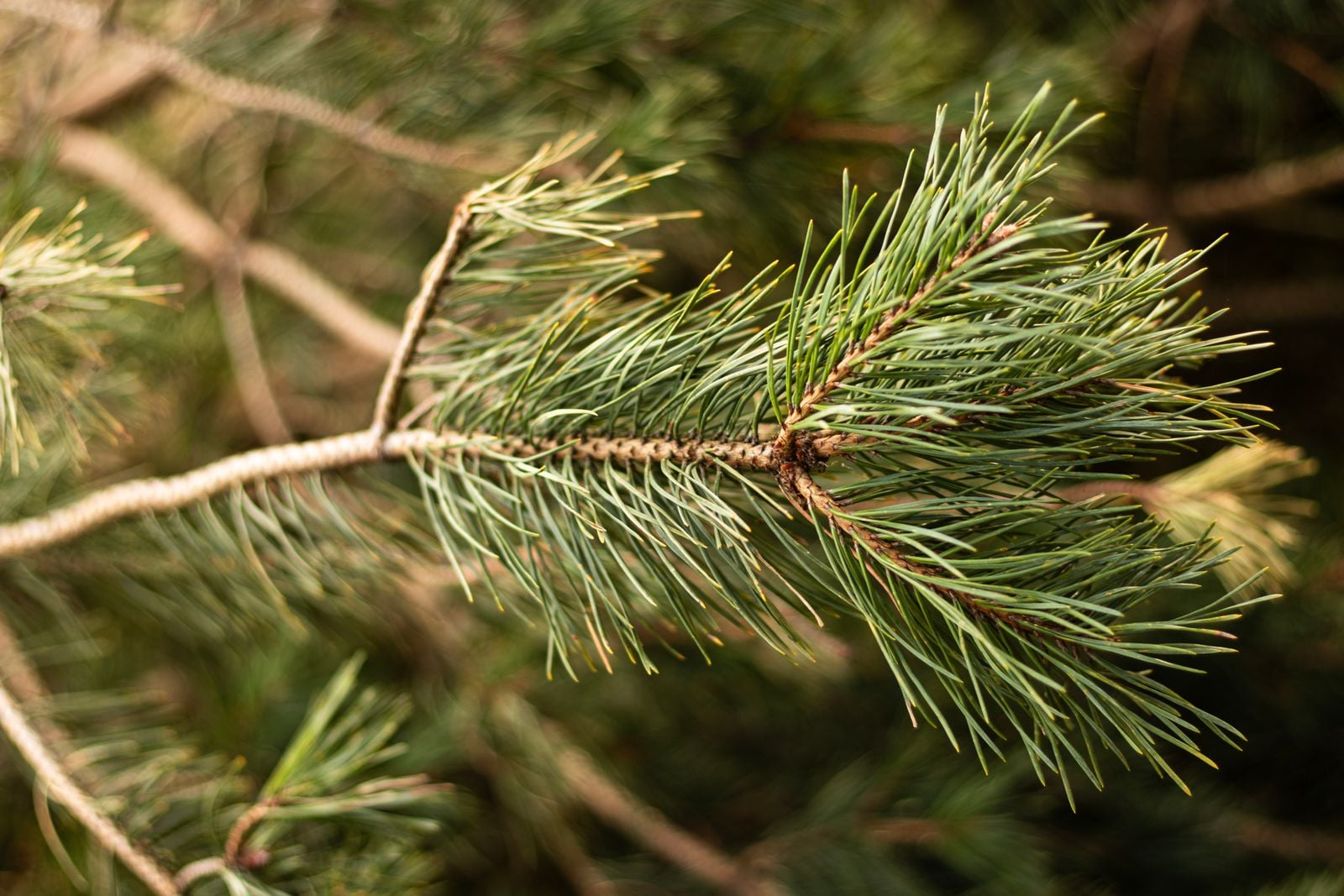
Wollemi pine foliage

What Noble actually found

The canyon is one of hundreds cut into the sandstone tableland that spreads west from Sydney into the Blue Mountains and, further north, into the Wollemi wilderness. Most have never been walked. They are too narrow, too wet, too choked with ferns and fallen rock, and they only open up if you rope in from the rim.

Noble was an experienced canyoner who had explored hundreds of them. He stopped at the base of one drop, looked up at a stand of tall trees he did not recognise, snapped off a piece of foliage, and put it in his backpack. It was the bark that caught him first. The trunk surface of a mature Wollemi pine is knobbled and nodular, and the comparison that stuck in Australian coverage was Coco Pops. Speaking at the National Arboretum in Canberra two decades later, Noble made the point that the find turned on a coincidence of person and place. As The Canberra Times reported, he said it had to be the right person at the right time, because it is one thing to be out there canyoning and another to be paying attention to the flora while you are.

Back in Sydney, the sample defeated the standard keys. It matched nothing living. The tree was eventually described as a new species in a new genus in 1995 by three people: Wyn Jones, a National Parks naturalist; Jan Allen, a horticulturist at the Blue Mountains Botanic Garden; and Ken Hill, a botanist at the Royal Botanic Garden Sydney. The species name honours Noble.

The fossil link came from pollen rather than leaves. Grains almost identical to Wollemia pollen had been catalogued for decades under the name Dilwynites, recovered from oil-exploration cores across southern Australia and later from New Zealand, East Antarctica and Patagonia. The morphospecies that most closely resembles modern Wollemi pollen, Dilwynites granulatus, is traceable to the Turonian age of the Late Cretaceous, between 89.8 and 93.9 million years ago.

Nobody had known what plant produced it. The macrofossils were worse than useless, because Araucariaceae leaf and cone fragments are hard to tell apart and the Wollemia characters sit awkwardly between the two genera anyone had to compare them with. The pollen had a name. The tree did not.

Why the lineage was written off

The Araucariaceae are an ancient conifer family. Their close relatives, the monkey puzzles and Norfolk Island pines and kauris, were once widespread across Gondwana. Dilwynites pollen turns up in sediment laid down when Australia was still joined to Antarctica and both were still joined to South America.

Then the record thins. American Scientist traced the decline: the pollen peaked in abundance during the Paleocene and Eocene, then fell away steadily as the planet cooled and Australia drifted north into drier latitudes. The most recent known Dilwynites came out of two-million-year-old sediment beneath the floor of Bass Strait, between Tasmania and the mainland. That is the early Pleistocene. After it, nothing.

Two million years of silence is enough for any palaeobotanist to close the file, and the file stayed closed until 1994.

The technical term for what Noble found is a Lazarus taxon: a group known first from fossils, then found alive. The coelacanth, hauled up off East London in South Africa in 1938, is the famous marine example. The Wollemi pine is the botanical one, and the gap it closes is longer.

How forty-six trees survived when the rest of the family did not

The canyon that holds the wild grove is a specific kind of refuge. Deep, narrow, permanently shaded, fed by a creek. The walls block wind. The overhang blocks most of the direct sun. Temperature barely fluctuates across the year and the humidity stays high.

These are the conditions Australia’s east coast used to have across far more of its area. As the surrounding country turned into dry sclerophyll forest and in places semi-desert, most of the moisture-loving Cretaceous flora died back. A handful of tiny pockets, canyon floors and permanently damp gullies and cloud-catching mountain tops, kept the old conditions going.

The trees also have a trick. Wollemi pines coppice prolifically, throwing new trunks from a single below-ground root mass, with some individuals carrying more than forty stems. Individual trunks can pass 400 years. The root systems are far older. Genome resequencing published in 2023 found the population has been relictual since the last major glacial and drying period in Australia, around 120,000 years ago.

Fire is the standing threat. In January 2020, as the Gospers Mountain fire moved through Wollemi National Park, air tankers laid retardant ahead of the front and specialist remote-area firefighters were winched into the gorge by helicopter to set up an irrigation system that wet the ground fuels. Helicopters water-bucketed the fire edge as it closed. Around 90 per cent of the park burned. The grove came through it singed but alive.

sandstone canyon Blue Mountains

The classified coordinates

The exact location of the wild stand has never been made public. New South Wales treats it the way it treats sensitive infrastructure: need-to-know, restricted access, penalties for trespass. The National Parks and Wildlife Service kept the 2020 firefighting operation quiet for the same reason, and only described it publicly after the fire had passed.

The concern is not theft. It is pathogens, and the concern is no longer hypothetical. Phytophthora cinnamomi, a soil-borne water mould that colonises and kills root systems, was detected in the largest subpopulation in 2005, and a second species, Phytophthora multivora, in 2009. Both are thought to have arrived on the footwear, clothing or equipment of unauthorised visitors. Infected mature trees have shown extensive stem and canopy dieback, though none is known to have died outright.

Rangers and approved researchers now follow a decontamination protocol that would not be out of place in a biosecurity lab, and are flown in and out to avoid tracking material along an approach path. Seed has been harvested from the canopy by helicopter.

The other structural weakness is genetic. For two decades after the discovery, repeated surveys could find no variation at all between wild individuals. Then researchers at the Royal Botanic Garden Sydney and the University of New South Wales sequenced whole chloroplast genomes from 65 trees covering all four wild sites. They found three chloroplast lineages, one dominant and two rare. It was the first variation ever detected in the species. It also confirmed how little there is.

Why the tree is now on sale in garden centres

The counterintuitive part of the conservation strategy is commercial propagation. Cuttings from the wild trees were rooted, grown on, and licensed to nurseries. Wollemi pines are now sold as ornamental garden trees in Australia, the United Kingdom, Europe, North America and Japan, and a share of the proceeds funds the recovery program.

The logic is simple. Every backyard specimen is an insurance policy. If the wild grove burns or the Phytophthora spreads, the species does not go with it. The nursery line is genetically narrow, mostly cloned from a handful of parents, but it exists in the thousands.

The serious conservation work is a step beyond that. Because the nursery trees carry so little of the wild variation, the Botanic Gardens of Sydney built a genetically diverse living collection at the Australian Botanic Garden Mount Annan, then shipped more than 170 saplings abroad to seed a metacollection. Six went into the ground at Bedgebury National Pinetum in Kent in 2023, with the rest distributed to 28 botanic gardens across the UK and Europe, plus five Australian gardens and one in Atlanta.

On the thirtieth anniversary of the discovery in September 2024, a backup collection went in at the Blue Mountains Botanic Garden Mount Tomah, and translocated populations inside Wollemi National Park were topped up to more than 835 saplings. A wild population of 89. A cultivated and translocated population in the thousands.

What ninety million years actually looks like

Try to hold the timescale. When the oldest Dilwynites pollen was settling into Australian sediment, the Atlantic was still opening. Flowering plants were a relatively new evolutionary experiment. Tyrannosaurus rex would not appear for more than another 20 million years. Australia was attached to Antarctica, and both were attached to South America.

The lineage was already old then.

It survived the asteroid strike at the end of the Cretaceous, apparently in small refugia. It survived the drying of the continent through the Miocene. It survived every glacial cycle of the Pleistocene. It survived roughly 65,000 years of Aboriginal land management and two centuries of European botanical surveying that concluded it did not exist.

It survived because one canyon stayed wet.

Before 1994 the working assumption in Australian botany was that the continent’s flora had been surveyed thoroughly enough that no large, distinctive, unknown tree could still be standing. The grove sits about a two-hour drive from the country’s largest city. Aircraft had flown over it. Bushwalkers had passed within kilometres of it for a century. Nobody had looked down into the right canyon. An earlier Space Daily piece worked through the tension that follows: the species needs public attention to be funded, and the population needs public ignorance to be safe.

The grove is doing about what it was doing on the morning of Noble’s abseil, and what it was doing for the two million years before anyone arrived to describe it. The adult trunks are slowly adding rings. New stems are coming up off the same root masses. Cones drop. The creek runs. The overhang holds back the sun. Somewhere on a New South Wales government server the coordinates sit in a restricted file, and a few dozen people know them.

The rest of us can go and look at the cultivated ones, at Kew, at Bedgebury, at Mount Annan, in a suburban backyard in Adelaide. The bark still knobbles the way it did in the canyon. The needles still come off in flat sprays. The tree is still doing what it was doing when the pollen that would become its only record was drifting down into a Cretaceous seabed.

It just took someone with a rope to notice.

The post In 1994, a bushwalker rappelling into a sandstone canyon 150 kilometres from Sydney found a stand of trees with waxy bubbled bark that matched fossils 90 million years old, and the Wollemi pine turned out to be a species everyone had assumed died with the dinosaurs appeared first on Space Daily.

  •  

More than three decades after the genocide, Rwanda has the highest share of women in a lower or single chamber of parliament of any country, and it is not close — 51 of 80 seats, 63.75%, against a global average of about 27%. The constitutional floor is 30%; women hold nearly half of the directly elected seats too

Women hold 51 of the 80 seats in Rwanda’s Chamber of Deputies. That works out to 63.75%, a figure the Inter-Parliamentary Union rounds to 63.8%.

In the IPU’s latest available ranking, Rwanda is first, ahead of Cuba at 57.2%. Around the world, women held 27.5% of national parliamentary seats as of 1 January 2026.

Rwanda isn’t narrowly ahead. It’s ahead by a distance.

The part that makes it interesting: the constitution doesn’t ask for anything like 63%. Rwanda’s constitution sets a floor of at least 30 per cent women in decision-making bodies. The country clears that floor by more than double, and keeps doing so, election after election. 

How the 51 seats break down

The Chamber has 80 seats, and they aren’t all filled the same way. Twenty-four are set aside for women, chosen by electoral colleges drawn from local government structures. Another 53 are elected by universal suffrage under proportional representation, while two seats are elected by the National Youth Council and one by the body representing people with disabilities. The 24 reserved seats are exactly 30% of the chamber.

That isn’t where women’s representation stops. In the 2024 election, the IPU recorded 25 women directly elected and 26 indirectly elected. The indirect group included the 24 reserved women, one of the two youth representatives and the representative of people with disabilities. So women won 25 of the 53 directly elected seats — nearly half — on top of the guaranteed 24.

This isn’t a fluke from one strong year. Women held 48.8% of seats after the 2003 election, 56.3% after 2008, 63.8% after 2013, 61.3% after 2018 and 63.8% after 2024. The total has moved around, but it has stayed far above the constitutional floor.

Where the 30% floor came from

To understand the floor, you have to go back to what produced it. The 1994 genocide against the Tutsi killed roughly 800,000 to a million people in roughly a hundred days. In its aftermath, many Rwandan women found themselves heading households, and women took on larger roles in political life. The 2003 Constitution wrote gender representation into the new political order.

The quota was not the only rule. A law on political organizations was later amended to require party lists to include at least 30% women candidates. 

Why the total keeps landing above the floor

Part of the answer is simple math. The reserved seats guarantee 24 women no matter what happens in the general vote. Any woman who wins one of the 53 directly elected seats is added on top of that base. More than two decades of women serving visibly in parliament also means female candidates are no novelty, while the closed-list proportional system gives parties substantial influence over who appears in electable positions.

But the number is also tied to Rwanda’s wider political system. A quota can guarantee a minimum. It cannot, by itself, explain why women have repeatedly taken such a large share of the non-reserved seats.

The caveats the number hides

The headline figure describes the lower house, not all of power. As of 1 January 2026, women held 5 of 19 cabinet posts, or 26.3%, according to IPU and UN Women. Rwanda’s Senate was 46.2% women. A lower house that is 63.8% women therefore sits inside a political system whose other institutions are less female-dominated.

Then there’s the question of what kind of state produces a result like this. Rwanda is dominated by the Rwandan Patriotic Front, and Freedom House classifies it as “Not Free”. Its 2025 report noted that President Paul Kagame won a fourth term in 2024 with 99.2% of the vote after prominent opposition figures were disqualified.

Assistant professors Marie E. Berry and Milli Lake argue that reserved seats have “allowed the ruling Rwandan Patriotic Front (RPF) to elevate its allies to positions of political power” while helping legitimize RPF dominance. That is their interpretation, not a settled fact, but it points at a real tension: who sits in the seats is not the same as how independent those seats are.

Not everyone reads the numbers so darkly. A policy review on Rwanda’s quota points to reforms associated with women parliamentarians, including equal access to land ownership and equal-pay labour laws. Both things can be true at once: a genuine change in who governs, and an open question about how much independent political power those representatives wield.

So the number that opens all this, 63.75% against a 30% floor, is best read as a starting point, not a verdict. The reserved seats explain 24 women cleanly. They do not explain the 25 women directly elected in 2024, the long normalization of women in political office, or the way Rwanda’s tightly controlled party system shapes who reaches parliament. The distance between what the constitution requires and what Rwanda produces is exactly where the interesting questions live.

The post More than three decades after the genocide, Rwanda has the highest share of women in a lower or single chamber of parliament of any country, and it is not close — 51 of 80 seats, 63.75%, against a global average of about 27%. The constitutional floor is 30%; women hold nearly half of the directly elected seats too appeared first on Space Daily.

  •  

In 1977, Carl Sagan and Frank Drake sat in a Cornell office arguing over what to put on the Voyager Golden Record, and among the greetings in 55 languages, the whale song, and the Bach they included the sound of a young woman’s brainwaves recorded while she thought about being in love.

In 1977, Carl Sagan and Frank Drake sat in a Cornell office arguing over what to put on the Voyager Golden Record, and among the greetings in 55 languages, the whale song, and the Bach they included the sound of a young woman's brainwaves recorded while she thought about being in love.

On the afternoon of 3 June 1977, a young woman lay on a table at Bellevue Hospital in New York while a computer converted the electrical activity of her brain into sound. Her name was Ann Druyan. She was 27, creative director of the Voyager Golden Record project, and two days earlier she had agreed by telephone to marry Carl Sagan. The hour of EEG and EKG data captured that afternoon — compressed to about a minute — was pressed into the grooves of a gold-plated copper disc, bolted to the side of two spacecraft, and launched toward the outer planets. It is now more than 25 billion kilometres from Earth.

The team had less than six weeks. Sagan, astronomer Frank Drake, writer Timothy Ferris, artist Jon Lomberg, and Druyan worked against a launch window that would not move, arguing over greetings, whale song, Bach, Chuck Berry, and what, exactly, a human being sounds like from the inside. The folklorist Alan Lomax, working from New York rather than Ithaca, selected the bulk of the field recordings.

What actually went onto the disc

The Golden Record is a 12-inch phonographic gold-plated copper disc, shipped with a stylus and cartridge and a diagram etched into its aluminium cover explaining how to play it. Each Voyager carries an identical copy. According to an account published by The Conversation on the record’s 40th anniversary, the grooves hold both ordinary audio and 115 encoded images, along with greetings in 55 languages and a curated tour of terrestrial sound.

The audio runs from a Georgian men’s chorus to Blind Willie Johnson’s Dark Was the Night, Cold Was the Ground. It includes Bach’s Brandenburg Concerto No. 2, Mozart’s Magic Flute, Louis Armstrong, Chuck Berry’s Johnny B. Goode, and honkyoku shakuhachi. It includes the sound of a kiss, a mother speaking to her newborn, thunder, surf, a chimpanzee, and a humpback whale. Ferris also wanted one mark made directly by a human hand, and JPL’s archive records the phrase he had etched between the label and the grooves: “To the makers of music – all worlds, all times.”

And then, near the end, the brainwaves.

Voyager Golden Record cover

How Druyan’s EEG got onto a spacecraft

The idea was Druyan’s. She had asked Sagan whether, if she recorded her brainwaves, a civilisation a billion years from now could conceivably read them. He did not know. He suggested they try anyway. The committee volunteered her to supply the signal, and she booked a laboratory at Bellevue where a technician captured an electroencephalogram, an electrocardiogram, eye movement and other bodily signals across a single hour.

She went in with a script. According to a 40th-anniversary panel at Caltech reported by the Orange County Register, Druyan tried to hold a mental itinerary of Earth’s history in her head during the recording — the movement of continents, the rise of civilisations, the invention of writing.

Her thoughts drifted.

Two days earlier, she and Sagan had ended a phone call by agreeing to marry. They had not yet kissed. Both were in other relationships. Writing years later in the epilogue to Sagan’s Billions and Billions, Druyan described entering the Bellevue laboratory and being hooked to a computer that turned the data from her brain and heart into sound. In an account of the recording session published by Futurism, she is quoted saying that “my feelings as a 27 year old woman, madly fallen in love, they’re on that record” — and that the permanence of it, on a timescale of a hundred million years, is the part she finds it hard to be afraid of.

The six weeks at Cornell

The selection process was compressed and contentious. Sagan had been given the assignment by NASA with a launch window that would not wait. NASA’s own account of the project puts it plainly: the group had less than six weeks to assemble something meant to represent the entire population of Earth. Frank Drake, who had designed the earlier Pioneer plaques with Sagan, proposed the format and worked out the technical encoding — how to press images into an audio groove so that a civilisation with no shared reference could reconstruct them. Ferris, writing in The New Yorker, described the production as a scramble of long-distance phone calls, borrowed studio time, and last-minute swaps.

Some choices were vetoed. NASA rejected a photograph of a nude man and pregnant woman; the team submitted a silhouette instead.

The most repeated story about the record is that the Beatles were nearly on it. In the usual telling, Here Comes the Sun was wanted, the band agreed, and EMI refused the rights. Ferris, who produced the record, has disputed the premise directly, writing in The New Yorker that the track was never a serious contender and that the wit of the title seemed unlikely to survive a billion years. The two accounts have never been reconciled. What is certain is that the song is not on the disc, and Chuck Berry is.

The Georgian folk song Tchakrulo made it on, but not before the committee found out what it said. Ferris has written that for all anyone on the team knew, the song could have been celebrating something indefensible. They located a Georgian speaker in Queens, Sandro Baratheli, and had him translate. It turned out to be a peasants’ protest against a feudal landlord. It stayed. Sagan, for his part, had come to Cornell after Harvard denied him tenure in the late 1960s, reportedly for being too public a scientist; Cornell named him David Duncan Professor of Astronomy and Space Sciences, and it was in a Space Sciences Building office there that much of the record was assembled.

What a brainwave actually is, and why it survived the trip

An EEG measures voltage differences between electrodes placed on the scalp — typically in the range of microvolts, oscillating at a few cycles to a few dozen cycles per second. It records the aggregate behaviour of large populations of neurons. It does not record thoughts. To fit an hour of that signal onto a record with finite groove length, the recording was heavily compressed, and what plays back is a burst of crackle and pulse with no intelligible content in it at all.

There is no way to extract Druyan’s actual thoughts from the disc. The signal is too coarse, and it was never a transcript to begin with. What survives is the fact of a nervous system, doing what nervous systems do, on a particular afternoon. We know what that minute meant only because Druyan later told us.

That is the object now travelling through interstellar space at roughly 17 kilometres per second.

Voyager spacecraft interstellar

Where the record is now

Voyager 1 crossed into interstellar space in 2012 and is currently the most distant human-made object. NASA’s mission tracker puts it past 25 billion kilometres, closing on a threshold it will cross in November 2026, when it becomes the first object built by humans to sit a full light-day from Earth. Voyager 2 crossed the heliopause in 2018 and trails behind. Both spacecraft are still transmitting on plutonium-238 radioisotope generators whose output falls a little each year, and NASA has been shutting down instruments to conserve the shrinking power budget.

The spacecraft themselves will eventually fall silent. The records will not. Gold-plated copper, in the near-vacuum of interstellar space, has no obvious mechanism of decay on any timescale that matters to human civilisation. Micrometeoroid strikes will pit the surface over millions of years. The information will remain readable for a very long time. The object was designed to outlive not only the spacecraft but plausibly the civilisation that made it.

There is no way to verify that any of it will be found. The nearest star to Voyager 1’s current trajectory is a red dwarf called Gliese 445, and the spacecraft will pass within about 1.6 light-years of it in roughly 40,000 years. Voyager 2 will pass Ross 248 on a similar timescale. Neither is a close approach in any meaningful sense. The odds of interception are effectively zero across any period a human being would care about.

The record is not really an experiment. It is a gesture whose meaning is fixed on the sending end.

The private layer inside a public artefact

The committee could have stopped at greetings, music, and images. The decision to include a physiological recording reflects a specific intuition Sagan and Druyan held about what a message to another mind should contain. Language would probably be unreadable. Music might be unrecognisable as music. But the electrical activity of a working brain is a physical signature that any technologically capable civilisation would, in principle, be able to identify as the output of a nervous system.

Whether or not that reasoning holds, it captures something about the project’s ambition. The record was not really designed for aliens. Sagan had said as much about the earlier Pioneer plaque, writing that its greater significance was not as a message to out there but as a message to back here.

Most of what went onto the record was chosen to represent humanity in the aggregate: many languages, many musics, many faces. The brainwave is the exception. It is one specific 27-year-old woman on one specific afternoon in June 1977, thinking about one specific man she had agreed to marry two days earlier.

Sagan and Druyan married in 1981 and stayed together until his death in 1996. Druyan has spoken openly about the recording in the decades since — at Caltech, on Radiolab, in interviews around the release of a Kickstarter-funded vinyl edition of the record that Business Insider covered in its explainer on the record’s contents. That reissue, as NPR reported, raised more than $1.3 million from backers who wanted to hear at home what had been sent to the stars. The personal layer inside the record was known to the team at the time but not widely publicised until decades later.

What is up there, exactly, is this. A 12-inch gold-plated copper disc. A stylus. A cartridge. An etched cover with a pulsar map and instructions. Bach, whale song, thunder, greetings in Akkadian and Mandarin and Wu, the sound of a kiss, a mother and child, a line scratched by hand to the makers of music in all worlds and all times, and — encoded near the end — the compressed electrical activity of a young woman’s brain during the hour she was thinking about the man she had just agreed to marry.

It is currently moving away from the Sun at roughly 61,000 kilometres per hour. It will keep going long after the transmitter goes dark, long after the last engineer who worked on Voyager is gone, and long after the Cornell office where the arguments happened is no longer standing. NASA expects the power budget to narrow through the late 2020s and into the 2030s. The record will not notice. Somewhere out past the heliopause, in the dark between stars, a minute of a June afternoon in 1977 is still travelling.

The post In 1977, Carl Sagan and Frank Drake sat in a Cornell office arguing over what to put on the Voyager Golden Record, and among the greetings in 55 languages, the whale song, and the Bach they included the sound of a young woman’s brainwaves recorded while she thought about being in love. appeared first on Space Daily.

  •  
❌