❌

Reading view

Scientists trace high-energy ghost particle to the 'Shadow Blaster' galaxy

Astronomers have traced a high-energy "ghost particle" back to Shadow Blaster, a star-forming galaxy located 11 billion light-years away. That means that this particle, a neutrino, had been travelling to us ever since the 13.8 billion year-old universe was just around 3 billion years old.

The discovery offers the first evidence that star-forming galaxies like Shadow Blaster play a significant role in populating the universe with mysterious high-energy cosmic ghost-neutrinos. These particles get their spooky nickname because, possessing virtually no mass and no electric charge, they pass through matter with little to no interaction while moving at nearly the speed of light. For context, as you read the preceding sentence, over 65 billion neutrinos streamed through every square inch of your body; that's about 100 billion per square centimeter.

Despite the difficulty associated with detecting such particles, humanity has been spotting neutrinos since the 1960s, but only a few sources of these particles have been identified. Neutrinos are the second most abundant particles in the cosmos after photons, particles of light, and the identified sources are nowhere near enough to account for this abundance. That has prompted the search for other, hidden neutrino sources, especially those which can accelerate neutrinos to high energies. Now that hunt has led to the identification of the incredibly bright Shadow Blaster galaxy, officially designated JCMT0402βˆ’0424, which shines in infrared, as a potential neutrino source.

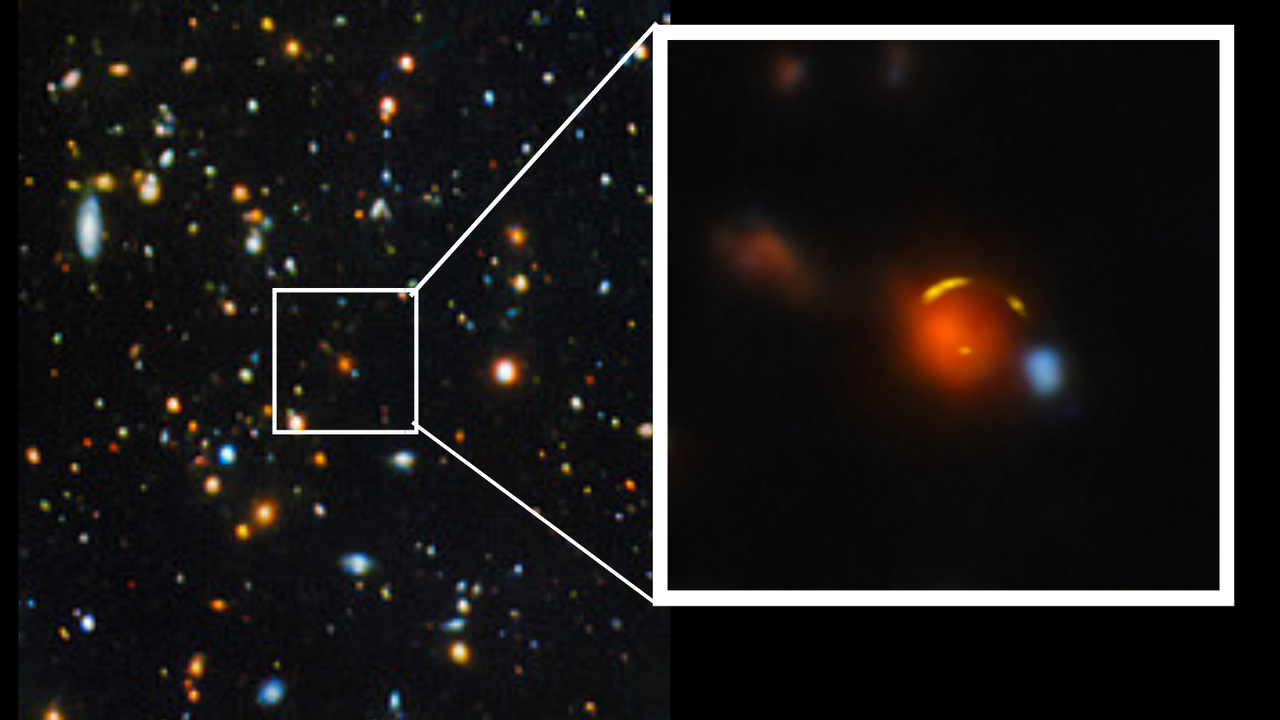
Three panels. The left one has lots of colorful blobs. The center has a red blob. The right has a curved reddish streak with a small red blob in the center bottom of the screen.

The galaxy JCMT0402βˆ’0424, or "Shadow Blaster" identified as a source of a high-energy neutrino detected in 2021. (Image credit: International Gemini Observatory/NOIRLab/NSF/AURA/ALMA (ESO/NAOJ/NRAO))

"Shadow Blaster possesses the kind of dense, gas-rich environment that theoretical models have long suggested could efficiently produce high-energy neutrinos," Yuji Urata of MITOS Science Co., LTD. in Taiwan said in a statement. "If confirmed, Shadow Blaster would be the first-ever individual dusty star-forming galaxy directly linked to a high-energy neutrino event."

Thus far, no other credible candidates exist as potential sources for this high-energy neutrino, designated IC 210922A.

Chasing ghosts

Astronomers were alerted to the existence of IC 210922A half a decade ago when this high-energy neutrino event was detected by the IceCube Neutrino Observatory located in Antarctica. This set the astronomical community scouring space in the direction of the constellation Eridanus for potential sources for an electromagnetic counterpart to this event with a range of telescopes. This turned up no convincing gamma-ray, X-ray or optical counterpart for the neutrino detection, nor could any gamma-ray burst, supernova, or tidal disruption event (in which a black hole violently shreds a star) be linked with IC 210922A.

Urata and colleagues began their personal search with the James Clerk Maxwell Telescope (JCMT), operated by the East Asian Observatory, and the Submillimeter Array (SMA), discovering Shadow Blaster, a galaxy in the right position and with the right level of brightness to be associated with IC 210922A. The team followed this up with an investigation using the Atacama Large Millimeter/submillimeter Array (ALMA), a collection of 66 radio wave antennas in northern Chile.

The detection of this galaxy was possible because it is strongly gravitationally lensed. Gravitational lensing is a phenomenon that occurs when an object of great mass comes between Earth and a distant background source, curving the fabric of spacetime. As light from the background source navigates this curvature, its path is curved. This results in light from the lensed source arriving at different times to our telescopes, causing it to be amplified.

In the case of Shadow Blaster, before the team could learn anything about this distant galaxy, they had to discover more about the object serving as the intermediate gravitational lens, specifically what type of object it is, its mass, and its distance from us. To do this, they turned to the Gemini North telescope and its Gemini Multi-Object Spectrograph (GMOS) and the Gemini Near-InfraRed Spectrograph (GNIRS) instruments.

With the model of a gravitational lens determined, the team discovered that Shadow Blaster is a galaxy with an extremely compact heart filled with dense clouds of gas and dust that is fueling an intense burst of star formation. A region such as this has long been theorized to serve as a powerful particle accelerator. Because Shadow Blaster lacks a feeding supermassive black hole, this research shows that these regions can still serve as cosmic particle accelerators when they harbor sleeping black holes and in the absence of the powerful jets that erupt from active galactic nuclei (AGNs).

As for the overall population of neutrinos, this research could help account for that too. Intensely star-forming galaxies, or starburst galaxies, are believed to have been prevalent around 10 billion years ago in the early universe. Thus, these galaxies could have been producing a multitude of high-energy neutrinos. Proving that may prove difficult, however, as astronomers don't have the good fortune to find all of these galaxies lurking behind a gravitational lens, meaning they may be too faint and distant to study.

"Our analysis suggests that this population could contribute up to roughly 20% of the observed diffuse neutrino background measured by IceCube," Urata concluded,

The team's research was published on Wednesday (June 17) in the journal Nature Astronomy.
  •  

James Webb Space Telescope finds a salty surprise on famous 'Pink Planet'

Using the James Webb Space Telescope, astronomers have discovered that the well-known "Pink Planet" harbors a salty surprise and an exotic atmospheric chemistry. The discovery marks an advancement in the study of cold objects beyond the solar system.

Initially discovered in 2013, GJ504b orbits a sun-like star located around 57 light-years from Earth. With a mass around 25 times that of Jupiter, this Pink Planet may not be a planet at all despite its moniker. It may instead be a brown dwarf, a failed star that formed like a star but was unable to gather enough mass to achieve the nuclear fusion of hydrogen to helium in its core. Thus, astronomers refer to it as a "planetary-mass companion," which means a planet-size object orbiting a parent star.

GJ504b remains one of the coldest planetary-mass companions discovered using ground-based telescopes, with a temperature of around 550 degrees Fahrenheit (290 degrees Celsius). Although, that still makes it hot enough to bake bread. Now, James Webb Space Telescope (JWST) data reveals it has a key ingredient for bread making too: salt located in its atmospheric clouds, unlike anything astronomers have seen before.

"The Pink Planet is the coldest companion ever discovered using ground-based instruments," team leader Aneesh Baburaj of Northwestern University said in a statement. "Many teams all around the world performed follow-up observations to study its light, but it was too faint for ground-based instruments. That made it a perfect target for JWST.

"When we finally obtained its spectrum, it immediately looked interesting. But once we started digging deeper into the data, we realized it was not like anything we have analyzed before."

The Pink Planet is cold and old

The team studied this planetary companion by measuring its faint electromagnetic radiation emissions and filtering out the bright glare of its parent star.

They found the relative coolness of the Pink Planet is a result of the planet's age. Both gas giant planets and brown dwarfs are born blisteringly hot but cool off as they get older. This new research estimated that GJ504b is between 2.5 billion and 4 billion years old.

Breaking down light from the Pink Planet into individual wavelengths, the team was also able to determine its chemical composition. This is possible because elements absorb and emit light at characteristic wavelengths, meaning they leave "fingerprints" on light passing through their atmospheres.

"In the past, other astronomers observed the companion for an entire night with some of the biggest telescopes in the world to obtain a spectrum," Baburaj said. "And they could not see the object. With JWST, our entire observation took around two hours, and we were successful."

The JWST data revealed a rich cocktail of chemicals in the atmosphere of the Pink Planet that included water, carbon dioxide, methane, and ammonia. However, these observations didn't match modeling of the planetary companion's atmosphere until the team factored in something completely unexpected: clouds of salt deep in the atmosphere.

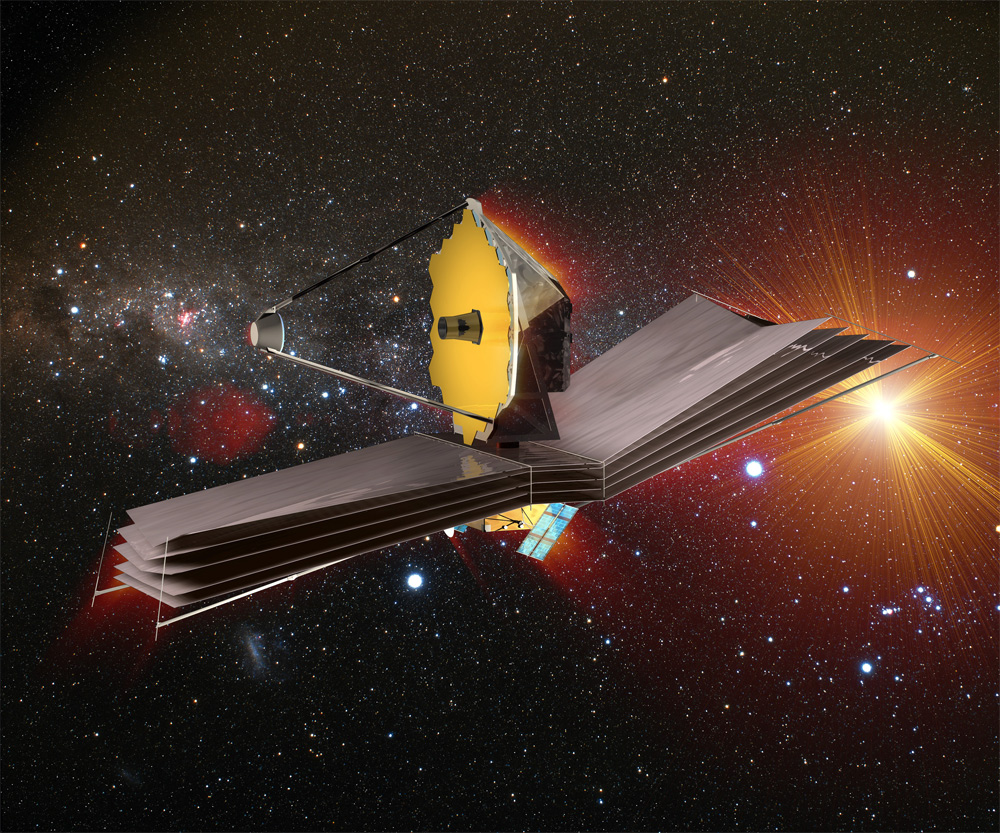
A depiction of a yellow-hexagon mirror attached to a long silver shield-shape object. This is the JWST. In the background, lots of stars across space. Toward the right in the background, glare from one star that is likely the sun.

An illustration of the JWST which has become a vital tool in the investigation of exoplanets and brown dwarfs. (Image credit: ESA)

"We ran simulations with clouds, and the results aligned with what we know about cold planets," Baburaj said. "We tried three different types of clouds, and salt clouds fit best. When we accounted for salt clouds, it subdued the signature of molecules hidden deeper in the companion’s atmosphere. Then, the results became physically possible.

"This is the first time we've found that salt clouds are critical to explaining the spectrum of an object. It's a good reminder to account for clouds in our models."

Though this mystery may be solved, there are still questions surrounding GJ504b that will only be solved with further investigation. The Pink Planet seems to be unusually rich in elements heavier than hydrogen and helium, which astronomers call metals. This means the team still can't pin down the origin of the Pink Planet; did it form like a planet, or like a star?

That means they aren't quite ready to determine if GJ504b is a gas giant planet or a brown dwarf... or should that be Pink Dwarf?

The team's research was published on Thursday (June 18) in The Astronomical Journal.

  •  

Jared Leto's unreal Skeletor transformation for 'Masters of the Universe' only took '15 minutes' (interview)

Emmy Award-winner Barrie Gower has helped created some of the most memorable beasts and creatures in the entertainment sphere, including "Stranger Things"' Vecna, "Game of Thrones"' chilling White Walker, the Night King, and the freaky fungus mutants of HBO's "The Last of Us."

For director Travis Knight’s sci-fi fantasy film, "Masters of the Universe," Gower called upon all of his veteran skills to provide special makeup and prosthetic applications for Jared Leto's Skeletor and his entire band of weird henchmen, plus He-Man's gang of crazy companions. From iconic characters like Spikor and Moss Man to Goat Man and Trap Jaw, Gower’s ace crew was tasked with bringing these monsters to the big screen.

"We got contacted a few years ago about 'Masters of the Universe' in 2018 or 2019," Gower tells Space.

"It was with a different director at the time and a different studio. It was two writer/directors, the Nee Brothers, who co-wrote the screenplay for this latest integration."

"The project changed studios two or three times and eventually they came back to us and the timing was bang on," explains Gower. "They’d enlisted Travis Knight and his vision was quite different to the original take, which was very high tech, very clean, very Marvelesque. Travis was a huge fan of He-Man and the '80s cartoon, the toy line, and the whole IP and franchise. His passion and love was really trying to do this film project justice and make it as true as possible."

a horned red goat man with five makeup artists

Team Goatman. (L to R) Sarah Downes, Barrie Gower, Hapthor Bjornson, Duncan Jarman, Anthony Parker and Gillian Jarvis (Image credit: Amazon MGM Studios)

The master plan was to still give the $200 million feature a fun modern spin, but Knight was interested from a character perspective of creating full-sized human equivalent action figures.

"He wanted the world to be ultra colorful, ultra bright, and have this sense of awe and eye candy. We went through the characters to decide what would be practical, what would be purely digital, and what would be a combination of the two. Because of Travis’s background with Laika Studios he was very much into the practical techniques."

That was all music to Gower's ears and his BGFX team began the process of bringing the menacing egomaniacal antagonist called Skeletor to life.

"Originally Skeletor was going to have some sort of decorative golden mask in the shape of a skull with possibly some kind of disfigured makeup underneath," he notes. "But Travis said we’re doing Skeletor properly. He’s going to have a skull for a talking face and a blue muscular body. And this is the prefect example of a combination between practical and digital effects.

"He was set on the idea of creating a practical muscle suit for Jared, and his head would be animated digitally. We had a scan of Jared's head that we reduced and classically sculpted the skull based on the concept art, then we 3D scanned that for a digital file which we shared with the visual effects department for them to use as an asset to animate."

blue latex skeleton man concept art

Gower's Skeletor build page for "Masters of the Universe" (Image credit: Amazon MGM Studios)

Creating this blue-hued Skeletor muscle suit was quite a complex job that included upper and lower body appliances crafted out of foam latex.

"It was using a lot of Jared’s muscle tones that we over-exaggerated and sculpted in more muscle sets and tones, but kept everything relatively anatomically accurate," adds Gower. "Then we went through a lot of testing and paint schemes. We originally did some silicone work, which is one of the most commonly used products in the prosthetics industry now because you get a beautiful translucency with it. But it’s very dense and non-porous and very heavy. So Jared would have been walking around with pounds and pounds of rubber on him. We did R&D and it was going in the right direction but we were running out of time, so we reverted to foam latex."

Jared's otherworldly outfit consisted of a foam suit, skeletal silicone gloves that fit over his hands, a foam latex collar, and then a hood fabricated by the costume department.

makeup artists touching up a spiked monster

Prosthetic artists Jon Moore and Ashley Powell with James Apps as Spikor (Image credit: Amazon MGM Studios)

"We'd actually built two suits based on Jared. It was on a January morning and we met him at a hotel near the London airport," Gower recalls. "We had a very small window of time before filming so we were praying we weren’t going to have many adjustments to make. Jared came in, we got the stuff on him, and he was really lovely with us. Very funny, very jovial. He had just stepped off a plane!

"It went really well, just a couple tiny adjustments. We had a small team looking after him with his suit every day. Usually with prosthetics if you’re gluing it over the entire body you’re looking at seven or eight hours to do an application each day. Apart from times where we had to glue a few things on him here or there, we actually got him into his suit in about 15 minutes. He was a joy to work with. He was a lot of fun on set and there was this charismatic presence every day."

"Masters of the Universe" is currently in theaters everywhere.

  •  

SpaceX launches new batch of US spy satellites from California (video)

SpaceX launched the latest batch of spy satellites for the U.S. government early Friday morning (June 19).

A Falcon 9 rocket lifted off from California's Vandenberg Space Force Base on Friday, at 4:50 a.m. EDT (0850 GMT; 1:50 a.m. local California time).

The launch kicked off a mission for the U.S. National Reconnaissance Office (NRO) called NROL-179.

an uncrewed orbital class rocket lifts off into the pitch black sky, lighting its launch pad below with its orange-white plume

SpaceX launched the NROL-179 mission for the U.S. government early Friday morning (June 19) from Vandenberg Space Force Base in California. (Image credit: SpaceX)

The NRO operates the United States' fleet of spy satellites. NROL-179 was the 14th mission dedicated to building out a new part of that fleet β€” a network the NRO calls its "proliferated architecture."

"To stay ahead of the competition and ensure it can continue to operate in a heightened threat environment, the NRO is modernizing its architecture in space and on the ground β€” delivering more capability faster with increased resilience," agency officials wrote in the NROL-179 press kit.

"A greater number of satellites β€” large and small, government and commercial, in multiple orbits β€” will deliver an order of magnitude more signals and images than is available today," they added.

SpaceX and Northrop Grumman build the "proliferated architecture" satellites. Information about the spacecraft is hard to come by; the NRO has not released details about their activities or orbits.

All of these satellites have reached orbit atop Falcon 9s flying out of Vandenberg, on California's central coast, with the first such mission launching in May 2024.

To plan, the Falcon 9's first stage returned to Earth a little less than eight minutes after liftoff on Friday, touching down at Vandenberg's Landing Zone 4. It was the third flight for this particular booster, according to a SpaceX mission description.

NROL-179 was the 71st Falcon 9 mission of 2026. Fifty-seven of the rocket's launches this year to date have been devoted to building out SpaceX's Starlink broadband megaconstellation in low Earth orbit.

Editor's note: This story was updated on June 19 with news of successful launch.

  •  

You can get my favorite image-stabilized binoculars for their cheapest ever price in this incredible anti-Prime Day deal

The Fujinon Techno-Stabi 1640 binoculars were the first image-stabilized (IS) binoculars I got my hands on and they are, quite literally, showstopping. Handheld stargazing actually became fun for me, instead of just getting annoyed at squiggly lines of light. Regardless of whether you are a seasoned binocular pro or a beginner, when you start upping the magnification, views start amplifying hand shake and make observation impossible. What is the point of spending loads on high quality optics if you can't even get a still picture? I truly believe that when it comes to non-telescope stargazing, image stabilization (IS) is one of the best things you can spend your money on.

Get the Fujinon Techno-Stabi TS-L 1640 image-stabilized binoculars, on sale right now for $1,125 at Walmart.

I'm not saying that image-stabilized binoculars aren't expensive. They are, but you would realistically never need to buy another pair of high-magnification binoculars again. I recommend the Fujinon Techno-Stabi 1640 binoculars at full price, so getting $275 off them at their lowest price really is a steal. For prices on other binoculars and other optics, check out our Prime Day hub for the best prices during the summer sales events.

Save a huge $275 on the incredible Techno-Stabi TS-L 1640 image-stabilized binoculars. They contain Fujifilm's premium optics in a lightweight package with some of the strongest image stabilization on the market.

I gave them four and a half stars in my full Fujifilm Fujinon Techno-Stabi TS-L 1640 image stabilized binoculars review.View Deal

A man looking through the Fujifilm Techno-Stabi TS-L 1640 image-stabilized binoculars upwards with trees and buildings in the background.
These binoculars are perfect for sharp handheld observation of a range of night sky objects including stars, clusters and the moon. Harry Bennett / Future
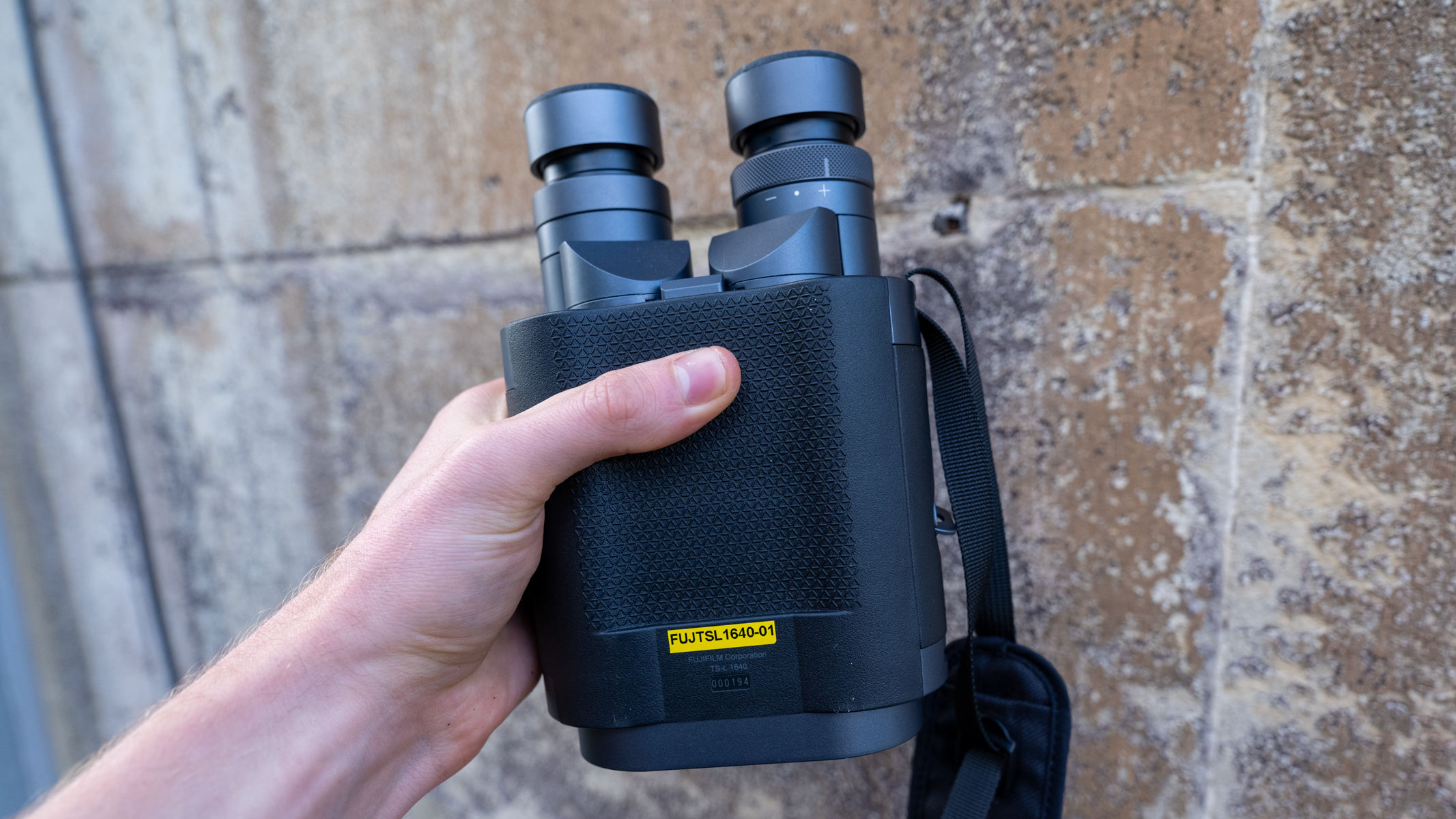
A hand holding the Fujifilm Techno-Stabi TS-L 1640 image-stabilized binoculars with a beige wall in the background.
The Techno-Stabi TS-L 1640 binoculars are great for holding in your hand and are highly portable. Harry Bennett / Future
A head-on view of the lenses on the Fujifilm Techno-Stabi TS-L 1640 image-stabilized binoculars on some wooden planks.
They have a neat, streamlined design despite their high-end optics.Harry Bennett / Future
A close-up of the lenses on the Fujifilm Techno-Stabi TS-L 1640 image-stabilized binoculars with wooden planks in the background.
40mm objective lenses aren't the biggest but the image-stabilization more than makes up for it. Harry Bennett / Future
A close-up of the battery compartment on the Fujifilm Techno-Stabi TS-L 1640 image-stabilized binoculars with wooden slats in the background.
A special screw feature tightens and loosens the battery compartment.Harry Bennett / Future
A close-up of the eyecups and right diopter on the Fujifilm Techno-Stabi TS-L 1640 image-stabilized binoculars with wooden planks in the background.
The eyecups are easy to adjust for different levels of eye relief. Harry Bennett / Future
A close-up view looking into the eyecups of the Fujifilm Techno-Stabi TS-L 1640 image-stabilized binoculars with wooden planks in the background.
The eyecups have over 15mm of eye relief with three different height presets. Harry Bennett / Future
The lens cover attached to the Fujifilm Techno-Stabi TS-L 1640 image-stabilized binoculars on wooden plank.
The rubber lens cap keeps the objective lenses dust-free during travel.Harry Bennett / Future
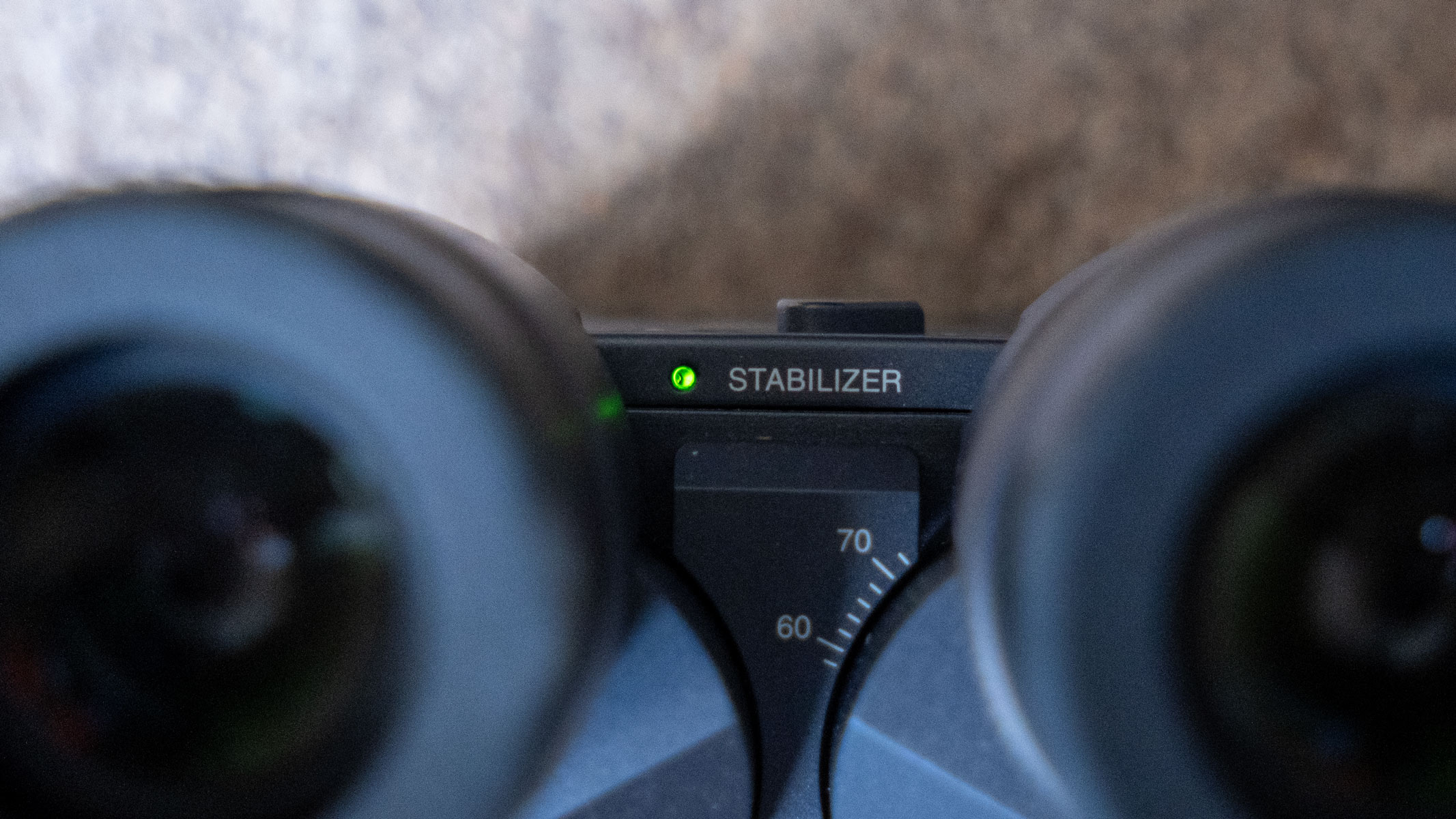
A close-up of the green image-stabilizer light with inter-pupillary distance markings on the Fujifilm Techno-Stabi TS-L 1640 image-stabilized binoculars.
A small green LED illuminates in between the eyecups when the image stabilization (IS) is active. Harry Bennett / Future
A birds-eye view of the Fujifilm Techno-Stabi TS-L 1640 image-stabilized binoculars on some wooden planks.
A roof prism design keeps the weight low at 1.9 lbs (856 g).Harry Bennett / Future
A Fujinon binoculars pouch on a wooden table with sunlight and shadow cast across it.
The binoculars come with a soft padded case for storage when travelling or storing for long periods. Harry Bennett / Future

The Fujinon Techno-Stabi TS-L 1640 image stabilized binoculars sit near the top of the binocular pyramid alongside the other best image stabilized binoculars thanks to their premium Fuji optics, lightweight build and powerful 3-degree image stabilization (IS). It is some of the strongest IS on the market, only being out ranked by other Fujifilm IS binoculars.

40mm objective lenses aren't the biggest for stargazing, where 50mm is the gold standard for low light, but you can't complain when observing star clusters at 16x magnification with zero shake. Even if you were using 16x50 binoculars without IS, that extra light-gathering ability would be useless when observing overhead without a tripod, the resulting view likely to be a mess of squiggly lights.

My favorite target with these was the Mirfak cluster in the constellation Perseus, which I could actually identify at this magnification thanks to the IS. It's amazing using them without the IS, then switching it on and watching the detail of the night sky emerge. They sit in a higher price bracket than regular models, but they really are some of the best optics you can buy for a heavy binocular user and now with over $250 off their asking price on Walmart, it's a great chance to save money on some exceptional technology. We are going to be seeing a lot of deals on binoculars, telescopes and cameras coming up to Amazon Prime Day. It starts on June 23, so make sure you check our Prime Day hub for all the best offers on skywatching gear and space gifts.

Key features: 16x magnification, 40mm objective lenses,+/- 3 degrees of image stabilization, multicoated extra-low dispersion (ED) glass, roof prism optical desing, 1.9 lbs (856 g) weight, 30-hour battery life.

Product launched: January 2025

Price history: This is the cheapest the Fujinon Techno-Stabi TS-L 1640 binoculars have been since May this year, when they dropped to 1150 on Amazon. This Walmart price currently beats Amazon's asking price.

Price comparison: Walmart: $1,125 | Amazon: $1,199 | Best Buy: $1,199

Reviews consensus: I rated the Fujinon Techno-Stabi TS-L 1640 binoculars four and half stars for their smooth image stabilization (IS) and lightweight design. Other reviews remark on the high price but argue that it is justified through the exceptional performance of these binoculars, with the difference made by IS like night and day.

Space: β˜…β˜…β˜…β˜…Β½

Featured in guides: Best binoculars, best image-stabilized binoculars

βœ… Buy them if: You want stock-still images of the night sky while using handheld binoculars.

❌ Don't buy them if: You want high definition images of deep-sky objects, whilst they can get you better views of them, a special deep space telescope or smart telescope will get you more detailed views of galaxies, star clusters and nebulas.

Check out our other guides to the best telescopes, binoculars, cameras, star projectors, drones, lego and much more.

  •  

Sun-like star may have swallowed an exoplanet with help from a mysterious companion: 'You are what you eat, right?'

Astronomers have a cosmic mystery on their hands, investigating a celestial crime scene to determine if a distant star has eaten a super-Earth exoplanet. The star may have had an accomplice β€” a failed star or "brown dwarf" companion β€” which may have steered the unfortunate planet toward its fiery doom.

The team charged with investigating this mystery first discovered hints of the crime when they found the star, TOI-5882, located around 1,300 light-years away, is surprisingly rich in the element lithium.

"You are what you eat, right?" team leader Brooke Kotten of the University of Michigan said in a statement. "We know that there's much more lithium in planetary material than there is in stars. So if a star eats a planet, it's going to take on a bunch of lithium."

So-called engulfment events such as this one occur very rapidly, on a timescale of a few days to a couple of weeks, which means catching stellar beings in the act of enjoying a planetary meal is extremely rare. Thus, astronomers have to act as cosmic crime scene investigators to reconstruct these events with the evidence at hand.

"That's what makes this field so exciting. You really are solving a mystery," Kotten said. "We can't just watch the crime happen, so we have to work with all the clues we're given to figure out whodunit."

One of the aims of these investigations is to discover the ways in which a star can devour a planet. One of the most common engulfment scenarios happens when a star runs out of hydrogen at its core at the end of its main sequence lifetime. This results in it swelling out to up to 100 times its original diameter, engulfing its attendant planets during its so-called red giant phase. This will occur in the solar system in around 5 billion years when the sun will puff out to around the orbit of Mars, swallowing the inner rocky planets, including our own.

However, Kotten and colleagues know this isn't what has happened in the TOI-5882 system, as this star hasn't yet become a red giant. Instead, the researchers think the sun-like star had assistance from its brown dwarf companion.

Companion brown dwarf of partner in crime?

Brown dwarfs get their slightly unfortunate nickname of "failed stars" because, despite forming from collapsing clouds of gas and dust, just like stars, they fail to grow to the masses needed to trigger the nuclear fusion of hydrogen to helium in their cores, the process that defines what a main-sequence star is. They're quite mysterious by existing in this sort of limbo between planet and star.

This particular brown dwarf has around 20 times the mass of Jupiter, or around 2% of the mass of the sun. That's not massive enough to trigger nuclear fusion, but is massive enough for it to have enough of a gravitational influence over planets orbiting TOI-5882. That means the team suspects this brown dwarf could have perturbed the orbit of this unfortunate planet enough to send it plummeting into its star.

This is something the scientists will need to investigate further. They may not have enough information yet to determine this planet's cause of death, but they do have some evidence that helps them identify the kind of world it would have been before it was obliterated. This comes from observations of the chemical composition and lithium content of 62 stars with similar ages and masses to TOI-5882.

"Lithium atoms delivered by planetary engulfment to a star are like sports fans arriving at a stadium," team member Seth Jacobson of Michigan State University said. "There may already be a few early arriving fans present, representing the initial amount of lithium in the stellar atmosphere, but they are quickly outnumbered."

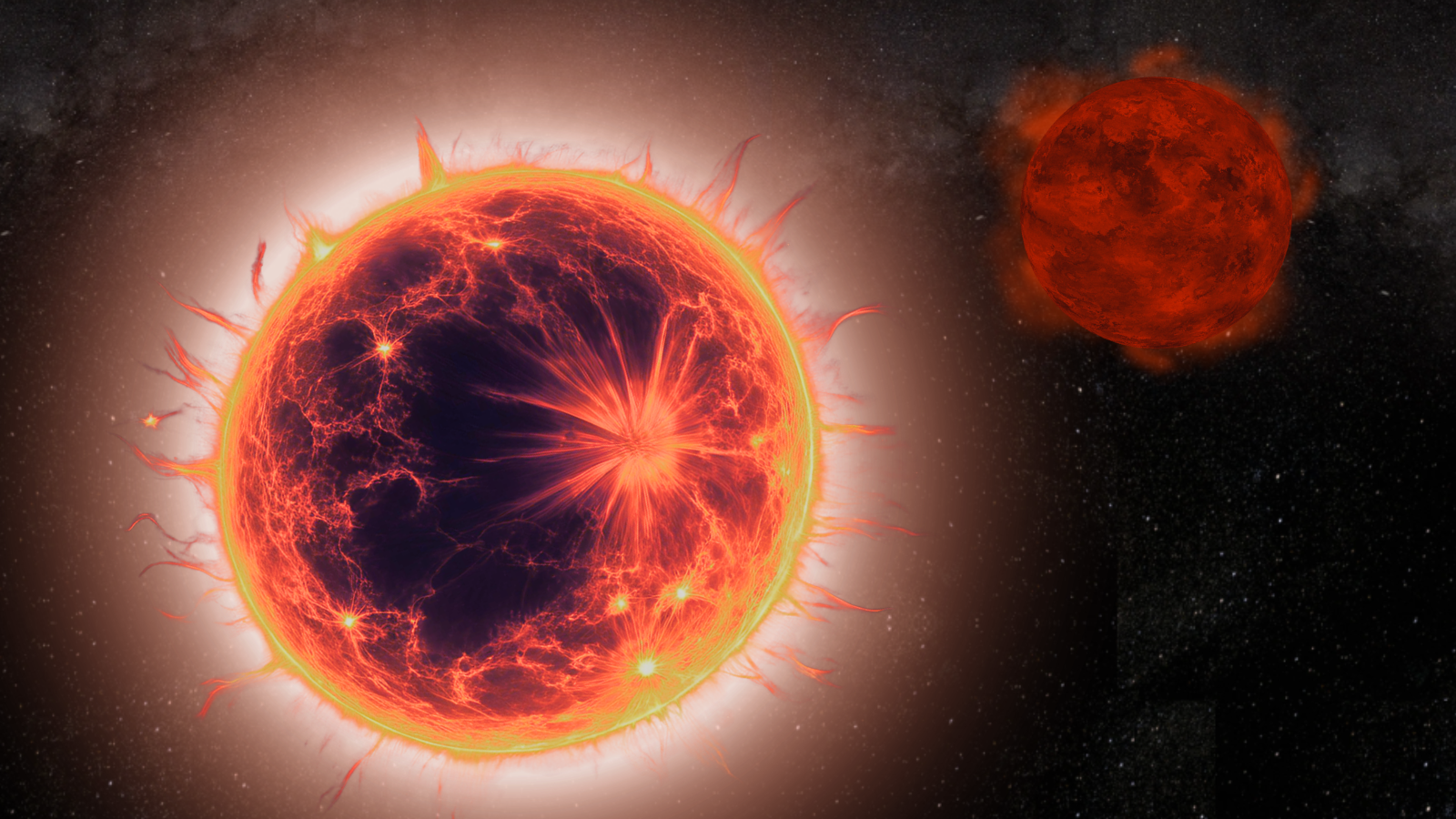
A red glowing orb with a smaller red orb in the background.

An illustration of the lithium-enriched star TOI-5882 with its brown dwarf. (Image credit: Robert Lea (created with Canva))

From the lithium abundance they measured, the team has determined that this planet was a so-called super-Earth with a mass somewhere between two times that of our planet and the mass of the solar-system ice giant Neptune, which is around 18 times as massive as Earth.

"The fact that we can look at a star 1,300 light-years away and say with confidence, 'This star has more lithium than you would expect,' is a testament to both the precision of modern instrumentation and the hard interpretive work that goes into making sense of that signal," said Melinda Soares-Furtado, a senior author of the study and assistant professor at the University of Wisconsin. "And it's not like you have to cherry-pick the data to make it stand out. It's robust. No matter how you slice it, TOI-5882 is so enriched in lithium it shows up as being at least in the 97th percentile."

Soares-Furtado added that TOI-5882 is one of the few stars she has seen demonstrating evidence of planetary engulfment, although a few of the other stars in the control sample were enriched in lithium, albeit not to the extent of TOI-5882. That leaves another mystery for the team to solve, something that Soares-Furtado may well be quite content with.

"When I was growing up, I dreamed about becoming a private investigator," she said. "I think that explains a lot about where I ended up. I do feel like a detective."

The team's research was published on Monday (June 15) in The Astrophysical Journal.

  •  
❌