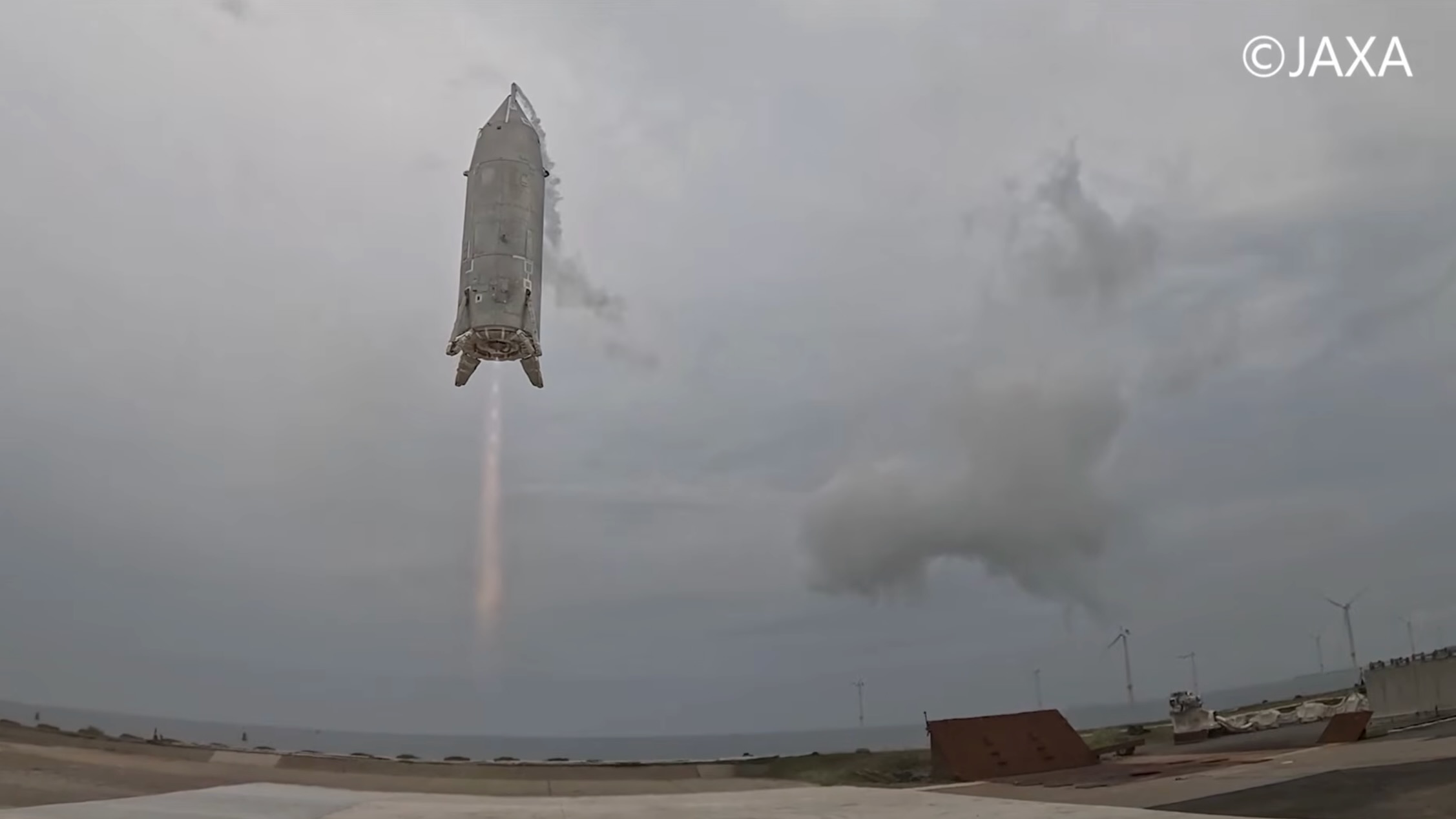
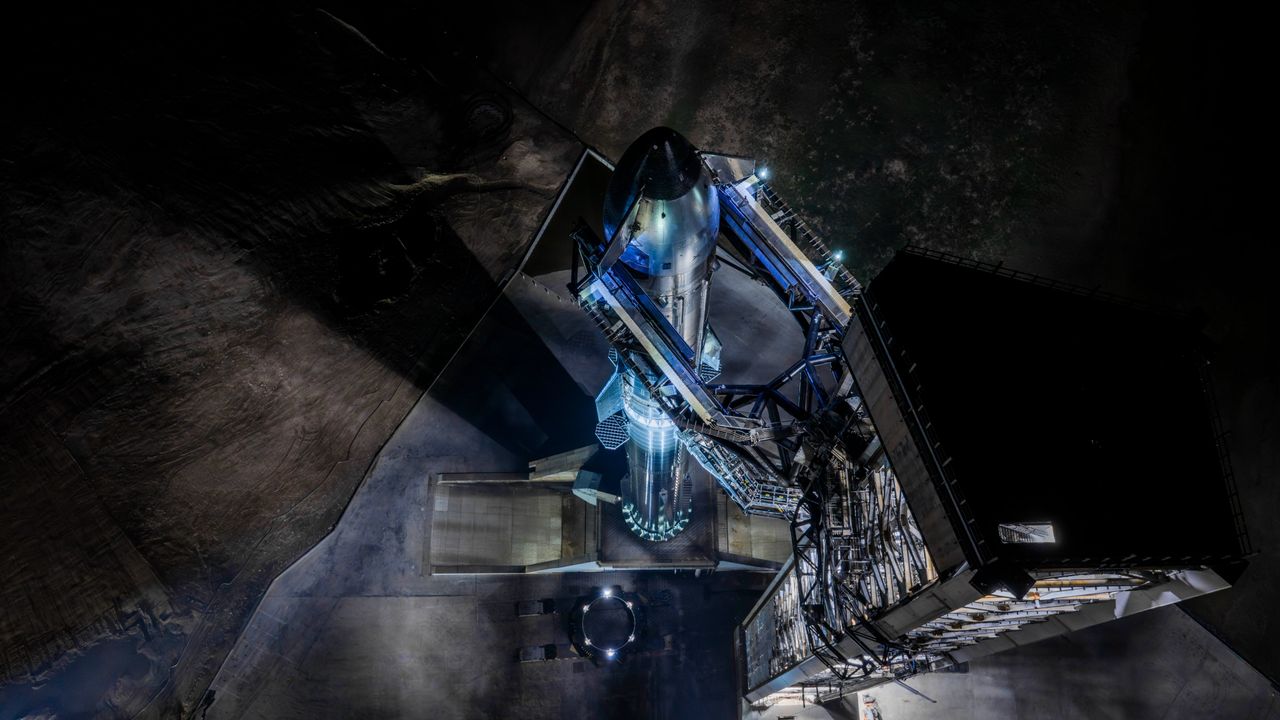
Japan has succeeded in the first-ever flight test of its RV-X experimental reusable rocket prototype.
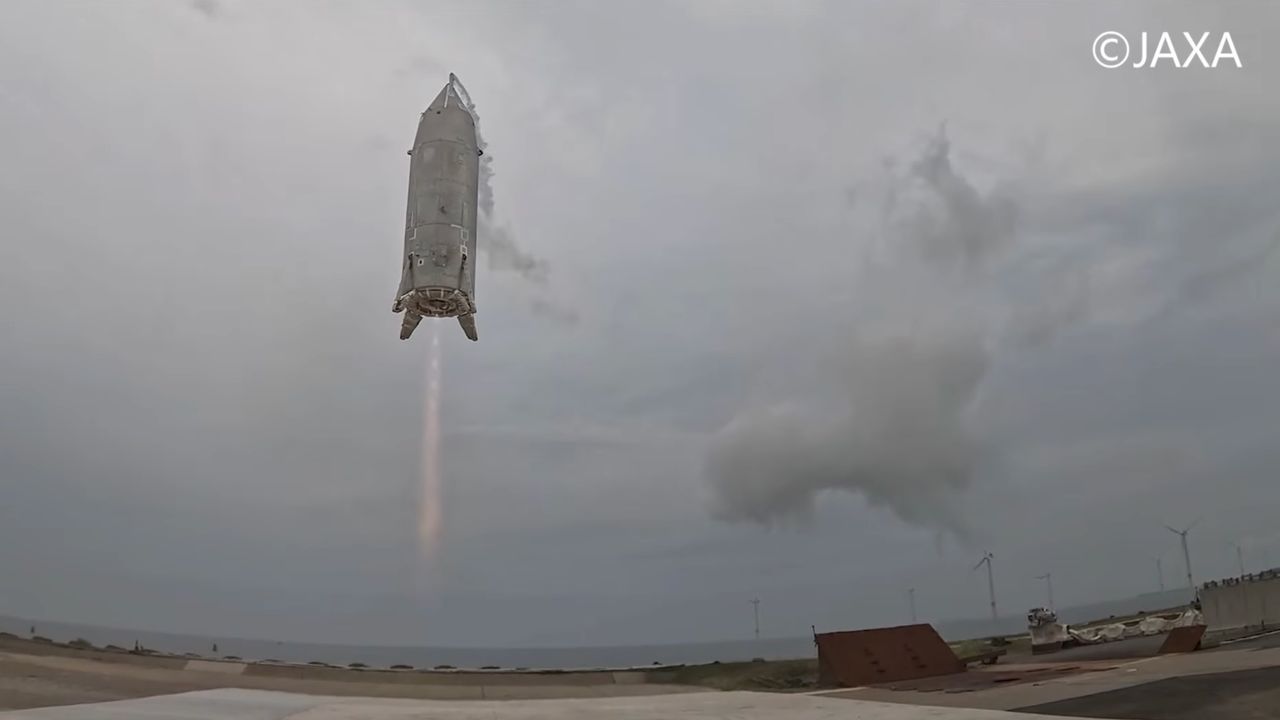
The launch — or hop, considering its duration and distance — took place at the Japan Aerospace Exploration Agency's (JAXA) Noshiro test facility on July 11 and lasted about 40 seconds. The 24-foot-tall (7.3 meters) test vehicle, powered by a single engine, rose just over 33 feet (10 m) in the air and traveled a horizontal distance of approximately 50 feet (15 m) across the site's concrete pad before touching down softly on the side opposite its liftoff point.
The short test flight went exactly as planned and puts JAXA and its partners one step closer to the development of a technological spaceflight achievement only ever accomplished by a small handful of orbital rockets — SpaceX's Falcon 9, Falcon Heavy and Starship, Blue Origin's New Glenn and, most recently, China's Long March 10B.
Japan's RV-X reusable rocket prototype takes its first hop, on July 11, 2026. (Image credit: JAXA)
JAXA's RV-X is being developed and operated in conjunction with Japan's Mitsubishi Heavy Industries and is a precursor vehicle to a single-stage reusable flight experiment project called CALLISTO. CALLISTO is a joint venture involving JAXA, France's space agency CNES and the German Aerospace Center (DLR) to design and build a single-stage rocket capable of vertical launch, landing, refurbishment and reuse. That vehicle will itself be a pathfinder rocket as JAXA seeks its own entry into the cost-saving playing field of reusable launch services.
Japan's most advanced rocket in operation, the H3, was introduced in 2023 but wasn't designed for reusability. The H3 is more efficient and cost-effective than its H-2A predecessor, which was retired last year. But two of the new rocket's eight launches have not been fully successful, and it falls short in its cost-effectiveness compared to more advanced reusable rocket stages. So JAXA is hard at work on the H3's future replacement.
"Reusable rockets require consideration of operational feasibility," JAXA's website says. "By repeatedly verifying maintenance, operation, vehicle movement and launch pad setup using an actual experimental vehicle in preparation for flight tests, we were able to establish operational procedures that will contribute to the repeated operation of future rockets."
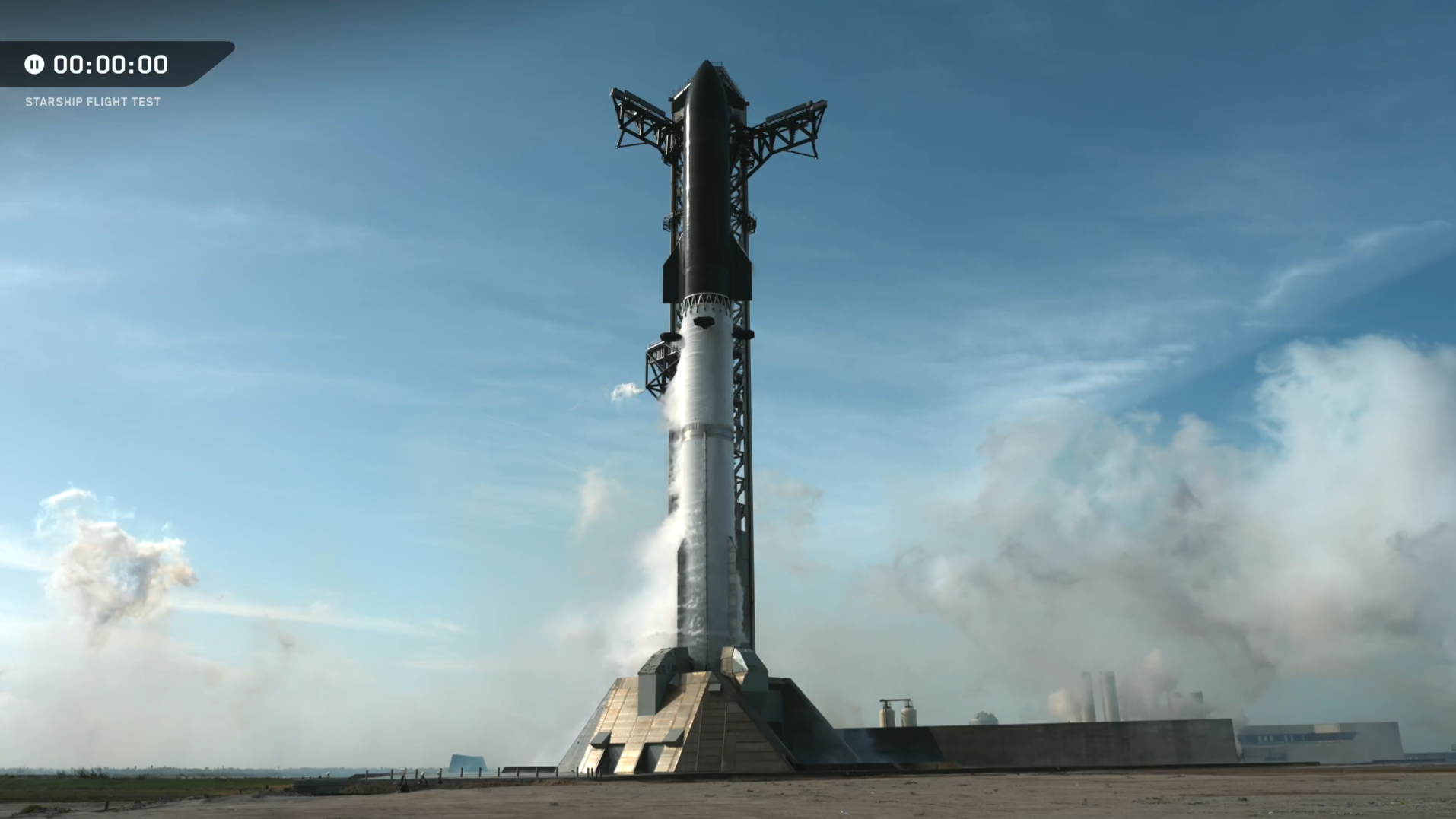
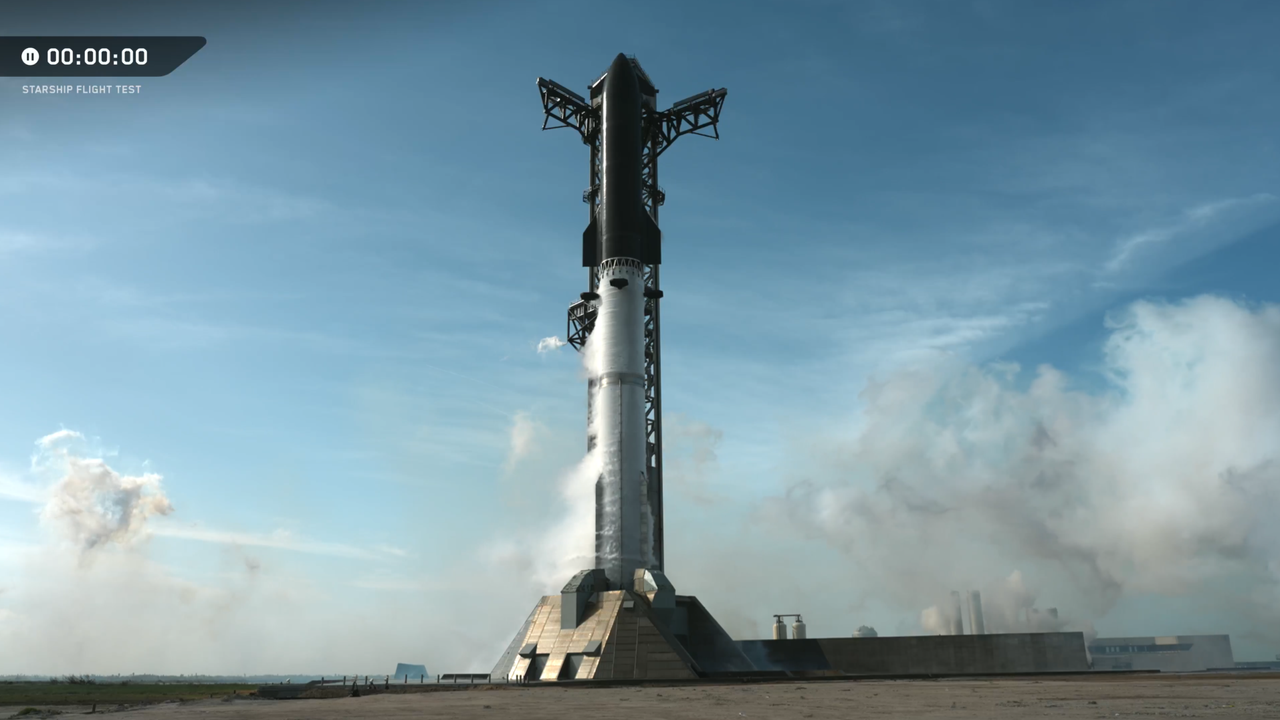
The test, and the RV-X vehicle itself, slightly resemble a similar flight article from SpaceX's early Starship development days. The "Starhopper" Starship prototype was compared to a water tower during its first "hopper" test in 2019. The first time the stumpy, three-legged, steel Starhopper jumped off the ground at SpaceX's Starbase facility in South Texas, it flew about 65 feet (20 m) straight up and back down.
Starhopper's success paved the way for higher jumps for longer durations as SpaceX honed Starship's early design, and the same is planned for RV-X. Now that JAXA's test rocket has completed its first 33-foot (10 m) hop, Japan's space agency is looking higher, too. RV-X's next launch is expected to fly as high as 330 feet (100 m), with another lateral crossover and hover included in its flight before landing.
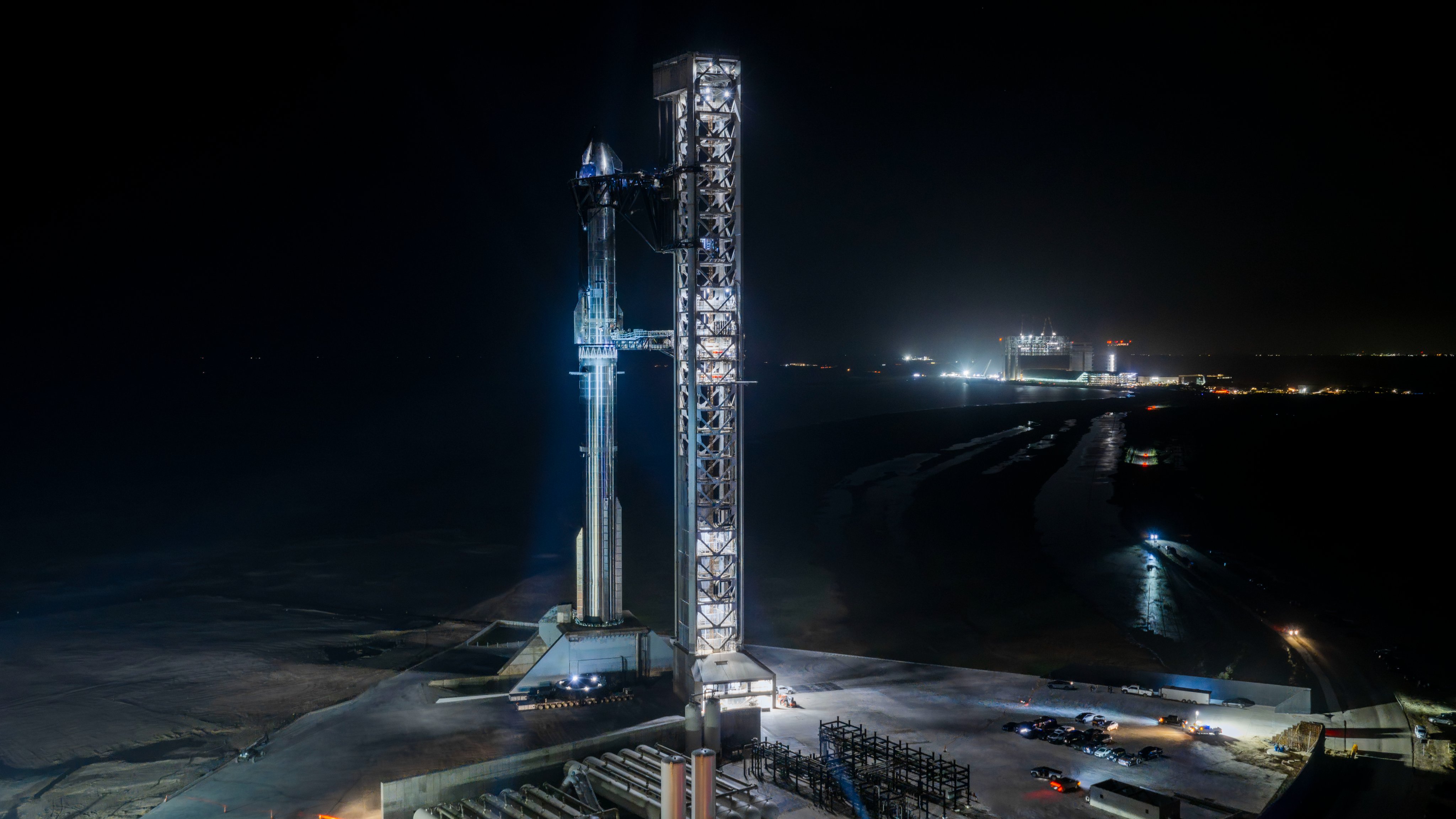
It's been busy, and some exciting things are happening! A couple of companies are moving into the space solar power arena — something we've long advocated — and that's welcome progress. Starship is set to fly Starship test number 13, and a lot is riding on this — the system is overdue for some proof of concept to keep up with NASA's HLS contract.
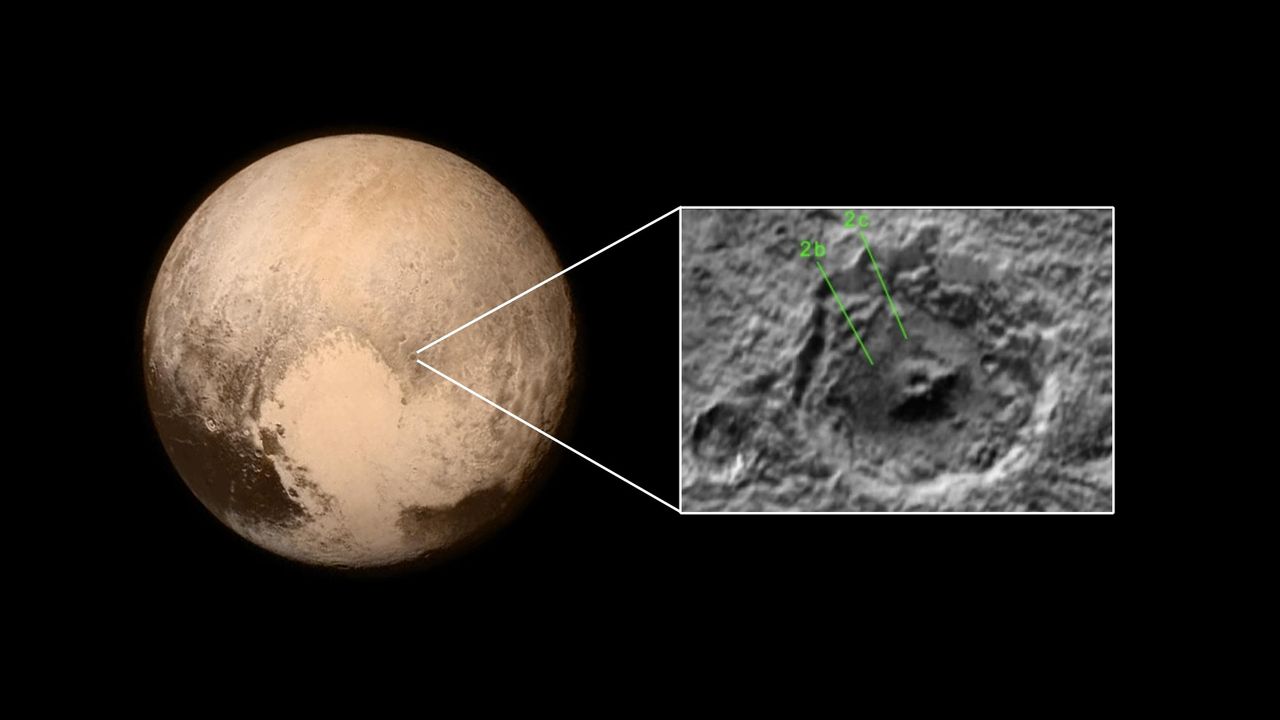
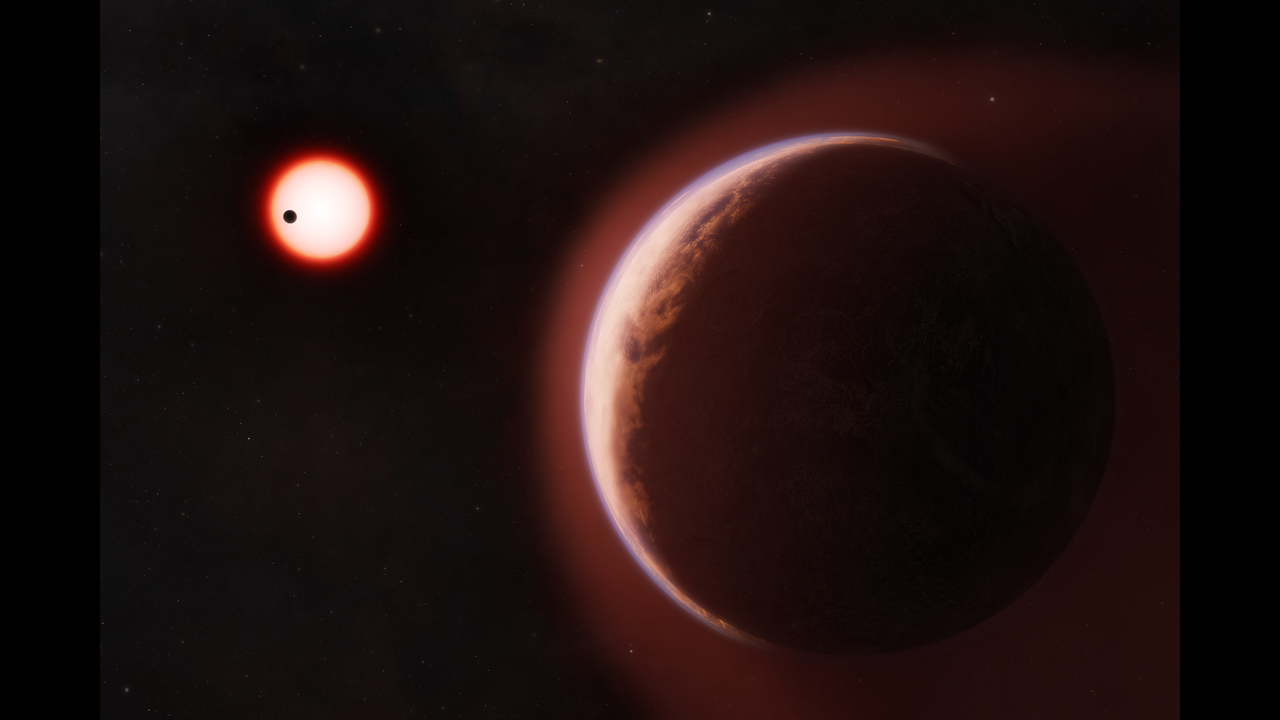
An exoplanet spotted a decade ago has shown signs of a potentially habitable atmosphere; there are landslides — big ones — on Pluto, and evidence of "space candy" sugars in an interstellar cloud are in the news. Finally, SpaceX is doubling down on their big defense contracts with a well-funded US Space Force. Join us for all the latest!
This Week in Space covers the new space age. Every Friday we take a deep dive into a fascinating topic. What's happening with the new race to the moon and other planets? When will SpaceX really send people to Mars?
Join Rod Pyle and Tariq Malik from Space.com as they tackle those questions and more each week on Friday afternoons. You can subscribe today on your favorite podcatcher.
It's almost inconceivable that 40 years have passed since what's been called the greatest sci-fi action filmof all time (and not just by us) assaulted theaters with the juiced-up sequel to Ridley Scott's 1979 classic, "Alien."
Director James Cameron's propulsive vision for a gung-ho military-style movie would call upon Stan Winston Studio's elite creature effects crew from 1984's "The Terminator" — a team that would later work on "Predator," "Terminator 2: Judgment Day," "Jurassic Park," and "Predator 2."
Cameron's "Aliens" greatly expands upon the xenomorph life cycle with the inclusion of a matriarchal beast that his screenplay described as "a massive silhouette in the mist, the ALIEN QUEEN glowers over her eggs like a great, glistening black insect-Buddha. Her fanged head is an unimaginable horror. Her six limbs, the four arms and two powerful legs, are folded grotesquely over her distended abdomen."
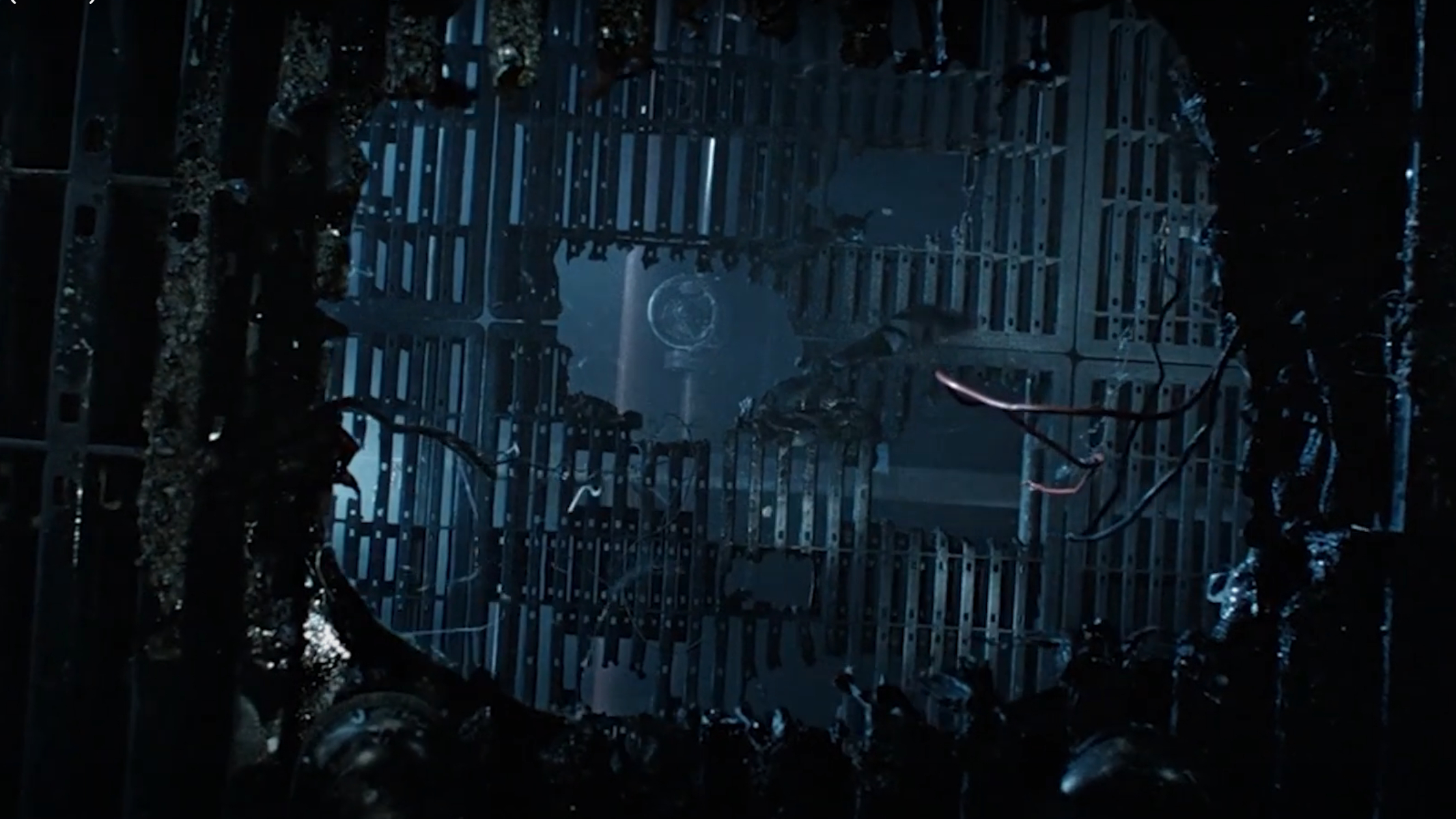
The brilliant filmmaker and Winston's energetic gang would craft and operate this 14-foot-tall articulated hydraulic puppet fabricated from fiberglass, foam rubber, and plastic. It contained two stunt performers in the torso and puppeteers on the ground manipulating legs and limbs.
Production was led by Stan Winston, Shane Mahan, Alec Gillis, John Rosengrant, Tom Woodruff Jr., and Lindsay MacGowan, the core wizards who’d later found the acclaimed Legacy Effects firm with J. Alan Scott following Stan Winston’s unfortunate death in 2008. Gillis and Woodruff would eventually split off to form Amalgamated Dynamics in 1988.
We caught up with Mahan and MacGowan to have them offer memories of working on "Aliens" at Pinewood Studios and specifically constructing this magnificent drooling, hissing monster that's spawned countless nightmares since the blockbuster landed on July 18, 1986.
"It was 1983 when I started at Stan's on the first 'Terminator,'” Mahan tells Space. "I’d worked with Jim on a Roger Corman movie that Makeup Effects Lab was doing, 'Battle Beyond the Stars.' [...] During 'Terminator,' Jim had drawings of Sigourney and the Power Loader he'd brought into the shop. I'd see them out of the corner of my eye and knew exactly what it was supposed to be. It was clearly an alien of that world with Sigourney Weaver.
"I was intrigued by it all because four years before, when 'Alien' had come out, it was so amazing cinematically. The lifecycle of the creature, and the organic nature of it. I had no idea that seven years later we'd be in England doing a sequel."
Mahan and posse began working on the Queen's preliminary designs in Southern California at Stan Winston's shop, where they conducted the infamous 'garbage bag test' out in the back parking lot, so named due to the flailing puppet being wrapped in black plastic trash bags.
"It was a proof of concept of how that was going to work," he explains. "Moving to Windsor, England, and setting up shop at Pinewood Studios was extraordinarily exciting. We then started making the full-size process of making the Queen and all the other effects, and we met the English crew, and Lindsay was one of them."
MacGowan fondly remembers his experience on the ambitious project and being recruited to join Stan Winston and the rest of the guys.
"They were legends at that point for us. We were also young and goofy, and it's amazing they actually let us do what we did when we were that young," MacGowan notes. "I was at college at the time, and I’d skip off college and make my way to Pinewood. It was like here’s the rock ‘n' roll Americans, and then we have our more reserved English team that got influenced by the American team. It was a lot of fun and some of my favorite memories of starting in the business.
"I remember it being incredibly cold at Pinewood at the time. There was no insulation in the warehouse, and we had these giant propane jet heaters, and they kept going out. We’d be nice and warm, then suddenly the flame would be out. It was a great time to get to know Shane, John, Alec, and Tom. I look at them as my American brothers."
Having everything under one roof, being created pre-shooting, was a great asset as it allowed Cameron to constantly oversee the process and monitor the progress being made.
"We were life-casting all the actors, various teams were doing the xenomorph warriors and the eggs and the facehuggers," Mahan adds. "It was a pretty big build list, and we had four or five months to get everything done. John Richardson was a great special effects man from the Bond films, and we all thought that was cool to work with guys that had done James Bond movies.
"That was my first time in England, so the setting was very new and exciting. Of course, we blew off a lot of steam occasionally, but we were very serious about just getting it all done. We knew we had a lot to live up to because of the first film. Very few people, if any, had come back from working on that first film. You don’t know how it's going to turn out. We all thought the 'Aliens' script was great. Jim had a lot of turmoil there and didn’t have a good time on his own for various reasons, but we weren't really privy to that."
Legacy Effects' Lindsay MacGowan between two armored supersuits created for 2008's "Ironman" (Image credit: Legacy Effects)
Before hopping across the pond to the UK, Mahan and his ace crew did molds and castings using a quarter-scale maquette of the Alien Queen sculpted at Stan Winston's shop for their design master.
"Back then, everything had to be done by measurements, by plotting out, and by eye. Today, it's so simple to have a computer generate and mill out a perfectly formed section. You had to use a really focused artistic eye to get exactly where we were supposed to be.
"We also had to make action suits, and there were a lot of them. I think there were 13 or 14, and then there were like eight eight-foot-tall puppets that were more spindly and long that were going to be used on wires and get hit and blow up and get shot. Then there was one articulated half-animatronic that would play in various scenes. You have to imagine an era that was pre-CGI. There was no reliance on rod removal or performer puppeteer removal. You had to hide everything and everybody in the frame. So in the dropship fight, it’s an enormous amount of people making the Queen operate, and you don’t see them.
"That all comes down to Jim Cameron and his magnificent eye for framing this action scene without seeing the crane or any of the support devices. Directors today, most of them don't even have any idea how to do that. And that was the magic of Jim Cameron and still is. He had the designing thought of shot composition and action that played off the best attributes of that hydraulic/actor-driven Queen. Because there were two guys inside and nine of us on her tail, her head, the cable, her hands, the feet. We were everywhere."
MacGowan took his role very seriously to get the fit and finishing perfect for this elegant egg-laying beast that would end up being the seething, android-ripping superstar of the popular 1986 sequel. -
"It was really just to honor what Giger had done in the past, but also to give Jim what he was looking for in his vision for the Queen," he recalls. "The Queen is really Jim's design and entire look. Our focus was making sure that we got what Jim wanted, but still make sure that fans of the original movie, which was all of us, could really appreciate."
As a mentor to his dedicated young crew of VFX creators, Winston schooled them in the subtle art of injecting personality and emotion into their creature performances.
"It's something they always reinforced, but if you’re a student of horror and science fiction films, you know all the great creatures and monsters have got some sympathetic or some interesting personality," adds Mahan. "Even the xenomorph in the first film, the personality is that it does not care. It's just going to kill you. But that’s still a personality trait.
"We were always taught by Stan that these are not effects; these are characters that we’re making; these are actors in the film. It just happens to be a creature from space, or a robot from the future, or a dinosaur. Whatever it is, it has to be believed, and we’ve always carried that philosophy through."
As to the mystery of exactly where the original Alien Queen screen-used puppet ended up, Mahan has a few clues, but sadly admits that most of it has unfortunately been lost to time.
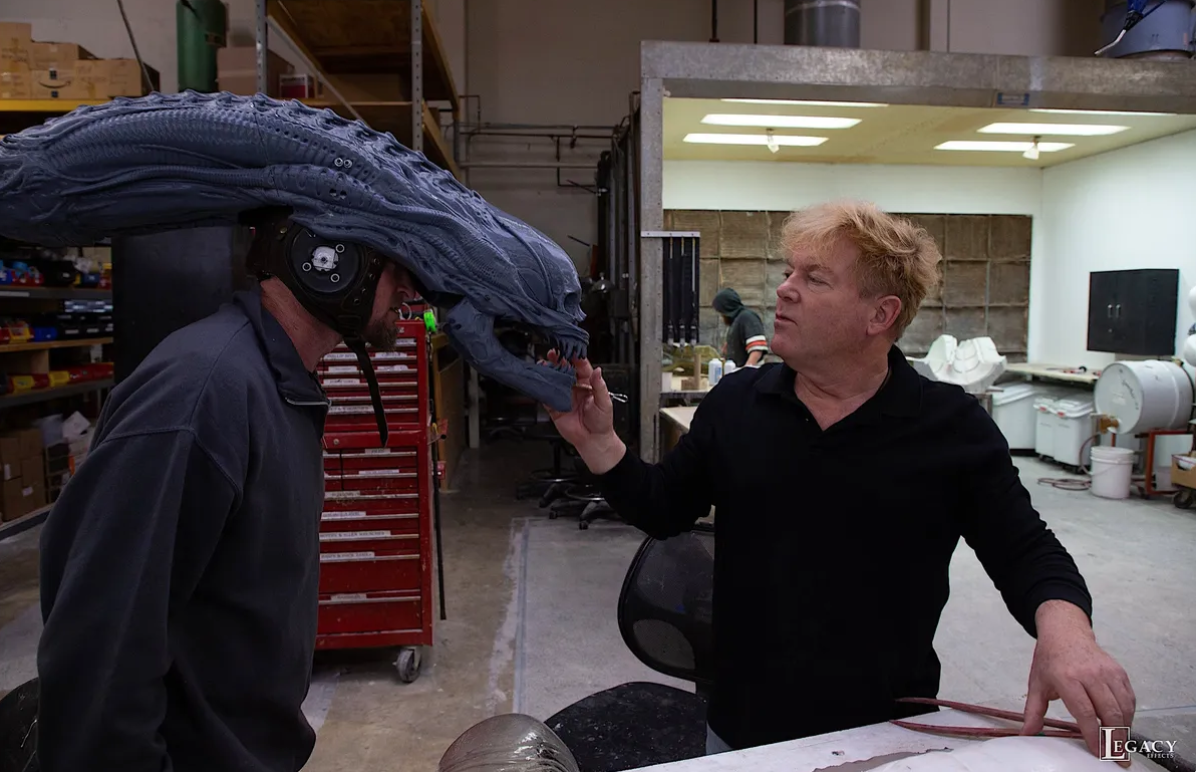
Legacy Effects' Shane Mahan working on a xenomorph design for "Alien: Romulus" (Image credit: Legacy Effects)
"Jim has one in his museum, and I think collector Bob Burns did have a head," Mahan shares. "The rest of it might be that it's fallen into disrepair. I know when we left, a lot of it was put into containers at Pinewood, and it sat and rotted for years. We always wanted to get that back, but I’ve not seen a real Queen in a while.
While the classic design hasn't changed much over the years, Mahan notes that the materials used to make creatures like the Alien Queen have.
"The head was fiberglass and had other foam rubber parts. The materials back then were not very sophisticated," explains Mahan. "The materials we have today, like what we did on 'Alien: Romulus', are like from outer space. They're translucent silicones, and they stretch well, and there’s lightweight plastic 3D-grown parts."
"Back then, the only thing we had was clear urethane that I got the cowl of her head to kind of move around. The original idea was that the skin on her face was supposed to be translucent. It ended up being foam rubber painted to look translucent. A lot of those materials have just fallen apart. On screen, it's pretty impressive.
"When we did 'Alien: Romulus,' Lindsay and I had not done an 'Alien' film since 'Aliens.' When that opportunity came up to revisit that world, the sensory memories came flooding back. It's one of those movies where I think I remember every day that I was on set for that film.”
"Aliens" is available to stream on Disney+ in the UK, and to rent and buy on various platforms in the US.
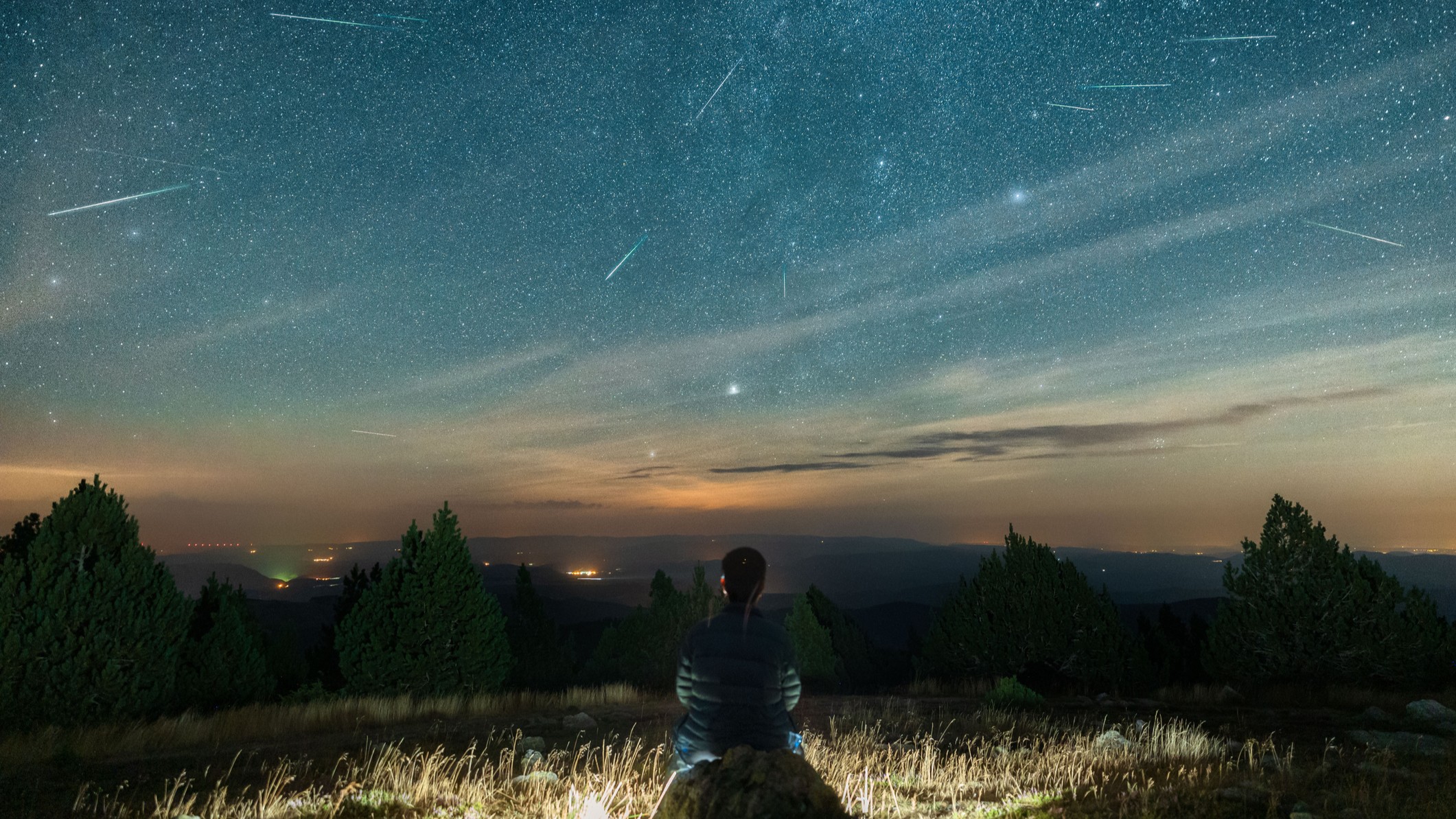
The Perseids may be the summer meteor shower everyone marks on the calendar, but they are not the only reason to look up this season.
From mid-July through late August, Earth plows through several other streams of comet and asteroid debris, triggering a series of lesser-known meteor showers across Northern Hemisphere skies.
Most will not deliver the dazzling hourly rates of the Perseids, and moonlight will spoil some peak nights in 2026. But for patient skywatchers under dark skies, these lesser-known showers can still serve up bright fireballs, faint streaks and a preview of the main event to come.
The duration in days of a shower we provide here is somewhat arbitrary, since the beginning and ending are gradual and indefinite. While the hourly rates from these other meteor streams provide but a fraction of the numbers produced by the Perseids, combined, overall, they provide a wide variety of meteors of differing colors, speeds and trajectories.
Capricornids
First to appear are the Capricornids, starting around July 10, with their maximum on July 25 and end on Aug. 15. Under the best conditions only a few bright meteors per hour come from this stream, so you'll hardly know it is in progress unless you plot meteor trails on a star map and trace them back to their common intersection point; most of the meteors you'll see will be sporadics or members of another shower.
The radiant reaches its highest point at about 30 degrees high in the south, about 2:00 a.m. local daylight time. The waxing gibbous moon will have set at around 1:40 a.m. on the night of the peak, leaving the rest of the night dark for prospective meteor watchers.
Delta Aquarids
Next come the Delta Aquarids, July's most prolific shower, with maximum on July 29, and as many as two or three dozen meteors per hour under ideal conditions. The shower lasts from July 12 to Aug. 23. It has a double radiant, indicating that we are seeing two distinct streams of celestial debris burning up in the Earth's atmosphere.
The meteors are mostly faint; a few bright, 5-10% leave persistent trains; they move at medium-slow speeds because they are coming in sideways across Earth's orbit. On peak night this year, the double radiant will be highest — roughly 40 degrees above the southern horizon — at 3:30 a.m. Unfortunately, in 2026, peak activity will coincide with full moon, so most of these streaks will likely be squelched by bright moonlight.
Piscis Australids
Another weak shower is the Piscis Australids, on July 30, with normal limits July 10 to Aug. 10. This is a lesser stream; only about eight members per hour are seen under best conditions to observers in the Southern Hemisphere, where the radiant — near the bright star Fomalhaut — climbs high in the sky.
As is the case with the Delta Aquarids, the moon, only one day past full, unfortunately, wrecks any chances of getting any decent views this year.
Alpha Capricornids
The final shower peaking in July is the Alpha Capricornids, which begin about July 7, peak on July 31, and end on Aug. 15. The radiant reaches its highest point, about 30 degrees high in the south at about 1:00 a.m. local daylight time. Though sparse (5 per hour) in number, the Alpha Capricornids are photogenic, frequently producing bright yellow fireballs that can be quite spectacular. Sadly, the bright moon, 93% illuminated, is in eastern Capricornus and will seriously impact the peak of this year's display.
Iota Aquarids
The last minor shower before the Perseids is the Iota Aquarids, a two-radiant shower having detectable members from July 15 to Aug. 25. At peak activity on Aug. 6, only about six members per hour are seen under good conditions; the radiants are at their highest point, about 40 degrees in the south at 2:30 a.m. A last quarter moon will be about one-third up in the eastern sky at that hour, which will interfere to an extent with viewing these meteors.
Perseids
The Perseids are predicted to reach their peak in 2026 on the morning of Aug. 13. Meteors whose paths extended backward intersect at a spot near the Perseid-Cassiopeia border not far from the famous Double Cluster in Perseus.
It rises at dusk and is highest in the sky — nearly overhead — at 5:40 a.m. When maximum occurs in a dark sky, as will be the case this year, this rich stream offers a crescendo in hourly rates averaging more than 50 members per hour, though double this rate has been seen on occasion. Many flaring meteors with trains are seen. This shower normally extends from July 17 through Aug. 24.
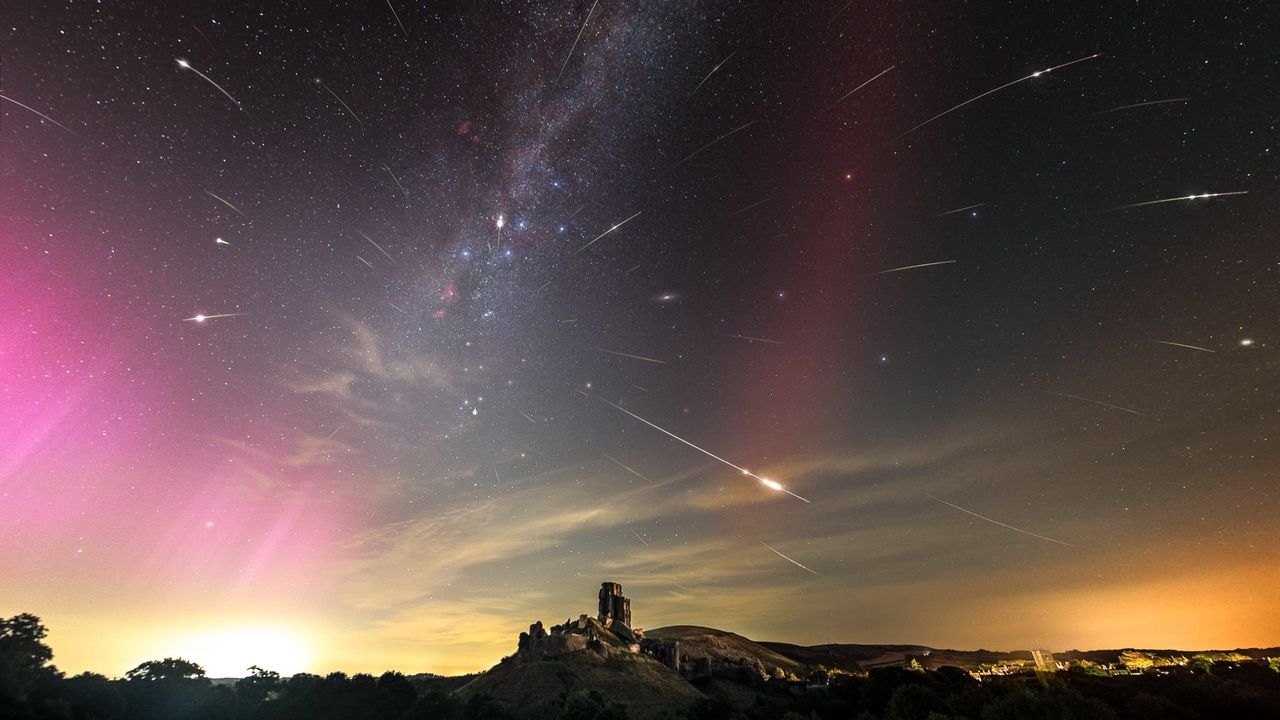
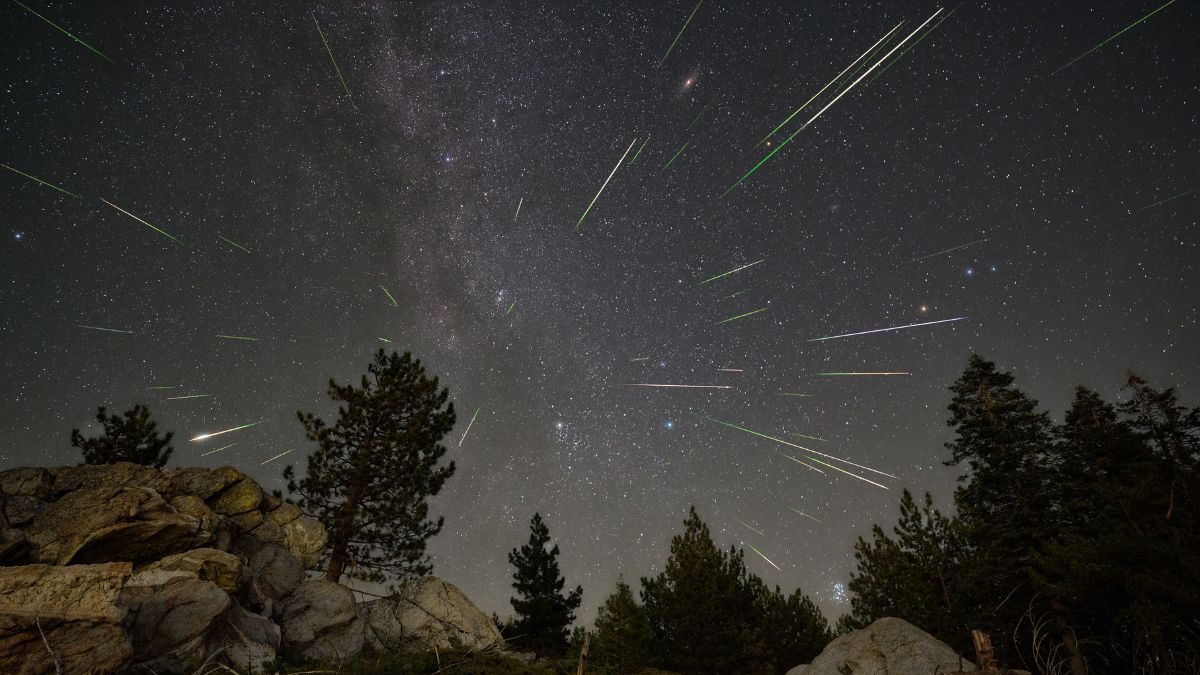
The Perseid meteor shower will be one of the top skywatching events this year as it will enjoy minimal interference from the moon. (Image credit: SEN LI via Getty Images)
Kappa Cygnids
The last summer shower is the Kappa Cygnids. The limits of this shower run from Aug. 3 to Aug. 25, with the peak on Aug. 17. Though the maximum rate is only about four per hour, the stream does provide slow-moving flaring fireballs, and a careful observer may be nicely rewarded for the time spent.
The radiant is just north of the star Kappa Cygni and is nearly overhead — some 80 degrees high — at around 10:00 p.m. local time. At about that same time, a waxing crescent moon is low in the southwest and is about to set and will offer little viewing interference.
Where to look
The radiant is the place in the sky where the paths of shower members, if extended backward, would intersect when plotted on a star chart. Many people are misled into thinking that this is the best place to look for these meteors, but only stationary meteors — ones coming nearly straight at you — can be seen here.
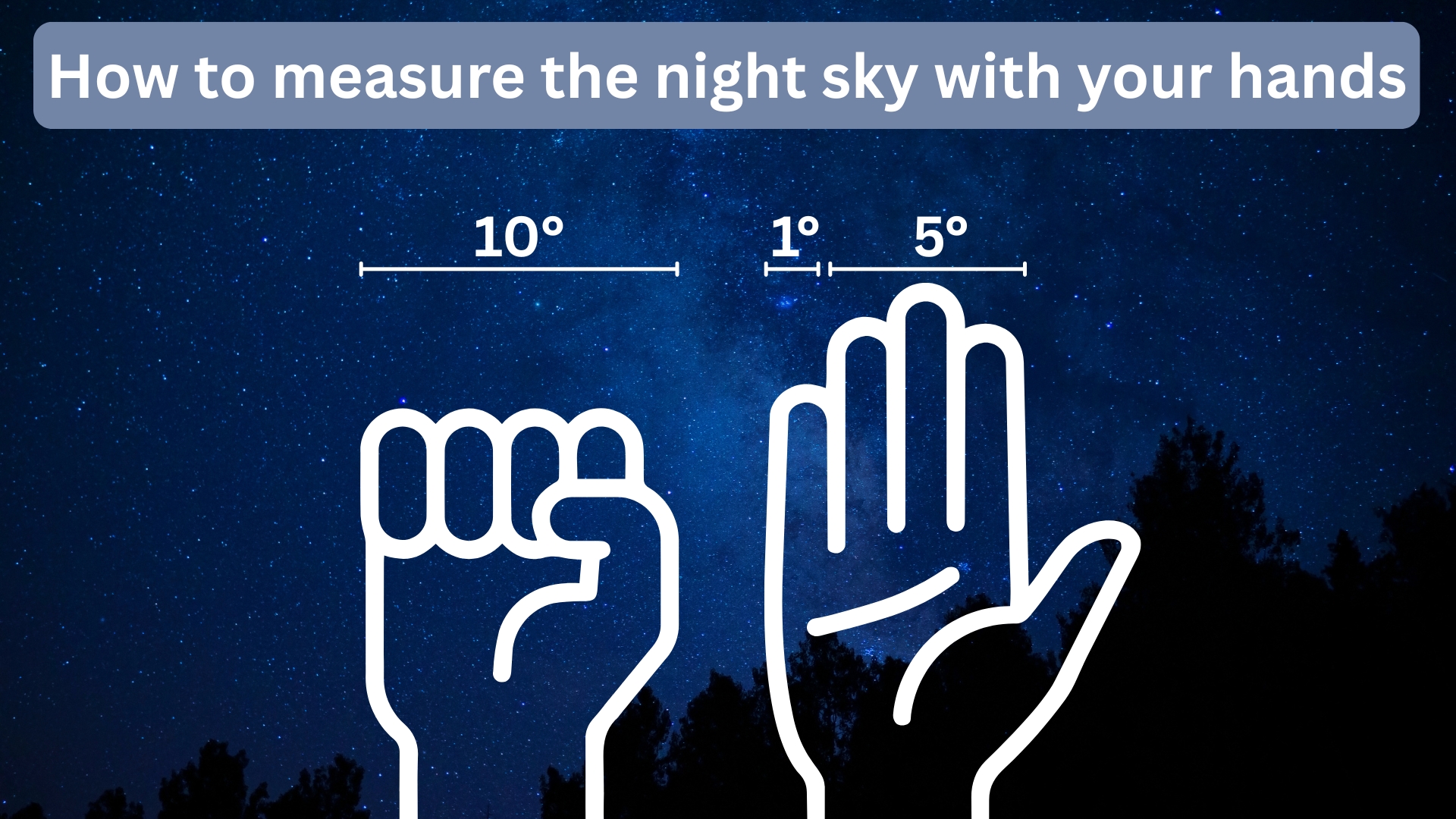
You hand held out at arm's length can be a useful tool for measuring the night sky. (Image credit: Created in Canva Pro)
The greatest numbers will be seen perhaps 30 degrees away from the radiant, in the general direction of the zenith. Remember that your clenched fist held at arm's length is roughly equal to 10 degrees.
In addition to shower meteors, there are always sporadic ones, apparently unrelated to one another, that occur at an average rate of about 7 per hour. The duration in days of a particular shower is somewhat arbitrary, since the beginning and ending are gradual and indefinite.
Skywatching tips
The only equipment you'll need is your eyes and a modest amount of patience.
The number of meteors an observer can see in an hour depends strongly on sky conditions. The rates quoted here are based on a limiting star magnitude of +6.5 (an exceptionally good, dark sky), an experienced observer, and the assumption that the radiant is directly overhead.
The lower the radiant in the sky, the fewer the numbers that will be seen. At an altitude of about 30 degrees, the hourly rate is halved, at 15 degrees it is one-third. No two observers prepare for a meteor vigil the same way.
Expect the overnight low temperature to be well below what the weather forecast suggests. When you sit quite still, close to the rapidly cooling ground, and if the air is even just slightly damp, you can become very chilled. It helps to take a late afternoon nap, followed by a shower, and to wear fresh clothing. Heavy blankets, sleeping bags, a ground cloth, an auto cushion, and a pillow are all necessary equipment. Some food and non-alcoholic beverages will help keep you comfortable.
Don't forget the moon
Another factor is the phase of the moon, which this year will be full on July 29 and new on Aug. 12. This makes it a very favorable year for viewing the Perseids, but not so favorable for those displays peaking at the end of July into early August. However, most are also active for a good number of days before and after maximum activity, so you can also watch for them when moonlight is not a hindrance.
Are these meteor showers worth watching?
In short, minor summer meteor showers are worth watching if you enjoy patient, low-key skywatching, but they are not ideal if you expect a dramatic display.
They offer a long observing season, require no equipment, and can produce a variety of meteors with different colors, speeds, paths, and occasionally bright fireballs. They also give observers more chances to watch when skies are clear and moonlight is less intrusive.
However,most are weak when compared to the Perseids, with low hourly rates and many faint meteors. Moonlight, low radiant positions, overlapping showers, and sporadic meteors can make them harder to see and identify, so observers need dark skies and patience.
It's not known whether "Ulysses 31" was on Christopher Nolan's radar in his teenage years, but it's intriguing to think it could have influenced the director's decision to take on Homer's "The Odyssey".
This animated space opera, a French/Japanese co-production, delivered a crash course in Greek mythology to a generation of kids who grew up in the '80s. And, although it looks more like "Star Wars" than Homer's original tale, it had a decent stab at transferring the Classics to the 31st century (the clue really was in the title), years before the Coen brothers took "The Odyssey" to the Deep South in "O Brother, Where Art Thou?"
The cartoon's core premise would be familiar to any Greek scholar, even though purists would surely bristle at the hero going under his Roman pseudonym, Ulysses, rather than the original Greek Odysseus.
(Image credit: DIC Audiovisuel & Tokyo Movie Shinsha)
At heart, it's that old story of a ship's captain racing to get home from Troy (in this case, a starbase) before his wife, Penelope, marries another man. That voyage is soon waylaid, however, when Ulysses' son, Telemachus, is abducted to become a sacrifice to a giant robot Cyclops.
Ulysses quickly lives up to the promise of his famous theme song — "Always fighting all the evil forces, bringing peace and justice to all" — by vanquishing the one-eyed menace and rescuing Telemachus along with Yumi and Numinor (a pair of blue alien Zotrians who, as far as we can tell, do not feature in the original Homer).
Unfortunately for Ulysses and his crew, he messed with the wrong giant robot Cyclops, because this one happened to belong to the Greek sea god Poseidon, who's now taken up residence in outer space. The deity is so annoyed at the puny mortal's impudence that he gets his brother, Zeus (aka the head honcho in Olympus), to inflict divine retribution.
(Image credit: DIC Audiovisuel & Tokyo Movie Shinsha)
Ulysses is subsequently sentenced to "travel among unknown stars" (his ship, the Odyssey, has its navigational databanks purged) while his crewmates — referred to, in what now sounds like contemporary corporate jargon, as "companions" — are put into a perpetual slumber. If he's going to make it home to Penelope, he'll need to find the Kingdom of Hades before his 26-episode run comes to an end.
It's less an update of Homer than a riff on his greatest hits, with several other notable classics of the Classical period thrown in for good measure. In addition to slaying the Cyclops, Ulysses follows in OG Odysseus's footsteps when he meets the Sirens and Lotus Eaters.
But he also ventures beyond the confines of Homer's narrative when he encounters Sisyphus (fated to devote his entire life to a repetitive, pointless task), Orpheus (en route to Hades to rescue Eurydice, the love of his life), and three-headed dog Cerberus, reinvented as an interceptor satellite with, yes, three heads.
(Image credit: DIC Audiovisuel & Tokyo Movie Shinsha)
Many of the character names are also familiar. Priam, the commander of the Troy starbase, shares his name with Troy's last king in antiquity, while Nestor, Ulysses' second in command, is an advisor in the original story. Shirka, the computer on Ulysses' ship, takes her name from Circe, a sorceress.
But the show also adopts a pretty liberal approach to the source material. Homer's version of Telemachus spends much of the story separated from his dad, whereas "Ulysses 31"'s is a constant presence. While Odysseus's shipmates mostly wound up dead, here they're plunged into a state of literal suspended animation, lifelessly floating in the ship's hold.
And Ulysses is already aware of the Greek gods before he makes first contact — in one episode, he even travels back thousands of years in time to meet his famous namesake.
(Image credit: DIC Audiovisuel & Tokyo Movie Shinsha)
If this sounds like writers sanitising the story for younger audiences, well, it didn't feel that way if you watched the show as a kid. At times, "Ulysses 31" is genuinely freaky, from those levitating lifeless bodies to some truly grotesque monsters. The gods themselves are also an unnerving presence, omnipresent beings of colossal power who see humans as their playthings and view Ulysses' toils as some twisted spectator sport.
Besides, unlike "Masters of the Universe" and many of the other biggest sci-fi cartoons of the '80s, the good guys weren't always guaranteed to win. Being Ulysses — a single dad guiding his son and adopted daughter Yumi through the cosmos — wasn't easy.
Now 45 years old (though it didn't find its way onto British and American TV screens until the mid-'80s), "Ulysses 31" is showing its age. The animation is often rudimentary, particularly in outer-space scenes that are effectively a cut-out of a starship being dragged across a stellar background. The dialogue, meanwhile, is played hilariously straight — good luck finding a laugh among these uncharted stars — and often consists of someone shouting another character's name. "Telemachus!" "Father!" "My son!" "Yumi!" etc. Telemachus's small red robot pal, Nono, is up there with the most irritating "cute" sidekicks of the era — quite the achievement in an extremely competitive field.
(Image credit: DIC Audiovisuel & Tokyo Movie Shinsha)
But there's also plenty to like. As static as they sometimes look, the spaceship designs have the feel of a classic space opera book cover, particularly Ulysses' eye-shaped craft, the aptly named Odyssey. The series also borrows heavily from a more modern piece of mythology, namely the "Star Wars" saga. Ulysses may not be a Jedi (as far as we know), but his gun/laser sword weapon looks a lot like a lightsaber. Some of the incidental music even apes John Williams' score from a galaxy far, far away.
Which brings us on to the soundtrack, the main reason this show lives on in the collective consciousness of a generation.
The work of Denny Crockett, Ike Egan, and, on selected tracks, Shuki Levy and Haim Saban (the latter duo also composed for "Masters of the Universe", "Jayce and the Wheeled Warriors," and many more cartoon classics), the music is a cut above. "The Curse of the Gods" refrain is loaded with menace, totally living up to its portentous title, and then there's that theme song.
Seriously, to people of a certain age — even those who remember nothing else about the show — hearing the name "Ulysses" is enough to get them singing "Ulysee-ee-ee-ee-ees" ad infinitum, an earworm truly worthy of the gods of Olympus.
Homer's tales may still be remembered thousands of years after he wrote them, but you can guarantee he didn't have a tune quite like that.
"Ulysses 31" isn't on any major streaming service, but there are fan uploads on YouTube if you want to experience the show for yourself.
If you still picture Mars as a monotonous red desert, it may be time for an update.
The European Space Agency's Mars Express orbiter has been capturing some of the Red Planet's most surreal landscapes, and its latest images reveal a sprawling field that looks like molten metal frozen across the floor of an ancient Mars crater.
The shimmering "waves" aren't metal at all, however. They are dark sand dunes dusted with seasonal frost, much of it carbon dioxide, or "dry ice," that settles on the surface during Martian winters, giving the dunes their uncanny chrome-like sheen, according to ESA.
The rest is a trick of light and contrast. Because the dark sand absorbs light and the white frost reflects it, the interplay transforms the landscape into something that looks more like a scene from a sci-fi movie than a windswept Martian plain.
A bird's-eye view of wind-blown dunes in Kaiser Crater. (Image credit: ESA/DLR/FU Berlin)
Over thousands of years, Martian winds have sculpted this volcanic sand into dunes that now ripple through the floor of Kaiser Crater, a 129-mile-wide (207-kilometer-wide) impact basin in the planet's southern highlands. The bowl-shaped crater acts as a giant sand trap that prevents the sand from escaping, according to NASA.
The dunes themselves are darker than much of Mars' surface because they are made of fine, basaltic sand rich in volcanic minerals such as pyroxene and olivine, rather than the iron-oxide dust that gives the planet its familiar rusty-red appearance and its famous moniker, the Red Planet.
Because the crater floor remains visible between the ridges, scientists think there is a relatively limited sand supply shaping the field. Still, these ripples of sand are massive, extending for several kilometers and towering more than 100 meters (320 feet) above the surrounding terrain.
The landscape isn't just visually dramatic, it also preserves clues to a time when Mars was a very different world.
Today, Mars is wrapped in an atmosphere little more than a thin veil that is 100 times thinner than Earth's and slowly leaking into space. That makes it harder for winds to lift and transport sand than it is on our own planet. Yet the soaring dunes inside Kaiser Crater show that Martian winds have nonetheless been powerful enough to sculpt vast landscapes over time, perhaps during a period when the Martian atmosphere was thicker a few billion years ago.
The new image adds to a growing collection of striking Martian scenes captured by Mars Express, which has been orbiting the Red Planet since 2003. Just last month, the probe tracked a frenetic cluster of 30 dust devils swirling through the canyons of Mamers Valles, also in the northern hemisphere.
Over the spring and summer, the orbiter similarly spotlighted the planet's vast and complex geological history, from Shalbatana Vallis — carved by groundwater floods about 3.5 billion years ago into winding valleys that span the length of Italy — to a massive blanket of dark volcanic ash elsewhere on the world that has spread across a large chunk of the terrain over just the last 50 years, having either been redistributed by Martian winds or exposed as the overlying dust was blown away.
However desolate Mars may appear from afar, there is certainly no shortage of activity on its surface — or discoveries still waiting to be made.
People keep asking me about the total solar eclipse on August 12. That's understandable. For anyone in the Northern Hemisphere, it is shaping up to be a joyous day of astronomy. Totality will cross eastern Greenland, western Iceland and northern Spain, but much of Europe will see a very deep partial eclipse, and even parts of North America will see a small bite taken from the sun. Then, just hours later, the Perseid meteor shower will peak beneath perfectly moonless skies. What a double-act!
The problem with promoting days and nights like that is that they make us think skywatching is only worth doing at very specific times. Everything becomes about moments, peaks and countdowns. That rings true for an eclipse, of course, but for the Perseids, it's less so.
The Perseid meteor shower actually begins right now. It's active from July 17 through August 24. Yes, it reaches a strong maximum overnight on August 12-13, where observers under ideal dark skies could see 50 or more "shooting stars" per hour. That's absolutely the night to aim for if you only go stargazing once a month. But for stargazers with a little more time, the hunt can begin right now.
The best Perseid is the first one you see. In these weeks before the peak, there's less expectation, less focus on the weather. An unexpected streak while you are outside feels accidental.
For me, it often happens when I've stopped observing properly for the night. Last summer, I was moving my telescope indoors late at night after a fairly unremarkable session looking at a few globular clusters. As I went back inside, I did my usual pause and look at the stars one last time. As I did, my peripheral vision caught a bright meteor whizzing across rooftops in the northeast. Summer's meteor season had begun with a bang when I least expected it to.
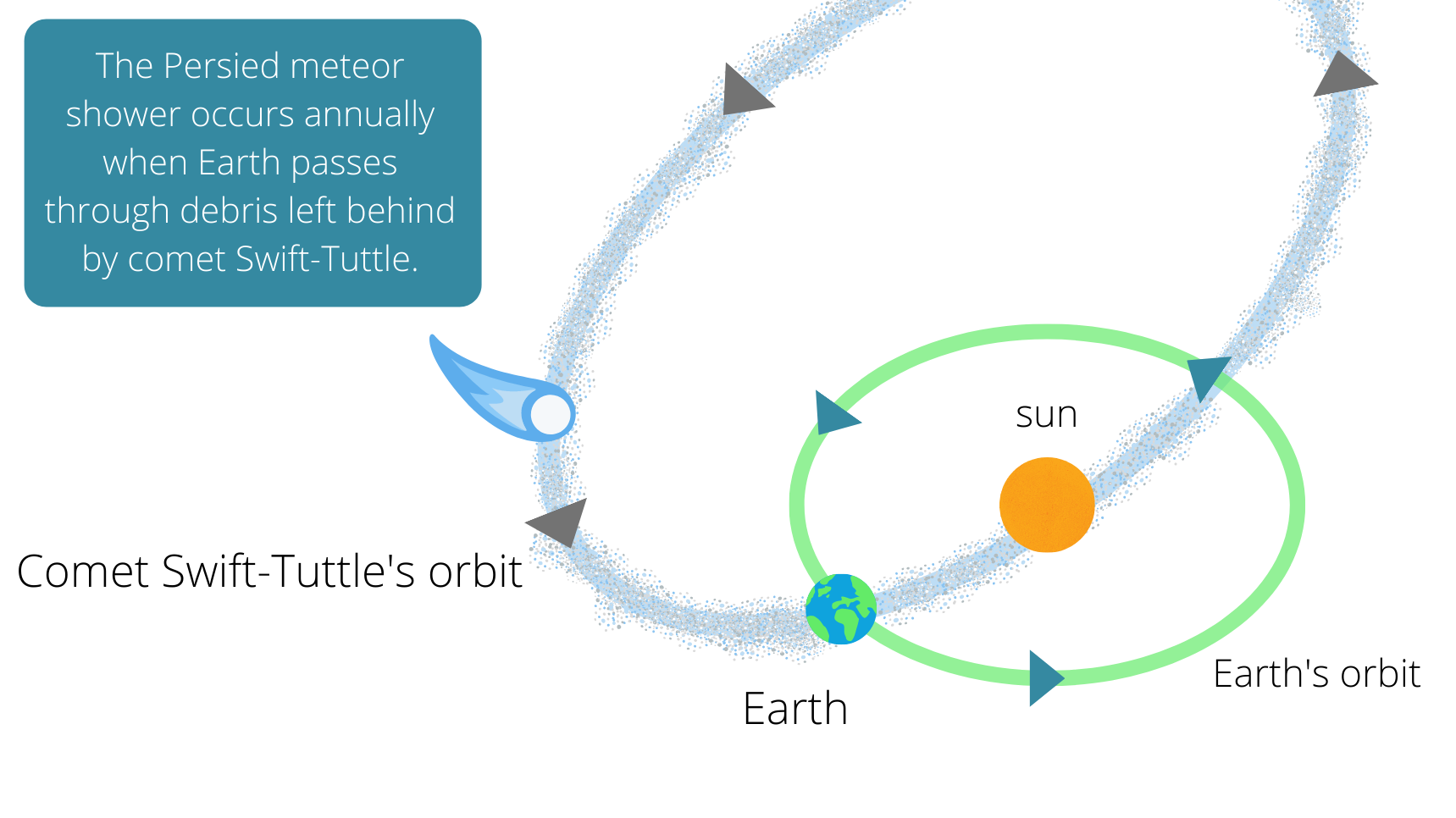
The Perseids officially build gradually over several weeks as Earth slowly enters the broad debris stream left behind by Comet Swift-Tuttle. It was last in the inner solar system in 1992 and will return in 2126. The peak around August 12—13 marks the densest part of the stream, but in mid-July, only a handful of meteors will appear each hour. That's exactly why early Perseids feel so special — you stumble across a meteor when you least expect it. Its gradual beginning also explains why some of the earliest Perseids can be surprisingly dramatic. The shower is famous for bright fireballs — large, vivid meteors that sometimes leave glowing trails lingering for several seconds. Even when overall meteor rates remain low in July, a single bright Perseid can add some magic to a night's observing.
What's happening and when to look
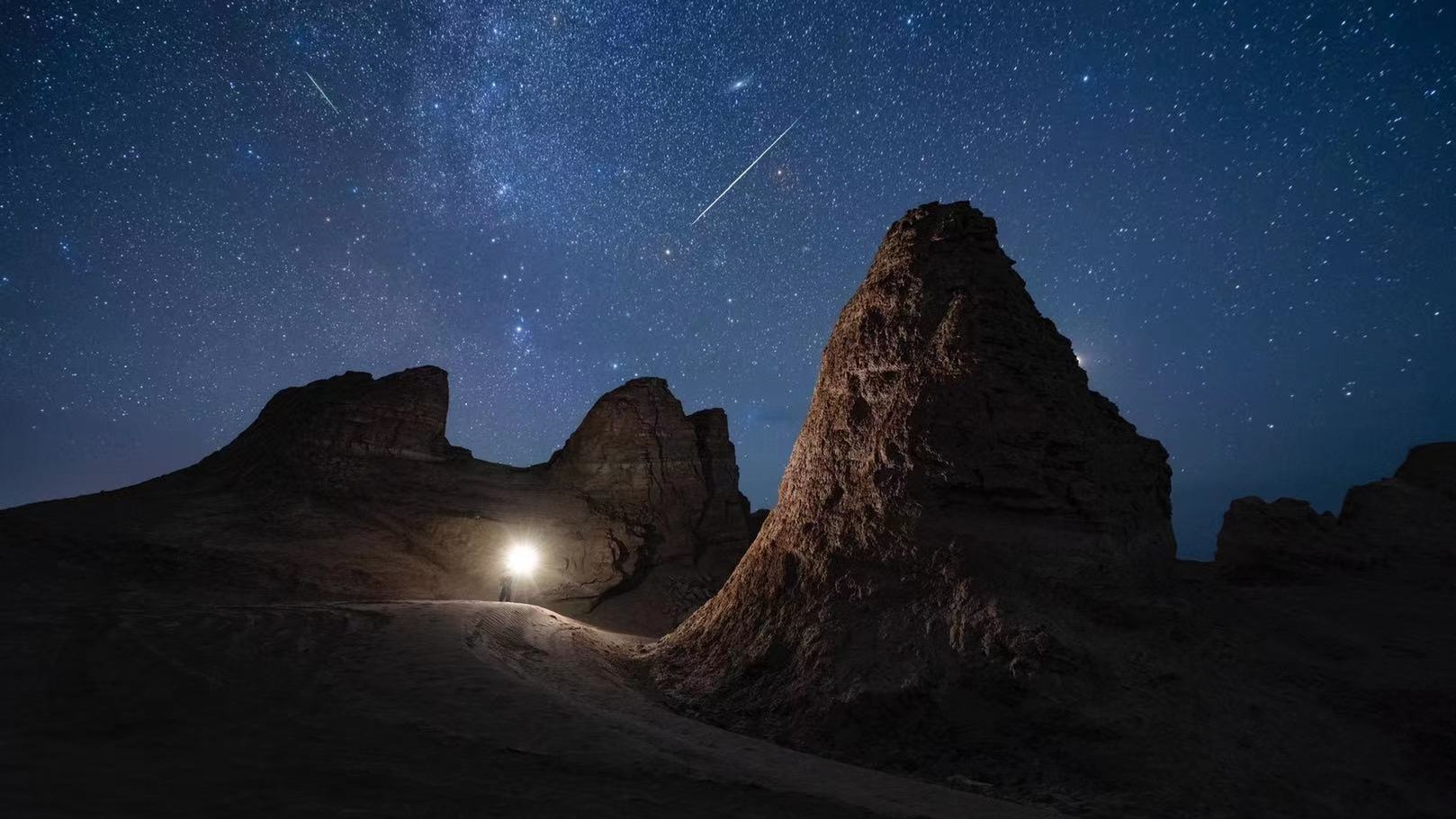
Meteors can technically appear anywhere in the night sky, but will appear to have come from the constellation Perseus. This photo shows a Perseid meteor over the Eboliang Yardang landform on August 12, 2022 in Haixi Mongolian and Tibetan Autonomous Prefecture, Qinghai Province of China. (Image credit: Photo by Wu Zhengjie/VCG via Getty Images)
If you want to begin watching for Perseids this week, the best time is after midnight through the small hours before dawn, when the radiant constellation, Perseus, climbs higher in the northeastern sky. "Shooting stars" can appear anywhere in the night sky, but if their paths backward point roughly toward Perseus, it's a Perseid. That's what gives the shower its name.
There's more to look at than Perseids because July is quietly crowded with other meteor showers. The Southern Delta Aquariids begin strengthening through the second half of the month. From southern latitudes, they can produce roughly 25 meteors per hour under dark skies, though observers farther north tend to see fewer because the radiant stays low in the southern sky. These meteors are usually softer and subtler than Perseids — medium-speed streaks without many dramatic fireballs or glowing trails.
Running alongside them are the Alpha Capricornids, active from early July into mid-August. Technically, this is a weak shower, often producing only a handful of meteors per hour, but it compensates with unusually bright, slow-moving fireballs.
Unfortunately, both showers peak this year beneath an almost full Buck Moon on July 30-31, which will wash out many fainter meteors. But bright meteors and fireballs should still occasionally punch through the moonlight.
Every year, Earth passes through the path of Comet Swift-Tuttle. With the Perseid meteor shower's peak occurring when Earth passes through the densest, dustiest area. (Image credit: Future)
How and when I'm watching it
I will probably begin meteor season the same way I always do: accidentally. I'll increase the odds by lingering outdoors slightly longer than necessary on warm nights, staying up later than I should and using my smart telescope to collect data on deep-sky objects while I search the skies for the first Perseid. It's best done now, before the moon waxes to full, and certainly before early August, when it wanes — the worst moon phase for observing meteors because it's in the sky just as meteor activity peaks.
Stargazer's corner: July 17-24, 2026
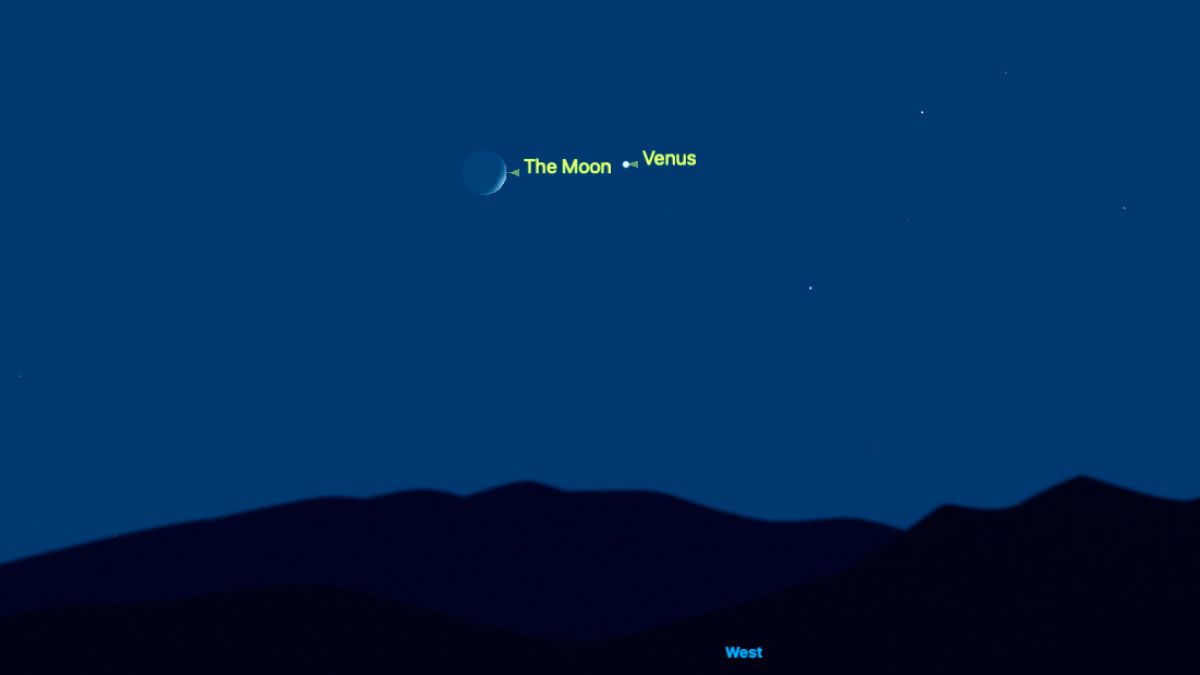
See a crescent moon and Venus on July 17. (Image credit: Starry Night)
With a new moon on July 14, this weekend is perfect for watching the return of a waxing crescent moon to the night sky. Look low in the west during dusk on Friday, July 17, to see a 16%-illuminated waxing crescent moon to the left of Venus. Watch it climb higher into the evening sky night after night, leaving genuinely dark late-night skies once it sets. It's good timing for the first serious Perseid-watching session of the season, particularly after midnight when meteor activity naturally increases as Earth rotates into the direction of travel around the sun.
Meanwhile, the Summer Triangle — formed by Vega, Deneb and Altair — hangs almost overhead during the darkest hours, making this one of the easiest seasonal star patterns for beginners to learn. Saturn now rises comfortably before midnight and dominates the southeastern sky by dawn, when it's joined by Mars and the stunning Pleiades open cluster.
Constellation of the week: Perseus
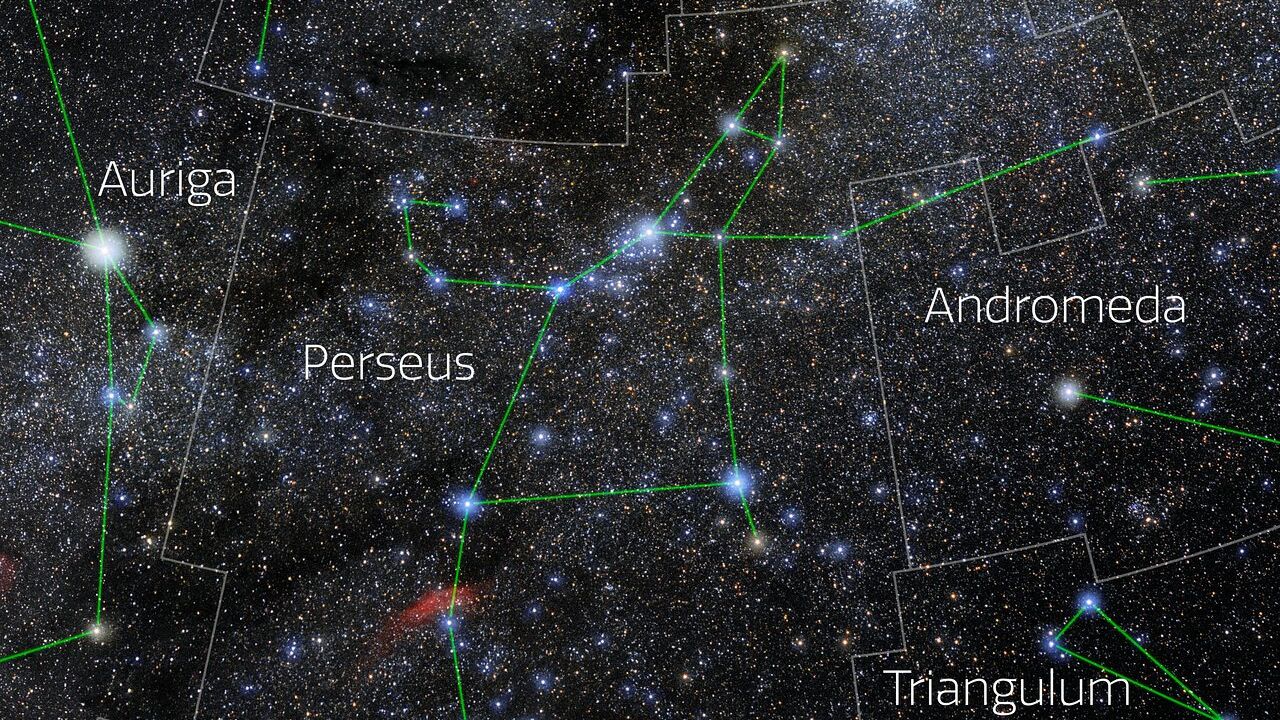
The constellation Perseus. (Image credit: E. Slawik/NOIRLab/NSF/AURA/M. Zamani)
Perseus, "The Hero," never quite looks how beginners expect. Rising into the northeastern night sky around midnight this week between bright star Capella and Saturn in the east, its name suggests something dramatic, but the constellation itself appears more like a loose chain of stars stretching below Cassiopeia in the northeastern sky. At this time of year, Perseus rises late, which is why the best Perseid activity happens after midnight once the radiant climbs higher. Beginners often assume meteors appear only near the radiant itself, but the longest and most impressive Perseids usually streak much farther away across the sky. Perseus matters less as a viewing target than as a reminder that meteor showers are fundamentally about perspective. The meteors are not actually emerging from the constellation at all — Earth is simply driving through comet debris head-on.
Making a sequel to Ridley Scott's 1979 classic "Alien" should have been a disaster. This was a movie that defined a whole new sub-genre of outer-space horror, a perfectly structured scarefest that also introduced one of cinema's greatest-ever monsters to the world.
Luckily, James Cameron — then one of Hollywood's hottest properties off the back of "The Terminator" — has never been a shrinking violet, and was brave enough to face the Xenomorph challenge head-on. Reinventing the franchise as a muscular sci-fi action movie, he created a whole new sub-genre of his own with a film every bit as memorable as its predecessor.
So, as the peerless "Aliens" turns 40, here — in honour of LV-426, the moon where the movie takes place — are 26 reasons it's still the greatest sci-fi action movie of all time.
1. James Cameron’$ original pitch
(Image credit: 20th Century Fox)
With only "The Terminator" (and the long-forgotten "Piranha II") on his resumé, James Cameron was yet to ascend to "king of the world" status when he pitched for the "Alien" sequel. His subsequent meeting with studio execs has since become the stuff of Hollywood legend.
The story goes that he turned over a copy of the script, wrote "ALIEN", added an S to the end, and then scrawled a couple of lines through the final letter. "ALIEN$" was a language the bigwigs understood, and you know what? Cameron was kinda right.
2. A new genre
(Image credit: 20th Century Fox)
Same continuity, same creature, same lead character… "Aliens" is undeniably a sequel to "Alien".
But while Ridley Scott's original film was already the definitive outer-space horror, Cameron boldly shifted genres to make the definitive outer-space action movie. Forty years on, fans are still debating which one is best.
3. Nothing is wasted
(Image credit: 20th Century Fox)
Anyone teaching action movie screenwriting should use "Aliens" as a core text. It's lean, it's efficient, and every line and moment is integral to the all-time classic whole.
It's no accident that Ripley shows off her Power Loader skills in the opening act — it's Cameron's version of Chekhov's gun.
4. The time jump
(Image credit: 20th Century Fox)
Some sequels pick up immediately after their predecessor left off. But by leaving Ellen Ripley in hypersleep for 57 years, the universe has a chance to evolve around her. Indeed, that's enough time for Weyland-Yutani to colonize LV-426 and — just maybe — pay a visit to that mysterious spaceship with all those eggs in its cargo hold.
What could possibly go wrong?
5. Ellen Ripley
(Image credit: 20th Century Studios)
Ellen Ripley may have been the accidental hero of "Alien", but she's 100% proactive in "Aliens". At the beginning of the movie, she's still traumatized by her experience on the Nostromo, and her employers at Weyland-Yutani are doing little to help. But her cool head in a high-pressure situation puts highly trained Colonial Marines to shame, and by the final act, she's grown into one of cinema's greatest heroes.
Sigourney Weaver rightly earned herself an Academy Award nomination for her tour de force performance.
6. The Colonial Marines
(Image credit: 20th Century Fox)
Cameron waited until late on in production to shoot the scene where the Colonial Marines wake up from hypersleep. It's a genius move, their real-life familiarity helping to establish a convincing camaraderie between these elite soldiers.
Even though most are lucky if they speak more than a line or two, Cameron's writing is so tight that we already know plenty — and care — about them when they inevitably become Xenomorph fodder. (Top fact: with the exception of Lt Gorman and Corporal Hicks, the Marines all share a first initial with the actor who plays them.)
7. The Dropship
(Image credit: 20th Century Fox)
Physics purists can bemoan the science all they like, but there's something undeniably cool about the craft that plunges the Marines to the surface of LV-426. A wonderfully utilitarian example of pre-CG model work.
8. The slow-build
(Image credit: 20th Century Studios)
In the original version of the movie, an entire hour has passed before you see an alien. Cameron doesn't waste a second of that time, however, establishing characters (see above), introducing Newt, showing off the geography of the Hadley's Hope terraforming base, and building a creeping sense of dread.
Those acid burns on the floor can't be good news, right?
9. The shouldercams
(Image credit: 20th Century Fox)
In an era when cameras can be shrunk down into phones or even a pair of glasses, anybody can film anything. But when Cameron gave his soldiers shoulder-mounted video units, it felt genuinely groundbreaking. It provides a suitably chaotic Marine's-eye-view as the carnage unfolds, but you always know whose perspective you're following because, well, their names are written on screen.
10. The ambush
(Image credit: 20th Century Fox)
"Aliens" may take its time getting to the actual aliens, but when it does, it doesn't hold back.
The walls start moving, flame-throwers start flaming, and suddenly the Marines are on the back foot against a vastly superior enemy. Throw in an exploding bag of ammunition, and it's all so brilliantly disconcerting that you need several rewatches to work out what you've just witnessed.
Within a matter of minutes, Hicks, Hudson, Vasquez, and Gorman are the only Marines left standing — and Gorman's technically comatose.
11. The Xenomorph drones
(Image credit: Twentieth Century Fox)
HR Giger's original Xenomorph is a design classic, but Cameron was more concerned about practicality than looks.
The new alien suits (usually occupied by gymnasts and acrobats) prioritized movement, as the director went big on research and development to make sure their motion was as inhuman — and as fast — as possible.
Remarkably, only six suits were built for "Aliens", but ingenious editing makes it look like Hadley's Hope is swarming with them.
12. The Alien Queen
(Image credit: 20th Century Fox)
We'd seen the eggs, the Facehuggers, and the drones. But, as Ripley pointedly asks, "Who's laying the eggs?"
The answer is a truly terrifying new stage in the Xenomorph life cycle, and arguably the last essential addition to the franchise's mythology.
Designed by Stan Winston (who'd worked with Cameron on "The Terminator" and won an Oscar for his work on "Aliens"), the Alien Queen is a towering apex predator who'll do anything to protect her kids.
13. Newt
(Image credit: 20th Century Fox)
Introducing a kid to a hard-boiled action franchise can be a risky move, but Rebecca Jordan (known to everyone as Newt, played by Carrie Henn) is totally integral to "Aliens".
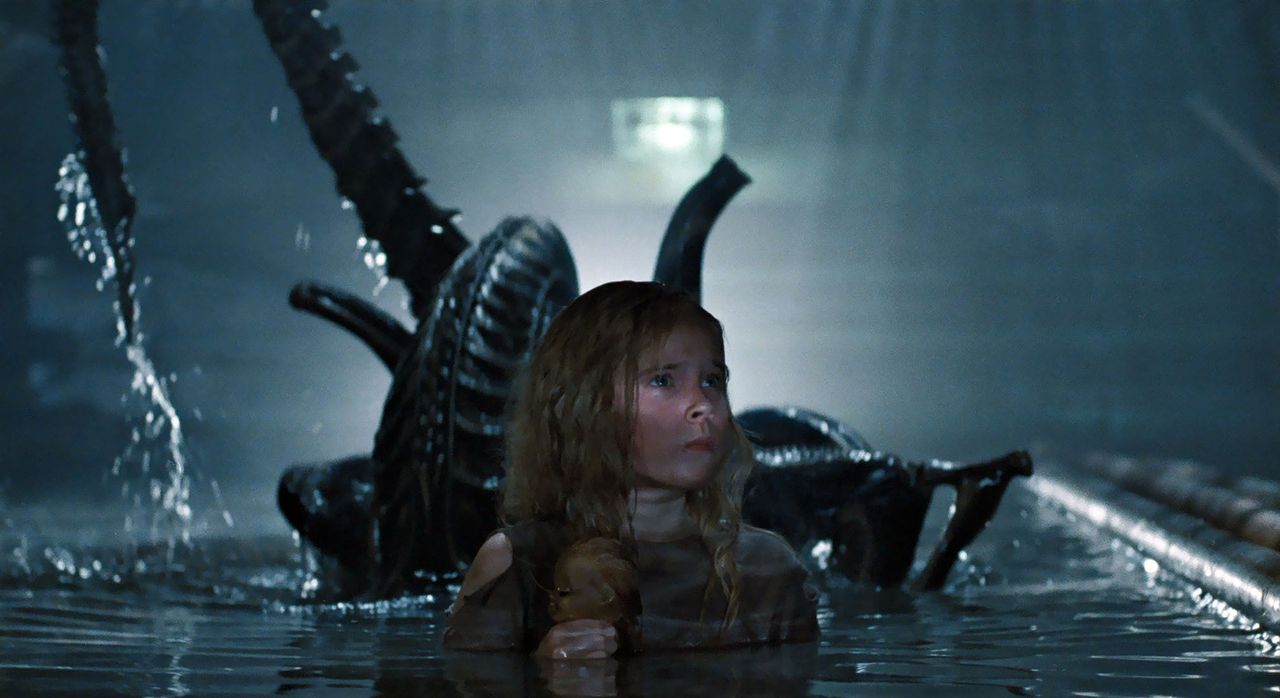
As the last known survivor of Hadley's Hope, she's resourceful as hell and has plenty to teach the heavily armed Marines about survival in a Xenomorph-infested world. She also brings out the maternal instinct in Ripley, a key theme of the movie that comes to a head in her famous face-off against the Queen: "Get away from her, you bitch!"
Speaking of which…
14. The quotable dialogue
(Image credit: 20th Century Fox)
"We're on an express elevator to hell." "They mostly come at night… mostly." "Game over, man. Game over." "I say we take off, nuke the site from orbit. It's the only way to be sure."
Few action movies — with the possible exception of "Predator" and "Die Hard" — are quite as chock-full of zingers as "Aliens".
15. The APC
(Image credit: 20th Century Fox)
The Armored Personnel Carrier is every bit as iconic as the dropship it calls home.
Part mobile base-of-operations, part all-terrain action vehicle, it's the reason the few remaining Marines escape their close encounter in one piece — even if its transaxles have issues dealing with concentrated acid blood.
It's telling that the Resources Development Administration hardware in the "Avatar" series is so heavily influenced by this timeless "Aliens" tech.
16. Facehuggers on the move
(Image credit: 20th Century Fox)
The Facehugger that jumped — and subsequently impregnated — Kane in the original “Alien was already the stuff of nightmares. But the parasites in the sequel are much more than some acid-blooded jack-in-a-box.
In “Aliens”, those spider-like legs allow them to scurry around to hunt down their prey, ensuring they're a clear and present danger — even if you're not foolhardy enough to put your face over an open egg.
17. Carter Burke
(Image credit: 20th Century Fox)
If there’s one thing the "Alien" saga has taught us, it's that you should never, ever trust Weyland-Yutani, chillingly referred to simply as "the Company".
If "Alien"'s Ash was the ultimate company android, Burke (Paul Reiser) is the epitome of the company man, a total scumbag whose friendly, "I'm-your-best-friend demeanor" can’t disguise the fact that he’d screw you over for a percentage, kiddo. The only character in the movie whose death by Xenomorph elicits a cheer.
18. The motion trackers
(Image credit: 20th Century Fox)
You don't need to see the Xenomorphs to know they're there.
The ominous beep of the Marines' motion trackers is a highly effective way of teasing the approaching menace — even when they're hiding in the ceiling.
19. A countdown to detonation
(Image credit: 20th Century Fox)
It's bad enough that you're trapped on a barren moon surrounded by a vicious hive of extraterrestrials who want to use you as hosts for their offspring. And that your primary choice of rescue has crashed on the surface, leaving you even more stranded.
Then, fate (or, to be more accurate, James Cameron) throws you a curveball in the form of an atmospheric processor about to go nuclear. The clock is well and truly ticking…
20. Bill Paxton
(Image credit: 20th Century Fox)
The late Bill Paxton was Cameron's lucky charm, also turning up in "The Terminator", "True Lies", and "Titanic". But "Aliens" is his signature role, as the famously pessimistic Private Hudson makes the most of his limited dialogue.
As an interesting sidenote, Paxton had the honor of being killed on screen by a Terminator, a Predator, and a Xenomorph.
21. The Power Loader
(Image credit: 20th Century Fox)
Part Japanese mecha, part Transformer, Ripley's Power Loader is an instantly iconic piece of kit, so painstakingly designed that it looks like it could actually work IRL.
If you're going to go woman-to-woman with an angry Alien Queen, never leave the house without one.
22. Bishop
(Image credit: 20th Century Fox)
Ash, the Nostromo's resident synthetic in "Alien", was a bona fide bad 'un, prepared to sacrifice the crew in the name of getting a valuable Xenomorph back to "the Company"’s weapons division.
It's hardly a surprise, then, that Ripley is suspicious of Bishop (Lance Henriksen) from the off. Luckily for everyone, he gradually proves his worth via his skills with the knife game, elite dropship-piloting abilities, and generally being an all-round good egg.
Not bad for an android… (Bishop is manufactured by Hyperdyne Systems, a nod to Cyberdyne in Cameron’s “Terminator” movies.)
23. The music
(Image credit: 20th Century Fox)
"Aliens" was James Horner's first collaboration with Cameron (he went on to write the scores for "Titanic" and "Avatar"), and the then-32-year-old provided the perfect musical backdrop for the action unfolding on screen.
Sure, some of the themes are derivative of the composer's own "The Wrath of Khan" soundtrack, but it's impossible to imagine "Aliens" without Horner's contribution.
24. The sound effects
(Image credit: 20th Century Fox)
The best sci-fi franchises are as recognisable for their sound as their visuals. So, just as, say, "Star Wars"’ lightsabers and "Star Trek"s transporters are aurally unmistakable, "Aliens" has its own distinctive soundscape.
Hear a pulse rifle firing or the squeal of a Xenomorph, and you know exactly where you are. Best Sound Effects Editing was one of the film's two Academy Award wins, and it's easy to see why.
25. The Special Edition
(Image credit: 20th Century Fox)
If you've never seen "Aliens", the tighter theatrical cut is definitely the place to start. But once you know what's waiting for the Colonial Marines on LV-426, the Special Edition is the definitive version of the movie.
From Newt's family making first contact with a Facehugger to a wonderfully tense sentry gun sequence, Cameron's extra footage enhances a classic. It also adds to the film's mother/child subtext when we learn that Ripley had a daughter, Amanda, who died just before Ellen was discovered by the Weyland-Yutani recovery crew.
Amanda would later be retconned to become the lead character in the survival horror video game "Alien: Isolation".
26. Cameron himself
(Image credit: Getty Images (Bob Penn))
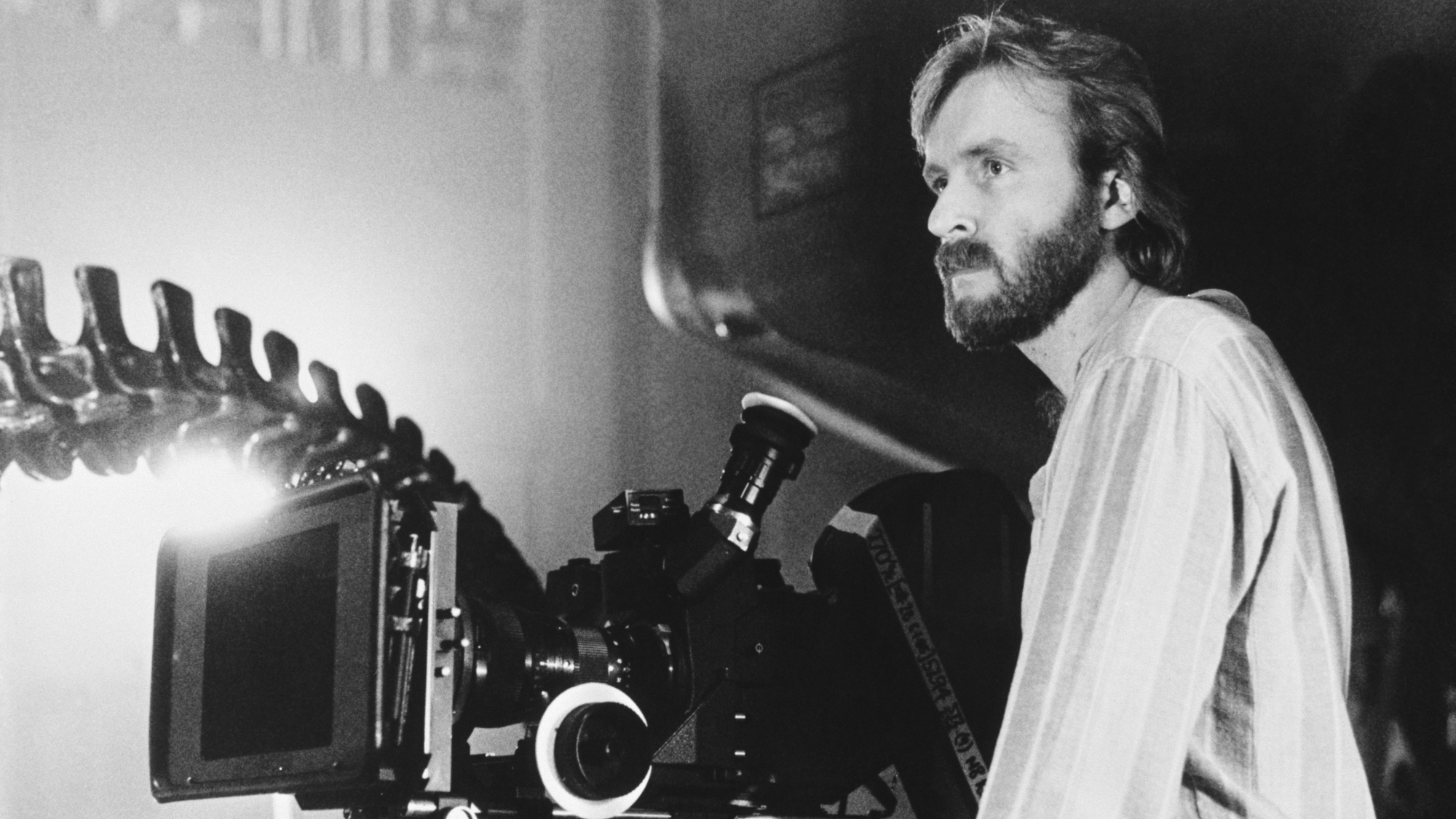
Cameron's intense working methods famously didn't go down well with his unionized British crew, who famously made t-shirts bearing the slogan "You can't scare me, I work for James Cameron".
But whatever the on-set experience, it's impossible to deny that he marshalled proceedings to perfection. Even the director's lesser works — the "Avatar" sequels, for example — feature action beats of unassailable genius. "Aliens", however, demonstrates a filmmaker at the pinnacle of his powers.
Every sci-fi action movie ever made will be judged against "Aliens". Even the brilliant "Predator" lives in the shadow of a movie that remains untouchable — and endlessly rewatchable — four decades after its original release.
"Aliens" is available to stream on Disney+ in the UK, and to rent and buy on various platforms in the US.
After more than two decades of searching, scientists have finally observed a phenomenon in a hot and dense particle 'soup' similar to that which filled the cosmos moments after the Big Bang. The observation could help cosmologists better understand the incredibly hot and dense state of the universe in its earliest moments.
The world's most powerful particle accelerator, the Large Hadron Collider (LHC), regularly creates this so-called quark-gluon plasma by smashing together the atomic nuclei of heavy elements like lead and generating sprays of particles called jets, from which this hot and dense particle soup emerges. This is necessary because in the modern universe, quarks and gluons, referred to as "partons," are only ever found together comprising particles like protons and neutrons. Thus, it takes the kind of energy generated by smashing atoms together at near-light-speeds to free these partons and generate the hot 'soup' known as quark-gluon plasma.
As particles ripple through the quark-gluon plasma, they lose energy and momentum to this medium, which should create wakes in this primordial soup, much like that which is created when the hull of a boat pushes through the ocean. However, researchers had failed to see this so-called "diffusion wake" for two decades. That is, until now.
"Observing and quantifying the quark-gluon plasma diffusion wake opens the door to the new precision characterization of the properties and dynamics of the quark-gluon plasma, and promises new insights into the evolution of the early universe,” team leader Raghunath Pradhan of the University of Illinois Chicago (UIC) said in a statement.
A new approach in the hunt for particle wakes
Previously, the search for wave signals had involved generating events involving the production of a jet alongside a particle called a Z boson. However, while this had provided some evidence of particle wakes, signals from these wakes are subtle and easily drowned out by other jet-related effects, meaning these detections weren't statistically significant enough to be classed as a confirmed detection.
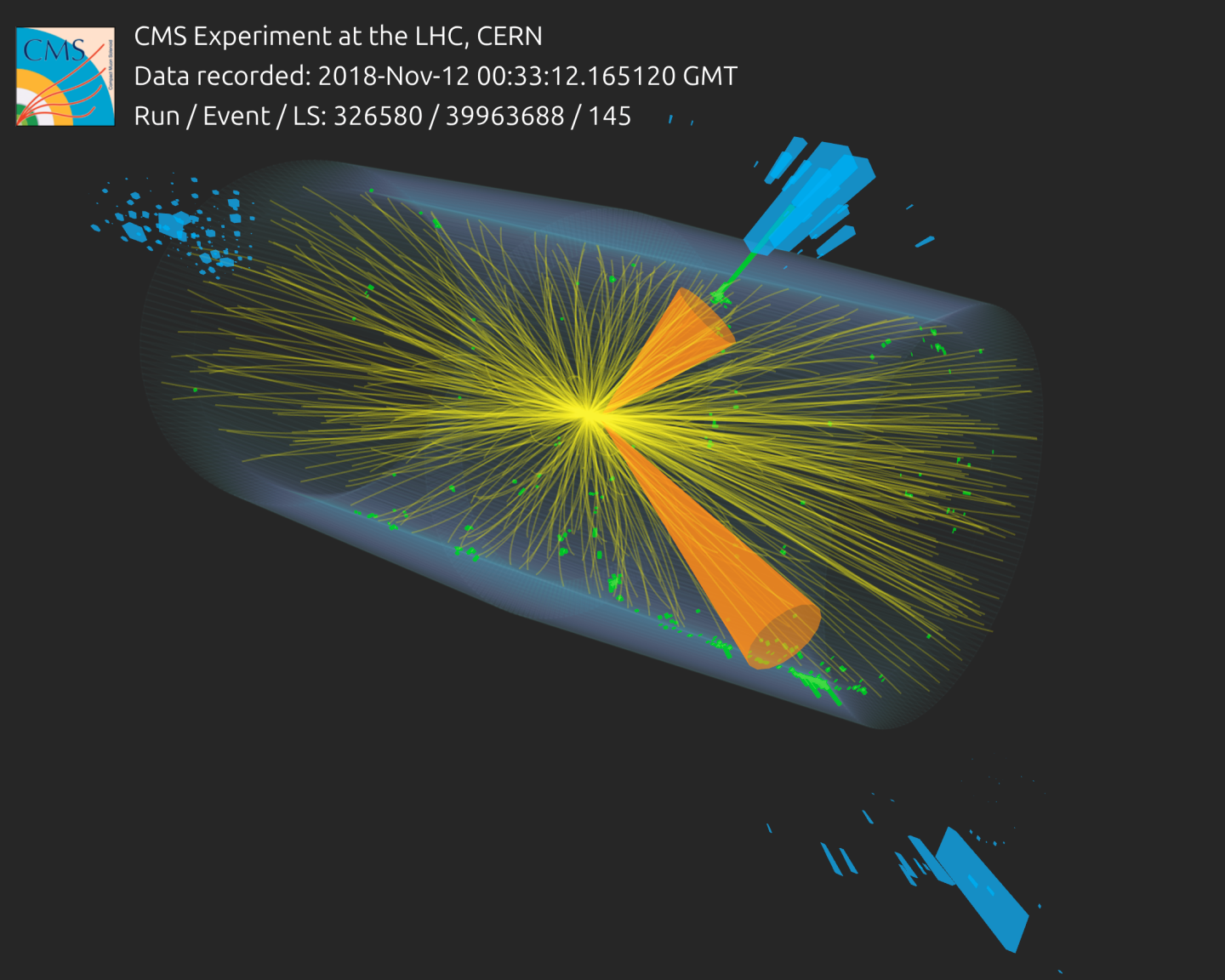
To search for the wave signal, this team took a different approach and used the LHC to smash together two lead nuclei to create jets of particles that were back-to-back, called a dijet event. The unique shape of these events meant that signals from wakes could be more easily disentangled from surrounding noise.
Display of a lead-lead collision, which produced two back-to-back jets, recorded by the CMS experiment. The jets are indicated by the orange cones. (Image credit: CERN)
The team's measurement showed a clear lack of particles behind the direction of the jets, which was particularly prominent at relatively low momentum. That is exactly what would be expected for a diffusion wake.The strongest wake signals were detected in more centralised lead-lead collisions, which create more quark-gluon plasma.
"This observation is a culmination of a decades-long quest to observe the wake phenomenon; it has been predicted by theory over 20 years ago, but remained elusive in the experimental data," team leader Olga Evdokimov of UIC said.
The team's research was accepted for publication on June 25 in the journal Physical Review Letters.
Skyroot Aerospace successfully launched its Vikram-1 rocket to low Earth orbit (LEO) early Saturday morning (July 18), making India just the third country with a private orbital launch capability. The other two are established space powers — the U.S. and China.
"It is the dawn of a new space era," one of Skyroot's commentators said during the company's launch webcast on Saturday.
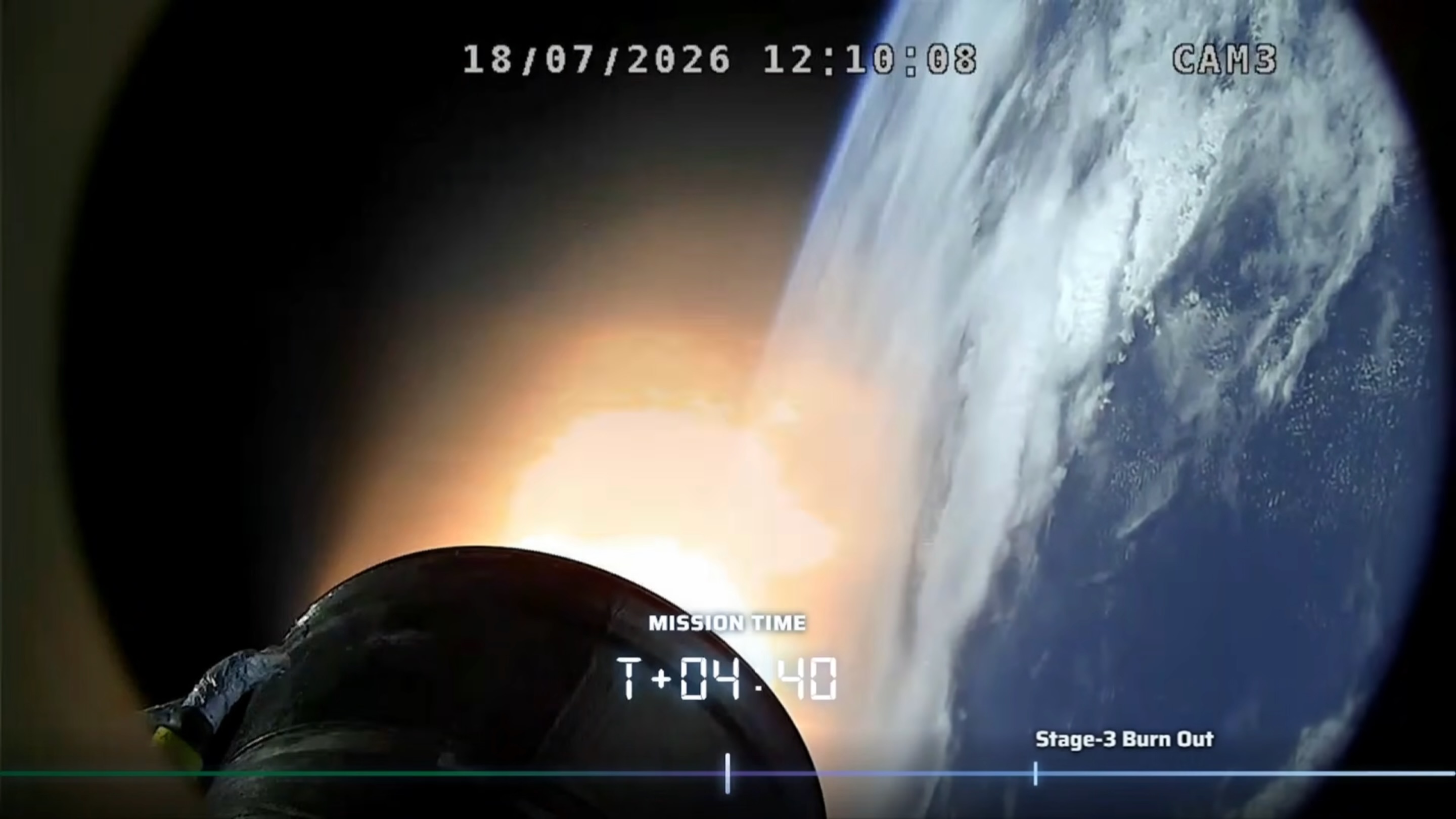
The view from the third stage of Skyroot Aerospace's Vikram-1 rocket during its debut launch on July 18, 2026. (Image credit: Skyroot Aerospace)
Skyroot Aerospace is based in the central Indian city of Hyderabad and was founded in 2018. The company made history for the first time four years later with its Vikram-S suborbital rocket, becoming the first private Indian outfit ever to reach space.
Vikram-1 is the next step for Skyroot: an orbital vehicle. The four-stage, seven-story-tall rocket is a small-satellite launcher; it can haul about 770 pounds (350 kilograms) of payload to LEO, according to the company.
"The small satellite launch market is deeply constrained on the supply side," Skyroot co-founder and CEO Pawan Kumar Chandana said in an emailed statement on Thursday (July 16).
"At the same time, the demand for services enabled by satellites in space will only continue to grow, and that is where Skyroot's opportunity lies," added Chandana, who, like company co-founder Naga Bharath Daka, used to work for the Indian Space Research Organisation.
The company began exploiting that opportunity on Saturday morning, with a test flight called Aagaman (Sanskrit for "Arrival"). The main goal was to see how Vikram-1 and its various systems performed during flight. But the rocket also carried some customer payloads, which were scheduled to be deployed at an altitude of 280 miles (450 kilometers).
Those payloads included a technology demonstration from the German company DCUBED; the Solaras S3 nanosatellite pathfinder from Indian startup Grahaa Space; and Embrace, a robotic arm built by the Indian company Cosmoserve Space that's designed to capture space debris.
Vikram-1 also carried Skyroot's SCOPE satellite, which collected a variety of data to help the company assess the rocket's performance during flight. There were two symbolic payloads on board as well — a small, 18-karat gold rocket from the artist Ajay Kumar Mattewada and "Cosmic Bloom," which was designed by Cosmos Diamonds, a company that makes jewelry using lab-grown gems.
Aerial view of Skyroot Aerospace's Infinity Campus in Hyderabad, India, showing a life-size model of the company's Vikram-1 rocket outside. (Image credit: Sumil Sudhakaran/Skyroot Aerospace)
All of them made it to space safe and sound. Vikram-1 lifted off from the Satish Dhawan Space Centre, on the Indian barrier island of Sriharikota, on Saturday at 2:35 a.m. EDT (0635 GMT; 12:05 p.m. India Standard Time), roaring off the pad in a flash thanks to its first-stage solid rocket motor.
The rocket performed as planned, sticking to a nominal trajectory and deploying the payloads right on schedule. Vikram-1 had ticked all of its boxes by just 17 minutes after liftoff, leading to a pronouncement from mission control.
"The Vikram-1 Aagaman mission is a grand success," the mission director said, eliciting cheers from the folks in the room.
It was a big moment for Skyroot and for India, and it augurs big things to come, according to Lt. Gen. AK Bhatt (retired), Director General of the Indian Space Association.
"The successful orbital launch of Skyroot Aerospace’s Vikram-1 (Mission Aagaman) is a defining milestone for India’s space journey," Bhatt said in an emailed statement shortly after the mission wrapped up. "By executing the nation's first fully private orbital flight, Skyroot has shattered legacy boundaries, demonstrating that our domestic industry is primed to handle end-to-end space missions."
Editor's note: This story was updated at 3:25 a.m. ET on July 18 with news of successful launch and satellite deployment.
Reboots and remakes may be all the rage in Hollywood with mixed degrees of success (we don't talk about the Nightmare on Elm Street reboot ... ever), but they aren't so popular in other forms of art such as painting. However, a recent cosmic rework of one of art's most well-regarded pieces could be just as breathtaking as its original counterpart.
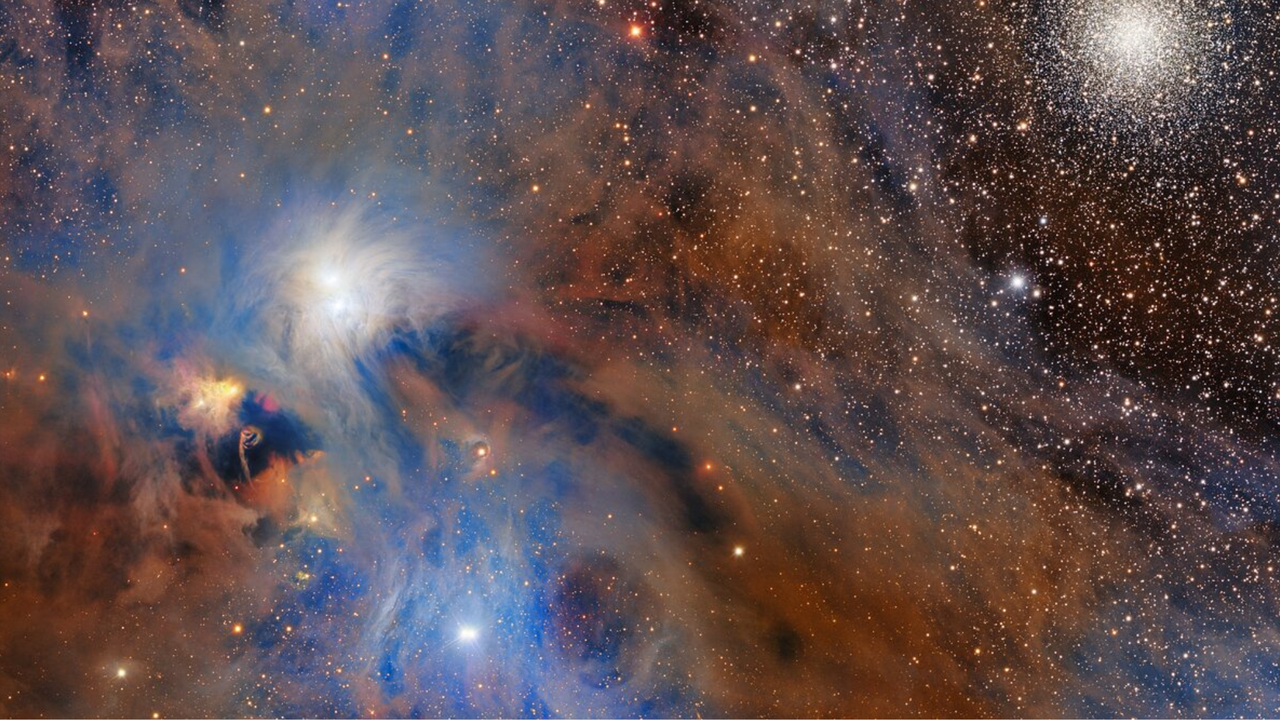
That's all thanks to the Dark Energy Camera (DECam), which has captured a vibrant view of the Corona Australis molecular cloud, that shows the star-forming region resembling a cosmic take on Vincent Van Gogh's iconic painting The Starry Night.
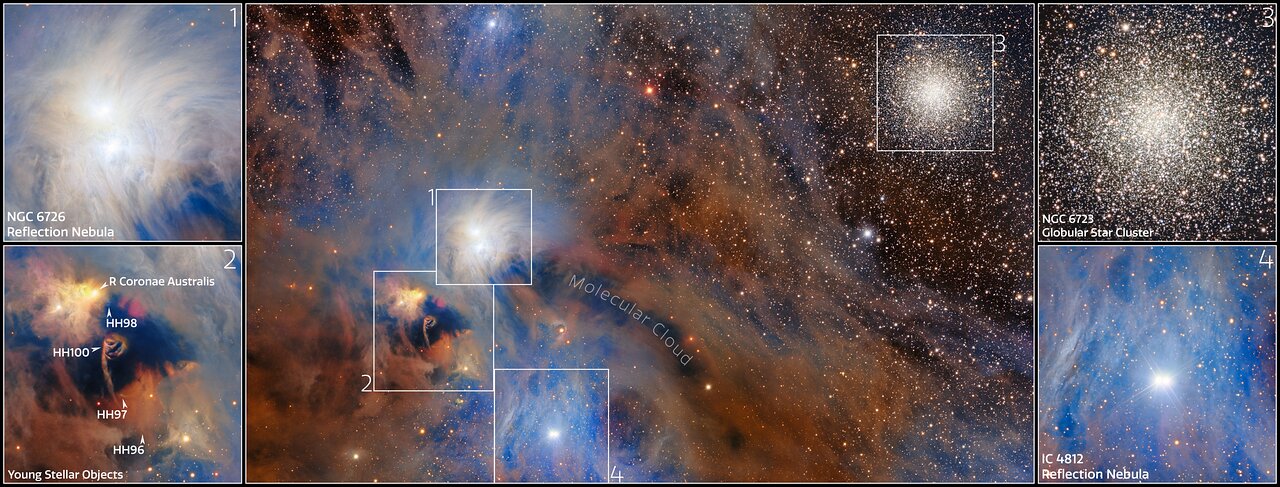
The Corona Australis Molecular Cloud measures around 16 light-years in diameter is located around 430 light-years from Earth, making it one of the closest star-birthing regions to our solar system. The molecular cloud and its dark lanes of gas and dust, the raw materials for star construction, are at the left of the DECam image.
A vibrant view of the Corona Australis Molecular Cloud as seen by the DECam painting a scene reminiscent of Van Gogh’s The Starry Night. (Image credit: Dark Energy Survey/DOE/FNAL/DECam/ CTIO/NOIRLab/NSF/AURA)
Also prominent on the left of the image is the shining nebulaNGC 6729, which is a reflection nebula of the Corona Australis Molecular Cloud. That means that it is a cloud of interstellar dust that is reflecting the light of the newborn stars embedded within this molecular cloud.
NGC 6729 is composed of different elements that can be seen on the left side of the image. This includes an orange cloud that is actually the binary star system R Coronae Australis. This binary consists of a pre-main-sequence star that has gathered mass but hasn't yet triggered the fusion of hydrogen to helium in its core, and its companion, a red dwarf star. These stars orbit each other every 43 to 47 years and are incredibly bright, with their light also reflecting from nearby reflection nebulas. This light also ionizes nearby gas, creating glowing regions called emission nebulae, also part of NGC 6729.
At left, the young binary system R Coronae Australis illuminates surrounding gas and dust, while the glittering globular cluster NGC 6723 shines at upper right, far beyond the nearby stellar nursery. (Image credit: Dark Energy Survey/ DOE/ FNAL/ DECam/ CTIO/NOIRLab/NSF/AURA)
To the top-right of the image is the globular clusterNGC 6723, nicknamed the Chandelier Cluster. Located around 29,000 light-years from Earth, NGC 6723 is thought to contain some of the oldest stars in the Milky Way.
The Chandelier Cluster contains tens of thousands to millions of stars, which aren't all ancient; within the spherically shaped globular cluster are more than a smattering of younger stars.
Astronomers and astrophotographers of all levels will be more than familiar with the Corona Australis Molecular Cloud and the Chandelier Cluster and this region as a whole.
But just as it took the artistic vision of Van Gogh to transform the night sky into a stunning painting, it has taken the observing power of the DECam, mounted on the Víctor M. Blanco 4-meter Telescopeat Cerro Tololo Inter-American Observatory (CTIO) in Chile, to bring out the stunning beauty of this slice of the night sky.
Smoke from wildfires across Canada travels across both Canada and the U.S. in this satellite image captured by NOAA-21 on July 14, 2026. (Image credit: NASA Earth Observatory/Lauren Dauphin)
The wildfires tearing across Canada are so extreme that the smoke billowing upward can be seen from space.
What is it?
Over 850 wildfires are currently devastating Canada, as reported by theCanadian Interagency Forest Fire Center. The fires are spreading across Manitoba, Saskatchewan and Ontario; most remain completely uncontrolled.
In addition to the immense destruction caused by the fires themselves, the smoke from these fires is causing serious concerns about dangerously poor air quality all across Canada and even in the northeastern United States. As far as New York, the air quality on Thursday (July 16) was labeled "very unhealthy" after the state activated emergency air quality protocols.
The smoke is so expansive it's clearly visible in this image captured on July 14 from Earth orbit.
Why is it noteworthy?
Studying wildfires and wildfire smoke from orbit can give us a bigger picture view of these catastrophic event. This data is important for disaster relief in the short term — but also in the long-term. With climate change continuing to progress due to human activities like burning coal for cheap power, we can expect natural disasters to worsen. Among the many effects of climate change, this includes longer and more intense wildfire seasons, especially in regions that are already susceptible to fire such as these regions across Canada.
The new image was captured by the NOAA-21 satellite with the instrument VIIRS (Visible Infrared Imagine Radiometer Suite). You can see massive plumes of smoke over southeastern Canada treading into the northeastern U.S. Thick smoke covers swaths of Canada's landscape and wisps of smoke trail all the way down through New York and across the U.S.
Most of this smoke, at least the smoke we can see in this satellite image, is coming from wildfires in northwestern Ontario. As the wildfires continue to burn, satellites like NOAA-21 will be keeping watch.
Look up! The Perseid meteor shower is finally active, bringing the potential for gorgeous shooting stars and fireballs as Earth plunges into the trail of debris shed by the icy comet Swift-Tuttle. Here's what you need to know.
The Perseid meteor shower 2026 is set to be a truly magnificent affair and a stark contrast to last year, when moonlight drowned out all but the brightest shooting stars. The shower will reach peak activity overnight on Aug. 12-13 under the dark skies of the new moon. During the peak, up to 100 shooting stars may be seen each hour as they cut fiery paths through the summer sky, according to the American Meteor Society.
You could even spot a Perseid brightening the false twilight triggered at the climax of the Aug. 12. eclipse, as the moon perfectly hides the surface of our parent star. But for that to happen you'd have to find yourself in the path of totality just as a large fireball-producing meteoroid struck Earth's atmosphere. It's certainly possible, but let's just say that the odds aren't stacked in your favor.
If you're not in the path of totality then there's no need to despair, you stand a much better chance of spotting Perseids the old fashioned way anyway!
How to spot Perseid shooting stars
Perseid meteors can be spotted anytime after dark from tonight onwards, streaking away from a patch of sky, or radiant, located close to the red supergiant star Eta Persei in the constellation Perseus.
How to measure distances in the night sky using your outstretched hand. (Image credit: Created in Canva Pro)
To find the best meteors, you'll first want to locate Perseus glistening above the northwestern horizon after dark. Next, find a patch of sky 40 degrees above it, and settle in for one of the year's premier natural light shows. This is where the shooting star trails will be at their longest.
The Perseids are also famed for producing vivid green fireballs capable of briefly turning night to day as larger chunks of debris collide with Earth's atmosphere at speeds of up to 37 miles per second (59 kilometers per second).
When to look for Perseid meteors
Perseid meteors may be spotted anytime from 10 p.m. onward for viewers in the U.S., though the number of visible shooting stars will be higher in the hours before dawn, when the radiant rises to its highest point in the summer night sky. Try to head away from city lights and allow at least 20 minutes for your eyes to adapt to the darkness.
Relatively few shooting stars will be visible in the days following the shower's awakening compared to the peak. However, if you do catch one, you'll have seen the demise of a meteoroid that's likely been flying through space for thousands of years before reaching Earth.
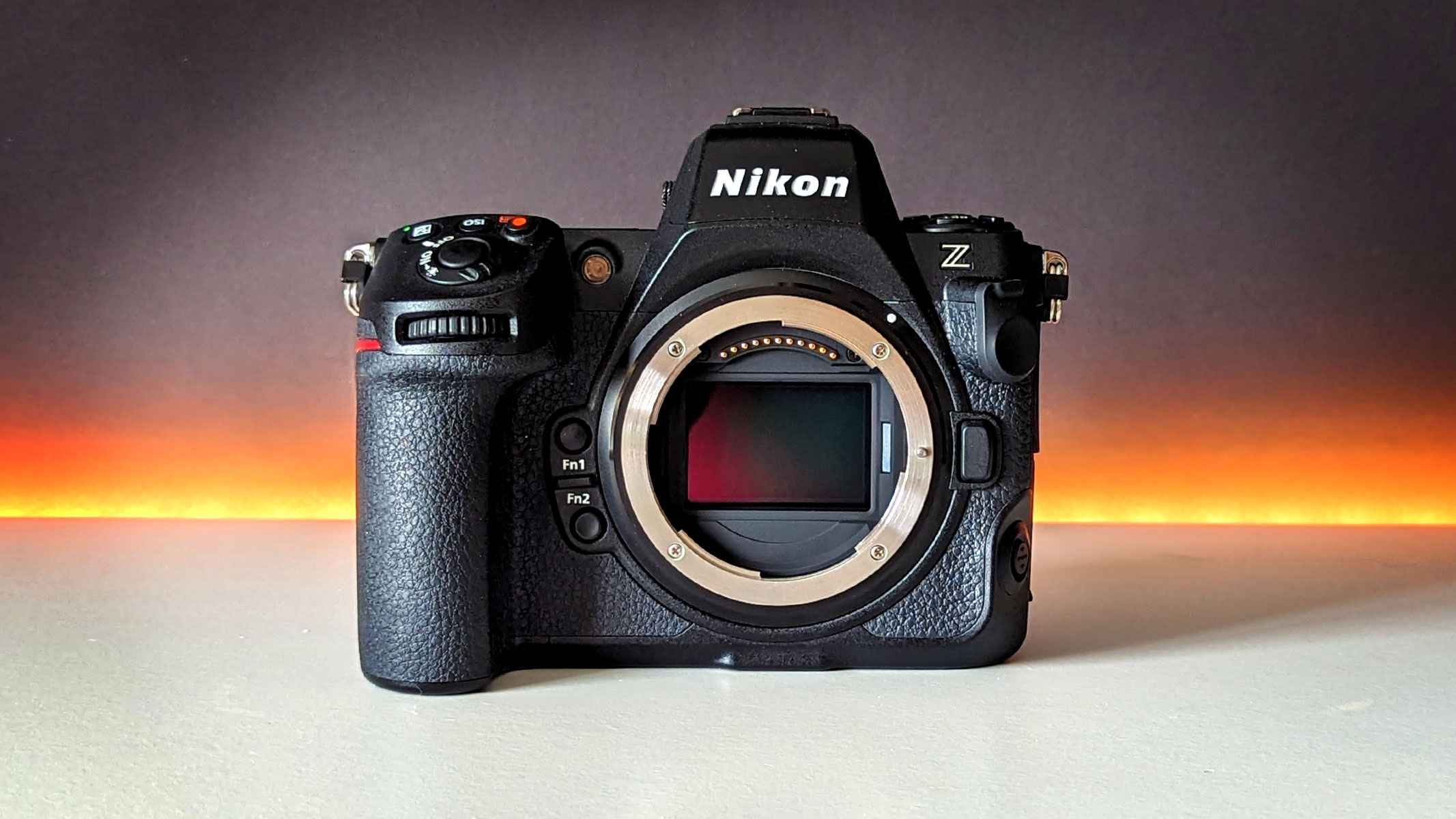
Nikon Z8
(Image credit: Jase Parnell-Brookes)
The Nikon Z8 excels in just about every department and we rate it as the best overall camera out there. It features a full-frame 45.7MP sensor, 8K video capabilities and, of course, excellent low-light performance. Check out our Nikon Z8 review for more.
"The meteors we see early and late during the activity are most likely the oldest as they have obviously been perturbed from the main orbit of the comet, which we encounter in mid-August," said Robsert Lunsford of the American Meteor Society in an email to Space.com.
The greatest number of meteors can be seen in the predawn hours of Aug. 13 as the shower reaches peak activity, when Earth passes through the densest section of the debris stream left behind by comet Swift-Tuttle.
Editor's Note: Did you capture a photo of a Perseid and want to share it with Space.com's readers? Then please send your photos and comments, along with your name and location to spacephotos@space.com.
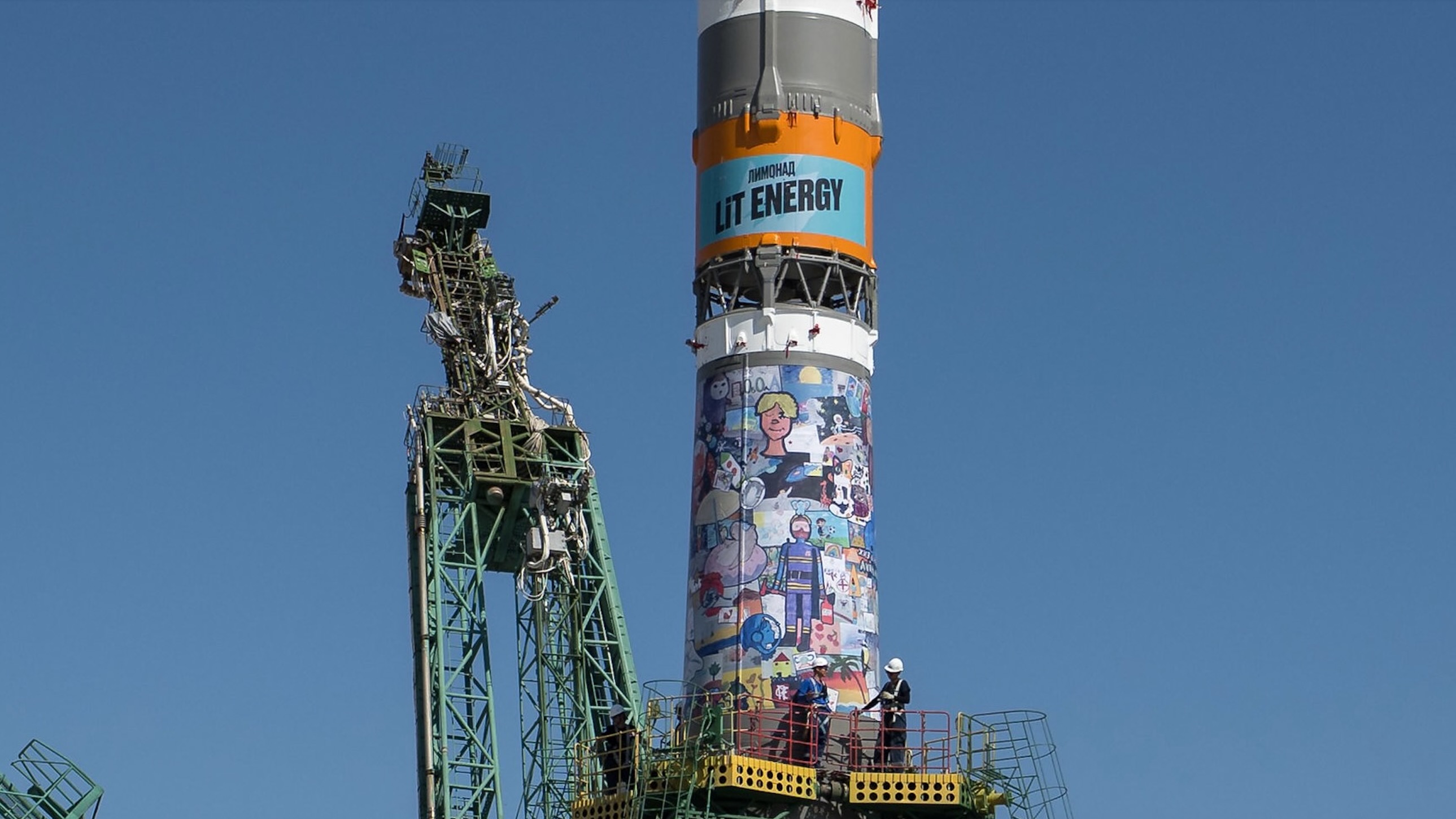
Astronauts just flew to Earth orbit space atop a rocket emblazoned with an energy-drink ad.
The Soyuz MS-29 launch to the International Space Station on Tuesday (July 14), from the Russian-run Baikonur Cosmodrome in Kazakhstan, used a Soyuz rocket festooned with ads for Лимонад ("Lemonade") LIT ENERGY. The ads are visible in shots of the rocket's rollout on July 11, published here and here via NASA's Flickr account.
The Soyuz used for the launch also featured drawings from children with cancer — as well as the phrase "Life has no end" — to advertise the Unity Charitable Foundation, according to a Russian-language state media report machine-translated into English. The campaign is part of a series in support of the foundation that began in November 2025, the media report added.
Zoomed-in view of the above photo, highlighting the ad for Lit Energy. (Image credit: NASA/Bill Ingalls)
To be sure, the Russian space agency Roscosmos (like other space agencies) often adorns its rockets with colorful artwork and logos that may not necessarily result in payment. In June 2018, for example, a Soyuz launched with a FIFA World Cup logo that may have been a publicity campaign to advertise the soccer competition, which was occurring that month in Russia.
While there have been some experiments by other space agencies regarding advertising — anyone remember the space cola wars? — here are a few notable examples from Russia and its predecessor state, the Soviet Union.
A 1990 cosmonaut launch, partly for the Tokyo Broadcasting Service, carried a Japanese journalist from TBS — as well as advertisements on the side of the Soviet Soyuz rocket. Sony, Unicharm and Pocari Sweat patches were also reportedly flown on the mission.
After the breakup of the Soviet Union, the Mir space station featured advertisements for companies like RadioShack, Pepsi and Israel's Tnuva Milk.
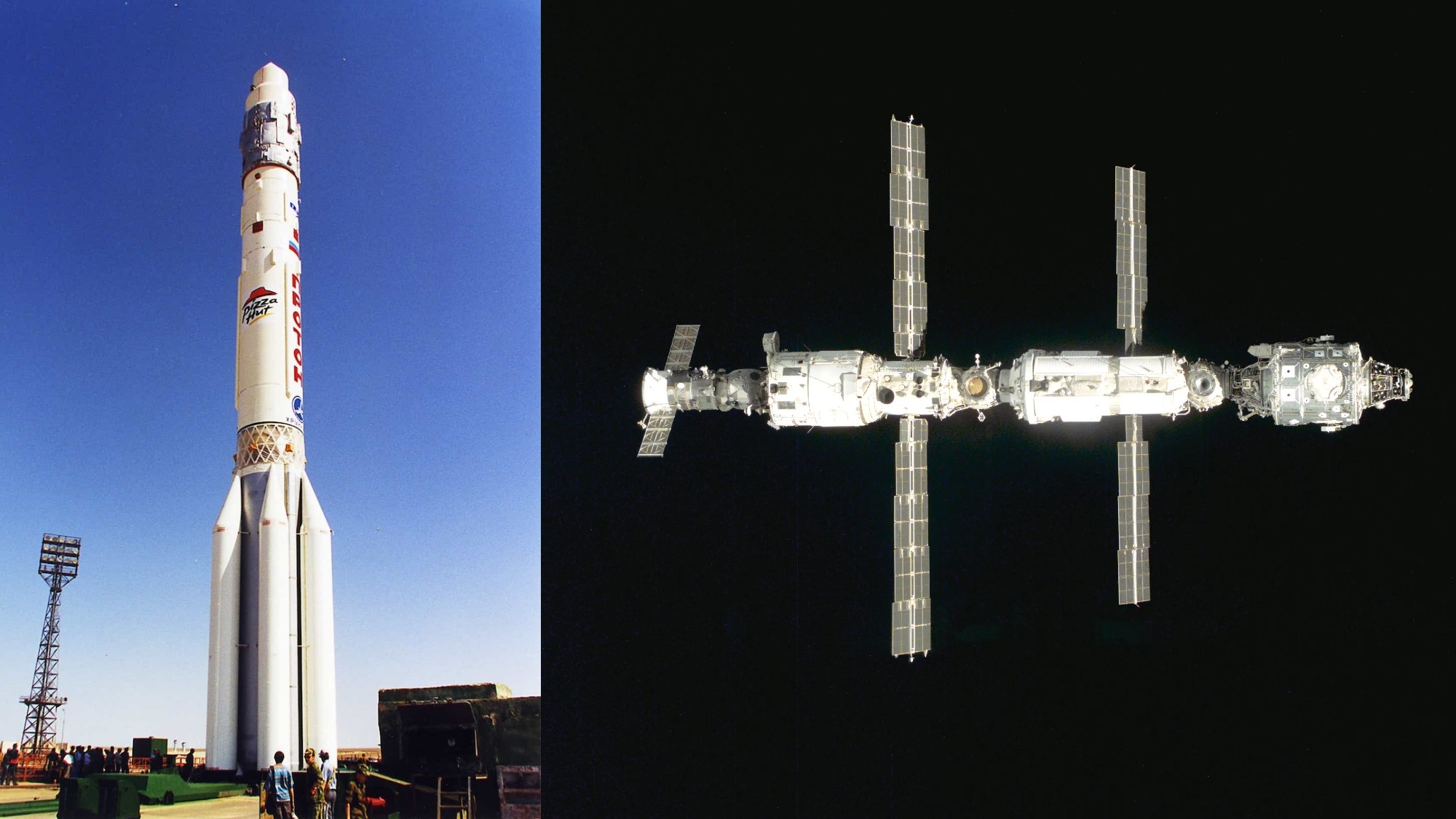
A Pizza Hut ad flew on a Russian Proton rocket in 2000 for roughly $1.25 million (nearly $3 million in today's dollars). The restaurant chain then followed up in 2001 with a special space pizza delivery — but using salami, as it is more shelf-stable than pepperoni.
A Pizza Hut ad on a Russian Proton rocket that launched the Zvezda service module to the International Space Station (seen on far left in the above ISS photo). (Image credit: Khrunichev State Research and Production Space Center/NASA)
So Russia's practice of launching ads into space is not new. However, Ars Technica has suggested that contractions in the Russian economy led to very recent changes in the country's laws for space advertising that could lead to more examples like this.
Russia's unsanctioned invasion of Ukraine in February 2022 caused many international partnerships in space (and other projects) to fall apart, which Ars believes may have led to Russian President Vladimir Putin's authorization for recurring space ads. The new legislation was cited on Roscosmos' Telegram account in October 2025, the Ars report added.
"According to the amendments, Roscosmos has been granted the right, effective January 1, 2026, to place advertising on space objects owned by both the state corporation itself and federally," said the Roscosmos statement, according to Ars. "The amendments will create a mechanism for attracting private investment in Russian space exploration, and reduce the burden on the state budget."
Roscosmos and NASA continue to work together on the ISS despite sanctions imposed after the invasion of Ukraine, which is ongoing. And Tuesday's launch marked a milestone in that cooperation, as NASA Administrator Jared Isaacman became the first with his title to attend a Soyuz launch in eight years.
SpaceNews noted that Isaacman and Roscosmos Director General Dmitry Bakanov had the first reported face-to-face meeting between the agency heads since the last in-person NASA chief visit, for an October 2018 launch. After the meeting between Isaacman and Bakanov, Russia announced a two-year extension of its ISS commitment, to 2030, as well as an agreement in principle to continue offering NASA astronauts seats on the Soyuz in exchange for seats on commercial U.S. vehicles, among other developments.
The most powerful solar storms to strike Earth may pack a bigger punch than scientists realized, according to a new study that suggests the impacts of extreme space weather have been underestimated.
Researchers found evidence that the apparent upper limit on Earth's response to the strongest solar storms may be an artifact of how solar wind has been measured rather than a true physical ceiling. If confirmed, the findings suggest that rare "once-in-a-thousand-year" geomagnetic storms could have a greater impact on modern technology than current estimates indicate, according to a statement.
"Our planet's magnetic field does a really great job of protecting us against many space weather effects and so they often just show up as glitches or beautiful aurora," Maria Walach, co-author of the study from Lancaster University, said in the statement. "There are however extreme cases."
Solar storms occur when eruptions from the sun, such as coronal mass ejections and solar flares, send clouds of charged particles hurtling toward Earth. While they can produce spectacular auroras, they can also disrupt satellites, GPS, radio communications and power grids.
History has shown the damage even less extreme storms can cause. The 1859 Carrington Event, the strongest geomagnetic storm on record, disrupted telegraph systems around the world and pushed auroras from their usual high-latitude skies near the Arctic and Antarctic to locations as far south as the tropics. Another powerful storm in 1989 collapsed Quebec's power grid, leaving millions without electricity, while the 2003 "Halloween storms" disrupted satellites, GPS and radio communications.
While the study doesn't suggest that an unprecedented solar storm is imminent, it argues that scientists may need to rethink how they estimate the severity of the rarest events — an increasingly important challenge as modern society grows more dependent on satellites and other vulnerable technologies.
The researchers traced the apparent upper limit to where most solar wind measurements are collected. Many observations of extreme events come from spacecraft near the Sun-Earth Lagrange Point 1 (L1), about 1 million miles (1.5 million kilometers) upstream of Earth. Because the strongest solar wind tends to weaken somewhat before reaching Earth, comparing L1 measurements with conditions at our planet can make it appear that Earth's upper atmosphere stops responding to increasingly intense solar wind, even when it does not.
A close-up of a solar flare on the sun. (Image credit: NASA/SDO)
To test that idea, the team analyzed more than one million solar wind measurements collected by NASA spacecraft orbiting much closer to Earth, where the solar wind directly interacts with our planet's magnetic field. Those observations showed that electrical currents flowing through Earth's upper atmosphere continued to increase alongside stronger solar wind, with no sign of the previously assumed upper limit. The results suggest that exceptionally powerful solar storms could generate stronger geomagnetic disturbances — and greater impacts on satellites, communications systems and power grids — than earlier estimates predicted.
"Fortunately, these very extreme cases are rare, but this also means we have limited data to work with and only time will tell what happens at the very extreme one-in-a-thousand-year kind of event," Walach said in the statement.
The study comes as the sun remains near the peak of its roughly 11-year solar cycle, known as solar maximum, when sunspots, solar flares and coronal mass ejections become more frequent. During the current cycle, strong geomagnetic storms have repeatedly sent auroras far beyond their usual polar skies.
In May 2024, the strongest geomagnetic storm in more than two decades illuminated skies across much of the United States and Europe while causing intermittent disruptions to high-frequency radio communications, GPS-guided equipment and some satellite operations. Although significant, that event was far less powerful than the Carrington Event — or the even rarer storms the new study suggests may be possible.
Update for 1:15 p.m. ET on July 17: SpaceX is now targeting Monday (July 20) for the launch of Starship Flight 13, during a 90-minute window that opens at 6:45 p.m. EDT (2245 GMT).
Starship wasn't quite ready to fly today (July 16).
SpaceX tried to launch the Starship megarocket on its 13th test flight today but couldn't quite pull it off. Something went wrong just as the giant vehicle's 33 first-stage Raptor engines started to fire up, and an abort was triggered.
"We'll take some time, dig into what triggered that abort once the booster was igniting to launch, and then we'll figure out what our path forward is going to be," SpaceX's Dan Huot said during the company's launch webcast today.
SpaceX's second V3 Starship vehicle tries to launch on July 16, 2026. The attempt was aborted at the last second. (Image credit: SpaceX)
It didn't take long for SpaceX to narrow in on the root cause and address it.
"To be confident of a good flight, 2 Raptors will be removed & replaced. Most probable launch timing is early next week," company founder and CEO Elon Musk said this evening via X, the social media platform he owns.
Starship Flight 13 will fly from SpaceX's Starbase site in South Texas. Today's attempt occurred at 6:45 p.m. EDT (2245 GMT; 5:45 p.m. local time), right at the beginning of a 90-minute launch window.
Even if you can't see SpaceX's Starship in person, you can score a model of your own. Standing at 13.77 inches (35 cm), this is a 1:375 ratio of SpaceX's Starship as a desktop model. The materials here are alloy steel and it weighs just 225g.View Deal
Flight 13 will be the second test launch of Starship Version 3 (V3), an upgraded variant of the megarocket designed to get it up to operational status.
V3's first jaunt, Flight 12 on May 22, was mostly successful, but there were a few issues. For example, Starship's Super Heavy first stage didn't steer itself back for a controlled splashdown in the Gulf of Mexico as planned, and the Ship upper stage wasn't able to relight one of its Raptor engines in space.
Starship V3 will get a second chance on Flight 13, whose goals are similar to those of Flight 12: Get Super Heavy down on target in the Gulf and send Ship most of the way around the world, for a controlled splashdown of its own off the coast of Western Australia. (Ship pulled that off on Flight 12.)
There are a few new objectives, however.
The most notable is the payload suite flying on Flight 13 — 20 of SpaceX's next-gen Starlink V3 internet satellites. The company wants to build a constellation of 100,000 Starlink V3 spacecraft in low Earth orbit using Starship, and Flight 13 will mark the satellites' first-ever trip to space.
They won't stay up there, however; the spacecraft will be deployed on Ship's suborbital trajectory and will crash back to Earth after about 20 minutes, according to SpaceX.
Six of the 20 Starlinks going up on Flight 13 will be equipped with cameras, to image Ship's heat shield. SpaceX did this with a couple of V2 Starlinks on Flight 12 as well.
Editor's note: This story was updated at 9:38 p.m. ET on July 16 with information from an Elon Musk X post.
The aftermath of landslides have been found in images of Pluto's surface taken when the New Horizons mission flew past the dwarf planet in 2015. The landslides are evidence that the icy world is still active, albeit on geological timescales.
A team led by geologist Marco Emanuele Discenza pored over images taken by New Horizons' LORRI (Long-Range Reconnaissance Imager) instrument, which was capable of detecting surface features as small as 984 feet (300 meters). They found convincing evidence for six landslides in total that have taken place down the inner walls of three craters on the western edge of Sputnik Planitia, the heart-shaped feature that characterizes Pluto's appearance.
Previously, geological features left behind by landslides have been found on a host of bodies in the solar system, including Mars, Ceres in the asteroid belt, some of the icy moons of the gas giants, and even Pluto's companion, Charon. However, these are the first to be found on Pluto.
A landslide that fell 1.4 miles (2.2 kilometers) was identified in Pluto's Coughlin crater, close to a secondary crater on Coughlin's rim that may have triggered the landslide in the first place. Two further landslide features were seen in Giclas crater, and another three were spotted in a third, unnamed, crater.
The landslides were identifiable by their large debris aprons that spilled out onto the crater floors, the distance the landslide material travelled ranging being between 6.3 and 9 miles (10.1 and 14.5 km). Some of these debris aprons appeared bumpy, as if they contain large boulders of solid ice, while the areas around the source of the landslides feature well-defined, concave-shaped cliffs where material has broken away and tumbled down the craters' steep walls.
The great lengths that the debris rolled means that Pluto's landslides are among the most mobile in the solar system, a product of low gravity and low-friction icy rubble. The largest of the debris aprons covers 50 square miles (130 square kilometers), which would be large enough to bury a small city or a large town.
Landslides are important processes in shaping planetary surfaces, enabling the transport of material across great distances. The trigger for Pluto's landslides, however, is not yet clear. While the landslide in Coughlin appears to have been caused by a smaller impact nearby, the other five have less certain origins. One possibility is thermal stresses in the surface ice caused by the slight temperature changes that cause Pluto's volatile materials – among them molecular nitrogen, carbon monoxide and methane – to periodically sublimate and then condense again. These temperature changes are the result of Pluto subtly heating up and cooling down as its elliptical orbit brings it slightly closer to the sun, crossing inside Neptune's orbit, and then moving farther away again.
There is also evidence for more landslides in other craters, but New Horizons' coverage of Pluto's surface was limited as it hurriedly flew past on July 4, 2015, and the imagery required to confirm these other landslides is lacking.
The findings were published in the journal Icarus.
This might be the closest we've gotten to finding a planet that could support life: Astronomers have detected an atmosphere around an Earth-like, rocky planet orbiting in the habitable zone around its star, a monumental first.
The rocky planet, called LHS 1140 b, is 48-light-years away from Earth and according to this new research, it has an atmosphere that contains helium. It is also the first rocky planet to have an atmosphere be detected directly. This is the first rocky planet to be found with an atmosphere that is also in the habitable zone, meaning it's at the right distance away from its star for liquid water to potentially exist on the planet. As we continue to search the cosmos for planets that can be considered "habitable," this planet checks more boxes than almost anything we've ever seen.
"We have actually detected directly the helium present in the atmosphere itself, and that's the first direct detection for any rocky exoplanet, which is really exciting … and then there's this added bonus that it's in the habitable zone, which is super exciting for astrobiology and habitability and searching for life," lead author Collin Cherubim, who recently earned his Ph.D. from Harvard University, told Space.com. "It feels kind of surreal."
What's this planet like?
Let's explore this planet and the system where it "lives."
This exoplanet, or planet outside of our solar system, was first discovered in 2017 by a team led by astronomer Jason Dittmann who is now a co-author on this new discovery.
"This planet was found like 10 years ago, and we're just now saying, okay, that's an atmosphere," Dittman told Space.com. "We're slowly narrowing the gap and checking these boxes … we're finding a planet that's rocky, a planet that's of the right temperature and now … it's like okay, we finally found one that has an atmosphere."
And being a rocky planet, "there's definitely a surface … it's made of rocks," Dittman said. What does the planet's surface look like? We can't say yet, but the researchers who found this planet's atmosphere think there's a good chance it could have water.
While it orbits a red dwarf star, which is smaller and cooler than the sun, it orbits closer than we do to our star, maintaining a temperature that keeps the planet in the "Goldilocks zone" where liquid water could exist on its surface.
"It probably also has a lot of water," Cherubim said. "If it has some amount of atmosphere that can provide a bit of a greenhouse effect, which we know that it does now … it will very likely be what we consider to be habitable conditions on Earth, and conditions that would likely support liquid water."
So is it Earth-like? While it's certainly not an Earth copy, this planet can be considered Earth-like in two main ways, Cherubim shared. One: its overall composition. The planet is rocky, likely with an iron core and (now we know) it has an atmosphere. And two: the planet's temperature is just right for liquid water, which is necessary for life at least as far as we understand it on our planet.
Finding an atmosphere
The discovery of the first exoplanet was confirmed just over 30 years ago. Since then, scientists have found over 6,000 exoplanets and counting. And while a few rocky planets have been found in their star's habitable zone, it wasn't until now that an atmosphere has been confirmed around a rocky planet in the habitable zone.
One reason why scientists have had a hard time finding such planets with atmospheres is their stars. LHS 1140 b orbits the most common type of star, a red dwarf, which is about one-third the size of our sun. This type of star remains active for a lot longer than stars like our sun. This activity means it releases bursts of extreme radiation like solar flares and coronal mass ejections. And typically, the extreme radiation around these stars totally strips the atmospheres from the planets orbiting them, so astronomers have wondered if planets orbiting these stars can have an atmosphere at all.
"This discovery is a big deal because it's showing that at least this rocky planet has retained an atmosphere over billions of years," Cherubim said. It's "a bona fide, robust way of saying yes, atmospheres can survive on rocky exoplanets."
It's possible that other gases beyond helium are in the planet's atmosphere, and it's possible that some of its atmosphere was previously stripped away by its star's radiation. But the red dwarf that this planet orbits is roughly 6 billion years old, a few billion years older than the age at which their extreme radiation activity begins calming down. So while some helium is still slowly escaping the planet's atmosphere over time, the team expects the planet to retain an atmosphere, Dittman shared. After all, even Earth's helium is slowly escaping our own atmosphere.
The proof is in the atmosphere
To prove that this planet has an atmosphere, the team started with a prediction that Cherubim made during graduate school. It all started with a theoretical model and a sneaking suspicion that there must be rocky exoplanets with atmospheres other than Earth.
"This came out of a very specific prediction from a planetary evolution model that I actually developed myself, from scratch, from first principles, for my Ph.D. as a theorist, and I made a very specific prediction about this planet," Cherubim said. "And then I went out and did a pretty unexpected, weird thing using this technique that's typically reserved for observing giant planets, and I used it for a rocky planet, which nobody has done before.
"And lo and behold, I made this measurement that was actually consistent with my prediction. And it was really nice to kind of close the whole loop of the scientific method."
The team took the theoretical model that Cherubim developed in graduate school and put it to the test using the Warm Infrared Echelle (WINERED) Spectrograph on the Magellan Observatory in Chile. And with their observations, they were able to see LHS 1140 b and another planet both transit, or pass in front of, their star in the same night. With this spectrographic data, they could identify the signatures of molecules in the atmospheres of these planets as they passed in front of the star. And while one planet yielded no results, this planet showed a direct, undeniable helium signature.
Are there aliens?
When looking at a planet that is rocky, has an atmosphere, and is in the habitable zone (meaning it could have liquid water), the question of life comes up quite quickly.
But the researchers don't have enough data to make that conjecture. "I'm not claiming this planet has life," Cherubim made clear. With further investigation, scientists could better understand what else might be in this planet's atmosphere, and they could confirm if it has water. Further observations might not be able to confirm habitability or identify any life on the planet, but they could at least help us to better understand planets like this.
With this being the first planet of its kind discovered, further exploration will help us to put the pieces together. But it is certainly a major step forward in the eternal human quest to answer the question: are we alone?
Starship is about to take to the skies on a bold new test flight of the world's most powerful rocket.
After several days of testing, SpaceX has stacked and readied its massive Starship rocket for its 13th test flight. The company tried to launch on Thursday, but that attempt was aborted at the last second. SpaceX is now targeting Monday (July 20), during a 90-minute launch window that opens at 6:45 p.m. EDT (2245 GMT), from pad 2 at SpaceX's facility in Starbase, Texas.
Both stages had been in their respective Starbase hangars for final checkouts following successful engine tests. Booster 40, the Super Heavy first stage launching on Starship Flight 13, was returned to the pad on Wednesday (July 15). Ship 40, the mission's upper-stage spacecraft, was rolled from the hangar beginning on Wednesday evening. The rocket was stacked overnight, according to a SpaceX post on X, and now awaits prelaunch procedures ahead of the beginning of Flight 13's launch countdown.
Starship is stacked at Starbase, Texas, ahead of its planned 13th test launch on July 16, 2026. That attempt was aborted; SapceX is now targeting July 20. (Image credit: SpaceX)
Flight 13 will launch the second "Version 3" (V3) Starship, a new iteration featuring extensive design upgrades to help mature the rocket toward clearing the vehicle for official operation. Compared to its Version 2 predecessor, V3 is taller, carries more propellant, and has lost significant mass around its engine section due to upgraded avionics systems. V3 is also equipped with 33 of SpaceX's upgraded Raptor 3 engines on Super Heavy, and another six (three sea-level, three vacuum-optimized) Raptor 3s on Ship.
Starship is designed for full reusability, with both Super Heavy and Ship capable of returning to their launch site for landing and refurbishment, which means making sure there's enough fuel in the tank to make the journey back. One critical upgrade for Starship V3 involves the propellant transfer docking ports that have been added to Ship's dorsal side (opposite the heat-shield tiles on its belly, or ventral side). Ship uses the majority of its fuel getting to space and will therefore require propellant transfers from various refueling flights in order to fly beyond low Earth orbit.
NASA is eyeing the development progress of Starship very closely, with a vested interest in the spacecraft's yet-unproven ability to transfer and maintain the types of cryogenic fuels that power its Raptor 3s. NASA has contracted SpaceX to design a lunar lander version of Starship to return astronauts to the moon as a part of the agency's Artemis program, and effectively managing its onboard propellants is one of the requirements on NASA's checklist to certify the vehicle to fly with crews.
Even if you can't see SpaceX's Starship in person, you can score a model of your own. Standing at 13.77 inches (35 cm), this is a 1:375 ratio of SpaceX's Starship as a desktop model. The materials here are alloy steel and it weighs just 225g.View Deal
SpaceX plans to complete such a demonstration later this year in preparation for Artemis III, targeted for mid-to-late 2027, which will fly a crew of four aboard NASA's Orion spacecraft to dock with Ship in Earth orbit ahead of the program's first moon landing mission on Artemis IV in 2028. NASA contracted Blue Origin's Blue Moon spacecraft as an additional Artemis lander, which will also launch to Earth orbit for docking operations with Orion during Artemis III.
Starship's readiness to fly those future missions will largely be determined by the rocket's performance on Flight 13, and its subsequent test launches in the coming months. The launch aims to smooth over a few rough patches that the vehicle ran into during V3's debut on the mostly successful Flight 12, which occurred on May 22. Those hiccups included Super Heavy failing to steer itself back to Earth for a controlled splashdown and Ship not relighting one of its Raptor engines in space as planned.
Stacking Starship for Flight 13 pic.twitter.com/L4XN6gqgRtJuly 16, 2026
If all goes according to plan on Flight 13, Super Heavy will perform a boostback burn and soft splashdown in the Gulf of Mexico. Ship will carry on with a suborbital trajectory, and is expected to release 20 Starlink V3 satellites — the first of the upgraded Starlinks to fly to space. Six of those spacecraft are equipped with cameras to inspect Ship's heat-shield tiles during flight. The satellites, though, will be on the same suborbital trajectory as Ship, and are expected to burn up during reentry through Earth's atmosphere. Ship is scheduled to perform a landing burn and soft splashdown of its own a little more than an hour after liftoff, and will meet a watery demise in the Indian Ocean.
Live coverage of Starship Flight 13 will begin about 30 minutes prior to liftoff, and can be streamed here on Space.com or directly on SpaceX's website and social media channels.
Editor's note: This story was updated at 1:15 p.m. ET on July 17 with the new target launch date of July 20.
After cracking into the animation world with family-friendly animated features from the "Despicable Me " and "Minions" franchise, "The Lorax," and the musical menagerie of "Sing," Illumination is finally setting their sights on outer space with next year's "Not Alone."
"Not Alone" isn’t due to arrive in theaters until Apr. 16, 2027 but this sneak peek — accompanied by David Bowie's somber 1969 anthem "Space Oddity" — sets a sweet tone telling the lively tale of an introverted rocket mechanic name Joe, and Fran, his astro-botanist colleague who has engineered the planet's first plant-based rocket, when alien fugitives toss their lives into chaos.
Xenomorph monstrosities and spaceship laser battles can often dominate sci-fi, so it's great to see something different on the horizon, and while a space rom-com starring Timothée Chalamet and Selena Gomez wasn't on our bingo card, the trailer has us really hyped for this one.
It's a wholly original story that's a definite departure for Illumination, but one that could strongly connect with audiences via the project’s colorful Euro style and humor. Vocal duties include the talents of Timothée Chalamet, Selena Gomez, Brett Goldstein, Rob Brydon, Jamie Demetriou, Diane Morgan, Allison Janney, and Lamorne Morris.
"When Joe and Fran are brought together to prepare for the inaugural launch of this revolutionary rocket, there are immediate sparks, but neither is particularly adept at romance," states the official synopsis.
Illumination's "Not Alone" lands in theaters on April 16, 2027. (Image credit: Illumination)
"Life becomes more complicated when three aliens—tiny, unruly, and adorable—take refuge in Joe's home. Dunk, Welly, and Shirm are on the interplanetary run from a zealous-yet-inept officer of the law named Zandro. The aliens determine that Fran’s rocket could provide their means of getting back home to safety."
The French animation factory recently launched an early trailer for this charming romantic comedy directed by Eric Guillon, Claire Dodgson, and Jonathan Del Val.
(Image credit: Illumination)
Guillon is an Illumination veteran whose career includes serving as lead designer for "Despicable Me" and "Minions," as well as co-directing "Despicable Me 3." Here he's joined by seasoned editor Claire Dodgson ("The Lorax," "Minions," Despicable Me 3," "Minions: The Rise of Gru") and Jonathan Del Val (co-director of "Minions: The Rise of Gru" and "The Secret Life of Pets 2").
This fun animated rom-com is produced by Illumination founder and CEO Chris Meledandri and executive produced by Joy Poirel, Richard Curtis, and David Distenfeld.

 Login