❌

Reading view

Analyze This: A rocket reentry spiked metal levels in the atmosphere

For the first time, scientists have measured metal pollutants leaching from a piece of space junk in the atmosphere. They caught a burst of lithium as a SpaceX rocket burned up high above Earth’s surface. Such pollutants can damage the ozone layer and may impact global climate.

Humans have been launching metal things into orbit around Earth for nearly 70 years. But the pace of launches has skyrocketed in the past decade. And private companies plan to boost the number of launches in the near future. Consider SpaceX’s Starlink system. This system provides internet to far-flung places. It will eventually consist of more than 40,000 satellites. Already, nearly 10,000 Starlink satellites orbit Earth.

Each piece of Starlink equipment has a planned life of about five years. After that, the satellite burns up in the upper atmosphere. This releases metals. They include lithium, aluminum and copper. Those metals may speed up chemical reactions that destroy ozone. That’s a problem, because the ozone layer of Earth’s atmosphere protects life on Earth from getting too much ultraviolet (UV) light from the sun.

Metal pollution from space junk may also affect Earth’s climate. Such metals could change the balance of light that reaches the ground or gets bounced back to space.

The stratosphere is the layer of the atmosphere that extends from 14 to 64 kilometers (9 to 31 miles) above Earth. A 2023 study found that about 10 percent of particles there contain pollutants from burnt-up satellites and rocket parts.
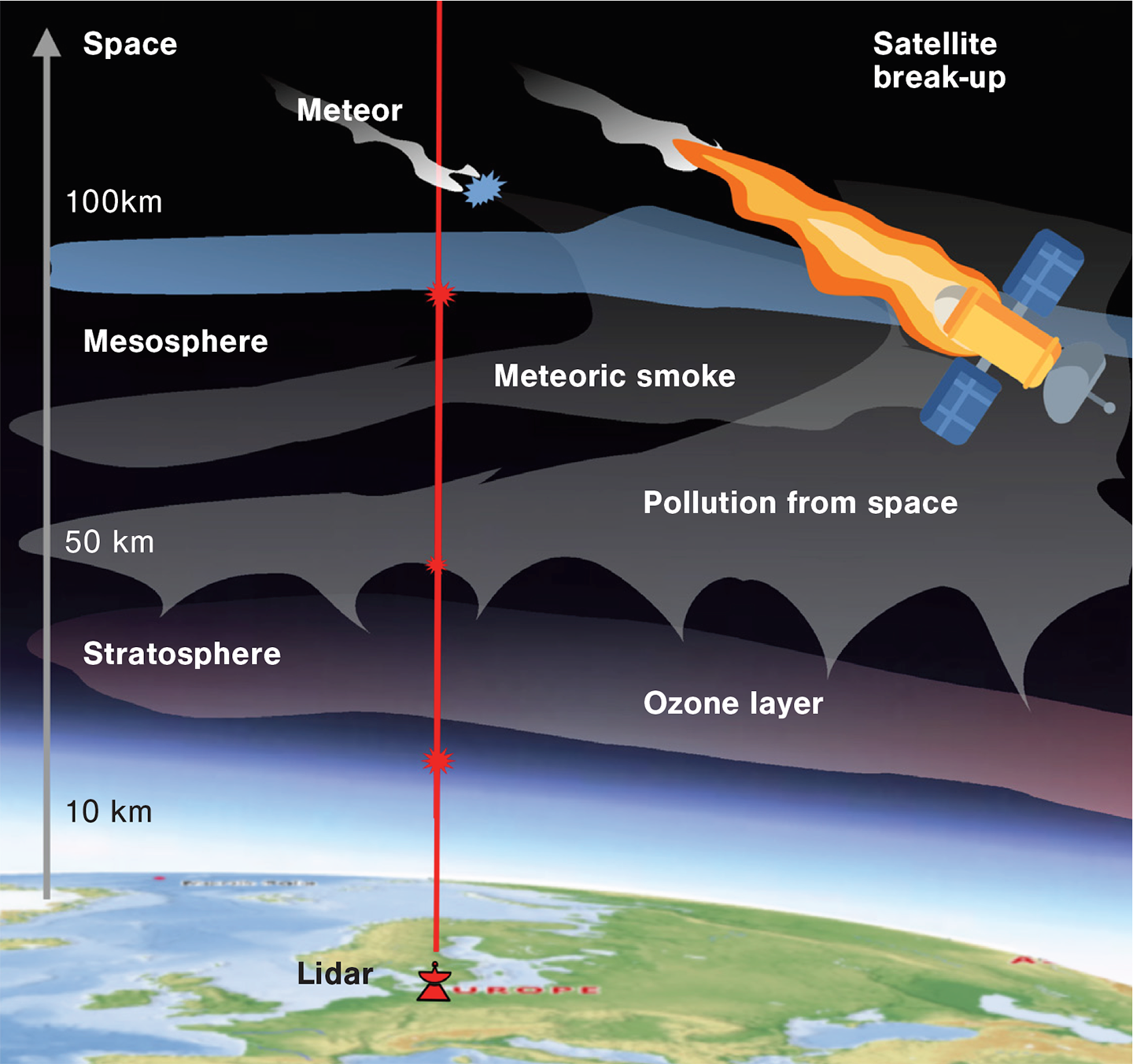
a diagram of Earth's atmosphere showing layers where pollution from meteors and burnt-up space debris can collect
This diagram shows different layers of the atmosphere. The breakup of meteors forms natural metal layers. But space junk can also cause pollution in the upper atmosphere that may mess with the ozone layer. R. Wing et al/Communications Earth & Environment 2026

Scientists wanted to see if they could directly trace such particles to a piece of space debris. They got their chance on February 19, 2025. That day, the researchers observed a cloud of lithium about 100 kilometers (60 miles) above Germany. It was blowing away from the upper stage of a Falcon 9 rocket. This rocket part contains fuel and an engine. The rocket part made a fireball as it broke apart over Ireland and the United Kingdom.

“A few hours after the reentry of this rocket, we could see 10 times more lithium than we would have observed otherwise,” says Claudia Stolle. She’s a meteorologist at the Leibniz Institute of Atmospheric Physics. That’s in Germany.

The measurements relied on lidar. Lidar sends out laser pulses and detects the light that bounces back. The laser light is tuned to specific wavelengths that reflect off particular materials, such as lithium.

The team also ran computer models of the atmosphere. These showed that the wind had carried the lithium from the spot where the rocket came down to the area over Kühlungsborn, Germany. That’s where the lidar was located.

The researchers shared their findings February 19. The work appeared in Communications Earth and Environment.

The technique could help monitor potential harms from space debris. Meteorites — space rocks that fall to Earth — bring metals into the atmosphere. But falling space junk may one day boost metal pollution by around 40 percent, Stolle’s team estimated. Tracking such contaminants and their effects will become increasingly important.

More companies and countries are planning to launch satellites into orbit, Stolle notes. “All of them will burn up sooner or later.”

Leaching lithium
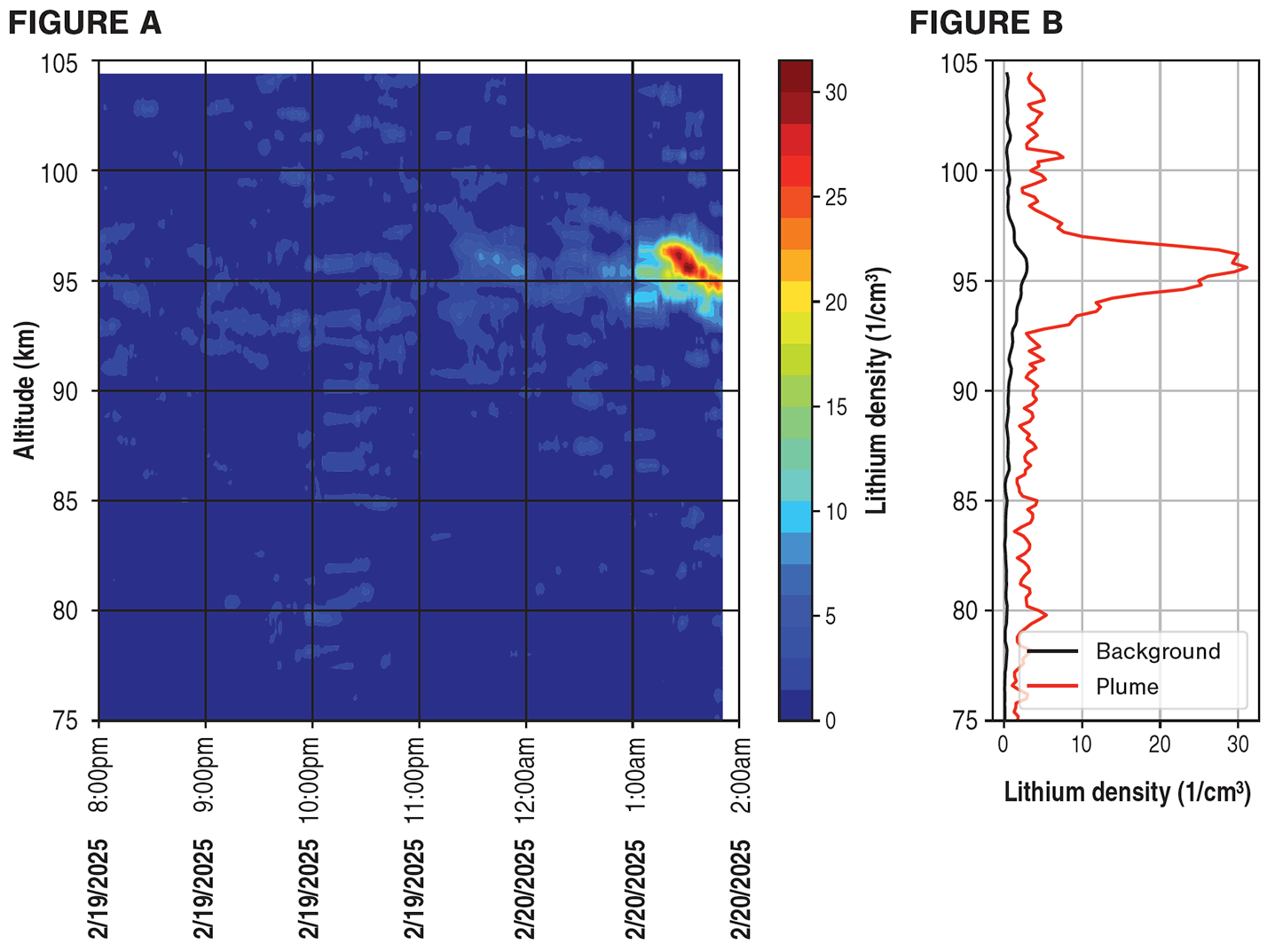
R. Wing et al/Communications Earth & Environment 2026

Using a technique called lidar, researchers in northern Germany caught a burst of lithium in the upper atmosphere. The lithium came from a piece of a Falcon 9 rocket. Carried by the wind, the lithium spread from one point to a wider area. This type of spread is called a plume. The figure on the left is a heat map. It shows the density of lithium (per cubic centimeter) at different altitudes over time (shown in local German time). The plot on the right shows the lithium density at different altitudes at 1:30 a.m. on February 20. The amount of lithium is higher in the center of the plume and lower at the plume’s edges.

Data Dive:

  1. Look at Figure A. When did the density of lithium increase?
  2. What was the altitude of the lithium plume?
  3. What was the lithium density at the center of the plume?
  4. Look at Figure B. How tall was the plume, top to bottom, at 1:30 a.m. on February 20?
  5. If the data continued recording after 2:00 a.m. on Feb 20, what would it likely look like?

  •  

The dawn of animal evolution saw a bizarre array of sea creatures

Animals may have had a rich variety of complex body types far earlier than scientists had recently thought.

A crucial moment in the history of life on Earth was the Cambrian explosion. Starting some 539 million years ago, it marks when animals very quickly became much more diverse. How this “explosion” in diversity happened has been a mystery. But a trove of newfound fossils points to an answer.

Animals seem to have begun evolving an array of strange body types even before the famed explosion. Researchers described them April 2 in Science.

“This paper is absolutely fascinating,” says Emily Mitchell. “It provides vital insights into [pre-Cambrian] life.” Mitchell is a paleontologist who did not take part in the research. She works at the University of Cambridge in England.  

The time just before the Cambrian explosion is known as the late Ediacaran (Ee-dee-OCK-ur-ən) Period. It lasted from about 575 million to 539 million years ago. The earliest fossils that were clearly animals date to this time. But until now, they haven’t offered many details about the bodies of critters who lived back then.

What’s more, many animals seen in the Cambrian Period haven’t been found in the Ediacaran Period. This led researchers to suspect the Cambrian explosion started with very few species.

Newfound fossils unearthed in southwestern China now challenge that idea. They show that more than 539 million years ago, Earth’s oceans teemed with a zoo of weird creatures.

Soft, clarinet-shaped animals anchored themselves to the seafloor. They swayed alongside creatures that looked like worms or baskets. Those were just a few of the complex species thriving in pre-Cambrian seas.

Strange sea creatures

Paleontologist Gaorong Li led the new research. It all started in 2022. He and others were collecting fossils near Yuxi, China. Their team was on the hunt for remnants of Ediacaran algae. But that hunt turned up something odd: fossil fragments of species they couldn’t identify.

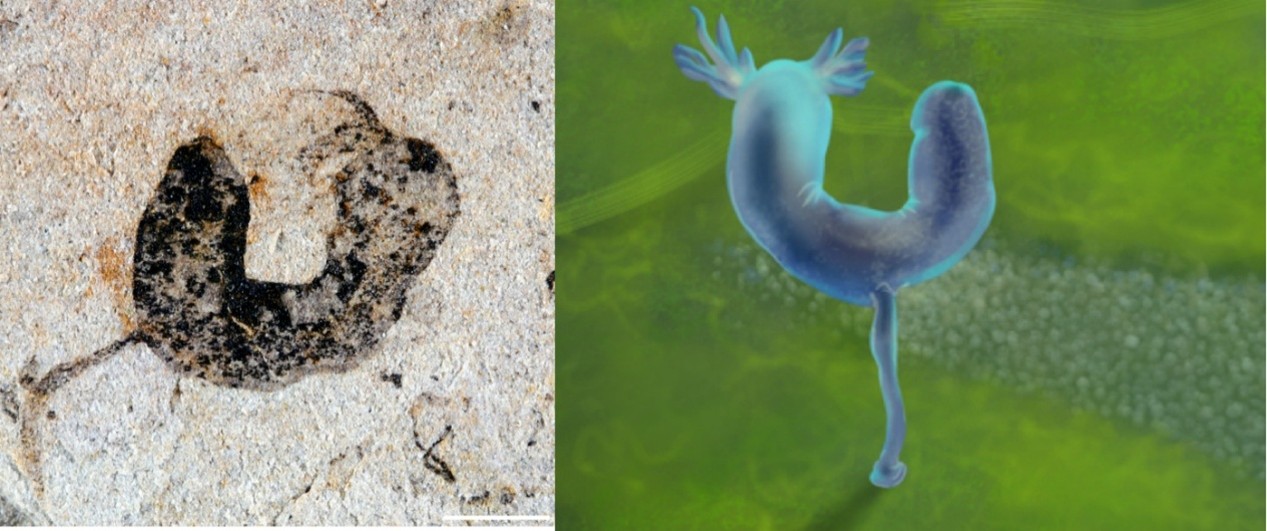
In 2023, the team discovered another surprise. They turned up fossils of bizarre, cylindrical animals several centimeters (inches) long. At one end, the critters had flat pads that could have gripped the ocean floor. At the other end were flag-shaped tentacles that appeared to extend from their mouths.

A fossil image on the left and illustration on the right of the fossilized creature on the right.
This early deuterostome (fossil at left, artist’s reconstruction at right) is related to animals like vertebrates and sea stars. It appears to have appendages on one end that may have been used in feeding. It’s also new, very early fossil evidence of animals with bilateral symmetry in the Ediacaran Period.Gaorong Li & Xiaodong Wang

Finding these “bugle worms” was a turning point, Li says. Back then, he worked at Yunnan University in Kunming, China. In 2024, his group joined forces with researchers at the University of Oxford in England. Together, they gathered roughly 700 late Ediacaran fossils.

They compared this haul to other Ediacaran fossils. They also compared the new fossils to those from the Cambrian Period.

Some of the new fossils looked like Haootia — an animal that lived some 560 million years ago. Haootia and these other fossils resembled martini glasses with tentacles on the rims. Like modern jellyfish, they had body parts that spread out from a central point. This is known as having radial symmetry.

A fossil image on the left and illustration on the right of the fossilized creature on the right.
The Haootia-like animal (fossil at left, artist’s illustration at right) may have been a relative of animals such as corals, anemones and jellies.Gaorong Li & Xiaodong Wang

Bilateral bodies

The freshly collected fossils included more eyebrow-raising finds. Some had bilateral symmetry. That is, they had similar features on the right and left sides of their bodies — as humans do.

It’s rare to find such early fossils with left-right symmetry. Until now, only four species from the Ediacaran Period had shown this feature. Li and his team found more than 180 bugle worms and other fossils with this type of symmetry. Some looked like sausages on skewers with feathery bits around their mouth ends.

The sheer number of fossils with bilateral symmetry that Li’s group found is striking, says Emmy Smith. She’s a paleontologist at Johns Hopkins University in Baltimore, Md. The diversity among these fossils amazed her.

Many had special structures for feeding, Smith notes. Clearly, the animals were quite physically complex. “That strengthens the view that [animals] were already diversifying before the Cambrian,” she says.

The Cambrian explosion, it seems, didn’t come out of nowhere, Li says. Instead, animal life had been getting more complex for millions of years before that.

Do you have a science question? We can help!

Submit your question here, and we might answer it an upcoming issue of Science News Explores

  •  

Could a storm last forever? 

The weather forecast can get extreme in the land of Hyrule, found in the Nintendo series The Legend of Zelda. A downpour in the coastal province of Faron, for instance, prevents Link, the game’s hero, from reaching Calora Lake. And constant lightning and rain threaten the skybound Thunderhead Isles. These storms only end once Link completes a series of quests, all while dodging lightning.

Never-ending storms make for moody gameplay. But real storms “can’t last forever,” says Stephanie Spera. Storms result from imbalances between moisture and temperature. “A storm kind of fixes a temporary imbalance,” she says. This physical geographer at the University of Richmond in Virginia uses satellite data to study changes to the landscape.

“The whole purpose of anything in weather is to get the atmosphere back in balance,” explains Chris Vagasky. He directs the Wisconsin Environmental Mesonet. It’s a network of weather stations. Physical features such as mountains and oceans, even buildings, often keep that from happening, he says. Though violent at times, thunderstorms help balance and redistribute heat, moisture and electrical charges.

For constant thunderstorms like those seen in Faron, those imbalances would have to remain out of whack. But on Earth, atmospheric physics ensures that even the strongest storms eventually fade away.

No storm lasts forever 

Thunderstorms form when warm, moist air rapidly rises and meets cooler air in the atmosphere. This creates the instability needed for a storm. Such moisture often comes from the evaporation of ocean water. As this moisture-filled, warm air rises, it creates updrafts — upward air movements. Water vapor in this air condenses into droplets, forming a cumulus cloud. This cloud formation, in turn, releases energy as heat. That heat fuels stronger updrafts, which power the storm.

Within the clouds, water droplets collide with ice crystals. This creates static charges and, in turn, lightning. As a cloud grows, water droplets become heavy enough to fall through it. The resulting rain and ice create cooler downward winds, or downdrafts. They cool the cloud and eventually overpower the warmer updrafts. As the atmosphere now regains its balance, the storm ends. 

Most thunderstorms only last an hour at most. For constant thunderstorms, such as those seen in Faron, you’d need to maximize a storm’s ingredients, says Vagasky. For moisture, there would need to be a “persistent conveyor belt of warm, moist air.” This air would most likely be heated by 24-hour sunlight. And the Thunderhead Isles would likely need to hug mountains that could help condense that moist air into clouds.

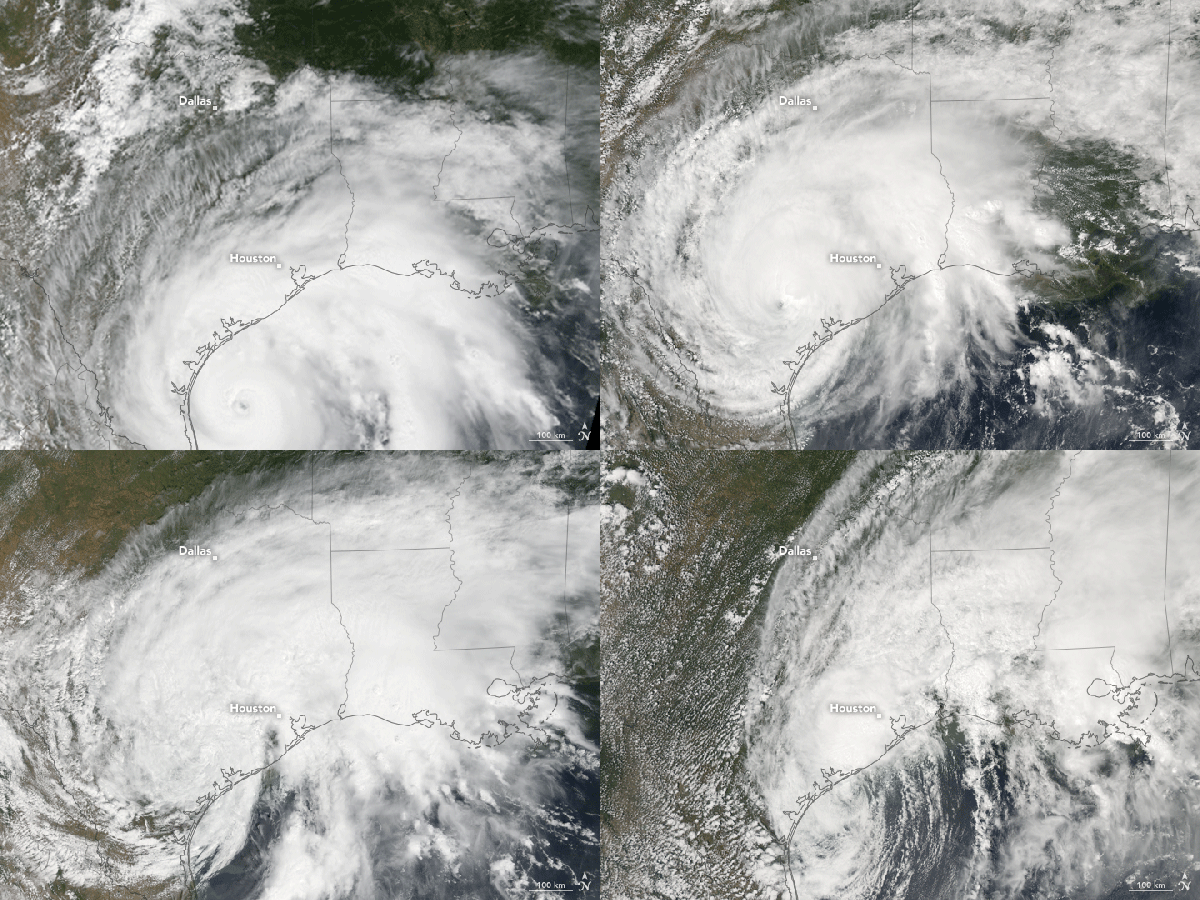
A gif shows Hurricane Harvey swirling over a satellite image of coastal Texas.
In 2017, Hurricane Harvey stalled over Houston, Texas, for about four days. During that time, some areas received more than 127 centimeters (50 inches) of rain.Jesse Allen/NASA

Keeping things moving 

Even if a storm could sustain its own internal energy, it couldn’t stay in the same place forever. That’s because Earth’s atmosphere is in constant motion. Large belts of wind blow in particular directions (based on their latitude). Some storms get an extra boost from fast, narrow bands of wind called jet streams. Like conveyor belts, these streams move weather across continents. Clocking in at up to 320 kilometers (200 miles) per hour, jet streams “really help to push all of that activity from one place to another,” Vagasky says.

Sometimes these wind patterns can increase how long storms last. High-pressure systems or the jet stream can make Earth’s longest-lasting storms — tropical cyclones — sort of stall out in one place for a bit. In August 2017, for instance, weak prevailing winds let two high-pressure systems hover over the United States. In turn, Hurricane Harvey stalled over Houston, Texas, for about four days. Fueled by warm coastal waters, some areas received more than 127 centimeters (50 inches) of rain before the storm moved inland and broke up.

Like Houston, Faron lies along a coast. Depending on where Hyrule is located on the planet, it may be at risk for cyclones. But a cyclone couldn’t last year-round unless the oceans stayed consistently warm. On Earth, cyclones die when they make landfall, face windshear or reach colder water in higher latitudes. “They need to be refueled, which is why they die over land,” says Spera. “There’s no energy source.”

Learn about the basic ingredients of every thunderstorm and how weather satellites watch for developing storms.

Earth’s flashiest storms 

Thanks to physics, perpetual storms like those in Faron are impossible on Earth. But certain scenarios come close.

The storm plaguing the Thunderhead Isles looks similar to a region called the Intertropical Convergence Zone (ITCZ), says Spera. This solid band of clouds encircles the globe near the equator. Here, prevailing winds from the northern and southern hemispheres meet. This lifts warm, humid air heated by the intense sunlight found in the tropics.

But the ITCZ isn’t a single, massive thunderstorm, Spera adds. Instead, a series of intense but short-lived events develop here. This zone also moves back and forth across the equator, leading to seasonal monsoon rains like those found on the Indian subcontinent. If the Thunderhead Isles were under the ITCZ, they wouldn’t have the relentless lightning storms seen in The Legend of Zelda games. Instead, it would just “be really rainy for a really long time.”

For flashier storms, the Catatumbo lightning phenomenon is truly unrivaled. This mass of thunderstorms occurs over Lake Maracaibo in coastal Venezuela. Here, lightning flashes up to 300 days per year and can last for nine hours at a stretch! Catatumbo holds the world’s record for the most concentrated lightning.

The key to Catatumbo lightning is geography. The nearby Caribbean Sea offers huge amounts of warm, humid air. Lake Maracaibo sends in added moisture. Winds whisk this moist air up the northern end of the Andes Mountains. There it meets colder air. The bowl-shaped mountains hugging the lake prevent the resulting cumulonimbus clouds from moving. This can lead to stagnant thunderstorms, ones similar to those of the Thunderhead Isles. Says Vagasky, “Catatumbo is one of the closest things that we might see to that.”

  •  

Scientists Say: Snow line

Snow line (noun, “SNOH line”)

The term “snow line” is used in both earth science and astronomy. It has similar, but slightly different, meanings in each field.

On Earth, a snow line is the boundary between snow-covered and bare ground.

Imagine you are hiking up a craggy, white-capped mountain. When you reach the edge of the snowpack, you’ve reached the snow line. This is an elevation-based snow line. Likewise, if you were to march toward one of Earth’s poles, you would eventually pass a point beyond which the ground remains snow-covered. This is a snow line based on latitude.

It is important to note that a snow line does not mark a place where snowmelt never occurs. It just marks a point at which the snow falls at least as fast as it melts and evaporates.

Some snow lines are permanent. Others are seasonal. They move as snow melts faster during warmer months and builds up faster during colder months.

Many factors determine the elevation or latitude where a snow line occurs. For example, it’s easier for snow to build up on mountains closer to Earth’s poles. So here, snow lines often occur at lower elevations — sometimes as low as sea level. But near the equator, it’s warmer and harder for snow to build up. There, a mountain’s snow line may occur over 6,000 meters (19,700 feet) above sea level.

Snow lines can even vary on two different sides of the same mountain. Intense sunlight on one side can raise a snow line. Harsh wind also makes it harder for a mountain to hold onto snow. So a wind-swept mountainside usually has a higher snow line.

In astronomy, a snow line refers to the distance from a star where it’s cold enough for a certain type of molecule to freeze. For example, water freezes the closest to a star. Carbon dioxide freezes farther out than that. Methane, carbon monoxide and other chemicals become solid farther and farther out.

The snow lines of different molecules play a key role in what types of planets form across a solar system. They also impact the chemical makeups of objects such as comets.

In a sentence

Thanks to artificial snow, major winter sports don’t have to happen above the natural snow line.

Check out the full list of Scientists Say.

  •  
❌