There are some skills that people think set us apart from other animals. These usually include language, tool use or the ability to do some types of math. But at least some cows can use tools and cockatoos can make their own. Other animals appear to have language. And now, it seems, we’re not even the only ones with a head for math.
A new study compared preschool kids, monkeys and groups of adults who hadn’t studied geometry (the math of shapes). All appeared to understand shapes in similar ways.
Researchers shared what they learned July 20. The work appeared in Proceedings of the National Academy of Sciences.
People spend a lot of time asking what it is that makes us different from other, similar animals, such as monkeys. “We look around, we notice how weird we are in the world and we want to know how something like this happens,” says Jessica Cantlon. A cognitive neuroscientist at Carnegie Mellon University in Pittsburgh, Pa., she studies how humans and animals think.
One thing scientists thought might make us different from other primates is how we think about geometry, notes Jialin Li. She, too, is a cognitive neuroscientist at Carnegie Mellon. Tens of thousands of years ago, she notes, people were drawing “right angles, parallel lines, equal size, equal lines.” These are basic ideas behind geometry.
That led some to suspect that the human mind must process shapes in a different way than a monkey’s — a way that has nothing to do with whether we’ve been to a geometry class.
Monkeying around with shapes
To test this, Cantlon and Li needed some shapes, clever games and a bunch of people. Oh, and monkeys, too. Don’t forget the monkeys.
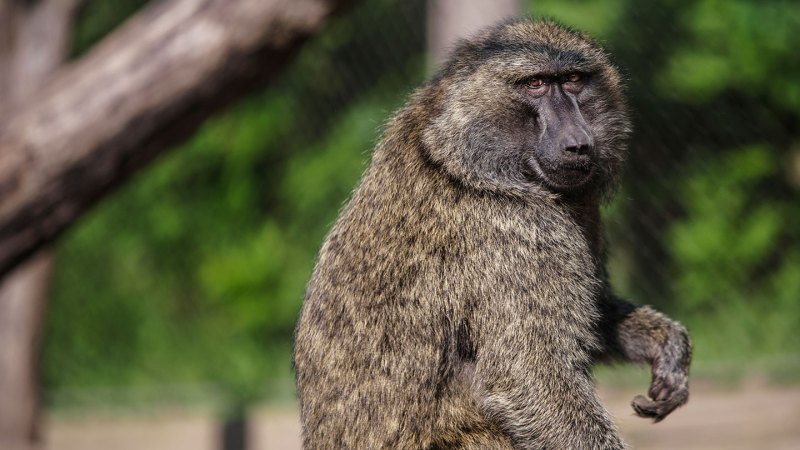
The scientists studied how well different groups matched shapes in a game. They compared two groups of people: Tsimane’ people from Bolivia and Himba people from Namibia. Neither group goes to schools where they would study shapes, as most U.S. students do. The scientists also compared U.S. preschoolers and two groups of monkeys — rhesus monkeys in a lab and olive baboons in a zoo.
All had to complete tests on a screen, matching shapes and angles. The monkeys worked for treats, Li notes, and some really enjoyed the games. Preschoolers worked for stickers and were a little harder to convince. “Sometimes kids reject you,” she says. “You have to bargain with them.”
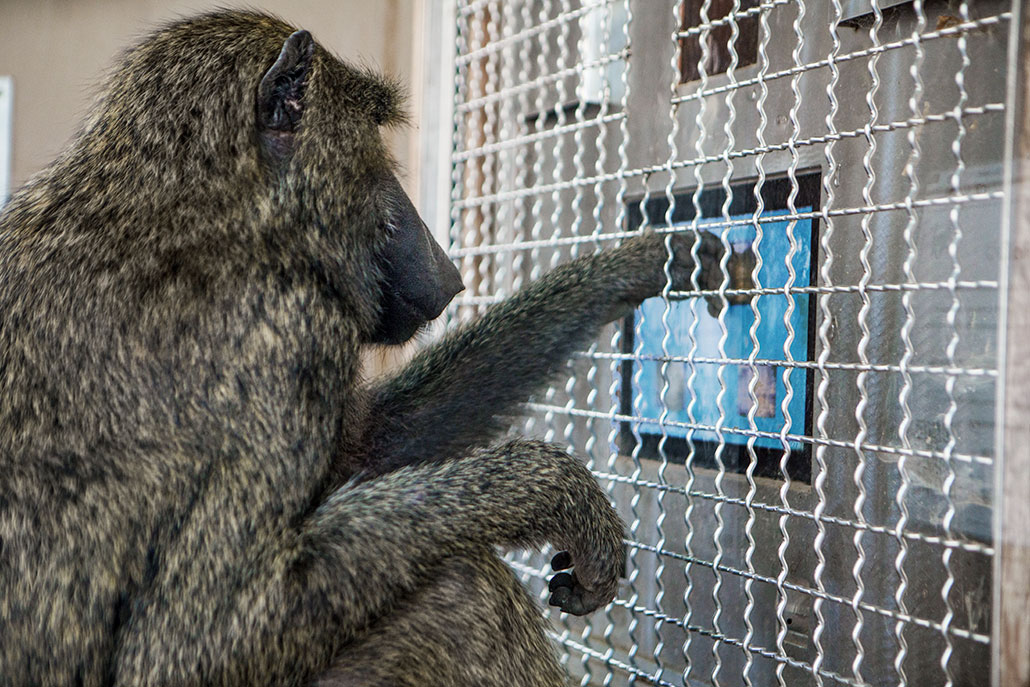
For some tests with monkeys, Cantlon and Li’s team worked with Caroline DeLong. She studies animal minds at the Rochester Institute of Technology in New York. Together, the researchers developed a Primate Portal. It let a group of olive baboons at the Seneca Park Zoo in Rochester play math games.
The portal is a cabin inside the olive baboon enclosure. Outside the hut, a screen displays games for the monkeys to play. Inside the hut sits a scientist putting games on the screen and giving out treats. One big male monkey, Kalamata, is an avid gamer. “He will play for hours a day,” DeLong says. The problem is trying to give other monkeys a chance!
An olive baboon plays a math game at the Seneca Park Zoo. Games like this help scientists understand how both monkeys and humans think about shapes. Scott Hamilton/RIT
How everyone shaped up
The researchers looked at how well each group did — and what mistakes they made. Then, they compared those mistakes to two computer models. The models were meant to mimic different ways of thinking about shapes.
Both monkey species and all of the humans made similar types of mistakes. This hinted that their minds were thinking about shapes in similar ways.
“Humans are not unique in this,” Li concludes, “but we are better.”
It’s exciting to see scientists looking at how geometric thinking came to be, says Moira Dillon, who did not take part in the study. She works at New York University in New York City, where she studies how minds develop. A model can offer one way to explain something, she says. But computer models aren’t minds. And, she notes, scientists can’t get into minds to follow how a monkey or kid thinks while playing a math game. So, she says, “I think there still remains the question of whether the mind is doing it that way.”
The new work used only two computer models, points out Véronique Izard. “Could they model it even better?” she wonders. Perhaps monkeys and humans seem very similar now, but a different model might find differences that these two missed. Izard works at the University of Paris Cité and the National Centre for Scientific Research in France. There, she studies how minds develop.
Through the Primate Portal, researchers are studying how baboons solve problems to learn more about how primate minds work.
A primate portal
Preschoolers weren’t the only kids involved in this research. Elementary school students are now programming games for the baboons.
To test shape knowledge, for instance, monkeys played a game called match-to-sample. A shape pops up, like a square. Then two shapes pop up, a square and a triangle. The monkey needs to pick which shape matches the first. If the monkey gets it right, it receives a piece of fruit cereal.
“It’s like a weird Froot Loop, and it does not taste good,” says Michael Sufra. Michael, 11, is a student at QUEST Elementary School in Hilton, N.Y. He coded his own match-to-sample games for monkeys. “It’s just really fun to make your own games,” he says.
He was part of a program where every kid got to code their own match-to-sample game. Michael used rocket shapes and a cartoon cat. Not only do students have to think about code, but also about the pictures, explains Cora Dimino, 12. If images are too much alike, “monkeys can’t really do that,” she says. (Her game had monkeys match animal images in different colors.)
Cora and Michael are two out of several hundred kids who have been able to make monkey games. They also watched monkeys play them. “There’s real joy in their faces when they see that,” DeLong says. And she’s shown that coding games for monkeys helps kids get better at problem-solving. DeLong hopes to even use some of the kids’ games in her monkey research.
Both Cora and Michael enjoy coding and were interested to learn that games like theirs showed that monkeys think about math much as we do. “I feel like monkeys are pretty smart, based off of what we saw,” Cora says. “It’s justice for the monkeys.”
When babies taste sugar for the first time, a look of delight spreads across their faces. Some wiggle with excitement. It turns out, we’re born with a sweet tooth.
“There’s a reason for that,” says Andrew Odegaard. “We crave it because our body needs it.” Odegaard works at the University of California, Irvine. As an epidemiologist, he studies health in groups of people.
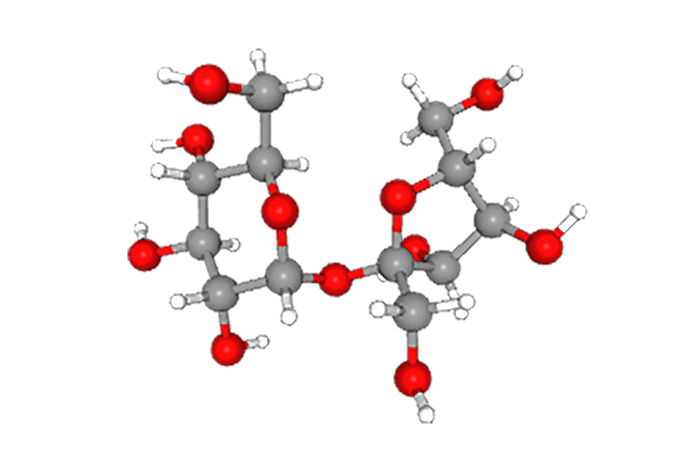
Sugars, the simplest of carbohydrates, are the body’s primary energy source. Our cells run on glucose. It’s one of the main monosaccharides, the basic building blocks of sugars. Table sugar, or sucrose, is made of one molecule of glucose and one of fructose (another monosaccharide). Joined together, the two become a disaccharide (here, “di-“ means two).
Table sugar
This is a representation of a molecule of sucrose, or table sugar. It shows its two component monosaccharides. The larger molecule on the left is glucose. On the right is fructose. They are bound together at the center.
PubChem Identifier: CID 5988
Sugar tastes sweet because its molecules bind to sweet receptors on your tongue. They signal the brain to let it know you’ve just tasted something delicious — and often full of energy.
“This role of our taste system is to act as the primary gateway controlling ingestion,” says Charles Zuker. A neuroscientist, he studies the brain at Columbia University in New York City. This system evolved, he says, “so we can be attracted to things we must have in our diet.”
Zuker is part of a team that discovered the sweet taste receptor in 2001. And this receptor requires quite a bit of sugar to make it take notice.
“It evolved that way,” Zuker says. This lets our brains tell the difference between higher- and lower-sugar foods. After all, it makes sense to pick the sweetest thing, Zuker says. “I get the most [calories] for my effort.”
In the past, when food was harder to find, that was probably very important. Today, though, many doctors worry that our diets have become too sugary.
Some people are filling up on soda and candy instead of fruits and vegetables. While some sugar is fine, eating too much can harm our health. As one way to cut back, scientists have now developed sugar-free compounds that mimic sugar’s sweetness.
Because we evolved to enjoy sugar, it becomes easy to eat too much of it.
Manufacturers add a lot of sugar to processed foods, such as snacks, drinks, sauces and even some breads, notes Monica Dus. She’s a neuroscientist at the University of Michigan in Ann Arbor.
When we eat more sugar than we need, our bodies will store the excess as fat. That can lead to weight gain. Over time, that extra fat can also increase someone’s risk of type 2 diabetes, obesity and heart disease, Odegaard says.
Eating sugar also causes levels of glucose to rise in the blood. When an organ called the pancreas senses these high levels, it releases a hormone called insulin.
Insulin helps glucose get into cells so they can use it for energy. But too much glucose in your blood over a long period will stress the pancreas, Odegaard says. This can lead to insulin resistance. Now, he says, “your cells can’t make use of all the sugar that you have, or they don’t work as well.”
When someone has diabetes, for example, they must be very careful about their blood glucose. That often means they need to sharply control how much sugar they eat.
No sugar added
Back in 1879, Constantin Fahlberg was a chemist at Johns Hopkins University in Baltimore, Md. One day he forgot to wash his hands when he raced out of the lab to dinner. He had been working with coal tar (a byproduct of coal). Sitting down to dinner, he was shocked to find that everything he touched tasted sweet.
He realized it was due to something he carried home from work on his hands.
Fahlberg raced back to the lab. “I tasted the contents of every beaker and evaporating dish on the table,” he later wrote. (Definitely do not try that.)
It turns out he had accidentally discovered saccharin, an artificial sweetener. Because the tongue’s sweet taste receptor is relatively insensitive, it responds to many things that aren’t sugar, Zuker explains. Some, like saccharin, bind more strongly to this receptor than sugar does.
Saccharin binds so strongly that even a tiny amount tastes intensely sweet. But our bodies don’t break down saccharin. So unlike sugar, our bodies get no energy from it.
Scientists have since developed other artificial sweeteners. The body also interprets some chemicals in fruits and other plants as sweet but doesn’t process them like sugar (see box). Some can’t be broken down by the body at all.
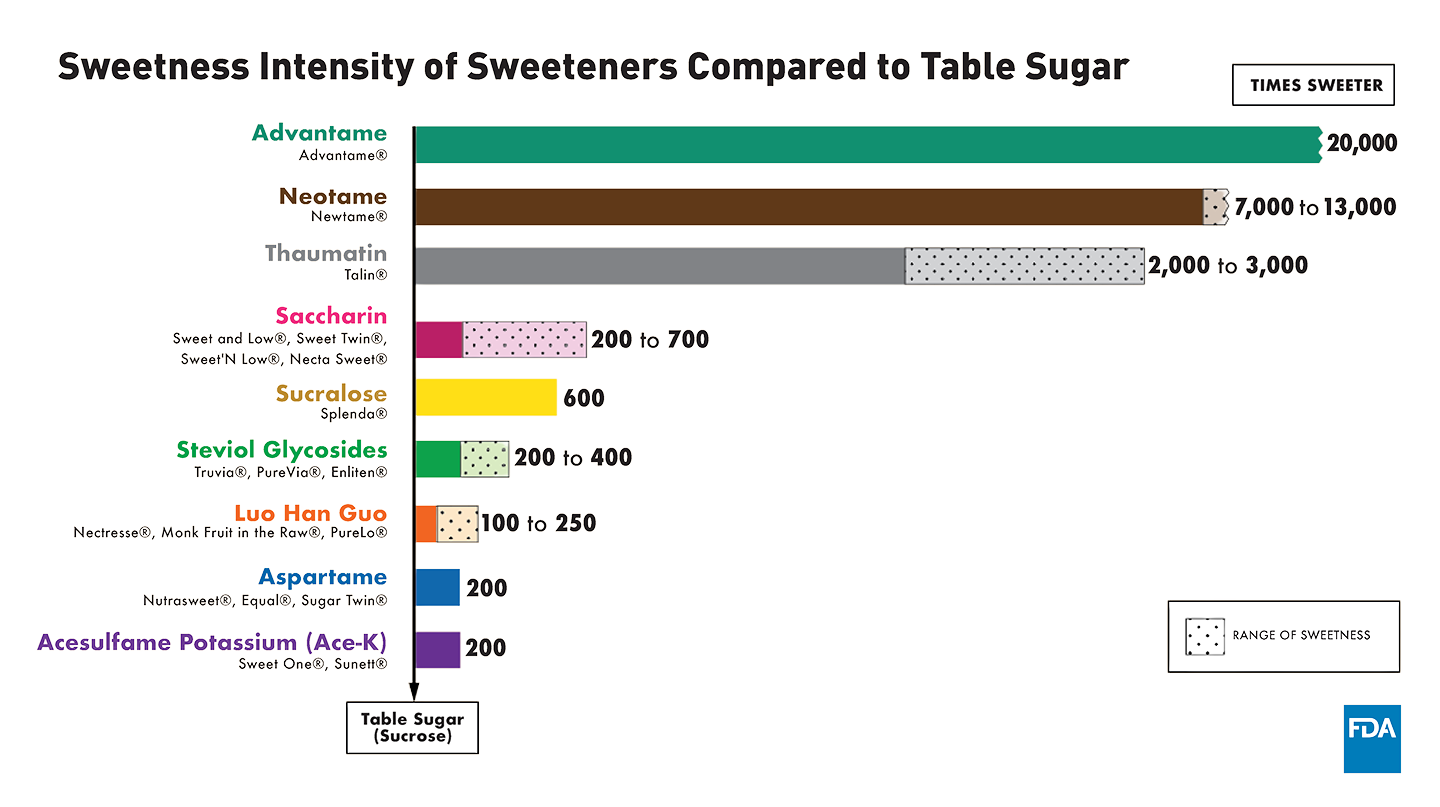
This table shows how sweet various chemicals taste compared to sucrose. For example, aspartame and acesulfame potassium, at the bottom of the table, are 200 times sweeter than sugar. The sweetest, advantame, is 20,000 times sweeter than sugar. U.S. Food and Drug Administration
“You essentially just [consume] them,” he says, “and then you just pee them out.” Such sweeteners have few or no calories. They also won’t spike blood glucose.
“The biggest challenge with artificial sweeteners nowadays is that none of them really ultimately taste like sugar,” Zuker says. Some have a funny aftertaste or a strange texture. And because some (such as allulose or sugar alcohols) don’t get digested, they can make your stomach pretty unhappy.
In 2025, Zuker’s team worked out the exact structure of the sweet taste receptor. By knowing precisely how different molecules fit into it, they hope to learn how to design better low- or no-sugar sweeteners.
Too much sugar can be bad for us, but that doesn’t mean we should stop eating it, says Dus at Michigan. Glucose, after all, is the brain’s favorite dish. She says it’s unfair to say “sugar is evil” or “sugar is bad.” In fact, Dus points out, “Sugar is part of our evolutionary history.”
It’s also an important part of most cultures: Consider how widespread sweet desserts are. So just saying that sugar’s bad, she says, risks “not recognizing our biology and not recognizing our humanity.”
Artificial sweeteners
Artificial sweeteners are not found in natural foods, such as fruits or vegetables. The U.S. Food and Drug Administration (FDA) has approved seven of these. They’re now found in many products, from diet soft drinks, chewing gums and sugar-free candies to toothpaste, cough drops and chewable vitamins. All but one are much sweeter than sugar.
Acesulfame potassium (Ace-K): Found in some diet drinks and protein shakes, this sweetener is heat stable, so it can be used in baking.
Advantame: Made from aspartame and vanillin, this sweetener is 20,000 times sweeter than sugar.
Aspartame: This sweetener is made of amino acids — the building blocks of proteins. It can be found in little blue packets under the name Equal.
Neotame: Sold as Newtame, this sweetener is similar to aspartame but thousands of times sweeter.
Saccharin: Fahlberg accidentally discovered this sweetener about 150 years ago. Now it’s found in pink packets under the name “Sweet’N Low.”
Sucralose: This sweetener is found in yellow packets with the name Splenda. Unlike other artificial sweeteners, it is made from sugar. Scientists altered the structure of the sugar molecule, however, so our bodies can’t digest it.
Sugar alcohols: This category includes erythritol, isomalt, lactitol, malitol, sorbitol and xylitol. Made from sugar, these chemicals have few calories and are less sweet than the sugar from which they were derived. They may not be good for your heart and may upset your stomach.
Plant- and fruit-based sweeteners
Other sweet compounds originated in plants. Today they are usually made in a lab.
Allulose: This is a type of sugar that is chemically quite similar to fructose. It’s found in very low amounts in fruits (such as dates) and maple syrup. At high levels, many people find it upsets their stomach.
Monk fruit: A group of chemicals called mogrosides derived from monk fruit, sometimes called swingle fruit (Siraitia grosvenorii).
Stevia: This group of chemicals — steviol glycosides — is found in the Stevia plant (Stevia rebaudiana).
Thaumatin: These are tiny, super sweet proteins extracted from katemfe, the fruit of a West African shrub (Thaumatococcus danielli).
Ever seen the guy online who eats raw liver? What about the podcast by the guy who only eats meat and a little spinach? Unlike tigers or sharks, people aren’t carnivores. But you’d never know that if you went on social media.
A lot of influencers on social media and podcasts promote diets with as much protein — and as few carbohydrates — as possible. Some diet influencers talk about carbohydrate-rich foods, such as potatoes and bread, as though they’re poison, not a source of nutrients.
Even the U.S. government has gotten on the low-carb bandwagon.
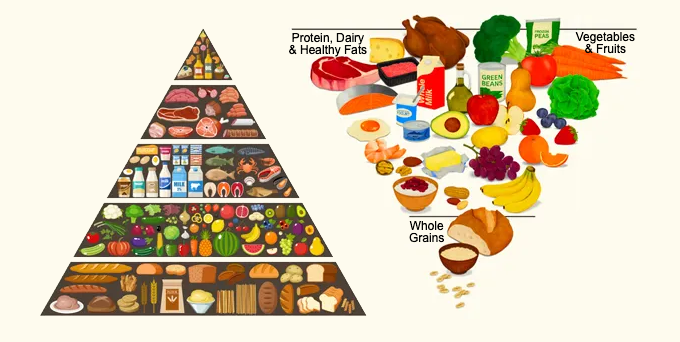
For more than 100 years, government agencies have helped people decide which foods to eat. Past guidelines often looked like a pyramid. The biggest section at the bottom — the foundation — comprised those foods that people should eat the most.
These images and guidelines changed over time as scientists learned more about how our bodies respond to food. But until 2026, the guidelines always promoted eating lots of bread, rice, cereals, fruits and veggies. These foods all have one important thing in common: carbohydrates. These foods are high in sugars, starch and fiber.
The latest food guidelines have now turned that pyramid upside down, literally.
The old food pyramid (left) had grains and carbohydrates at the bottom, making up the base. It suggested you should eat a lot of them. The new food pyramid (right) is flipped, with grains only at the tip. It now suggests you should eat very few carbs. Left: Gurzzza/iStock/Getty Images Plus Right: U.S. Department of Agriculture/U.S. Department of Health and Human Services; adapted by LSH
Scientists and doctors have worried that too many sugary treats can promote weight gain and poor health. And carbohydrates tend to be a big component of cookies, candy and soft drinks. Based on that, some people trying to promote health will suggest we eat as few carbohydrates as possible. There are even people who try to eat mostly meat and fats — and go on social media trying to get others to do the same.
But carbohydrates aren’t evil. Often, they’re exactly the burst of energy our bodies need.
Carbs come in many different types. Some provide quick energy for our brains and muscles. Others feed our gut bacteria or help us poop. Too many carbohydrates from sugars can be harmful in the long run. But cutting them from our diet isn’t the answer. Carbs can be an important — and delicious — part of healthful eating.
How to build carbohydrates
All living cells contain carbs. The word “carbohydrate” points to what these molecules are made of: a mix of carbon, hydrogen and oxygen atoms. (Carbo refers to carbon. Hydrate points to their hydrogen and oxygen atoms.) Which carbohydrate they are will depend on how many atoms come from each element and how they are arranged.
Every carbohydrate is built from sugar units called saccharides (SAK-uh-rydes). The smallest building block — a monosaccharide (MON-oh-sak-uh-ryde) — denotes that it has just one saccharide.
Glucose is a monosaccharide. Its chemical formula — C6H12O6 — denotes that it has 6 carbon atoms, 12 hydrogens and 6 oxygen atoms. This molecule is important to health. It provides energy for our cells, including our muscles and brain. The term blood sugar refers to the amount of this glucose circulating in our blood.
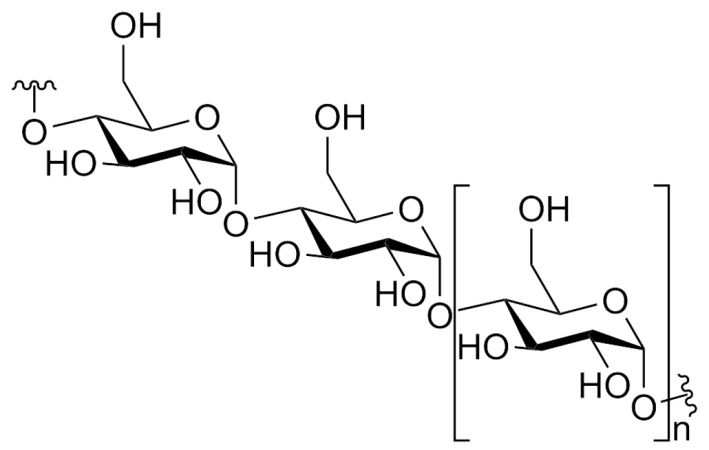
Amylose
This is a chemical drawing of amylose, a type of starch that is a long chain of glucose molecules linked together. The brackets indicate a single glucose unit. The “n” at the bottom right corner is to show that there could be many more glucose molecules.
Hbf878/Wikimedia Commons
Other monosaccharides your body might encounter include fructose (FROOK-tose), galactose (gah-LACK-tose) and xylose (ZY-lose).
Sucrose, sometimes called table sugar, sweetens a lot of candy and baked goods. It’s a disaccharide (die-SAK-uh-ryde), meaning made of two sugar units — in this case, a glucose hooked onto a fructose molecule.
Then there are the polysaccharides. These “are usually long chains of multiple glucose molecules joined together,” explains Michael Gleeson. He’s a sport nutritionist at Loughborough University in England.
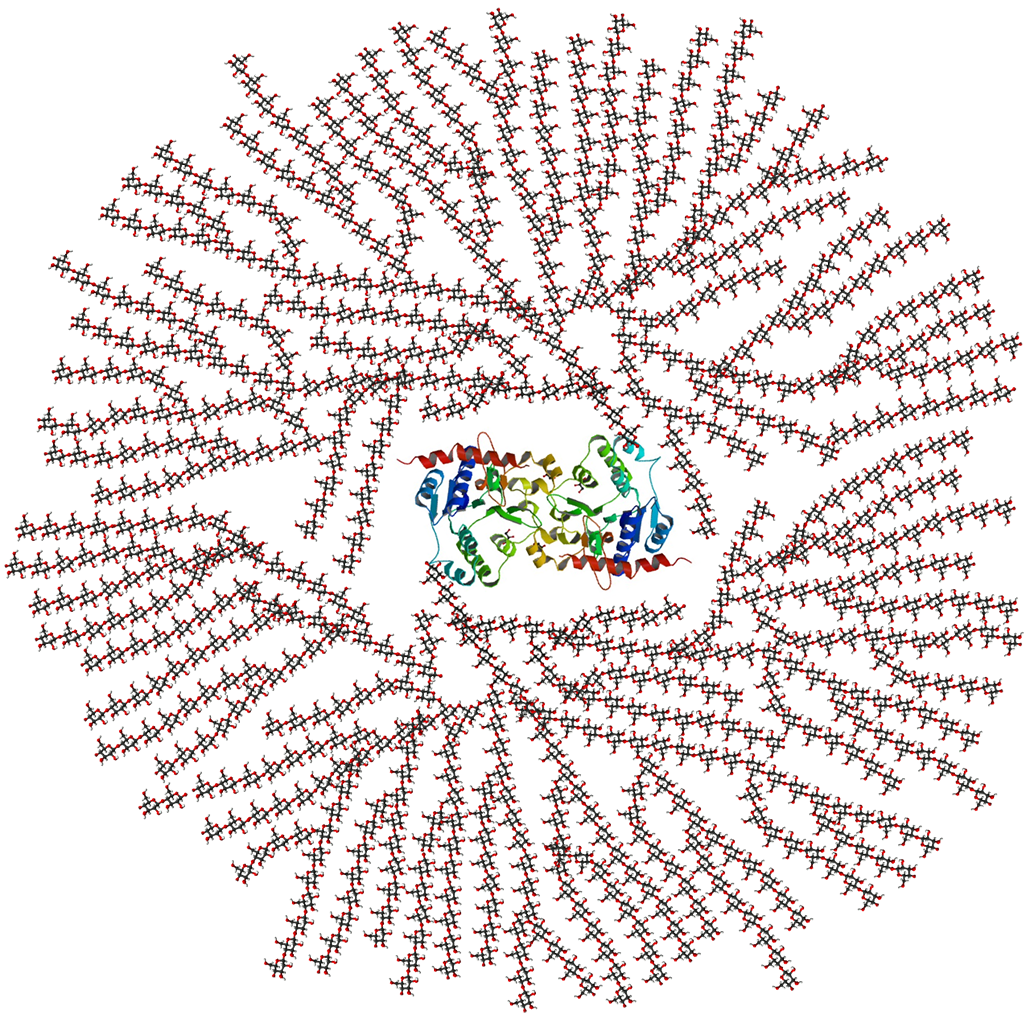
Glycogen
Mikael Häggström, used with permission/Wikimedia Commons
This is a chemical drawing of glycogen, a carbohydrate molecule that our bodies use to store glucose. The long chains here are made up of glucose molecules waiting to be used.
Although there are many types of polysaccharides, our bodies encounter three most often. One is glycogen. Animals use this molecule to store sugars as energy. “We find that in our muscles and our liver,” Gleeson says. The second, or starch, is “a storage form of energy in plants,” he explains. The third type is fiber, which our bodies can’t turn into energy.
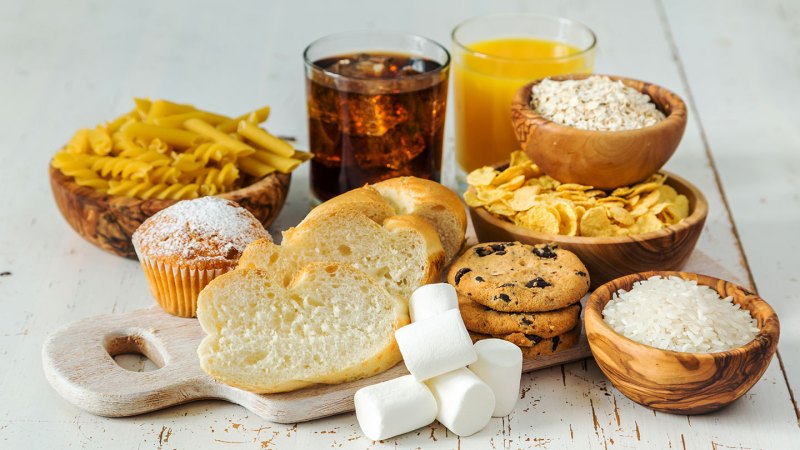
When scientists talk about carbohydrates in food, they call monosaccharides and disaccharides “simple” sugars. These are common in processed foods. Polysaccharides such as starch are “complex” carbohydrates and more commonly turn up in less-processed foods, explains Kimber Stanhope. She’s a nutrition researcher at the University of California, Davis. “Rice and wheat and oats and corn — those foods are mostly starch,” she notes.
Types of carbs
Type of carbohydrate
Examples
Where to find them
Monosaccharides
Glucose, fructose, galactose, xylose
Glucose tablets or nutrition supplements
Disaccharides
Sucrose, lactose
Table sugar, sugar in milk
Oligosaccharides
Starches such as amylose and amylopectin
Starchy foods like bread or rice
Polysaccharides
Pectin, cellulose, hydrocolloids, guar gum
Whole fruits and vegetables, beans, jams and jellies, corn starch
From food to fuel
Foods we classify as “carb-rich” often contain a mix of different carbohydrate molecules. For example, a cookie will have plenty of sucrose. But it also has flour, which contains starch. Whole-wheat bread will have starch and some sugar, as well as fiber. Vegetables, such as carrots, are made of cells that contain starch, sugars and fiber.
Our bodies can use glucose molecules right away. Other carbohydrate molecules must first be broken down.
Complex carbohydrates “are relatively large molecules,” Gleeson explains. The gut can’t directly absorb them. They must be digested — their polysaccharide chains broken apart — to release their glucose units.
That digestion starts in the mouth, Gleeson explains. Saliva contains enzymes — molecules that speed up chemical reactions. “Your spit contains some enzymes, which break down the long-chain carbohydrates into disaccharide units,” he says. Those much simpler sugars head to the stomach. But, he adds, little carbohydrate digestion goes on there. Why? “The enzymes that are coming [in with] the saliva,” he explains, “are inactivated by [stomach] acid.”
After the stomach, “you’ve mixed everything up into a nice sort of soup-like consistency,” called chyme (KYME), Gleeson explains. “That’s sort of squirted, almost, into the small intestine. And there we secrete enzymes into the small intestine from the pancreas.”
Those enzymes finish the job, splitting disaccharides into monosaccharides such as glucose. Our blood then absorbs the glucose and moves it around the body.
When that blood reaches the liver, an enzyme grabs glucose from it. Called glycogen synthase (GLY-koh-jen SIN-thays), this enzyme links up the glucose molecules to form glycogen. Glycogen then gets stored in the liver and muscles. Fat cells also store glucose in the form of triglycerides (Try-GLIH-sur-ides). The body will draw on these sources when it needs more energy.
This liver-enzyme reaction has turned carbs from food into a stored fuel. The liver turns off this enzyme when it determines that it has made enough glycogen.
Sugar’s not always sweet
The body aims to keep blood glucose levels fairly constant. So when cells draw down this sugar, the liver begins breaking down some stored glycogen, releasing its glucose into the blood.
That’s especially important during exercise, as your muscles burn through glucose to power activity.
It’s a different story for fructose. This monosaccharide pairs up with glucose to make sucrose. But it’s also found on its own in fruits, vegetables and honey. Manufacturers have also sweetened many sugary foods and drinks with this sugar in the form of high-fructose corn syrup.
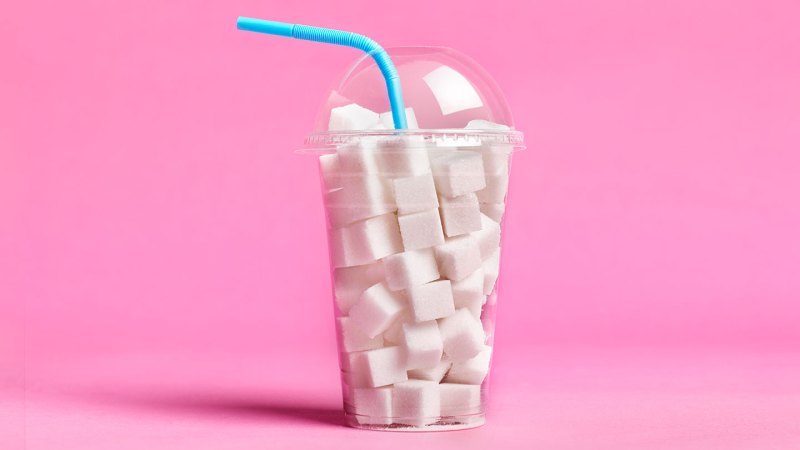
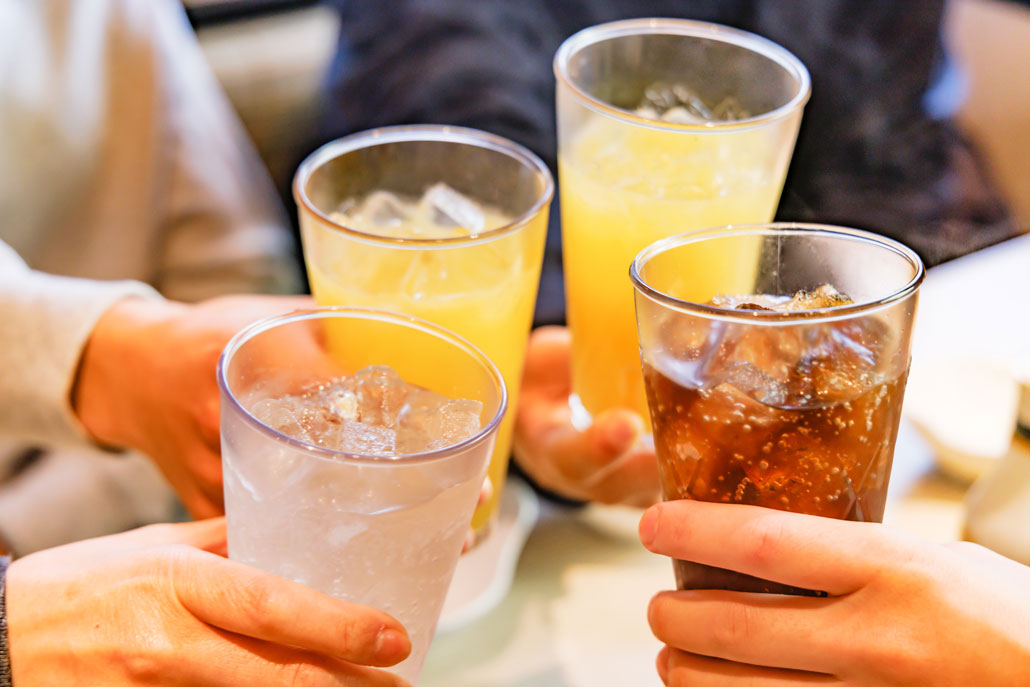
Sweetened drinks can contain a lot of sucrose, a disaccharide made of equal amounts of glucose and fructose. But many are sweetened with high-fructose corn syrup, which has more fructose than glucose. taka4332/iStock/Getty Images Plus
In the liver, an enzyme called fructokinase (Frook-toh-KY-nase) sets off the first step in turning fructose into glycogen. But unlike the enzyme that processes glucose, fructokinase “doesn’t seem to get turned off — ever,” explains Stanhope at UC Davis.
So if you’re drinking a sugary soft drink, “86 percent of all the fructose you’re consuming in that … drink goes into the liver,” Stanhope says. “The liver does the best it can with all this fructose, but now it’s overloaded.” The liver will now turn any excess into fat, she explains.
Too much fat can hamper how the liver reacts to hormones such as insulin. As a result, the organ stores even more sugars as fat. “You just keep going around in circles and making the situation worse,” Stanhope explains.
That’s why eating too much fructose can be a problem. The issue isn’t fructose from fruits and vegetables, though. Consider a sweet fruit, such as grapes, Stanhope says. “They basically average around 16 percent of their weight as sugar.” But fruits and veggies also contain fiber and other complex carbohydrates, as well as vitamins and other nutrients.
Most of the sugar in our diet doesn’t come from fruit but from sweetened baked goods and drinks. Oreos, for instance, are 38 percent sugar, of which fructose is half.
Many sweets have even higher levels of fructose than that. Some highly processed foods — not only soda but also canned soups and some sauces — can contain a type of corn syrup that is 55 percent fructose (five percent more fructose than in table sugar), Stanhope says.
What really worries her are some corn syrups where the share of fructose is higher still. One 2014 study tested sodas and juices containing high-fructose corn syrup. Many of these drinks contained 60 percent fructose — some even close to 70 percent. That’s a lot for the liver to handle.
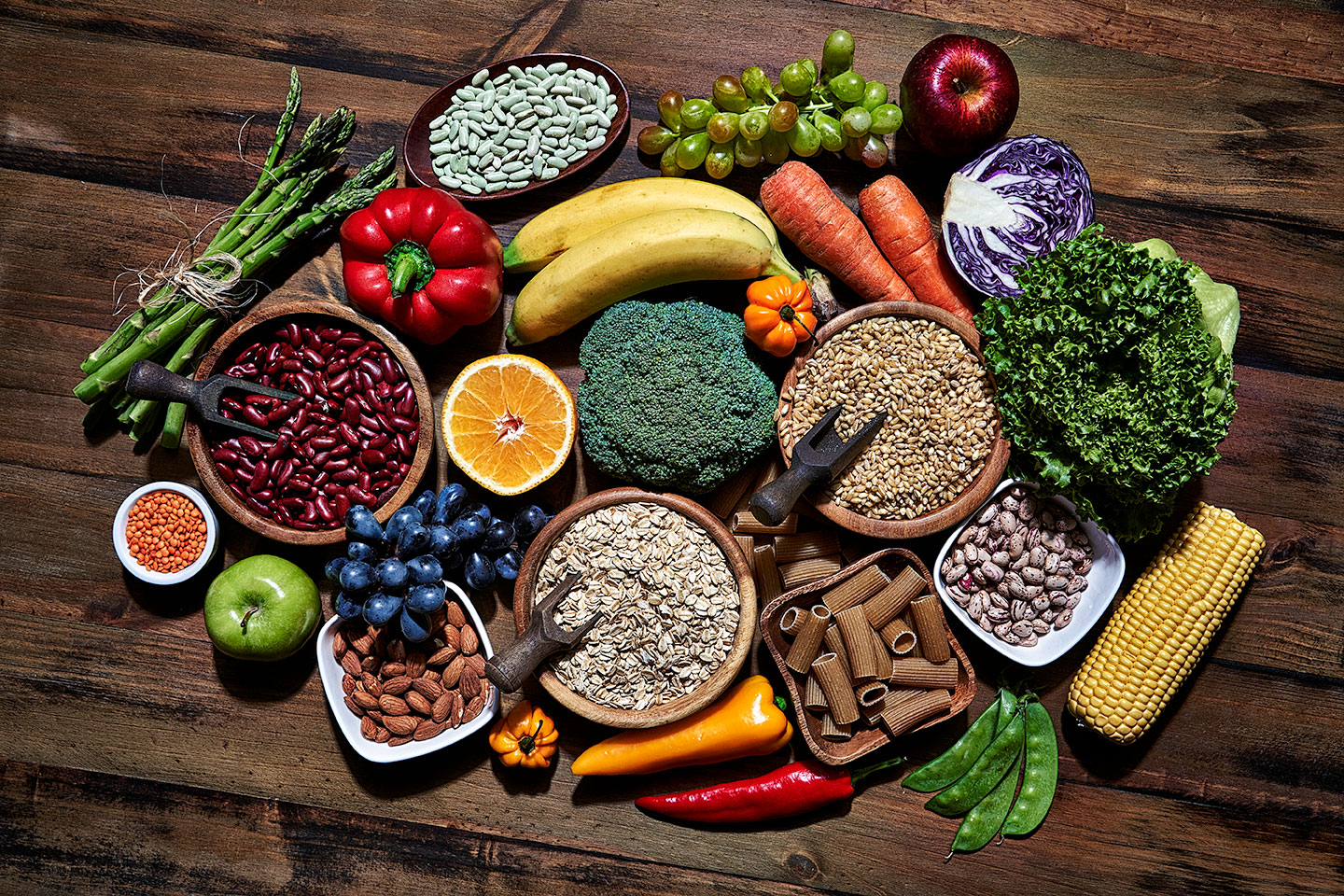
Fruits, vegetables, beans and whole grains have lots of fiber, which can help control cholesterol and blood glucose — and help you poop. apomares/E+/Getty Images
Too much sugar, not enough fiber
While our bodies can break down starches and sugars for energy, other carbohydrates are tougher. Consider fiber.
Fibers are polysaccharides found in plants. Our bodies cannot fully break these down. Fibers include the cellulose that makes plant cell walls stiff. They include the pectins (PEC-tins) that firm up fruits. You’ll find them in whole fruits, vegetables, beans and whole-grain products (such as whole-wheat bread).
Our bodies can’t convert fiber into energy. But our bodies still find it useful, notes Leslie Cho. A cardiologist, or heart specialist, she works at the Cleveland Clinic in Ohio.
Fiber comes in two types. Soluble fiber, as its name suggests, dissolves in water. This type shows up in foods such as apples, bananas, avocados, citrus fruits, carrots, beans and oats. By acting like a sponge, Cho says, “it helps you lower your cholesterol and glucose.”
Cholesterol (Ko-LES-ter-ol) is a fatty material that drifts in our blood. Over time, it can collect in blood vessels and increase someone’s risk of heart attack or stroke. By soaking up cholesterol, soluble fiber helps eliminate it.
That sponge-like fiber can also trap glucose so that it takes longer for those sugar molecules to enter the blood stream. If you eat a lot of sugar and no fiber, Cho explains, “you absorb glucose very quickly and you tend to get hungry again.” Soluble fiber keeps you feeling fuller longer. And it’s especially helpful for people with high blood sugar, such as those with type 2 diabetes.
The other fiber — the insoluble type — “doesn’t dissolve in water, and it helps you with your stomach and your intestine,” Cho says. Vegetables, whole-wheat bread, potatoes, beans, nuts and seeds all contain this type.
This fiber even helps you poop; it’s one of the ways your body takes out the trash. How? Insoluble fiber adds bulk and pulls water into your stool. That keeps you pooping just often enough for comfort.
Soluble and insoluble fibers also serve as an important food for the bacteria in your microbiome. Those are the bacteria that live in your gut, Gleeson explains. “They have a big influence on your immune system and on your health.”
Bacteria can break some fiber down into molecules that affect our immune and other systems. These bacteria “also produce chemicals that can communicate with the brain,” Gleeson says. In this way, “They influence your mood and your sleep.”
Most people eat too little fiber, Gleeson says. Diets with lots of simple sugars don’t have enough fiber to keep our microbes happy. We’re talking about meals that contain lots of white bread or rice, cookies and cakes — and too few fruits, vegetables, beans or whole grains.
Like proteins and fats, carbohydrates are an important macronutrient. But do people need them?
The body needs certain fatty acids and amino acids to build cells and operate effectively. That’s why we need to eat fats; they provide some essential fatty acids that our bodies can’t make, notes Gleeson. And, he adds, “Protein is absolutely essential, because there are [also] amino acids in those proteins” that we can’t make on our own.
But technically speaking, he says, you can live without eating carbohydrates.
Glucose is an essential fuel for the brain, Gleeson explains. Fortunately, the body can make it from fats, amino acids and water. Getting glucose this way wouldn’t be a very tasty life, though. And people who live on extremely low-carb diets can miss out on fiber, vitamins and other nutrients.
But for some carbs, reducing how much of them you eat isn’t a bad idea. We don’t need nearly as much sugar — especially soft drinks, candy or cake — as we eat, observes Stanhope at UC Davis.
“There is simply no doubt,” she says: “Evidence shows sugar is detrimental to our health when consumed at high levels.” The problem: “We just don’t know for sure how high ‘high’ is.”
Because of worries about too much sugar, some people try diets with as few carbohydrates in them as they can manage — eating mostly meat and a few veggies. But such low-carb diets won’t necessarily result in a healthy body, Gleeson points out.
Living the low-carb life tends to be high in fats and protein. Long term, all that fat and protein can put people at risk for heart disease, type 2 diabetes and problems with their kidneys (the organs that produce urine). People on low-carb diets who don’t eat enough fiber also don’t poop enough, suffering constipation.
Carbohydrates are important forms of energy, especially if you’re about to do a high-intensity workout, like sprinting. Tony Anderson/Stone/Getty Images
And if you’re an athlete, your body definitely needs carbs. Athletes perform their best with carbs, Gleeson has shown in his research. Complex and simple carbohydrates are the easy energy our bodies use to work hard.
“As soon as you start doing hard running, sprinting as fast as you can, performing any all-out efforts, then you’re going to be using carbohydrate,” he says.
“There is no food group that’s bad,” Cho adds. “You can’t eliminate one whole thing and think you’re doing a good job.” Although high doses of simple sugars can cause problems, other carbohydrates don’t. “We often [confuse] ‘good’ carbohydrates with ‘bad’ carbohydrates,” she notes. And unfortunately, that can give important nutrients a bad rap.
The trick is eating enough carbs — and a diverse mix of them — to give us energy and a great-tasting diet. Just don’t overdo it.
“Moderation is important, even though these things taste good,” Cho says. And much as cookies, soda and candy are delicious, they don’t contain fiber or other nutrients. “Instead of having five chocolate bars, maybe you can just have one.”
Editor’s note: The enzyme used to transform glucose to glycogen was originally misreported as phosphofructokinase. This was corrected to glycogen synthase on September 9. In addition, fat stores glucose not as glycogen, but as triglycerides.
Frozen, ice-age squirrel poop doesn’t stink. At least not at first. But that changes if it warms. As it thaws, the smell shows fecal pellets are not just stony fossils. And as a new study shows, they can host DNA and clues to what ancient squirrels had dined on.
Melting feces release a pungent smell.
“There’s no mistaking. This is a very poopy-smelling lab,” says Tyler Murchie. He’s an archaeologist in Canada who studies ancient DNA. He works at the Hakai Institute in Heriot Bay, British Columbia. His team has been analyzing prehistoric squirrel scat.
In it, they turned up fragments of DNA — molecules that hold a cell’s operational instructions. The scat DNA pointed to what the squirrels had eaten. It now also helps paint a newly detailed picture of the squirrels’ ecosystem.
Murchie and his colleagues shared what they learned June 9 in Nature Communications.
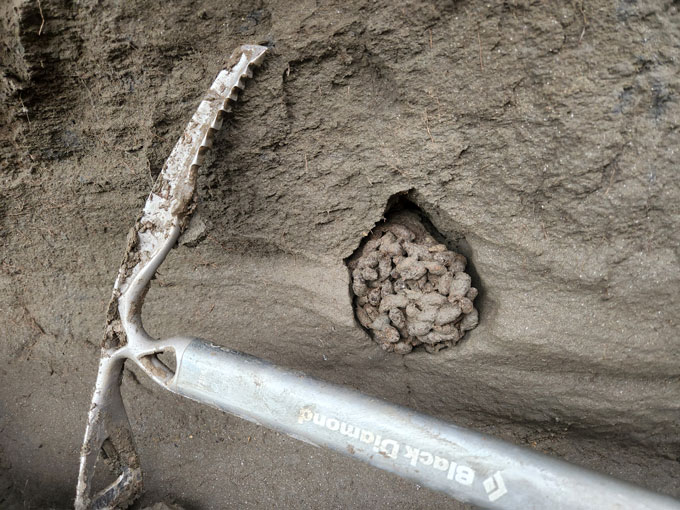
This soil hosted a surprise — a small cluster of squirrel poo. It’s been frozen in Yukon permafrost for thousands of years. These fecal pellets contained DNA from hundreds of species living in the Pleistocene ecosystem.Scott Cocker
A gold mine’s frozen treasure
Miners uncovered these fecal pellets. They melted Yukon permafrost to expose gold, Murchie says. This also turned up bones and the mummified remains of ancient creatures. For instance, they found bones of mammoths and steppe bison.
As the miners’ work progresses, eventually “you see these large exposures on the valley walls,” he notes. “There’s all these little pockets.” Those holes are the remains of ground squirrel burrows (genus Urocitellus).
Their homes are literally frozen in time. “They have little latrine areas and tunnel networks and caches of food,” Murchie says. (Sometimes, they even host frozen squirrels.)
Squirrels “really function as little naturalists or archivists,” Murchie says. Like “pack rats,” they stash all these bits of plant material, seeds, leaves, twigs and even bones. Scientists had already carefully cataloged contents of the burrows.
But no one had looked at the frozen poop left behind by these prehistoric Yukon squirrels.
So the researchers plugged their noses, thawed the pellets and extracted DNA from 13 squirrel coprolites — specimens of prehistoric poop. The oldest turned out to be nearly 700,000 years old. Others ranged from about 80,000 to 17,000 years old, part of the Pleistocene epoch. This was a period of alternating ice ages and warming periods.
Scientists usually assume Pleistocene squirrels were the same type found in the Yukon today. But “the species we thought these all were doesn’t seem to actually be the species that’s there today,” Murchie says. “There’s been a population turnover of some sort.”
At nearly 700,000 years old, the oldest sample could even be a new species. “It sits in its own evolutionary branch,” he says. “The closest thing to it is squirrels that are in China now.”
Prehistoric poop scoop
The poop held other surprises too. “I thought the DNA would mostly just be the squirrel plus their gut microbiome,” Murchie says. But there were fragments from what the squirrels had dined on, too.
Ground squirrels are not picky eaters. Genetic material popped up from all sorts of living things. Their menu included grasses, willows, beetles, grasshoppers, woolly mammoths, steppe bison, wolves, ancient horses and more.
Packs of ground squirrels would not have been ravenously chasing down mammoths, says Jacquelyn Gill. More likely they were scavenging, says this paleontologist who studies ancient ecosystems. Gill works at the University of Maine in Orono and did not take part in this new work. “They could have been chewing on [mammoth] bone for [its] calcium,” she says.
Rodents today frequently do that. “I remember watching one on my fence eating a bone,” Murchie says.
The ancient squirrels’ diet of both plants and animals allowed Murchie’s team to reconstruct the genomes of the mitochondria from 24 animals. Samples included 12 from the squirrels themselves, a snowshoe hare (used as a control, or comparison), two bison, three horses and six mammoths.
All those species in the scat offer a detailed window into the squirrels’ ecosystem, Gill says. “A mammoth bone will tell you a mammoth was here,” she says. “These ground squirrel coprolites are telling you we had a ground squirrel here eating these plants, living among these insects, sharing the landscape.”
It’s easy to want to study a mammoth tusk, Gill says. It’s a bit harder, she admits, to see the promise in poop. “I think you have to have a little bit of imagination and maybe a little humility.”
When a human has a sudden need to go number two, they might seek out a bathroom. When mammals in the forests of Costa Rica need to poop, they find a strangler fig. A survey of 169 trees found 11 that doubled as elevated toilets; all were figs. Cameras caught 17 different species using one of these treetop potties.
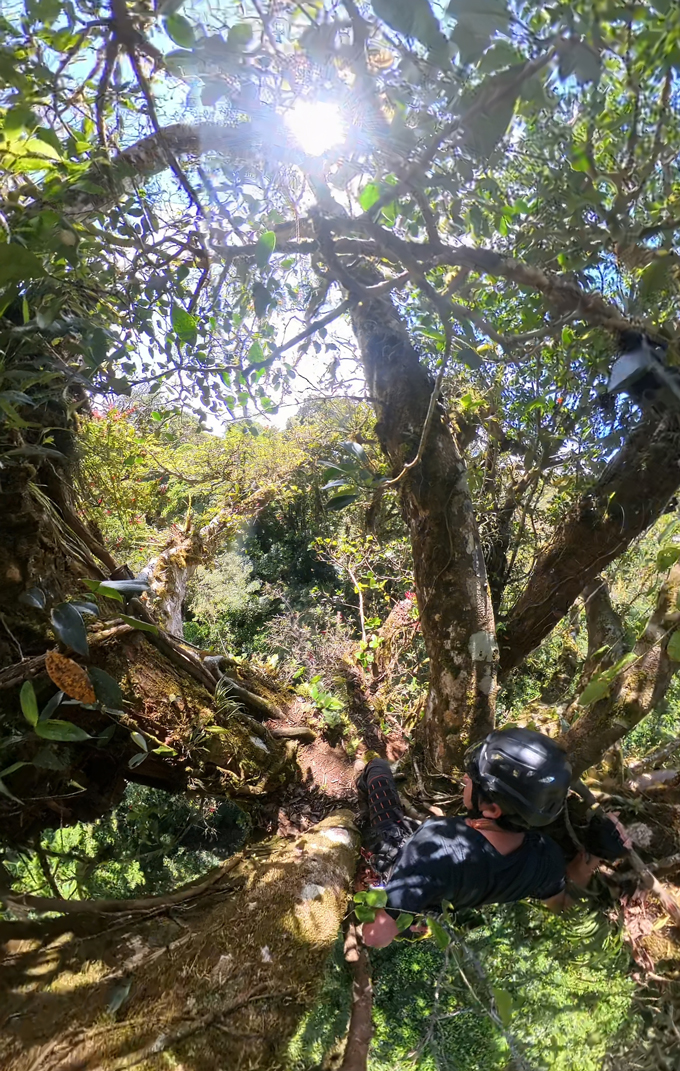
Jeremy Quirós-Navarro stands on the edge of an animal toilet that is tens of meters up in a strangler fig tree. The area where the branches join serves as a flat surface for animals to poop. Tropical canopy ecology project
Many mammals choose a favorite place to poo, says Mike Cove. He did not take part in the new research, but he does study mammals at the North Carolina Museum of Natural Sciences. That’s in Raleigh. There’ve been lots of reports of multiple tropical species sharing a pooping spot, Cove says. But all those toilets, also called latrines, were on the ground.
Jeremy Quirós-Navarro found his first treetop toilet by accident. At the time of this doo-doo discovery, he had been documenting plant life in the cloud forest of Costa Rica. These are forests that have a constant cover of mist and clouds. Quirós-Navarro works at the University of Connecticut, in Storrs, where he studies plant identification.
In a tree, right where a bunch of large branches came together, Quirós-Navarro found a pile of poo. As he kept climbing, he found more poop piles. “But only in a specific [type of] tree,” he says.
The lucky tree was a strangler fig (Ficus tuerckheimii). This plant is very important in tropical ecosystems. It provides plenty of food. It also has lots of holes that animals can use for shelter. Its wide, spreading branches along the forest ceiling also create walkways for many animals.
All these things make the strangler fig a hub for cloud forest mammals. That, in turn, makes this tree what scientists call a keystone species. Serving as a public restroom might be yet one more role that strangler figs play in forests.
Researchers shared their new findings March 16 in Ecology and Evolution.
The go-to for number two
Quirós-Navarro may have found the first fig tree toilet by accident. But after running into three more, “we started thinking that this is a pattern,” he recalls. So his team decided to look for more treetop latrines. They checked 29 different species — in all, 169 trees.
They turned up 11 latrines, all in strangler figs. In fact, 73 percent of the fig trees his team inspected had at least one pooping place. That’s almost three out of every four fig trees.
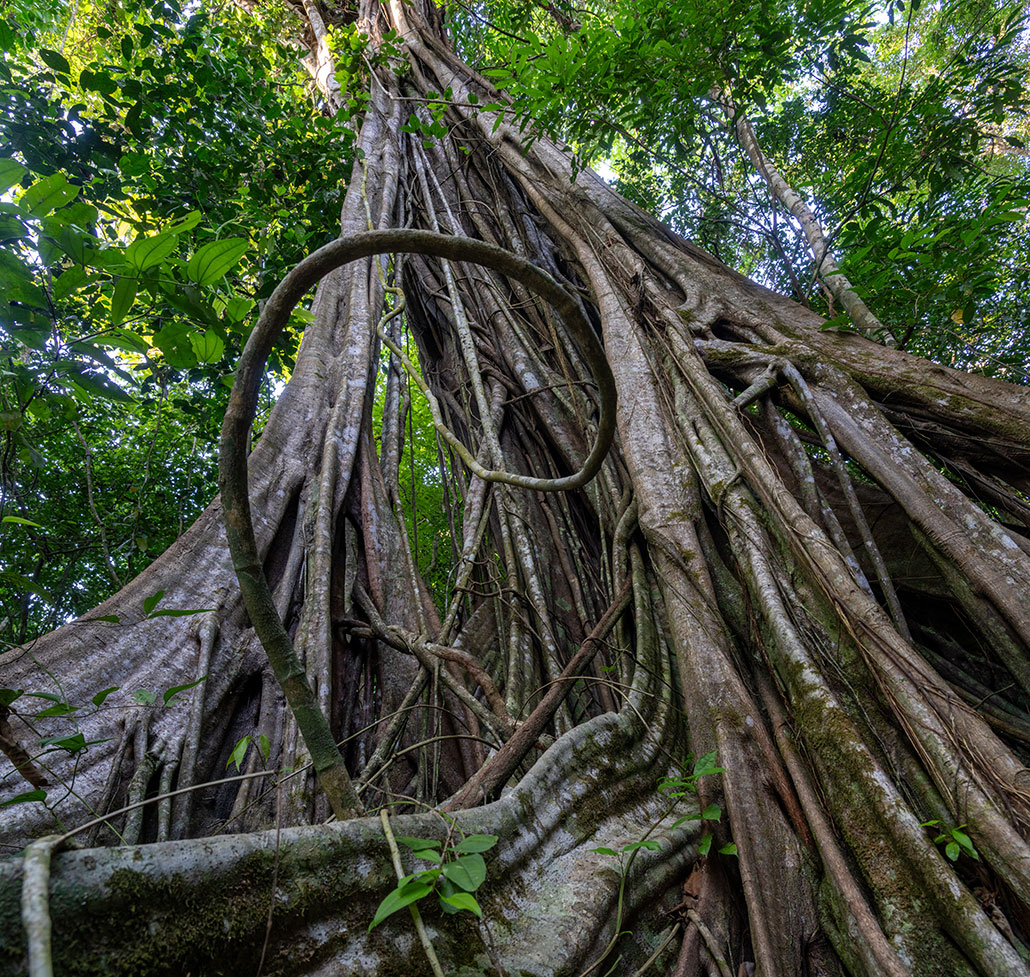
The scientists don’t know why figs are the preferred elevated forest potty. But Quirós-Navarro thinks the tree’s structure is important. “They have a specific and particular structure that forms, like, a hand at the crown,” he says. “All the branches grow from that part.”
The flat platform where all the branches join can be up to one meter (39 inches) wide and filled with soil and small plants. And poop.
Looking up into a strangler fig tree. Many mammals that dwell in tropical forests spend much of their lives high above the ground in the forest canopy. When one feels the need to “do its business,” those in Costa Rica often choose this type of tree as their latrine of choice.Michael Metzger/iStock/Getty Images Plus
A bathroom grapevine
To figure out which critters visited treetop toilets, researchers added a camera trap to one of the latrines. Over two months, this potty was used by about three mammals a day. They came from 17 different species.
Mexican hairy dwarf porcupines were the most frequent visitors. But kinkajous, opossums, pocket mice, coatis and capuchin monkeys all stopped by. Even margays, secretive tree-dwelling cats, hit the toilet (though only to spray urine).
A porcupine pauses to poo in a tree latrine. Porcupines live in trees in Costa Rica and were frequent visitors to the treetop potties.Tropical canopy ecology project
The most surprising visitor was Hoffmann’s two-toed sloths. This was unexpected because these sloths were thought to come down to the ground to poop. Both visits caught on camera were made by a female with young. That might be why they used the tree latrine. “It’s more [of a] risk for them to go and poop in the ground,” Quirós-Navarro says.
It’s also possible the sloth didn’t realize the platform wasn’t the ground, Erik Hom points out. He studies symbiosis at the University of Mississippi in University and did not take part in the research. Once an animal is in a tree, “coming down is quite a way,” he says. So a flat, dirt-covered place in the branches might seem enough like the ground to go on.
It’s especially interesting that there are so many species using these poop spots, Cove says. “You have all of these animals coming together,” he says. They are “scent marking, defecating, urinating — and then, in some cases, rolling in it.”
Tree toilets might serve as the group chats of the forest canopy, Quirós-Navarro adds. All these mammals using the same toilet leave signals for each other through their poop and pee. The message could be “a predator was here,” “I’m looking for a mate” or even “this tree is mine.”
In the future, Quirós-Navarro hopes to find out why fig trees are the forest’s potty of choice. But serving as potties only adds to the strangler fig’s value in tropical forests. It’s a food source, a highway — and now, a la-tree-n.

 Login