
❌

Reading view

Fossil Evidence Suggests Early Homo Had Abandoned Tree-Climbing by 1.8 Million Years Ago
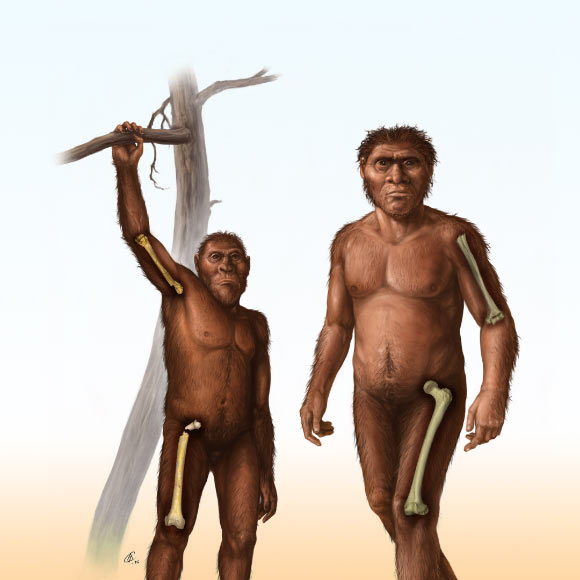
A depiction of an early Homo (right) characterized by relatively greater bone strength of the femur in the thigh compared to the humerus in the arm, and a depiction of an older human ancestor, Australopithecus (left), characterized by more equivalent strength in the bones of the arm and thigh. Image credit: Cullen Townsend.

New research led by University of the Witwatersrand and University of Southern California paleoanthropologists sheds more light on one of the most debated transitions in human evolution: when our ancestors stopped regularly climbing trees and committed fully to walking on two legs.

The post Fossil Evidence Suggests Early Homo Had Abandoned Tree-Climbing by 1.8 Million Years Ago appeared first on Sci.News: Breaking Science News.
  •  

CERN Physicists Find Evidence of One of Higgs Boson’s Rarest Decays

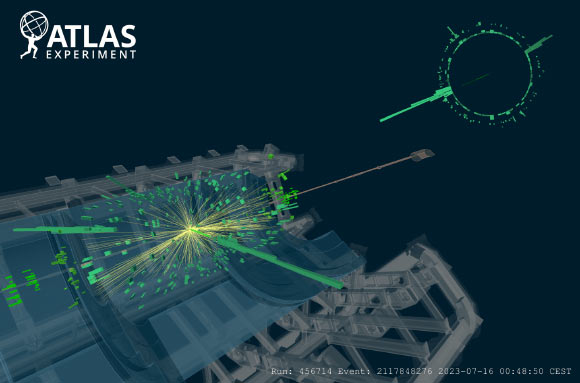
Event display of a candidate Higgs boson decay to a photon and a lepton pair, from proton-proton collisions recorded with the ATLAS detector in 2022. Image credit: ATLAS Collaboration / CERN.

Physicists from the ATLAS Collaboration at CERN’s Large Hadron Collider (LHC) have found evidence of the Higgs boson decaying into a β€˜virtual’ photon and a real photon, which in turn produces a pair of leptons.

The post CERN Physicists Find Evidence of One of Higgs Boson’s Rarest Decays appeared first on Sci.News: Breaking Science News.

  •  
❌