
❌

Reading view

Exceptionally Preserved Bird Feathers Found in 66-Million-Year-Old Dinosaur Coprolite

While some dinosaurs are thought to have had β€˜fuzzy’ or β€˜downy’ feathers (shown in this illustration as the yellow spikes on a Nanotyrannus’ neck), ancient birds (such as the one in the Nanotyrannus’ mouth) were more likely to have had feathers that look similar to the birds of today. Image credit: Andrey Atuchin.

Paleontologists in Montana have discovered remarkably preserved feathers of an ancient aquatic bird inside a fossilized dinosaur dropping, offering rare insight into why certain birds survived the asteroid strike that wiped out the dinosaurs 66 million years ago.

The post Exceptionally Preserved Bird Feathers Found in 66-Million-Year-Old Dinosaur Coprolite appeared first on Sci.News: Breaking Science News.

  •  

Denisovans Once Roamed Southwest China, New Fossils Reveal

An artist’s concept of a Penghu Denisovan walking under the bright Sun during the Pleistocene of Taiwan. Image credit: Cheng-Han Sun.

Paleoanthropologists have identified a trove of Denisovan fossils from a cave in China’s Yunnan province, extending the known range of the elusive human relative and providing the first-ever direct evidence of what its forearm bones looked like.

The post Denisovans Once Roamed Southwest China, New Fossils Reveal appeared first on Sci.News: Breaking Science News.
  •  

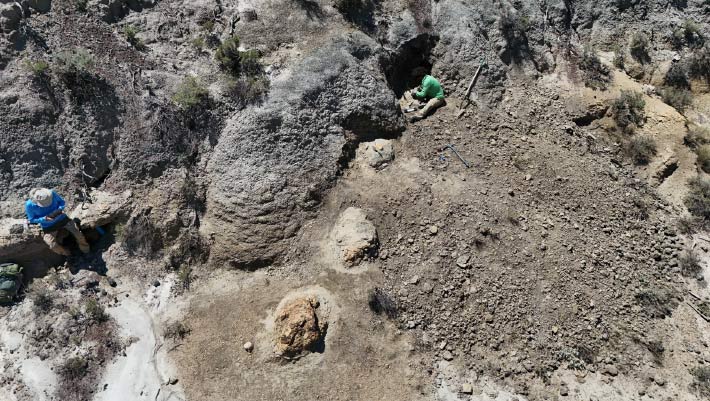
Paleontologists Discover First-Ever Adult Tyrannosaurus rex Trackway

The Tyrannosaurus rex trackway in the Hell Creek Formation in North Dakota, the United States. Image credit: Kent Hups.

Paleontologists in North Dakota have unearthed a set of 66.5-million-year-old fossilized footprints that can be confidently attributed to a full-grown Tyrannosaurus rex.

The post Paleontologists Discover First-Ever Adult Tyrannosaurus rex Trackway appeared first on Sci.News: Breaking Science News.

  •  

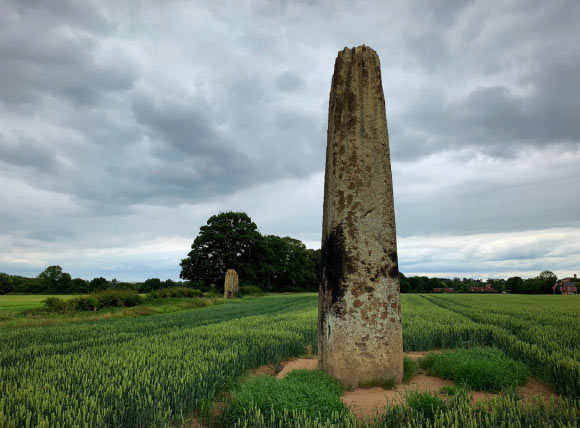
Britain’s Tallest Standing Stones Traced to Their Geological Source

The Devil’s Arrows, the three towering gritstone megaliths on the western outskirts of Boroughbridge, Yorkshire, the United Kingdom. Image credit: Curtin University.

Scientists from Curtin University and the University of York have pinpointed the origin of the Devil’s Arrows, the three towering gritstone megaliths that have stood on the edge of Boroughbridge, Yorkshire, for roughly 4,000 years, ending a long-running archaeological debate.

The post Britain’s Tallest Standing Stones Traced to Their Geological Source appeared first on Sci.News: Breaking Science News.

  •  
❌