Every year, the villagers of Kiang Jifarong contribute labor and money to build earthen dikes using clay and mud in an effort to keep seawater out of their farms. Rice fields once stretched unbroken for 5 kilometers, about 3 miles, along the Bintang Bolong estuary here in western Gambia. For generations, families cultivated rice on these fertile lowlands, relying on seasonal floods and freshwater to sustain one of the country’s oldest farming traditions. There are now worrying gaps in this productive landscape. For 10 years now, many of the villagers have retreated inland, away from the coastline, as saltwater transforms once-productive rice fields into barren land. Farmers say saltwater stress is easy to recognize: rice leaves turn yellow, while harvested grains become light and hollow because the plants fail to develop properly. “The grains become almost empty,” says Tombong Barrow from the Kiang Jifarong village development committee, a statutory body responsible for identifying local development needs at the village level and coordinating responses to them. “The salt makes them useless.” Aerial view of the Bintang Bolong estuary at Kiang Sankandi, the Gambia. Image courtesy of Ansumana Darboe. Jonni Kinteh and Mama Njie, both veteran rice farmers, say they abandoned their fields eight years ago after repeated crop failures linked to salinity. “We have farmed these fields since childhood alongside our mothers,” Kinteh says. “Now we can no longer use them.” “Our parents farmed much closer to the river,” Barrow says. “Now those fields have been completely taken over by salt.…This article was originally published on Mongabay
In 2020, a juvenile osprey was fatally shot in Ghana. The bird, one of hundreds of raptors killed in similar circumstances across West Africa every year, had been fitted with a leg ring by the British Trust for Ornithology in Scotland the previous year. Ospreys (Pandion haliaetus) were locally extirpated in Scotland in the early 1900s due to persecution, and the bird killed in Ghana was part of a population reintroduced to that part of the U.K. beginning in the 1990s. Tim Mackrill, an osprey expert and director of the Scotland-based Roy Dennis Wildlife Foundation, said the bird’s death points to the need for a conservation approach that spans migratory birds’ entire habitat. “If you’re not thinking of the whole flyway of migratory routes, connectivity, and then where the birds are actually wintering, then conservation efforts for that species are really not sufficient.” Many raptor species, such as ospreys, return to the same wintering site year after year. “They are literally faithful to the same tree, whether it’s in Ghana, whether it’s in Guinea, or whether it’s in Gambia,” Mackrill said. Raptors such as ospreys travel in large numbers from Europe to West Africa during the Northern Hemisphere winter. Image by Eileen Fonferko via Flickr (CC BY-NC 2.0) Millions of birds travel from Europe to Africa each year, spending the Northern Hemisphere’s coldest months in warmer climates far to the south. “People put a huge amount of effort into restoring raptors and protecting them in Europe, and that is a…This article was originally published on Mongabay
Every year, twice a year, millions of birds belonging to hundreds of species fly between breeding grounds in Europe and Asia and their non-breeding habitats in Africa. Scientists have surprisingly sparse knowledge of exactly where many species actually go — or what risks and obstacles the migrating birds encounter along the way. Populations of the vulnerable curlew sandpiper, which breeds in in Siberia, for example, appear everywhere from South Asia to East and Southern Africa during the northern hemisphere winter. “One important fact that we all need to understand is that migratory birds do not belong to any one country, but are a shared global heritage, and their survival requires a borderless safety net,” says Alex Ngari, who manages the migratory birds and flyways program for BirdLife Africa. “These birds know no borders, which means that the conservation methods that we develop must be aware of that fact, and every country has a responsibility to protect them.” Until recently, what monitoring there was relied on ringing — but piecing together birds’ year-long itinerary depends on where someone encounters a ringed bird, on that person knowing what the band on its leg means, and details of the encounter reaching some coordinating authority. As lighter and more reliable electronic tags that can be fitted to birds to record and broadcast their locations have become available, researchers have started to gather more detailed information about migratory pathways. This type of tracking is still relatively expensive, however, especially for tags small enough for small-bodied…This article was originally published on Mongabay
In the grassy dwarf shrublands of South Africa’s Karoo, Michelle Marie Schroeder is looking for a very specific kind of poo. Black-footed cats spend most of the day hidden in burrows and emerge mainly under the cover of darkness, making them notoriously difficult to study. That’s why the conservation biologist relies unconventional assistants: Lyka and Sebala, two German Shorthaired Pointers trained to detect the cats’ scat by scent. When the dogs find a sample, they lie down and remain still to alert Schroeder, who works with the non-profit Canines for African Nature. Working on her own, Schroeder found just four scats in more than a year. Ten-year-old Lyka, by contrast, has located hundreds of samples in just a few months, providing the basis for non-invasive genetic monitoring of Felis nigripes. “I probably wouldn’t have found more than 90% of the scats without help,” she tells Mongabay. “And it’s also very difficult to distinguish them from those of other small carnivores. The dogs are much more accurate.” Lyka has located hundreds of black-footed cat scat samples, making non-invasive monitoring of the elusive species possible. Image courtesy of Veer Bills. On the trail of the black-footed cat Hal Brindley, a researcher at the Institute for Communities and Wildlife in Africa at the University of Cape Town, also studies these small, cryptic predators. “Studying the black-footed cat is incredibly difficult without resorting to invasive methods like trapping and collaring,” he says. “More common non-invasive approaches, such as camera trapping, are often ineffective. Fecal…This article was originally published on Mongabay
ACCRA — In a landmark ruling, the Accra High Court has sentenced Bernard Antwi Boasiako, a regional chairman of the opposition New Patriotic Party, to 20 years in prison for facilitating unlicensed mining in the Samreboi concession. The concession is in Ghana’s Western Region, in the Upper Guinean Forest Belt that extends across the subregion from Togo and Ghana in the east to Guinea in the west. The concession is set in the remains of the belt’s tropical rainforest. While large parts of the landscape at Samreboi have been logged and converted to cocoa plantations or other farmland in recent decades, significant tracts of natural forest remain, including the nearby Tano Nimiri and Aboi forest reserves. In recent years, the area has been massively degraded by illegal mining, known locally as “galamsey,” damaging remaining wildlife habitat, destroying farmland, and altering natural drainage patterns. This has left a landscape deeply scarred by abandoned pits. During heavy rainfall in June, the Tano River burst its banks and submerged more than 200 houses in Samreboi and neighboring communities, with some buildings collapsing entirely. While illegal mining dominates headlines, industrial mining is the leading cause of forest loss in Ghana — Africa’s biggest gold producer. This damage was exacerbated by legislation passed in 2022, allowing mining concessions to be granted even inside forest reserves, opening previously protected forests to exploitation. That legislation was repealed in 2025. Graphic by Mongabay. The NPP official’s conviction and sentencing, handed down on July 20, has prompted energetic public…This article was originally published on Mongabay
Fishers from western and central Ghana are renowned in the region, traveling the length of the West African coastline to cast their nets in the richest fishing grounds. These migrant fishers, relying on beach and purse seining, dry their catch to preserve them for transport to distant markets. Fish is an important dietary component for West Africans, according to Ghanaian marine biologist Issah Seidu, but its availability is under threat. “There has been a tremendous decline in fish like the tunas, anchovies, mackerel,” he told Mongabay. “And in response, the fishermen have switched gears from the traditional fishing tools to now using gillnet to target these species as their last safety net to support their livelihood.” Issah Seidu with two colleagues from his NGO, Aqualife. Image courtesy of Issah Seidu. As well as bony fish, elasmobranches — like sharks and rays, whose skeletons are made of cartilage — are much sought after. Fifty years ago, sawfish and wedgefish were widely found in shallow water along Ghana’s coast; today, both groups of elasmobranches have been fished to local extinction. Seidu, the founder of a marine conservation NGO called AquaLife, said fishers he’s interviewed for his research say sawfish haven’t been seen in Ghanaian waters since the 1980s, and it’s now been more than eight years since wedgefish were last caught. He said guitarfish, a group of rays, could be next. “Guitarfish are at a tipping point,” Seidu told Mongabay in an interview in March, “owing to their lucrative and high-value white…This article was originally published on Mongabay
CONAKRY — Over the next few months, Guinea’s environment ministry will review an environmental and social impact assessment for an iron ore mine in the country’s Nimba Mountains. The project, named Kon Kweni, is to be carved out of Mount Nimba Strict Nature Reserve, a UNESCO World Heritage Site. Comprising a unique combination of tropical forest and high-elevation savanna, the Nimba highlands are a biodiversity hotspot, home to dozens of endemic species. According to the environmental and social impact assessment (ESIA), these highlands would face “direct and major risks,” “irreversible damage,” and “threat to species survival” if the mining operations go ahead. The impact assessment is an essential step toward securing a mining permit and commencing operations on a project that has been in discussion since 2003, when Guinean mining company SMFG was founded. (The company acquired by U.S. miner Ivanhoe Atlantic in 2019.) Mongabay obtained a copy of the ESIA, a confidential document. The assessment was commissioned by Ivanhoe and carried out by Biotope, a French environmental consultancy, and reveals how Ivanhoe is planning to go about developing the Nimba concession and how the plan is projected to impact Nimba’s ecosystems. In the Mount Nimba Strict Forest Reserve, 2006. Image by Manfred Schweda via Wikicommons (CC BY-SA 4.0) Guinea’s environmental regulator, the AGEE, a branch of the environment ministry, will assess the project’s anticipated environmental impact and the company’s proposed plans to mitigate damage, alongside the precision and comprehensiveness of its assessments. Seydou Cissé, the AGEE director, said the…This article was originally published on Mongabay
DJOUROUTOU, Côte d’Ivoire — After a night of heavy rain, the chimpanzees of Taï Forest, in southwestern Côte d’Ivoire, like to sleep in. Early on a late May morning, chimpanzee guide Evariste Tere led a group of scientists and conservationists to a chimp group’s nesting site that he had marked with his GPS the previous evening. The humans set off at 4:30 a.m., then spent an hour and a half waiting for the chimpanzees (Pan troglodytes ssp. verus) to wake up. Eventually, one of them did. Moisture gathered in her nest from the night’s rain gushed down, and then the other trees began to bend and creak as their occupants — one male, four females and a baby — stirred. One of the females, with the baby clinging to her belly, moved through the treetops to a bigger tree, then used the handholds and footholds of a strangler fig snaking its way up the trunk to reach the canopy. This didn’t seem to impress the male, who was already on the ground and, noticing the humans, wanted to get his group moving. He screamed angrily and beat his hands on the buttress root of a large tree so that the sound echoed through the forest like a drum. “He’s angry that they didn’t follow,” Tere said, adding that while Taï’s chimpanzees are used to seeing tourists, a group of five was bigger than normal, and the male did not want to linger. Instead, he would keep his charges moving until…This article was originally published on Mongabay
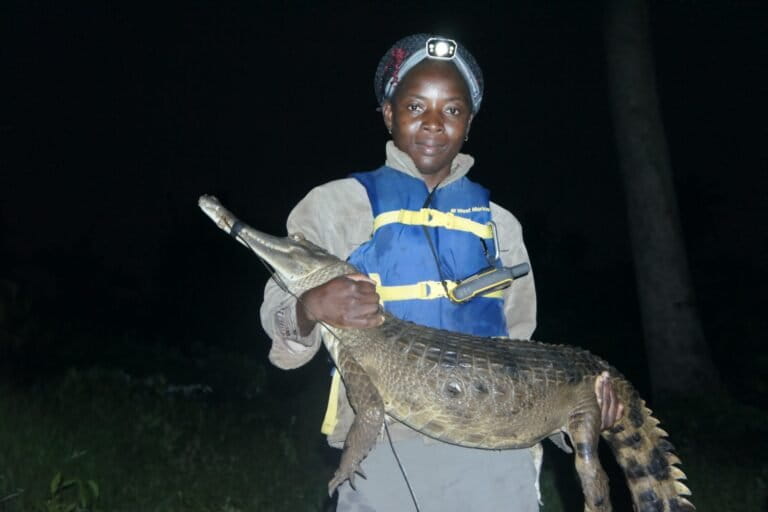
TAI NATIONAL PARK, Côte d’Ivoire — Environmental scientist Christine Kouman says she has always had a passion to take care of things that are overlooked or neglected. The West African slender-snouted crocodile and its habitat in what remains of the Upper Guinean Forest qualify on both fronts. Kouman, co-founder of a conservation NGO called EBURCO that is collaborating with authorities to protect and raise the profile of Taï National Park — a key stronghold of the slender-snouted crocodile (Mecistops cataphractus), — has studied this species in her native Côte d’Ivoire for more than a decade. Her work, which is supported by Project Mecistops, – has produced insights into this little-known species. The project is part of the Tropical Conservation Institute at Florida International University in the U.S. Mongabay recently accompanied Kouman on a night-time boat trip in Taï National Park, up the Hana River, a place where she has undertaken many hours of grueling fieldwork. This interview has been lightly edited for clarity. The slender-snouted crocodile has adapted to its rainforest environment by basking on trees and rocks that protrude from the river. Image courtesy of Christine Kouman. Mongabay: Tell us something about the slender-snouted crocodile. Christine Kouman: I can say it’s a gentle crocodile, because it feeds mainly on fish, and I’ve never heard of the species attacking people. I’ve been working on them for more than 10 years now, and during those 10 years, I touched them, handled them, but I still have all my fingers and my…This article was originally published on Mongabay
TAÏ NATIONAL PARK, Côte d’Ivoire — The path that leads through the rainforest towards a nesting site for one of its most curious inhabitants is not made by humans but by animals. “It might be half a million years old, this animal path,” says Michele Menegon, a herpetologist and regular visitor to Taï National Park, in southwestern Côte d’Ivoire. It could of course be younger, he adds, but such a clear trail through the forest, following the contour of a ridge, is likely to be an ancient one — maintained by the passage of both Taï’s great and small, from forest elephants (Loxodonta cyclotis) to diminutive antelopes like the Maxwell’s duiker (Philantomba maxwellii), whose piles of tiny black droppings are visible beside the path. The forest floor here is relatively clear of undergrowth. Dominant trees, supported by huge buttress roots, hold their canopies out of sight above; they restrict the sunlight and curtail the growth below. “I’ve never been in a forest with this density of giant forest trees,” Menegon says. The guide, Gliman Hyacinthe, a ranger with the Ivorian Office of Parks and Reserves (OIPR), identifies one of the tree giants as kosipo — Entandrophragma candollei — one of the mahoganies. This part of the forest is boulder-strewn, situated as it is on the slope beneath a large dome of granite whose summit breaks through the canopy of trees but is barely visible from within the forest. OIPR ranger Gliman Hyachinthe, University of Pavia student Caterina Danielon and herpetologist Michele…This article was originally published on Mongabay
ROOIELS, South Africa — Baboons aren’t exactly punctual, but Gavin Lundie still expected them to appear in the village around 9 a.m. “They’re coming!” his wife Lesley called. Members of the Rooiels baboon troop had begun to make their way down. Lesley made her way to the sliding doors on their patio and secured it with two shoelaces attached to a hook. She remained on the balcony and watched as the troop entered into the village a few properties away. The Lundies live in Rooiels, a small, affluent village on False Bay, approximately 80 kilometers (50 miles) from Cape Town’s city center. The village, scattered from the coastal flats up the slopes of the Klein Hangklip mountain, is part of the Kogelberg Biosphere Reserve. The mountain’s cliff faces offer sleeping baboons (Papio ursinus) protection from leopards, their natural predator, but the sparse vegetation doesn’t offer enough for them to eat or drink. In contrast, the lower slopes, where the village has grown up, is still covered with dense fynbos scrub on undeveloped plots, in gardens and along unpaved verges. The baboons forage on a range of flowers, seeds and berries in the warmer months; in winter, when the fynbos is dormant, the baboons eat kikuyu grass from lawns in the village. They also eat limpets in the intertidal zone, and the Rooiels River is a year-round source of freshwater. A juvenile baboon clings to its mother’s back as she forages in fynbos on the roadside in Rooi Els. Image by…This article was originally published on Mongabay
NIGRE, Côte d’Ivoire — The village of Nigré in southwestern Côte d’Ivoire sits — like much of this part of West Africa — in a landscape of rice and cassava fields, oil palm plantations and stands of rubber trees that have replaced the forests that once clothed the landscape. Chief Djahi Bertin and his attendants offer a traditional welcome to a group of scientists, conservationists and park rangers in an open-sided building in the chief’s yard. The guests are served slices of radish-red kola nut, together with a teaspoon of ginger-colored spices, and a choice of wine, beer, spirits or soda. Bertin takes a glass of wine, half full, and empties it on the concrete floor. The splash resembles the palm of a hand, fingers splayed out. Both the palm and the digits form a unified whole, he says. “We are of one mind.” Chief Djahi Bertin, left, and his advisers meet with conservationists and scientists at his residence in the village of Nigré to discuss the creation of an ecological corridor linking the nearby Taï National Park, with Grebo National Park just 4 kilometers away in neighboring Liberia. Image by Ryan Truscott for Mongabay. The village is not far from the western edge of Taï Forest. At 5,000 square kilometers (1,930 square miles), it’s the largest intact remnant of Upper Guinean Rainforest, which once stretched east from Liberia, across Côte d’Ivoire and Ghana, to Togo. During a two-day road trip from the commercial hub of Abidjan to Taï, Mongabay…This article was originally published on Mongabay
Up until 10 years ago, large sections of the road linking Malawi and Zambia to the Indian Ocean port of Nacala would become nearly impassable during the rainy season, with potholes, damaged bridges and traffic bottlenecks causing long delays along this regional transport artery across northern Mozambique. The Mozambique government has carried out major upgrades to transport infrastructure, but this may have come at the cost of accelerating deforestation across the region. Between 2017 and 2022, the African Development Bank (AfDB), the Japan International Cooperation Agency (JICA) and the World Bank financed major transportation upgrades along the Nacala Corridor, centered on the 912-kilometer (565-mile) rail line linking coal mines in western Mozambique with ports on the Indian Ocean, as well as road upgrades, to lower costs and improve regional trade connections with Malawi and Zambia. “This project reduces the ‘penalty of remoteness’ that poorer households pay,” Romulo Cunha Correa, Mozambique country manager for the African Development Bank, told Mongabay in an interview. The AfDB has prioritized improvements to road and rail infrastructure across the continent, also backing projects linking Cameroon to the cities of Brazzaville and Kinshasa on the Congo River, and South Sudan to Indian Ocean ports in Kenya. But researchers studying this expansion of infrastructure have warned that the road upgrades can intensify deforestation and habitat loss. Women walk past a fish pond in Moatize, in Mozambique’s western province of Tete, in 2011. Image by Peter Fredenburg via Flickr (CC BY-NC-ND 2.0) Manuel Mario Nazare, a conservationist with…This article was originally published on Mongabay
An undercover operation by Guinean authorities in the capital Conakry caught four men in possession of more than 2,000 dried seahorses and 26 kg (57 lbs) of shark and ray fins on May 22, 2026. According to a press release, the seizure was supported by the Guinea branch of the anti-wildlife trafficking NGO Eco Activists for Governance and Law Enforcement (EAGLE). EAGLE identified the arrested men as Daouda Camara, Thierno Sadou Bah, Sekou Soumah, and Abdoulaye Camara, all Guinean nationals aged between 20 and 55 years old. The NGO told Mongabay they are believed to be part of a transnational criminal network operating across West Africa. The network has been involved in smuggling wildlife for more than four decades, but none of those arrested were previously known to law enforcement authorities. Antonia Gustafsson, coordinator of EAGLE Guinée, said the alleged traffickers were trying to sell dried seahorses to Chinese nationals in the country, who would then illegally ship them to China. When authorities searched a storage facility linked to the traffickers, they found the stashed shark and ray fins. Shark and ray fins are key ingredients in shark fin soup, a delicacy in much of China and Southeast Asia. Dried seahorses are in high demand in China as they are used in traditional Chinese medicine preparations. Both products are high-value seafood and a highly lucrative trade: Prices for dried seahorses have peaked as high as $600/kg. Seized shark and ray fins, which were destined for export to China, where they…This article was originally published on Mongabay
CHIRADZULU, Malawi — In Chiradzulu district in southern Malawi, 60 women who are members of the Rural Women’s Assembly grow fruits and vegetables alongside their staple crop, maize. In recent years, there’s been growing demand for their organically produced crops from buyers in the nearby city of Blantyre, Malawi’s commercial capital. The assembly’s chair in Chiradzulu, Diana Sitima, runs a 3.5-hectare (8.6-acre) organic farm here. She says when she started the farm in 1993, she used to take the produce to consumers in Blantyre. “Now they are coming to us. They say our produce has a good taste,” Sitima says. According to the women, the biggest obstacles they face as farmers is that they lack land titles and capital to invest in their farming. As members of the RWA, these are the issues they discuss at their meetings and bring to their local council and central government for solutions. Ester Samuel spreads maize to dry in Balaka, Malawi. Image by CIMMYT via Flickr (CC BY-NC-SA 2.0) In 1998, not long after she got married, RWA member Lonely Kholowa’s parents gave her a piece of land to cultivate. But after her father passed away in 2009 — her mother had died seven years earlier — her father’s older brother grabbed the land, arguing that according to their culture, she belonged to the family of her mother who came from Machinga district in the east of the country. Today, Kholowa farms land in her husband’s village elsewhere in Chiradzulu. “I don’t have…This article was originally published on Mongabay
A North Korean man is set to face trial in Tanzania this week following his arrest in April while in possession of 500 elephant tusks. Un Hyok Ra was arrested April 19 at a hotel in Dar es Salaam, and is scheduled on June 9 to answer to charges of unlawful possession of the ivory and intent to trade it. Tanzania is a signatory to CITES, the global wildlife trade convention, which requires parties to conduct forensic analysis of ivory seizures of 500 kilograms (1,100 pounds) or more to determine where it came from. This is intended to support investigations that go beyond the typically low-level traffickers who are caught in possession. Tanzanian police did not respond to questions from Mongabay about the origins of the seized ivory or who Ra allegedly planned to sell it to. During an administrative hearing on May 28, prosecutor Florida Wancelaus told the court only that investigations are ongoing. Chris Morris, founder of wildlife crime monitoring group Saving Elephants through Education and Justice (SEEJ), based in neighboring Kenya, estimated that 504 tusks would weigh roughly 2,500 kg (about 5,500 lbs). In an email to Mongabay, he said law enforcement in the region does not always meet the CITES requirement to conduct DNA analysis on confiscated ivory. “It remains to be seen if Tanzania will comply with this directive,” Morris wrote. Morris, a former war crimes investigator, said Tanzanian authorities have often withheld information that would help sister agencies in the region and beyond trace…This article was originally published on Mongabay
ELEPHANT MARSH, Malawi — At 5:30 am, trader Flora Kumilai is squatting before a heap of smoked catfish at Sorjin Market in southern Malawi’s Elephant Marsh, haggling with sellers over the price. “I found gold in fish,” she chuckles as she fills a third cardboard box. “And Elephant Marsh is the mine.” Kumilai, who has traveled here from Malawi’s commercial capital, Blantyre, will spend a week in the area, visiting other fish markets around the marsh until she has 12 of these boxes, around 900 kilograms (1,990 pounds) of smoked fish. Then she will band together with other traders to hire a truck to transport their goods back to Blantyre, 140 kilometers (87 miles) to the north. But for Kumilai, the final destination for her goods is more than 1,500 km (930 mi) away, at a market in Kasumbalesa on the border between Zambia and the Democratic Republic of Congo. She’s been in business for more than a decade now, mostly trading in produce within Malawi and sometimes importing clothes from Tanzania and South Africa for customers in the city. In October 2024, she changed course, when fellow traders introduced her to the cross-border trade in fish. In Kasumbalesa, most of Kumilai’s customers are from the DRC, she tells Mongabay in Chichewa. “They pay in [U.S.] dollars. When we change it on the black market to Malawi kwacha, it gives us a lot of money. That’s how I’m able to pay for my son’s education [at Chandigarh University in India].”…This article was originally published on Mongabay

 Login