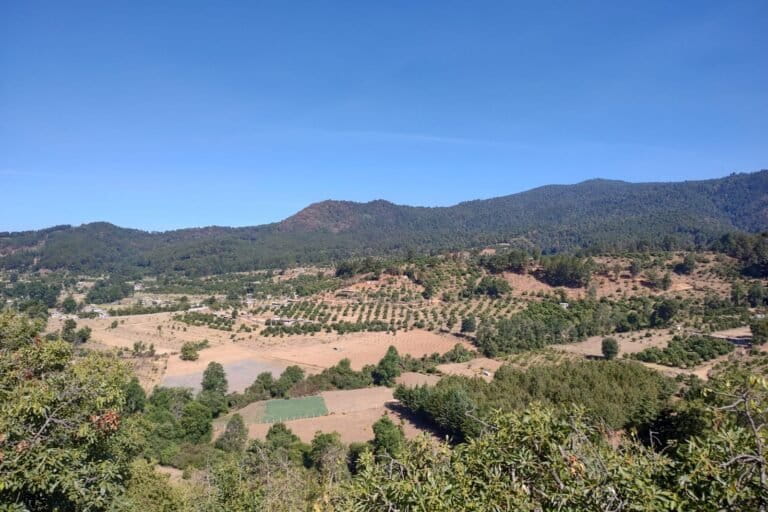
The plane sprayed the soy fields beside the forest. Residents of Khikatxi said the single-engine aircraft appeared several times during each harvest and passed over Wawi Indigenous Territory. They worried about pesticides reaching their water, gardens, animals, and homes. People reported itching and diarrhea. Crops weakened, streams grew cloudy, and some game animals seemed to smell of agricultural chemicals. For years, Khuiusi Khisêtjê watched the farms advance around his people’s land. In 2018 he made a decision. The community would rebuild its village ten kilometers deeper in the forest. Leaving a village is difficult. Houses must be rebuilt, paths cleared, gardens planted, and daily routines restored. The old place contained years of work and memory. Khuiusi Khisêtjê had already lived through several such upheavals. He knew what was lost when people were forced from their land. He also knew when it had become unsafe to remain. The move took the Khisêtjê farther from the expanding agricultural frontier. It was one more decision in a life devoted to the survival of his people. Khuiusi, who died in Goiânia on July 3rd, at about 80, belonged to a generation that saw the Khisêtjê come close to extinction. He was born when his people still lived beyond the settled frontiers of central Brazil. Their villages lay among rivers, forest, and savanna in a region that would later form part of the Xingu Indigenous Territory and the adjoining Wawi Indigenous Territory in Mato Grosso. Contact with outsiders brought disease, violence, and displacement. Epidemics killed…This article was originally published on Mongabay
The Kenya Wildlife Service (KWS) has been accused of harassing co-petitioners in a case challenging the relocation of the Nairobi Animal Orphanage to make it part of the larger Bomas International Conference Complex. The proposal would carve out between 76 and 89 acres inside Nairobi National Park for upgrades to wildlife rescue and rehabilitation facilities. Conservationists are concerned that the facility, which will include parking for 1,300 vehicles, poses threats to a protected indigenous forest and habitat for the critically endangered black rhino. On July 16, the Environment and Land Court in Nairobi ordered its deputy registrar Vincent Kiplagat to visit the park in the presence of all parties to prepare and file a report about the proposed facility. The Nairobi-based NGO Save the Nairobi National Park (SaveNNP) said it was denied court-ordered access to the site. In a statement sent to Mongabay, SaveNNP condemned “threats and intimidation” by KWS personnel. In the same statement, SaveNNP and JustAct, another Nairobi-based NGO, accused the KWS of planning to “control the narrative and ensure the voice of Kenyans was not heard by the courts or the media while on site.” Similar claims were made by Friends of Nairobi National Park. Mongabay asked KWS spokesperson Duncan Wanyama for a comment and was referred to a local media report in which Wanyama said the visitors were not obstructed and that rangers were just enforcing standard protocols within the park. The activists said they were later allowed in, but “only once the court officers, KWS…This article was originally published on Mongabay
The Mojave Desert may look like a flat, brown stretch of nothing between Los Angeles and Las Vegas. But threading through its rocky mountain ranges is an intricate network of wildlife movement that has sustained desert species for thousands of years. Now, scientists and advocates say a solar project approved by the state of California threatens to sever it. In April, the California Energy Commission, the state agency that oversees energy infrastructure, voted 4-0 to approve a $700 million, 1,080-hectare (2,670-acre) solar facility proposed by New Jersey-based developer VC Renewables on federal land adjacent to the Mojave National Preserve. The preserve, spanning more than 1.6 million acres, is one of the largest in the U.S. National Park System and is located in Southern California. The project, known as Soda Mountain Solar, sits in the migration corridor that desert bighorn sheep (Ovis canadensis nelsoni) use to move between mountain ranges. This large solar array would also obstruct desert tortoise (Gopherus agassizii) habitat, which has already undergone significant loss due to climate change and land developments. The energy commission’s environmental review found the project would cause significant and unavoidable harm to wildlife. Scientists and conservation advocates say the approval threatens one of the last intact desert ecosystems in California. But the commission’s final order memo states that ecological mitigation incorporated into the solar project would reduce the impacts on desert wildlife to “less than significant” and that the commission expects the project will bring more renewable energy to the state. Scientists and…This article was originally published on Mongabay
GUWAHATI, India (AP) — Flooding in India’s northeastern Assam state has killed at least 50 people and displaced 700,000 after days of heavy monsoon rain that overflowed the Brahmaputra River, officials said Friday. The river, one of Asia’s largest that originates in China’s Tibet region and flows about 900 kilometers (560 miles) through Assam, flooded villages, swept away homes and forced nearly 300,000 people into government-run relief camps, officials said. Authorities provided food and relief supplies to flood victims including airdrops from helicopters, Assam Chief Minister Himanta Biswa Sarma said. Nearly 900 villages were submerged and more than 7,000 homes were without electricity, he said. Police, disaster response teams and local volunteers were working to rescue stranded residents and deliver essential supplies to flood-hit communities, officials said. Jatin Gogoi, a 52-year-old farmer from Nazira, said the rising waters swept away his bamboo-walled home and destroyed his livelihood. “I lost all my cattle. My five-member family and I have nowhere to go, so we are taking shelter in a relative’s home,” he said over the phone. Flooding on Thursday evening disrupted parts of Guwahati, Assam’s capital with about 2 million residents, as submerged roads left commuters stranded for hours. “I had to stay overnight at my office. The roads were filled with water, some waist deep,” said Sudip Mazumdar, a journalist in Guwahati. Experts say human-caused climate change is intensifying South Asia’s monsoons, which traditionally run from June to September and again from October to December. The rains, once predictable, now arrive in…This article was originally published on Mongabay
In celebration of World Mangrove Day on July 26, the U.S.-based Mangrove Action Project (MAP) has announced the winners of its 12th annual photography awards. “Mangroves are the underdog. They will never be as glamorous as the Amazon rainforest or coral reefs. But through photography we can change that narrative, and intrigue people by showing them their beauty, diversity and fragility,” Leo Thom, creative director with MAP told Mongabay in an email. Mangroves cover just 0.1% of the surface of the Earth but are essential ecosystems; they stabilize coastlines and provide habitat for diverse wildlife including fish, reptiles, amphibians, birds, primates and, even, big cats such as tigers. Mangroves also store three to five times more carbon per acre than tropical forests. Scientists estimate that more than half of all mangrove ecosystems are at risk of collapse by 2050, mostly from sea-level rise and severe storms associated with climate change. Gaurav Patil/Mangrove Photography Awards (MPA) The 2026 overall winning photograph features another threat to mangroves — ghost nets, fishing nets that are discarded or lost at sea. This photo was taken near Nandgaon village, south of Mumbai, India. At sea, such fishing gear can entangle wildlife including sea turtles, birds and whales. Less understood is how problematic ghost nets are for mangroves. “I have been watching ghost nets getting trapped in mangroves for the last several years,” photographer Gaurav Patil from India, said in a press release. Michol Sanchez/MPA A “highly commended” photo in the threats category of the contest…This article was originally published on Mongabay
JAKARTA — Endi sat in front of the door leading to the second deck of a fishing boat at the Nizam Zachman fishing port in Jakarta. As he waited for the vessel to depart, the 42-year-old member shared his experience working at sea. “I only have a primary school education. I tried other jobs, like construction, but I couldn’t handle it. The pay was low,” he told Mongabay. On fishing boats, he said, crew members are paid according to their roles. Ordinary deckhands earn around 25,000 rupiah per day, or about $1.40, while the chief engineer gets up to four times that much. For a two-month voyage, that puts total earnings anywhere from 1.5 million to 6 million rupiah ($84-$334). Endi said that while this is still insufficient to support a family, he remains grateful to have work. This could improve in the near future. In April this year, the Indonesian government ratified the International Labour Organization’s Work in Fishing Convention of 2007 (also known as ILO 188), marking a major step toward strengthening labor protections in the fishing sector. The government now has one year to prepare for its implementation, including revising existing regulations governing the recruitment, training, certification, and management of fishing crews. Overall, the convention seeks to establish minimum standards for occupational safety and health, fair wages, decent working conditions, social security, legal protection, and adequate rest for workers in the fishing industry. Fishing crew members wait for their vessel’s scheduled departure from the Nizam Zachman fishing…This article was originally published on Mongabay
ACCRA — In a landmark ruling, the Accra High Court has sentenced Bernard Antwi Boasiako, a regional chairman of the opposition New Patriotic Party, to 20 years in prison for facilitating unlicensed mining in the Samreboi concession. The concession is in Ghana’s Western Region, in the Upper Guinean Forest Belt that extends across the subregion from Togo and Ghana in the east to Guinea in the west. The concession is set in the remains of the belt’s tropical rainforest. While large parts of the landscape at Samreboi have been logged and converted to cocoa plantations or other farmland in recent decades, significant tracts of natural forest remain, including the nearby Tano Nimiri and Aboi forest reserves. In recent years, the area has been massively degraded by illegal mining, known locally as “galamsey,” damaging remaining wildlife habitat, destroying farmland, and altering natural drainage patterns. This has left a landscape deeply scarred by abandoned pits. During heavy rainfall in June, the Tano River burst its banks and submerged more than 200 houses in Samreboi and neighboring communities, with some buildings collapsing entirely. While illegal mining dominates headlines, industrial mining is the leading cause of forest loss in Ghana — Africa’s biggest gold producer. This damage was exacerbated by legislation passed in 2022, allowing mining concessions to be granted even inside forest reserves, opening previously protected forests to exploitation. That legislation was repealed in 2025. Graphic by Mongabay. The NPP official’s conviction and sentencing, handed down on July 20, has prompted energetic public…This article was originally published on Mongabay
Fishers from western and central Ghana are renowned in the region, traveling the length of the West African coastline to cast their nets in the richest fishing grounds. These migrant fishers, relying on beach and purse seining, dry their catch to preserve them for transport to distant markets. Fish is an important dietary component for West Africans, according to Ghanaian marine biologist Issah Seidu, but its availability is under threat. “There has been a tremendous decline in fish like the tunas, anchovies, mackerel,” he told Mongabay. “And in response, the fishermen have switched gears from the traditional fishing tools to now using gillnet to target these species as their last safety net to support their livelihood.” Issah Seidu with two colleagues from his NGO, Aqualife. Image courtesy of Issah Seidu. As well as bony fish, elasmobranches — like sharks and rays, whose skeletons are made of cartilage — are much sought after. Fifty years ago, sawfish and wedgefish were widely found in shallow water along Ghana’s coast; today, both groups of elasmobranches have been fished to local extinction. Seidu, the founder of a marine conservation NGO called AquaLife, said fishers he’s interviewed for his research say sawfish haven’t been seen in Ghanaian waters since the 1980s, and it’s now been more than eight years since wedgefish were last caught. He said guitarfish, a group of rays, could be next. “Guitarfish are at a tipping point,” Seidu told Mongabay in an interview in March, “owing to their lucrative and high-value white…This article was originally published on Mongabay
A handful of animal lovers, mostly representing the youth community, spread across Bangladesh, have become crucial arsenals of the Forest Department’s wildlife crime control efforts. Despite not being assigned by the state, like the responsibilities a crime control force shoulders, the animal lovers help the Forest Department trace stressed wildlife in traps, cages or enclosures of poachers and smugglers. Primarily, they share intel information about any potential wildlife crime. Often, they join the wildlife inspectors of the department, act as undercover buyers, reach the crime scene, and help arrest the criminals. All things they do are under life threats — voluntarily. The Forest Department’s Wildlife Crime Control Unit (WCCU), established in 2012, conducted more than 3,000 raids against wildlife criminals between July 2012 and March 2026. Almost all raids were planned with volunteers’ tip-offs. Chief conservator of forests, Md Amir Hosain Chowdhury, told Mongabay: “Volunteers are our crucial partners [in wildlife conservation].” The government of Bangladesh has also recognized the collaboration between the WCCU and the volunteers. The WCCU and wildlife photographer and conservationist Faisal Bin Azad, better known as Adnan Azad, were honored with the National Wildlife Conservation Awards 2026 on July 9. Azad is one of the pioneers in non-government campaigns for nature conservation and was one of the original volunteers with WCCU. Local volunteers and Forest Department officers pose for photographs with an administration officia after two pooches were detained while possessing a macaque illegally. Image by Siddiqur Rahman Rabbi. The Forest Department on Nov. 6, 2025,…This article was originally published on Mongabay
Four African wild dogs were recently spotted in Kasungu National Park in Malawi, making it the first confirmation of the endangered species in the park in more than a decade. The wild dogs appear to have travelled hundreds of kilometers from a park in eastern Zambia to reach Kasungu. Matthew Becker, chief executive of the Zambian Carnivore Programme, told Mongabay his team recognized the four African wild dogs (Lycaon pictus) from a database of known wild dogs collected in South Luangwa National Park and the Luangwa River valley as part of a long-term study. South Luangwa is located around 300 kilometers (186 miles) to the west of Kasungu. The four dogs had been recorded in May near a school in Mfuwe village, just outside South Luangwa, Becker said. The wild dogs may have traversed parts of the Malawi-Zambia Transfrontier Conservation Area (TFCA), Becker added. The TFCA connects Malawi’s Kasungu to Zambia’s Lukusuzi National Park adjoining the Luangwa Valley, through a long narrow region of densely packed villages, farms and homesteads, “I suspect they would have used the areas that were least impacted by development and (with the) least amount of threats, but one never knows with dogs,” Becker said. He added that “it’s very promising” the wild dogs were able to move from South Luangwa all the way into Malawi. “I think hopefully this signals more dogs in the future exchanging between the countries through dispersal,” he said, adding that the journey of the four dogs to Kasungu shows that…This article was originally published on Mongabay
In the rugged, high-altitude meadows of the Eastern Himalayas in India, researchers have confirmed the presence of a tiny plant with purple-blue flowers, last documented in the country more than 150 years ago. The plant, Cyananthus hookeri, was previously recorded in India by British botanist Sir Joseph Dalton Hooker who collected some specimens from the northeastern state of Sikkim in 1867. Last year, a research team located the species at an altitude of 3,600 meters (11,811 feet) in Chuna Valley in Tawang district of Arunachal Pradesh state, also in northeast India. This milestone, documented in a recent update in Oryx, marks the first confirmed record of the species in Arunachal Pradesh and the first record from India in 158 years, the researchers write. Sudhanshu Sekhar Dash, one of the botanists on the research team from the Botanical Survey of India, told Mongabay over email that the rediscovery of Cyananthus hookeri “is an exciting and significant botanical finding.” “What impressed us most was that such a distinctive species had remained undetected despite extensive botanical exploration in the eastern Himalaya,” Sekhar Dash said. “This highlights how remote alpine ecosystems still harbor poorly documented plant diversity.” C. hookeri is a small, short plant that grows in mat-like clumps. It has densely hairy stems, and striking purple-blue flowers with hairy throats. Sekhar Dash said the plant is a highly specialized herb that’s adapted to harsh mountain climates. “It creates robust, hairy cushions that protect it from the severe mountain conditions,” he said. Despite the…This article was originally published on Mongabay
More than 40 years after sediment from a volcanic eruption filled up a stretch of the North Fork Toutle River in the U.S. state of Washington, beavers are turning the smothered waterway into a thriving wetland. However, a planned infrastructure project now threatens to undo five years of restoration progress, reports contributor Isabel Gil for Mongabay. Following the 1980 eruption of Mount St. Helens, Mark and Dawn Smith, owners of the Eco Park Resort, watched as volcanic sediment accumulated over native vegetation and wildlife along the river. The degradation was exacerbated when the U.S. Army Corps of Engineers in 1989 built a sediment retention structure (SRS) to hold back sediment to protect shipping routes and downstream communities from flooding. The structure trapped volcanic material, creating a massive sediment plain on the Smiths’ property. In 2021, the Smith family began collaborating with natural resource experts from the Cowlitz Indian Tribe, the Cascade Tribe, and conservation groups to reintroduce beavers (Castor canadensis) to the area. Emily Fairfax, an assistant professor of geography at the University of Minnesota, told Mongabay that 58 beavers have been relocated to the resort in the last five years. Many of them were at risk of being euthanized after coming into conflict with humans in other areas. The relocated beavers have established a complex network of dams and what Smith described as “honeycomb” canals, deepening ponds and allowing native willows and alders to take root. Smith said he’s seen ducks and elk return to his property. Moreover, the…This article was originally published on Mongabay
Sawfish, a group of large marine rays, derive their name from a striking appendage: Their long, saw-like snout lined with teeth-like scales. Nature intended these fish to use their snout, also called a rostrum, to send out electric signals that shock unsuspecting prey, slice it like a sword to impale it, and devour the catch. Humans, on the other hand, use these sharp teeth as cockfighting spurs — a spiky object strapped to a game cock’s legs so it can deliver lethal blows to its opponent and win the fight. For centuries, practitioners of the sport in Latin America have carved sawfish (fam.Pristidae) teeth into spurs. But in the 2000s, as sawfish became overfished for their fins, many cockfighting associations in the region officially banned using their teeth as spurs. In 2007, all sawfish species were added to CITES, the global wildlife trade agreement, and their commercial international trade was banned. A sawfish’s rostrum is lined with sharp teeth-like scales, which are carved into cockfighting spursCredits: Vassil – CC0. A recent study, published in the journal Conservation Letters, found that international commerce in sawfish rostra and teeth continues in Latin America despite bans. Talking to cockfighting practitioners and association representatives, the researchers found most rostral teeth entering the trade came from Peru, Brazil, Ecuador, Central America and Colombia. Peru topped the list as a destination. They call for stricter law enforcement and coordination in these countries, and urge CITES to take action to curb the “hidden” trade. Although the peak…This article was originally published on Mongabay
MEXICO CITY — In the heart of Mexico’s southwestern state of Michoacán, Juan Madrigal spends his free time organizing to protect the city of Uruapan’s urban ecological park, a 50-hectare (124-acre) plot of land at the edge of the Río Santa Bárbara. A state-protected area since 1995, the park’s marshlands help to purify the surrounding Cupatitzio watershed, where nine natural springs provide drinking water to approximately half a million people. According to Madrigal, the park, a habitat of the ruddy-capped nightingale-thrush (Catharus frantzii), the endangered Michoacán pocket gopher (Zygogeomys trichopus) and the endemic Pátzcuaro frog (Lithobates dunni), is a victim of neglect. “The authorities have never paid any attention to it, and it’s us citizens who’ve been speaking out,” Madrigal, who in 1993 founded Ecocentro del Río Cupatitzio, a nonprofit educational center, tells Mongabay by phone. The movement to protect the park gained momentum after it involved the ranchers that grow fruit and corn downstream, Madrigal says. “They realized the importance of us supporting each other in defending the vital sources of life,” he says. “Without trees, there is no water.” For a certain type of tree, however, the inverse occurs: Without water, there are no avocados. Defending native forests, urban or otherwise, is a small but important fight in Michoacán, where avocado orchards have replaced nearly 700,000 hectares (1.7 million acres) of tree cover, an area almost three times the size of Cape Town, between 1993 and 2023. Michoacán is the top avocado exporter in Mexico and the only…This article was originally published on Mongabay
Sea salt sold in markets across Lombok Island, Indonesia, is contaminated with microplastics, according to a recent study. Microplastics are small plastic particles less than 5 millimeters in length that form when larger plastic waste breaks down. Microplastics have been found everywhere scientists have looked for them, including seafood and table salt, raising concerns for public health. Much of the plastic waste generated on land ends up in the ocean where it can break down into microplastics. Because sea salt is created by evaporating salt water, it is particularly vulnerable to microplastic contamination when the source water contains suspended microplastics. Scientists estimate that there are millions of tons of plastic pollution in the ocean, by far the largest form of marine pollution. The research team lead by Anna Ida Sunaryo Purwiyanto collected 20 salt samples from vendors at 10 markets across Lombok Island. They extracted potential microplastic particles from the samples and identified the particles using a stereo microscope. Every salt sample contained microplastics, “indicating widespread contamination across the surveyed markets,” the study notes. The researchers found some variation in microplastic contamination levels in different markets and in crystal versus fine sea salt. However, the results consistently showed that the source material for the salt, the ocean surrounding Lombok Island, is contaminated with microplastics. The researchers note that crystal sea salt had higher levels of microplastics than fine salt, likely because fine salt is washed and filtered, which removes some microplastic particles. They conclude that additional washing and filtering of salt…This article was originally published on Mongabay
PARIS (AP) — About 20,000 people were evacuated from towns and vacation resorts along the French Atlantic coast Thursday as the latest in a series of wildfires raged and hundreds of firefighters were dispatched to tackle it. Local authorities said the fire in a forest near the town of Lège-Cap Ferret, southwest of Bordeaux, spread over more than 31 square kilometers (12 square miles), though no injuries have been reported. The prefect, or head of the surrounding Gironde region, Sophie Brocas, said some 700 firefighters have been deployed, including forces sent from the Paris region. The fire came within 300 meters (980 feet) of the first homes in Lège, and water bombers were being used. Later in the day, the prefect’s office said the wildfire had not yet been brought under control but remained contained to the north of Lège. More than 10,000 people, including tourists staying at holiday camps and campgrounds, were moved to safety overnight, along with more than 1,000 residents living in residential areas along the forest edge. Authorities later evacuated the village of Claouey, including residents staying at several campsites, as a precautionary measure. Brocas said the evacuation involved 8,800 people. Several municipalities have opened reception and respite centers for evacuees, the prefecture said. Southern Europe has seen multiple large fires this summer. Scientists warn that climate change is exacerbating the frequency and intensity of heat and dryness, making the region more vulnerable to wildfires. Following a succession of heat waves that started even before the summer, wildfires…This article was originally published on Mongabay
Hypertensive or high blood pressure disorders are among the leading causes of maternal deaths in low-income countries. A pregnancy complication known as preeclampsia, a hypertensive disorder, is listed among the top five causes of maternal deaths in Bangladesh. For expectant women with preeclampsia, timely treatment is required; otherwise, it can lead to issues such as elevated liver enzymes, low platelet count syndrome, hepatic failure, coma or loss of life.The Sustainable Development Goals adopted by the U.N. set an ambitious target to reduce the maternal mortality rate to less than 70 per 100,000 live births by the end of 2030. While many developed nations have already achieved the U.N. target, low- and middle-income countries are yet to achieve these goals. In Bangladesh, the maternal mortality rate is 196 per 100,000 live births and rates remain significantly higher in the neighboring countries . A recent study reported an association between hypertension, preeclampsia and high-salinity drinking water. The same study argues that, in Bangladesh, preeclampsia is associated with high-salt drinking water. Epidemiological evidence links high salt intake to hypertension in both adults and children. The scarcity of safe drinking water has become a serious global issue due to agricultural expansion, sea level rise caused by global warming and population growth. The IPCC, in its sixth Assessment Report (AR6), stated that climate change affects water availability and water quality. Globally, around 4 billion people face water scarcity for at least one month each year. Storm surges and rising sea levels make it easier for…This article was originally published on Mongabay
When Mongabay Latam began publishing in 2016, the decision felt like a logical next step. Mongabay Indonesia, launched four years earlier, had shown that a locally led, local-language newsroom could build an audience for sustained environmental reporting. Spanish offered the chance to apply that approach across a region extending from Mexico through Central America and the Andes to Chile and Argentina. The political and ecological conditions varied widely, but the need was similar: important environmental stories were going unreported, or receiving attention only after a crisis became difficult to ignore. Latin America and the Caribbean are the most biologically diverse region on Earth, holding nearly half of the world’s tropical forests and unusually large shares of its mammals, birds, fish, insects, reptiles, amphibians, and plants. The Spanish-speaking countries in Mongabay Latam’s coverage area include some of the richest parts of the Amazon rainforest, the tropical Andes, Mesoamerica, the Chocó, and the eastern Pacific. These landscapes face growing pressure from mining, agriculture, infrastructure, organized crime, and climate change. Macaws in Peru. Image by Rhett Butler for Mongabay. I was also drawn to the region’s cultural and intellectual range. Latin America has produced many responses to these pressures, including Indigenous territorial governance, community forestry, new legal approaches to nature, and locally designed conservation programs. A regional news service could document environmental damage while also examining how people were responding to it. Mongabay Latam’s staff and contributors built the newsroom that followed. Editors developed the judgment, relationships, and institutional memory needed to…This article was originally published on Mongabay
IBIRAMA-LA KLÃNÕ INDIGENOUS TERRITORY, Brazil — Zág, pronounced “zã,” is the Xokleng word for the Brazilian pine. This tree species, Araucaria angustifolia, is typical of the Atlantic Forest that runs along Brazil’s south and southeastern coast, and has been evolving on the planet for about 200 million years. Each female tree produces dozens of cones, which in turn carry hundreds of seeds. Known in Brazil as pinhão, the Brazilian pine seed is a nut eaten by at least 22 animal species as well as humans, who rely on it for both nutrition and income. For some Indigenous peoples, however, it means more than food. It’s part of their culture, history, and origin myths. That’s the case for the Xokleng people, also known as the Laklãnõ, in what is today Santa Catarina state. In their villages, people are even named after the tree. “Brazilian pines are sacred to us,” says Carl Gakran, executive director of the Zág Institute. “You can’t tell the story of our people without speaking of them. Our creation myth says the protective animal was made from that tree, so it appears in the very first story.” Carl decided to do something for the pines in 2016, after learning that the species was critically endangered as a result of deforestation, urban expansion, and logging. Currently, Brazilian pine forests are estimated to cover less than 3% of their original range, which once stretched across much of the states of Paraná, Santa Catarina and Rio Grande do Sul, with small patches…This article was originally published on Mongabay
A songbird species previously thought to occur across two Indonesian islands has turned out to be two distinct species, according to a recent study. For more than 120 years, many scientists believed that Indonesia’s Babar Islands in eastern Banda Sea, and Tanimbar Islands, roughly 135 kilometers (84 miles) east of the Babar Islands, were both home to the cinnamon-tailed fantail (Rhipidura fuscorufa). But a team of researchers led by James A. Eaton of Birdtour Asia Limited and Alex J. Berryman of BirdLife International has confirmed that the songbird on Babar Islands is a distinct species, which they’ve named the cheerful fantail (Rhipidura laguceria). To confirm these findings, the researchers analyzed 19 museum specimens of birds labeled cinnamon-tailed fantail, historically collected from both Tanimbar and Babar islands. They also recorded songs of the birds on both islands, then played the recorded calls back to the wild birds 132 separate times over several years. The researchers found that physical differences between the populations on the two islands are subtle: The cheerful fantail possess slightly darker upperparts and less extensive cinnamon plumage below than the cinnamon-tailed fantail. However, their songs vary considerably. The researchers said in the study that songs of the birds on Babar typically consist of “single whistles that rise in pitch towards the end.” By contrast, the Tanimbar birds combine very short and longer whistles, which gives their songs a “much more rhythmic cadence,” with pitch that typically goes up and down. The song recording experiments also revealed that birds…This article was originally published on Mongabay

 Login