Two Przewalski’s horse foals were born in a reintroduction center in the grasslands of central Kazakhstan in late August. They are reportedly the first wild horses born on Kazakh soil in more than 200 years. The first foal, a male, was born Aug. 22 to a 7-year-old mare named Tessa. The second, also male, followed on Aug. 31, born to a mare named Umbra. They share the same father, a stallion named Zorro who has since died. The Equus ferus przewalskii foals have not yet been named, but their births are being celebrated as a milestone of the Kazakhi reintroduction effort. “The birth of these two foals is important because it shows that the horses are adapting to this climate, to this territory,” Alyona Krivosheyeva, conservation director of the Association for the Conservation of Biodiversity of Kazakhstan (ACBK), told Mongabay by phone. “This is the proof of success of what we do.” Rewilded Przewalski’s horses with the second foal born on Aug. 31. Image courtesy of Kanat Batyrkhanuly/ACBK. Both foals were born inside a 56-hectare (140-acre) enclosure at the Alibi Wild Ungulates Reintroduction Center, part of Kazakhstan’s 489,000-hectare (1.2-million-acre) Altyn Dala State Nature Reserve. The reserve has also been an important recovery site for saiga antelopes (Saiga tatarica) and Asiatic wild asses (Equus hemionus kulan). Known locally as kertagy, Przewalski’s horse is the only living wild relative of the domestic horse. It was listed as extinct-in-the-wild until one adult was found in 1996, after which it was re-listed as critically…This article was originally published on Mongabay
Scientists recently described a new species of a tiny brown frog found in the Amazonian floodplain forests of Ecuador and northwestern Brazil. It looks nearly identical to related species but its slow, widely spaced out call sets it apart, researchers note in a study. “I’ve had to get into arguments because people said the frog I study is ugly,” lead author Marianna Borburema, who studied the species as an undergraduate student at the Federal University of Minas Gerais and is now a researcher at the University of São Paulo, told Mongabay by phone. “I find it absurd. The frog I study is beautiful! It is super cute.” “Super cute” specimen of the newly described Adenomera varcena species. Images courtesy of Marianna Borburema. Despite dazzling the study’s lead author, the evolution of the frog, named Adenomera varcena, hasn’t been one focused on appearances. Biologists call this a “cryptic species”, a species whose external traits can be very similar to related species. It is roughly 22 to 24 millimeters (0.9 inches) long and has brown skin and dark blotchy patterns. “Because of natural selection, the pressure isn’t on the frog’s appearance, it’s on the call,” said Borburema, who spent three weeks analyzing the frogs’ sounds. “We understand that evolution happens faster in their call because the song is what interests the female.” Related species typically call frequently, some up to 70 notes a minute. However, the songs of A. varcenas include just one to five notes a minute, the slowest rate documented…This article was originally published on Mongabay
A federal judge in Brazil has given the country’s government 24 months to recognize the traditional territory of the Kajkwakratxi-Tapayuna Indigenous people in the northwestern state of Mato Grosso. The court accepted evidence from federal prosecutors that detailed decades of government inaction following massacres, forced displacement and other human rights violations against the Kajkwakratxi-Tapayuna people. The ruling, issued on June 11 by Federal Judge Pablo Kipper Aguilar in Diamantino, Mato Grosso, also orders the federal government to issue a public apology and pay 10 million reais ($2 million) in collective moral damages. “It has been a very difficult journey,” Yaiku Suya Tapayuna, a leader of the Kajkwakratxi-Tapayuna people, told Operação Amazônia Nativa (OPAN). “It is a decision we have dreamed about, and we are now celebrating this victory.” In his decision, the judge drew upon decades of evidence of violence against the Kajkwakratxi-Tapayuna, beginning with a massacre in 1953 involving armed attacks and deliberate poisoning. A dictatorship-era report published in 1967 documented that a nearby rubber tapping business left a sack of sugar laced with arsenic on a riverbank in the Tapayuna area for the Indigenous community to consume. Another poisoning attack occurred in the 1960s with meat laced with tick poison. In 1969, a “poorly planned” official visit organized by the federal Indigenous affairs agency brought in the influenza virus, contaminating the Kajkwakratxi-Tapayuna people. An account given to national media at the time described, “Indigenous corpses decimated by the flu across the forest, and children nursing from the breasts…This article was originally published on Mongabay
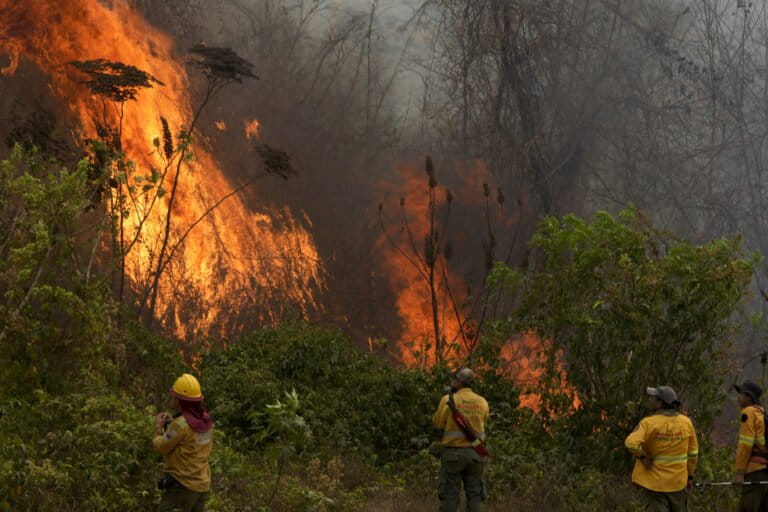
Wildfires have burned thousands of hectares of forest and savanna in the Chacobo-Pacahuara Indigenous territory in the Beni department of northern Bolivia, according to satellite imagery and on-the-ground sources. The fires likely resulted from illegal burns in pastures surrounding the Indigenous territory. The fires hit Chacobo-Pacahuara in September and October 2025, the third consecutive year of unusually high fire activity in the Indigenous land, according to the most recent data released by Global Forest Watch, a platform that uses satellite data to track forest loss worldwide. The flames consumed Indigenous subsistence crops and homes. Locals also expressed worry for the safety of isolated Indigenous communities. “We have Indigenous relatives who live in voluntary isolation, and we do not know what has happened to them because the forest and the forest islands where they lived burned,” Constantino Toledo Ortiz, a leader of the Chácobo people, told Mongabay in a voice message. “We think they may have crossed into Brazil.” According to a bulletin published by the Center for Legal Studies and Social Research (CEJIS), 1,141 heat hotspots, typically caused by fire, were recorded in the territory between Jan. 1 and Sept. 12, 2025. CEJIS recorded an additional 845 heat hotspots between Sept. 29 and Oct. 16, 2025. The sharp increase is in line with the Bolivian Amazon’s typical fire season, which usually peaks around August and September when the climate is at its driest. Chacobo-Pacahuara was the most affected Indigenous territory in the Bolivian Amazon in 2025. Map by Andrés Alegría/Mongabay. In 2024,…This article was originally published on Mongabay
Tree rings from the Amazon show that the world’s largest rainforest has developed wetter wet seasons and drier dry seasons over the past four decades. The findings point to intense seasonal swings that can cause significant harm to biodiversity and suggest that widespread drying out across the entire Amazon basin is unlikely. Researchers collected tree cores from two species of floodplain trees; one species only grows in the wet season and another that only grows in dry conditions. They analyzed oxygen isotopes and the chronology of chemical marks left along the annual growth rings from each tree. They found that wet-season rainfall increased by 15-22% since 1980, while dry-season rainfall declined by 5.8-13.5%. “For a long time, there has been talk that it will dry up, and climate models created in the 1990s and early 2000s did indeed show that the Amazon was following that path,” study lead author Bruno Cintra, a biologist at the University of Birmingham, said, reported Mongabay contributor Luís Patriani. “But when we observe how the climate has developed over the last 40 or 50 years, what we see is that there is no clear pattern indicating that the biome as a whole is drying up.” The biome isn’t drying up entirely, because changes in weather patterns are not impacting all regions across the massive forest in the same way. The northern portion of the rainforest is receiving more rain during the wet season, while the southern Amazon region is facing longer and drier dry seasons.…This article was originally published on Mongabay
The world’s largest meatpacking company, JBS, has scrapped two of its key environmental goals in its latest annual sustainability report. JBS’s “Net Zero by 2040,” which aimed to reduce greenhouse gas emissions throughout its supply chain, and zero deforestation targets were substantially rolled back compared to previous years, according to its 2025 Sustainability report, published July 8. Instead, the company redesigned its targets with a focus solely on its most direct emissions, called Scope 1 and Scope 2. Those include direct emissions from JBS factories, vehicles, and electricity provided to its facilities. Indirect emissions, called Scope 3, make up the vast majority of the company’s emissions and were dropped. Those include methane from cows, and transportation and deforestation emissions from supplier farms. “Backtracking on measurable targets doesn’t diminish the scrutiny JBS will face for its climate and nature-wrecking record of pollution, deforestation, land grabbing, human rights abuses and corruption,” Gemma Hoskins, global climate lead at U.S.-based environmental nonprofit Mighty Earth, wrote in a statement. Until 2025, JBS touted a commitment to “zero illegal deforestation in all Brazilian biomes by the end of 2025 for direct and indirect cattle suppliers,” Mongabay previously reported. JBS justified the change by saying it’s difficult to control indirect emissions. “Bold ambition is fine, but you now need to actually have really good, measurable, accountable goals. And that’s what we’re doing — we’re now setting goals that we believe where we have operational control,” Jason Weller, JBS’s chief sustainability officer, told the Financial Times. JBS operates more than 250 meat production facilities, mostly in Brazil and the U.S. It…This article was originally published on Mongabay
The European Union has dropped leather from its final list of products targeted under the bloc’s landmark antideforestation law. Experts say the July 13 decision is the result of industry lobbying rather than a true reflection of leather’s deforestation footprint. The EU deforestation regulation, or EUDR, mandates that companies selling commodities such as cattle, soy, palm oil and cacao in the European market must prove their supply chains aren’t sourcing from recently deforested land. The law is currently set to take effect at the end of this year, following two years of delays. It has faced a series of revisions that effectively weaken the law since it was first passed. “The decision to exclude leather from the EUDR is deeply disappointing. It ignores strong evidence linking European consumption of leather to deforestation in Latin America,” Fyfe Strachan, policy lead at U.K.-based watchdog organization Earthsight, wrote in an email statement. “It overlooks the voices of EU citizens from the recent public consultation and instead prioritizes the interests of industry lobbies,” she added. As Mongabay recently reported, the European Commission’s own research concluded that leather could account for up to 17% of the deforestation footprint linked to imports covered by the EUDR. Transparency records compiled by the nonprofit LobbyFacts revealed that leather industry groups met with lawmakers at least 22 times since 2021, and the EUDR was explicitly listed as a discussion topic in 11 of the meetings. The lobbying efforts were led by two Italian leather tannery unions, COTANCE and Unione…This article was originally published on Mongabay
Every year, June 22 marks World Rainforest Day, an awareness day launched by Rainforest Partnership in 2017 to advocate for the immediate protection and restoration of the world’s tropical forests. These ecosystems support at least half of all known plant and animal species. They also regulate rainfall and stabilize the global climate. In 2025, less tropical primary forest was cut down compared to 2024, which was a record high year. In total, records showed a 35% drop in forest cover in 2025, largely led by reduced deforestation in Brazil, which hosts the world’s largest area of rainforest in the Amazon. “A drop of this scale in a single year is encouraging — it shows what decisive government action can achieve,” Elizabeth Goldman, co-director of Global Forest Watch, told Mongabay reporter Hans Nicholas Jong following the publication of its yearly report in April 2026. But the overall trend is still cause for concern: According to the Global Forest Review, the total area of tropical primary forest destroyed globally each year remains “46% higher than a decade ago.” And over the past three years, between 2023-25, “fires burned more than twice as much tree cover as they did two decades ago,” worldwide, the review said. In 2026, temperatures are expected to soar as precipitation falls in key rainforest areas such as the northern Amazon and throughout Indonesia’s Sundaland rainforest due to the upcoming El Niño, predicted to be one of the strongest of this century. In 2021, more than 140 countries pledged…This article was originally published on Mongabay
Former sea turtle hunters in Cabo Verde, off the coast of West Africa, have shifted to working in loggerhead turtle conservation along the archipelago nation’s main nesting beaches. The change was propelled by 2018 legislation that criminalized killing threatened turtle species, Sonam Lama Hyolmo reported for Mongabay. Rangers, around a dozen of which used to poach or hunt turtles, now patrol key beaches where turtles lay their eggs, walking several kilometers each night during the nesting season, which runs from June to October. Turtle meat is historically consumed in Cabo Verde and many other regions, which has created a conflict between conservation needs and local customs. However, awareness campaigns and employment opportunities are helping to bridge that gap. “I had turtle meat for personal consumption and never realized I could make a living out of conserving them,” Roni Nelson Batista Ramos, a ranger and camp coordinator at the Turtle Foundation, told Mongabay. “But now, I guard them against the poachers, and it’s motivating to see how these efforts have driven positive impacts for their conservation.” Ramos and others monitor around 31 kilometers (19 miles) of coastline, patrolling the beaches on foot, and using drones and dogs for added assistance. Roughly two-thirds of loggerhead turtle nesting activity in Cabo Verde happens on the eastern island of Boa Vista, which has seen a dramatic decline in illegal turtle hunting, according to the Turtle Foundation. In 2007, 1,253 female loggerheads were illegally caught on the island; by 2024 there were just 20. Over…This article was originally published on Mongabay
A Mexican long-tongued bat, featured above, flies into the blooms of an agave plant, a feeding and pollination technique used to reach nectar. The bats (Choeronycteris mexicana) have unusually long tongues to access nectar while their impact spreads pollen grains everywhere to pollinate nearby agave. Peter Hudson, a professor of biology at Penn State University, U.S., photographed the moment in 2019 in Arizona’s Sonoran Desert near the U.S.-Mexico border. The region is a biodiversity hotspot, home to native species including trogons and antelope jackrabbits (Lepus alleni). “These bats just go, like little kids on a sugar rush,” Hudson told Mongabay by phone. “They’re taking in so much of this rich sugar stuff that they’re flying about doing happy laps, as it were, in the sky.” The bats’ long tongues can extend nearly 8 centimeters (3 inches) from their body and are covered in hair-like protusions, papillae, that help it drink nectar from flowers. They primarily feed on agave nectar, cactus flowers, soft fruits and the occasional insect. Hudson used a movement trigger and flash to snap the moment. “It all happens so fast,” he said. “You have to get the bat as it’s coming into the plant and see if you can capture it as it hits the plant.” The agave plant is used to make tequila and mezcal, Mexico’s national spirit. As demand for export has increased, the country has experienced a more than 700% surge in mezcal production in the past decade. The jump in demand for Mexican…This article was originally published on Mongabay
On June 6, nine female white rhinos arrived in Mozambique’s Zinave National Park following a two-day translocation. Their arrival marks the culmination of nearly 10 years of rhino reintroduction efforts in the park, aimed at rebuilding a viable breeding population of the mammals in Zinave after decades of local extinction. The white rhinos (Ceratotherium simum) were transferred from the Manketti Game Reserve in South Africa and join another 30 white rhinos and 22 black rhinos (Diceros bicornis) introduced to Zinave since 2022. “[The translocation] went fantastically well,” Antony Alexander, a regional manager for the conservation nonprofit Peace Parks Foundation, which manages Zinave and organized the translocation, told Mongabay by phone. “I’m sure they’re happy to be in the wild again.” Zinave, which covers around 4,090 square kilometers (1,580 square miles) in the southern province of Inhambane, has previously been called a “silent park” after decades of civil war wiped out much of its wildlife. “You could almost sense the very low levels of life with insects and birds and smells and sounds,” said Alexander, describing Zinave before wildlife restoration efforts began. “That’s changed dramatically over the last 10 years.” Among the species reintroduced since 2016 are the critically endangered black rhino and Selous’ zebra (Equus quagga selousi), as well as the endangered African savanna elephant (Loxodonta africana), vulnerable leopard (Panthera pardus) and spotted hyenas (Crocuta crocuta). The rhinos help maintain Zinave’s ecosystem as they are bulk grazers, eating a high volume of grass. This helps prevent fire risk, as overgrown…This article was originally published on Mongabay
The rumble of ship traffic is drowning out the calls of long-finned pilot whales and potentially other marine species in the Strait of Gibraltar, a narrow strip of water between Morocco and Spain that separates the Atlantic Ocean from the Mediterranean Sea. Researchers who investigated this looked at near and long-distance communication between long-finned pilot whales (Globicephala melas), which are actually a species of large dolphin. They found the mammals were able to increase the volume of their calls used for short distances, but long-distance calling was more challenging, according to their recently published study. The dolphins may not be able to overpower noise pollution in the Strait of Gibraltar when calling pod mates far away, raising concerns that they could become lost and isolated from the group, the researchers said. Roughly 60,000 ships pass through the Strait of Gibraltar each year. “If they cannot communicate with one another, they may need to stay much closer together, or all that communication may become ineffective,” study co-author Renaud de Stephanis, director at the Spain-based organization CIRCE (Conservación, Información y Estudio sobre Cetáceos), told Mongabay by phone. Researchers focused the study on a small resident population of roughly 250 pilot whales in the strait. The team attached suction-cup recorders to the backs of 23 individuals. Later, they categorized more than 1,400 calls into four different categories. They found that pilot whales were able to adjust to the noise pollution for two types of calls, the high-frequency and short-pulsed calls, by simply raising…This article was originally published on Mongabay
Deforestation in Brazil’s Amazon biome fell by 23.5% in 2025 compared with 2024, according to a new report from MapBiomas, a Brazil-based land-use mapping project. Reductions in deforestation were recorded across the board in all of Brazil’s biomes, culminating in a 21% nationwide decrease in forest loss. In total, nearly 985,000 hectares (2.4 million acres) of forested land was cut down in 2025, the report found. Of this, 289,478 hectares (715,315 acres) was deforested in the Amazon. The decline in deforestation likely reflects a combination of stronger environmental enforcement, improved satellite monitoring and growing market demands for sustainable production, Nathalia Crusco, a researcher with MapBiomas, wrote to Mongabay. Only 5% of deforested land overlapped with enforcement actions or clearing authorizations in 2019, compared with 65% over the 2019-2025 period, she added, based on MapBiomas data. Deforestation also fell by nearly 17% in the Cerrado savanna, where agriculture expansion is most aggressive. More than half of the Cerrado’s native vegetation has already been cleared. And while the rate of deforestation in the Cerrado declined, the majority of forest clearing in Brazil, 55%, took place in the Cerrado savanna, the report said. Much of the reduction in deforestation was within Indigenous territories. Clear-cut deforestation on Indigenous lands in the Brazilian Amazon fell by 25% in 2025, according to a technical memo shared with Mongabay by Brazil’s Indigenous agency, Funai. Funai’s Remote Monitoring Center compiled the recent report. A total of 30,128 hectares (74,450 acres) of clear-cutting on Indigenous land was recorded last…This article was originally published on Mongabay
Common medications that billions of people take for ailments like pain, fever and infections were detected in several sites along Djibouti’s Gulf of Tadjourah in East Africa, according to a recent study. Researchers found that untreated urban wastewater contained dangerous concentrations of anti-inflammatory medicine like ibuprofen, caffeine, and the antiepileptic drug carbamazepine, which were contaminating Djibouti’s coastal ecosystem. They also detected the presence of levofloxacin, an anti-tuberculosis antibiotic, and 12 other pharmaceutical and personal care compounds. The Gulf of Tadjourah is an important marine biodiversity hotspot that is home to coral reefs, mangroves and fish nurseries. Djibouti City, home to more than 70% of the country’s population, borders the gulf. “One particularly surprising finding was the relatively high ecological risk associated with some common everyday pharmaceuticals, especially ibuprofen and caffeine,” lead author of the study Abdillahi Elmi Adaneh, an environmental chemist at the regional Observatory for Research on the Environment and Climate (ORREC) in Djibouti, told Mongabay by email. “These compounds are often perceived as ‘ordinary’ substances, yet they were among the main contributors to ecological risk in the coastal waters we studied,” he added. Ibuprofen was among the most concerning substances detected, Adaneh said. At one sampling site, where urban and hospital wastewater are dumped in the water, the team found ibuprofen concentrations hundreds of times higher than levels considered safe for aquatic organisms. “[Ibuprofen] can disrupt several biological functions in marine organisms, including reproduction, growth, enzymatic activity, and physiological responses,” Adaneh said. “Invertebrates, fish, and algae are particularly…This article was originally published on Mongabay
World Oceans Day is celebrated every June 8 to raise awareness about the conservation of Earth’s oceans. In honor of World Oceans Day 2026, the United Nations is focused on marine protected areas (MPA), and the goal of protecting 30% of the world’s oceans by 2030. The world collectively reached a third of the goal in April 2026, MPAs now cover 10% of oceans. Another 20% will need to be protected over the next four years to reach the 30% goal. New Marine Protected Areas The latest additions of MPAs included 284 marine or coastal protected areas in Indonesia and Thailand. This year, Ghana also declared its first MPA, the Greater Cape Three Points MPA, after more than 15 years of efforts. And in September 2025, Pakistan protected the key biodiversity hotspot of Miani Hor Lagoon, home to dalmatian pelicans (Pelecanus crispus) and great black-headed gulls (Ichthyaetus ichthyaetus). French Polynesia, a Pacific territory controlled by France, declared the world’s largest MPA in June 2025. It covers the archipelagos’ entire exclusive economic zone; 4.8 million square kilometers (roughly 1.9 million square miles) of ocean gained official protection with overwhelming local support. Some MPAs allow bottom trawling While there has been progress, experts have also highlighted that some MPAs do not have enough protection. Throughout Europe, many MPAs still allow bottom trawling, a damaging fishing practice that drags weighted nets across the seafloor. Though bottom trawling targets just a few commercially viable species, a recent study found such nets collect roughly 3,000 distinct…This article was originally published on Mongabay

 Login