❌

Reading view

AMD Displaces Intel and Advances AI Leadership at Moscone Center West: The Ghost of IDF at Moscone West

For decades, if you wanted to understand the absolute heartbeat of the technology sector and the definitive direction of enterprise computing, you booked a flight to San Francisco and walked into the Moscone Center. Specifically, you attended the Intel Developer Forum (IDF). In its prime, IDF was the ultimate flex of corporate muscle. It was a sprawling, multi-day showcase where Intel essentially dictated the future of silicon, client computing, and datacenter architecture to the rest of the world. It was the undisputed center of the universe for hardware developers, IT executives, and industry analysts. Today, that physical and psychological real estate has been comprehensively conquered by Advanced Micro Devices, and the implications for the broader market are staggering.

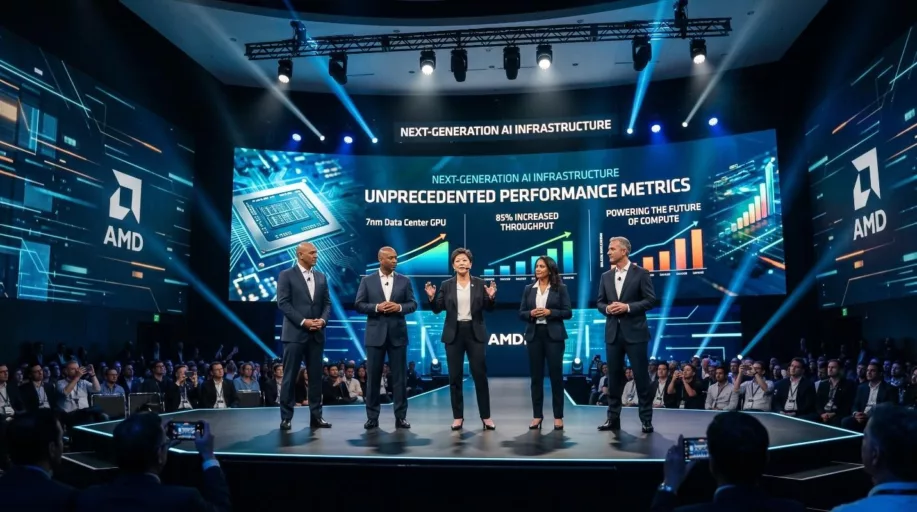
Attending AMD’s Advancing AI 2026 event, it was impossible to ignore the heavy symbolism of the venue. Staged prominently in Moscone Center West, the very building that once hosted Intel’s most triumphant industry moments, AMD did far more than just rent a convenient convention hall. They served a very public notice that they are displacing Intel, not just in the server market share reports, but deeply within the minds, strategic planning, and capital budgets of global enterprise buyers.

Asset 019f901e-4609-7bf0-850e-82f449bd9bb7The transition is profound and multi-layered. When an enterprise buyer or infrastructure architect walks into Moscone West today, they are no longer looking for incremental, single-digit performance updates to legacy architectures. They are looking for transformative enterprise solutions and massive parallel processing scale capable of handling trillion-parameter models. By aggressively occupying this historical venue, AMD has effectively rewritten the entire enterprise narrative. The psychological impact on IT decision-makers cannot be overstated; when the physical venue that an entire generation of engineers associates with industry dominance changes its corporate colors to your primary competitor, the subconscious message is that the torch has officially been passed. AMD has successfully transformed what was once a relatively modest, tightly controlled press briefing into a massive, multi-day ecosystem event. With hundreds of developer sessions, packed expo floors, and keynote presentations that rival NVIDIA’s GTC in scale and importance, AMD is signaling a definitive and permanent shift in industry leadership.

Leadership and the Andy Grove Paradigm

The starkest and most consequential contrast between AMD and Intel right now isn’t merely found in benchmark scores, transistor counts, or node process advantages; it is fundamentally found in corporate culture and leadership strategy. The artificial intelligence opportunity is undeniably massive, representing the most significant platform and compute shift since the commercialization of the internet itself. However, the rate of technology advancement in this space is absolutely unprecedented. The window to establish dominance is narrow, and success requires relentless innovation, aggressive talent acquisition, and an internal environment that actively fosters bold risk-taking.

Currently, Intel, operating under the direction of CEO Lip-Bu Tan, is undergoing significant structural changes and executing massive, painful layoffs in a desperate attempt to right-size the business and appease restless shareholders. While aggressively cutting headcount does, over the short term, temporarily improve the financials on a quarterly earnings report, it is a fundamentally flawed strategy when facing a generational technology inflection point. In fact, Intel’s current trajectory seems to explicitly ignore the very survival lessons taught by its most legendary leader, the late Andy Grove. Grove famously understood and preached that you simply cannot cut your way out of a competitive hole. When the market is accelerating away from you, pulling back on resources hollows out a company’s core engineering capabilities, making the execution of future roadmaps even more difficult, if not impossible.
The cultural implications of these wildly divergent management strategies are massive and self-perpetuating. AMD is actively hiring, acquiring startups, and advancing their internal capabilities. It is inherently more fun, engaging, and highly productive to work for a company that is expanding its footprint. In a growing organization like AMD, opportunities for career advancement naturally increase, cross-departmental collaboration flows easily, and engineers are actively encouraged to push boundaries because the company is playing to win.

Conversely, a downsizing company creates an incredibly toxic, paralyzed, and stressful environment. When a company is continuously announcing workforce reductions, the internal dynamic fundamentally breaks down. Employees immediately stop positioning for long-term advancement and start worrying exclusively about simply surviving the next quarter. This pervasive termination fear reduces risk-taking and innovation to near zero. The employee concern violently flips from standing out positively to being absolutely terrified to stand out at all, knowing full well that any project failure—even a noble one—could place a fatal target on their back. By maintaining a steadfast focus on growth and capability expansion, Dr. Lisa Su has ensured that AMD’s engineering teams remain aggressively focused on defeating NVIDIA and Intel in the marketplace, rather than worrying about paying their mortgages.

The Synergy of CPU, NPU, and GPU

While much of the financial market’s attention over the last three years has been hyper-focused exclusively on standalone AI accelerators, the operational reality of modern enterprise computing is far more complex. AI factories, sovereign clouds, and next-generation corporate datacenters require a holistic, deeply integrated approach to silicon. This is exactly where AMD possesses a historic, structural, and currently insurmountable advantage: they have a far better, more mature, and seamlessly integrated blend of CPU, NPU, and GPU intellectual property than either NVIDIA or Intel.

NVIDIA undeniably leads the discrete GPU market with an iron grip, but their general-purpose CPU capabilities remain relatively nascent. They rely heavily on Arm-based Grace processors that, while efficient, do not always offer the native x86 compatibility and broad software ecosystem support that many legacy enterprise environments still strictly demand. On the other side of the spectrum, Intel possesses the x86 CPU legacy but has consistently struggled over multiple generations to deliver competitive, high-margin discrete AI accelerators at a scale that challenges the market leaders. AMD sits perfectly positioned in the middle, actively leveraging their dominant EPYC CPUs, their highly capable Instinct GPUs, and their deeply integrated Neural Processing Units (NPUs) to deliver cohesive, full-stack compute solutions.
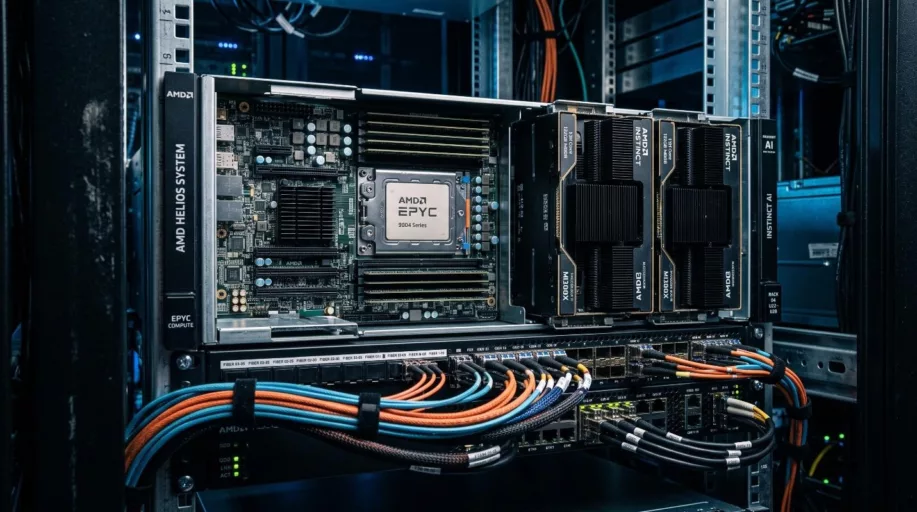
This unique silicon synergy was on spectacular full display with the introduction of the AMD Helios Rackscale Solution. By brilliantly combining next-generation EPYC “Venice” CPUs based on the Zen 6 architecture, cutting-edge MI455X accelerators, and highly efficient Pensando DPUs for advanced networking, AMD is delivering a fully integrated, open-standards AI powerhouse. And the market is responding with unprecedented enthusiasm. AMD is no longer an also-ran picking up the low-margin scraps that NVIDIA leaves behind. They are actively securing massive gigawatt-level infrastructure deals with the world’s largest hyperscalers, including Anthropic, Meta, and Microsoft Azure.

Furthermore, AMD is routinely showcasing performance and power advantages that are in the 20% range even against NVIDIA’s most formidable current hardware offerings. This power efficiency is not just a marketing bullet point; it is absolutely critical for modern deployments. As AI datacenters scale to unprecedented sizes, sheer power consumption and thermal management have become the ultimate operational bottlenecks. AMD’s unique ability to optimize the entire data pathway—from the EPYC CPU handling the initial massive data preparation and vectoring, to the NPU managing localized edge inference, to the Instinct GPU churning through massive training parameters—provides a compelling and tangible total cost of ownership advantage. Historically, AMD was widely known as a friendly, collaborative partner, willing to work within open ecosystems. More recently, however, they have leveraged that collaborative nature into a highly strategic and lethal weapon, building an open software ecosystem with ROCm that directly and aggressively challenges proprietary walled gardens, successfully pivoting the company to firmly lead the AI future.

Wrapping Up

The technology industry is notoriously unforgiving, and dramatic shifts in market dominance often happen slowly, beneath the surface, before they suddenly happen all at once. The Advancing AI 2026 event at Moscone Center West feels exactly like that critical, irreversible tipping point. AMD has successfully executed a masterclass in strategic corporate growth, aggressively leveraging their comprehensive silicon portfolio to meet the enterprise market exactly where it is heading. By consciously choosing to invest heavily in top-tier talent and advanced engineering capabilities while their oldest and fiercest rival, under Lip-Bu Tan, resorts to defensive, morale-crushing layoffs, AMD has captured both the technological high ground and the industry’s collective imagination.

The ghost of IDF may still silently linger in the cavernous halls of Moscone West, serving as a stark reminder of how quickly empires can fall in the semiconductor market. But make no mistake: the future being built in those halls today belongs entirely to AMD. They have conclusively proven that they possess the visionary leadership, the unparalleled hardware synergy, and the required corporate courage to not just participate in the ongoing AI revolution, but to aggressively dictate its terms.

  •  

Enterprise AI Data Workloads Crush Global 5G Networks Forcing Massive Shifts In Edge Computing Hardware

Every decade or so, the technology industry collectively forgets a fundamental law of physics: you cannot push an ocean of data through a garden hose, no matter how efficiently you compress it. We are currently watching this exact scenario play out with Generative AI and our global cellular networks. I have been warning about the limitations of cloud-dependent architectures for years, arguing that the “dumb terminal” approach to mobile computing is fundamentally flawed when dealing with persistent, high-bandwidth data streams.

Now, the data is officially backing up the theory. Recent network diagnostics highlight a looming crisis that IT decision-makers can no longer ignore. The immediate ramifications for telecommunications, edge hardware, and component supply chains are profound, and they are about to rapidly accelerate the obsolescence of current-generation enterprise mobility strategies.

The Hidden Cost of Cloud AI on 5G Infrastructure

When 5G was rolled out, it was marketed as the ultimate connectivity panacea – a pipeline so wide that latency and bandwidth constraints would effectively vanish. However, 5G networks were primarily optimized for asymmetric traffic: heavy downlinks for streaming high-definition video and relatively light uplinks for requests and text.

Generative AI fundamentally breaks this model. Today’s enterprise AI workloads demand continuous, massive bidirectional data flows. Employees are uploading massive proprietary datasets for Retrieval-Augmented Generation (RAG), querying massive language models, and streaming continuous real-time video and audio for AI-driven analytics. According to recent diagnostic testing, these highly persistent AI workloads strain 5G infrastructure in ways carriers never modeled for. The Ookla data clearly illustrates that cell towers in dense enterprise zones are experiencing severe spectral congestion, driving up latency and degrading the experience for all users on the node.

This isn’t just a carrier problem; it is an enterprise productivity crisis. When a cloud-dependent AI application encounters network latency, the resulting “hallucinations” or processing delays destroy the user experience. The cloud simply cannot be the sole brain for real-time enterprise AI.

Vindication for Qualcomm and the Push for Edge AI

If you look closely at what Qualcomm, Apple, and a handful of other smartphone technology leaders have been doing over the past three years, it looks remarkably prescient today. Rather than relying entirely on the cloud, Qualcomm has aggressively pivoted toward integrating high-performance Neural Processing Units (NPUs) directly into their Snapdragon mobile platforms and PC processors.

This strategy is no longer just a “nice-to-have” feature; it is an absolute necessity. By processing AI workloads locally on the device—often referred to as Edge AI—smartphones and enterprise laptops bypass the 5G bottleneck entirely. Qualcomm’s approach offloads inference tasks, such as live translation, local document summarization, and ambient noise cancellation, keeping that massive data footprint off the carrier network.

This hybrid AI model, where the heavy training happens in the data center but the localized, privacy-sensitive inference happens on the user’s device, is the only sustainable path forward. It justifies the massive R&D budgets these silicon vendors have poured into edge computing capabilities. Companies heavily invested in thin-client architectures that rely exclusively on cloud processing are going to find their deployments struggling against network physics, while edge-heavy deployments will experience a massive competitive advantage in speed, reliability, and security.

The Memory Wall Threatening Edge AI Innovations

However, pushing AI to the edge introduces a critical, potentially catastrophic supply chain chokepoint: memory. Running Large Language Models (LLMs) or sophisticated multimodal AI locally requires massive amounts of high-speed random-access memory.

Here is the problem: the global semiconductor industry is currently heavily constrained. Foundries are aggressively retooling their DRAM production lines to manufacture High Bandwidth Memory (HBM) to feed the insatiable demand for Nvidia’s data center GPUs. Because HBM yields are lower and the production process is more complex, this shift is actively cannibalizing the production of LPDDR (Low-Power Double Data Rate) memory used in smartphones, laptops, and edge devices.

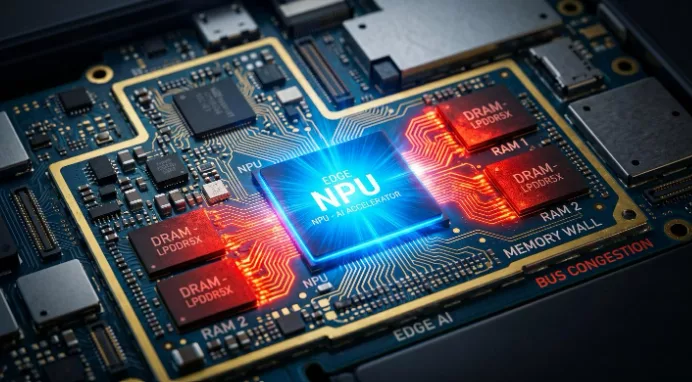
This memory shortage is going to adversely impact efforts to provide more AI capability at the edge. We are already seeing price hikes in the spot market for standard memory modules. For enterprise IT buyers, this means the cost of next-generation, AI-capable endpoint devices is going to surge. Furthermore, battery constraints on mobile devices limit how much active memory can be powered simultaneously. Silicon engineers are currently battling a “memory wall,” where the computational power of the NPU far outpaces the bandwidth and capacity of the device’s onboard RAM. Without immediate breakthroughs in memory architecture, the promise of localized edge AI will hit a hard physical ceiling.

Transforming Edge Hardware and Wide Area Networks

Because mobile devices will be constrained by this memory wall, we are going to see a radical transformation in intermediary Edge Hardware and Wide Area Networks (WAN). If the smartphone can’t process the entire workload, and the cloud is too far away (and the 5G pipe too congested), the compute must move to the network edge.

We are going to see a massive proliferation of Multi-access Edge Computing (MEC) nodes installed directly in enterprise branch offices, factory floors, and at the base of cell towers. These localized AI servers will act as intelligent proxies. Hardware vendors like Dell, HPE, and Lenovo are already positioning high-density, ruggedized micro-servers designed specifically to ingest and process local AI workloads before they ever touch the broader cellular network.

Simultaneously, SD-WAN (Software-Defined Wide Area Network) architectures are undergoing a fundamental rewrite. Traditional SD-WAN routed traffic based on IP addresses and simple port protocols. The new generation of AI-native WAN networks will dynamically inspect data flows, actively dropping non-essential AI telemetry, compressing inference results, and prioritizing real-time AI API calls over standard web traffic. The network itself must become self-aware and predictive to survive the incoming data tsunami.

The Shape of Post-2030 Devices

Looking beyond the current decade, the fallout from this network strain and edge hardware evolution will dictate the design of post-2030 devices. The traditional smartphone, as a rectangular slab of glass that you poke with your finger, will likely be entirely deprecated by 2030.

Future devices will likely take the form of distributed wearables – AR glasses, intelligent earpieces, and biometric sensors—that act as fragmented input/output interfaces. These peripherals will rely on an entirely new computing paradigm called “dynamic workload partitioning.” Depending on the real-time health of the local 6G network, the battery life of the device, and the user’s proximity to a localized edge node, the device will instantly and seamlessly decide where to process a generative AI request.

We will also see the commercialization of neuromorphic computing in endpoint hardware. Because traditional Von Neumann architectures (separating CPU and Memory) are causing the current bottlenecks, post-2030 silicon will mimic the human brain, processing and storing data in the same microscopic location to drastically reduce power consumption and eliminate the memory bandwidth wall. By 2030, devices won’t just run AI; their underlying hardware architecture will be fundamentally redefined by it.

Contrary and Accelerating Trends

While the strain on 5G is driving compute to the edge, there are fascinating cross-currents in the industry that demand attention.

One highly accelerating trend is the push toward Small Language Models (SLMs). While the media obsesses over trillion-parameter models like GPT-4, developers are rapidly realizing that a highly optimized 7-billion parameter model (like Meta’s Llama 3 8B or Microsoft’s Phi-3) can easily run locally on a Qualcomm Snapdragon chip with exceptional accuracy for specific tasks. This trend directly mitigates the 5G strain, as developers abandon massive general-purpose cloud models in favor of hyper-specialized, local SLMs. It is a trend born out of necessity to bypass the exact network congestion Ookla has identified.

Conversely, a contrary trend exists within the hyperscaler ecosystem (AWS, Google Cloud, Microsoft Azure). Despite the network physics working against them, they are aggressively pushing “AI-as-a-Service” thin clients, essentially trying to brute-force the cloud AI model. They are investing heavily in custom silicon to drive down data center inference costs, hoping that specialized compression algorithms and future 6G rollouts will save their centralized business models. This creates a massive strategic war in the enterprise space: the Hyperscalers fighting to keep data in the cloud, versus silicon vendors like Qualcomm and Intel fighting to keep it on the endpoint.

In my view, the laws of physics heavily favor the edge. You cannot virtualize away the speed of light or the limits of radio frequency spectrum.

Wrapping Up

The telecom industry is waking up to a harsh reality: Generative AI is fundamentally hostile to current 5G network architectures. The recent Ookla data proving that enterprise AI workloads are heavily taxing cellular infrastructure is the canary in the coal mine. This crisis provides total validation for the localized AI strategies championed by Qualcomm and edge hardware vendors, proving that local processing is the only way to ensure reliable enterprise AI performance.

However, the transition to the edge is fraught with its own hardware hurdles, most notably a severe global memory shortage driven by competing data center demands. Solving this will require an entire overhaul of how we build wide-area networks, the deployment of intelligent micro-servers at the edge, and eventually, the abandonment of traditional mobile architectures in favor of neuromorphic, dynamically partitioned devices post-2030. The AI revolution isn’t just changing software; it is actively ripping apart and rebuilding the entire global hardware and telecommunications stack. Those who fail to adapt their IT strategies to this new edge-heavy reality will find themselves stranded on the wrong side of the network bottleneck.

  •  

HP Neutralizes Agentic AI Intrusions Using Advanced Hardware Endpoint Isolation

I have spent decades analyzing the architectural shifts that define personal computing, watching the industry pivot from mainframes to client-server, and then from local desktops to the cloud. We are currently navigating another massive transition that will fundamentally redefine how we interact with machines. As the industry races to integrate artificial intelligence directly into the operating system and local hardware, the attack surface for enterprise organizations is expanding at an alarming rate. The gap between raw generative processing capability and enforced software security is where the real danger lies, and it is a gap that traditional security vendors are struggling to bridge.

Today, the modern workstation – increasingly a powerful, portable notebook that effectively serves as a mobile desktop replacement – holds the keys to an enterprise’s most sensitive, confidential information. Yet, most organizations are still applying legacy, reactive security paradigms to an entirely new class of computational behavior. As artificial intelligence moves from the cloud to the endpoint, the rules of the game have completely changed. 

The Unique Vulnerability of Agentic AI Workflows

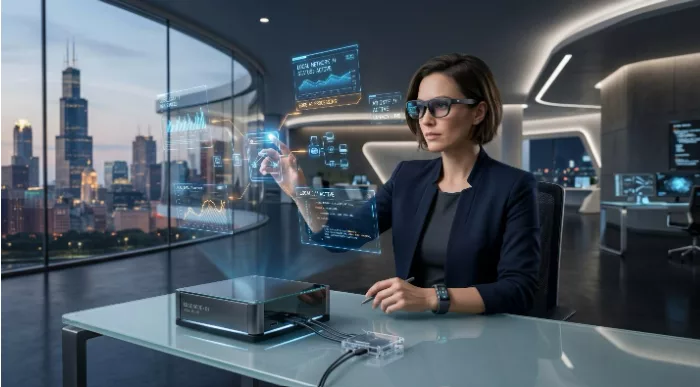
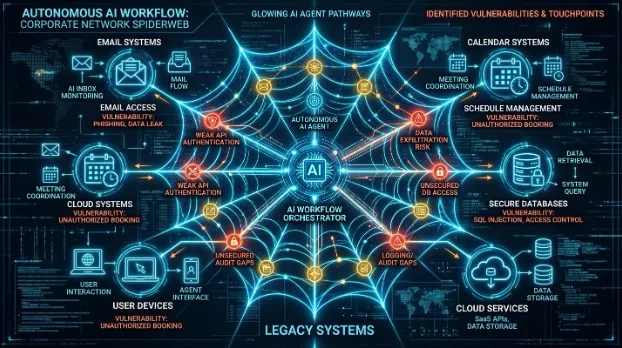
The conversation around artificial intelligence has rapidly shifted from simple, passive generative text chatbots to what the industry now calls agentic AI. Unlike passive tools that sit idle until you type a prompt, agentic AI workflows operate autonomously in the background. They can parse your calendar, read your incoming emails, draft contextual responses, scrape web data, and execute commands across multiple local and cloud applications to achieve a stated goal.

A prime example of this reality is OpenClaw, a free and open-source autonomous artificial intelligence agent that can execute complex tasks via large language models (LLMs), using messaging platforms as its main user interface. While OpenClaw represents an incredible leap in personal productivity, allowing users to build a “second brain” that acts on their behalf 24/7 by routing tasks through a local background daemon, it also represents an unprecedented security vulnerability for IT administrators. These agents require vast, unrestrained access to system resources, local data, and user credentials to function effectively.

If an agentic AI framework like OpenClaw is subjected to a prompt injection attack, or if it falls under malicious influences through poisoned data sets, the consequences for the enterprise are disastrous. A compromised agent doesn’t just crash or throw an error code; it actively works against the user, potentially exfiltrating highly sensitive corporate data, overriding network permissions, and creating a massive privacy protection failure. Because these agents are designed to operate seamlessly in the background and mimic legitimate user actions, traditional signature-based antivirus software often completely misses the unauthorized activity. The legacy security software assumes the agent is simply executing its normal, authorized routine. 

This lack of visibility into AI presence and behavior is the critical failure point for most modern endpoint defenses. You cannot secure what you cannot see, and you cannot stop an attack if your security software cannot distinguish between a legitimate agentic workflow and a malicious, data-stealing exploit.

HP’s Sandbox and Container Mastery

This is where HP has a distinct, structural advantage over nearly every other PC original equipment manufacturer (OEM) on the market. HP has long maintained a best-in-class enforced security offering for endpoints, largely because their engineering teams recognized early on that relying purely on reactive software detection was a losing battle against sophisticated adversaries. Instead, HP has leaned heavily into proactive isolation technology. 

Their advanced HP Wolf Security architecture is built on a very strong, mature sandbox and container background. Through their Sure Click technology, HP has perfected the art of hardware-enforced micro-virtual machines (micro-VMs). Traditionally, when a user opens an untrusted file, clicks a sketchy link, or downloads a potentially dangerous email attachment, HP automatically isolates that specific activity within a disposable micro-VM powered by Intel and AMD virtualization extensions. If malware is present, it executes, but it is entirely contained within that sealed digital environment. When the task is closed, the micro-VM is destroyed, and the malware simply vanishes without ever touching the host operating system. 

Applying mature, existing virtualization foundations to the novel AI security problem is rapidly becoming a strategic imperative across the industry. Leading cybersecurity architectures are now leveraging hardware-enforced isolation technology to create essential guardrails for agentic AI workflows. What the modern enterprise security stack must deliver is comprehensive AI governance. First, these next-generation systems provide vital visibility by discovering when and where an autonomous AI is operating on the local machine. Second, they utilize secure AI containment, automatically placing robust agentic frameworks inside isolated micro-VM solutions rather than relying on legacy software detection.

By running the AI agent inside a tightly controlled micro-VM container, enterprise security providers ensure that even if the AI is compromised by a malicious payload or an unauthorized external command, the agent remains completely contained. The malicious influence cannot cross the virtualized boundary into the host operating system, nor can it access confidential data outside of its strictly defined policy controls. Furthermore, the industry is increasingly engineering these architectures with simple, standardized deployment methodologies, meaning IT administrators can seamlessly roll out these complex AI policy controls without requiring bespoke, customized configurations for every individual device in the corporate fleet.

While threat intelligence experts honestly note that the broader industry does not yet have extensive examples of containing hyper-advanced AI malware “in the wild”—largely because these specific agentic threat vectors are still actively emerging—security researchers have conclusively demonstrated in the lab that this containerized technology is entirely viable. The micro-VM approach works just as effectively against an errant, malfunctioning AI agent as it does against a traditional ransomware executable. Ultimately, this hardware-backed isolation enables the prompt execution of local analytics and agentic AI tasks without sacrificing absolute privacy protection against confidential data leakage.

Anchoring Trust With A Silicon-to-Cloud Approach

However, software containers, no matter how intelligently designed, are only as strong as the physical hardware they run on. A truly secure endpoint requires a silicon-agnostic but deeply integrated hardware root of trust. HP’s unique silicon-to-cloud solution allows them to stand out in a profoundly competitive and increasingly commoditized hardware field. 

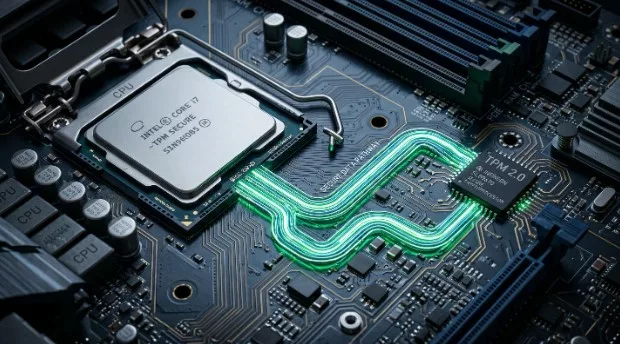
You cannot just secure the operating system; you must secure the firmware and the physical communication pathways on the motherboard itself. HP has historically led this charge with their self-healing BIOS technology, Sure Start, but their recent introduction of HP TPM Guard perfectly exemplifies their unmatched hardware differentiation against physical access attacks.

The Trusted Platform Module (TPM) is the cryptographic vault of the modern PC, heavily utilized by enterprise encryption tools like Microsoft BitLocker to protect data at rest. However, sophisticated attackers with physical access to a machine can use probing tools to intercept the encryption keys as they travel across the unencrypted bus between the TPM and the CPU. HP TPM Guard solves this critical vulnerability by physically and cryptographically encrypting this specific link, utilizing an authenticated tunnel that stops physical bus-intercept and sniffing attacks dead in their tracks. It physically binds the TPM securely to the device, rendering the chip completely inoperable if it is removed or tampered with by a bad actor. 

This level of paranoia and precision at the hardware level fundamentally reinforces the micro-VMs operating at the software level. It creates a cohesive, highly enforced security ecosystem where the physical hardware, the firmware, the operating system, and the cutting-edge AI applications are all continuously monitored, verified, and protected from the factory floor to the employee’s desk. 

Turning Security Dominance Into Sales Volume

When you evaluate corporate history and the mechanics of massive industry turnarounds—much like observing the strategic shifts at IBM in the 1990s or Apple in the early 2000s—you realize that having the superior product is only half the battle. The other half is ensuring that the broader market fundamentally understands the existential necessity of your technological solution.

Currently, HP’s security stack is a significant, highly respected part of every sales engagement. IT buyers and enterprise customers who use this technology frequently respond that HP is the only company that seems to fully grasp and actively mitigate these rapidly growing security risks. The problem, from a purely commercial standpoint, is that this realization often happens after the customer has engaged deeply with HP’s technical engineering teams, rather than being the primary, urgent driver that brings the customer to the purchasing table in the first place.

To drastically leverage these clear endpoint security advantages and significantly increase enterprise sales volume, HP needs to pivot its broader market messaging.

First, HP must stop selling “security features” and start selling “AI Insurance.” The enterprise market is universally terrified of AI data leakage, intellectual property theft, and rogue agentic workflows. HP needs to aggressively position their micro-VM containment not just as a neat, value-added security feature, but as the only responsible way to deploy artificial intelligence in a corporate environment. If a Chief Information Officer is going to allow highly autonomous tools like OpenClaw on their network, HP needs to make it abundantly clear that an HP endpoint is the only hardware platform where that deployment can be executed safely and legally. The core marketing message should be stark and uncompromising: deploying autonomous, agentic AI without HP’s hardware-enforced containment is nothing short of corporate negligence. 

Second, HP needs to lean even harder into their partner ecosystem. HP uniquely educates and enables their global partners to successfully help deploy secure solutions, but this enablement needs to be weaponized specifically for the impending AI era. Channel partners shouldn’t just be quoting prices for fleet laptop refreshes; they should be actively conducting “AI Readiness and Risk Assessments” powered by HP Wolf Security frameworks. By empowering their channel partners to tangibly demonstrate the terrifying ease of prompt injection and data exfiltration in uncontained environments, the hardware sale naturally becomes a secondary consequence of a primary, unignorable security imperative.

Finally, HP should elevate the visibility of foundational technologies like TPM Guard to the C-suite and the boardroom. Board members intimately understand physical theft, regulatory compliance, and corporate espionage. By clearly explaining that a standard competitor’s laptop can be cracked with a physical probing tool to extract BitLocker keys, while an HP machine physically encrypts the internal pathways to protect the data, HP moves the conversation away from the IT department’s budget constraints and directly into the Board’s risk management portfolio. When security mitigates board-level risk, premium hardware pricing becomes irrelevant, and volume sales naturally follow.

Wrapping Up

The rapid influx of agentic AI is transforming the traditional personal computer from a simple, passive tool into an active, autonomous digital employee. But with this incredible autonomy comes an unprecedented risk to data privacy, intellectual property, and overall system integrity. Traditional software-based security is fundamentally ill-equipped to manage or police autonomous agents that are deliberately designed to mimic human behavior and access deep systemic resources.

HP’s foresight in developing deep, hardware-enforced isolation technology has positioned them perfectly for this exact inflection point in computing history. By intelligently utilizing mature micro-VM containers to physically wall off agentic AI workflows, and aggressively backing that up with impenetrable, silicon-to-cloud hardware defenses like TPM Guard, HP has built the safest, most resilient endpoint on the market. If HP can successfully translate this sheer engineering triumph into an aggressive, channel-driven narrative centered squarely about AI risk management, they won’t just secure their corporate users’ data—they will secure a dominant, unassailable share of the enterprise hardware market for the next decade.

  •  

The 2026 Fujian Global Innovation and Entrepreneurship Competition Has Been Launched

Xiamen, China – The 2026 Fujian Global Innovation and Entrepreneurship Competition has been recently launched in Fujian, China. The organizing committee will provide more favorable policies, a broader platform, and better services to help talents from around the world settle and develop in Fujian.

The competition was first held in 2025, attracting 683 projects from 39 countries and regions. Among them, 72 projects have made to the finals, and 24 projects won the first, second, and third prizes.

Photo of the First Global Innovation and Entrepreneurship Competition (2025)
Applications for the 2026 competition are now open to the talents worldwide. The main applicant of each project is required: to have earned a master’s degree (or above) overseas (or outside the Chinese mainland) or to have more than two years of innovation and entrepreneurship experience overseas (or outside the Chinese mainland); and to be currently employed overseas (or outside the Chinese mainland) or to have established businesses/been employed on the Chinese mainland after January 1, 2021. Participating projects must possess completely independent intellectual property rights, demonstrate the technological level that is internationally advanced or leading in China, and exhibit a clear business model and promising market prospects.

The 2026 competition will be organized into three tracks: Electronic Information, Biotechnology, and Advanced Manufacturing. The Electronic Information track includes artificial intelligence, integrated circuits, and information technology; the Biotechnology track covers innovative drugs and therapies, high-end medical devices, and cutting-edge biotechnology; the Advanced Manufacturing track spans new energy, new materials, and equipment manufacturing. The competition provides talents in the relevant industries with excellent opportunities to quickly connect with industrial application scenarios, venture capital funds, and research platforms.

This year, the number of final awards has been increased. There are 6 First Prizes, 9 Second Prizes, and 15 Third Prizes Excellence Award will be given to projects ranked 11th to 20th in each track. First Prize winners may also receive project funding of up to RMB 2 million. Additionally, a referral reward of up to RMB 20,000 is available to individuals or organizations that have recommended prize-winning projects.

The finals will be held in Xiamen, Fujian Province, during the 2026 China International Fair for Investment and Trade (CIFIT). The organizing committee will provide accommodation and meals for up to two members per finalist team and reimburse travel expenses for up to two members (up to RMB 20,000 per person, depending on the places of departure).

Online application is now accessible on the official website: https://www.fujiantalent.com. The deadline of application is 24:00 Beijing time on June 30, 2026.

For inquiries, please contact the organizing committee office.

The organizing committee confirms that no fees will be charged to participants. Applicants must guarantee the authenticity of the project information provided and the clarity of intellectual property rights, and will bear all legal consequences resulting from inaccurate information or disputes. The organizing committee reserves the right to further supplement the competition rules and to provide the final interpretation.

We warmly welcome the talents from around the world!

  •  

AMD Shatters the AI Memory Bottleneck with Predictive MEXT Technology

I used to build about two custom desktop systems every quarter to keep my finger on the pulse of hardware modularity and performance scaling (I don’t do that anymore because memory costs have made this practice too expensive). Sitting in my Bend office, reviewing component invoices and watching the fluctuating prices of DDR5, gives me a very localized, micro-perspective on a massive, macro-level industry crisis. Managing the cost-to-performance ratio of high-speed memory is a constant headache for the enthusiast, but what is a mere annoyance for a desktop builder has escalated into a full-blown financial catastrophe for enterprise data centers scaling up artificial intelligence.

The industry has spent the last few years obsessing over raw compute – chasing after the highest teraflops and the most advanced neural processing units. But processing power is only half the equation. You can have the fastest processor in the world, but if it is constantly sitting idle waiting for data to be retrieved from storage, you are burning capital for zero return. This brings us to the most critical, yet historically overlooked, challenge of the current generative AI era, a challenge that Advanced Micro Devices (AMD) is now addressing head-on with a fascinating strategic acquisition.

The Expanding Memory Bottleneck

To understand why this move matters, we first need to define the current memory bottleneck, often referred to in engineering circles as the “memory wall.” For decades, the performance of CPUs and GPUs has scaled at a much faster rate than the bandwidth and capacity of the memory supporting them. Large Language Models (LLMs), deep learning analytics, and virtualization workloads require vast amounts of high-speed memory, specifically Dynamic Random-Access Memory (DRAM) and High Bandwidth Memory (HBM), to hold the parameters and datasets actively being processed.

When an AI accelerator exhausts its available high-speed memory, the system is forced to swap data back and forth from much slower non-volatile storage, like NAND flash drives. This data swap introduces massive latency, completely stalling the processors. Currently, the solution to this bottleneck has been blunt-force economics: just buy more DRAM. However, this approach has hit a wall of its own. Memory now accounts for roughly 30% of total hyperscaler data center expenditure, marking a staggering fourfold increase in just a few short years. Relying purely on hardware scaling to solve the memory bottleneck is no longer economically viable for anyone outside of a sovereign wealth fund.

The Persistent Nature of the Memory Crisis

Is the memory bottleneck expected to get worse? The short answer is yes, and significantly so. The AI boom has triggered an insatiable appetite for data ingestion, and the hardware supply chain simply cannot keep pace. We are currently seeing a massive constraint on the supply side. Semiconductor foundries are incredibly complex, multi-billion-dollar facilities that take years to build and calibrate. You cannot simply flip a switch and double global DRAM output.

According to recent industry analytics, the AI infrastructure rush is driving a strategic reallocation of memory production toward high-margin, enterprise-grade components. As a result, standard DRAM supply growth is projected to remain well below historical norms, hovering around 16% year-over-year. This creates immense pricing pressure across the entire market. How long will this last? Top executives across the silicon landscape, including the leadership at NVIDIA, have publicly acknowledged that memory shortages and related supply constraints are expected to continue for several years. We are looking at a prolonged, multi-year reality where high-speed memory remains a scarce, premium commodity that dictates the upper limits of AI scalability.

Enter MEXT and Predictive Memory Tiering

Faced with a bottleneck that silicon manufacturing cannot quickly resolve, AMD has intelligently pivoted to a software-driven solution. On June 15, 2026, AMD announced its acquisition of MEXT, a California-based startup specializing in AI-driven memory optimization. Rather than trying to out-build the DRAM shortage, AMD acquired the capability to bypass it conceptually.

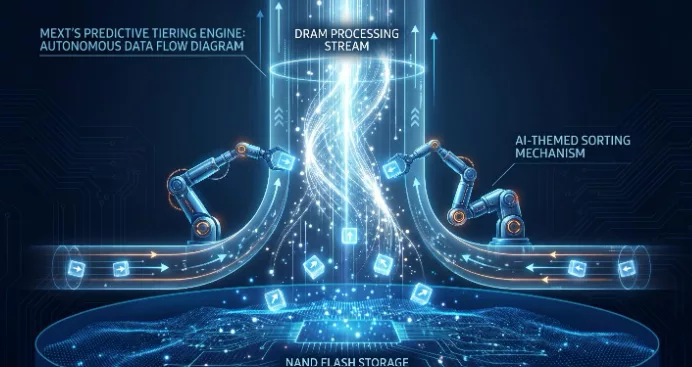
MEXT’s core technology is an AI-powered predictive memory tiering engine designed to make highly affordable NAND flash storage behave more like expensive DRAM. Traditional storage tiering is reactive; a system asks for data, realizes it isn’t in DRAM, and then goes to fetch it from flash, incurring a latency penalty. MEXT completely flips this paradigm.

By utilizing advanced machine learning algorithms, MEXT’s software analyzes a system’s memory access patterns in real time. Because enterprise workloads—like AI inference, large-scale data analytics, and server virtualization—tend to follow highly structured and repetitive data access loops, the software can effectively learn the rhythm of the workload. It then anticipates which data pages the operating system will need next and proactively moves them from the slower flash storage into the high-speed DRAM before the request is even made.

It functions much like the predictive algorithms Skynet might use in a Terminator scenario to anticipate human resistance tactics—analyzing behavioral patterns to execute a preemptive action before the adversary even moves. By successfully predicting data demands, MEXT hides the inherent latency of flash storage. The result is an infrastructure illusion: the operating system believes it has access to a massive pool of high-speed DRAM, when in reality, it is seamlessly leveraging far cheaper NAND storage.

Integration Timeline and Implementation

Of course, acquiring a technology and successfully deploying it at an enterprise scale are two entirely different endeavors. How long will it take for MEXT’s predictive engine to become fully integrated into AMD’s data center solutions?

While financial terms and exact product roadmaps are closely guarded, enterprise infrastructure moves at a deliberate pace to ensure stability. MEXT’s software must be deeply woven into AMD’s existing architecture, particularly the ROCm open software platform that developers use to optimize AI workloads on AMD Instinct GPUs and EPYC CPUs. This is not a simple driver update; it is a fundamental reworking of how the processor interacts with the memory hierarchy.

We can realistically expect to see early-stage integration rolling out to AMD’s top-tier hyperscaler partners within the next 6 to 9 months, allowing for aggressive real-world stress testing. Broad commercial availability—where standard enterprise customers can purchase AMD servers equipped with this predictive memory tiering out of the box—will likely take 12 to 18 months. AMD needs to ensure that the AI overhead required to run MEXT’s predictive algorithms does not cannibalize the processing power intended for the customer’s actual AI workloads. Once optimized, this integration will fundamentally reduce infrastructure costs and improve resource utilization across their entire enterprise portfolio.

Market Impact on AI Availability, Pricing, and Performance

The successful integration of MEXT’s technology will have profound ripple effects across the entire technology sector, fundamentally altering the economics of artificial intelligence.

First, the impact on the memory bottleneck itself will be transformative. While MEXT cannot replace the need for ultra-fast HBM in the most latency-sensitive AI training environments, it serves as a massive relief valve for AI inference, retrieval-augmented generation (RAG), and general-purpose analytics. By expanding the usable memory capacity without requiring proportional hardware expansion, AMD provides a practical way for enterprises to delay incredibly expensive hardware upgrades.

This leads directly to AI availability and pricing. Right now, building a localized AI data center is prohibitively expensive for mid-sized enterprises, largely due to memory costs. If AMD can deliver a server platform that offers DRAM-like performance using a storage array composed heavily of cheaper NAND flash, the Total Cost of Ownership (TCO) for AI infrastructure will plummet. This democratization of hardware means that advanced AI capabilities will no longer be strictly sequestered within the massive public clouds operated by Google, Microsoft, and Amazon. More organizations will be able to afford local, sovereign AI deployments, accelerating innovation across healthcare, finance, and manufacturing.

Finally, regarding performance, we are witnessing a critical shift in the AI arms race. We have officially moved beyond the “silicon wars” and entered the “infrastructure optimization war.” Raw processor speed is taking a back seat to holistic system efficiency. AMD is signaling that the future of computing performance won’t just be dictated by who can etch the smallest transistors on a wafer, but by who has the smartest software orchestrating the flow of data between those transistors.

Wrapping Up

The memory bottleneck is arguably the most significant physical constraint limiting the proliferation of artificial intelligence today. With DRAM prices skyrocketing and supply struggling to keep up with explosive demand, the industry requires innovative detours around the hardware limitations it has encountered.

AMD’s acquisition of MEXT is a brilliant strategic maneuver that acknowledges a hard truth: you cannot simply buy your way out of the current memory shortage. By leveraging AI-powered predictive software to make cost-effective flash storage perform like premium DRAM, AMD is positioning itself to offer highly efficient, lower-cost AI infrastructure. While it will take 12 to 18 months to see this fully realized in commercial data centers, the integration of MEXT’s technology promises to shatter the memory wall, ultimately democratizing AI access and redefining performance metrics for the entire enterprise computing industry.

  •  

AMD Shatters Training Benchmarks as Frustrated AI Developers Seek Alternatives to Expensive NVIDIA Hardware

For decades, building around two high-performance desktop systems a quarter has provided me with a direct, hands-on appreciation for the evolution of compute architectures. Over the years, a sustained preference for AMD Threadripper processors has consistently demonstrated what a focused, aggressive engineering team can accomplish when they prioritize massive, scalable throughput. That same engineering DNA that reshaped the high-end desktop market is now actively reshaping the enterprise data center, and the timing could not be more critical for the artificial intelligence industry.

We are currently navigating a turbulent inflection point in the AI hardware market. While the initial generative AI boom was defined by a frantic, almost panic-driven rush to acquire hardware at any cost, the market is now entering a mature phase of deployment and rationalization. Chief Information Officers and enterprise developers are looking at their balance sheets, evaluating their power envelopes, and asking hard questions about long-term sustainability. In this environment, the undisputed market leader is suddenly showing significant vulnerabilities, creating a massive opportunity for a well-positioned challenger.

NVIDIA Encounters the Limits of Price and Power

NVIDIA deserves immense credit for kickstarting the generative AI revolution. Their foresight in developing the CUDA software ecosystem and their early bets on parallel processing architectures made them the default choice for AI training and inference. However, being the default choice in a monopoly-like environment inevitably leads to friction with the customer base.

Today, NVIDIA is increasingly falling out of favor with a growing segment of AI developers and enterprise companies. The primary drivers of this frustration are exorbitant pricing models and staggering power requirements. Procuring NVIDIA’s flagship H100 or the upcoming Blackwell B200 GPUs requires massive capital expenditures. For many startups and mid-tier enterprises, the cost of entry is becoming prohibitive, threatening to stifle the very innovation that the AI boom promised to democratize.

Furthermore, the power draw of these systems is testing the physical limits of modern data centers. You cannot simply plug infinite racks of green hardware into a facility; you are bound by the electrical grid and the thermal dissipation capabilities of the building. Companies are discovering that the total cost of ownership extends far beyond the sticker price of the chips; it includes the massive utility bills and retrofitting required to keep these systems from melting down. Developers are actively seeking out architectures that prioritize efficiency alongside raw performance. They need hardware that delivers the compute necessary for advanced models without requiring a dedicated nuclear reactor to run it.

AMD’s Breakthrough in MLPerf Training 6.0

Taking advantage of a competitor’s market friction requires more than just showing up; it requires undeniable technical execution. This brings us to the latest benchmarks published by MLCommons, the industry standard for evaluating machine learning performance. AMD has delivered an absolute masterclass in execution with their recent MLPerf Training 6.0 results, proving that their Instinct MI300X accelerators are not just viable alternatives, but top-tier competitive solutions.

The MLPerf results provide validated, third-party proof that AMD’s hardware can stand toe-to-toe with NVIDIA in highly complex training workloads, particularly in large language models (LLMs). Training AI models is the most computationally intensive phase of AI development. It is where hardware bottlenecks are mercilessly exposed. By posting breakthrough numbers in MLPerf 6.0, AMD has definitively answered the question of whether they have the silicon capable of handling the heavy lifting of enterprise AI.

This achievement is not a lucky break; it is the result of sustained, grueling work. AMD’s engineering team and executive leadership deserve tremendous credit for staying incredibly focused on their strategic roadmap. Under the guidance of CEO Lisa Su and the broader technical leadership, AMD has refused to be distracted by industry noise. They have methodically built chiplet-based architectures, expanded their memory bandwidth, and optimized their interconnects to deliver the exact performance profiles that today’s AI workloads demand. They have earned their technical stripes, and the MLPerf results are the irrefutable receipt.

The Marketing Gap and the Strategic Hire of Carolyn Guss

However, having the best or most efficient hardware is only half the battle in the enterprise technology sector. The graveyard of Silicon Valley is filled with superior technologies that failed because they could not tell their story or build market perception. Historically, this has been AMD’s Achilles heel against NVIDIA and Intel. AMD has often won the technical benchmarks but lost the marketing war, allowing competitors to dominate mindshare and maintain premium pricing.

To capitalize on NVIDIA’s current vulnerabilities, AMD must aggressively translate its technical achievements into corporate recognition. This makes the timely appointment of Carolyn Guss as Chief Communications Officer a critical strategic maneuver. While often viewed through the lens of a CMO-equivalent in terms of shaping global narrative, Guss is stepping in to oversee corporate, product, and executive communications at the exact moment AMD needs to scale its AI leadership story.

Guss brings over two decades of heavy-hitting experience that maps perfectly to AMD’s current challenges. Coming from Salesforce—a company that masterfully transitioned from a simple CRM tool into a global standard for enterprise cloud computing—she understands how to position complex enterprise solutions to C-suite decision-makers. Her previous roles at PagerDuty and Orange provide a deep track record in product launches and reputation management.

AMD does not need to convince hardware engineers that their silicon is good; the MLPerf results do that. AMD needs to convince CIOs, CFOs, and enterprise boards that AMD is the safe, strategic, and financially responsible choice for their AI infrastructure. Guss’s expertise in executive counsel and corporate storytelling is exactly what is required to reframe AMD not as an “alternative” to NVIDIA, but as the smarter, more efficient foundation for the next decade of AI. She has the background to craft campaigns that highlight NVIDIA’s high total cost of ownership while showcasing AMD’s efficiency, open-source alignment, and engineering stability.

What Else AMD Needs to Do to Seize the Market

While the hardware is competitive and the communications leadership is now in place, the war is far from over. To truly effectively take advantage of current market trends, AMD must execute flawlessly on several remaining fronts.

First and foremost is the software ecosystem. NVIDIA’s deepest moat is CUDA. To break this monopoly, AMD must continue to heavily fund and rapidly iterate on their ROCm open software platform. They need to make the transition from CUDA to ROCm entirely frictionless for developers. This means aggressive investments in developer relations, comprehensive documentation, and direct engineering support for major open-source AI frameworks like PyTorch and TensorFlow. If a developer has to spend weeks rewriting code to port their model to an MI300X, the cost savings of the hardware are negated by the cost of labor. AMD must ensure that their software stack “just works.”

Secondly, AMD needs to align its hardware and software optimizations with the emerging trends in AI architecture, specifically the shift toward agentic AI. It is vital to distinguish between agentic AI, which operates at the cognitive layer to reason, plan, and make decisions, and standard automation, which merely handles the execution layer of predefined tasks. The hardware requirements for these two layers are different. Agentic AI requires massive, continuous context windows and rapid memory access to maintain situational awareness and reasoning loops. AMD’s strategy of providing massive memory capacity on their accelerators positions them perfectly for agentic workloads. They need to aggressively market this specific capability, showing how AMD hardware is uniquely suited to power the advanced cognitive models of the future, rather than just the simple automation tasks of the past.

Finally, AMD must secure deeper, more exclusive partnerships with hyperscale cloud providers and enterprise system integrators. Availability is a feature. If an enterprise wants to transition to AMD but cannot secure the necessary cloud instances from AWS, Azure, or Google Cloud, they will default back to NVIDIA. AMD must ensure that their MLPerf-winning hardware is ubiquitous and easily accessible across all major cloud platforms.

Wrapping Up

The competitive dynamics of the AI hardware market are shifting rapidly. NVIDIA, while still the dominant force, is testing the patience of its customer base with astronomical prices and unsustainable power demands. AI developers and enterprise buyers are actively searching for a viable, efficient alternative.

With their breakthrough MLPerf Training 6.0 results, AMD’s engineering and leadership teams have proven they have the silicon to compete at the absolute highest levels of machine learning workloads. They have stayed focused, executed their roadmap, and delivered a product that solves real-world pain points. By bringing in Carolyn Guss to overhaul their global communications and narrative strategy, AMD is finally equipping itself to win the mindshare battle that has long eluded them.

If AMD can pair this hardware excellence and improved storytelling with a relentless focus on improving their software ecosystem and optimizing for next-generation agentic AI, they are positioned to not just compete with NVIDIA, but to fundamentally disrupt their dominance in the data center. The hardware is ready; now it is time for AMD to capture the market they have rightfully earned.

  •  

Apple Transformed Child Safety at WWDC 2026 but Left Parents with a Part Time IT Job

At its Worldwide Developers Conference (WWDC) 2026, Apple took the stage to announce a sweeping overhaul of its ecosystem’s child safety and parental control features. Built on a foundation of end-to-end encryption, strict Safari privacy permissions, and core device protections like crash protection, the company emphasized its commitment to building a fundamentally safe platform for minors. As detailed in their official release, Apple previews new child safety features, these improvements were crafted in tandem with experts in child behavior to address holistic wellbeing, encompassing digital habits alongside physical activities and sleep.

The update introduces robust age-based experiences that explicitly demand active adult supervision. Under this new paradigm, an Apple child account automatically blocks adult websites, restricts media consumption to age-safe tiers, and institutes a powerful, highly granular matrix of parental controls. Parents can now strictly limit exactly who their children communicate with and dictate which apps they are permitted to download. The update mandates that parents must actively provide permission for their children’s activities, improving oversight on what minors buy and what they browse.

Furthermore, Apple’s Screen Time received a major analytical upgrade. Moving past the legacy model of merely reporting weekly usage, the system now allows parents to enforce precise time allowances mapped directly to the recommendations established by the American Academy of Pediatrics. App availability can be tightly scheduled, ensuring that applications deemed inappropriate for the classroom are automatically blacked out while kids are in school. Screen Time is remarkably granular now, providing parents with time-of-use data broken down by individual applications. Apple has even extended this capability inside its native apps, enabling parents to tailor internal feature access to ensure appropriate usage.

While these tools are technically impressive and undeniably thorough, they spotlight a foundational flaw in Apple’s architectural philosophy. By engineering an incredibly complex dashboard that demands constant intervention, Apple has inadvertently worsened the single greatest issue plaguing digital parenting today: parents simply do not have the time to manage it all.

The Historical Failure of Parental Controls

For more than two decades, the consumer technology industry has approached parental controls with a distinct lack of empathy for the realities of modern family life. From the early days of desktop web-filtering software to the initial rollout of mobile screen-time trackers, the structural design of these systems has shifted the burden of enforcement entirely onto the parents.

The historical problem with parental controls is not a lack of features. The actual issue is that parents do not have the time, energy, or technical literacy to effectively use them. The modern household is characterized by dual-income dynamics, exhausting commutes, and the endless cognitive load of managing school, extracurriculars, and domestic duties. Expecting a parent to act as a Chief Information Officer for their household is an unsustainable fantasy. Survey data routinely indicates that while the vast majority of parents consider managing screen time a priority, they struggle to consistently enforce these rules because of the sheer effort required to maintain them.

Setup processes are notoriously opaque, requiring users to navigate labyrinthine settings menus to block specific URLs, restrict mature content, or establish daily time limits. Worse, these systems have historically been fragile. A single operating system update can reset configurations, or a child can discover an obscure workaround via a third-party proxy or a time-zone manipulation trick. When a system requires constant monitoring, troubleshooting, and manual adjustment to remain effective, it ceases to be a helpful tool and becomes an unpaid, highly frustrating part-time job. Consequently, most parents default to a policy of benign neglect, hoping for the best because the alternative is a perpetual battle against their own devices. 

How Apple’s 2026 Enhancements Magnify the Time Crisis

Instead of alleviating this structural friction, the announcements coming out of WWDC 2026 effectively make the problem of not having enough time much worse. Apple has doubled down on granularity, mistakenly equating more control knobs with better protection. In doing so, they have designed a system that requires an unsustainable level of active daily management.

Consider the new real-time permission framework. Under the updated system, parents must provide permission for an ever-expanding list of digital requests. Children must ask for explicit approval not just for App Store purchases, but for individual web browsing destinations and app downloads. This means a parent’s device will be bombarded with a relentless stream of push notifications throughout the workday. Every time a child clicks an educational link sent by a teacher that triggers a false positive in Safari’s filtering engine, the parent must stop what they are doing, evaluate the URL, and grant permission. This notification fatigue leads many parents to reflexively tap “Allow” just to make pop-ups disappear, completely undermining the ecosystem’s security.

The introduction of hyper-granular Screen Time metrics and age-based time allowances sounds phenomenal in a press release, but it demands an immense amount of analytical oversight. Parents are now expected to audit time-of-use data broken down by individual applications and tailor settings within specific Apple apps.

Scheduling app availability to block non-educational tools during school hours requires parents to manually align device profiles with shifting school schedules, half-days, and seasonal breaks. Apple’s philosophy remains explicitly rooted in the premise that “parents remain in full control.” In practice, “full control” translates to “full liability and constant manual labor,” turning the smartphone into a vector for relentless friction between time-starved parents and their digitally native children.

A Better Path for Apple Shifting from Mitigation to Automation

To truly protect children without fracturing the sanity of their guardians, Apple needs to fundamentally re-engineer its approach. The goal of a modern parental control suite should be total cognitive offloading. Apple should transition from a philosophy of manual mitigation to one of intelligent automation, creating an environment that is safe by default and requires intervention only by exception.

First, Apple must leverage its vast repository of user data and behavioral insights to implement automated, crowd-sourced profile templates that adapt dynamically. Instead of forcing a parent to manually input time allowances and block lists, the device should automatically configure itself based on the child’s verified age, grade level, and local school district calendar. If a child is in the sixth grade, their device should automatically enter a standardized mode during regional instructional hours—muting entertainment apps, locking down communication to verified guardians, and white-listing educational platforms without requiring the parent to click a single button.

Second, Apple needs to move away from the disruptive, real-time push-notification approval model. Instead of interrupting a parent’s workday with dozens of isolated requests, the system should aggregate non-urgent permissions into a daily or weekly digest. If a child wants to download a new game or access a borderline website, the request should be held in a low-priority queue that the parent can review and approve en masse during a designated time, such as after dinner. Furthermore, Apple should establish an automated trust network within the OS, allowing parents to delegate approval authority to verified teachers or tutors during specific hours, ensuring that educational bottlenecks are resolved instantly without parental involvement.

Industry Examples of Low-Burden Security That Works

Apple does not need to invent this philosophy from scratch; multiple sectors of the technology industry have successfully deployed automated, low-burden control systems that get the job done without alienating the end user.

In the enterprise software space, cybersecurity giants utilize a philosophy known as conditional access and automated endpoint management. Administrators do not manually review every website an employee visits. Instead, platforms like CrowdStrike’s endpoint security suite operate on AI-driven threat intelligence that automatically categorizes risk, quarantines anomalies, and self-heals permissions in the background. If a corporate tool can seamlessly manage the security configuration of fifty thousand corporate devices simultaneously with minimal human intervention, a consumer technology ecosystem should easily be able to manage two or three devices within a single family.

In the consumer hardware space, networking companies have revolutionized home internet filtering by utilizing cloud-based, AI-driven categorization engines. When a parent sets up an eero network with eero Secure parental controls, they can assign devices to specific family profiles. The network then automatically applies real-time, zero-configuration filtering based on global threat feeds and age-appropriateness databases. The system handles millions of URL re-routes and security checks quietly in the background. It only alerts the parent if a major security boundary is crossed or if an explicit, anomalous bypass attempt is detected. These companies have proven that consumers prefer a set-it-and-forget-it architecture that relies on intelligent defaults rather than a continuous stream of micro-transactions for user attention.

The Promises and Perils of AI-Driven Digital Parenting

The integration of advanced Artificial Intelligence and machine learning offers the ultimate pathway toward automating parental controls within Apple’s ecosystem. By embedding localized, privacy-first AI models directly onto the device, Apple could move past rigid keyword filters and static time limits toward true contextual understanding.

An AI-driven parental control system would be capable of analyzing the semantic content of messages, emails, and web pages in real time. Instead of blocking a web page because it contains a forbidden word, the AI can evaluate the context, distinguishing between a child researching biology homework and a child seeking inappropriate explicit content. Furthermore, an onboard AI can monitor behavioral patterns, automatically detecting signs of cyberbullying, predatory grooming, or radicalization by analyzing shifts in typing cadence, language sentiment, and app switching frequencies. The AI could then step in to shadow-block harmful interactions before they escalate, providing real-time defense without parent intervention.

However, relying entirely on AI introduces a dangerous point of failure: children are exceptionally adept at gaming systems. History has shown that digitally native youth possess an uncanny ability to reverse-engineer restrictions and discover exploits that adult developers overlook. It is a well-documented phenomenon that children regularly share methods to bypass Apple’s Screen Time constraints—using everything from screen recording to steal parental passcodes to exploiting time zone settings to extend their downtime limits.

If an AI is trained to detect explicit language, children will instantly pivot to complex leetspeak, obscure emojis, or deliberate typos to bypass the semantic filter. If the AI restricts access based on perceived sentiment, kids will learn to frame inappropriate queries using hyper-polite, academic language designed to soothe the algorithm into submission. They will exploit edge cases in the prompt logic, essentially conducting mini prompt-injection attacks on their own devices to unlock restricted applications or extend screen time boundaries.

Because of this inevitable cat-and-mouse dynamic, AI can never completely replace human oversight. Even with the most sophisticated automated tools, parents will still need to regularly check up on what the AI is doing. The relationship between a parent and an automated parental control system must mirror the concept of “Human-in-the-Loop” systems used in industrial automation. The AI serves as the primary operator—handling 95 percent of the daily labor, filtering out noise, and managing baseline boundaries—while the human steps in as an auditor and supervisor. Parents must periodically review the AI’s decision logs, verify that the system has not been compromised or manipulated, and look for structural anomalies that indicate their child has found an exploit. Automation minimizes the time required to manage digital safety, but it does not absolve parents of ultimate oversight.

Wrapping Up

Apple’s announcements at WWDC 2026 represent a massive technical achievement in the realm of child safety, offering unprecedented protection for families deeply embedded in the iOS ecosystem. The combination of age-based media filtering, granular app scheduling, and time limitations mapped to pediatric guidelines creates a formidable barrier against digital harms.

Yet, by building this system around an intricately manual architecture that requires parents to approve an unending sequence of individual requests, Apple has failed to account for the finite nature of parental time. True safety should not require a parent to moonlight as a system administrator.

To create lasting, systemic change, Apple must shift its design philosophy toward intelligent automation. By leveraging enterprise-grade endpoint management principles and localized AI to handle the heavy lifting, Apple can establish robust, automated defaults that self-adjust based on age and context. Only by respecting the parent’s time can Apple provide real peace of mind, ensuring that technology remains a tool for enrichment rather than a source of continuous domestic friction.

  •  

How Lenovo’s Enterprise AI and Edge Computing Are Revolutionizing the 2026 FIFA World Cup Experience: A Deep Dive into Real-Time Broadcasts and Smarter Football

Lenovo’s near real-time AI infrastructure and advanced edge computing are transforming the 2026 FIFA World Cup, delivering ultra-low-latency broadcasts, unparalleled fan experiences, and democratized sports analytics on a global scale.

When the 2026 FIFA World Cup™ kicks off, it will be an event of unprecedented magnitude. Spanning three host countries, featuring an expanded roster of 48 teams, and anticipated to draw the eyes of an estimated 6 billion fans globally, the sheer scale of this tournament defies traditional broadcast and operational models. To meet this monumental logistical challenge, FIFA has partnered with Lenovo, relying heavily on the tech giant’s enterprise-level capabilities to orchestrate the most complex sporting event in human history. 
Business Wire

This partnership is not simply a high-profile sponsorship; it is a foundational integration of advanced edge computing, artificial intelligence, and robust enterprise infrastructure. By effectively migrating critical processing workloads from distant cloud servers to on-premise edge locations, Lenovo is demonstrating why modern live sports require a dynamic, hybrid approach. From deploying cutting-edge data center hardware to utilizing advanced AI models for real-time analytics, Lenovo is proving that its technological competence extends far beyond standard consumer devices, solidifying its position as a dominant force in enterprise IT and global mission-critical event operations. 

Powering an Unprecedented Global Broadcast at the Edge

Live sports broadcasting has always battled the inescapable laws of physics: latency. When billions of people are tuning in concurrently, even a few seconds of delay between the action on the pitch and the viewer’s screen can ruin the experience—especially in an era dominated by instantaneous social media updates. Traditional cloud-only broadcast solutions, while highly scalable, frequently fall short of the strict ultra-low-latency requirements demanded by high-stakes live production due to the inherent delays of transmitting heavy video packets to centralized data centers and back.

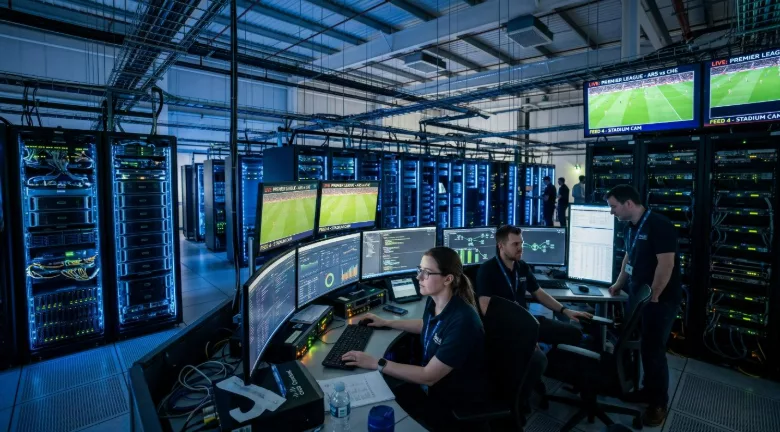
Lenovo has directly addressed this bottleneck through a massive deployment of near real-time AI-powered infrastructure at the edge. The core of this colossal operation is housed at the International Broadcast Center (IBC) in Dallas, Texas. Here, Lenovo has installed a formidable array of enterprise hardware, anchored by the Lenovo ThinkSystem SR635 V3 Rack Servers. Engineered specifically for high-density, mission-critical environments, these servers are tasked with ingesting, processing, and distributing massive volumes of live, uncompressed video data streaming in from stadiums across North America.

The results of this on-premise edge compute strategy are profound and measurable. Lenovo has managed to reduce Internet Protocol Television (IPTV) delays to under five seconds. This means that across ten dedicated live channels beaming to over 1,000 screens throughout FIFA venues, fans, media personnel, and VIPs are experiencing the action with practically zero noticeable lag. This execution is a masterclass in enterprise IT. To guarantee that this massive network remains flawless throughout the tournament, Lenovo has strategically deployed more than 17,000 Lenovo and Motorola devices and stationed over 200 highly trained engineers across all host venues and Team Base Camp training sites.

The AI Nerve Center: Mission-Critical Operational Control

Managing a tournament of this unprecedented geographical footprint requires a centralized “brain” capable of seeing, analyzing, and reacting to telemetry data from thousands of endpoints in an instant. This is where the Technology Command Center in Miami and the Tournament Operation Center come into play. Functioning as the definitive “mission control” for the duration of the World Cup, these hubs represent the absolute pinnacle of Lenovo’s Hybrid AI Solutions.

At these nerve centers, experienced engineers and senior FIFA management monitor the entire technological footprint of the games in near real-time. Lenovo’s AI infrastructure is designed to run flawlessly under the world’s most demanding conditions, constantly parsing data from stadium networks, security systems, and global broadcast feeds. This localized intelligence allows for rapid incident detection and immediate issue resolution, ensuring that minor technical anomalies are addressed before they can cascade into global broadcast failures.

“The FIFA World Cup is one of the largest and most complex sporting events in the world,” noted Nacho Fresco, Director of Technology at FIFA. “With this edition set to be the biggest in history, delivering exceptional operational efficiency and cutting-edge technology is critical.” This operational efficiency is achieved because enterprise AI is being applied not just as an experimental novelty, but as an active, functional tool for massive-scale system administration. Lenovo’s architecture effectively grants tournament organizers a comprehensive, god’s-eye view of the event’s digital health, empowering them to make vital decisions with supreme confidence.

Transforming the Fan Experience with Real-Time AI Transparency

While robust back-end server infrastructure is the unsung hero of the tournament, the front-end fan experience is where Lenovo’s AI innovations become highly visible and truly transformative. For decades, contentious refereeing decisions have been a major source of friction and debate in global football. Through advanced Generative AI and real-time player data ingestion, Lenovo is introducing AI-enabled 3D player avatars to provide immediate, transparent visualizations of highly complex calls.

These 3D avatars are far more than flashy broadcast graphics; they are highly accurate, data-driven spatial reconstructions of the pitch at the exact microsecond of a critical event. They serve a vital dual purpose: providing an objective, secondary value input to support FIFA’s Match Officials in their high-pressure decision-making, and giving fans clear, indisputable visual evidence of why a specific call was made. This profound level of transparency helps demystify the rules of the game and substantially enhances the overall viewing experience by removing ambiguity.

Furthermore, Lenovo is leveraging its AI competence to dramatically improve the physical in-venue experience for the millions of attending fans. AI-driven navigation systems are being actively deployed across stadiums to dynamically manage crowd flow, significantly reducing physical congestion and streamlining movement across massive, complex venues. For those watching the broadcast at home, Lenovo has introduced AI-driven stabilized “Referee Views.” This technology utilizes advanced algorithmic image processing to deliver first-person referee perspectives with up to 50% less motion distortion. Combined with highly immersive digital and holographic experiences set up in official fan zones, Lenovo is radically redefining what it means to attend and interact with a live sporting event in the 21st century.

Leveling the Playing Field Through the Lenovo AI Factory

Perhaps the most culturally significant technological implementation at the 2026 World Cup is Lenovo’s unyielding commitment to democratizing elite football analytics. Historically, wealthier national federations have held a distinct competitive advantage due to their ability to afford massive teams of data analysts, bespoke software, and expensive processing hardware. Lenovo is actively aiming to dismantle that disparity and level the playing field through its inclusive “Smarter AI for All” vision.

For this tournament, Lenovo is deploying the groundbreaking FIFA AI Pro platform to all 48 competing teams. This next-generation AI-powered knowledge assistant delivers deep, actionable tactical insights directly to coaches, players, and video analysts. The robust backbone of this platform is built entirely using the Lenovo AI Factory—an integrated, enterprise-grade system where sophisticated machine learning models are developed, trained, continuously refined, and deployed to generate insights from incredibly complex sports datasets.

By providing every single national team—regardless of their internal federation budget—with identical access to elite-level data processing, pattern recognition, and predictive analytics, Lenovo is ensuring that the tournament is decided by athletic prowess and tactical brilliance on the pitch, rather than financial superiority in the back office. This powerful initiative beautifully illustrates how enterprise-level AI can be utilized ethically to promote fairness, equity, and elevated competition on the global stage.

Bringing the Game Home with Special Edition Collections

The technological marvels of the World Cup aren’t strictly confined to secure server rooms and massive stadiums. Recognizing the immense, deeply rooted passion of global football fans, Lenovo has cleverly bridged its enterprise success with its robust consumer electronics division by releasing a stunning collection of FIFA Special Edition devices.

This limited-edition lineup spans across Lenovo’s commercial, consumer, and high-performance gaming portfolios, featuring exclusive FIFA World Cup 2026™ branding and bespoke packaging. Fans are now able to carry a piece of the world’s largest sporting event in their pockets with the motorola razr FIFA World Cup 26th Edition, or elevate their daily professional productivity with the ThinkPad X9-14 Gen 1 and the ThinkPad X1 Carbon Gen 13 and 14. For content creators and gamers who require massive local compute power, the Yoga Slim 7i ultra Aura Edition and the formidable Lenovo Legion Pro 7i provide top-tier performance infused with the spirit of the game.

This strategic product rollout is a masterstroke in brand synergy. It allows everyday consumers to physically interact with the exact same brand of technology that is actively powering the global broadcast they are enjoying. It also serves to highlight the massive scale of Lenovo’s broader corporate investment in the sports industry, directly underscoring the successful launch of their dedicated sports vertical earlier this year. By cohesively integrating AI infrastructure, edge computing, smart devices, and managed services into a unified end-to-end operational model, Lenovo is proving that their technological ecosystem is entirely unmatched in both its breadth and raw capability.

Wrapping Up

The 2026 FIFA World Cup™ is undeniably set to be a watershed moment—not just for international football, but for the tangible deployment of enterprise artificial intelligence and edge computing at a massive, unforgiving global scale. Lenovo’s critical role as the Official Technology Partner is a resounding testament to the company’s unparalleled ability to engineer, deploy, and maintain end-to-end solutions under the most extreme, mission-critical conditions imaginable.

From the flawless, ultra-low-latency IPTV video distribution powered by resilient ThinkSystem hardware at the Dallas IBC, to the AI Nerve Center in Miami providing real-time operational oversight, Lenovo has successfully moved the sports broadcast industry away from historically fragmented systems toward a cohesive, real-time control methodology. By radically enhancing fan experiences with GenAI 3D avatars, streamlining stadium safety protocols, and leveling the competitive playing field for all 48 teams via their AI Factory, Lenovo is truly living up to its core ethos of “Smarter Technology for All.” As billions watch the drama unfold on the pitch this summer, it will be abundantly clear that the real game-changer is the invisible, flawless technological backbone working silently behind the scenes.

  •  

Lenovo Obliterates Market Headwinds and Eclipses Competitors With Unprecedented Revenue Growth

Sitting in my home office in the high desert of Bend, OR, watching the technology market navigate the treacherous economic waters of early 2026 has been an exercise in managing expectations. We are seeing profound macroeconomic friction across the board. Between persistent inflation squeezing enterprise budgets, consumer discretionary spending pulling back, and massive logistical bottlenecks, the hardware sector was supposed to be treading water. Most vendors have spent the past several quarters managing their own decline, offering myriad excuses for why their performance has plateaued. Yet, when analyzing the exceptional Q4 and full-year financial results recently announced by Lenovo Group, it becomes immediately apparent that they are operating on an entirely different competitive plane.

Lenovo reported an all-time fourth-quarter high of $21.6 billion in revenue, representing a staggering 27% year-on-year growth rate. This isn’t just a slight beat in a recovering market; this is their highest year-on-year growth rate in five years, with adjusted net income doubling to $559 million. For the full fiscal year 2025/26, the company delivered a record $83.1 billion. In an era where hardware margins are traditionally razor-thin and competitors are blaming macroeconomic trends for missed targets, Lenovo’s performance is nothing short of a masterclass in strategic execution, operational resilience, and technological foresight.

Defying the 2026 Tech Headwinds

To truly appreciate the magnitude of Lenovo’s $83.1 billion full-year revenue, one must properly contextualize it within the broader, highly challenged industry environment. The past year has been characterized by soaring shipping costs and supply chain disruptions that have heavily hampered hardware margins across the globe. Components remain stubbornly expensive, shipping routes have been unpredictably compromised, and the post-pandemic hardware refresh cycles have been sluggish at best. Yet, defying gravity, Lenovo achieved solid double-digit year-on-year revenue growth across all of its distinct business groups.

A significant driver of this growth stems from an acute, deeply researched understanding of user needs and the ongoing evolution of device form factors. In the commercial PC space, for instance, professional workflows have radically shifted over the past few years. There is a rapidly accelerating preference among professionals for 16-inch notebooks. I prefer 16-inch notebooks personally because the larger display makes them far closer to a desktop, drastically improving productivity without tethering the user to a desk. By prioritizing these premium, highly capable machines tailored to modern productivity demands rather than racing to the bottom with budget models, Lenovo is commanding higher average selling prices. Consequently, they are far outpacing the broader industry’s single-digit recovery.

But the real accelerant here, the engine driving this unprecedented growth, is artificial intelligence. AI-related revenue stood out as Lenovo’s leading growth engine, soaring an incredible 84% year-on-year to account for 38% of total Group revenue in the fourth quarter alone. For the full year, AI-related revenue doubled, making up a full third of their global business. This indicates something vital: Lenovo is not merely riding an industry buzzword; they are fundamentally and successfully monetizing the massive enterprise transition toward localized intelligence and high-performance computing.

The Power of Consistent Leadership

Financial results of this caliber do not happen by accident, nor are they simply the result of favorable market timing; they are the lagging indicator of years of steadfast strategic planning. One of Lenovo’s most underappreciated assets – and perhaps its strongest competitive moat – is the absolute consistency of its leadership. Under Chairman and CEO Yuanqing Yang, Lenovo has maintained a clear, unwavering trajectory for over a decade. This stability allows the company to confidently invest in multi-year infrastructure architectures and complex, globally distributed logistical networks without the chaotic course corrections that so frequently plague their rivals.

Contrast this profound stability with the broader tech landscape. You routinely see legacy technology giants playing musical chairs in the executive suite, desperately pivoting strategies with every missed earnings call or activist investor threat. Take Intel, for example, which recently had to navigate a critical transition from Pat Gelsinger to its current CEO, Lip-Bu Tan, in a necessary effort to stabilize its foundry operations and processor roadmaps. While competitors are forced to spend critical cycles restructuring their management hierarchies and re-explaining their core missions to anxious shareholders, Lenovo’s executive team remains locked in on execution. This consistency fosters deep, unshakeable trust with enterprise buyers who are looking for long-term ecosystem partners to guide their AI transitions, not just transactional hardware vendors.

The Multi-Country Advantage

Another critical pillar supporting Lenovo’s record-breaking fiscal year is its sophisticated multi-country advantage. Lenovo operates a truly globalized, hybrid model that uniquely bridges Eastern manufacturing scale with Western market sensibilities, rigorous compliance frameworks, and local support infrastructures. In a geopolitical climate fraught with tariff threats, export restrictions, and regional instability, having a singular point of failure in a supply chain is a fatal flaw that many vendors are currently paying for.

Lenovo aggressively mitigates this by maintaining a highly diversified, dynamically balanced manufacturing footprint spanning over 30 sites across multiple continents. This operational elasticity allows them to dynamically reroute production and manage component shortages – such as the memory chip constraints that have squeezed the rest of the industry – far more effectively than their peers. They aren’t just building products; they are engineering supply chain resilience as a core, defining feature of their business model. This multi-country leverage ensures that when demand spikes for their premium notebooks or their high-end, liquid-cooled servers, they have the capacity to deliver. This allows them to capture market share precisely when competitors are stuck waiting for freighters or negotiating with bottlenecked contract manufacturers.

Eclipsing Dell’s Logistics Advantages

For decades, Dell was the undisputed, widely recognized king of supply chain logistics. Their direct-to-customer model and just-in-time inventory systems were the subjects of countless Harvard Business School case studies and the envy of the manufacturing world. However, looking closely at the performance of Lenovo’s Infrastructure Solutions Group (ISG), it is abundantly clear that Lenovo has thoroughly eclipsed Dell’s historical logistics advantage.

ISG delivered its highest-ever operating profits and margins since Lenovo entered the enterprise server business. They posted a record quarterly revenue of $5.6 billion – up a massive 37% year-on-year – and full-year revenue of $19.2 billion. The momentum here is simply staggering, driven by an AI server business pipeline that has swelled to a massive $21 billion and already encompasses more than 5,800 customer AI deployments.

Lenovo has achieved this unprecedented scale by out-manufacturing and out-innovating the competition at the rack level. They have scaled their annual server manufacturing capacity to surpass 70,000 racks across AI, compute, and storage systems. Crucially, this massive output includes more than 11,000 Direct Liquid-Cooled racks, purpose-built from the ground up for the massive thermal envelopes of modern AI workloads. While Dell publicly grapples with integrating advanced cooling at scale and managing massive supply chain delays, Lenovo’s rack-scale execution is already advancing rapidly into the market. They shipped their first GB300 NVL72 racks last quarter and have their Rubin-based platforms on track for targeted time-to-market in the second half of the year. Coupled with the highly strategic acquisition of Infinidat in early April to strengthen their high-end enterprise storage capabilities, Lenovo is now actively dictating the pace of enterprise infrastructure, leaving legacy logistics champions struggling to keep up.

Internal AI Experience Drives External Success

Perhaps the most compelling aspect of Lenovo’s financial triumph is that they are their own best, most rigorous case study. Lenovo isn’t just enthusiastically selling artificial intelligence hardware; they are aggressively utilizing it internally to optimize their own sprawling logistics and manufacturing operations. When you move over 300,000 components a day through facilities like LCFC, applying AI to predict supply chain bottlenecks, optimize routing, and automate quality control yields massive, compounding efficiencies.

This internal mastery heavily informs their forward-looking product strategy. They understand better than most that the future of enterprise AI is not solely tethered to massive, latency-prone cloud deployments. Instead, they are championing the critical shift toward Agentic AI and Physical AI. By prioritizing robust local NPU performance, they are enabling secure, real-time inferencing directly at the edge. This is about deploying highly capable, autonomous agents capable of managing complex local environments and data sets without requiring constant cloud arbitration.

The clarity of this vision was palpable when I attended the Lenovo Sphere TechWorld event on the evening of January 6, 2026. The roadmap presented there wasn’t just about simple generative text bots; it was a comprehensive blueprint for Agentic AI capable of fundamentally transforming industrial workflows. For a deeper dive into this practical application, one only needs to watch how Lenovo Supercharges Enterprise AI with Agentic AI to see how organizations can deploy robust governance and automated workflows using purposeful Agentic AI platforms.

Furthermore, this internal innovation isn’t siloed in the server room. We see Lenovo’s broader device ecosystem pushing the boundaries of what is possible with concepts like Motorola’s Project Maxwell—a wearable that demonstrates how localized intelligence can revolutionize user interaction well beyond the traditional PC. By proving these complex AI concepts within their own highly complex corporate structure first, Lenovo approaches the enterprise market not just as a vendor, but as an experienced practitioner offering proven, hardened solutions.

Wrapping Up

Lenovo’s fiscal year 2025/26 results are a powerful testament to what happens when visionary leadership meets flawless operational execution. Generating $83.1 billion in a highly restrictive macroeconomic environment designed to suppress hardware growth is a monumental achievement. By leveraging a resilient, dynamic multi-country supply chain, investing heavily in the correct form factors, and pioneering the necessary shift toward Agentic AI and edge computing, Lenovo has expertly outmaneuvered the traditional tech headwinds.

More importantly, they have systematically dismantled the logistical moats of competitors like Dell, proving that superior global manufacturing and advanced thermal infrastructure at scale win the day. As the industry continues its rapid pivot from basic generative tools toward highly capable, autonomous Agentic AI ecosystems, Lenovo’s ability to internally validate and externally deliver these vital technologies positions them not just as a current market leader, but as the primary architect of the next generation of enterprise computing.

  •  

The Next Mass Extinction: How Gemini 3.5 Flash and Antigravity Are Rendering Legacy Software Obsolete (And Why Microsoft Should Be Sweating)

Google’s I/O 2026 just lit a match under the traditional software stack. If the makers of Office, Photoshop, and legacy IDEs don’t pivot immediately, they are walking right into the same trap Nokia and BlackBerry fell into during the iPhone revolution.

At Google I/O 2026, the tech giant wasn’t just announcing new features—they were quietly organizing a funeral for the way we’ve worked for the last thirty years. With the launch of the Gemini 3.5 series, specifically Gemini 3.5 Flash and the terrifyingly capable Antigravity 2.0 platform, Google fired a direct broadside at the monolithic productivity suites that have dominated enterprise and creative markets.

We are no longer just talking about “AI assistants” living inside sidebars. We are talking about Agentic AI that runs continuously in the background, capable of operating systems from scratch and building full-stack applications while you sleep. And the immediate targets? Legacy giants like Microsoft Office, Google’s own legacy Docs, Adobe Creative Cloud, Apple Creator Studio, and a host of integrated development environments (IDEs). 

Here is why these legacy product owners need to fight back immediately, and what they can learn from the ghosts of tech failures past.

The Hit List: Who Gemini 3.5 is Coming For

The capabilities demonstrated with Gemini 3.5 Flash and Gemini Spark aren’t just iterative upgrades; they are category killers.

  • Microsoft Office (Word, Excel, PowerPoint) and Google’s Legacy Workspace: The new Docs Live feature allows users to perform a “verbal brain dump”—speaking naturally about a topic—and Gemini structures it into a polished, formatted document. Gemini Spark, a 24/7 personal AI agent, can synthesize meeting notes across emails and chats and draft the resulting documents automatically. Why spend an hour wrestling with formatting in Word or PowerPoint when an agent can build a customized, highly accurate presentation based on a simple voice command and real-time data scraped by the new “Information Agents”? 
  • Adobe Creative Cloud and Apple Creator Studio: Google showcased Google Pics with aggressive, on-device AI editing, and Google Stitch, which allows users to command entirely new website designs into existence via voice. More devastatingly, Gemini Omni allows users to input any modality (text, audio, image) and output highly accurate, physics-aware video. The days of needing a multi-tool suite like Premiere Pro or Photoshop to execute basic or even intermediate creative visions are numbered when Omni can execute complex post-production workflows autonomously. 
  • Legacy IDEs (Visual Studio, Eclipse, etc.): The most shocking demonstration at I/O was Antigravity 2.0. This agent-first development platform spun up specialized subagents that generated a fully functioning operating system from scratch in roughly 12 hours. It can also “vibe code” full-stack Android apps natively. If you are selling an IDE that requires a developer to write boilerplate code manually, your product is now fundamentally obsolete. 

Avoiding the BlackBerry Trap

The tech graveyard is full of companies that saw a paradigm shift and decided their existing market share would protect them.

When Apple launched the iPhone, Nokia, BlackBerry, and Microsoft (with Windows Mobile) scoffed. They believed their physical keyboards, established carrier relationships, and corporate email dominance made them invulnerable to a device lacking a physical keypad. They fundamentally misunderstood that the iPhone wasn’t just a phone; it was a pocket computer.

Similarly, in the 1990s, productivity giants like Lotus (1-2-3) and Novell (WordPerfect) dominated the market. They failed to realize that Microsoft Office’s integration—bundling applications into a single, cohesive, albeit initially clunky suite—was the future. They clung to their standalone dominance and were obliterated.

Today, Microsoft, Adobe, and Apple face the exact same threat from Google’s Agentic ecosystem.

If Microsoft simply bolts “Copilot” onto the side of an increasingly bloated Word or Excel interface, they will fail. If Adobe continues to charge premium subscriptions for complex interfaces while Google Omni allows a user to say, “Make this video look like a 1980s VHS tape and adjust the lighting,” Adobe will bleed out from the bottom up.

The mistake legacy software makers make is trying to optimize the old way of doing things rather than inventing the new way. The new way is autonomous, continuous, and agent – driven.

Will They Pivot in Time?

The likelihood of these massive companies pivoting successfully is mixed, but the stakes have never been higher.

Microsoft is perhaps the best-positioned to fight back. They have a massive enterprise moat, a tight partnership with OpenAI, and they understand platform dynamics. However, they need to aggressively intertwine OpenAI’s capabilities deeper into the OS layer—making Windows itself an agentic platform—rather than just adding AI features to legacy Office apps. They need to disrupt their own cash cows before Google’s Antigravity and Spark do it for them.

Adobe has a steeper hill to climb. Their entire business model is predicated on software complexity that requires human mastery. While they have introduced AI (like Firefly), they are still fundamentally selling tools to creators, whereas Google is moving toward selling outcomes.

Apple is the wild card. While Google is pushing heavily into cloud-based agents and cross-platform tools, Apple has the hardware advantage. Their counter-move must be hyper-private, on-device agentic AI that executes flawlessly within the Apple ecosystem, bypassing the need for Google’s cloud infrastructure entirely.

The Timing of the Collapse

So, when does the bottom fall out? Historically, enterprise software has a massive “stickiness” factor. It takes a long time for users to abandon a product they’ve used for decades, primarily due to muscle memory, legacy file formats, and corporate IT inertia.

However, things are moving exponentially faster this decade. Google highlighted that AI Mode queries have been doubling every other month, and Gemini active users have surged past 900 million. The transition won’t happen overnight, but it will happen in a surprisingly compressed timeframe. Expect to see the first major fractures in the market share of legacy IDEs and mid-tier design tools within the next 18 to 24 months, as companies realize they can save upwards of $1 billion a year by utilizing tools like Gemini 3.5 Flash and Antigravity instead of maintaining massive legacy codebases or outsourcing basic design tasks. 

Wrapping Up: How Enterprises Can Survive the Shift

For enterprises and individual users, the arrival of Gemini 3.5 Flash and the era of agentic AI is thrilling but perilous. Moving too quickly to abandon legacy systems can cause operational chaos, but moving too slowly ensures obsolescence.

To take advantage of this advancement without moving prematurely, organizations must:

  1. Adopt an “Orchestration” Mindset: Stop training employees on how to use specific software features (like complex Excel macros or Photoshop layering) and start training them on how to define goals, write complex prompts, and manage AI agents. The future belongs to the orchestrator, not the operator.
  2. Sandbox the New Tech: Don’t rip out Microsoft Office tomorrow. Instead, create dedicated teams to pilot Gemini Spark and Antigravity 2.0 on specific, low-risk, high-friction workflows (like internal documentation or rapid prototyping).
  3. Demand Interoperability: As Google pushes the “Universal Cart” and cross-platform agents, demand that your legacy software vendors do the same. If an application cannot integrate cleanly with the new AI agent ecosystem, it needs to be flagged for replacement.

The war for the desktop is over; the war for the autonomous background has just begun. The software you use today is already legacy. The only question is how quickly you are willing to let it go.

  •  

Disney Magic Meets Robotic Muscle as Familiar Machines Reinvents the Concept of the Digital Best Friend

In the technology world, we often talk about “disruption” as if it’s a purely mechanical process—faster chips, better screens, more efficient code. But every once in a while, a company emerges that understands that for technology to truly integrate into our lives, it needs to move beyond the cold logic of a circuit board and tap into something more ephemeral: character. That is precisely what is happening with the launch of Familiar Machines and Magic, and it might just be the most important thing to happen to robotics since we convinced a vacuum cleaner to stop eating our shoelaces.

A Trip Down Memory Lane with Red-Eyed Hell-Cats

To appreciate where we are going, we have to look back at the glorious, slightly terrifying failures of the past. If you go back to the early 1980s, the legendary Nolan Bushnell—the man who gave us Atari and Chuck E. Cheese—founded a company called Androbot. His vision was a world filled with personal robots that would act as companions. The technology was, to put it mildly, optimistic for its time.

I actually owned one of their robotic cats. It was a marvel of beige plastic and clunky motors, but it had one feature that was accidentally brilliant: a pair of glowing red eyes. At the time, I was locked in a nightly psychological war with my actual, biological cat. He believed that my closed bedroom door was a personal insult and would pound on it until I surrendered.

I eventually decided to use the robotic cat as a sentry. I placed it in front of the door with those red eyes blazing into the dark hallway. My cat walked up, saw what appeared to be a mechanical demon from the feline underworld, and decided he was suddenly very busy elsewhere. It was a crude form of companionship—or at least, a crude form of security—but it proved that a physical machine could influence a living environment in ways a screen never could.

The Practical Ethics of Unbreakable Empathy

While scaring pets is fun, the real-world application for Familiar Machines is deeply humanitarian. We currently have a massive demographic shift: an aging population that is increasingly lonely and often restricted by limited mobility. Many of these individuals desperately want the companionship of a pet but can no longer manage the physical demands of walking a dog or the health risks associated with a litter box.

A physical AI pet doesn’t need a 6:00 AM walk in the snow, and it won’t trip its owner in the hallway—a leading cause of hip fractures in the elderly. It provides the tactile comfort of a living creature without the logistical nightmare.

Furthermore, we need to talk about children. We like to think of kids as “natural” animal lovers, but history suggests they are often more like tiny, chaotic scientists. I recall a former colleague who shared a horrifying story of her childhood curiosity: she decided to see what a hot poker would do to her family dog’s genitals. It’s a grisly reminder that real animals are vulnerable to the impulsive cruelty of children who haven’t yet developed empathy. An AI pet, however, is virtually indestructible and incapable of feeling pain. It serves as an “empathy trainer,” allowing children to learn how to care for a creature before they are trusted with a living, breathing one.

Beyond Cuteness: The Sentinel in the Living Room

The real “magic” happens when you realize these aren’t just toys; they are sophisticated edge-computing platforms. Because a physical AI pet moves through your environment, it sees what a static smart speaker cannot. A Familiar Machine can be programmed to detect environmental hazards like carbon monoxide or water leaks before they become catastrophes. (This story of a real cat who used technology to save it’s owner’s life highlights how an AI pet could save yours). 

Imagine a robotic companion that notices a change in its owner’s gait or a slight tremor in their hand—early indicators of neurological issues – and quietly alerts a healthcare provider. Or, in a security context, a pet that doesn’t just bark at an intruder but intelligently identifies them and contacts the authorities while guiding the homeowner to safety. Over time, as the AI learns your preferences and habits, it transitions from a “pet” to a “personal advisor,” offering suggestions on everything from your schedule to your health, all delivered through the non-threatening interface of a loyal companion.

The Imagineering of Reality

What makes Familiar Machines and Magic so distinct from the myriads of “social robots” that have failed before (looking at you, Anki and Jibo) is the pedigree of the team. You have Colin Angle, the co-founder of iRobot and the father of the Roomba, providing the mechanical and logistical backbone. But the secret sauce is the inclusion of former Disney Imagineers.

Disney has spent a century perfecting the art of “The Illusion of Life.” They understand that a character isn’t just a set of movements; it’s a personality. By applying the principles of animation and storytelling to physical AI, Familiar Machines is moving away from the “uncanny valley” – that creepy sensation you get when a robot tries too hard to be human. Instead, they are creating “Familiars” – creatures that are unashamedly mechanical but imbued with a charm and “soul” that makes you want to protect them as much as they protect you.

Forecasting the Critical Mass of the Digital Familiar

So, when does every home have a robotic “Familiar”? We are currently in the “Apple II” phase of this industry. The hardware is reaching a price point where it’s accessible to the upper-middle class, and the AI models—thanks to the surge in generative technology—are finally capable of nuanced interaction.

I forecast that we will see this technology reach maturity and critical mass by 2029. Within the next three to five years, several factors will converge:

  1. Solid-State Batteries: Allowing for 24-hour “active” life without the pet constantly needing to “nap” on a charger.
  2. On-Device LLMs: Providing the ability for the pet to hold actual conversations and give advice without needing to send your private data to the cloud.
  3. Ubiquitous 6G: Ensuring that the pet is always connected to the smart home ecosystem.

By the turn of the decade, the “loneliness epidemic” will be significantly mitigated by these machines. The world will look like a place where the elderly are safer, children are kinder, and your “best friend” might just be a masterpiece of silicon and Disney magic.

Wrapping Up

The launch of Familiar Machines and Magic marks the end of the “toy” era for home robotics. By merging the rugged, real-world utility of iRobot with the emotional intelligence of Disney Imagineering, we are finally getting the companions we were promised in the 1950s. Whether it’s scaring away a pestering house cat, monitoring the health of a grandparent, or teaching a child the value of kindness, these machines are set to become an essential part of the human family. Just remember: if yours starts looking at you with glowing red eyes, it’s probably just checking the Wi-Fi, we hope…

  •  
❌