❌

Reading view

aweXome Ray Raises 7.5 Billion Won to Accelerate EUV Pellicle Membrane Commercialization
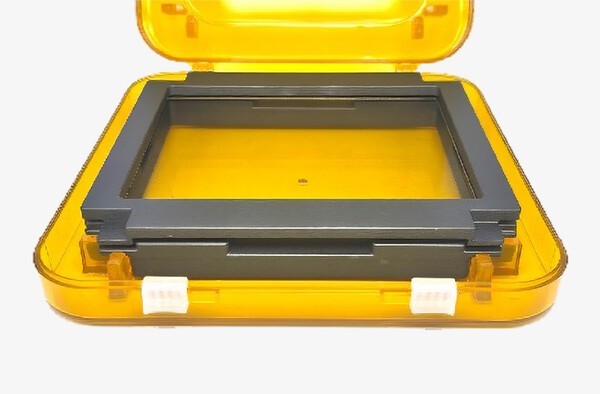
EUV pellicle. (Photo: aweXome Ray)

aweXome Ray said on Aug. 11 it has secured 7.5 billion won in a Series B bridge financing round, with investors recognizing the technological and commercial potential of its carbon nanotube (CNT)-based extreme ultraviolet (EUV) pellicle membrane.

Strategic investors included S&S Investment, an affiliate of S&S Tech, a manufacturer of photomasks and EUV pellicles, as well as Wonik Investment Partners. Wonik Investment Partners and Hanwha Investment & Securities participated through a jointly managed fund. Other investors included Reinvestment, L&S Venture Capital, KNET Investment Partners, Union Investment Partners, and Ascendo Ventures.

The company said participation by pellicle manufacturers, semiconductor materials and equipment companies, and financial investors demonstrates industry recognition of both the technological competitiveness and commercialization potential of its CNT-based pellicle membrane. It added that the participation of a defense-focused fund jointly managed by Wonik Investment Partners and Hanwha Investment & Securities also highlights the potential application of its CNT fibers and membranes in aerospace and defense.

The proceeds will be used to stabilize production of EUV pellicle membranes, strengthen quality control systems and support customer supply programs. aweXome Ray has established a dedicated cleanroom production line for EUV pellicle membranes in Anyang, Gyeonggi Province, to produce qualification samples and support initial customer shipments. The company said customer evaluations are currently underway and expects initial commercial supply and revenue once qualification is completed.

aweXome Ray is developing CNT-based membranes for EUV pellicles used in advanced semiconductor lithography. Pellicles protect photomasks carrying semiconductor circuit patterns from contamination during the EUV exposure process, requiring both high EUV transmittance and exceptional heat resistance. The company said CNT materials, which are lightweight, thin and highly heat-resistant, are well suited for next-generation pellicles designed for high-power EUV exposure environments.

The company has also strengthened its pellicle business with additional industry expertise. Hong Sung-chul, a senior executive at S&S Investment, joined aweXome Ray's board as an outside director in March. A former Samsung Electronics engineer with experience in semiconductor photomask and pellicle development, Hong will support customer qualification and technical engagement.

In February, Lee Dong-wook, who previously led advanced materials commercialization at LG Chem and EcoPro BM, joined the company as Chief Product Officer (CPO). He oversees the pellicle business division and is responsible for converting research and development achievements into commercial products and customer supply.

aweXome Ray is also participating in a government-funded pellicle technology development project under South Korea's Deep Tech Challenge program administered by the Ministry of SMEs and Startups. The company is carrying out a 3.6 billion won research and development project and has been selected for the Korea Technology Finance Corporation (KIBO) Unicorn Bridge program, securing 600 million won in funding and eligibility for up to 20 billion won in technology guarantees. The company plans to combine private investment with government R&D support to advance its technology and accelerate commercialization.

The company is also stepping up preparations for an initial public offering (IPO). After signing an investment agreement with Jeju Special Self-Governing Province in March, it relocated its headquarters to the Jeju Science Park. Having been selected as one of the province's IPO support companies, aweXome Ray is preparing to appoint an IPO underwriter and undergo a preliminary technology assessment. The company aims to pursue a technology-track listing in 2028 while advancing customer qualification and initial product shipments.

Hong Sung-chul, senior executive at S&S Investment, said aweXome Ray possesses differentiated CNT-based EUV pellicle membrane technology and strong commercialization potential.

"With its production line now in place and customer qualification underway, the company has entered the commercialization stage. We will actively support the establishment of a stable supply chain and successful market entry," he said.

Chief Executive Officer Kim Se-hoon said the new production line and funding round represent an important milestone in transforming aweXome Ray from a research-focused company into an advanced materials supplier capable of serving customers.

"We will successfully complete customer qualification, accelerate commercialization of our CNT-based EUV pellicle membrane, and strengthen our competitiveness in the global semiconductor materials market," he said.
  •  

Samsung, SK hynix Join Ceramics Supply Chain Forum

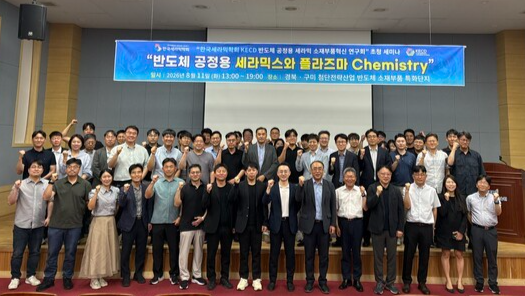
The Semiconductor Process Ceramics Materials and Components Innovation Forum Seminar hosted by KECD on Aug. 11. (Photo: KECD)

Semiconductor ceramics materials suppliers and their customers are expanding technical collaboration while strengthening industry-academia-research partnerships to reinforce the semiconductor supply chain.

The Engineering Ceramics Division (KECD) of the Korean Ceramic Society said on Aug. 11 it hosted the Semiconductor Process Ceramics Materials and Components Innovation Forum Seminar at the IT Medical Convergence Technology Center in Geumo Techno Valley, Gumi, North Gyeongsang Province. The event was jointly organized with the Semiconductor Process Ceramics Materials and Components Innovation Forum and the Gyeongbuk–Gumi Semiconductor Specialized Complex Promotion Team.

The seminar brought together semiconductor manufacturers and equipment companies including Samsung Electronics, SK hynix, SEMES, Lam Research Korea, Wonik IPS, TES, and Eugene Technology. A total of 30 companies participated overall, including ceramics materials and components suppliers such as Wonik QnC, Komico, Mico Ceramics, TCK, Worldex Industry, CMTX, and LKN Engineering.

The seminar focused on "Ceramics and Plasma Chemistry for Semiconductor Manufacturing Processes." Presentations covered plasma resistance characteristics of ceramic materials used in etching and deposition chambers, particle reduction technologies and design strategies for high-durability ceramics. Researchers from Korea Aerospace University, the Korea Research Institute of Standards and Science (KRISS), Kumoh National Institute of Technology, and the Korea Institute of Materials Science (KIMS) presented their latest research.

Following the seminar, participants held an industry-academia networking session to discuss expanding technical collaboration and joint research among companies and research institutes. The promotion team said it plans to make the seminar a regular event and use it as a platform for future commercial cooperation.

Lee Hyun-kwon, head of the Gyeongbuk–Gumi Semiconductor Specialized Complex Promotion Team, said the event marked the first opportunity for leading semiconductor manufacturers and materials suppliers in South Korea to share commercialization technologies and on-site industry requirements.

He added that the Gyeongbuk–Gumi Semiconductor Specialized Complex will strengthen its role as a collaborative platform linking companies with one another as well as with research institutions.

  •  

Avaco Launches Pilot Line for Glass Substrate TGV Process

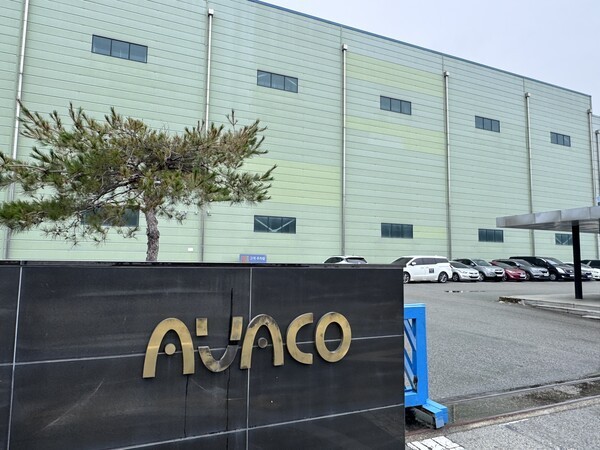
Avaco's Gumi Plant 1. (Photo: THE ELEC)

Avaco said on Aug. 11 it has begun operating a pilot production line, developed in collaboration with affiliate AVATEC, to validate through-glass via (TGV) processes for next-generation semiconductor packaging substrates.

The companies completed construction of the pilot line in the first half of this year. The line supports large-format glass substrates measuring 515 Γ— 510 millimeters and integrates laser drilling, etching, seed-layer deposition and optical inspection into a single process flow.

In addition to evaluating the performance of individual production tools, the pilot line is designed to verify process integration and repeatability in mass production. AVATEC, drawing on its manufacturing experience in display glass etching and thin-film processing, will oversee process operation and production stability.

Avaco has been investing in TGV equipment and process technologies since 2023. Its flagship second-generation TGV laser drilling system, AXIUM AP-250K, is capable of processing up to 10,000 via holes per second using dual optical heads. The company said the system achieves tolerances below 5 micrometers, enabling uniform processing across large-area glass panels.

The company has also secured alkaline wet etching technology and seed-layer deposition equipment for post-laser processing. By combining physical vapor deposition (PVD) with hybrid deposition techniques, Avaco is advancing process technologies for controlling high-aspect-ratio structures and forming uniform metal layers, both of which are critical for TGV substrates.

An optical inspection system has also been installed to inspect defects generated during the manufacturing process. The system performs full inspection of TGV hole geometry and processing quality and will be linked with an automated production line to validate quality control systems for mass production. The company added that it has secured a variety of glass materials through non-disclosure agreements (NDAs) with major glass suppliers.

The two companies plan to provide TGV glass substrate samples incorporating laser drilling through seed-layer deposition in 2026. The samples will range in size from 100 Γ— 100 millimeters to 515 Γ— 510 millimeters. In 2027, they plan to expand sample offerings to include metallized substrates incorporating laser drilling, etching, deposition, via filling and planarization processes.

Avaco said it is currently discussing technology collaboration and future mass production with multiple overseas customers. Once the pilot line has completed process and equipment validation, Avaco plans to expand its TGV equipment business, while AVATEC will participate in commercialization of glass substrates by leveraging its etching technology and process operation expertise.

An Avaco official said the company believes that validating the entire manufacturing processβ€”not just individual toolsβ€”is essential for entering the glass substrate market.

"Through our collaboration with AVATEC, we will organically combine equipment, process technology and mass production expertise to establish an integrated TGV solution capable of delivering the production-ready products our customers require," the official said.

  •  

Synopex Wins South Korean Approval for Hemodialysis Machine

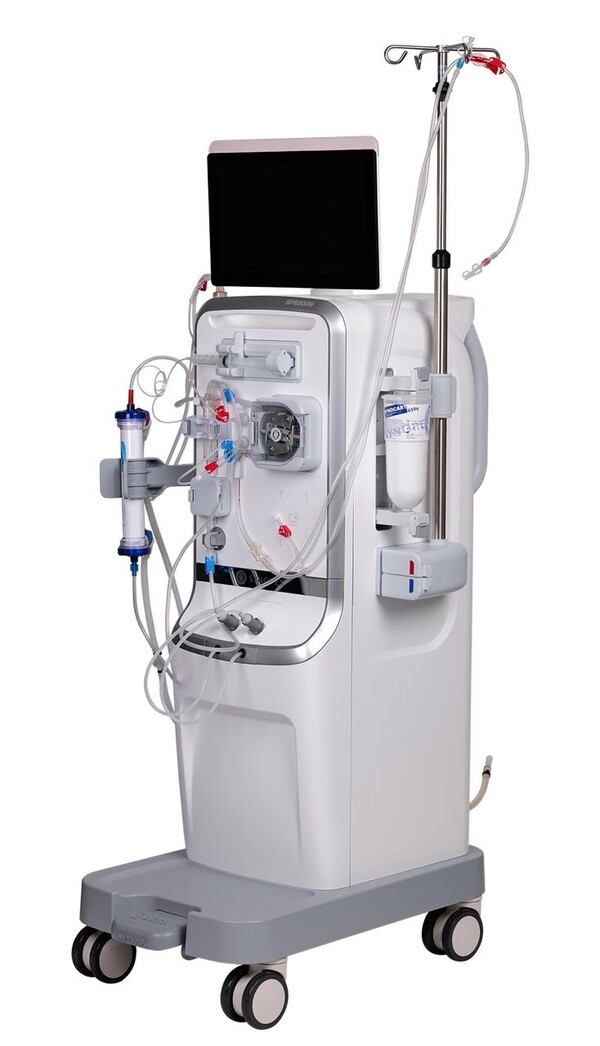
Synopex's hemodialysis (HD) machine. (Photo: Synopex)

Synopex said on Aug. 11 it has received marketing approval from South Korea's Ministry of Food and Drug Safety (MFDS) for its hemodialysis (HD) machine, paving the way for domestically developed products to enter a market that has been entirely dependent on imported systems.

Hemodialysis is a treatment that removes waste products and excess fluid from the blood of patients with chronic kidney disease. The procedure relies on several key medical devices, including hemodialysis machines, dialyzers and water purification systems.

With the approval, Synopex said it has completed the localization of the three core medical device solutions used in hemodialysis: dialyzers (hemodialysis filters), portable water purification systems for hemodialysis machines and HD machines. The company had previously obtained MFDS approvals for 11 hemodialysis filter products, a continuous renal replacement therapy (CRRT) system for critically ill patients and a portable water purification system for hemodialysis equipment.

The HD machine was developed under a national project led by the Korea Medical Device Development Fund (KMDF) in collaboration with researchers from the Department of Nephrology and the Department of Biomedical Engineering at Seoul National University Hospital. In 2024, KMDF designated the localization of the three core hemodialysis medical devices as one of its 10 flagship national projects.

Synopex is developing an upgraded follow-up model of its CRRT system for critically ill patients. It is also working on a mass-production version of its HD machine equipped with hemodiafiltration (HDF) functionality. The company plans to seek regulatory approval and commercialize the HDF-equipped model in the future.

Kang Chang-ho, head of Synopex's Artificial Kidney Sales Division, said the MFDS approval for the HD machine marks "a historic starting point" in establishing medical sovereignty in South Korea's hemodialysis device market, which has long relied entirely on imported products.

He added that the company is preparing for mass production of the HD machine alongside its dialyzers and water purification systems, which are already being introduced to the market.

  •  

Wacker Chemicals Korea Launches RainGuard Water Repellent for Building Exteriors

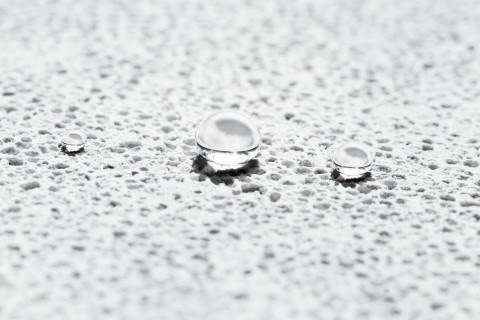
Water droplets formed on the surface of autoclaved lightweight concrete (ALC) after treatment with LC4004WR RainGuard. (Photo: Wacker Chemicals Korea)

Wacker Chemicals Korea said on Aug. 11 it has launched RainGuard, a premium water-repellent treatment for building exteriors designed to reduce moisture penetration and improve the durability of exterior walls.

The new product, LC4004WR RainGuard, is a water-based penetrating water repellent that maintains water vapor permeability, allowing moisture inside building materials to escape. It can be applied to concrete, brick and mortar using spray, roller or brush application methods.

Without forming a separate coating film on exterior surfaces, the product reduces water absorption by approximately 20% to 25% compared with conventional products, according to the company. It also increases the water contact angle by about 10%, enhancing the beading effect. Wacker said early water-repellent treatment is important because prolonged exposure to moisture can lead to reduced thermal insulation performance, efflorescence and cracking in building exteriors.

The product was developed using Wacker's silane- and siloxane-based water-repellent technology from Germany. The water-based emulsion preserves the breathability of building materials while providing excellent beading performance and weather resistance. It is designed for use as a water-repellent treatment for mineral-based exterior building materials.

  •  
❌