Login

Qualcomm Bets on Snapdragon Ecosystem to Power the Personal AI Era

Qualcomm is expanding the reach of its Snapdragon platform beyond smartphones, positioning the brand at the center of the emerging personal artificial intelligence (AI) era. By extending Snapdragon across smartphones, PCs, automobiles, wearables and extended reality (XR) devices, the company aims to strengthen its market leadership through a unified AI ecosystem.
According to Qualcomm, Snapdragon platforms have now shipped in more than 3.5 billion devices worldwide. Since debuting in smartphones in 2007, Snapdragon has evolved into a consumer platform spanning wearables, PCs, vehicles and XR devices. Qualcomm's next objective is to expand the Snapdragon ecosystem to enable AI agents to operate seamlessly across multiple devices, replacing today's fragmented, device-specific experiences.
Cristiano Amon, Qualcomm's chief executive officer, underscored that vision during Samsung Electronics' Galaxy Unpacked 2026 event on July 22.
"Personal devices will become the ultimate destination for AI agents," Amon said. "That means high-performance, power-efficient on-device computing and reliable connectivity will become increasingly important, and Qualcomm provides the technologies needed to make that possible."
Samsung unveiled several Snapdragon-powered personal AI devices during the event. The Galaxy Z Fold8 Ultra and Galaxy Z Flip8 are powered by the Snapdragon 8 Elite Gen 5 for Galaxy, while the Galaxy Watch9 and Galaxy Watch Ultra2 use the Snapdragon Wear Elite platform. Samsung's Intelligent Eyewear smart glasses also incorporate Qualcomm's Snapdragon AR1 Gen 1 platform.
Qualcomm's strategy of expanding the Snapdragon ecosystem reflects a broader shift in the way consumers experience digital services. In the past, smartphones served as the primary gateway to digital experiences, while wearables largely complemented or extended smartphone functionality.
The rise of agentic AI is changing that paradigm by enabling consistent digital experiences regardless of device form factor. Personal AI systems can understand a user's intent and context, allowing them to deliver personalized services across multiple devices. During his keynote address at MWC 2026, Amon said the industry was moving beyond a smartphone-centric ecosystem.
"Until now, everything revolved around the smartphone," he said. "Going forward, every device will exist around the AI agent."
Competition among mobile chipmakers is also shifting toward AI-driven user experiences. Industry participants increasingly emphasize the importance of AI agents delivering continuous, coordinated experiences across multiple devices rather than maximizing performance on a single product.
Kim Won-joon, executive vice president and head of development at Samsung Electronics' Mobile eXperience (MX) Business, echoed that view.
"A premium experience can no longer be defined by a single product," Kim said. "The intelligence that connects all devices together is what defines a premium experience."
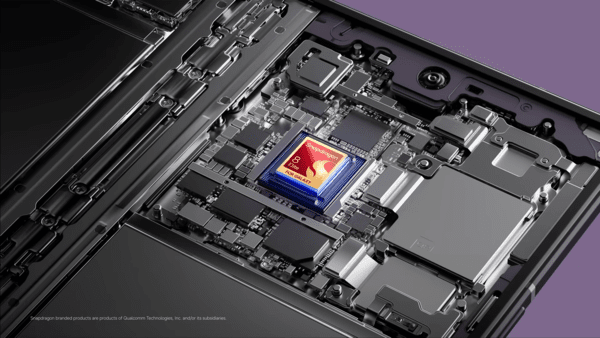
To deliver a consistent digital experience across multiple devices, sufficient computing performance and stable connectivity are essential. Qualcomm says it is positioning Snapdragon as a platform capable of providing a unified AI experience regardless of device form factor by optimizing central processing units (CPUs), graphics processing units (GPUs), neural processing units (NPUs) and connectivity technologies within a single integrated system.
One example is the Snapdragon 8 Elite Gen 5 for Galaxy, which combines Qualcomm's proprietary Oryon CPU architecture, Adreno GPU, Hexagon NPU and FastConnect 7900 connectivity system, all optimized specifically for Galaxy smartphones. The platform is designed to deliver flagship-class performance and responsiveness while maintaining high power efficiency.
The chipset also enables intelligent camera functions, enhanced gaming performance and AI-powered connectivity for more responsive real-time AI experiences. It supports video playback at up to 8K resolution (7,680 × 4,320) at 60 frames per second, while compatibility with AV1 and H.265 codecs helps reduce battery consumption during extended video streaming.
The Snapdragon Wear Elite platform introduces another industry first by integrating an NPU into a wearable processor. It can run AI models with up to 1 billion parameters directly on the device without relying on cloud connectivity. This enables AI agent capabilities such as contextual awareness, natural voice interaction and continuous personal activity logging.
The platform also incorporates Qualcomm's first multimode connectivity architecture integrating six next-generation communication technologies into a single chip. It supports 5G RedCap, designed for lower-power 5G connectivity, micro-power Wi-Fi and Bluetooth 6.0 for precise device-to-device communication, allowing continuous collection of contextual signals to enhance personal AI experiences.
Similarly, the Snapdragon AR1 platform for smart glasses combines an ultra-lightweight, low-power design with sufficient processing capability to support AI agents. It integrates an NPU, a visual analysis engine and enhanced memory to provide stable wireless streaming and AI-powered computing within compact wearable devices.
Snapdragon has already established a strong position in the premium mobile market. According to Qualcomm, 61% of South Korean consumers identify Snapdragon as a key factor in improving the experience of premium Android devices.
By expanding the Snapdragon ecosystem across a broader range of connected products, Qualcomm aims to strengthen its competitiveness in the personal AI era while reinforcing its leadership in the intelligent device market.