
❌

Reading view

Patrick Brammall Takes a Dark Turn in Apple TV’s Last Seen

Patrick Brammall is heading into a much darker week on television. Following the Last Seen screening in Sydney, the Colin from Accounts star arrives on Apple TV as a father whose missing daughter has left his life suspended for more than a decade. The Australian thriller premieres September 9, bringing a very different kind of emotional discomfort from the romantic comedy that introduced him to many American viewers.

In Colin from Accounts, embarrassment can become an opening for affection. Last Seen gives Brammall a character with far less room to recover from a bad decision. Ian Ridley is a former detective, now working as a police dispatcher, who receives a call he believes could finally lead him back to his daughter.

The casting offers an immediate reason to be curious. Audiences familiar with Brammall’s comic timing will be watching him carry a story built around loss, uncertainty, and a hope that could become dangerous.

Patrick Brammall Finds a Personal Connection to Ian Ridley

Brammall has described drawing on fatherhood to understand the role. In an interview with Radio Times, he explained that being the father of two young daughters gave him access to an emotional vulnerability he could bring into the performance.

He did not need to imagine the story happening to his own children. Becoming a parent had already changed how available those feelings were to him.

“Ian is like a raw nerve,” he said.

That description gives a more precise sense of the character than the familiar image of a troubled detective. Ian’s professional experience may help him interpret a crisis, but his connection to this particular call makes distance almost impossible.

The challenge for a performance like this lies in keeping both sides believable. An audience needs to understand why Ian recognizes a possibility others might dismiss, while remaining alert to how much he wants that possibility to be true.

Brammall also credited his classical theater training and casting director Kirsty McGregor with helping him move between genres. The dramatic assignment draws on an established acting background, even if it surprises viewers who associate him most closely with comedy.

Patrick Brammall | Last Seen | Description: A woman with long hair buries her face in a man's chest, appearing upset, while the bearded man holds her protectively and looks ahead with a serious expression in a warmly lit room, evoking the emotional intensity of Last Seen on Apple TV.
Image Credit: Apple Inc.

One Phone Call Reopens an Eleven-Year Absence

Maggie disappeared 11 years before the events of Last Seen. Ian has never accepted that she might be gone forever. When a teenage girl calls for help, he becomes convinced that he recognizes his daughter and begins pursuing the possibility of bringing her home.

The premise places an ordinary professional responsibility under extraordinary personal pressure. A dispatcher must listen carefully, gather information, and help someone through an emergency. Ian suddenly has to do that while confronting the possibility that the voice belongs to the person he has spent years hoping to find.

There is tension in the simple absence of a face. A voice offers clues without providing the certainty of seeing someone. Memory, fear, and recognition can arrive together, leaving very little time to sort one from another.

The emotional question extends beyond whether the caller is Maggie. Eleven years have passed for everyone involved. Even a reunion could not return the family to the day before she disappeared.

That gives the story room to explore the difference between finding someone and recovering the life that existed before their loss. It also gives Brammall something more complicated to play than determination alone: a man whose idea of rescue may be tied to a past that cannot be restored.

These are the tensions established by the premise. How the series resolves them remains part of the mystery awaiting viewers.

An Australian Production With a Substantial Supporting Cast

Last Seen adapts Ryan David Jahn’s novel The Dispatcher, with Kris Mrksa serving as writer and executive producer. The series is produced by 60Forty Films and was entirely set and filmed in Victoria, Australia.

The official cast and crew credits name Christian Schwochow as director and executive producer. Brammall is joined by Maxine Peake, Brendan Cowell, Daniel Henshall, Jessica Wren, Zahra Newman, Chloe Jean Lourdes, and Tobias Muhafidin. Executive producers also include Hakan Kousetta, Jamie Laurenson, and Joanna Werner.

For American audiences, the Australian setting gives the show an identity outside the familiar geography of U.S. police dramas. Victoria is the location of the story itself, allowing the adaptation to establish its own surroundings rather than asking local scenery to stand in for another country.

The ensemble also creates room for perspectives beyond Ian’s. A missing-person story can become claustrophobic when every event is filtered through a single person’s conviction. The dramatic interest comes partly from encountering people who have their own knowledge, loyalties, and reasons for responding differently.

Brammall carries the central search, but the relationships around him will determine whether that search feels convincing as a family story.

The Action Was a Physical Challenge

Last Seen also demanded action sequences, and Brammall has been candid about finding them harder at 50 than he once imagined.

Discussing the production with Radio Times, he credited a younger scene partner with taking on much of the physical work during an early confrontation. Asked about the possibility of doing more action, he offered a practical condition: “Give me the right stunt double and I’ll do it.”

His account brings a welcome human detail to the promotional image of a desperate father fighting his way toward an answer. Performing that desperation requires choreography, cooperation, and people prepared to absorb the physical demands of a scene.

For the character, physical vulnerability can be useful territory. Ian’s willingness to intervene does not necessarily mean he is equipped to control what follows. The possibility of getting hurt gives an impulsive decision consequences beyond moving the investigation forward.

When Last Seen Arrives in the U.S.

Apple’s official premiere announcement confirms that the first two episodes arrive together on Wednesday, September 9. The remaining four episodes follow weekly, with the sixth scheduled for October 7.

That gives the thriller a five-week release window. Viewers can begin with a substantial introduction to Ian’s situation, then follow the investigation one chapter at a time. Those who prefer watching a complete season can plan around the final episode’s arrival.

The U.S. Last Seen page provides access to the series through Apple TV. No familiarity with the source novel or Brammall’s previous work is needed to begin.

American viewers will have an unusually sharp contrast available the following day. Paramount+ has confirmed that the third and final season of Colin from Accounts arrives September 10, with all episodes released at once.

Brammall returns there alongside Harriet Dyer, his wife and fellow creator, writer, and star. Their comedy began with a car accident, an injured dog, and two strangers drawn into each other’s lives. Its farewell season places another set of complicated relationships on his schedule, with considerably more space for laughter between the difficult moments.

Six people stand together in front of a green backdrop with large white letters. Dressed in formal attire, with some smiling at the camera, they gather to celebrate the premiere of an exciting Australian thriller starring Patrick Brammall on Apple TV.
Image Credit: Apple Inc.

The post Patrick Brammall Takes a Dark Turn in Apple TV’s Last Seen appeared first on AppleMagazine.

💾

Enjoy the videos and music you love, upload original content, and share it all with friends, family, and the world on YouTube.
  •  

iPhone 18 Launch: Apple Park Prepares for a Bigger In-Person Event

iPhone 18 launch, Apple Park, iPhone 18, iPhone 18 Pro, iPhone 18 Pro Max, iPhone Ultra, foldable iPhone, Apple event, September event, John Ternus, Steve Jobs Theater, iOS 27, iPhone camera, variable aperture, liquid metal hinge, foldable display, hands-on event, product launch, Cupertino, smartphone news

The iPhone 18 launch is turning Apple Park into more than a stage for Wednesday’s presentation. The September 9 Apple event already carries unusual expectations around a possible foldable iPhone, a new generation of Pro cameras, and John Ternus’ first major product introduction as CEO. Reports of additional event staff now suggest that the experience awaiting invited media could be larger and more demanding than a conventional iPhone demonstration.

The official event announcement confirms that “Surprise and shine” begins September 9 at 10 a.m. Pacific Time, with worldwide streaming through apple.com, Apple TV, and YouTube. The invited audience will attend from Apple Park, but the increased activity surrounding the event does not necessarily mean that the company will abandon its carefully produced video format for a completely live keynote.

A polished presentation can explain specifications, introduce software, and display new hardware from perfect angles. It cannot reproduce the first sensation of opening a foldable screen, examining a crease under direct light, testing a mechanical hinge, or watching a camera respond as the lighting changes. Those moments happen after the main presentation, inside the hands-on areas where early opinions begin to form.

Apple Park

Apple Park Scales Up for the iPhone 18 Launch

The first indication of a larger operation arrived through an internal program for US retail employees. According to reporting distributed by Bloomberg, store employees were invited to enter a lottery for positions supporting the in-person unveiling.

Selected employees were expected to organize lines, check in guests, provide directions, welcome attendees, and assist security teams. Employees who participated in WWDC 2026 or the iPhone 17 event were reportedly excluded, allowing another group of retail workers to experience the launch.

The existence of the lottery does not prove that the keynote itself will return to a traditional live-stage presentation. Apple has previously recruited retail employees to support events, and the company has not disclosed how many people were selected this year.

It does confirm that the Apple Park gathering requires a substantial customer-facing operation beyond the team producing the presentation. Retail employees already know how to direct visitors, explain products without overwhelming them, manage queues, and identify when someone needs technical help.

Those skills become particularly useful during an event attended by journalists, photographers, analysts, creators, and international guests, all trying to reach the same devices within a short period. Additional staff can prevent the hands-on area from becoming a crowded ring around a few demonstration tables.

The iPhone 18 launch may also require more movement between specialized spaces. A conventional phone can be displayed in rows according to color or size. A foldable model needs room for repeated opening and closing, interface demonstrations, durability questions, and comparisons between its exterior and interior screens. Camera testing requires a different environment again.

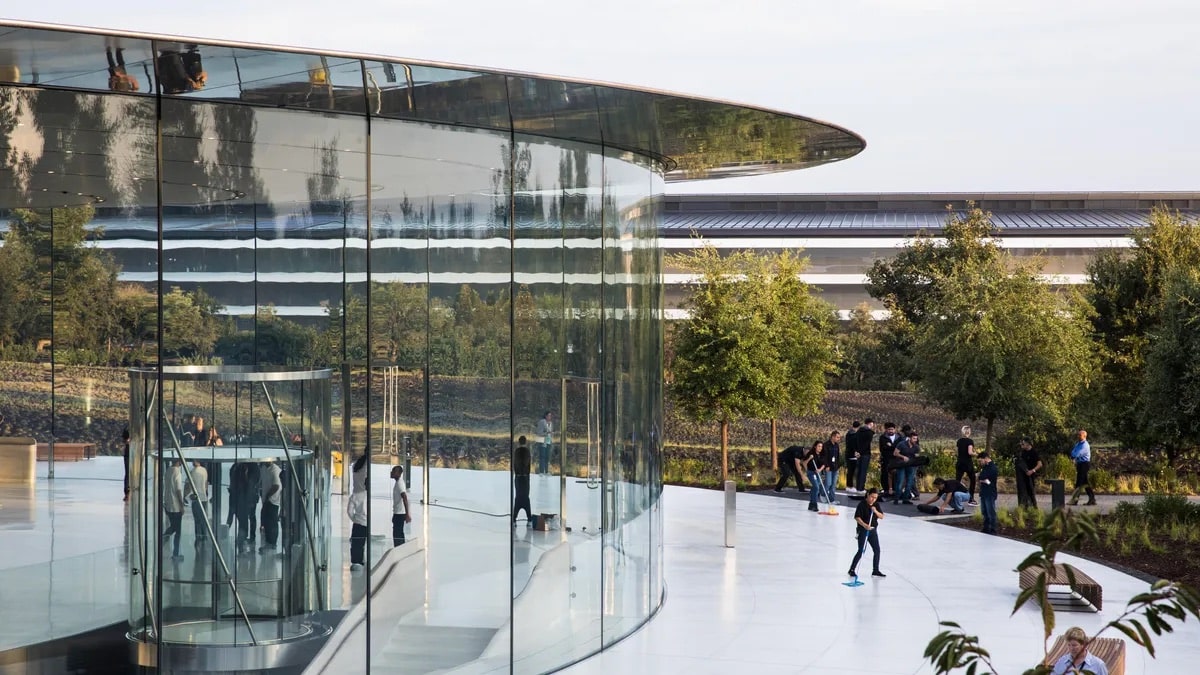
Apple Park does not need to undergo a permanent architectural transformation for that expansion. Modular tables, managed lighting, guided demonstrations, additional charging equipment, and more employees can significantly enlarge the experience around Steve Jobs Theater for a single afternoon.

A person holds a foldable smartphone displaying the time, 09:07, in a cozy café with wooden tables, drinks, and a blurred background of people and large windows—perhaps testing out new features on iOS 27 Beta or eagerly comparing it to rumors about the upcoming iPhone 18.
Image Credit: AppleMagazine

A Foldable iPhone Needs a Different Kind of Demo

The rumored iPhone Ultra is likely to attract the longest lines if it appears on Wednesday. It would represent the first substantially new iPhone form factor since the current full-screen design became established, and its appeal cannot be communicated through processor charts alone.

Visitors will want to know how the hinge feels at different angles, whether the device stays open when partially folded, how much pressure is required to close it, and whether both sides align evenly. They will inspect the central folding area under bright light and move a finger across the display to determine whether the crease is visible, noticeable by touch, or effectively hidden during normal use.

Display stress remains one of the most difficult engineering problems in the foldable category. TrendForce’s analysis of foldable display technology explains that crease reduction depends on controlling stress across the panel’s multilayer structure. Ultra-thin glass, optically clear adhesive, support plates, and the position of the display’s neutral layer can all influence how the screen behaves after repeated folding.

Reports have associated the iPhone Ultra with a liquid-metal hinge and a virtually creaseless internal display, but neither detail has been announced. Even if the production device resembles those descriptions, “virtually creaseless” will remain a subjective claim until people can examine the screen from different angles and under different lighting conditions.

Apple will consequently need demonstration units that are fully accessible rather than fixed behind stands. A journalist should be able to fold the device repeatedly, rotate the internal display, type with the phone partially open, and watch iOS 27 transfer an activity between the exterior and interior screens.

Those interface transitions could be as revealing as the physical hardware. A larger display gains value when an app can reveal another column, create a more capable workspace, or reposition controls without simply enlarging the standard iPhone interface.

Demonstrators may need to direct visitors toward examples that reveal those differences within the limited time available. Mail, Maps, Photos, Safari, video calling, document editing, and drag-and-drop workflows could communicate the benefit of the larger display faster than a static home screen.

The hands-on area must also answer durability questions without pretending that a few minutes can replace months of ownership. Hinge resistance, protection around the folding axis, weight distribution, screen reflections, and off-center visibility can be judged immediately. Long-term wear, dust resistance, and thousands of folding cycles cannot.

Camera Testing Could Become Part of the Event

The Pro camera system is expected to receive one of the lineup’s most technical hardware changes. Previous iPhone 18 Pro camera reporting has centered on a mechanical or variable aperture, which could physically alter the amount of light passing through the main lens.

A conventional fixed-aperture smartphone camera manages exposure through shutter speed, sensor sensitivity, computational processing, and other electronic controls. A mechanical aperture can change the physical opening through which light reaches the sensor. Depending on its design, that could provide additional control over exposure, depth of field, highlights, and the appearance of subjects at different distances.

Current pre-event iPhone 18 expectations indicate that the feature may be exclusive to the iPhone 18 Pro Max, although its final availability will remain uncertain until the presentation.

A normal demonstration table would reveal little about such a camera system. Effective testing requires contrast, motion, faces, reflections, foreground objects, and meaningful changes in brightness.

Apple has previously used prepared scenes to demonstrate cameras, making controlled lighting stations a reasonable possibility for the iPhone 18 launch. No dependable report has confirmed that a dedicated photography pavilion or a particular new installation has been constructed for Wednesday, however.

A useful setup would allow creators to move between bright and dim areas while watching the aperture respond. A foreground object positioned near a person could demonstrate changes in depth of field. Directional lights could reveal highlight handling, while a darker scene could test whether the physical aperture works smoothly with computational photography.

Video creates another challenge. Any aperture adjustment during recording must appear gradual rather than causing sudden jumps in exposure or background separation. If manual control is available, photographers will immediately look for the number of supported aperture positions and whether a chosen setting can be locked before recording.

These demonstrations would offer the in-person audience something that cannot be reproduced during the stream. The presentation can display carefully selected photographs and video clips, but activity around the camera stations will reveal how quickly professionals understand the controls and whether the results remain convincing outside a prepared promotional sequence.

John Ternus Faces His First Apple Park Test

Wednesday’s event will be John Ternus’ first major product launch as CEO. That creates an unusual balance between continuity and change. The campus, production team, executives, and controlled demonstrations remain familiar, while the person responsible for the final message has changed.

Ternus does not need to replace every established event practice during his first days in the role. A larger in-person component would let him place more attention on direct product experience without sacrificing the timing and visual precision of a prerecorded presentation.

A live welcome, appearances around the campus, and extended media access after the video could establish his presence without forcing the event into an entirely different format. His background in hardware engineering also makes this a suitable launch for more detailed demonstrations, particularly if the lineup includes a new hinge, display construction, or mechanical camera component.

The hardware surrounding the iPhone 18 launch will test how well the company explains unfamiliar decisions. A foldable iPhone must justify its size, construction, software behavior, and likely premium price within minutes. The Pro camera must demonstrate an advantage that remains visible after computational processing. Accessories must protect new shapes without making them unpleasant to hold.

Retail employees working at Apple Park can observe those reactions closely. They will hear which controls require an explanation, which accessories create hesitation, and which claims prompt the same questions repeatedly. That experience can return to stores before customers begin arriving for demonstrations of their own.

The Hands-On Area Becomes the Real Examination

Apple controls every frame of its presentation video, but it cannot control every observation made after the screens turn off. A foldable display will be photographed from difficult angles. Its hinge will be opened hundreds of times. Camera samples will be compared before visitors have left Apple Park. Any awkward transition, reflection, or confusing control will circulate within minutes.

This makes the in-person operation more demanding than a larger guest list might suggest. Every demonstration unit must remain charged, connected, clean, updated, and ready for the next visitor. Foldable devices may require closer inspection between sessions, while camera areas need staff who understand both the feature and the conditions created to demonstrate it.

The employees around those spaces should provide enough guidance to help visitors locate unfamiliar features without turning every interaction into another scripted presentation. Excessive control makes a demonstration feel artificial; too little creates confusion and crowded tables.

Apple Park therefore becomes a second launch platform after the worldwide stream. The video introduces the products, while the hands-on area exposes them to fingers, lenses, questions, and immediate judgment. By Wednesday afternoon, the questions repeated most frequently around those demonstration tables may offer the first indication of how easily the iPhone 18 lineup can explain itself.

iPhone 18 red color concept shown front and back with edge-to-edge display.

The post iPhone 18 Launch: Apple Park Prepares for a Bigger In-Person Event appeared first on AppleMagazine.

  •  
❌